Successful Treatment of Unilateral Cryptorchid Boys Risking
Infertility with LH-RH Analogue
Faruk Hadziselimovic
Kindertagesklinik, Liestal, Switzerland
ABSTRACT
Introduction: Infertility is the primary concern for boys with uni- or bilateral undescended testes. An early and seemingly
successful orchiopexy does not improve fertility in a substantial number of cryptorchid males. We conirmed that LH-RH analogue (LH-RHa) treatment induces an increase in and maturation of the germ cells; however, it was uncertain if treat -ment would improve the chance of fertility later in life.
Materials and Methods: Thirty unilateral cryptorchid boys, with an average age of 3 years at the time of surgery, were included in the study. Testicular biopsy showed that they had impaired testicular maturation and were therefore at high
risk for infertility. Fifteen of the 30 unilateral cryptorchid boys were treated with 10 µg LH-RHa (Buserelin) nasal spray, administered on alternate days for a period of 6 months, following orchiopexy. The control group consisted of 15 crypt
-orchid boys who had been treated by Schoemakers type of orchiopexy, alone. After puberty, the ejaculates of both groups
were analyzed.
Results: All males in the untreated group were severely oligospermic, with 20% being azoospermic. In contrast, 86% of
the treated ex-cryptorchid males had a sperm concentration within the normal range; this was signiicantly different from the sperm concentration found in the untreated group (p = 0.000008).
Conclusion: For the irst time, we demonstrate that infertility in cryptorchidism can be successfully corrected when suit
-ably treated with a LH-RHa. Sperm parameters normalized following therapy in the majority of cryptorchid males who, untreated, would have remained infertile. This innovative hormonal treatment will have a profound effect on the current
recommended surgical treatment of boys with undescended testes.
Key words: cryptorchidism; sperm; Ad spermatogonia; fertility; LH-RH analogue; treatment Int Braz J Urol. 2008; 34: 319-28
INTRODUCTION
Cryptorchidism is the most common
uro-genital birth-defect in males, necessitating surgery in about 27,000 boys each year in the United States (1). Since 1960, when Charny stated that “the surgical
techniques currently practiced by most surgeons must
improve signiicantly, albeit the cosmetic results are
arguably better but the functional results fall far short
of the intent” very little has changed (2). Although
the effect on testicular development and fertility has
been studied extensively since that time, there is only
one general consensus: untreated boys with bilateral undescended testes will be infertile.
In 1975, Ludwig and Potempa found that the
fertility rate is inversely proportional to the age of the
patient at the time of surgery. Consequently, it was
could be cured if orchiopexy was performed before
the second year of life (3). Thirty years later, when the fertility results of early surgery were obtainable, we
realized that the therapeutic strategy to operate before
the age of 2 years had not improved fertility hopes in a substantial number of cryptorchid patients (4). Crypt -orchid boys lacking Ad spermatogonia will be infertile despite a seemingly successful orchiopexy at an early
age (4). The main cause is impaired mini-puberty, the
surge of gonadotropins and testosterone that occurs
in early infancy (5). In an attempt to correct impaired mini-puberty, we administered a LH-RH analogue to
cryptorchid boys following successful surgery and
achieved an increase in the number of germ cells (6). We report the results of the irst 15 patients treated with LH-RHa after successful surgery, who are now young adults, and compare the outcomes with patients
who were treated with surgery only. The ameliora-tion of testicular maturaameliora-tion appears to result in the normalization of excretory testicular function.
MATERIALS AND METHODS
Fifteen unilateral cryptorchid boys who had a Schoemakers type of orchiopexy between the ages
of 1-6 years were subsequently treated with LH-RH.
Their cryptorchid testes were located outside of
the scrotum since birth. A vast majority had testes
located inguinal or at external inguinal ring. Two
pa-tients, one of each in treated and untreated group had testes located in abdomen. Twelve out of 15 patients had an unsuccessful HCG treatment before surgery. Testicular biopsies were obtained during orchiopexy, ixed in 3% glutaraldehyde, and embedded in Epon. Semi-thin sections, 1 µ thick, were examined with light microscopy. At least 100 tubular cross sections
were counted to estimate the total number of germ cells per testis. The entire biopsy was analyzed for the occurrence of Ad spermatogonia. All patients had
< 0.2 germ cells per tubular cross section (normal > 2 per tubular cross section) and none had Ad (dark) spermatogonia. Therefore, these patients were at high risk of being infertile (7,8). Within 3 months following surgery, treatment with the LH-RH ana
-logue Buserelin, a nonapeptide ethilamide of D-Ser (But)6 LH-RH, was initiated, with 10 µg applied as
an intranasal spray in the evening on alternate days for a period of 6 months. All patients had regular monthly check-ups during the course of treatment. The boys’ mothers were questioned about compli-ance to the nasal spray treatment as well as possible
adverse side effects of the medication. Furthermore,
their general well being and genital status were
es-timated, including determining testicular volume, penile length with a ruler, and Tanner stage of sexual
development.
These 15 patients, who are now young adults, were among the irst to receive LH-RH analogue treatment at the ages of 1-6 years (average age, 3 years; 95% CI 2 - 4 years). They were recruited from a group of 19 who were invited to participate in the study, and were older than 18 years of age. None of
the patients had additional surgeries or severe illness
requiring hospitalization during the 15-19 years fol
-lowing treatment. Twelve of 15 were non-smokers
and none was on chronic medication or was drug
abusers. During a very recent medical check-up, their
general status and Tanner stage of pubertal develop-ment was appraised. Testicular volume and the length of stretched penis were measured. Testicular volume
was determined according to the formula; V=4/3 x π x D/2 x d2; (0.71 x D x d2). An ejaculate was collected
following sexual abstinence for at least 5 days. Semen
analysis was performed by computer-assistance and
additionally conirmed with repeated microscopic examinations. In accordance with WHO standards,
infertility was assumed if the sperm concentration
was < 40 x 106 per ejaculate (9). All patients with a
sperm concentration within the infertile range had at
least a second ejaculate analyzed within 2-4 weeks. The better sperm concentration of the 2 evaluations was included in the study. The majority (8/15) of pa
-tients had to deliver their sperm specimens by mail; therefore, sperm motility could not be evaluated. Nevertheless, sperm concentration, ejaculate volumes,
and sperm morphology with teratozoospermic index were evaluated.
The age-matched control group was selected
from 181 unilateral cryptorchid patients who had had their sperm ejaculates analyzed. Patients in the
control group had all undergone a successful Schoe-maker type orchiopexy and a testicular biopsy was
undergo additional LH-RH treatment. Fifteen of the 181 fulilled the same criteria as the treated group
and were included in the control group. They all had
unilateral cryptorchidism, were the same age at treat
-ment (average age, 4 years; 95% CI 2-6; p = 0.35), had no Ad spermatogonia, and had a total number of germ cells < 0.2 per tubule. 13 out of 15 patients had an unsuccessful HCG treatment prior to surgery.
Statistical Analysis
The recruitment of patients for this, non ran
-domized, study was designed to be balanced. Given the customary values for the signiicance level α = 0.05 and the power β = 90% and using the module “MTT1-1” in the software “nQuery Advisor” The sample sizes are determined to N = 12 for a one-sided and to N = 14 for the two-sided Wilcoxon/Mann-Whitney U-test.
Following assumptions were entered into the
module “MTT1-1” of nQuery Advisor: That the mean sperm count in the treated group was larger than 40
millions whereas in the untreated group it was smaller
than 10 millions where standard deviation was esti
-mated to be smaller than 20 millions.
We therefore irst analyzed the group of 181 ex-unilateral cryptorchid males who were only surgically treated and identiied 15 who fulilled the entry requirements for the study. Consequently, we invited our irst 19 ex-unilateral cryptorchid males, who had LH-RHa treatment and were older than 18 years, to participate in the study. Fifteen of the irst consecutive responders entered the study. The Mann-Whitney U test for unpaired data was used in the software package StatXact 6.30 (2004) from CYTEL Corporation. Nonparametric 95% coni -dence intervals for the medians were computed by bootstrapping.
Ethical Considerations
In accordance with the Helsinki declaration, the Institutional Review Board (IRB), and the Inde
-pendent Ethics Committee of University Children’s Hospital Basel approved all aspects of this study. In particular, approval was given for research involv
-ing the use of material (data, documents, records or specimens) that had been collected for non-research
purposes.
RESULTS
The total number of germ cells in the surgery
“only” group was an average of 0.02 germ cells per tubular cross section (95% CI: 0 - 0.2). This was the same as the number observed in the treated group, who had an average of 0 germ cells per tubular cross section (95% CI: 0.- 0.05; p = 0.22). Both groups had no Ad (dark) spermatogonia present in their entire
testicular biopsies. Indicating defective germ cell transformation due to an impaired mini puberty.
There were no adverse side effects and no changes in the Tanner stage of pubertal development during the hormonal treatment.
Most often, mothers reported that their boys
were more active than usual during treatment. Tes-ticular volume remained unchanged compared with
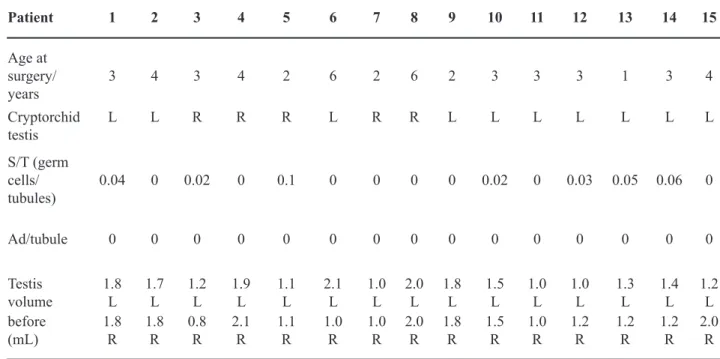
that before the treatment, while there was a signiicant increase in penile length from an average of 4.5 cm (95% CI 4-5) before treatment to an average of 5.0 cm (95% CI 4.5-6) after treatment (p < 0.001) (Table-1).
At a recent examination at an average age of
19 years (95% CI 18-22), all males were in a healthy condition. They all had Tanner V stage of sexual de -velopment and normal erectile function. The length of the stretched penis was in the lower normal limit with
average length of 12 cm (95% CI 10-13 cm) (Table-2).
Testicular volume of orchiopexy testes was less when
compared with the contralateral descended partner; ex-undescended testicle 29 mL (95% CI 22.- 36 mL) vs. contralateral descended testicle 38 mL (95% CI 30-46 mL; p < 0.0026) (Table-2).
Spermiogram
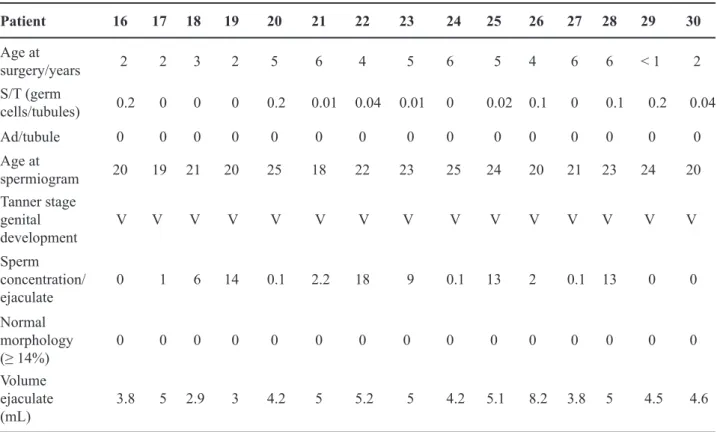
In the surgery “only” group, all ex-cryptor
-chid males suffered severe oligospermia, and 20% (3/15) of the group had azoospermia. The average sperm concentration was 1 x 10⁶ (95% CI: 0-13) per
ejaculate (Figure-1), Table-3.
In the LH-RH treated group, one male had
oligospermia and one had a diminished sperm
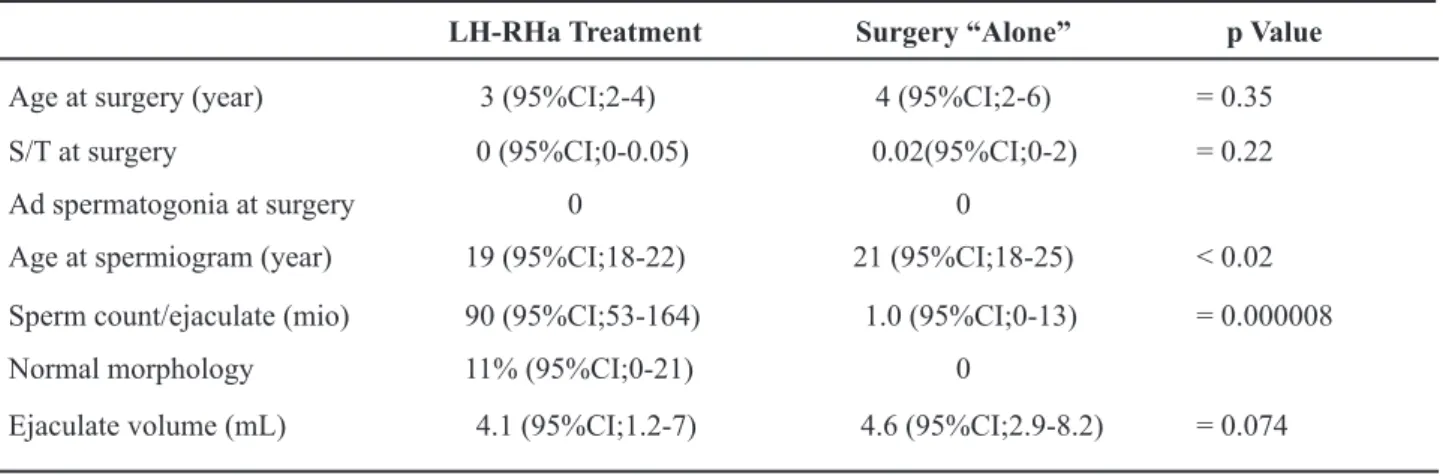
concen-tration while in the remaining 13 males had a normal sperm concentration, (Table-2). Average total sperm concentration in the treated group was of 90 x 106
in the surgery “only” group (p = 0.000008) (Figure-1). Furthermore, in the LH-RHa treated group, the tera
-tozoospermic index and volume of ejaculates were in the normal range (Table-2). If fertility capacity were deined according to the Tygerberg strict criteria, then
sperm morphologic pattern was distributed similar to the distribution found in the normal fertile population
(10). Two males had P-pattern (poor-prognosis), 8 were in the G-pattern (good prognosis) group, and 5 were in the N-pattern (normal forms > 14%) group (Table-2).
COMMENTS
Attempting to improve the unfavorable fertility results through early treatment of cryptor-chidism is generally recommended and accepted
today. According to current thinking, hormonal, hormonal/surgical, or only surgical treatment should
be completed before the patient’s second birthday.
However, boys with a severe reduction and im
-Table 1 – Characteristics of the 15 patients with cryptorchidism immediately before and after treatment with luteinizing hormone releasing hormone.
Patient 1 2 3 4 5 6 7 8 9 10 11 12 13 14 15
Age at
surgery/
years
3 4 3 4 2 6 2 6 2 3 3 3 1 3 4
Cryptorchid testis
L L R R R L R R L L L L L L L
S/T (germ cells/
tubules) 0.04 0 0.02 0 0.1 0 0 0 0 0.02 0 0.03 0.05 0.06 0
Ad/tubule 0 0 0 0 0 0 0 0 0 0 0 0 0 0 0
Testis volume
1.8
L 1.7 L 1.2 L 1.9 L 1.1 L 2.1 L 1.0 L 2.0 L 1.8 L 1.5 L 1.0 L 1.0 L 1.3 L 1.4 L 1.2 L
before
(mL) 1.8 R 1.8 R 0.8 R 2.1 R 1.1 R 1.0 R 1.0 R 2.0 R 1.8 R 1.5 R 1.0 R 1.2 R 1.2 R 1.2 R 2.0 R
paired transformation of germ cells regardless of
the time of surgery, as well as uni- or bilaterality of cryptorchid gonads, were infertile (4,11). Therefore,
whether or not the patient will achieve normal fer-tility following successful surgery depends mainly upon the presence of Ad spermatogonia at the time
of orchiopexy (4,11). At least half of cryptorchid
population undergoing surgery had no Ad sper-matogonia and consequently were candidates for
hormonal treatment (7). It is known that a testis
in an intra-abdominal position has in general bad
testicular histology beyond one year of age, and
that a testis in pre-scrotal position has a better or
is more close to normal testicular histology (8,11). However, in all positions, although with different incidences, the testes with no Ad spermatogonia and < 0.2 germ cell per tubule could be observed. Thus,
the histological indings distinguished those patients who speciically required additional treatment than testicular position at surgery, albeit the fact that 90% of boys with intra-abdominal testes probably
require hormonal treatment. In this study only two
patients; one of each group had their testis located in the abdomen, therefore the study is comparable also
with regard to testicular position found at surgery. In male gonadotropin secretion which increases from
2 to 4 months after birth stimulating Leydig cells to secrete testosterone (12-14). Testosterone increase is blunted in cryptorchid boys (13,14). This insuficient
testosterone secretion is responsible for impaired transformation of gonocytes into Ad spermatogonia
(4,5,11,15-17). Additional rationale for LH-RHa
treatment was based on the histological analyses of
undescended testes in infancy (4,5,11,15-20). Table 2 – Characteristics of the 15 patients with cryptorchidism initially treated with surgery and luteinizing hormone releasing hormone, at follow-up after puberty.
Patient 1 2 3 4 5 6 7 8 9 10 11 12 13 14 15
Age at spermiogram
21 20 18 19 19 23 18 25 18 19 18 20 20 18 22
Testis volume (mL) 42 L 52 R 37 L 52 R 32 L 11 R 32 L 35 R 68 L 57 R 9 L 13 R 26 L 32 R 68 L 43 R 18 L 32 R 26 L 42 R 36 L 34 R 29 L 48 R 21 L 22 R 36 L 45 R 13 L 29 R Penis
length (cm) 12 12 12 13 13 10 11 14 9 14 12 10 13 12 12.5
Tanner stage genital
development V V V V V V V V V V V V V V V
Sperm
concentration 57 53 19 58 198 115 1 94 60 107 164 97 63 180 81
Normal morphology %
(≥ 14%) 7 8 11 11 18 21 0 12 4 15 8 15 11 14 11
Teratozoospermic-index (< 1.8) 1.2 1.8 1.4 1.4 1.4 1.1 1.9 1.7 1.5 1.5 1.5 1.3 1.2 1.3 1.5
Volume
ment of impaired mini-puberty should be performed before this age.
In 1997, we presented results of fertility
outcome in cryptorchid boys who were treated with
a LH-RH analogue at the age of 8 years and older. Compared with surgery as the only treatment, a sig
-niicant amelioration, but not normalization, of sperm concentration was achieved in the treated group (22). This result showed that LH-RHa treatment had a last -ing effect upon spermatogonial development.
Table 3 – Characteristics of the 15 patients with cryptorchidism initially treated with surgery at follow up after puberty.
Patient 16 17 18 19 20 21 22 23 24 25 26 27 28 29 30
Age at
surgery/years 2 2 3 2 5 6 4 5 6 5 4 6 6 < 1 2
S/T (germ
cells/tubules) 0.2 0 0 0 0.2 0.01 0.04 0.01 0 0.02 0.1 0 0.1 0.2 0.04
Ad/tubule 0 0 0 0 0 0 0 0 0 0 0 0 0 0 0
Age at
spermiogram 20 19 21 20 25 18 22 23 25 24 20 21 23 24 20 Tanner stage
genital development
V V V V V V V V V V V V V V V
Sperm
concentration/
ejaculate 0 1 6 14 0.1 2.2 18 9 0.1 13 2 0.1 13 0 0
Normal
morphology
(≥ 14%) 0 0 0 0 0 0 0 0 0 0 0 0 0 0 0
Volume ejaculate
(mL) 3.8 5 2.9 3 4.2 5 5.2 5 4.2 5.1 8.2 3.8 5 4.5 4.6
Table 4 – Characteristics of genitalia in boys treated with LH-RHa before and after treatment.
Testicular Volume (mL) Before Treatment After Treatment p Value
Cryptorchid testis 1.4 (95%CI;0.8-2.1) 1.2 (95%CI;1-3.2) 0.65
Descended testis 1.2 (95%CI;1-3.2) 1.4 (95%CI;1-2.5) 0.52
Penis length (cm) 4.5 (CI;4-5) 5.0 (95%CI;4.5-6) < 0.001
The LH-RH analogue (Buserelin) given on alternate days for a period of ive months in a previous
study caused no inhibition of gonadotropin secretion
(21). Moreover, LH values determined in the irst
morning urine were higher at the end of the treatment
(21). Six months LH-RHa treatment increased the number of germ cells in cryptorchid testis (7,21). This increase was age dependent (7). The best results were
achieved if the cryptorchid boys were treated before
-To analyze the efficacy of the LH-RHa (Buserelin) treatment in boys younger than 7 years,
we treated unilateral cryptorchid patients with a high infertility risk according to their testicular histol-ogy. The recruitment of patients for this study was designed to be balanced [see statistics section]. From
181 ex-unilateral cryptorchid males who were only
surgically treated [representing entire group studied]
15 patients fulilled the entry requirements for the study. Consequently, we invited our irst 19 ex-uni
-lateral cryptorchid males, who had LH-RHa treat
-ment and were older than 18 years, to participate in the study. Fifteen of the irst consecutive responders
entered the study Spermiogram results showed that
13 of 15 unilateral cryptorchid males had a normal sperm concentration. In addition, the distribution of
the fertility patterns of the sperm morphology was identical to that of the normal fertile population
(10). Furthermore, in those males with a P-pattern morphology, an excellent sperm concentration will compensate, with a signiicantly better chance of inducing pregnancy (23). Normalization of the sperm concentration in 86% of unilateral cryptorchid males,
who were in the high risk group for developing
infertility, profoundly changes our current concept of cryptorchidism treatment. For the irst time, it
is possible to demonstrate that infertility caused by cryptorchidism that was believed to be a congenital malformation can be successfully corrected if ad-equately treated.
Table 5 – Summary of characteristics.
LH-RHa Treatment Surgery “Alone” p Value
Age at surgery (year) 3 (95%CI;2-4) 4 (95%CI;2-6) = 0.35
S/T at surgery 0 (95%CI;0-0.05) 0.02(95%CI;0-2) = 0.22
Ad spermatogonia at surgery 0 0
Age at spermiogram (year) 19 (95%CI;18-22) 21 (95%CI;18-25) < 0.02
Sperm count/ejaculate (mio) 90 (95%CI;53-164) 1.0 (95%CI;0-13) = 0.000008
Normal morphology 11% (95%CI;0-21) 0
Ejaculate volume (mL) 4.1 (95%CI;1.2-7) 4.6 (95%CI;2.9-8.2) = 0.074
In conclusion, infertility induced by crypt -orchidism is an endocrine disease of impaired
mini-puberty. Treatment with a LH-RHa before the age of
six years following a successful orchiopexy resulted in the normalization of sperm parameters in the vast
majority of patients. Since not all patients with uni -lateral cryptorchidism belong to the infertility risk
group, some will proit from early surgery without need for subsequent LH-RHa treatment. Testicular
biopsy is the only diagnostic procedure capable of identifying patients who need to be treated with
LH-RHa following successful surgery. Because of its important prognostic value, a testicular biopsy
should be routinely performed during the orchio-pexy.
ACKNOWLEDGMENT
This study was sponsored in part by the
Swiss National Science Foundation. Dr. Mauro Buser, from the Institute for Statistics, Riehen Swit
-zerland, performed the statistical analyses.
CONFLICT OF INTEREST
REFERENCES
1. Trussell JC, Lee PA: The relationship of cryptorchi
-dism to fertility. Curr Urol Rep. 2004; 5: 142-8. 2. Charny CW: The spermatogenic potential of the unde
-scended testis before and after treatment. J Urol. 1960; 83: 697-705.
3. Ludwig G, Potempa J: Optimal time for treating crypt
-orchism (author’s transl). Dtsch Med Wochenschr. 1975; 100: 680-3.
4. Hadziselimovic F, Herzog B: The importance of both
an early orchidopexy and germ cell maturation for
fertility. Lancet. 2001; 358: 1156-7.
5. Hadziselimovic F, Zivkovic D, Bica DT, Emmons LR: The importance of mini-puberty for fertility in cryptorchidism. J Urol. 2005; 174: 1536-9; discussion 1538-9.
6. Hadziselimovic F, Höcht B: Prospectives. In: Hadziselimovic F (ed.), Cryptorchidism: Manage
-ment and Implications. Berlin, Springer-Verlag. 1983; pp. 135.
7. Hadziselimovic F, Huff D, Duckett J, Herzog B, Elder J, Snyder HM 3rd, et al.: Treatment of cryptorchidism
with low doses of buserelin over a 6-months period.
Eur J Pediatr. 1987; 146(Suppl 2): S56-8.
8. Hadziselimovic F, Hecker E, Herzog B: The value of testicular biopsy in cryptorchidism. Urol Res. 1984; 12: 171-4.
9. World Health Organization. WHO Laboratory Manual for the Examination of Human Semen and Semen-Cervical Mucus Interaction, 4th ed. Cambridge, Cambridge University Press. 1999; pp. 60-61. 10. Kruger TF, Van der Merwe J, Van Waart J: The Tyger
-berg Strict Criteria: What Are the Clinical Thresholds
for in vitro Fertilization. Intrauterine Insemination, and in vivo Fertilization? In: Kruger TF, Franken DR (eds.). Atlas of Human Sperm Morphology Evaluation. London, Taylor & Francis, 2004:13-18.
11. Hadziselimovic F, Hocht B, Herzog B, Buser MW:
Infertility in cryptorchidism is linked to the stage of
germ cell development at orchidopexy. Horm Res. 2007; 68: 46-52.
12. Forest MG, Sizonenko PC, Cathiard AM, Bertrand J: Hypophyso-gonadal function in humans during the irst year of life. 1. Evidence for testicular activity in early infancy.J Clin Invest. 1974; 53: 819-28. 13. Job JC, Toublanc JE, Chaussain JL, Gendrel D,
Roger M, Canlorbe P: The pituitary-gonadal axis in cryptorchid infants and children. Eur J Pediatr. 1987; 146(Suppl 2): S2-5.
14. Hamza AF, Elrahim M, Elnagar, Maaty SA, Bassiouny E, Jehannin B: Testicular descent: when to interfere? Eur J Pediatr Surg. 2001; 11: 173-6.
15. Hadziselimovic F, Thommen L, Girard J, Herzog B: The signiicance of postnatal gonadotropin surge for
testicular development in normal and cryptorchid
testes. J Urol. 1986; 136: 274-6.
16. Hadziselimovic F, Emmons LR, Buser MW: A di -minished postnatal surge of Ad spermatogonia in cryptorchid infants is additional evidence for
hypo-gonadotropic hypogonadism. Swiss Med Wkly. 2004; 134: 381-4.
17. Zivkovic D, Bica DT, Hadziselimovic F: Relationship
between adult dark spermatogonia and secretory
capac-ity of Leydig cells in cryptorchidism. BJU Int. 2007; 100: 1147-9; discussion 1149.
18. Hadziselimovic F, Herzog B, Huff DS, Menardi G: The
morphometric histopathology of undescended testes and testes associated with incarcerated inguinal hernia:
a comparative study. J Urol. 1991; 146: 627-9. 19. Huff DS, Hadziselimovic F, Snyder HM 3rd, Blyth B,
Duckett JW: Early postnatal testicular maldevelopment in cryptorchidism. J Urol. 1991; 146: 624-6.
20. Huff DS, Fenig DM, Canning DA, Carr MG, Zderic SA, Snyder HM 3rd: Abnormal germ cell development in cryptorchidism. Horm Res. 2001; 55: 11-7. 21. Hadziselimovic F, Hoecht B, Herzog B, Girard J:
Does Long Term Treatment with Buserein Improve the Fertility Chances of Cryptorchid Testes? In: Labrie F, Belanger A, Dupont A. (ed.), LH-RH and its Ana
-logues. Amsterdam, Elsevier. 1984.
22. Hadziselimovic F, Herzog B: Treatment with a lu -teinizing hormone-releasing hormone analogue after successful orchiopexy markedly improves the chance
of fertility later in life. J Urol. 1997; 158: 1193-5. 23. Montanaro Gauci M, Kruger TF, Coetzee K, Smith K,
Van Der Merwe JP, Lombard CJ: Stepwise regression
analysis to study male and female factors impacting on pregnancy rate in an intrauterine insemination
programme. Andrologia. 2001; 33: 135-41.
Accepted after revision: May 5, 2008
Correspondence address: Dr. Faruk Hadziselimovic Kindertagesklinik Liestal Oristalstrasse 87
Liestal, 4410, Switzerland Fax:+ 41 61 922-0533
EDITORIAL COMMENT
The present study reinforce the concept that cryptorchidism is resultant of hormonal alteration
that affect both testes, even when the alteration is
unilateral.
The study design evidences that the mere relocation of an ectopic gonad in the correct anatomic position is not enough to grant future fertility.
Hormonal therapy for cryptorchidism was
confused with an alternative therapy for surgery.
Nevertheless, the main objective of the hormonal
therapy is to improve the histological quality of the
gonad, improving future fertility rates.
This study indicates that hormonal therapy acts synergically with surgery for obtaining nearly normal fertility rates in the future.
REFERENCES
1. Lee PA, Bellinger MF, Coughlin MT: Correlations among hormone levels, sperm parameters and paternity in formerly unilaterally cryptorchid men. J Urol. 1998; 160: 1155-7; discussion 1178.
2. Coughlin MT, Bellinger MF, Lee PA: Age at unilateral
orchiopexy: effect on hormone levels and sperm count
in adulthood. J Urol. 1999; 162: 986-8; discussion 989.
3. Taskinen S, Wikström S: Effect of age at operation,
location of testis and preoperative hormonal treatment
on testicular growth after cryptorchidism. J Urol. 1997; 158: 471-3.
4. Lala R, Matarazzo P, Chiabotto P, Gennari F, Cortese MG, Canavese F, et al.: Early hormonal and surgical treatment of cryptorchidism. J Urol. 1997; 157: 1898-901.
5. Bica DT, Hadziselimovic F: Buserelin treatment of cryptorchidism: a randomized, double-blind, placebo-controlled study. J Urol. 1992; 148: 617-21.
Dr. Marcelo P. Braz
Section of Pediatric Urology Bonsucesso General Hospital Rio de Janeiro, RJ, Brazil E-mail: [email protected]EDITORIAL COMMENT
Cryptorchidism is one of the most common congenital pathologies in boys. Treatment of this congenital anomaly concerns the possibility of dimin-ishing risk of malignant degeneration and improving fertility. Surgery is the best treatment for cryptorchi-dism but there are many studies showing good results
for testicular migration after therapy with hCG or with GnRH (1-3). The evidence for the use of hCG vs. GnRH shows advantages for hCG, and a recent
review also shows that there is evidence that
lutein-izing hormone releasing hormone (LH-RH) is more effective than placebo (4) The hormonal treatment
in cryptorchidism is controversial. Considering the
eficacy and the possible side effects of the hormonal
treatment a recent meta-analysis recommended that the hormonal treatment of cryptorchidism could not
be further recommended (5). An experimental study
shows that hCG impairs the seminiferous tubule histology in normal testes of rats (6). There is still controversy on whether it may be useful as an adjunct
to surgery to stimulate germ cells. Current evidence suggests that hormonal therapy may not stimulate transformation of neonatal gonocytes but may trig-ger prepubertal mitosis of primary spermatocytes
(7). Subfertility is considered the main consequence
of cryptorchidism even after timely orchiopexy.
Gonadotropin-releasing hormone (GnRH) treatment
appears to improve fertility later in life by inducing germ cell maturation. A recent paper shows that
neo-adjuvant GnRH treatment improves fertility index in prepubertal cryptorchidism (8). The great contribution
dism therapy: systematic review with metanalysis of
randomized clinical trials. Pediatr Surg Int. 2004; 20: 357-9.
5. Thorsson AV, Christiansen P, Ritzén M: Eficacy and
safety of hormonal treatment of cryptorchidism:
cur-rent state of the art. Acta Paediatr. 2007; 96: 628-30. 6. Kaya C, Karaman MI, Pirincci N, Ozturk M, Yilmazg
-umrukcu G: Human chorionic gonadotropin deterio
-rates the histology of rat testes. Urol Int. 2006; 76: 274-7.
7. Ong C, Hasthorpe S, Hutson JM: Germ cell develop -ment in the descended and cryptorchid testis and the
effects of hormonal manipulation. Pediatr Surg Int. 2005; 21: 240-54.
8. Schwentner C, Oswald J, Kreczy A, Lunacek A, Bartsch G, Deibl M, et al.: Neoadjuvant
gonadotropin-releasing hormone therapy before surgery may improve the fertility index in undescended testes: a prospective
randomized trial. J Urol. 2005; 173: 974-7.
Dr. Luciano A. Favorito
Urogenital Research Unit State University of Rio de Janeiro Rio de Janeiro, RJ, Brazil E-mail: [email protected]to conirm the beneicial effects of medical treatment
after orchiopexy in patients with high risk of infertility
conirmed by testicular biopsy. One important conclu -sion of this paper is that testicular biopsy should be performed routinely to evaluate testicular histology during surgery in patients with cryptorchidism.
REFERENCES
1. Bica DT, Hadziselimovic F: Buserelin treatment of cryptorchidism: a randomized, double-blind, placebo-controlled study. J Urol. 1992; 148: 617-21.
2. Favorito LA, Toledo Filho JS: Study of testicular
migration after treatment with human chorionic
go-nadotropin in patients with cryptorchidism. Braz J Urol, 27: 270-274, 2001
3. Gill B, Kogan S: Cryptorchidism. Current concepts. Pediatr Clin North Am. 1997; 44: 1211-27.