Abstract
Objective: To examine the association between wheezing in children and adolescents and living downwind of the dispersion plume of atmospheric pollutants emitted by the Guamaré Petrochemical Complex, in the state of Rio Grande do Norte, Brazil.
Methods: Cross-sectional study of wheezing in children and adolescents (aged 0 to 14 years) living in the vicinity of the Guamaré petrochemical complex in 2006. The standardized International Study of Asthma and Allergies in Childhood questionnaire was used, with additional questions concerning tobacco use, income, living conditions, and educational achievement. Daily concentrations of PM10, PM2.5, black carbon, SO2, NO2, O3, benzene, toluene, and xylenes were measured at a ixed monitoring station. According to their position relative to wind direction, communities present in the area affected by plant emissions were categorized into one of two groups, exposed communities and reference communities.
Results: Two hundred and nine children and adolescents took part in the study. Mean daily concentrations of the monitored pollutants were consistently below established acceptable upper limits. The prevalence of wheezing in the 12 months prior to study was 27.3%. After adjustment, statistically signiicant associations were found between wheezing and living in exposed communities (adjusted odds ratio [ORadj] 2.01; 95% conidence interval [95%CI] 1.01-4.01), male gender (ORadj 2.50; 95%CI 1.21-5.18), and age 0 to 6 years (ORadj 5.00; 95%CI 2.41-10.39).
Conclusion: Even with low levels of atmospheric pollutants, respiratory symptoms in children and adolescents were associated with living downwind of a petrochemical plant. Male preschoolers were the most vulnerable group.
J Pediatr (Rio J). 2010;86(4):337-344: Wheezing, children, adolescents, air pollution, petrochemicals.
O
RiginAlA
RtiCleJornal de Pediatria
Copyright © 2010 by Sociedade Brasileira de Pediatria
337 introduction
The main atmospheric pollutants emitted by oil
reineries are sulfur and nitrogen oxides (SOx and NOx),
carbon monoxide (CO), particulate matter (PM), and hydrocarbons.1 These pollutants have been associated
with several detrimental health effects – particularly on the respiratory system – in vulnerable populations, such as children2-5 and persons with asthma.6
Studies have reported associations between living in the vicinity of highways and industrial plants and adverse respiratory outcomes in children, including wheezing and asthma exacerbations.7-9 Smargiassi et al.8 reported that
episodic increases in sulfur dioxide (SO2) emissions from a
Canadian reinery were associated with increased frequency
of asthma attacks in children living nearby. Wichmann et
Wheezing in children and adolescents living next to a
petrochemical plant in Rio grande do norte, Brazil
Ana Claudia lopes de Moraes,1 eliane ignotti,2 Paulo Artaxo netto,3
ludmilla da Silva Viana Jacobson,4 Hermano Castro,5 Sandra de Souza Hacon6
1. Doutoranda, Saúde Pública e Meio Ambiente, Escola Nacional de Saúde Pública Sérgio Arouca (ENSP), Fundação Oswaldo Cruz (Fiocruz), Rio de Janeiro, RJ, Brazil.
2. Co-orientadora. Professora, Epidemiologia, Universidade do Estado de Mato Grosso (UNEMAT), Cáceres, MT, Brazil. Programa de Mestrado e Doutorado em Saúde Pública e Meio Ambiente, ENSP, Fiocruz, Rio de Janeiro, RJ, Brazil.
3. Instituto de Física, Universidade de São Paulo (USP), São Paulo, SP, Brazil.
4. Programa de Mestrado e Doutorado em Saúde Pública e Meio Ambiente, ENSP, Fiocruz, Rio de Janeiro, RJ, Brazil. 5. Centro de Estudos de Saúde do Trabalhador e Ecologia Humana, ENSP, Fiocruz, Rio de Janeiro, RJ, Brazil.
6. Orientadora. Pesquisadora titular, Programa de Mestrado e Doutorado, Saúde Pública e Meio Ambiente, ENSP, Fiocruz, Rio de Janeiro, RJ, Brazil.
No conflicts of interest declared concerning the publication of this article.
Suggested citation: de Moraes AC, Ignotti E, Netto PA, Jacobson LS, Castro H, Hacon SS. Wheezing in children and adolescents living next to a petrochemical plant in Rio Grande do Norte, Brazil. J Pediatr (Rio J). 2010;86(4):337-344.
al.9 reported that children living next to a petrochemical
plant in Argentina had a higher prevalence of asthma, respiratory symptoms and reduced lung function than did children living elsewhere.
Early identiication of recurring wheezing is important, as
reduced lung function and severe disease may persist into adulthood.10-12 In children under the age of 5, the diagnosis
of asthma is quite complex, and the diagnostic approach is based on wheezing symptoms.13 The presence of wheezing
and associated risk factors over a 12-month period has been used as a measure of asthma prevalence in epidemiological studies.14,15 Exposure to air pollutants has been discussed
as an associated environmental factor.6,15,16
Little is known of the health impacts of living near petrochemical plants on Brazilian children. This adds to the relevance of the present study, which is an offshoot of a prior research project, “Social and environmental impact assessment of atmospheric emissions and their health effects in surrounding communities,” conducted in partnership with the Guamaré Petrochemical Complex in Guamaré, Rio Grande do Norte; the Oswaldo Cruz Foundation (Fiocruz), Rio de Janeiro; and the University of São Paulo (USP), São Paulo.
The study sought to veriicar the association between
reported wheezing in children and adolescents and living downwind or upwind of the dispersion plume of pollutants emitted by the Guamaré complex.
Methods
Study design
Cross-sectional study of reported wheezing in children and adolescents living in the vicinity of the Guamaré Petrochemical Complex, in Rio Grande do Norte, Brazil, as of 2006.
Study population and area
The study included all children and adolescents (aged 0 through 14 years) who, as of 2006, had lived within a 5-kilometer radius of the petrochemical complex for at least 1 year. As all participants were underage, their legal guardians signed free and informed consent forms after agreeing to allow study participation. The project was approved by the Fiocruz Research Ethics Committee with request no. 153/06.
The chosen radius of inluence was based on prior
similar studies.1,17 The study area comprised the ive
communities that surround the petrochemical complex, which produces natural gas (for domestic and industrial uses), diesel fuel, aviation fuel, naphtha, and gasoline. The sample included 209 children living in the communities of Lagoa Doce (A), Mangue Seco I (B), Mangue Seco II (C), Ponta de Salina (D), and Salina da Cruz (E).
The municipality of Guamaré, totaling 259 km2 in area,
is located on the northern coast of Rio Grande do Norte, 180 km from the state capital of Natal, at latitude 5° 06’ 27”S and longitude 36° 19’ 13”W, 3 m above mean sea level. It is bordered by the Atlantic Ocean to the north.18
Estimated population was 9,678 in 2006 (49% females and 51% males), with 56% of the municipality’s inhabitants living in rural areas. As of 2000, its Human Development Index (HDI) was 0.645.19
The municipality is in a hot semi-arid climate zone. The rainy season runs from February through May, and average annual precipitation, relative humidity, and temperature are 711 mm, 68%, and 27.2 °C respectively.18
Environmental data
A continuous real-time air quality monitoring station and a weather station were set up and operated continuously between March 27 and July 18, 2006, which included the rainy season and periods of drought. Levels of PM10, PM2.5, black carbon (BC), sulfur dioxide (SO2), nitrogen dioxide (NO2), ozone (O3), and benzene, toluene, and xylenes (BTX) were measured. The station was set up approximately 4 km from the petrochemical complex and downwind of it. Station placement was based on 5-year historical data obtained
from the ixed weather station set up by the Petrochemical Complex and on local topography (we chose a lat area
unimpeded by any obstacles).
Considering the small number of vehicles in the area and the absence of any other industrial activities in the region, all contaminant levels measures at the monitoring station were ascribed to petrochemical complex emissions.
Health data
We used the asthma module of the International Study of Asthma and Allergies in Childhood (ISAAC) Phase I questionnaire,20 which has been internationally standardized
for detection of asthma in schoolchildren and has been validated in Brazil.21,22 Use of the International Study of
Wheezing in Infants (Estudo Internacional de Sibilâncias em Lactentes, EISL)23 is recommended in children under the
age of 3; however, due to the small number of participants in this age range, we chose to use the ISAAC questionnaire, which places special emphasis on wheezing.
Questions on personal and family income, living conditions, educational achievement of the head of household, agricultural exposure, use of alternative energy sources, and exposure to tobacco smoke in the home were added.
control was accomplished by means of training, oversight, questionnaire review, and double data entry (two-pass
veriication).
Study variables
We investigated reports of wheezing, lifetime diagnosis of asthma, dry cough at night in the absence of respiratory infection, frequency of wheezing attacks in the last 12 months, and frequency with which wheezing disturbed sleep, as well as variables concerning demographic characteristics, socioeconomic status, living conditions, sanitation, and household exposure to energy sources and tobacco smoke.
For multivariate analysis, children were categorized into two age brackets: 0 to 6 years (preschoolers) and 7 to 14
years (schoolchildren and adolescents). Race was classiied into one of two categories, deined by white or brown skin
color, and the only black child in the sample was included in the brown skin color group. Socioeconomic status was
deined by total family income, divided into minimum wage
tertiles, and by per capita income (R$45.00 or less; R$45.00 to R$100.00; and R$100.00 or more per person). Educational
achievement of the head of household was stratiied into
illiterate/literate and primary/secondary education. Household exposure and living conditions were assessed by variables concerning the domestic environment itself (number of rooms, number of persons living in the house), availability of basic sanitation (water supply and disposition of household waste), and presence or absence of farming activities. Household-related variables included number of persons living in the house per room (fewer than 2, 2 or
more). In terms of sanitation, homes were stratiied into
those served by mains water supply and waste collection and those not served by either.
We also assessed exposure to tobacco smoke in the home or during pregnancy, as well as the use of alternative
energy sources for home lighting. The use of irewood (for
cooking) was not addressed, as all communities receive gas vouchers.
In terms of environmental exposure, communities
were classiied according to their location in relation to
the petrochemical complex and their wind exposure. Communities established downwind of the petrochemical
complex, and thus under greater inluence of its dispersion plume (A, B, C), were classiied as “exposed communities”
(ECs). Those upwind of the plant and thus less exposed to its dispersion plume (D, E) were used as reference communities (RCs). The results of pollution monitoring represent the approximate levels of exposure of ECs.
Categorization of communities in relation to wind direction was used as a proxy for exposure. Assessment of health outcomes used a 12-month recall period to reduce
memory bias and avoid any seasonal inluence.15
Data analysis
Mean daily levels of monitored pollutants were compared to the air quality standards established by the World Health Organization (WHO),2 as these are more stringent
than those set forth in National Environmental Council (Conselho Nacional do Meio Ambiente, CONAMA) Resolution 003/1990.24
The chi-square test was used for comparison of asthma symptom prevalence ratios between genders. The
signiicance level was set at 0.05. Positive response to
ISAAC questionnaire Q1 (presence of wheezing in the last 12 months) was used as a dependent variable for bivariate and multivariate analysis. Two study categories were therefore created: patients who experienced wheezing in the last 12 months and those with no wheezing in the same period. Crude odds ratios were estimated for the association between asthma symptoms and each study variable. Multivariate analysis using logistic regression analysis included all
variables that reached the a signiicance level of 0.20 or less, and models were considered statistically signiicant with a 95% conidence interval (95%CI). All data were
analyzed in the Statistical Package for the Social Sciences (SPSS) version 16.0 software package.
Results
Mean levels of PM, BC, and gaseous pollutants were within the acceptable range established in WHO air quality standards (Table 1). Mean daily concentrations of PM2.5 and PM10 in the study area were 4.9 (±2.5) µg/m3 and 9.8
(±7.7) µg/m3 respectively, and mean BC levels were 0.18
(±0.20) µg/m3. Mean O
3 concentrations were 10.13 (±4.99)
ppb, and mean NO2 concentrations were 5.48 (±4.75) ppb; SO2 levels never reached 2.5 µg/m3. Mean BTX values were
32.4 (±9.9) µg/m3, 18.8 (±20.1) µg/m3, and 18.1 (±10.7)
µg/m3, respectively.
The sample included 209 children and adolescents, 56% of whom were male; 15.6% were 0 to 1 years old, 33.5% were 2 to 6 years old, 17.2% were 7 to 9 years old, and 34.0% were between the ages of 10 and 14. Table 2 shows the frequency of positive responses to the ISAAC
questionnaire, stratiied by gender. The lifetime prevalence of
wheezing was 39.9% higher among boys (42.2 vs. 37.0%; 95%CI 33.2-46.9). The prevalence of wheezing in the last 12 months was 27.3%, also higher among boys (33.3 vs. 19.6%; 95%CI 21.4-33.8). In the study sample, 21.1% of participants had received a diagnosis of asthma in their
lifetime; again, the igure was higher among boys (23.1 vs. 18,5%; 95%CI 15.7-27.2). We found statistically signiicant
no. times measured
Measured no. value exceeded RV
Pollutant value RV Sampling measurements during study period
PM2.5 4.9±2.5 µg/m3 25 µg/m3 Every 30 minutes with a > 5,000 13 isolated
TEOM mass monitor measurements
(Rupprecht & Patashnick Co. > 25 µg/m3,
Inc., Albany, NY, USA) never exceeding mean
reference values
PM10 9.8±7.7 µg/m3 50 µg/m3* Every 30 minutes with a > 28,000 51 isolated
DataRAM Scattering monitor measurements
(MIE Inc., Billerica, MA, USA), > 50 µg/m3,
wich allows calculation of the size never exceeding mean
distribution of particulate matters reference values
BC 0.18±0.20 µg/m3 – Every 30 minutes with an > 5,000 Only 3 isolated peak
AethalometerTM (Magee Scientiic, events
Berkeley, CA, USA)
O3 10.13±4.99 µg/m3 100 µg/m3† Every 10 minutes with an ozone > 11,000 O3 levels never exceeded
monitor (2B Technologies Inc., acceptable standards
Boulder, CO, USA), which measures during the study period
atmospheric O3 levels by analyzing ultraviolet absorption
SO2 < 2.5 µg/m3 500 µg/m3‡ Every 10 minutes, with a differential > 11,000 SO2 levels never
optical absorption spectroscopy exceeded
(DOAS) device 2,5 μg/m3 throughout
the study period
NO2 5.48±4.75 ppb 40 µg/m3* Every 10 minutes, with a > 11,000 All values were very
DOAS device close to the DOAS
detection threshold throughout the sampling period
Benzene 32.4±9.9 µg/m3 – Every 10 minutes, > 11,000 §
with a DOAS device
Toluene 18.8±20.1 µg/m3 – Every 10 minutes, > 11,000 §
with a DOAS device
Xylene 18.1±10.7 µg/m3 – Every 10 minutes, > 11,000 §
with a DOAS device
table 1 - Environmental monitoring data obtained in the vicinity of the Guamaré Petrochemical Complex, Rio Grande do Norte, Brazil, 2006
BC = black carbon; DOAS = differential optical absorption spectroscopy; O3 = ozone; NO2 = nitrogen dioxide; PM = particulate matters; RV = reference values; SO2 = sulfur dioxide; TEOM = tapered oscillating microbalance. * 24-hour mean.
† 8-hour mean.
‡ 10-minute mean (WHO Air Quality Guidelines 2005)2.
§ Hydrocarbon concentrations varied during the study period, but were always lower than those measured in urban areas (1,25).
Inhalable particulate matter was collected by fine (PM2.5) and coarse (PM10) PM samplers. Fine and coarse sampling allowed separation of aerosols into two PM size fractions, for which total mass and elemental composition were calculated.
Table 3 shows the results of bivariate analysis of the dependent variable (wheezing in the last 12 months) and variables concerning demographic characteristics, household and environmental exposure, income, educational achievement (of the participant’s parent or legal guardian), sanitation and living conditions. Children living in ECs were 81% more likely to have had wheezing in the last 12 months than those living in RCs (95%CI 0.94-3.50).
Male participants were twice as likely as female participants to have had wheezing in the last 12 months (ORcrude = 2.06; 95%CI 1.03-4.12). The likelihood of wheezing declined with increasing age. As for racial differences, white participants were 43% less likely to
experience wheezing, although this inding did not reach statistical signiicance (p = 0.100). There was no statistical
Subtotal Subtotal
Positive Positive total
Chi-responses Male responses Female (%) square
Questions (n = 117) (%) (n = 92) (%) (n = 209) 95%Ci (p)
1 - Have you ever had
wheezing or whistling in the chest
at any time in the past? 49 42.2 34 37.0 39.9 33.2-46.9 2.61 (0.1064)
2 - Have you had wheezing or whistling
in the chest in the last 12 months? 39 33.3 18 19.6 27.3 21.4-33.8 6.51 (0.011)*
3 - How many attacks of wheezing have you had in the last 12 months?
1–3 33 84.6 14 77.8 82.5 70.1-91.3 7.28 (0.007)*
≥ 4 6 15.4 4 22.2 17.5 15.4-22.2 0.02 (0.895)
4 - In the last 12 months, how often, on average, has your sleep been disturbed due to wheezing?
< 1 night per week 16 41.0 2 11.1 31.6 19.9-45.2 –
≥ 1 night per week 17 43.6 9 50.0 45.6 32.4-59.3 1.24 (0.265)
5 - In the last 12 months, has wheezing ever been severe enough to limit
your speech? 7 17.9 3 16.7 17.5 8.7-29.9 –
Have you ever had asthma? 27 23.1 17 18.5 21.1 15.7-27.2 2.00 (0.157)
Has your chest sounded wheezy during
or after exercise? 10 25.6 5 27.8 26.3 15.5-39.7 0.31 (0.576)
Have you had a dry cough at night? 35 30.4 22 24.2 27.7 21.7-34.3 3.02 (0.082)
table 2 - Percentage prevalence of asthma symptoms according to gender, Guamaré, Rio Grande do Norte, Brazil, 2006
95%CI = 95% confidence interval.
* Chi-square test for difference between genders (p < 0.05).
smoke in the home or during pregnancy (ORcrude = 0.98; 95%CI 0.48-2.0 and ORcrude = 0.68; 95%CI 0.25-1.78 respectively).
The use of alternate energy sources for cooking or home
lighting was not signiicantly associated with wheezing,
nor was family income, per capita income, educational achievement, or sanitation status.
Participants living in homes with two or more rooms were 86% less likely to have had wheezing in the last 12 months than those living in homes with one or two rooms (p = 0.000).
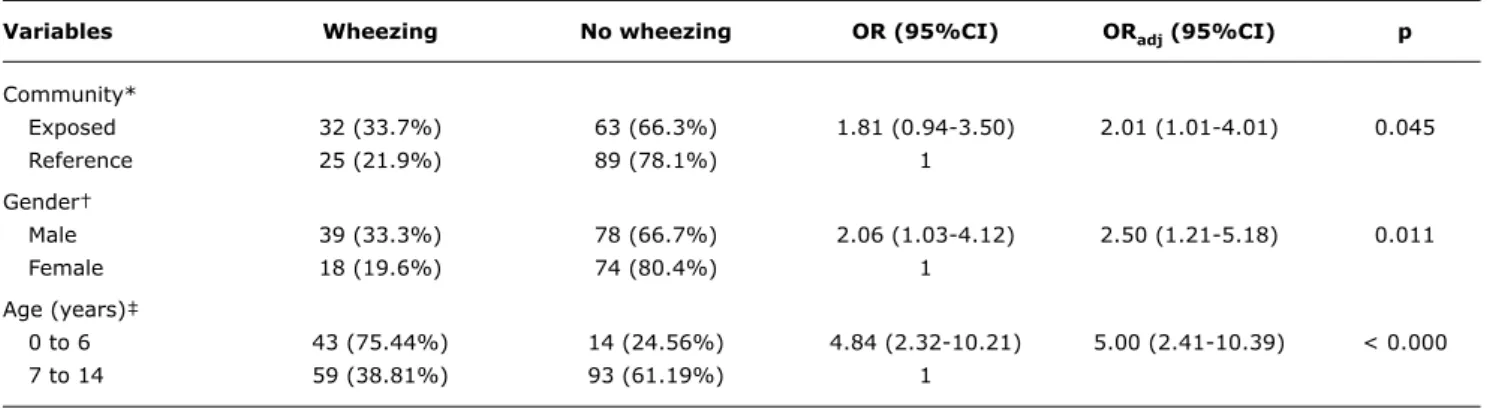
Even after adjusting for age and gender, participants living in ECs were twice as likely to have had wheezing in the last 12 months as those living in RCs (ORadj 2.01; 95%CI 1.01-4.01).
Gender was associated with wheezing in the last 12 months; boys were 2.5 times more likely to have experienced wheezing than girls (ORadj 2.5; 95%CI 1.21-5.18), after adjusting for age and community.
Age, in turn, was fount do be signiicantly associated
with wheezing (p < 0.000) after adjusting for community and gender. Preschoolers (children under 6 years of age)
were ive times more likely to have experienced wheezing
in the last 12 months than older children and adolescents (ORadj 5.00; 95%CI 2.41-10.39) (Table 4).
Discussion
Analysis of the dispersion plume of atmospheric pollutants emitted by the Guamaré Petrochemical Complex led to the
identiication of a set of communities which we considered
“exposed” to air pollution. Although the environmental levels of monitored pollutants were consistently within acceptable limits for the duration of the study, respiratory symptoms were more frequent in children and adolescents living in exposed communities. In addition to place of residence, male gender and age under 7 years were also risk factors for wheezing among inhabitants of the Guamaré Petrochemical Complex area.
Fluctuations in mean levels were within established acceptable limits, rarely peaking but never exceeding acceptable thresholds. As health effect measurements were collected at a single point in time, we were unable to assess whether these minor peaks in pollutant levels were in any way associated with adverse health effects.
Variables Wheezing (n, %) no wheezing (n, %) OR (95%Ci) p
Community
Exposed 32 (33.7) 63 (66.3) 1.81 (0.94-3.50) 0.057
Reference 25 (21.9) 89 (78.1) 1.0
Gender
Male 39 (33.3) 78 (66.7) 2.06 (1.03-4.12) 0.026
Female 18 (19.6) 74 (80.4) 1.0
Age (years)
0 to 1 15 (46.9) 17 (53.1) 1.0
2 to 6 28 (40) 42 (60) 0.76 (0.30-1.91) 0.514
7 to 9 6 (16.7) 30 (83.3) 0.23 (0.06-0.78) 0.007
10 to 14 8 (11.3) 63 (88.7) 0.14 (0.05-0.44) 0.000
Skin color
White 15 (20.3) 59 (79.3) 0.57 (0.27-1.18) 0.100
Brown 39 (30.9) 87 (69.1) 1.0
Smoker(s) at home
Yes 17 (27.0) 46 (73.0) 0.98 (0.48-2.00) 0.950
No 40 (27.0) 106 (72.6) 1.0
Maternal smoking during pregnancy
Yes 7 (20.6) 27 (79.4) 0.68 (0.25-1.78) 0.395
No 44 (27.7) 115 (72.3) 1.0
Other power source available
Yes 3 (13.0) 20 (87.0) 0.37 (0.08-1.38) 0.105
No 53 (29.0) 130 (71.0) 1.0
Farming activities
Yes 17 (25.4) 50 (74.6) 0.83 (0.41-1.69) 0.588
No 40 (29.0) 98 (71.0) 1.0
Family income (in minimum wages)*
< 1 21 (24.7) 64 (75.3) 0.81 (0.38-1.72) 0.543
1 9 (25.7) 26 (74.3) 0.85 (0.31-2.29) 0.724
> 1 22 (28.9) 54 (71.1) 1.0
Per capita income (R$)
0.00 to 45.00 18 (26.1) 51 (73.9) 0.79 (0.35-1.77) 0.534
45.00 to 100.00 18 (25.7) 52 (74.3) 0.77 (0.34-1.74) 0.500
100.00 or more 21 (30.9) 47 (69.1) 1.0
Educational achievement of the head of household
Illiterate/literate 38 (27.7) 99 (72.3) 1.01 (0.50-2.03) 0.975
Primary/secondary education 19 (27.5) 50 (72.5) 1.0
No. persons living in home (per room)
2 or fewer 53 (27.5) 140 (72.5) 1.0
2 or more 4 (25.0) 12 (75.0) 0.14 (0.03-0.53) 0.000
House type
Masonry 53 (29.0) 130 (71.0) 1.0
Wood/mud/rammed earth 4 (15.4) 22 (84.6) 0.45 (0.12-1.46) 0.145
Water supply
Mains 48 (28.4) 121 (71.6) 1.0
Other 9 (22.5) 31 (77.5) 0.73 (0.30-1.75) 0.451
Waste collection
Available 52 (29.7) 123 (70.3) 1.0
Not available/other 5 (14.7) 29 (85.3) 0.41 (0.13-1.19) 0.072
table 3 - Distribution of asthma symptoms (wheezing in the last 12 months) by demographic and environmental parameters, living conditions, and educational achievement of the head of household (Guamaré, Rio Grande do Norte, Brazil, 2006)
table 4 - Logistic regression models for presence of wheezing in the last 12 months, stratiied by community, gender, and age
95%CI = 95% confidence interval; OR = odds ratio. * Adjusted for gender and age.
† Adjusted for community and age. ‡ Adjusted for community and gender.
Variables Wheezing no wheezing OR (95%Ci) ORadj (95%Ci) p
Community*
Exposed 32 (33.7%) 63 (66.3%) 1.81 (0.94-3.50) 2.01 (1.01-4.01) 0.045
Reference 25 (21.9%) 89 (78.1%) 1
Gender†
Male 39 (33.3%) 78 (66.7%) 2.06 (1.03-4.12) 2.50 (1.21-5.18) 0.011
Female 18 (19.6%) 74 (80.4%) 1
Age (years)‡
0 to 6 43 (75.44%) 14 (24.56%) 4.84 (2.32-10.21) 5.00 (2.41-10.39) < 0.000
7 to 14 59 (38.81%) 93 (61.19%) 1
et al.11 reported a 2.6-fold risk of recurring wheezing in
homes where other fuels were used. We also found no association between crowding and wheezing, even though other authors have reported a 59% higher likelihood of adverse respiratory outcomes in homes in which two or more persons share the same room.11
The prevalence of wheezing was higher among boys.
This is consistent with previously published indings, and
is likely due to gender differences in airway physiology and higher thresholds of methacholine airway response.12
The results of our atmospheric pollution measurements revealed low exposure, as reported by Kalabokas et al.,1
who found that BTX levels in the vicinity of an oil reinery
were lower than those detected in major Greek urban areas. Fluctuations in toluene levels were worthy of note, but levels were still lower than those found in urban areas.1,25
Nonetheless, when in the atmosphere, pollutants occur as complex blends; therefore, the possibility of additive, synergistic, or antagonistic effects cannot be ruled out.4,9
The location of communities relative to industrial complexes and wind direction has been used as an exposure parameter.17 The pollutant dispersion plume and the location
of communities we considered “exposed” may account for the higher prevalences of wheezing in the 12 months prior to study, lifetime history of wheezing, and dry cough at night found in these communities. These results are consistent with prior studies, which have shown respiratory effects in children even when atmospheric pollution is within acceptable limits.5,26
Established exposure limits for atmospheric pollutants have been undergoing discussion, particularly as they apply to the protection of vulnerable groups, which led WHO to set more stringent limits for human exposure in 2005.2 The prevalence rates of wheezing determined in
our sample are consistent with those reported in other studies, which have shown a high prevalence of this symptom in Latin American nations, particularly Brazil,
and even higher rates in the North and Northeast Regions of the county.27-29
Wichmann et al.9 used the ISAAC questionnaire in their
study of the respiratory effects of exposure to petrochemical pollutants in 1,212 Argentinean children aged 6 to 12. They found the prevalence of respiratory events to be higher in the area surrounding the plant than in urban areas, even when levels of exposure were similar. This suggests that not only the concentration of pollutants but also the source and makeup of particulate matter could be associated with respiratory effects. Solé et al.6 also used
this questionnaire in an assessment of the relationship between exposure to pollutant gases (O3, CO, NO2, and SO2), socioeconomic status, and prevalence of asthma, rhinitis, and allergy symptoms in a sample of 16,209 13- and 14-year-olds from various Brazilian cities. Their results suggested an association between higher pollutant levels and higher prevalence of asthma, rhinitis, and allergy, with no difference in socioeconomic status between cities. In our study, socioeconomic conditions were also very similar in all communities, which may account for the lack of association between socioeconomic status and prevalence of wheezing, as reported in other studies.27,30
The communities studied herein were homogeneous in terms of dietary habits, lifestyle, and socioeconomic status. All were characterized by low levels of educational achievement, low literacy rates, poor sanitation and living conditions, a dearth of public services and employment, and low family income often boosted by welfare programs.
This homogeneous proile makes it hard to distinguish any
factors that may be associated with wheezing symptoms in the communities that surround the Guamaré Petrochemical Complex.
Correspondence:
Ana Claudia Lopes de Moraes
Rua Marques do Paraná, 303, 3º andar, frente, Centro CEP 24033-900 - Niterói, RJ - Brazil
Tel.: +55 (21) 2629.9021 Fax: +55 (21) 2629.9021
E-mail: [email protected] References
1. Kalabokas PD, Hatzianestesis J, Bartzis JG, Papagiannakopolous P. Atmospheric concentrations of satured and aromatic hydrocarbons around a Greek oil refinery. Atmospheric Environment. 2001;35:2545-55.
2. World Health Organization. WHO air quality guidelines - global update 2005. Bonn, Germany: WHO, 2005.
3. Trasande L, Thurston GD. The role of air pollution in asthma and other pediatric morbidities. J Allergy Clin Immunol. 2005;115:689-99.
4. Salvi S. Health effects of ambient air pollution in children. Paediatr Respir Rev. 2007;8:275-80.
5. Castro HA, Cunha MF, Mendonça GA, Junger WL, Cunha-Cruz J, Leon AP. Effect of air pollution on lung function in schoolchildren in Rio de Janeiro, Brazil. Rev Saude Publica. 2009;43:26-34. 6. Solé D, Camelo-Nunes IC, Wandalsen GF, Pastorino AC, Jacob
CM, Gonzalez C, et al. Prevalence of symptoms of asthma, rhinitis and atopic eczema in Brazilian adolescents related to exposure to gaseous air pollutants and socioeconomic status. J Investig Allergol Clin Immunol. 2007;17:6-13.
7. Annesi-Maesano I, Moreau D, Caillaud D, Lavaud F, Le Moullec Y, Taytard A, et al. Residential proximity ine particles related
to allergic sensitisation and asthma in primary school children.
Respir Med. 2007;101:1721-9.
8. Smargiassi A, Kosatsky T, Hicks J, Plante C, Armstrong B, Villeneuve PJ, et al. Risk of asthmatic episodes in children exposed to sulfur
dioxide stack emissions form a reinery point source in Montreal,
Canada. Environ Health Perspect. 2009;117:653-9.
9. Wichmann FA, Müller A, Busi LE, Cianni N, Massolo L, Schlink U, et al. Increased asthma and respiratory symptoms in children exposed to petrochemical pollution. J Allergy Clin Immunol. 2009;123:632-8.
10. Chong Neto HJ, Rosário NA, Grupo EISL Curitiba (Estudio Internacional de Sibilancias en Lactentes). Risk factors for wheezing
in the irst year of life. J Pedritr (Rio J). 2008;84:495-502. 11. Prietsch SO, Fischer GB, César JA, Cervo PV, Sangaletti LL,
Wietzycoski CR, et al. Fatores de risco para sibilância recorrente em menores de 13 anos no Sul do Brasil. Rev Panam Salud Publica. 2006;20:331-7.
12. Uekert SJ, Akan G, Evans MD, Li Z, Roberg K, Tisler C, et al. Sex-related differences in immune development and the expression of atopy in early childhood.J Allergy Clin Immunol. 2006;118:1375-81.
13. Chong Neto HJ, Rosáro NA. Wheezing in infancy: epidemiology, investigation, and treatment. J Pediatr (Rio J). 2010;86:171-8. 14. Maia JG, Marcopito LF, Amaral AN, Tavares Bde F, Santos FA.
Prevalência de asma e sintomas asmáticos em escolares de 13 e 14 anos de idade. Rev Saude Publica. 2004;38:292-9. 15. Casagrande RR, Pastorino AC, Souza RG, Leone C, Solé D, Jacob
CM. Prevalência de asma e fatores de risco em escolares da cidade de São Paulo. Rev Saude Publica. 2008;42:517-23.
16. Cassol VE, Solé D, Menna-Barreto SS, Teche SP, Rizzato TM, Maldonado M, et al. Prevalência de asma em adolescentes urbanos de Santa Maria (RS). Projeto ISAAC – International Study of Asthma and Allergies in Childhood. J Bras Pneumol. 2005;31:191-6. 17. Luginaah IN, Taylor SM, Elliot SJ, Eyles JD. A longitudinal study
of the health impacts of a petroleum reinery. Soc Sci Med. 2000;50:1155-66.
18. MME. Ministério de Minas e Energia. Secretaria de Geologia, Mineração e Transformação Mineral. CPRM- Serviço Geológico do Brasil. Projeto cadastro de fontes de abastecimento por água subterrânea estado do Rio Grande do Norte. Diagnóstico do Município de Guamaré. Recife, 2005. 22 p. www.cprm.gov.br/rehi/ atlas/rgnorte/relatorios/GUAM051.PDF. Access: 07/11/2009. 19. IBGE. Instituto Brasileiro de Geograia e Estatística. [website].
Brasília. http://www.ibge.gov.br/home. Access: 01/09/2009. 20. ISAAC Steering Committee. [website]. International Study of
Asthma and Allergies in Childhood. Nova Zelândia. http://isaac. auckland.ac.nz/. Access: 01/09/2009.
21. Asher MI, Keil U, Anderson HR, Beasley R, Crane J, Martinez F.
International Study of Asthma and Allergies in Childhood (ISAAC): rationale and methods. Eur Respir J. 1995;8:483-91.
22. Solé D, Vanna AT, Yamada E, Rizzo MC, Naspitz CK. International Study of Asthma and Allergies in Childhood (ISAAC) written questionnaire: validation of the asthma component among Brazilian children. J Investig Allergol Clin Immunol. 1998;8:376-82. 23. Dela Bianca AC, Wandalsen GF, Miyagi K, Camargo L, Cezarin D,
Mallol J, et al. International Study of Wheezing in Infants (EISL): validation of written questionnaire for children aged below 3 years. J Investing Allergol Clin Immunol. 2009;19:35-42.
24. CONAMA. Conselho Nacional do Meio Ambiente. Resolução CONAMA Nº 003, de 28 de junho de 1990. Brasília, 1990. http://www. mma.gov.br/port/conama/res/res90/res0390.html. Access: 07/11/2009.
25. Han X, Naeher LP. A review of trafic-related air pollution
exposure assessment studies in the developing world. Environ Int. 2006;32:106-20.
26. Moura M, Junger WL, Mendonça GA, de Leon AP. Qualidade do ar e transtornos respiratórios agudos em crianças. Rev Saude Publica. 2008;42:503-11.
27. Mallol J, Solé D, Asher I, Clayton T, Stein R, Soto-Quiroz M.
Prevalence of asthma symptoms in Latin America: the International Study of Asthma and Allergies in Childhood (ISAAC). Pediatr Pulmonol. 2000;30:439-44.
28. Solé D, Wandalsen GF, Camelo-Nunes IC, Naspitz CK; ISAAC - Brazilian Group. Prevalence of symptoms of asthma rhinitis, and
atopic eczema among Brazilian children and adolescents identiied
by the International Study of Asthma and Allergies in Childhood (ISAAC) – Phase 3. J Pediatr (Rio J). 2006;82:341-6.
29. Rosa AM, Ignotti E, Hacon Sde S, Castro HA. Prevalence of asthma in children and adolescents in a city in the Brazilian Amazon region. J Bras Pneumol. 2009;35:7-13.
30. Fischer GB, Camargos PA, Mocelin HT. The burden of asthma in children: a Latin American perspective. Pediatric Respir Rev. 2005;6:8-13.
a tool for assessment of the health effects of atmospheric pollution in ages and samples quite different from those for which it has been validated in the country.5,9,15
The present study sought to detect symptoms indicative of vulnerability (particularly wheezing), not diagnose asthma. The EISL questionnaire provides a more detailed approach to respiratory diseases and symptoms, such as bronchitis and wheezing. It is therefore likely that the ISAAC questionnaire failed to detect some symptomatic participants in the under-3 age range. However, considering the results reported by Dela Bianca et al.23 and the fact that some
detection failures likely occurred in every community, this does not invalidate our results.
The indings of this study underscore the relevance of
air quality monitoring and health assessment of the groups most susceptible to the effects of atmospheric pollution in the vicinity of industrial areas, both from a public health standpoint and in terms of risk management and corporate social and environmental responsibility.