ORIGIN
AL RESEAR
CH
Electromyographic activity and cocontraction of trunk
muscles during exercises performed with an oscillatory
pole: an analysis of the efect of diferent postures
Atividade eletromiográica e cocontração dos músculos do tronco durante exercícios realizados
com haste oscilatória: uma análise do efeito de diferentes posturas
Actividad electromiográica y co-contracción de los músculos del tronco durante ejercicios con
barra oscilante: análisis del efecto de diferentes posturas
Luis Renato Garcia Martinez Martins¹, Nise Ribeiro Marques², Juliana Rodrigues Soares Ruzene³,
Ângela Kazue Morita4, Marcelo TavellaNavega2,5
Mailing address: Marcelo Tavella Navega – Av. HyginoMuzzi Filho, 737 – Mirante – CEP: 17525-000 – Marília (SP) – E-mail: [email protected] – Presentation: Jan. 2014 – Accepted for publication: Apr. 2015 – Funding source: CNPqe Fapesp – Oicial Opinion from the Ethics Committee: 0616/2012
A study developed in the Musculoskeletal Evaluation Laboratory of the Philosophy and Science School of Universidade Estadual Paulista (UNESP) – Marília (SP), Brazil.
1Professor in the Physical Therapy course at UNESP – Campus Marília. 2Professor in the Physical Therapy course at UNESP – Campus Marília.
3Physiotherapist, master in Human Development and Technologies at São Paulo State University – Campus Rio Claro – Rio Claro (SP), Brazil. 4Physical Therapist at Centro de Estudos da Educação e da Saúde (Center for Education and Health Studies) – CEES, UNESP –
Campus Marília; Graduate Student (Master’s) in Human Development and Technologies.
5Professor in the Graduation Program in Human Development and Technologies, Bioscience Institute, Unesp – Campus Rio Claro.
ABSTRACT | This study aimed at analyzing the
electromyographic activity (EMG) and cocontraction of torso muscles during exercises with a lexi bar, in two diferent postures (neutral pelvis and posterior pelvic tilt). 20 young women with no lower back pain took part in the study (ages between 18 and 28 years) and they were recruited from a university population. In order to collect the data, an exercise was performed with a lexi bar being held with both hands. It was perpendicular to the ground and it was oscillating in the sagittal plane. That exercise was conducted in two diferent pelvis postures (neutral and posterior tilted). The EMG signals were collected bilaterally on the following muscles: internal oblique (IO), rectus abdominals (RA), iliocostalis lumborum (IL) and multiidus (MU). The analysis of variance (ANOVA) of repeated measurements was found to display an interaction between muscles and postures (F=5.18; p=0.003). The activation of IL muscle in the neutral posture was 7.93% higher than in the posteriorly tilted posture (p=0.005), and the activation of IO muscle was 13.62% higher in the posteriorly tilted posture than during the exercise in the neutral posture (p=0.002). According to our results, the performance of the exercise with a posteriorly tilted pelvis increased the activation of IO muscle, whereas IL muscle was found to 119
have a higher activation when the exercise was performed in a neutral posture. Future studies need to be conducted in order to understand the neuromuscular adaptations that are generated by exercises with lexi bars, and their relevance to the prevention and treatment of nonspeciic lower back pain.
Keywords | Electromyography; Physical Therapy Modality; Applied Kinesiology; Lower Back Pain.
interação entre músculos e posturas (F=5,18; p=0,003), sendo que a ativação do músculo IL na postura neutra foi 7,93% maior do que a postura retrovertida (p=0,055), e a ativação do músculo OI foi 13,62% maior na postura retrovertida do que durante o exercício em postura neutra (p=0,002). De acordo com os nossos resultados, a realização do exercício em postura com retroversão da pelve aumentou a ativação do músculo OI, enquanto o músculo IL apresentou maior ativação durante a realização do exercício em postura neutra. Futuros estudos são necessários para o entendimento das adaptações neuromusculares geradas pelo treino com exercícios com haste oscilatória e sua relevância para a prevenção e tratamento da dor lombar inespecíica.
Descritores | Eletromiograia; Modalidade de Fisioterapia; Cinesiologia Aplicada; Dor Lombar.
RESUMEN | Este estudio tuvo por objetivo analizar la actividad electromiográica (EMG) y la co-contracción de los músculos del tronco durante el ejercicio con barra oscilante en dos posturas distintas, la pelvis neutral y la en retroversión. Participaron veinte mujeres entre los 18 hasta los 28 años de edad, sin dolor lumbar, reclutadas en una universidad. La recolección de datos
se realizó por un ejercicio con barra oscilante, que colocada verticalmente al suelo, podría ser agarrada por ambas manos de las participantes y, así, oscilar en el plan sagital. Las señales EMG se recogieron de forma bilateral en los músculos oblicuo interno (OI), recto abdominal (RA), iliocostal lumbar (IL) y multiidus (MU). El análisis de la varianza (ANOVA) de las medidas repetidas mostró interacción entre músculos y posturas (F=5,18, p=0,003), siendo que la activación del músculo IL en la postura neutral fue un 7,93% mayor que en la postura en retroversión (p=0,055) y la activación del músculo OI fue un 13,62% mayor en la postura en retroversión que durante el ejercicio en la postural neutral (p=0,002). Con respecto a los resultados, el ejercicio realizado con la postura en retroversión de la pelvis aumentó la activación del músculo OI, mientras que el realizado con la postura neutral aumentó la activación del músculo IL. Es necesario que se hagan futuros estudios para comprender mejor las adaptaciones neuromusculares generadas por el entrenamiento con ejercicios con barra oscilante y su importancia para la prevención y el tratamiento del dolor lumbar inespecíico.
Palabras clave | Electromiografía; Modalidad de Fisioterapia; Quinesiología Aplicada; Dolor Lumbar.
INTRODUCTION
Nonspeciic lower back pain is characterized as one of the musculoskeletal dysfunctions which afect adult people the most, which leads to a high cost for health care and social security systems1,2. Among the probable causes which are the most mentioned for the onset of nonspeciic lower back pain is the reduced stability in the lumbar area3.
Lumbar spine stability is maintained through the interconnected actions of three sub-systems: the active, the passive, and the neural feedback system4,5. he active sub-system is the irst mechanism which is triggered to stabilize spine segments when external disturbances occur4,5. his sub-system, which is composed of the torso muscles, bay be subdivided, according to its anatomical and functional characteristics, in local muscles, such as the multiidus, the transverse abdominal muscle (TrA), and the internal oblique (IO), which are inserted in the lumbar vertebrae and stabilize the vertebral segments; and global muscles, such as the rectus abdominis (RA), the external oblique (EO), and the iliocostalis lumborum (IL), which are inserted in diferent anatomical points in the vertebrae, and are capable of generating very long movements8.
Previous studies indicated exercises which promote the activation of torso-stabilizing muscles, such as the IO and the MU, in order to treat and prevent nonspeciic lower back pain9. Among the several physical exercise techniques that have been recently proposed to promote the cocontraction and training of the lower back-stabilizing muscles are the exercises with lexi bars10. In that kind of exercise, unlike the exercises that are performed on vibrating platforms, the vibration of the rod is produced through the contraction of the muscles in the upper segment, and it is transmitted to the whole body of the person performing ht exercise11. hus, the oscillation of the rod promotes disturbances on the core of the person performing the exercise. In order to maintain both core and lumbar stability, such person resorts to posture adjustments, such as contracting the deep muscles of the abdomen, such as the TrA and the
OI10,12,13.
(IO and MU) is increased with the use of a lexi bar, as compared to the performance of the same exercise through the use of a rigid bar. he rod oscillation plane results in changes in the pattern through which muscles are recruited, and it may or may not favor the activation of the deep muscles of the trunk10,12-15. Besides that, performing exercises with a lexi bar in the standing position favors the activation of IO and MU muscles, in relation to a sitting position10,13,15.
In that sense, considering that the exercise with a lexi bar may be an important clinical tool for physical therapists in the prevention and treatment of nonspeciic lower back pain, understanding the factors that interfere in its prescription, such as the posture in which it must be performed, is extremely relevant. Considering that, as far as the authors know, no previous study has mentioned the efect of pelvic posture in the muscle recruitment pattern during exercises with lexi bars, this study aimed at analyzing the electromyographic activity (EMG) and cocontraction of torso muscles during exercises with a lexi bar, in two diferent postures (neutral pelvis and posterior pelvic tilt). he initial hypothesis of this study is that performing the exercise in the neutral pelvic position may promote a higher activity in the stabilizing muscles, once that during rest (no exercises being performed), in the neutral position, those muscles were found to be more activated8.
METHODOLOGY
Subjects
20 women, aged 18 to 21 years, with body masses of 56.9±5.1kg, who were 1.68±0.07m tall, and who had body mass indices of 24.9±1.3kg.m-² took part in the study. hey had no lower back pain, and had not taken part in physical training for the previous three months. he volunteers who mentioned muscular, tendon, articulatory, or ligamentous injury in the torso or upper limbs in the three previous months were not included in the study.
Equipment
he following equipment was used in the study:
• Flexi bar (Sanny®, São Bernardo do Campo, Brazil), with the following dimensions: 1.50m
long, 9.70mm in diameter, and weighing 800g, made of iberglass and rubber;
• Biological signal acquisition module (Myosystem-Br1P84, Data Hominis®, Uberlândia, Brazil), with a sample rate adjusted to 2000Hz, and total gain of 2000 times (20 times in the sensor and another 100 times in the device).
Procedure
he procedures for the collection of data were conducted in a single day. Initially, the volunteers familiarized themselves with the exercise by using the lexi bar with its oscillation set to 5Hz, through acoustic stimuli from a metronome10,12,13,15.
After familiarized, volunteers started being prepared for the EMG signal acquisition. Before the electrodes were placed, their skin was shaved, sanded with a ine-grit sandpaper, and cleaned with alcohol, as a way to prevent possible interferences in the electromyographic signal16. he electrodes were placed bilaterally on the internal oblique (IO), rectus abdominis (RA), iliocostalis lumborum (IL) and multiidus (MU) muscles10,16.
he exercises with lexi bars were conducted with volunteers standing, with their shoulders lexed by approximately 90 degrees, holding the bar with both hands in the vertical position and performing the oscillations in the sagittal plane, in two distinct postures (Figure 1): (a) straightened lumbar spine, with posteriorly tilted pelvis and semi-lexed knees; (b) lumbar spine in neutral pelvic position and completely extended knees8,17.
Figure 1. (A). Exercise performed in a neutral posture, (B). Exercise performed in a posteriorly tilted posture, (B)
he order in which the exercises were performed, with the lumbar spine straightened or not, was randomly selected
through a simple rale. he exercises were vperformed in 3 series of 15 seconds, with 1-minute intervals between each series and each exercise.
ANALYSIS OF DATA
he EMG signal was analyzed in speciic routines that were developed in a Matlab (Mathworks®) environment. he data were processed through the use of a 20-500Hz band-pass ilter. Following that, the signal was rectiied with the use of the full-wave rectiication method. In order to create the linear envelope, a fourth-order low-pass ilter with a 6Hz cutof frequency, in order to smooth the signal. he EMG signals between the ifth and the tenth seconds of the third series of the exercise were analyzed (Figure 2).
he activation of each muscle was calculated through the average activation during the ive seconds that were considered for analysis. he EMG signal was normalized through the peak activation value of the exercise in neutral posture.
Besides that, the linear envelope of EMG signals was used to calculate the antagonist cocontraction between IO/RA and MU/IL muscles, through the use of the following equation18,19:
where the common A&B area represents the common activation area between two muscles, and A and B areas represent the area of each of those muscles.
he statistical package PASW 18.0 (SPSS inc.) was used to conduct the statistical analysis. Shapiro-Wilk test was used for testing the normality of data. Analysis of Variance (ANOVA) was used for repeated measurements, considering muscles, sides, and postures as dependent variables, and the electromyographic activation as the independent variable. Bonferroni’s post hoc analysis was used when factors were found to interact with one another. he signiicance level was adjusted to p<0.05.
RESULTS
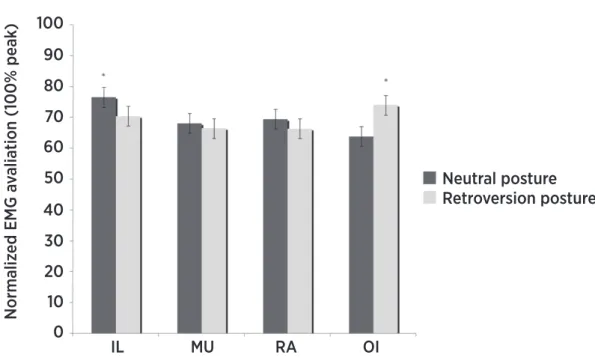
Signiicant diferences were found in the interaction among muscles and postures (F=5.18 and p=0.003). p=0.002hus, the activation of IL (Average±SD) was 7.93% higher in the neutral posture as compared to the posteriorly tilted posture (p=0.055), and the activation of IO (Average±SD) was 13.62% higher in the posteriorly tilted posture as compared to the neutral posture (p=0.002, Figure 2). No main posture efects were found for the cocontraction analyses (F=0.896 and p=0.404).
Common A&B area A area + B area
Cocontraction index = 2 x x 100
IL
Normaliz
ed EMG a
valia
tion (100% peak)
MU RA OI
0 10 20 30 40 50 60 70 80 90 100
Neutral posture Retroversion posture
DISCUSSION
his study aimed at analyzing the EMG activity and the contraction of torso muscles during exercises with a lexi bar, in two diferent postures (neutral pelvis and posterior pelvic tilt). he most relevant result in this study was the fact that IO muscle was 13.62% more recruited during the exercise in the posteriorly tilted position as compared to the exercise that was performed in the neutral posture. On the other hand, the IL muscle was found to have an EMG activation that was 7.93% higher during the exercise in the neutral posture. In that sense, our results refute the initial hypothesis of this study, as, unlike what was expected, there was increased Io activation during the exercise that was performed with a posteriorly tilted pelvis, and increased IL muscle activation during the exercise with a neutral position.
Previous studies provided two different ways to understand the effects of exercises with flexi bars in the lumbar spine stability. According to Anders et al.12, a single muscle group (OI, MU, and TrA), has the exclusive function of promoting stability, whereas another muscle group – called global (RA and IL) is uniquely responsible for generating torque and torso movements12. Marques et al.10, Moreside et al.14, and Gonçalves et al.15 indicated that the (standing or sitting) posture in which the exercise is performed, and the oscillation plane of the bar modify muscle recruitment and cocontraction. Thus, lumbar spine stability is not only provided through the action of local muscles, but rather by the joint action of all torso muscles. Our results corroborate the ones from Marques et al.10, Moreside et al.14, and Gonçalves et al.15, once the activation for both the local muscle (IO) and the global muscle (IL) was modified according to the alterations in pelvis positioning.
The IL muscle is inferiorly inserted into the dorsal sacrum side, and the IO muscle is inferiorly inserted into the region of the iliac crest and the anterior superior iliac spine20. Therefore, the pelvic position may alter the length of those muscles, thus contributing to or hindering the muscle contraction efficiency. The higher activation of IL muscle during the exercise that was performed in a neutral posture is possibly related to the fact that, in that position, the muscle is in an optimal length-tension relationship in order to generate torque, and, therefore, its activation
may promote increased stability to the spine in the sagittal plane.
For the IO muscle, we suggest that the performance of exercises with lexi bars in the posture with a straight lower back puts the pelvis into a more unstable position. hat takes place because some lumbo-pelvic stabilizing muscles, such as the iliopsoas and the IL muscles are stretched, which reduces the contraction eiciency of those muscles to generate force. In that sense, the higher IO muscle recruitment during the performance of exercises in the posteriorly tilted pelvic posture occurred in order to ofset the reduced stabilizing eiciency of other muscles in the lumbo-pelvic region. Besides that, in the posteriorly tilted pelvic position, the center of mass is displaced from its position of balance, thus adding an increased challenge for torso stability20.
he relationship between the pelvic positioning and the EMG activation of torso muscles was previously studied during rest, in standing, and sitting positions, by O’Sullivan et al.8,17. According to those authors, in both postures, the neutral pelvic position was the one to favor the most the recruitment of torso-stabilizing muscles (IO an MU) as compared to the position with a posteriorly or anteriorly tilted pelvis. hat took place as, in the neutral pelvic position, there is decreased action of passive tissues (fasciae, ligaments, etc.) for spine stabilization. hus, the results in this study are not in agreement with the results found by O’Sullivan et al.8,17.
Despite that, as far as the authors know, no previous studies have evaluated EMG activation during exercises with flexi bars in different pelvic positions, Marques et al.10, Anders et al.13, and Gonçalves et al.15 demonstrated that IO activation in the standing posture was higher than the one in the sitting posture during the performance of exercises with flexi bars. According to those authors, there was higher IO activation, as in the standing position, the pelvis is more unstable, which implies in a higher muscular action in order to maintain stability10,13,15. Thus, the possible explanation for our results not to corroborate the studies by O’Sullivan et al.8 and O’Sullivan et al.17 is that, besides the instability that is caused by the standing posture, the posteriorly tilted pelvic position and the oscillation of the bar added challenges to spine stability, thus altering the muscular recruitment responses.
during the performance of exercises with lexi bars. hus, based on our results, it is possible to state that the positioning of the pelvis may later the muscular recruitment pattern. However, it is not possible to determine which pelvic position - neutral or posteriorly tilted - is the one that is the most indicated for the prevention and treatment of lower back pain, nor whether the adoption of the posteriorly tilted pelvic position during the performance of exercises with lexi bars may result in any kind of overload to the lumbar spine. herefore, further investigation is necessary in order to contribute to the understanding of the most adequate pelvic positioning to the performance of exercises with lexi bars and their possible efects in the prevention and treatment of lower back pain.
Constraints
he results of this study refer to the muscular activation responses from young and healthy people with no lower back pain, which limits the use of our results with other populations. Besides that, only one kind of exercise was tested, which suggests the need for further studies which investigate the efect of exercises with lexi bars, as performed in diferent pelvic positions and with bars oscillating in diferent planes of movement in the muscular recruitment of the torso.
CONCLUSION
According to our results, the performance of exercises with lexi bars in a posteriorly tilted pelvic position increased the activation of the muscle IO, whereas the performance of exercises with lexi bars in a neutral pelvic position increased the activation of IL. In that sense, this study demonstrated that the positioning of the pelvis may alter the muscular recruitment pattern of the torso. herefore, further investigation is necessary in order to contribute to the understanding of the most adequate pelvic positioning for the performance of exercises with lexi bars and their possible efects in the prevention and treatment of lower back pain.
REFERENCES
1. Knoplich J. Enfermidades da coluna vertebral. 3. ed. São Paulo: Robe Editorial, 2003.
2. Gonçalves M, Barbosa F. Análise de parâmetros de força e resistência dos músculos eretores da espinha lombar durante a realização de exercício isométrico em diferentes níveis de esforço. Rev Bras Med Esp. 2005;11(2):102-14.
3. Van Dieen JH, Cholewicki J, Radebold A. Trunk muscle recruitment patterns in patients with low back enhance the stability of lumbar spine. Spine. 2003;28:834-41.
4. Panjabi MM. The stabilizing system of the spine: part I: function, dysfunction, adaptation, and enhancement. J Spinal Disord. 1992;5(4):383-9.
5. Granata KP, Marras WS. Cost-beneit of muscle cocontraction in protecting against spinal instability. Spine. 2000;25(11):1398-404.
6. Newcomer KL, Jacobson TD, Gabriel DA, Larson DR, Brey RH, An KN. Muscle activation patterns insubjects with and without low back pain. Arch Phys Med Rehab. 2002;83(6):816-21. 7. Mac Donald D, Moseley GL, Hodges PW. Why do some
patients keep hurting their back? Evidence ongoing back muscle dysfunction during remission from recurrence back pain. Pain. 2009;142(3):183-8.
8. O’Sullivan PB, Grahamslaw KM, Kendell M, Lapenskie SC, Möeller NE, Richards KV. The efects of diferent standing and sitting postures on trunk muscle activity in a pain free population. Spine. 2002;27(11):1238-44.
9. França FJR, Burke TN, Claret DC, Marques AP. Estabilização segmentar da coluna lombar nas lombalgias: uma revisão bibliográica e um programa de exercícios. Fisioter Pesq. 2008;15(2):200-6.
10. Marques NR, Hallal CZ, Goncalves M. Padrão de co-ativação dos músculos do tronco durante exercícios com haste oscilatória. Motriz. 2012;18(2):245-52.
11. Hallal CZ, Marques NR, Goncalves M. O uso da vibração como método auxiliar no treinamento de capacidades físicas: uma revisão da literature. Motriz. 2010;16(2):527-33.
12. Anders C, Wenzel B, Scholle HC. Activation characteristics of trunk muscles during cyclic upper-body perturbations caused by an oscillating pole. Arch Phys Med Rehab. 2008;89(7):1314-22.
13. Anders C, Wenzel B, Scholle HC. Cyclic upper body perturbations caused by a lexible pole: inluence of oscillation frequency and direction on trunk muscle co-ordination. J Back Musculoskel Rehab. 2007;20(4):167-75. 14. Moreside JM,Vera-Garcia FJ,McGill SM. Trunk muscle activation
patterns, lumbar compressive forces, an spine stability when using the body-blade. Phys Ther. 2007;87(2):153-64.
15. Gonçalves M, Marques NR, Hallal CZ,Van Dieen JH. Electromyographic Activity of trunk muscles during exercises with lexible and non-lexible poles. J Back Musculoskel Rehab. 2011;24(4):209-14.
16. Hermens HJ, Freriks B, Disselhorst-K, Rau G. Development of recommendation for SEMG sensors and sensor placement procedures. J Electromyogr Kines. 2000;10(5):361-74.
18. Candotti CT, Loss JF, Begatini D, Soares DP, Rocha EK, Oliveira AR, Guimarães ACS. Cocontraction and economy of triathletes and cyclistsat diferent cadences during cycling motion. J Electromyogr Kines. 2009;19(5):915-21.
19. Winter, D.A. Biomechanicsand Motor Control of Human Movement.4 ed. New York:Wiley, 2009.