J Pediatr (Rio J). 2014;90(4):426---428
www.jped.com.br
LETTERS TO THE EDITOR
Z-Score: Fenton 2013. Ten-year
update
夽,夽夽Escore Z: Fenton 2013. Atualizac
¸ão de dez
anos
Dear Editor,
We read with great interest the article by Lima et al.1on the
determination of extrauterine growth restriction (EUGR) in very low birth weight infants, as well as the effect several perinatal variables had on this outcome. They define EUGR as weight Z-score or head circumference Z-score less than or equal to -2. Also, they classify the newborns as adequate for gestational age (AGA) or small for gestational age (SGA) based on the birth weight Z-score. It is important to denote here that the calculated Z-scores were based on Fenton’s growth chart of 2003.2,3
In 2013, the Fenton 2003 Preterm Growth chart was updated by a rigorous meta-analysis which included 3,986,456 births from Germany, United States, Italy, Aus-tralia, Scotland, and Canada.4,5 By doing so, they updated
the Z-scores for length, head circumference, and weight; these new Z-scores can be easily calculated using the online calculators at: http://www.ucalgary.ca/fenton/.
We do not know whether the results of the study would have been the same if the Z-scores of the study had been based on the 2013 Fenton Preterm Growth Chart. However, it was impossible for Lima et al. to base their study on the updated Z-scores, since Fenton’s new growth chart was pub-lished a month after their study was submitted to the Jornal de Pediatria. We would like to know whether it would be pos-sible to revise the study using the new and updated growth chart to see if the results are different.
We must add that Fenton’s 2013 growth chart is the best reference we have until now. Nevertheless, we are look-ing forward to the new results of the INTERGROWTH-21st
DOI of original article:
http://dx.doi.org/10.1016/j.jped.2013.05.007
夽 Please cite this article as: Proa˜no A, Aragón RE, Proa˜no JL.
Z-Score: Fenton 2013. Ten-year update. J Pediatr (Rio J). 2014;90:426.
夽夽Study conducted at the Facultad de Medicina Alberto Hurtado,
Universidad Peruana Cayetano Heredia, Lima, Peru.
Project, which will give us better international growth stan-dards for preterm infants.6
Conflicts of interest
The authors declare no conflicts of interest.
References
1. Lima PA, de Carvalho M, da Costa AC, Moreira ME. Variables associated with extrauterine growth restriction in very low birth weight infants. J Pediatr (Rio J). 2014;90:22---7.
2. Fenton TR. A new growth chart for preterm babies: Babson and Benda’s chart updated with recent data and a new format. BMC Pediatr. 2003;3:13.
3. Fenton TR, Sauve RS. Using the LMS method to calculate Z-scores for the Fenton preterm infant growth chart. Eur J Clin Nutr. 2007;61:1380---5.
4. Fenton TR, Kim JH. A systematic review and meta-analysis to revise the Fenton growth chart for preterm infants. BMC Pediatr. 2013;13:59.
5. Fenton TR, Nasser R, Eliasziw M, Kim JH, Bilan D, Sauve R. Vali-dating the weight gain of preterm infants between the reference growth curve of the fetus and the term infant. BMC Pediatr. 2013;13:92.
6. Villar J, Altman DG, Purwar M, Noble JA, Knight HE, Ruyan P, et al. The objectives, design and implementa-tion of the INTERGROWTH-21st Project. BJOG. 2013;120:9---26.
Alvaro Proa˜noa,∗, Romina E. Aragóna,
José Leonidas Proa˜nob
aFacultad de Medicina Alberto Hurtado, Universidad
Peruana Cayetano Heredia, Lima, Peru
bDepartment of Pediatrics, Complejo Hospitalario San
Pablo, Lima, Peru
Corresponding author.
E-mail:[email protected] (A. Proa˜no).
http://dx.doi.org/10.1016/j.jped.2014.04.003
LETTERS TO THE EDITOR 427
Author’s reply: Z-Score:
Fenton 2013. Ten-year update
夽Resposta do autor: Escore Z: Fenton 2013.
Atualizac
¸ão de 10 Anos
Dear Editor,
We would like to thank Proa˜no et al., for their review and comments on our article ‘‘Variables associated with extra uterine growth restriction in very low birth weight infants’’,1
which certainly contributed to a better understanding of our results.
We used Fenton 20032 as reference for data analysis in
our previous article,1since it was the reference available at
the time. Encouraged by the letter from Proa˜no et al., we chose to recalculate using the New Fenton 2013 reference3
and did the analysis again. Indeed, different results were observed with this new reference.3
Methods
Using the same data from the previous study,1we used the
Bulk Research Calculator, available at http://www.ucalgary. ca/fenton/2013chart, to calculate the Z-scores for weight and head circumference (HC), and observed the following results:
New results
Of the population studied, 49% were males, 67.4% of the newborns were appropriate for gestational age (AGA), and 32.6% were small for gestational age (SGA). It was observed that although the mean Z-score for HC decreased slightly during the hospitalization period (-0.495 to -0.496), the mean weight Z-score showed worsening (-0.958 to -1.798). Of the 570 newborns evaluated, 39.1% presented growth restriction at discharge, considering weight, and 7.5% when the evaluated variable was HC.
AGA infants presented a reduction in weight Z-score (-0.52 to -1.46) and HC Z-score (-0.03 to -0.29). In SGA infants, the decrease in weight Z-score was lower (-1.87 to -2.49) when compared to AGA infants, and the HC Z-score showed an increase (-1.46 to -0.93). Of the 32.6% (186/570) infants born SGA, 73.7% (137/186) had extra uterine growth restriction (EUGR) at discharge considering weight and 12.9% (24/186) considering HC. Rates of EUGR for AGA infants were 22.4% (86/384) considering weight and 4.9% (19/384) considering HC. These differences were statistically signifi-cant for weight (p = 0.000) and HC (p = 0.001). Regarding growth restriction, it was observed that, at birth, 11.4% of the newborns studied had intra uterine growth restric-tion (IUGR), considering weight. Upon discharge, this rate of
DOI of refers to article:
http://dx.doi.org/10.1016/j.jped.2014.04.003
夽
Please cite this article as: Lima PA, de Carvalho M, da Costa AC, Moreira ME. Author’s reply: Z-Score: Fenton 2013. Ten-year update. J Pediatr (Rio J). 2014;90:427---8.
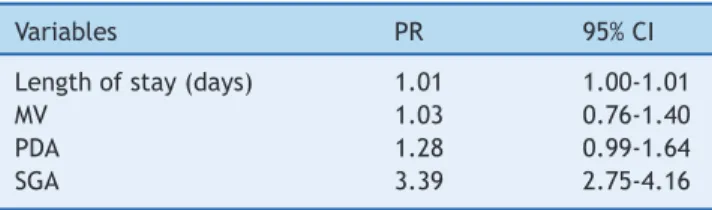
Table 1 Variables in the final model of Poisson regression for HC Z-score at hospital discharge.
Variables PR 95% CI
Length of stay (days) 1.01 1.00-1.01
MV 1.03 0.76-1.40
PDA 1.28 0.99-1.64
SGA 3.39 2.75-4.16
HC, head circumference; CI, confidence interval; PR, prevalence ratio; MV; mechanical ventilation; PDA, patent ductus arterio-sus; SGA, small for gestational age.
Variables included in the analysis: gender, SGA, use of antena-tal steroids, maternal hypertension, PDA, respiratory distress syndrome, use of MV, oxygen use at 36 weeks, and length of stay.
growth restriction had increased to 39.1%. Regarding HC, the rate of growth restriction at birth was 9.5% and at discharge, 7.5%.
At the univariate analysis, the variables that presented statistical significance when the outcome variable was the HC Z-score at discharge were: SGA (PR = 1.08; 95% CI: 1.03-1.14), oxygen use at 36 weeks (PR = 1.14; 95% CI: 1.04-1.24), patent ductus arteriosus (PDA; PR = 1.06; 95% CI: 1.01-1.11), and hospital length of stay (PR =1.01; 95% CI: 1.01-1.02). For the weight Z-score at hospital discharge these variables were: maternal hypertension (PR = 1.26; 95% CI: 1.02-1.54), oxygen use at 36 weeks (PR = 1.48; 95% CI: 1.18-1.87), SGA (PR = 3.29; 95% CI: 2.68-4.04), respiratory distress syndrome (RDS; PR= 0.79; 95% CI: 0.64-0.97), and hospital length of stay (PR = 1.01; 95% CI: 1.01-1.02). Proven sepsis and necrotizing enterocolitis (NEC) presented low frequency in the population, 4.6% and 1.2%, respectively, and were not included in the regression analysis.
At the regression analysis, using as outcome the HC Z-score≤-2 corrected for gestational age at discharge, the
variables that entered in the final model had statistical significance: hospital length of stay and be SGA at birth (Table 1).
It was observed that adding one day in the length of stay increased by 1% the chance of growth restriction at dis-charge, and SGA birth increased this risk by three times. When the outcome was weight Z-score≤ -2 for corrected
age at discharge, the variables that remained in the final model were: length of hospital stay and SGA birth (Table 2).
Table 2 Variables of the final model of Poisson regression for weight Z-score at hospital discharge.
Variables PR 95% CI
Length of stay (days) 1.01 1.01-1.02
SGA 3.41 2.79-4.18
PR, prevalence ratio; CI, confidence interval; SGA, small for ges-tational age.
428 LETTERS TO THE EDITOR
Adding one day to the hospital length of stay resulted in a 1% increase in the chance of having growth restriction at discharge. The risk factor with the greatest impact was SGA. In conclusion, when we re-analyzed the data, the results were worse than with the previously used reference, and the most important factors associated with a extra-uterine growth restriction were being SGA and length of stay, which probably reflects disease severity.
Conflicts of interest
The authors declare no conflicts of interest.
References
1. Lima PA, de Carvalho M, da Costa AC, Moreira ME. Variables asso-ciated with extra uterine growth restriction in very low birth weight infants. J Pediatr (Rio J). 2014;90:22---7.
2. Fenton TR. A new growth chart for preterm babies: Babson and Benda’s chart updated with recent data and a new format. BMC Pediatr. 2003;3:13.
3. Fenton TR, Kim JH. A systematic review and meta-analysis to revise the Fenton growth chart for preterm infants. BMC Pediatr. 2013;13:59.
Paola Azara Tabicas Limaa,b,c, Manoel de Carvalhoa,b,c,
Ana Carolina Carioca da Costaa,d,
Maria Elisabeth Lopes Moreiraa,b,e,∗
aInstituto Fernandes Figueira, Fundac¸ão Oswaldo Cruz
(FIOCRUZ), Rio de Janeiro, RJ, Brazil
bClínica Perinatal Laranjeiras, Rio de Janeiro, RJ, Brazil
cUniversidade Federal Fluminense, Rio de Janeiro, RJ,
Brazil
dEscola Nacional de Saúde Pública, Fundac¸ão Oswaldo Cruz
(FIOCRUZ), Rio de Janeiro, RJ, Brazil
eUniversidade de São Paulo, São Paulo, SP, Brazil
Corresponding author.
E-mail:[email protected] (M.E.L. Moreira).