371
REVIEW ARTICLESociedade Brasileira para o Estudo da Dor
c
Rev Dor. São Paulo, 2012 oct-dec;13(4):371-3
Temporomandibular disorders and pregnancy*
Disfunção temporomandibular em gestantes
Priscila Brenner Hilgenberg
1, Rafael Schlogel Cunali
2, Daniel Bonotto
3, Aguinaldo Coelho de Farias
4,
Paulo Afonso Cunali
5* Received from the Federal University of Paraná (UFPR). Curitiba, PR.
1. Master in Oral Rehabilitation and Specialist in Dental Pros-thesis, Dentistry School of Bauru, University of São Paulo (SP). Curitiba, PR, Brazil.
2. Specialist in Temporomandibular Disorders and Orofacial Pain and Specialist in Dental Prosthesis, Federal University of Paraná (UFPR). Curitiba, PR, Brazil.
3. Master in Health Sciences, Catholic University of Paraná (PUC-PR) and Specialist in Temporomandibular Disorders and Orofacial Pain, and Specialist in Dental Prosthesis, Fede-ral University of Paraná (UFUPR). Curitiba, PR, Brazil. 4. Doctor in Orthodontics, Dentistry School of Araçatuba, Paulista State University (UNESP) and Specialist in Tempo-romandibular Disorder and Orofacial Pain, Federal Council of Dentistry (CFO). Curitiba, PR, Brazil.
5. Doctor in Sciences, School of Medicine, Federal University of São Paulo (UNIFESP), and Specialist in Temporomandibu-lar Disorders and Orofacial Pain, Federal Council of Dentistry (CFO). Curitiba, PR, Brazil.
Correspondence to:
Priscila Brenner Hilgenberg
Rua da Glória, 314, Cj. 23 – Centro Cívico 80030-060 Curitiba, PR.
Phone: (41) 3253-4616 E-mail: [email protected]
SUMMARY
BACKGROUND AND OBJECTIVES:
Temporoman-dibular disorders (TMD) may present as pain at muscle and/or joint function and palpation, decreased mouth amplitude, jaw locking, clicking joints, among others,
which when present during pregnancy may signiicantly
impact quality of life. This study aimed at reviewing the literature on the prevalence of TMD signs and symptoms during pregnancy.
CONTENTS: Major available international databases (Medline, Cochrane, EMBASE, Pubmed) were queried from January 2000 to August 2012. Initially, 17 articles were found and after applying established criteria, only three were eligible for inclusion and discussion herein.
CONCLUSION: There is smaller however signii -cant prevalence of TMD signs and symptoms during pregnancy.
Keywords:Facial pain, Pregnancy, Prevalence, Tempo-romandibular joint disorders.
RESUMO
JUSTIFICATIVA E OBJETIVOS: As disfunções
temporomandibulares (DTM) podem apresentar-se como dor à função e palpação muscular e/ou articular, diminuição da amplitude bucal, travamentos mandibu-lares, estalos articumandibu-lares, entre outros, que quando pre-sentes durante a gravidez podem gerar um importante impacto na qualidade de vida. O objetivo deste estudo foi analisar a literatura a respeito da prevalência de si-nais e sintomas de DTM em gestantes.
CONTEÚDO: Realizou-se busca eletrônica nas princi-pais bases de dados internacionais disponíveis (Medline, Cochrane, EMBASE, Pubmed), referente ao período de janeiro de 2000 a agosto de 2012. Inicialmente foram encontrados 17 artigos, e após a aplicação dos critérios estabelecidos restaram três para inclusão e discussão neste estudo.
CONCLUSÃO: Há menor, porém não signiicativa
prevalência de sinais e sintomas de DTM em pacientes gestantes.
Descritores: Dor facial, Gestantes, Prevalência, Tran-stornos da articulação temporomandibular.
INTRODUCTION
Temporomandibular disorders (TMD) are a subgroup of musculoskeletal disorders and are the primary source of facial pain, excluding dental pain1. The
litera-ture suggests that it is 1.5 to 2 times more prevalent in females as compared to males and that 80% of patients treated for TMD are females2-4. The severity of
symp-toms is also related to patients’ age, with peaks at re-productive age, with the highest prevalence in females aged between 20 and 40 years5,6, and low prevalence in
Hilgenberg, Cunali, Bonotto et al.
Rev Dor. São Paulo, 2012 oct-dec;13(4):371-3
372
Most individuals looking for TMD treatment are fe-males in reproductive age5,6, however there is still no
consensus in the literature about the reason for the high-er prevalence among females6. Highest TMD prevalence
at reproductive age, added to the pattern of starting after puberty, higher association to pre-menstrual period and lower prevalence in the post-menopausal period suggest that female hormones may play important role in TMD etiology or maintenance6,8,9.
In addition, gestation brings about dramatic changes in sexual estrogen and progesterone hormones. Both are increased throughout pregnancy, with higher elevation rate starting in early second trimester and returning to their normal rates in up to one year after delivery10.
Dur-ing gestation there is also increase of relaxin hormone, responsible for increased mobility of body joints6.
Gen-eralized joint hypermobility may contribute to the de-velopment of TMD11, such as luxation or subluxation of
temporomandibular joints (TMJ), for example.
TMDs may present as pain at muscle and/or joint func-tion and palpafunc-tion, decreased mouth opening amplitude, jaw locking and clicking joints1-3, among others, which
when present during pregnancy may signiicantly impact
quality of life10,12. This study aimed at reviewing the
lit-erature on the prevalence of TMD signs and symptoms during pregnancy.
CONTENTS
Major available international databases (Medline, Cochrane, EMBASE and Pubmed) were queried from January 2000 to August 2012. Keywords used and crossed during query were “pregnant women”, temporo-mandibular joint disorders”, “facial pain”, “prevalence”,
and “hormones”, which were obtained from the DeCS/ MeSH dictionary. Initial list of articles was submitted to evaluation according to inclusion and exclusion crite-ria. They are: articles written in English; following the evidence-based dentistry concept we have selected ob-servational (transversal) and longitudinal (prospective) studies; articles published from January 2000 to August 2012; studies evaluating the prevalence of orofacial pain and/or TMD in pregnant adult women aged above 18
years; orofacial pain and/or TMD classiication accord -ing to the criteria of the American Academy of Orofacial Pain or of RDC/TMD. Articles evaluating the preva-lence of dental pain, headache or periodontal disease in pregnant women were excluded.
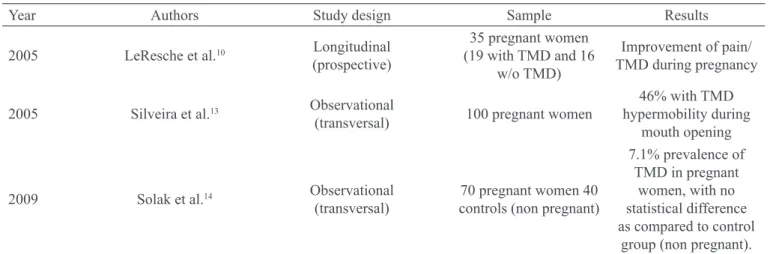
We have found 17 articles and after applying inclusion and exclusion criteria three were left to be included and discussed herein (Table 1)
In the context of Evidence-based Dentistry,
observation-al studies are not the highest scientiic evidence level,
however they are the most adequate when the goal is to study the prevalence of a certain condition in a popula-tion. Longitudinal studies may evaluate both prevalence and incidence of a certain condition/disease in a popula-tion15. We have looked for observational and
longitudi-nal studies evaluating the prevalence of orofacial pain and/or TMD in pregnant patients.
An important study10 evaluating the evolution of TMD
signs and symptoms in women before, during and after pregnancy, has observed that TMD symptoms previous-ly present have decreased during pregnancy and there has been increased mouth opening amplitude during the same period. Reported pain rates, which decreased throughout pregnancy, have returned to baseline values in one year after delivery. The same was true to estradiol
Table 1 – Included articles.
Year Authors Study design Sample Results
2005 LeResche et al.10 Longitudinal
(prospective)
35 pregnant women (19 with TMD and 16
w/o TMD)
Improvement of pain/ TMD during pregnancy
2005 Silveira et al.13 Observational
(transversal) 100 pregnant women
46% with TMD hypermobility during
mouth opening
2009 Solak et al.14 Observational
(transversal)
70 pregnant women 40 controls (non pregnant)
7.1% prevalence of TMD in pregnant
women, with no statistical difference as compared to control
Temporomandibular disorders
and pregnancy Rev Dor. São Paulo, 2012 oct-dec;13(4):371-3
373
and progesterone levels, which the authors believe is an indication of the role of such hormones in modulating pain during pregnancy.
In 2005, a group of authors13 has studied the possible
association of systemic joint hypermobility and tempo-romandibular joint hypermobility in pregnant women as a way to establish a higher predisposition to the
devel-opment of TMD. Although not inding an association
between both conditions, there has been a prevalence of 46% TMJ hypermobility during mouth opening among pregnant women.
With similar objective, a study evaluating 70 pregnant women14 has not found higher prevalence of
system-ic joint hypermobility as compared to non-pregnant women. In addition, and similar to the already men-tioned study13, it was not possible to establish
associa-tion between systemic joint hypermobility and TMJ hypermobility.
If estradiol and progesterone levels inluence orofacial
pain experience, a decrease in pain reports may be
ex-pected during pregnancy. Although inding increased
mouth opening amplitude during pregnancy, there has been no association with generalized joint hypermobility in pregnant patients.
Our study is a warning about the scarcity of studies eval-uating TMD prevalence in pregnant women, being
nec-essary studies with well-deined methodology to obtain
reliable results.
CONCLUSION
Analyzed studies have shown lower, however not
sig-niicant prevalence of TMD signs and symptoms among
pregnant patients.
REFERENCES
1. Kuttila M, Niemi PM, Kuttila S, et al. TMD treatment need in relation to age, gender, stress, and diagnostic subgroup. J Orofac Pain. 1998;12(1):67-74.
2. Conti PC, Ferreira PM, Pegoraro LF, et al. A cross-sectional study of prevalence and etiology of signs and symptoms of temporomandibular disorders in high school and university students. J Orofac Pain. 1996;10(3):254-62.
3. Cooper BC, Kleinberg I. Examination of a large patient population for the presence of symptoms and signs of
tem-poromandibular disorders. Cranio. 2007;25(2):114-26. 4. Macfarlane TV, Glenny AM, Worthington HV. Sys-tematic review of population-based epidemiological studies of oro-facial pain. J Dent. 2001;29(7):451-67. 5. Manfredini D, Arveda N, Guarda-Nardini L, et al. Distribution of diagnoses in a population of patients with temporomandibular disorders. Oral Surg Oral Med Oral Pathol Oral Radiol. 2012;114(5):e35-41.
6. Warren MP, Fried JL. Temporomandibular disor-ders and hormones in women. Cells Tissues Organs. 2001;169(3):187-92.
7. Dworkin SF, Huggins KH, LeResche L, et al. Epide-miology of signs and symptoms in temporomandibular disorders: clinical signs in cases and controls. J Am Dent Assoc. 1990;120(3):273-81.
8. Macfarlane TV, Blinkhorn AS, Davies RM, et al. As-sociation between female hormonal factors and oro-facial pain: study in the community. Pain. 2002;97(1-2):5-10. 9. Nekora-Azak A, Evlioglu G, Ceyhan A, et al. Estro-gen replacement therapy among postmenopausal women and its effects on signs and symptoms of temporoman-dibular disorders. Cranio. 2008;26(3):211-5.
10. LeResche L, Sherman JJ, Huggins K, et al. Musculo-skeletal orofacial pain and other signs and symptoms of temporomandibular disorders during pregnancy: a pro-spective study. J Orofac Pain. 2005;19(3):193-201. 11. Kavuncu V, Sahin S, Kamanli A, et al. The role of systemic hypermobility and condylar hypermobility in temporomandibular joint dysfunction syndrome. Rheu-matol Int. 2006;26(3):257-60.
12. de Oliveira BH, Nadanovsky P. The impact of oral pain on quality of life during pregnancy in low-income Brazilian women. J Orofac Pain. 2006;20(4):297-305. 13. Silveira EB, Rocabado M, Russo AK, et al. Inci-dence of systemic joint hypermobility and temporo-mandibular joint hypermobility in pregnancy. Cranio. 2005;23(2):138-43.
14. Solak Ö, Turhan-Haktanir N, Köken G, et al. Preva-lence of temporomandibular disorders in pregnancy. Eur J Gen Med. 2009;6(4):223-8.
15. Reis FB, Ciconelli RM, Faloppa F. Pesquisa
cientí-ica: a importância da metodologia. Rev Bras Ortop.
2002;37(3):51-5.
Submitted in June 01, 2012.