Household availability of lipids for consumption and its relationship
with serum lipids in adolescents
Disponibilidade domiciliar de lipídeos para consumo e sua relação com os lipídeos séricos de adolescentess
Disponibilidad domiciliar de lípidos para consumo y su relación con los lípidos séricos de adolescentes
Vivian Siqueira S. Gonçalves1, Otaviana Cardoso Chaves2, Sônia Machado R. Ribeiro3, Luciana Ferreira R. Sant´Ana4, Sylvia do Carmo C. Franceschini5, Silvia Eloiza Priore6
Instituição: Universidade Federal de Viçosa (UFV), Viçosa, MG, Brasil 1Graduanda em Nutrição na UFV, Viçosa, MG, Brasil
2Mestre em Ciência da Nutrição pela UFV; Professora Substituta do Departamento de Nutrição da Universidade Federal dos Vales do Jequitinhonha e Mucuri (UFVJM), Diamantina, MG, Brasil
3Doutora em Bioquímica Agrícola pela UFV; Professora do Departamento de Nutrição e Saúde da UFV, Viçosa, MG, Brasil
4Doutora em Ciência e Tecnologia de Alimentos pela UFV; Professora do Departamento de Nutrição e Saúde da UFV, Viçosa, MG, Brasil
5Doutora em Ciências pela Universidade Federal de São Paulo (Unifesp); Professora do Departamento de Nutrição e Saúde da UFV, Viçosa, MG, Brasil 6Doutora em Nutrição pela Unifesp; Professora do Departamento de Nutrição e Saúde da UFV, Viçosa, MG, Brasil
ABSTRACT
Objective: To analyze the correlation between household availability of lipids to be consumed and the serum lipid profile in adolescents.
Methods: This cross sectional study enrolled 95 adoles-cents aged 10–13 years, selected by random raffle in public schools of Viçosa, Southeast Brazil. A monthly shopping list was used to evaluate the availability of food per capita. A blood sample was collected from each adolescent and Brazilian Cardiology Society guideline was adopted as a reference for lipid profile adequacy. For categorical variables, the chi-square was applied and the Odds Ratio calculated. For comparison between groups, Mann-Whitney or Student’s t
test, Kruskall-Wallis test or ANOVA were applied. Associa-tion between biochemical parameters and lipid availability was evaluated by Spearman or Pearson correlation tests.
Results: 27.2% of the total available energy came from lipids. The availability of saturated fatty acids, monounsatu-rated and polyunsatumonounsatu-rated agreed with the recommendation for their consumption. Regarding serum lipids, 51.9% of boys and 55.8% of girls showed alteration in total cholesterol (p=0.66); 18.6 and 25.6% of boys and girls, respectively, showed increased triglycerides level (girls>boys; p=0.02). In relation to LDL, 21.2 and 32.6% of boys and girls, re-spectively, showed alteration (p=0.91). The prevalence of
inadequacy for HDL was of 26.9 and 30.2% of boys and girls, respectively (p=0.93). There was no correlation be-tween the available lipids for consumption and the serum lipids. The teenagers with more than 35% of lipids to be consumed had 9.1-fold higher levels of total cholesterol (95%CI 1.81–61.74).
Conclusions: It is possible that adolescents with higher lipid availability at home show higher total cholesterol.
Key-words: dietary fats; dyslipidemias; adolescent nu-trition.
RESUMO
Objetivo: Relacionar a disponibilidade domiciliar de lipídeos para consumo e o perfil lipídico sérico de adoles-centes.
Métodos: Estudo transversal observacional. Avaliaram-se 95 adolescentes púberes de 10 a 13 anos de escolas públicas em Viçosa, Minas Gerais. Utilizou-se uma lista de compras mensal para avaliar a disponibilidade de alimentos per capita. Coletou-se amostra de sangue dos adolescentes, adotando-se o preconizado pela Sociedade Brasileira de Cardiologia como referência para adequação do perfil lipídico. Para as variáveis categóricas realizou-se o teste do qui-quadrado e calculou-se a Odds Ratio. Para comparar os grupos, aplicaram-se os testes
Endereço para correspondência: Vivian Siqueira S. Gonçalves
Travessa Felício Brandi, 40/604 – Centro CEP 36570-000 – Viçosa/MG
E-mail: [email protected] Conflito de interesse: nada a declarar Recebido em: 5/6/2011
Mann-Whitney ou t de Student, Kruskall-Wallis ou ANOVA. Verificou-se relação entre exames bioquímicos e disponibilida-de disponibilida-de lipídisponibilida-deos pelas correlações disponibilida-de Spearmam ou disponibilida-de Pearson. Resultados: Da energia total disponível, 27,2% foram provenientes de lipídeos. A disponibilidade de ácidos graxos saturados, monoinsaturados e poli-insaturados esteve de acordo com a recomendação de consumo. Em relação aos lipídeos sé-ricos, 51,9% dos meninos e 55,8% das meninas apresentaram alterações de colesterol total (p=0,66); 18,6 e 25,6%, dos me-ninos e das meninas, respectivamente, apresentaram elevação de triglicerídeos, (meninas>meninos; p=0,02). Em relação ao LDL, 21,2 e 32,6% dos meninos e das meninas, respectivamente, apresentaram alterações (p=0,91). A prevalência de inadequação para HDL foi de 26,9 e 30,2% (p=0,93), para meninos e me-ninas, respectivamente. Não houve correlação entre os lipídeos disponíveis para consumo e os lipídeos séricos. Os adolescentes que possuíam mais que 35% de lipídeos disponíveis para con-sumo tiveram 9,1 vezes mais chances de apresentarem alterações de colesterol total (IC95% 1,81–61,74).
Conclusões: É possível que adolescentes com maior dis-ponibilidade de lipídeos para consumo apresentem colesterol total mais elevado.
Palavras-chave: gorduras na dieta; dislipidemias; nutri-ção do adolescente.
RESUMEN
Objetivo: Relacionar la disponibilidad domiciliar de lípidos para consumo y el perfil lipídico sérico de adoles-centes.
Métodos: Estudio transversal, observacional. Se evaluó a 95 adolescentes púberes de 10 a 13 años, de escuelas pú-blicas en Viçosa, Minas Gerais (Brasil). Se utilizó una lista de compras mensual para evaluación de la disponibilidad de alimentos per capita. Se recogió muestra de sangre de los adolescentes, adoptándose lo preconizado por la Sociedad Brasileña de Cardiología como referencia para adecuación del perfil lipídico. Para las variables categóricas, se utilizó la prueba de chi cuadrado y se calculó la Odds Ratio. Para com-parar los grupos, se aplicaron las pruebas de Mann-Whitney o t de Student, Kruskall-Wallis o ANOVA. Se verificó la relación entre exámenes bioquímicos y disponibilidad de lípidos por las correlaciones de Spearman o de Pearson.
Resultados: De la energía total disponible, el 27,2% fue proveniente de lípidos. La disponibilidad de ácidos grasos saturados, monoinsaturados o poli-insaturados, estuvo en
conformidad con la recomendación de consumo. Respecto a los lípidos séricos, 51,9% de los muchachos y 55,8% de las muchachas presentaron alteraciones de colesterol total (p=0,66); 18,6 y 25,6% de los muchachos y muchachas, respectivamente, presentaron aumento de los triglicéridos (muchachas>muchachos; p=0,02). Respecto al LDL, 21,2 y 32,6% de los muchachos y muchachas, respectivamente, presentaron alteraciones (p=0,91). La prevalencia de ina-decuación para HDL fue de 26,9 y 30,2% (p=0,93) respecti-vamente para muchachos y muchachas. No hubo correlación entre lípidos disponibles para consumo y lípidos séricos. Los adolescentes que poseían más que 35% de lípidos disponibles para consumo tuvieron 9,1 veces más posibilidad de presentar alteraciones de colesterol total (IC95% 1,81–61,74).
Conclusiones: Es posible que adolescentes con mayor disponibilidad de lípidos para consumo presenten colesterol total más elevado.
Palabras clave: grasas en la dieta; dislipidemias; nutri-ción del adolescente.
Introduction
In adolescence, which is deined by the World Health Organization (WHO) as the period between 10 and 19 years old, there are physiological, psychological and social changes that may occur in different ways in different individuals. This is a period of nutritional vulnerability and consolidation of food habits, which, if not adequate, can cause the risk of diseases(1).
The Household Budget Survey (HBS), conducted in met-ropolitan areas of Brazil between 2002 and 2003, showed that the diet of the Brazilian population was characterized by increased levels of saturated fat and lipid content in general, also showing that the evolution of food consump-tion patterns in the last three decades has tended towards the increase of risk factors for the development of obesity, diabetes, cardiovascular disease, certain types of cancers and other chronic diseases(2). The 2008–2009 HBS showed that
excess body weight in the population has been increasing since the mid-1970s and is found in about half of Brazilian people(3). Campos et al(4) point out that, regardless of
ethnic-ity, there is evidence that the individuals who consume high amounts of lipids, especially of the saturated kind, usually have high levels of serum cholesterol and higher risks of developing cardiovascular disease.
and the feeling of satiety. They also convey liposoluble vi-tamins, being almost all of them composed of fatty acids. Saturated fatty acids are found primarily in animal fats. Unsaturated fatty acids are divided into monounsaturated fats, present in oils such as the olive oil, and polyunsaturated fats, common in soybean, canola and ish oils, including also the so-called trans, present in some industrialized products. There are also the polyunsaturated fatty acids called essential, which cannot be synthesized by the human organism, and that must be provided through feeding, among which we highlight omega 3 and 6(5).
The lipid proile is deined by biochemical determinations of total cholesterol (TC), high-density lipoprotein (HDL), low-density lipoprotein (LDL) and triglycerides (TG) after fasting for 12 to 14 hours(6), and can be used to assess the
adequate balance of blood lipids.
In this context, it is important to check the food avail-ability in adolescent households, since the exaggerated lipid intake may contribute to inadequate dietary habits, which can contribute to negative consequences on their future health. Therefore, this study aimed at verifying the relationship between the lipid availability for household consumption and the lipid proile of adolescents in Viçosa, Minas Gerais.
Method
This was a cross-sectional, observational study, taking the individual as the study unity. The sample selection was based on information from the Anísio Teixeira National Institute of Educational Studies and Research (INEP), which indicated, in 2008, the presence of 25 schools offering elementary educa-tion in the municipality of Viçosa(7).The study encompassed
100% (n=19) of public schools in the urban area.
To calculate the sample size, the present study, which is part of a more comprehensive research(8), used the total number
of adolescents between 10 and 13 years in the municipality, which, according to Datasus(9) was of 4,815; the frequency of
excess weight of 10%, obtained in previous studies with the local population of adolescents(10), with acceptable margin
variation of 2% and conidence level of 99%, totaling 92 adolescents to be studied. Due to the possible sample loss expected and for a higher homogeneity and distribution of the data regarding gender and age group, 20% were added to the initial calculation, totaling 110 adolescents.
The schools were visited and all the students who dem-onstrated interest in participating were subjected to random
selection. The presence of chronic diseases and/or medications that could alter lipid metabolism constituted exclusion crite-ria. At the end, 146 adolescents of both sexes were randomly selected, who attended the assessment of sexual maturation, from which 25 were excluded for being pre-pubertal and one for abandonment. Thus, 120 adolescents underwent biochemi-cal tests, but we were able to obtain the monthly shopping-list of the families with information on foodstuffs and quantities of 95 adolescents, which was the inal number of the sample. All adolescents lived with their families in Viçosa. They were considered pubertal, according to the Tanner(11) classiication,
after being examined by a pediatrician.
The family shopping-list was used to assess the per capita food availability in households of adolescents and contained information about the monthly amount of food purchased. Such information was obtained by receipts or by estimating the amount and frequency of purchase in a single month(2,12).
The estimated calculation of food available daily per capita was achieved by dividing the monthly amount of available food at home by the number of residents and the number of days of that month(12).Foods that did not have the speciied
amount were discarded.
The food composition and its lipid content were estab-lished by the Diet Pro® 4.0 software, from the Table of
Dietary Guidelines for Americans (USDA). For foods that were not listed on this table, the information was taken from labels or tables of chemical composition(13).
The diets lipid values were compared with the diet rec-ommended by the Institute of Medicine(IOM)(14), using the
Acceptable Macronutrient Distribution Range (AMDR). According to the IOM, 25 to 35% of the total energy intake should be derived from lipids, 5 to 10% from omega-6 (ω-6 PFA) and 0.6 to 1.2% from omega-3 (ω-3 PFA).
The percentage of saturated fat (SFA) was considered high when it exceeded 7% and of monounsaturated (MFA) when above 20% of total caloric intake(15). The availability of soy
oil, widely used by Brazilians, was also measured, and the per capita amount stipulated by the food pyramid adapted to the Brazilian population, 16mL (16), was considered adequate.
The contribution of various kinds of meat to the inal lipid composition of shopping-lists was also considered and integrated the data presented, since 100% of families reported buying meat regularly.
with disposable material. We collected 10mL of venous blood, which was centrifuged in an Excelsa centrifuge (206 BL) for 10 minutes at 3,500rpm right after the collection (observing time for blood clotting). TC, HDL and TG were measured enzymati-cally, and automated by the Cobas Mira Plus (Roche®)
equip-ment; LDL was calculated with the Friedwald(17) formula. The
results were assessed according to the I Guideline for Prevention of Atherosclerosis in Childhood and Adolescence(15).
For analysis of categorical variables, the chi-square test was performed and the Odds Ratio (OR) was calculated. Quantitative variables were tested for normality with the Kolmogorov-Smirnov test, from which the best test was selected to compare two groups (Mann-Whitney or t Student
test) or three groups (Kruskall-Wallis or ANOVA). The rela-tion between biochemical exams and lipid availability was veriied by the Spearman or Pearson correlation tests. The Sigma Statistic® 2.0 and Epi-Info 6.0 softwares were used,
and p<0.05 was considered signiicant.
Participants presented informed consent term signed by their parents or guardians. The study was approved by the Ethics Committee in Research with Humans of the Universidade Federal de Viçosa.
Results
Boys totaled 54.7% (n=52) of the sample. The total daily energy available presented median of 1,952kcal (862.0– 4,263) for both genders; 1,908kcal for boys, (862.2–4,263) and 1,959kcal (935.1–3,864) for girls (p=0.70).
Table 1 shows the per capita caloric availability of added lipids and constitution of foods. There was no gender differ-ence for this parameter (p=0.87). Regarding total energy, the availability was of 27.7% for boys and 27.0% for girls. For the total sample, there was an availability of 27.2%.
Table 2 shows the percentage of lipids adequacy, accord-ing to the recommended levels. There was no difference between genders.
All the families interviewed purchased soy oil. Quantitative analysis of this product showed 23mL (5–72mL) available daily per capita, which meant approximately 760mL of soy oil available monthly for each family member.
The type of lipid, as source of the fatty acid types, was analyzed and is presented in Table 3. Table 4 presents the mean and median values of serum lipid proile in adolescents.
n X–±DP Md (min–max)
Male 52 592.8±263.2 532.9 (145.4–1,495.8) Female 43 591.4±261.9 528.9 (235.6–1,510.3) Total 95 592.2±261.3 530.0 (145.4–1,510.3) Table 1 - daily caloric lipid availability per capita
X±DP: mean and standard deviation; Md: median; min-max: mini-mum and maximini-mum values. Mann-Whitney Test (p=0.87)
Table 2 - Adequacy of per capita lipid availability obtained by the shopping-list of adolescents between 10 and 13 years, by gender
Above
(>35%)
Adequate
(25–35%)
Below
(<25%)
% % %
Male (n=52) 21.2 55.8 23.1 Female (n=43) 16.3 58.2 25.6
Total 18.9 56.8 24.2
Chi-square: Above vs. Adequate (p=0.58); Adequate vs. Below (p=0.90); Above vs. Below (p=0.56)
Lipids (g)
Total (n=95) Male (n=52) Female (n=43)
p-value X–±DP Md
(min-max) % X
–
±DP Md
(min-max) % X
–
±DP Md
(min-max) %
TL 65.8±29.0 58.8
(16.2–167.8) 27.2 66.5±28.9
59.2
(16.2–166.2) 27.7 64.9±29.5
58.7
(16.2–167.8) 27.0 0.76
SFA 16.5±8.8 14.6
(3.0–49.9) 6.7 16.3±8.5
14.7
(3.0–43.6) 6.9 16.7±9.3
14.5
(3.0–49.9) 6.7 0.99
MFA 19.5±10.4 17.1
(4.3–67.5) 7.9 19.5±9.8
17.4
(4.3–54.9) 8.2 19.6±11.2
17.0
(4.3–67.5) 7.8 0.78 PFA
ω-6 17.4±8.1
16.3
(1.2 –45.5) 7.5 17.9±9.0
16.8
(1.2–45.5) 7.9 16.9±7.1
15.9
(5.8–32.5) 7.3 0.53 PFA
ω-3 2.3±1.1
2.1
(0.5–5.8) 0.9 2.3±1.2
2.2
(0.5–5.8) 1.1 2.2±0.9
2.0
(0.6–4.3) 0.9 0.54 Table 3 - Amount and class of fatty acids available for consumption by adolescents from 10 to 13 years, by gender
Regarding the prevalence of changes, 69.8% (n=67) pre-sented at least one and 5.3% (n=5) prepre-sented all four bio-chemical exams altered. It was veriied that 51.9% of boys and 55.8% of girls had changes in TC values; 18.6 and 25.6% of boys and girls, respectively, presented high TG. In relation to LDL, 21.1 and 32.6% of boys and girls had high values for this parameter, respectively. The prevalence of HDL inadequacy was of 26.9 and 30.2%, respectively, for boys and girls.
Table 5 shows the correlations between lipid serum proile and lipid availability for consumption of the adolescents.
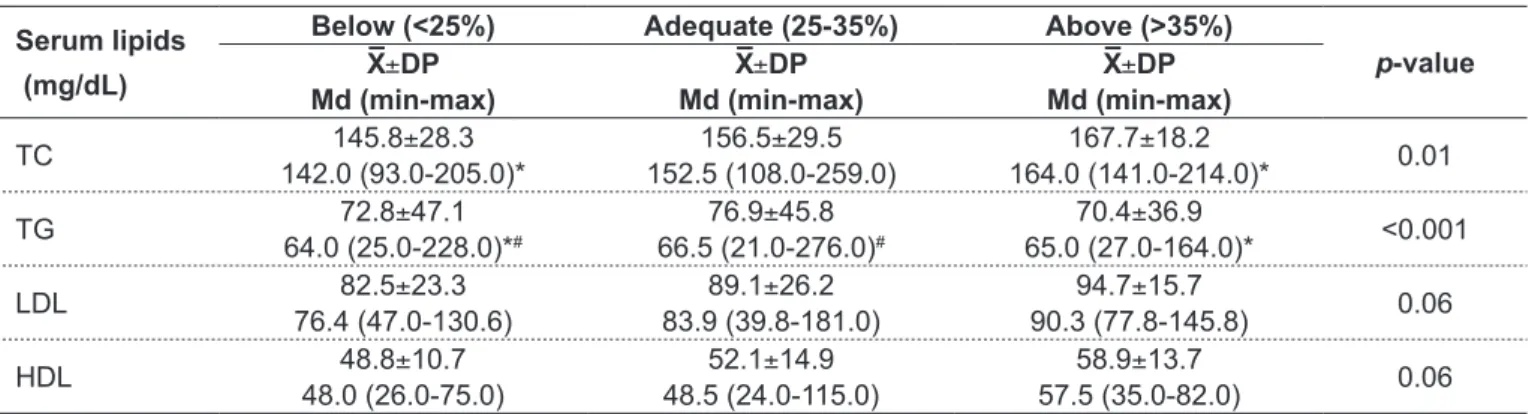
The results of the comparison between the lipid serum proile, according to the lipid availability adequacy for con-sumption, are found in Table 6.
Through OR, it was found that the adolescents who had more than 35% fat available for consumption were 9.11-fold more likely (95%CI 1.81–61.74) to present changes in total choles-terol than the adolescents with adequate or low availability. Lipids (mg/dL)
Male (n=52) Female (n=43)
p-value X–±DP
Md (min-max)
X–±DP Md (min-max)
TC 154.9±25.9
151.5 (114.0–259.0)
157.5±30.9
154.0 (93.0–221.0) 0.65
TG 68.9±47.0
55.0 (21.0–276.0)
81.6±40.1
72.0 (30.0–195.0) 0.02
LDL 88.6±22.5
86.4 (47.0–181.0)
88.5±25.9
82.6 (39.8–147.6) 0.90
HDL 52.5±11.8
49.0 (31.0–85.0)
52.7±16.6
52.0 (24.0–115.0) 0.93
X±DP: mean and standard deviation; Md: median; min-max: minimum and maximum values; TC: total cholesterol; TG: triglycerides: LDL: low-density lipoprotein; HDL: high-low-density lipoprotein
Table 4 - lipid serum proile of adolescents from 10 to 13 years, by gender
Serum lipids Lipids available for consumption
TL SFA PFA ω-3 PFA ω-6 MFA
TC -0.2 0.1 -0.1 -0.2 0.1
TG 0.1 0.1 0.1 0.1 0.3
LDL -0.2 0.1 -0.1 -0.2* 0.1
HDL -0.1 0.2* -0.1 -0.1 0.2
Table 5 - Correlation between lipid proile and lipid availability for consumption by teenagers from 10 to 13 years
TL: total lipids; SFA: saturated fatty acids; MFA: monounsaturated fatty acids; PFA ω-3: omega-3 polyunsaturated fatty acids; PFA ω-6: ome-ga-6 polyunsaturated fatty acids; TC: total cholesterol; TG: triglycerides; LDL: low-density lipoprotein; HDL: high-density lipoprotein. *p<0.05 (Pearson or Spearman Correlation).
Serum lipids
(mg/dL)
Below (<25%) Adequate (25-35%) Above (>35%)
p-value X–±DP
Md (min-max)
X–±DP Md (min-max)
X–±DP Md (min-max)
TC 145.8±28.3
142.0 (93.0-205.0)*
156.5±29.5 152.5 (108.0-259.0)
167.7±18.2
164.0 (141.0-214.0)* 0.01
TG 72.8±47.1
64.0 (25.0-228.0)*#
76.9±45.8 66.5 (21.0-276.0)#
70.4±36.9
65.0 (27.0-164.0)* <0.001
LDL 82.5±23.3
76.4 (47.0-130.6)
89.1±26.2 83.9 (39.8-181.0)
94.7±15.7
90.3 (77.8-145.8) 0.06
HDL 48.8±10.7
48.0 (26.0-75.0)
52.1±14.9 48.5 (24.0-115.0)
58.9±13.7
57.5 (35.0-82.0) 0.06 Table 6 - Serum lipid proile in adolescents from 10 to 13 years, according to the adequacy of lipid availability
X±DP: mean and standard deviation; Md: median; min-max: minimum and maximum values; TC: total cholesterol; TG: triglycerides; LDL: low-density lipoprotein; HDL: high-low-density lipoprotein. *#Dunn’s multiple comparisons test: equal symbols on the same row indicate statistical
Discussion
Important changes in serum lipid proile of the individu-als were observed, as well as a high number of families with lipid availability over 35% of total calories. Such facts may be the result of the current trend of increased consumption of energetic foods with high fat content.
According to the HBS(2), in 2002 and 2003 in Brazil, the
average energy availability per capita was of 1,800kcal/day. In 2006, using the shopping-list, Barbosa et al(12) studied
female adolescents and found a median daily availability of 1,868kcal. Comparing to the present study, there was an increase of 7.7% in relation to the HBS(2) and 4.3% in
rela-tion to the study of Barbosa et al(12). The 2008–2009 HBS(3)
points out more satisfaction of the Brazilian population with the amount of food consumed, 64.5% of families report to always have enough food at their homes, a percentage that is higher than the presented in 2002–2003 (53.0%). Such facts may show that the population is having access to a larger amount of food, which may explain the increased caloric availability.
However, a considerate percentage of adolescents had larger quantities of lipids at home than the recommended for consumption. This fact requires attention, since it is expected that, as the availability is increased, the consumption may also increase. The prevalence of excess consumption of this nutrient is already reported in some studies(18-20). If increasing access to
food in Brazil is not complemented by concrete strategies of nutrition education, dietary inadequacies will probably tend to grow, bringing the risk of development of non-communicable chronic diseases by age groups ever younger.
The percentage of availability of SFA, MFA, ω-3 and ω-6 PFA were within the ranges recommended by the AMDR, which means that the adolescents had enough quantity and quality of lipids to balance their meals. It should be noted, however, a ratio of approximately 8:1 of ω-6 and ω-3 PFA. In a review study, Barbosa et al(21) address the controversial
recommendations of this ratio, pointing out that in case it was smaller, there could be synergistic effects between the consumption of both fatty acids.
In a study with female adolescents, aged 14–17 years(10),
there was a daily average per capita availability of 24mL soy oil; the values found in the present study, however, are inferior, but both are above the recommended by the food pyramid adapted to the Brazilian population(16). This fact may
contrib-ute to the imbalance of the adequate proportion of ω-3 and
ω-6 PFA, since soy oil is a source of ω-6 PFA(21).
The inadequacies found for serum cholesterol fractions (LDL and HDL) are worth highlighting, as well as those for TG. Different studies on adolescents presented similar means to those found in this study(22-25). In a study conducted
in northeastern Brazil with adolescents from public schools and at the same age group, Pereira et al(26) found a percentage
of TC inadequacy of 36.2%, a value below those found for boys and girls in this study (51.9 and 55.8%, respectively). The authors also found that, as in this study, there were great inadequacies in the concentrations of HDL (56.0%), LDL (14.5%) and TG (35.3%). In Mexico, in a study with adolescents of both genders, it was also found a signiicant percentage of changes in lipid proile, 20% for TG, 20% for TC, 30% for LDL and 66% for HDL(27).
The inappropriate feeding behavior, as well as the de-cline of physical activity becoming increasingly promi-nent in modern life, may be determining factors for those inadequacies(28,29). Intervention strategies are urgently
needed and must be a concern of the family, the school and the government.
According to Katon, Flores and Salmerón(30), metabolic
pro-ile, including lipid variables, is strongly associated with sexual development. However, the fact that all adolescents in this study were in pubertal stage provided more homogeneity to the data. Girls had higher values in serum TG levels. Some studies found no gender differences(31,32), while others, similarly to the
observed results, showed higher values for females(25,33-35).
According to the correlations presented, it was found that the lipid availability for was not related to the lipid proile of adolescents, except in two unexpected situations in which HDL was positively related to the availability of SFA (r=0.21; p<0.05) and LDL was negatively correlated with the availability of ω-6 PFA (r=-0.25; p<0.05). It is known that SFA are potentially atherogenic, and are related to the increase of TC and LDL but not HDL. The disproportionate consumption of ω-6 and ω-3 PFA may also have an athero-genic effect, increasing levels of LDL(15). Such discrepancies
may be explained by the fact that the family shopping-list may infer consumption, but not necessarily predict the actual food consumption.
The present study, as well as the HBS(2), did not take into
References
1. World Health Organization. Nutrition in adolescence – issues and challenges for the health sector. Issues in adolescent health and development. Geneva: WHO; 2005. 2. Levy-Costa RB, Sichieri R, Pontes NS, Monteiro CA. Household food availability in
Brazil: distribution and trends (1974-2003). Rev Saude Publica 2005;39:530-40.
3. Brasil. Instituto Brasileiro de Geograia e Estatística. Pesquisa de orçamentos familiares ‑ POF 2008‑2009: despesas, rendimentos e condições de vida. Rio de Janeiro: IBGE; 2010.
4. Campos W, Stabelini Neto A, Bozza R, Ulbrich AZ, Bertin RL, Mascarenhas LP et al. Physical activity, lipid consumption and risk factors for atheroscleorosis in adolescents. Arq Bras Cardiol 2010;94:601-7.
5. Santos TM. Lipídios. In: Dutra‑de‑Oliveira JE, Marchini JS, editors. Ciências
nutricionais. 2 ed. São Paulo: Sarvier; 2008. p.107-21.
6. Sposito AC, Caramelli B, Fonseca FA, Bertolami MC, Aiune Neto A, Souza
AD, et al; Sociedade Brasileira de Cardiologia. IV Brazilian Guideline for Dyslipidemia and Atherosclerosis prevention: Department of Atherosclerosis of Brazilian Society of Cardiology. Arq Bras Cardiol 2007;88 (Suppl 1):2-19.
7. Brasil. Instituto Nacional de Estudos e Pesquisas Educacionais Anísio Teixeira [homepage on the Internet]. Censo Escolar [cited 2008 Apr 21]. Available from:
http://portal.inep.gov.br/basica-censo-escolar-matricula
8. Chaves OC. Associação dos determinantes do estado nutricional dos pais com o estado nutricional dos adolescentes em Viçosa‑MG [tese de mestrado]. Viçosa: Universidade Federal de Viçosa; 2009.
9. Brasil. Ministério da Saúde – Datasus [homepage on the Internet]. Informações de saúde: Viçosa‑2007 [cited 2008 Mar 03]. Available from: http://tabnet.
datasus.gov.br/cgi/deftohtm.exe?ibge/cnv/popmg.def
10. De Faria ER. Critérios diagnósticos e fatores de risco para síndrome metabólica, em adolescentes que já apresentaram a menarca, de escolas públicas de Viçosa‑ MG [tese de mestrado]. Viçosa Universidade Federal de Viçosa; 2007. 11. Tanner JM. Growth at adolescence. Oxford: Blackwell Scientiic; 1962. 12. Barbosa KB, Rosado LE, Franceschini SC, Priore SE. Instrumentos de
inquérito dietético utilizados na avaliação do consumo alimentar em adolescentes: comparação entre métodos. ALAN 2007;57:43‑50.
13. Franco G. Tabela de composição química dos alimentos. 9 ed. São Paulo:
Atheneu; 2008.
14. Institute of Medicine. Dietary reference intakes for energy, carbohydrate, iber,
fatty acids, cholesterol, protein and amino acids (Macronutrients). Food and Nutrition Board. Washington: National Academy Press; 2002.
15. Sociedade Brasileira de Hipertensão, Sociedade Brasileira de Cardiologia,
Sociedade Brasileira de Endocrinologia e Metabologia, Sociedade Brasileira de Diabetes, Associação Brasileira para Estudos da Obesidade. I Diretriz de prevenção da aterosclerose na infância e na adolescência. Arq Bras Cardiol
2005;85 (Suppl 1):3-28.
16. Philippi ST, Latterza AR, Cruz AT, Ribeiro LC. Adapted food pyramid: a guide for a right food choice. Rev Nutr 1999;12:65-80.
17. Friedwald WT, Levy RI, Fredrickson DS. Estimation of the concentration of
low-density lipoprotein cholesterol in plasma, without use of the preparative ultracentrifuge. Clin Chem 1972;18:499-502.
18. Toral N, Slater B, Silva MV. Food consumption and overweight in adolescents from Piracicaba, São Paulo, Brazil. Rev Nutr 2007;20:449-59.
19. Bertin RL, Karkle EN, Ulbrich AZ, Stabelini Neto A, Bozza R, Araújo IQ et al. The nutritional status and dietary intake of adolescents in public schools in the city of São Mateus do Sul, in the state of Paraná, Brazil. Rev Bras Saude Matern Infant 2008;8:435-43.
20. Toselli S, Argnani L, Canducci E, Ricci E, Gualdi‑Russo E. Food habits and nutritional status of adolescents in Emilia‑Romagna, Italy. Nutr Hosp 2010;25:613‑21.
21. Barbosa KB, Volp AC, Renhe IR, Stringheta PC. Omega-3 and 6 fatty acids and implications on human health. Rev Soc Bras Alim Nutr 2007;32:129-45. 22. Carvalho DF, Paiva AA, Melo AS, Ramos AT, Medeiros JS, Medeiros CC et al.
Blood lipid levels and nutritional status of adolescents. Rev Bras Epidemiol
2007;10:491-8.
From these results, it is noteworthy that, possibly, a larger number of lists, as well as the inclusion of products purchased outside the home environment by the adolescent, or the as-sociation of the list with an investigation that considers the consumption of food, would be useful resources in comple-menting the data. Another important point is the variation of information between tables and labels, which may under-estimate or overunder-estimate their lipid composition.
TC showed a association with the availability of lipids, and adolescents with more than 35% fat intake were more likely to present changes. In another study with adolescents, Guedes et al(24) found that at analyzing the intake of total
lipids, girls who had an excess intake were 1.93-fold (95%CI 1.66–2.17) more likely to have high levels of TC. Boys were 1.61-fold (95%CI 1.42–1.83) more likely. In this case, it is veriied that, despite the dificulty in relating available lipids with serum lipids, the shopping-list was able to present an important association.
The use of the shopping-list may have been a limita-tion of this study, once it is known that, regardless of
the method chosen to quantify the food intake and/or availability, it is dificult to obtain valid and reliable data, since there is no method considered as gold stan-dard. The dificulty in relating the availability of lipids for consumption with the lipid proile is adolescents can be explained, partly, by the errors, which are inherent to dietary assessment. However, the shopping-list allows us to learn about food availability in the context in which the individual belongs, which is a prerequisite in the identiication of dietary habits, the planning of effective intervention and nutritional guidance.
23. Mendes GA, Martinez TL, Izar MC, Amancio OM, Novo NF, Matheus SC et al.
Lipid proile and nutrition counseling effects in adolescents with family history
of premature coronary artery disease. Arq Bras Cardiol 2006;86:361-5.
24. Guedes DP, Guedes JE, Barbosa DS, Oliveira JA, Stanganelli LC.
Cardiovascular risk factors in adolescents: biological and behavioral indicators. Arq Bras Cardiol 2006;86:439-50.
25. Moreira C, Santos R, Vale S, Santos PC, Abreu S, Marques AI et al. Ability of different measures of adiposity to identify high metabolic risk in adolescents. J Obes 2011;2011:578106.
26. Pereira PB, Arruda IK, Cavalcanti AM, Diniz AS. Lipid proile of schoolchildren from Recife, PE. Arq Bras Cardiol 2010;95:606‑13.
27. Rentfro AR, Nino JC, Pones RM, Innis-Whitehouse W, Barroso CS, Rahbar MH et al. Adiposity, biological markers of disease, and insulin resistance in Mexican American adolescents, 2004-2005. Prev Chronic Dis 2011;8:A40.
28. Zhang L, Qin LQ, Liu AP, Wang PY. Prevalence of risk factors for cardiovascular
disease and their associations with diet and physical activity in suburban
Beijing, China. J Epidemiol 2010;20:237‑43.
29. Beck CC, Lopes AS, Giuliano IC, Borgatto AF. Cardiovascular risk factors in
adolescents from a town in the Brazilian South: prevalence and association
with sociodemographic variables. Rev Bras Epidemiol 2011;14:36‑49. 30. Katon JG, Flores YN, Salmerón J. Sexual maturation and metabolic proile
among adolescents and children of the Health Worker Cohort Study in Mexico. Salud Publica Mex 2009;51:219-26.
31. Faria ER, Franceschini SC, Pelúzio MC, Priore SE. Estado nutricional e
dislipidemias de acordo com o sexo, em adolescentes atendidos em um
programa especíico de Viçosa – MG. Rev Bras Nutr Clin 2005;21:83‑8.
32. Ribas SA, Silva LC. Dyslipidemia in schoolchildren from private schools in Belém. Arq Bras Cardiol 2009;92:446-51.
33. Brotons Cuixart C, Gabriel Sánchez R, Muñiz García J, Ribera Solé A, Málaga Guerrero S, Sáenz Aranzubia PE et al. Pattern of the distribution of total cholesterol and cHDL cholesterol Spanish children and adolescents: Ricardin Study. Med Clin (Barc) 2000;115:644-9.
34. Franca E, Alves JG. Dysplidemia among adolescents and children from
Pernambuco. Arq Bras Cardiol 2006;87:722-7.
35. Lunardi CC, Petroski EL. Body mass index, waist circumference and skinfolds for predicting lipid abnormalities in 11 years old children. Arq Bras Endocrinol