Família Program
Denilson Bandeira Coêlho
Universidade de Brasília / Institute of Political Science Brasília / DF — Brazil
Antônio Sérgio Araújo Fernandes
Universidade Federal da Bahia / Centre of Post-Graduation in Administration Salvador / BA — Brazil
he literature on the Bolsa Família Program has focused on issues such as the impact on poverty and inequality, the efects related to the electoral process and the role of conditionalities. However, the Bolsa Família Program is also associated with a problem of principal-agent relationship, because it requires the efective control of a set of rules for its operation. In the national literature, little has been produced on the efect of formal rules as instruments for political actors’ behavioral modeling. he proposal here is to explore the role of the federal and local bureaucracies in public policies management in a highly decentralized federation. In order to test how factors of policy, institutio-nal and geographical nature inluence the intersectoral management of the program, the study uses multiple linear regression models for a comparative analysis between about 5.500 cities. he results show that variables such as political competition and regional location positively impact the quality of management. he study concludes that the efective application of rules was crucial to generate institutional learning among actors involved in the policy.
Keywords: principal-agent; rules; control; Bolsa Família Program.
Regras importam: determinantes do controle burocrático no Programa Bolsa Família
A literatura concernente ao Programa Bolsa Família tem focado questões como o impacto sobre a pobreza e a desigualdade, os efeitos relacionados com o processo eleitoral e a função das condicionalidades. Entretanto, o Programa Bolsa Família está também associado a um problema de relação principal-agente, pois requer o controle efetivo de um conjunto de regras para seu funcionamento. Na literatura nacional, pouco se tem produzido sobre o efeito de regras formais como instrumentos de modelagem comportamental dos atores políticos. Propõe-se aqui explorar o papel das burocracias federal e municipal na gestão de políticas públicas em uma federação altamente descentralizada. Para testar como fatores de natureza política, institucional e geográica inluenciam a gestão intersetorial do programa, o estudo usa modelos de regressão linear múltipla para uma análise comparada entre cerca de 5.500 municípios. Os resultados apontam que variáveis como competição política e localização regional impactam positivamente a qualidade da gestão. O estudo conclui que a aplicação efetiva de regras foi determinante para gerar um aprendizado institucional entre os atores da política.
Palavras-chave: principal-agente; regras; controle; Programa Bolsa Família.
Reglas importan: determinantes de control burocrático en el Programa Bolsa Familia
La literatura sobre el Programa Bolsa Familia se ha centrado en cuestiones tales como el impacto sobre la pobreza y la desigualdad, los efectos relacionados con el proceso electoral y el papel de las condicionalidades. Sin embargo, el Programa Bolsa Familia también está asociado con un problema de la relación principal-agente, se requiere un control eicaz de un conjunto de reglas para su funcionamiento. En la literatura nacional, poco se ha hecho de los efectos de las reglas formales como instrumentos de modelización del comportamiento de los actores políticos. Se propone aquí explorar el papel de las burocracias federal y municipal en la gestión de las políticas públicas en una federación altamente descentralizada. Para probar cómo factores de naturaleza política, institucional y geográica inluyen en la gestión intersectorial del programa, lo estudio utiliza múltiples modelos de regresión lineal para un análisis compa-rativo entre aproximadamente 5.500 municipios. Los resultados muestran que las variables tales como la política de competencia y la ubicación regional tienen un impacto positivo en la calidad de la gestión. El estudio concluye que la aplicación efectiva de las normas era crucial para generar un aprendizaje institucional entre los actores de la política.
Palabras clave: principal-agente; reglas; control; Programa Bolsa Familia.
DOI: http://dx.doi.org/10.1590/0034-7612148139
Article received on April 6, 2015 and accepted on April 10, 2017.
1. INTRODUCTION
his article explores the efect of applying formal rules to decentralized public policies, and an-alyzes the importance of actors and institutions in the process of formulating and implementing policies related to bureaucracy control. Lupia and McCubbins (1994) point out that some research-ers identify a number of obstacles preventing monitoring of the bureaucratic apparatus, whereas others see advances regarding this issue. It is also important to consider that, in general, the pro-vision of public goods by the state to society results in some level of mutual dependency between subnational and national actors. Such dynamics require the establishment of a governance model with administrative capacity to reduce problems regarding cooperation and coordination. In this perspective, the decentralization, the design of the country as a federation of states, and the role of the government agency to be monitored play a crucial role in the deinition of the tools used to supervise and monitor the bureaucracy. his decision-making process proves to be critical given that governance models in the public sector pose a challenge to the policy and to the bureaucratic apparatus of the state.
herefore, the study described in this article analyzes how the federal administration controls the performance of municipal governments in Brazil. he Brazilian case is exceptional, since the units of the federation are clearly diferent in political, institutional, economic and geographical aspects. he Bolsa Família Program (BFP) was selected because of two attributes. he irst is that the governance1 model of the BFP is hierarchical, i.e. it follows a vertical logic in which the central
government establishes rules and regulations for contracting subnational governments. he second is that the program presents a complex federative arrangement due to its inter-sectorial management, which results in governance in multiple levels of interaction involving several government agencies requiring mutual control (Charbit, 2011). hese attributes characterize the phenomenon as ‘agency costs’ problem. Based on this conception, the research problem seeks to understand why a policy with a legally binding contract shaped the behavior of bureaucracy and improved inter-federative coordination among subnational governments.
he general hypothesis of this article is that BFP was successful because the rules were applied through systematic operational supervision and incentives to the agents’ cooperation. In this sense, intergovernmental relations present a typical case of principal-agent problem with the federal gov-ernment in the role of “principal” and the local govgov-ernments in the role of “agents”. Since the 1988 Constitution, the country has adopted new models of administrative decentralization, which has resulted in diferent degrees of federal autonomy. However, as Bichir (2011) argues, coordination of the Union, local capacity of the state, and the characteristics of the political system, remain crucial factors in explaining the outcome of policy implementation. As a contribution to the ield of public management, the study described here seeks to understand how institutional designs adopting formal rules of accountability (by means of contracts) between governments,2 impact on the implementation
1 his article does not intend to discuss an ideal model of governance. he purpose is to show that one among several models of
gover-nance was adopted in the contract that rules the Bolsa Família Program. he article adopts the concept by Hooghe and Marks (2003) of governance as mandatory decision-making in the public sphere.
2 Cigno and partners (2000), Kaufmann and Ferrara (2013), and Stolk and Patil (2013) analyzed principal-agent relationship showing
of decentralized public policies. In order to conduct this research, an econometric model was developed to test the determinants of the BFP’s management among the more than 5,500 municipalities in Brazil. he knowledge on factors that afect the behavior of public agents is a theme that has received important contributions from authors such as Cavalcante and Ribeiro (2013), Estrella and Ribeiro (2008), Bichir (2010), Hall (2012), Silva (2013), Silveira and partners (2014); Araújo and partners (2015). Araújo and partners (2015) have contributed to this theme with greater concern in un-derstanding the performance of the BFP focusing on the actors’ behavior. Together, the work of these authors is fundamental in order to understand the performance of BFP from factors linked to bureaucratic actors.
Nevertheless, these important studies do not consider that the performance of public policies may be the result of a combination between the modeling of bureaucratic behavior and endogenous and exogenous factors in the political system, as argued by Rodden (2005) and Bardhan and Mookher-jee (2005). his is precisely the purpose of this study: to observe how the rules of public policy and the characteristics of the political system afect the performance of a public policy such as the BFP. hus, this study uses a mixed approach, focusing on the institutional design of the policy and on the elements of the local political system.
he hypothesis, therefore, is aligned with what is explored in international literature: the outcome of a public policy depends on the behavior of actors, which is directly afected by the rules of politics and by the characteristics of the political system (Rodden, 2005; Bardhan and Mookherjee, 2005).
he article is structured in ive sections along with this introduction. Section 2 presents a theoretical review of the literature on control focusing on the principal-agent problem, aiming at demonstrat-ing how the theory has been substantially adapted from the economy to the phenomena of public administration and public policies. Section 3 describes the design of the Bolsa Família Program and the role of institutions and actors in the control policy. Section 4 presents the methodology and the research explanatory model, and section 5 discusses the results of the analysis. Finally, the last section presents the conclusions.
2. PRINCIPAL-AGENT PROBLEM
he irst assumes that the bureaucracy uses its informational advantages to demand an increase of the programs’ budget and the expansion of the personnel, as well as other compensations. he second also calls for an increase in the budget in an environment in which bureaucrats intend to gain prestige in their agencies, as they feel great appreciation for their positions. he third is rel-atively opposed to short-term individual gains and consists of fulilling the institutional mission and providing services to the population as a means to achieve career progression. However, as in the previous examples, there is the aim of increasing the agency’s inancial capacity in order to achieve goals. he similarity connecting these lines of thought is that bureaucracy pressures the political system to increase the budget of administrative agencies. his similarity is determinant in the behavior of the bureaucratic agencies towards politics. From the perspective of rational choice theory, politicians seek to maximize their gains with the least possible eforts. In other words, politicians interested in re-election wish to beneit their constituencies, but do not want to dispute and allocate large sums in the budgets. herefore, there is a clear distinction of preferences. he issue would be to idealize how the two politics and bureaucracy would act uniformly. Weber (1958) identiied that in the political world there is an asymmetrical relationship in which the power of authority is allocated on one side and the informational advantages on the other. Waterman and Meier (1998) emphasize that the combination of changes in coalitions and bureaucratic procedures creates potential conlicts between parties when goals and objectives are at odds. he authors point out that politicians’ strategies seek to change existing legislation, in order to serve interests of co-alitions. As for bureaucracies, they try to maintain the monopoly on implementation and modify the original design of programs in order to reduce politicians’ expertise on how programs should be implemented.
com-ply with the agreements reached, conirming the principal’s preferences and not stray from their obligation to seek beneits.
Lupia and McCubbins (1994), in studying the American Congress, address the issue of the consequences of delegation to legislatures, when legislatures interact with the demands of the bureaucracy. he authors identify two enforcement mechanisms applied by the ‘principal’ (leg-islative) to ‘agents’ (bureaucracy): police patrols and ire alarms. In short, the irst mechanism works as direct monitoring where legislators gain insider knowledge and information about the bureaucracy’s proposal to eventually make amendments according to the bureaucracy interests. he second is an indirect oversight mechanism in a situation where the ‘principal’ receives infor-mation from third parties as warning signs about bureaucracy’s proposals. In the view of Kassim and Menon (2003), the two mechanisms impose costs on the ‘principal’ for the time spent on the process and the amount paid to monitor the steps of the ‘agent’. hese costs are proportionally larger, the more complex the policy institutional designs are, which denotes a trade-of between monitoring practice and future gains in limiting non-compliance. In this sense, the focus of liter-ature on the principle-agent problem rests on the ideal contract that will “tie” the parties in order to minimize conlicts. Contracts can be based primarily on agents’ behavior or expected policy outcomes (Hooghe and Marks, 2003). When the principal satisfactorily monitors the actions of the agents, they assume a contract based on the agents’ foreseeable behavior. he opposite situation occurs in cases where it is not possible to know exactly the degree of dedication of the agents, which requires a contract based on results and sanctions.3 Since agents have conlicting goals and
the principal cannot infer how much their contractors will work to fulil their tasks, the rules to be written in the contract gain considerable relevance to the principal-agent problem. he so-called agency problems arising from these hazy scenarios are moral hazard and adverse selection. hus, moral hazard problems refer to the misconduct of agents whilst working on their duties. As literature commonly ascribes, as a rule, agents shirk and practice opportunistic behavior. he problem of adverse selection occurs because of the ineiciency of the agency in selecting compe-tent personnel for complex tasks, or because there are no instruments to evaluate the agents who claim superior positions in the hierarchy of a government agency. In these terms, in a contract of intergovernmental relations, principal’s goal is to select a “compliant agent”. he key for a successful relationship would be in the state’s ability to put together a governance structure considering a mix between centralized authority and modern governance, where crucial mechanisms such as command and central control, combined with the participation of multiple centers of authority would form an administration model democratically legitimate and institutionally strong. Eforts to achieve such a result would bring rewards such as the durability of policies and mechanisms that contain the constant attempts to change policy legislation. Eisenhardt (1989) points out that the principal will have a better chance of learning about agent behavior from long-term contrac-tual relations. herefore, the stability of the policy and of the governance model is central to the adjustment of control mechanisms.
3 In this case, the agent activities can also be more technically complex in comparison to the irst type of contract. heoretically in this
It is important to mention at this point that this study is limited by the epistemological per-spective adopted, recognizing that, as far as the understanding of bureaucratic performance is concerned, the issue of stability of the policy goes far beyond the design of the rules. Noteworthy are variables such as institutional capacities, which inluence the outcome of policies because they involve important elements such as technical, bureaucratic and political resources, as argued by Bichir (2011:33, 57). Aligned with the perspective from Bichir (2011), Lotta (2014) explains how the practices implemented by bureaucrats inluence the performance of the policies, when exam-ining the case of the ProgramaSaúde da Família (Family Health Program). Complementary to the dimension of “state capabilities”, the literature of political science and public choice considers that other dimensions also afect the implementation of public policies. he approach investigates how the political competition afects the provision of public goods. Speciically, the studies explore how the electoral dispute between parties generates positive efects on public management and on the behavior of public agents (Lake and Baum, 2001; Keefer and Khemani, 2003; Melo, 2007).
3. CONTROL OPERATIONAL DESIGN OF THE BOLSA FAMÍLIA PROGRAM
he BFP was launched in 20034 and it was considered an institutional innovation in terms of public
policy management. he cash transfer programs such as Bolsa Escola (monthly grant to keep children at school), Auxílio-Gás (allowance to buy gas), Bolsa Alimentação and Cartão Alimentação (both programs related to food and nutrition), administered by the Ministries of Education, Mines and Energy and Health, were put together in one program, the BFP. he new model followed a logic of intersectoral management, with emphasis on the coordinating actions of the Ministry of Social Development and Fight against Hunger (MDS). Aiming at the concentration of actions to ight poverty, the MDS was structured to replace and connect the policies until then carried out by the Extraordinary Ministry of Food and Nutrition Security (Mesa), the Ministry of Social Assistance (MAS) and the Executive Secretariat of the BFP Inter-ministerial Management Council. One of the main advances observed ater more than a decade of implementation is the universalization of the access of the target public to the program in all regions of the country. he evolution of the social protection network was extremely signiicant, from 3.2 million families in 2003, to 13.8 million in 2012 (Brazil, 2012). In addition to the importance of increasing the number of beneiciaries, studies show that the program is a determining factor in reducing social inequality and poverty (Soares et al., 2010; Soares and Satyro, 2009). A speciic component of policy implementation lies in the program’s guidelines regarding the monitoring of teachers, school principals, and health and social care workers, street bureaucrats5 who play an important role in dealing directly with the
beneicia-ries of the policy at the local level. he areas of education and health follow similar lows in terms of institutional attributions, but diferent in terms of periodicity and volume of information.6 he
low of education management begins with the submission by the MDS of the list of beneiciaries
4 he provisional measure n. 132 of 20 October 2003, is a normative act that established the Bolsa Família Program. he law creating the
program is law number 10.836, of 9 January of 2004.
5 A systematic analysis on street bureaucrats was conducted by Lipsky (1980).
6 For education, the period of monitoring is every two months, except during January and December. As for health, the monitoring
between the ages of six and 17 to the Ministry of Education (MEC). he ministry is responsible for systematizing and passing on the database of school attendance to municipalities. he munic-ipalities, through local management, register the student’s attendance information and send it to the MEC in order to consolidate such results and forward them to the MDS. MDS identiies the number of families with problems of noncompliance with the rules to proceed with notiications or sanctions that, in practice, means the blocking, suspension or temporary cancellation of inancial transfers to the beneiciary. Families receive a notiication via their bank statement and through the local manager at the city council they can present a justiication for noncompliance. At this stage, the notiied families are assisted at the Social Assistance Reference Centers (Cras). he low of health management begins with sending the list of beneiciaries aged up to seven years old and potential pregnant women between 14 and 44 years old to the Ministry of Health (MS) in order to organize the base of beneiciaries and make it available to the municipalities. he municipal administrations, through the healthcare professionals, register the information in the Food and Nutrition Surveillance System (Sisvan) and send it to MS/DataSus, which consolidates the numbers and informs the Ministry of Social Development and Fight against Hunger (MDS). he ministry is responsible for identifying noncompliance and initiating the notiications or sanctions to families who, ater receiving notiication, contact the municipal administration to justify noncompliance. As in the area of education, families are referred for family support services at Cras. he monitor-ing is conducted based on the Decentralized Management Index (DMI)7— an index to calculate
a inancial transfer to municipalities — and the grants are transferred directly from the federal government to the municipality. he DMI is calculated based on the number of follow-up of health and education conditionalities, and the number of people registered and actually validated in the
Cadastro Único (CadÚnico), a uniied social database. he municipal administration is responsi-ble for managing the inancial transfers made availaresponsi-ble based on the DMI through two actions: a) supervision of the database (CadÚnico) and b) focalization. he registering activities refer to the updating of the number of beneiciaries and potential beneiciaries of the program (families with income up to minimum wage per capita) and the database revalidation every two years. As for the focalization, the aim is to keep information about the conditionalities regarding education and health (school enrollment and attendance for education and infant immunization, prenatal care of pregnant women and nutritional monitoring of children for health). he DMI varies on a scale of 0 to 1 and is calculated by means of a simple average of these four indicators, and the result is called the Operation Factor.8 Considering such a complex arrangement, during the implementation the
actors involved face real problems such as asymmetry of information and potential discretionary attitudes that deceive the contract.
7 DMI was established in 2006 by decree MDS/GM n. 148. In 2009, it was regulated by law n. 12.058. In 2010, it was changed by decree
MDS/GM n. 754 and in 2011 by decree MDS/GM n. 319.
8 From 2010, the factors a) inclusion in the uniied system of social assistance (Suas); b) information on the presentation of the receipts of
3.1 FEDERAL GOVERNMENT AS ‘PRINCIPAL’: POLICE PATROL
he strategy of responsive governments in public policies is to ensure control and to limit deviation from the ‘agent’. However, the rationale of the decision will take into account agency costs. In making choices to rigidly control some programs over others, the central government has an important in-stitutional task, which is to delegate functions of the State to subnational governments to ensure the performance of public management. In the case of the BFP, the launch of the policy in 2003 and the rapid municipal and state participation9 revealed a scenario of operational diiculties and problems of
implementation gaps. Between 2004 and 2005, the program went through a critical period. he crisis was caused by a series of accusations made by the media about the violation of the selection rules and the accumulation of beneits by some politicians and local public civil servants (Britto, 2008). In this period, therefore, it is possible to identify the irst example of how the ‘principal’ monitors the ‘agents’ by means of ire alarm mechanisms. With the support of the media and control bodies such as the Prosecutor’s Oice and the Managing Councils, afected social groups triggered the ‘ire alarms’ and expressed criticisms of the program’s administration failures. In an attempt to control its agents, the federal government pointed out that there were still millions of families not registered in the da-tabase (CadÚnico) and therefore requested more eiciency from municipalities, even implementing some temporary inancial incentives. However, at that time, the contract between the parties did not establish mechanisms of selective incentive or punishment, and discretionary and deviant behavior alerted the ‘principal’. From the ‘ire alarms’, the principal re-examined the contract and established ‘police patrol’ in the form of the DMI. At the same time, the mechanism generated incentives through inancial transfers, and the principal modeled the behavior of the agents. he institutional results can be evidenced in the way the original design of the program was kept, undergoing some changes when incremental adjustments were required. he adjustments eventually worked as positive feedback and minimized conlicts and asymmetries of information. he adjustments can also be thought of in terms of the quality of the written rules, relatively simple to be applied by the bureaucracy and understood by the target audience. Although the BFP was created by a provisional measure in a typical top down model, the team responsible for deining the contract had the ability to dialogue with policy sectors and minimize transaction costs. According to Waterman and Meier (1998), the relations between politics and bureaucracy are not a cauldron of conlicts because the environment of interaction is dynamic and the conlicts vary according to the degree of information that the parties have. It seems that this have been the process that occurred with the BFP, observed from the point of view of the principal-agent problem.
In addition to the DMI, other procedures were contractually established to monitor the responsi-bilities and functions of managers. he BFP establishes strict rules, such as the power to terminate the contract with the municipality in case of non-compliance with the management of the conditionalities procedures, and also prohibits municipalities from imposing other sanctions on families or setting other rules than those provided by the program.10
3.2 LOCAL GOVERNMENTS AS AGENTS: REACTION AND SUPPORT TOWARDS LOCAL CONTROL MECHANISMS
Municipal agents are central actors in the BFP since a series of attributions have been assigned to them, such as the selection of families, updating the social database, exercising shared management and accountability regarding the conditionalities.11 In 93% of city councils, the inter-sectoral
coordi-nation of the program is carried out by the bureaucracy responsible for the social assistance, which also organizes the CadÚnico in 97% of the municipalities. his universe is formed by approximately 48 thousand bureaucrats who take up roles of coordination, supervision and operation of systems in 9,143 service stations of the policy (Brazil, 2015). As can be seen, the front line of action is carried out by managers at the local level, who fulill the mission of controlling the public goods of the program and at the same time are controlled by the ‘principal’. Two possible problems arise from this dynamic. Institutional fraud sponsored by bureaucrats or politicians and fraud by the beneiciaries themselves through the issuing of false information. According to Oliveira (2012), the discretionary power of the bureaucrats who work in the reception of the service stations, in the wards of healthcare units, in the classrooms and on the streets is decisive in the implementation of public policies. he institutional response to control the discretion of the ‘agents’ comes from the rules of the BFP and of agencies or instruments of municipal inspection. he social control management councils have the important task of informing the MDS of irregularities detected, such as misuse of resources or inappropriate selection of beneiciaries. As an example of this instrument, the annual accounts of the Social As-sistance Funds of the states, municipalities and Federal District should present in a speciic item the budget execution of the BFP (Brazil, 2004). Although at the beginning of the implementation there was resistance to the BFP model, the local bureaucracy experienced a gradual process of assimilation and knowledge of the rules of the program, which resulted in cooperation and improvement of coor-dination over time. Institutional inclusiveness has evolved signiicantly between 2003 and 2012, with the number of CRAS increasing from 454 to 7,445. In the direct application of the control, together with notiications, interruptions, suspensions and cancellations referring to the noncompliance of the conditionalities by the families, a signiicant increase of the action is observed. his indicator increased from 419,210 cases in 2006 to 1,654,253 in 2011. In a similar period, the cancellation of cash transfers increased from 23,525 in 2007 to 86,497 in 2011. As for the municipal DMI, this indicator increased from 0.71 in 2007 to 0.82 in 2013 (Brazil, 2013). In the results of Decentralized Management Index (DMI), beyond its positive evolution, what should be observed is the maintenance of this indicator of the management quality, which varies from 0 to 0.54 (very low), 0.55 and 0.69 (weak), 0.70 and 0.84 (good) and 0.85 and 1.00 (excellent). Contrary to the disordered processes of decentralization, the extension of the program generated a sort of spillover efect in which the cooperative and supervising behavior of the actors spread out, resulting in the adjustment and control of the policy.
11 he conditionalities are, in education: a) enrolling children between 06 and 15 years old in regular schools; b) attendance of over 85%
4. METHODOLOGY
he methodology of the study seeks to measure the degree of implementation of the legislation of the BFP from the results of the Decentralized Management Index (DMI). Two periods were established in order to conduct a comparative analysis of the DMI performance. he comparison at diferent moments allows identifying the efect of ‘police patrol’ and the degree of control that the ‘principal’ exercises over the ‘agents’. hus, a cross-sectional analysis comprising the years 2007 and 2013 was conducted. he justiication is that the DMI was launched in 2006, but its efective implementation took place in the following year. he year 2013 represents the last period in which data is available for analysis. he research adopts the statistical model of multiple linear regression, which allows to explain the result of a dependent variable considering its linear relation with a set of independent variables (Gujarati, 2006).
4.1 ANALYTICAL STRATEGY: HYPOTHESIS AND EXPLANATORY MODEL
he strategy of analysis to explain how the federal government controlled the municipal agents includes both the control approach and the determinants of public management. From this perspective, the dependent variable DMI was used to test the efect of political and institutional mechanisms on policy control. he specialized literature has tested the political, institutional and socioeconomic dimensions, as well as spatial characteristics such as geographical location to explain the variation in the results of public policies. herefore, based on these analytical aspects, speciic hypotheses were proposed in order to test the inluence of multiple factors on the quality of BFP management. he studies consider that electoral dispute is a determining factor for the behavior of elected politicians, and therefore, it is expected that greater electoral competition results in greater control of policies and incentives for quality public management (Coêlho, 2012; Cavalcante, 2016). Based on this assumption, this study tests the inluence of electoral competition on the results of the DMI.
Hypothesis 1: he greater the degree of municipal political competition (% of votes of the elected candidate), the better the result of management.
As far as ideology is concerned, the theoretical premise is that let-wing political parties are more likely to ofer social programs in comparison to center-right parties (Przeworski, 1985; Mainwaring et al., 2000). hus, the study tests whether the ideology variable afects the indicator of program management.
Hypothesis 2: Let-wing municipal governments perform better in managing the BFP when compared to municipal governments positioned as center or right-wing.
he alignment between the levels of government (national, state and municipality) is described in the literature as an important element for subnational governments backed by a central govern-ment to more appropriately solve implegovern-mentation problems, such as the qualiication of bureaucracy (Cox and McCubbins, 1993). Observing this assumption, the explanatory model tests the possible correlation between political alignment and DMI management.
When it comes to institutional dynamics, two iscal and economic hypotheses are tested. From the iscal point of view, the literature suggests that a positive performance in tax collection allows managers to deine a portfolio of social policies that is more extensive to the population (Tullock, 2005). Given this situation, it is expected that local iscal capacity has an efect on the management of public policies.
Hypothesis 4: he greater the iscal capacity of the municipality, the better the management of the BFP. As for economic attributes, the assumption is that governments who manage large sums of re-sources are likely to have better capacity to manage public afairs. Veloso (2011) identiies the inancial issue among the four key areas for municipal management, where economic indicators directly afect the institutional structure of municipalities. In this sense, the association between local economic activity and the management of social programs is tested.
Hypothesis 5: Greater GDP per capita in the municipality positively afect the performance of the BFP. he geographical characteristics of the municipalities were used as control variables. he geograph-ical distinction gained importance in the analysis due to the great social and economic diferences of the regions, territories and population. Studies and oicial data from the government have identiied an association between geographic factors, poor populations and quality in the management of BFP (Estrella and Ribeiro, 2008; Monteiro et al., 2008; Cavalcante and Ribeiro, 2013). he assumption is that vulnerable populations living in less developed regions, such as the Northeast of Brazil, demand greater access to education and public health. In this sense, there would be a positive response from the municipal bureaucracy to social demands and policy control. According to this point of view, the study tests the validity of these indings for diferent periods of policy implementation and includes more variables for comparison with the other territories.
Hypothesis 6: Municipalities located in the Northeast region have better DMI compared to other municipalities in the country.
Hypothesis 7: Municipalities with a smaller urban area positively inluence the management of the DMI. he variables “metropolitan region” and “population” are used to control the diferences in location and demographic density in order to ensure a more accurate comparison between the municipalities. Based on these hypotheses, the study deines two multiple regression models to test the efect of politi-cal, institutional and geographic factors on the results of BFP management in the years 2007 and 2013. he two models present a dependent variable y and n independent variables xi, where the purpose is to determine the coeicients of the equation of the line through the ordinary least squares method used to minimize the sum of the squared deviation of the covariates in relation to y. his allows the adjustment of the models (Wooldridge, 2011), represented by the following equation:
y = a + b1x1 + b2x2 + . . . + bnxn + ∈
Where,
y = is the dependent variable (DMI 2007 and DMI 2013); a = is the intercept with the parameter to be estimated;
b1 = parameter vector that measures the relative efects towards the covariates of the matrix X for all covariates;
X = matrix of the covariates;
he models present the following equations:
DMI 2007 = α + β1 (Political competition) + β2 (ideology) + β3 (political alignment) + β4 (iscal capacity) + β5 (GDP per capita) + β6 (Northeast region) + β7 (urbanization rate) + β8 (metropolitan region) + β9 (population) + ∈.
DMI 2013 = α + β1 (political competition) + β2 (ideology) + β3 (political alignment) + β4 (iscal capacity) + β5 (GDP per capita) + β6 (Northeast region) + β7 (urbanization rate) + β8 (metropolitan region) + β9 (population)∈.
4.2 ORGANIZATION OF DATA AND VARIABLES
he organization of the data was systematized in the statistical sotware package Stata 12. he sources used for the operationalization of the variables of the research are the MDS, other government insti-tutions such as the Brazilian Institute of Geography and Statistics (IBGE) and the Finances of Brazil report (Finbra) of the Secretary of the National Treasury (STN). he universe analyzed comprises about 5,500 cases, equivalent to 98% of the municipalities in the country.
Dependent variable: Result of the DMI in 2007 and in 2013.
he dependent variable of the model is the DMI. Using a scale that varies from 0 to 1, the DMI shows the capacity of the bureaucracy to comply with the rules deined in the institutional design of the program. A maximum value means that education and health conditionalities are being duly fulilled and that the re-registration of beneiciary families is perfectly carried out by the bureaucracy.
Independent variables: political, institutional and geographical dimension. (i) Political competition (% of votes of the elected candidate)
Dichotomous variable that deines the degree of political competition in the municipality. he value 1 is given to municipalities with competitive elections (where the elected candidate wins the contest with less than 45% of the valid votes). he value 0 is informed for municipalities with non-competitive elections where the elected party wins the contest with more than 45% of valid votes. For the DMI 2007, the study considered the percentage of votes cast by the 2004 elections. he study considered the average percentages of votes of the winning candidate in 1996, 2000, 2004 and 2008 were considered for the DMI 2013.
(ii) Ideology
he variable considers the ideological scale developed by Power and Zucco (2009) and relects the perception of members of the congress in the period from 1990 to 2005 on the ideological position of the parties. he continuous type scale ranges from 0 to 1; he minimum value indi-cates the letmost position and the maximum value, the rightmost position.
(iii) Political alignment
Dichotomous variable that measures the inluence of alignment between the diferent levels of government (national, state and municipality). he value 1 informs that the municipal govern-ment has aligned politically with the federal governgovern-ment and the value 0, informs that there has been no alignment.
(iv) Fiscal capacity
(v) GDP per capita
Continuous variable that measures the distribution of the total revenue of the municipality di-vided by the population. For the DMI 2007, the study considered the indicator of 2004. As for the DMI 2013, the study used the average percentage of the period between 1996 and 2008. (vi) Northeast Region
A dummy variable that tests the efect of municipalities located in the Northeast region on the management of the policy.
(vii) Urbanization rate
he variable urbanization rate consists of the percentage of the population living in urban areas for the years 1996, 1999, 2007 and 2010. For the DMI 2007, the study considered the indicator of 2004. As for the DMI 2013, the study used the average percentage of the period.
(viii) Metropolitan Region
Control variable that assumes the value 1 for municipalities located in metropolitan regions and the value 0 for the other municipalities.
(ix) Population
Control variable that aims at reducing demographic diferences in order to adjust the comparison between units that are markedly diferent in terms of population.
5. ANALYSIS OF THE RESULTS: TESTING THE EFFECT OF THE INTERNAL ATTRIBUTES AS INDIRECT CONTROL MECHANISMS
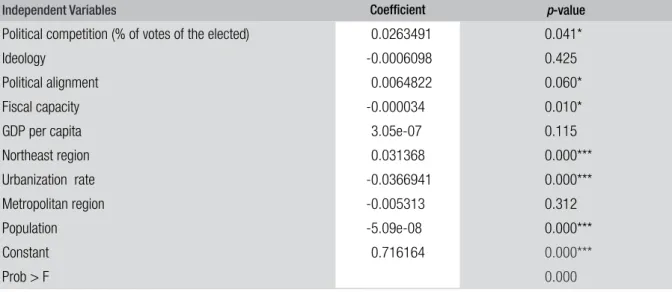
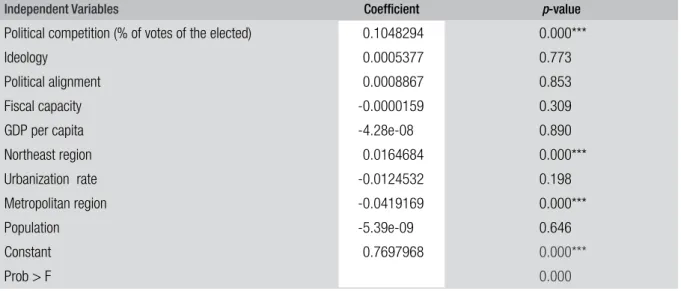
Table 1 and table 2 present the coeicient obtained from the estimation as well as the p-value of the variables in the two models of multiple linear regression.
TABLE 1 DETERMINANTS OF DMI (2007)
Independent Variables Coeficient p-value
Political competition (% of votes of the elected) 0.0263491 0.041*
Ideology -0.0006098 0.425
Political alignment 0.0064822 0.060*
Fiscal capacity -0.000034 0.010*
GDP per capita 3.05e-07 0.115
Northeast region 0.031368 0.000***
Urbanization rate -0.0366941 0.000***
Metropolitan region -0.005313 0.312
Population -5.09e-08 0.000***
Constant 0.716164 0.000***
Prob > F 0.000
Note: * p < 0.1, ** p < 0.05, ***p < 0.01. N = 5185.
TABLE 2 DETERMINANTS OF DMI (2013)
Independent Variables Coeficient p-value
Political competition (% of votes of the elected) 0.1048294 0.000***
Ideology 0.0005377 0.773
Political alignment 0.0008867 0.853
Fiscal capacity -0.0000159 0.309
GDP per capita -4.28e-08 0.890
Northeast region 0.0164684 0.000***
Urbanization rate -0.0124532 0.198
Metropolitan region -0.0419169 0.000***
Population -5.39e-09 0.646
Constant 0.7697968 0.000***
Prob > F 0.000
Note: * p < 0.1, ** p < 0.05, ***p < 0.01. N = 5503. Source: Elaborated by the authors.
he model presented in table 1 illustrates that most of the selected variables afected the man-agement of BFP for 2007. Of the three political variables tested, two of them presented statistical signiicance. he municipal political competition measured in terms of the percentage of the votes obtained by the elected candidate, proved an important factor to measure the policy control since the irst years of implementation of the DMI. In other words, the results show that there is a positive correlation between a strong electoral dispute and the improvement of program management. Like-wise, local governments politically aligned with the federal government achieved better results in terms of control management. he ideology variable did not generate control efects, which means that, for this period, the fact that there were let-wing parties in government did not change the DMI. Regarding the institutional variables, the coeicients show diferent results for iscal capacity and GDP per capita. While the irst variable is relevant signiicant with negative value, the second has no inluence on the dependent variable. his means the municipalities with highest iscal capacity are those with worse results in control management, corroborating the indings of other studies that point to a greater need to improve BFP management for more socioeconomically developed munic-ipalities. Regarding geographic aspects, the regression results show that belonging to the Northeast region is a highly correlated factor with the conditionalities compliance index. In comparative terms, it can be inferred that municipalities located in the Northeast region obtain better results than the other municipalities in the country. Regarding the urbanization rate, more developed municipalities with less rural area have lower DMI. Control variables illustrate that the fact that the municipality is located in the metropolitan region does not interfere with the administration of the policy and that larger population means less control capacity of the local administration.
com-petition’ remained an explanatory factor of the success of the DMI during the period. Moreover, the statistical signiicance of the variable achieved a maximum value, which empirically allows airming that municipalities with competitive elections are those that had better supervision over the BFP. In turn, the political alignment factor no longer has positive efects on policy management. Once again, the non signiicance of the ideological spectrum is conirmed, i.e. a municipality managed by a letist government does not afect local performance. Institutional factors were not statistically signiicant. he iscal capacity is not inluenced negatively by the DMI, which allows inferring that the municipalities with the higher iscal capacity also started to improve their levels of management. Once again, GDP per capita did not change the behavior of managers. he geographical aspects were partially reconirmed in this second model. Location in the Northeast continues to guarantee better management results compared to other regions. As for the rural or urban aspect, it ceases to be an explanatory factor for the policy. In part, this result combined with the iscal capacity reinforces the argument that the more developed municipalities have improved the management of the program. Finally, the analysis of the control variables shows that, surprisingly, the units located in metropolitan areas started to have lower DMI and the population size becomes irrelevant.
In general, the temporal analysis reveals the usefulness of the two econometric models to com-paratively explain the results of the DMI. It is important to highlight that the adoption of multiple linear regression allowed illustrating which variables proved to be crucial to test the efect of indirect mechanisms of policy control. Since the institutional characteristics of the units are insuicient to guarantee the quality of the implementation of public policies, indirect control mechanisms are central to the principal’s purposes in relation to agents. In other words, the design of the rules matters, but certain endogenous attributes positively impact the ‘police patrol’ and the behavior of management bureaucracy. Although the correlation of the other variables changed over time, it is possible to con-clude that the municipalities that complied with the program rules had the following proile: located in the Northeast and with competitive local elections.
6. CONCLUSION
police patrol in the form of the Decentralized Management Index (DMI), in addition to adopting sanction instruments for beneiciary entities and families. Such action generated positive results for the policy. It is possible to say that learning in ‘political games’ regulates the relationship between the ‘agents’ and the ‘principal’, which contributes to the reduction of conlicts and the asymmetry of information. Based on these indings, the principal-agent problem takes a irst look at analysis that aim to understand the constraint of the State when decentralizing the policy, by supervising the performance of bureaucracies. herefore, the study presents a new interpretation on the impacts of multilevel governance models, deconstructing the traditional view that explains the performance of public management as a result exclusively associated to the so-called islands of excellence.
With regard to the hypotheses, the efect of multiple factors on bureaucracy behavior was tested. he DMI, the main indicator of policy control, was taken as the unit of analysis. Multiple linear re-gression models revealed that the quality of BFP management is directly associated with the political and geographical dynamics of municipalities. he efect generated by politically competitive environ-ments and the efect by belonging to the Northeast region of the country were maintained over the analyzed period. herefore, it is possible to infer that there is a positive relationship between election results, geographic location and control of public policies. he efect of political alignment proved to be statistically signiicant only in the irst moment of the analysis, suggesting a scenario in which government relations did not contribute decisively to the improvement of the policy, denoting that the design of the program minimized this aspect of Brazilian federalism. he econometric results corroborate previous indings in the literature, insofar as it has been partially conirmed that munici-palities with higher iscal capacities, urbanization rates and population size, have lower management indicators. An unexpected result revealed that in the most recent period, metropolitan municipalities started to obtain lower DMI, which probably indicates that this speciic group has other characteristics that negatively interfere in the management. he other variables did not inluence the DMI results.
REFERÊNCIAS
ARAÚJO, Fábio R. de et al. Uma avaliação do Ín-dice de Gestão Descentralizada do Programa Bolsa Família. Rev. Adm. Pública, v. 49, n. 2, p. 367-393, Mar./Apr. 2015.
BARDHAN, Pranab; MOOKHERJEE, Dilip. De-centralization, corruption and government accou-ntability: an overview. 2005. Available at: <http:// emlab.berkeley.edu/users/webfac/bardhan/papers/ BardhanDecent,Corruption.pdf>. Accessed on: 1 July 2016.
BATLEY, Richard. The politics of service deli-very reform. Development and Change, v. 5, n. 1, p. 31-56, 2004.
BICHIR, Renata M. Mecanismos federais de coorde-nação de políticas sociais e capacidades institucionais locais: o caso do Programa Bolsa Família. Doctoral thesis — Instituto de Estudos Sociais e Políticos, Universidade do Estado do Rio de Janeiro, Rio de Janeiro, 2011.
BICHIR, Renata M. O Bolsa Família na berlinda? Os desaios atuais dos programas de transferência de renda. Novos Estudos, n. 87, p. 115-129, 2010.
BRAZIL. Decreto no 5.209, de 17 de setembro de 2004. Regulamenta a Lei no 10.836, de 9 de janeiro
de 2004, que cria o Programa Bolsa Família, e dá outras providências. Brasília, 2004.
BRAZIL. Ministério de Desenvolvimento Social e Combate à Fome. Portaria CM/MDS no 551 de 9 de novembro de 2005. Regulamenta a gestão das con-dicionalidades do Programa Bolsa Família. 2005a.
BRAZIL. Ministério de Desenvolvimento Social e Combate à Fome. Bolsa Família Informa, no 318, 17
maio 2012.
BRAZIL. Ministério de Desenvolvimento Social e Combate à Fome. Programa Bolsa Família. Cálculo Mensal IGD — abr. 2006 a mar. 2014. 2013.
BRAZIL. Ministério do Desenvolvimento Social e Combate à Fome. Programa Bolsa Família, Informe no 27. MDS faz balanço do Programa Bolsa Família.
Brasília, 2005b.
BRAZIL. Ministério do Desenvolvimento Social e Combate à Fome. Programa Bolsa Família. Relatório de gestão 2015. 2015.
BRITTO, Tatiana F. de. he emergence and popula-rity of conditional cash transfers in Latin America. In: BARRIENTOS, Armando; HULME, David (Ed.). Social protection for the poor and the poorest: concepts, policies and politics. Hampshire: Palgrave Macmillan, 2008.
CAMPBELL, Colin. he political roles of senior government officials in advanced democracies.
British Journal of Political Science, v. 18, n. 2, p. 243-272, 1988.
CAVALCANTE, Pedro. Desempenho iscal e elei-ções no Brasil: uma análise comparada dos governos municipais. Rev. Adm. Pública, v. 50, n. 2, p. 307-330, Mar./Apr. 2016.
CAVALCANTE, Pedro; RIBEIRO, Beatriz. B. Des-centralização do Programa Bolsa Família: determi-nantes do desempenho municipal. Revista Brasileira de Monitoramento e Avaliação, v. 3, p. 54-75, 2013
CHARBIT, Claire. Governance of public policies in decentralized contexts: the multi-level approach.
OECD Regional Development Working Papers, OECD
Publishing, 2011.
CIGNO, Alessandro; LUPORINI, Annalisa; PET-TINI, Ana. Transfers to families with children as a principal-agent problem. CESifo Working Paper, n. 351. 2000.
COÊLHO, Denilson. B. Political Competition and the difusion of conditional cash transfers in Brazil. Brazilian Political Science Review, v. 6, n. 2, p. 56-87, 2012.
COX, Gary W.; MCCUBBINS, Mathew D. Legislative Leviathan: party government in the house. Berkeley: University of California Press, 1993.
DERLIEN, Hans-U. Mandarins or managers? he bureaucratic elite in: Bonn, 1970 to 1987 and beyond. Governance, v. 16, p. 401-428, 2003.
EISENHARDT, Kathleen M. Agency theory: an as-sessment and review. he Academy of Management Review, v. 14, n. 1, p. 57-74, 1989.
GUJARATI, Damodar. Econometria básica. Rio de Janeiro: Elsevier, 2006.
HALL, Anthony. he last shall be irst: political dimensions of conditional cash transfers in Brazil. Journal of Policy Practice, v. 11, n. 1-2, p. 25-41, 2012.
HAM, Christopher; MICHAEL, Hill. he policy pro-cess in the modern capitalist state. London: Harvester Wheatsheaf, 1993.
HOOGHE, Liesbet; MARKS, Gary. Unraveling the central state, but how? Types of multi-level gover-nance. he American Political Science Review, v. 97, n. 2, p. 233-243, 2003.
KASSIM, Hussein; MENON, Anand. he princi-pal-agent approach and the study of the European Union: promise unfulilled? Journal of European Public Policy, v. 10, n. 1, p. 121-139, 2003.
KAUFMANN, Katja M.; FERRARA, Eliana L.; BROLLO, Fernanda. Learning about the enforcement
of conditional welfare programs: evidence from the
Bolsa Familia Program in Brazil. Milão: Bocconi University, 2013.
KEEFER, Philip; KHEMANI, Stuti. Democracy,
public expenditures, and the poor. Development
research group. Washington: he World Bank, 2003.
LAKE, David A.; BAUM, Mathew A. he invisible hand of democracy: political control and the provi-sion of public services. Comparative Political Studies, v. 34, n. 6, p. 587-621, 2001.
LIPSKY, Michael. Street-level bureaucracy, dilemmas of the individual in public services. New York: Russell Sage Foundation, 1980.
LOTTA, Gabriela. Agentes de implementação: uma forma de análise de políticas públicas. Cadernos Ges-tão Pública e Cidadania, v. 19, n. 65, p. 188-208, 2014.
LOUREIRO, Maria R.; ABRUCIO, Fernando. Polí-tica e burocracia no presidencialismo brasileiro: o papel do Ministério da Fazenda no primeiro governo Fernando Henrique Cardoso. Revista Brasileira de Ciências Sociais, v. 14, n. 41, p. 69-89, 1999.
LUPIA, Arthur; McCUBBINS, Mathew D. Designing bureaucratic accountability. Law and Contemporary Problems, v. 57, n. 1, p. 91-126, 1994.
LUPIA, Arthur; McCUBBINS, Mathew D. Learning from oversight: ire alarms and police patrols
recons-tructed. Journal of Law, Economics and Organization, v. 10, n. 1, p. 96-125, 1994.
MAINWARING, Scott; MENEGUELLO, Rachel; POWER, Timothy. Conservative parties, democracy, and economic reform in contemporary Brazil. In: MIDDLEBROOK, Kevin (Ed.). Conservative parties, the right, and democracy in Latin America. Baltimore: Johns Hopkins University Press, 2000. p. 164-222.
MELO, Marcus A. Political competition can be po-sitive: embedding cash transfer programs in Brazil. In: BEBBINGTON, Anthony; MCCOURT, Willy (Ed.). Development success: statecrat in the South. London: Palgrave, 2007. p. 30-51.
MILLER, Gary J. he political evolution of princi-pal-agent models. Annual Review of Political Science, v. 8, p. 203-225, 2005.
MONTEIRO, Doraliza; FERREIRA, Marco A.; DENÚBILA, Laís. Alocação de recursos e eiciência na gestão do Programa Bolsa Família em Minas Gerais. Revista de Ciências Humanas, v. 8, n. 2, p. 193-207, 2008.
NISKANEN, William A. Bureaucracy and
represen-tative government. Chicago: Aldine, 1971.
OLIVEIRA, Antonio. Burocratas da linha de frente: executores e fazedores das políticas públicas. Rev.
Adm. Pública, v. 46, n. 6, p. 1551-1573, Nov./Dec.
2012.
OLIVIERI, Cecília. Política, burocracia e redes sociais: as nomeações para o alto escalão do Banco Central do Brasil. Revista de Sociologia e Política, n. 29, p. 147-168, 2007.
PAGE, Edward. Political authority and bureaucratic
power: a comparative analysis. 2. ed. New York:
Harvester Wheatsheaf, 1992.
POWER, Timothy; ZUCCO, Cesar Jr. Estimating ideology of Brazilian legislative parties, 1990-2005: a research communication. Latin American Research Review, v. 44, n. 1, p. 218-246, 2009.
PRZEWORSKI, Adam. Capitalism and social
de-mocracy. Cambridge, UK: Cambridge University
Press, 1985.
SHEPSLE, Kenneth A.; BONCHEK, Mark S. Analy-zing politics: rationality, behavior, and institutions. New York: W. W. Norton & Company, Inc., 500 Fith Avenue, 1997.
SILVA, Lucas A. L. da. Mecanismos da construção federal da intersetorialidade no Programa Bolsa Família: o papel das burocracias. Revista do Serviço Público, v. 64, n. 3, p. 327-350, 2013.
SILVEIRA, Andreia de F. M. da; GUERRA, Ana Ca-rolina; PESSANHA, Gabriel R. G. Desempenho na gestão do Programa Bolsa Família na microrregião de Varginha-MG: uma análise a partir do Índice de Gestão Descentralizada (IDG) no período de janei-ro de 2007 a junho de 2013. In: ENCONTRO DA ANPAD, XXXVIII, 2014, Rio de Janeiro.
SOARES, Fábio V.; RIBAS, Rafael P.; OSÓRIO, Rafael G. Evaluating the impact of Brazil’s Bolsa Família: cash transfer programs in comparative perspective. Latin American Research Review, v. 45, n. 2, p. 173-190, 2010.
SOARES, Sergei S.; SÁTYRO, Natália. O Programa Bolsa Família: desenho institucional, impactos e pos-sibilidades futuras. Discussion Papers 1424, Instituto de Pesquisa Econômica Aplicada, 2009.
STOLK, Christian V.; PATIL, Sunil. Understanding the quality of implementation in Bolsa Familia: a look inside the ‘black box’ of a conditional cash transfer programme. In: ECPR GENERAL CON-FERENCE, 2013, Bordeaux.
TULLOCK, Gordon A. Teoria da escolha pública. In: TULLOCK, Gordon; SELDON, Arthur; BRADY, Gordon L. (Ed.). Falhas de governo: uma introdução à teoria da escolha pública. Rio de Janeiro: Instituto Liberal, 2005. p. 13-91.
WATERMAN, Richard W.; MEIER, Kenneth J. Principal-agent models: an expansion? Journal of
Public Administration Research and heory, v. 8,
n. 2, p.173-202, 1998.
VELOSO, João F. A. et al. Uma visão inicial dos sub-sistemas da gestão pública municipal. In: VELOSO, João F. A. et al.(Org.). Gestão municipal no Brasil: um retrato das prefeituras. Brasília: Ipea, 2011.
WEBER, Max. From Max Weber: essays in sociology. New York: Oxford University Press, 1958.
WOOLDRIDGE, Jefrey M. Introdução à econome-tria: uma abordagem moderna. São Paulo: Cengage Learning, 2011.
Denilson Bandeira Coêlho
Professor at the Institute of Political Science and researcher at the Laboratory of Research on Political Beha-vior, Institutions and Public Policies (LAPCIPP) of the Universidade de Brasília. E-mail: [email protected].
Antônio Sérgio Araújo Fernandes