Received 12/13/2012 Accepted 8/4/2013 (005973)
1 Programa de Pós-graduação em Engenharia Química, Departamento de Engenharia Química, Universidade Federal do Ceará – UFC, Campus do Pici, Bloco 709, CEP 60455-760, Fortaleza, CE, Brasil
2 Embrapa Agroindústria Tropical, Rua Dra. Sara Mesquita, 2270, Pici, CEP 60511-110, Fortaleza, CE, Brasil, e-mail: [email protected] *Corresponding author
Effect of treatment with adsorbent resin on the volatile profile and physicochemical
characteristics of clarified cashew apple juice
Adriana Dutra SOUSA1,2, Edy Sousa de BRITO1,2*
1 Introduction
Cashew is a tropical fruit that consists of two parts: the nut and the peduncle. Despite the peduncle potential as a raw material for many products, nearly 90% of its production is discarded every year. Some reasons that explain such waste are the peduncle high perishability and the cashew nut business importance (OLIVEIRA; ANDRADE, 2011). One of the products obtained by peduncle processing is the clarified cashew apple juice, which has a lower astringency compared to that of non-clarified juice. Clarified juice can be obtained by microfiltration or by a process using gelatin and filtration.
The clarified cashew apple juice can be used to improve nutritional characteristics of mixed drinks by the supplementation of nutrients, such as vitamin C and carotenoids (ASSUNÇÃO; MERCADANTE, 2003; ABREU et al., 2009), sugars (SILVA; RABELO; RODRIGUES, 2012), flavonol glucosides (BRITO et al., 2007; MICHODJEHOUN-MESTRES et al., 2009a), anacardic acids (KUBO et al., 2006; TREVISAN et al., 2006) phenolic acids, and prodelphinidins (MICHODJEHOUN-MESTRES et al., 2009b, c). Moreover, some studies show the functional properties of the cashew apple, such as prevention of acute gastritis caused by Helicobacter pylori (KUBO; LEE; KUBO, 1999) and antioxidant activity (ABREU et al., 2009; LUZIA; JORGE, 2011). However, the characteristic intense odor of cashew apple juice can affect blended formulations containing this material.
Cashew apple flavor has been studied specially in the fruit pulp, juice, and condensed water-phase (GARRUTI et al., 2003; CARASEK; PAWLISZYN, 2006; SAMPAIO et al., 2011).
The main odor impact compounds identified were 3-methyl-1-butanol, ethyl 3-methyl butanoate, ethyl trans-2-butenoate, ethyl butanoate, 3-methylbutanoic acid, and hexanal. They were responsible for the green, fruity, and cashew-like aroma.
Adsorption can be used for removal of volatile compounds. This technique may be described as an enrichment of compounds, for example, from fluids to the surfaces of solid state bodies. During the accumulation of these compounds interactions between the molecules of the fluid phase (adsorptive) and the solid (adsorbent) occur. The solid surface may be regarded as a site with certain electronic and sterical properties characteristic of the adsorbent matrix structure, which induce energetically heterogeneous energy levels based on the degree of the interaction with the adsorptive (KAMMERER; CARLE; KAMMERER, 2011).
Synthetic resins are polymeric adsorbents with large internal surface areas and a consistent structure. They are manufactured by polycondensation or polymerization (KAMMERER; CARLE; KAMMERER, 2011). Today there are various types of resins, such as the Amberlite series, which have been used for removing apolar, polar, non-aromatic, and aromatic compounds. For example, XAD4 and FPX66 resins consist of a macroreticular crosslinked aromatic polymer and adsorb hydrophobic molecules from polar solvents or volatile organic compounds from vapor streams. XAD761 and FPA54 have a crosslinked phenol-formaldehyde polycondensate matrix. The phenolic hydroxyl and methoxyl groups account for their hydrophilic properties (ROHM..., 2012). The aim of
Abstract
Increased preference for healthy and functional foods could be an opportunity to increase the consumption of clarified cashew apple juice. Given its level of fructose, glucose, and vitamin C, it can be used as a base in blends. However, its characteristic odor can interfere with the acceptance of these formulations, especially by consumers who are not familiar with cashew aroma. The aim of this study was to evaluate the effect of treatment with macroporous resins (FPA54, FPX66, XAD761, and XAD4) on the volatile profile and physicochemical characteristics of clarified cashew apple juice. After the treatment with the resins, the volatile profile was evaluated using solid-phase microextraction (SPME) and gas chromatography/mass spectrometry (GC/MS). The physicochemical analyses performed were: pH, soluble solids (°Brix), total titrable acidity, reducing sugars, and vitamin C. Gas chromatography analyses showed that XAD4 and FPX66 led to a reduction of the initial amount of volatile compounds to 14.05% and 15.72%, respectively. These two resins also did not affect the physicochemical characteristics of the clarified cashew apple juice.
model 3800 gas chromatograph. The splitless mode injector was maintained at 250 °C and the flame ionization detector (FID) at 250 °C. Hydrogen was used as the carrier gas at a flow rate of 1.5 mL min–1. The oven temperature was set at 30 °C, kept
for 7 minutes, programmed to 90 °C (3 °C min–1), and then to
200 °C (10 °C min–1), and kept at 200 °C for 10 minutes.
2.5 Gas chromatography/mass spectrometry and compound identification
The volatile compounds were identified using a Shimadzu gas chromatograph (Kyoto, Japan) coupled to a mass spectrometer (GC/MS-QP-2010) at an MS ionization voltage of 70 eV and 1 scan s–1 MS scan range. Column and oven conditions
were the same as those used for the chromatographic analysis. Helium was used as the carrier gas at a flow rate of 1.0 mL min–1.
Identification was made by comparing the experimentally obtained mass spectra of the compound with those in the NIST 27 and NIST 147 libraries, comparing the volatile retention index obtained using the CP-Sil-8CB column with the retention indices published in the literature for columns with the same polarity (LINSTROM; MALLARD, 2010), and comparing the volatile mass spectra with the mass spectra of pure compounds analyzed in the same gas chromatograph – mass spectrometer using the same methodological conditions.
2.6 Determination of volatile compound percentages
The volatile profile of control sample was used as a reference for comparison with those of the volatiles of the treated juices. The total area of volatile compounds present in the control juice corresponded to 100%, and the percentages of the areas of the volatile compounds of the treated juices were calculated using Equation 1.
= ×
%compound compound area 100
control total area (1)
2.7 Physicochemical analysis
The physicochemical analyses were performed in triplicate for all treatments. The following analyses were performed: pH, determined by direct reading in a WTW potentiometer (model 330i/SET) (ASSOCIATION..., 1999); soluble solids (°Brix), determined by refractometry using an ATAGO refractometer, according to IAL (INSTITUTO..., 2005); total acidity, determined by titration, carried out as described by IAL (INSTITUTO..., 2005) and expressed as g citric acid/100 g; reducing sugars, determined according to Miller (1959); and vitamin C, determined by the colorimetric method (2,6-dichlorophenolindophenol) described by Pearson (1975) and expressed as mg ascorbic acid/100 mL.
2.8 Statistical analysis
The physicochemical results were evaluated using analysis of variance (ANOVA), and the means were compared by the Tukey’s test at 5% significance level. Statistical analysis was performed using the SAS System (STATISTICAL..., 2001) for Windows.
this study was to evaluate the effect of treatments with different Amberlite resins (FPA54, FPX66, XAD761, and XAD4) on the volatile profile and the physicochemical characteristics of clarified cashew apple juice to obtain a deodorized juice that can be used as a base product in juice formulations.
2 Materials and methods
2.1 Raw material
Cashew apples (clone CCP76) collected in Pacajus - CE, Brazil, were used. Five kilograms of fruit were harvested in the second semester of 2010 at the maturity stage 7 (completely ripe) (LOPES et al., 2011). The cashew nuts were removed, and the peduncles were selected followed by washed and sanitized. Pulp was obtained using an expeller type press (INCOMAP, Fortaleza-CE). The juice was clarified using a microfiltration unit, as described by Castro, Abreu and Carioca (2007).
2.2 Resin treatment
For resin activation, four chromatographic columns were filled with Amberlite resin types FPA54, FPX66, XAD761, and XAD4. After that 50 mL of distilled water (60 °C) were added every 15 minutes for three hours. Juice treatment with these resins was performed by transferring 100 mL to an erlenmeyer flask and keeping it in contact with 20 g of resin under agitation in a rotatory shaker at 30 °C and 150 rpm for 1 hour. In addition, an erlenmeyer flask containing only the juice was used as control. Finally, the juice was separated from the resins by filtration using an 8 µm pore filter. After treatment, the resins were washed several times with a NaOH 2% solution for regeneration until obtaining a clear solution. Next, it was washed with water to begin the activation process. All juice treatments were performed in triplicate.
2.3 Isolation of volatile compounds by solid-phase microextraction (SPME)
Cashew apple juice (10 g) with NaCl 30% w/w was kept in a hermetically sealed extraction vial for 45 minutes at 45 °C under continuous stirring to equilibrate the headspace. Subsequently, the SPME device was inserted into the sealed vial through the septum, and the CAR-PDMS (85 µm) fiber was exposed to the sample headspace for 30 minutes for adsorption of volatiles. Following the sampling procedure, the fiber was immediately inserted into the GC injector, and the fiber was thermally desorbed for 3 minutes at 250 °C. Before each sampling procedure, the fiber was automatically conditioned for 5 minutes in the Needle Heater port at 250 °C. This conditioning procedure was enough to guarantee no peaks in blank runs, and it was a good compromise between the chromatography runs and the extraction procedures.
2.4 Gas chromatography analysis
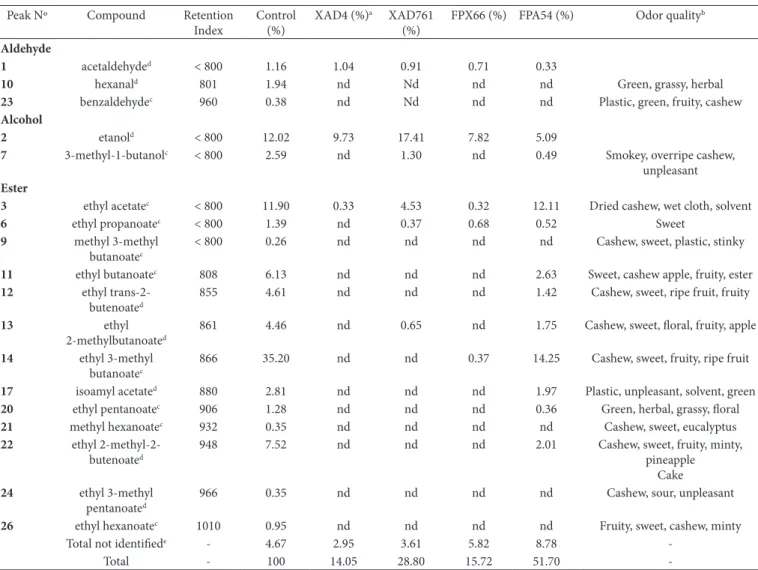
ethyl acetate (11.90%), ethyl 2-methyl-2-butenoate (7.52%), ethyl butanoate (6.13%), ethyl trans-2-butenoate (4.61%), and ethyl 2-methylbutanoate (4.46%). Ethanol was the exception when compared to those previous studies since it was found in large amounts. This might be explained by previous sample fermentation since this compound was present in the control and treated juices. Garruti et al. (2003) also found ethyl 3-methyl butanoate as the most abundant compound and others such as ethyl butanoate, methyl 3-methyl butanoate, hexanal, and 3-methyl-1-butanol, which were also found in this study.
The XAD4 resin proved more efficient in removing volatiles if compared to others, reducing the initial amount of volatile compounds (control) to 14.05%. This adsorbent removed the compounds with a positive impact on the odor of the cashew apple juice (cashew odor) and also with a negative impact (off-flavors), which leads to a weaker fruity aroma (Kranz, Adler and Kunz (2011) also observed a flavor loss during adsorptive debittering of grapefruit juice using XAD-7HP resin. Although FPX66 resin removed most of the compoounds (15.72% of the control), some odor active volatiles such as ethyl propanoate and ethyl 3-methyl butanoate were still present, which imparted 3 Results and discussion
The volatile composition of clarified cashew apple juice is shown in Table 1. A total of 26 compounds were detected by high-resolution gas chromatography and 18 were identified in the control. The volatile compounds were predominantly esters (72% of total identified compounds), followed by aldehydes (16%) and alcohols (11%). These results are consistent with those found by Bicalho et al. (2000) and Garruti et al. (2003), who detected many ethyl and methyl esters in Brazilian cashew apples. They found a large number of compounds compared to those of the current study; however, their techniques were different than the ones used here. The authors used organic solvents to eluate the extracted volatiles and injected this mixture into the GC. In the present study, the volatiles were adsorbed onto a fiber that was inserted into the GC injector without solvent. Carasek and Pawliszyn (2006) also found a small number of compounds (14 identified compounds) using SPME with the same fiber used in the present study for the industrialized cashew pulp from the northeastern region of Brazil. The main compounds found in the current study were ethyl 3-methyl butanoate (35.20%), ethanol (12.02%),
Table 1. Volatile profile and compounds odor quality of clarified cashew juice treated with different resins.
Peak Nº Compound Retention Index
Control (%)
XAD4 (%)a XAD761
(%)
FPX66 (%) FPA54 (%) Odor qualityb
Aldehyde
1 acetaldehyded < 800 1.16 1.04 0.91 0.71 0.33
10 hexanald 801 1.94 nd Nd nd nd Green, grassy, herbal
23 benzaldehydec 960 0.38 nd Nd nd nd Plastic, green, fruity, cashew
Alcohol
2 etanold < 800 12.02 9.73 17.41 7.82 5.09
7 3-methyl-1-butanolc < 800 2.59 nd 1.30 nd 0.49 Smokey, overripe cashew,
unpleasant
Ester
3 ethyl acetatec < 800 11.90 0.33 4.53 0.32 12.11 Dried cashew, wet cloth, solvent
6 ethyl propanoatec < 800 1.39 nd 0.37 0.68 0.52 Sweet
9 methyl 3-methyl butanoatec
< 800 0.26 nd nd nd nd Cashew, sweet, plastic, stinky
11 ethyl butanoatec 808 6.13 nd nd nd 2.63 Sweet, cashew apple, fruity, ester
12 ethyl trans-2-butenoated
855 4.61 nd nd nd 1.42 Cashew, sweet, ripe fruit, fruity
13 ethyl
2-methylbutanoated
861 4.46 nd 0.65 nd 1.75 Cashew, sweet, floral, fruity, apple
14 ethyl 3-methyl butanoatec
866 35.20 nd nd 0.37 14.25 Cashew, sweet, fruity, ripe fruit
17 isoamyl acetated 880 2.81 nd nd nd 1.97 Plastic, unpleasant, solvent, green
20 ethyl pentanoatec 906 1.28 nd nd nd 0.36 Green, herbal, grassy, floral
21 methyl hexanoatec 932 0.35 nd nd nd nd Cashew, sweet, eucalyptus
22 ethyl 2-methyl-2-butenoated
948 7.52 nd nd nd 2.01 Cashew, sweet, fruity, minty,
pineapple Cake
24 ethyl 3-methyl pentanoated
966 0.35 nd nd nd nd Cashew, sour, unpleasant
26 ethyl hexanoatec 1010 0.95 nd nd nd nd Fruity, sweet, cashew, minty
Total not identifiede - 4.67 2.95 3.61 5.82 8.78
-Total - 100 14.05 28.80 15.72 51.70
-aRelative to control; bGarruti et al. (2003); cCompound positively identified (pure standard); dCompound identified by MS and linear retention index; nd, compound not detected; etotal
Acknowledgments
The authors are grateful for the financial support provided by EMBRAPA, INCT-Frutos Tropicais and CNPq.
References
ABREU, C. R. A. et al. Bioactive compounds and antioxidant activity of cashew apple (Anacardium occidentale L.) from commercial early dwarf clones. Acta Horticulturae, v. 841, p. 451-454, 2009. ASSOCIATION OF OFFICIAL ANALYTICAL CHEMISTS - AOAC.
Official Methods of Analysis of the Association of Analytical Chemistry. 15th ed. Washington: AOAC, 1999. 2 v.
ASSUNÇÃO, R. B.; MERCADANTE, A. Z. Carotenoids and ascorbic acid composition from commercial pro#ducts of cashew apple (Anacardium occidentale L.). Journal of Food Composition and Analysis, v. 16, p. 647-657, 2003. http://dx.doi.org/10.1016/S0889-1575(03)00098-X
BICALHO, B. et al. Application of high-temperature gas chromatography- mass spectrometry to the investigation of glycosidically bound components related to cashew apple (Anacardium occidentale L. var. nanum) volatiles. Journal of Agricultural and Food Chemistry, v. 48, n. 4, p. 1167-1174, 2000. http://dx.doi.org/10.1021/jf9909252
BRITO, E. S. et al. Determination of the flavonoid components of
cashew apple (Anacardium occidentale) by LC-DAD-ESI/MS. Food
Chemistry, v. 105, p. 1112-1118, 2007. http://dx.doi.org/10.1016/j. foodchem.2007.02.009
CARASEK, E.; PAWLISZYN, J. Screening of tropical fruit volatile compounds using solid-phase microextraction (SPME) fibers and internally cooled SPME fiber. Journal of Agricultural and Food Chemistry, v. 54, p. 8688-8696, 2006.
CASTRO, T. R.; ABREU, F. A. P.; CARIOCA, J. O. B. Obtenção de suco clarificado de caju (Anacardium occidentali, L) utilizando processos de separação por membranas. Revista Ciência Agronômica, v. 38, n. 2, p. 164-168, 2007.
CIANCI, F. C. et al. Clarificação e concentração de suco de caju por
processos com membranas. Ciência e Tecnologia de Alimentos,
v. 25, n. 3, p. 579-583, 2005. http://dx.doi.org/10.1590/S0101-20612005000300030
GARRUTI, D. S. et al. Evaluation of volatile flavour compounds from cashew apple (Anacardium occidentale L) juice by the Osme gas
chromatography/olfactometry technique. Journal of the Science
of Food and Agriculture, v. 83, p. 1455-1462, 2003. http://dx.doi. org/10.1002/jsfa.1560
INSTITUTO ADOLFO LUTZ - IAL. Normas analíticas do Instituto
Adolfo Lutz: métodos físicos e químicos para a análise de alimentos. 3. ed. São Paulo: IAL, 2005.
moderate odor intensities (GARRUTI et al., 2003). The XAD 761 resin reduced the volatiles, but its efficiency was lower (28.80% of the control). The worst result was obtained using FPA54, which maintained most volatiles in the juice, 51.70% of their initial value, including those with negative attributes. The resins that obtained better results (XAD4 and FPX66) have an aromatic structure, with affinity for hydrophobic molecules. On the other hand, XAD761 and FPA54 resins have affinity for hydrophilic molecules.
According to the physicochemical analyses (Table 2), there was a vitamin C decrease in all resin treatments. The concentration reduced from 159 mg AA/100 mL (control) to 134 (FPX66), 132 (XAD4), 117 (FPA54), and 105 mg AA/100 mL (XAD761). Despite this decrease, the samples treated with the XAD4 and FPX66 resins showed values close to those of the control, showing better retention of vitamin C. This compound provides health benefits and must be preserved after resin treatment. Resin treatments compared to the control reduced the soluble solids and reducing sugars significantly. There was no difference in the pH values between the XAD4 and FPX66 and that of the control, while XAD761 and FPA54 showed higher values. This behavior was consistent with the acidity value results, which decreased in relation to the control, and XAD761 and FPA54 showed higher affinity than XAD4 and FPX66. Like volatile compounds, XAD761 and FPA54 have affinity for hydrophilic molecules. Cianci et al. (2005), studying clarified cashew apple juice by microfiltration, found results similar to those of the control for vitamin C, soluble solids, and pH. The higher pH values obtained using XAD761 and FPA54 may be a consequence of the reduced levels of ascorbic acid, also reflected in acidity determination. Vivekanand, Ajlouni and Iyer (2003) used an adsorbent resin and a weak ion exchanger to improve clarified pear juice quality. These authors also found a decrease in the titratable acidity and increase in pH, without great loss of sugars and other nutritional constituents (minerals and ascorbic acid) in treated juices, but the volatile profile was not evaluated in their study.
4 Conclusions
The volatile profile analysis showed that the best resins for deodorization of cashew apple juice were XAD4 and FPX66 due to almost complete volatiles removal and lower effects on the physicochemical characteristics. After resin treatment, juices can be used as an ingredient in the production of blended beverages, especially those involving cashew apple juice.
Table 2. Physicochemical characterization of clarified cashew apple juice treated with resins.
Treatment Vitamin C (mg AA/100mL)
SST (ºbrix)
reducing sugars
(%) pH
acidity (g/100g)
Control 159.42±0.16a* 11.3±0.2a 10.45±0.02a 4.21±0.02b 0.28±0.01a
FPA54 117.28±0.20d 10.4±0.1b 9.58±0.06b 5.08±0.07a 0.23±0.02b
FPX66 134.08±0.20b 10.1±0.3b 9.56±0.06b 4.24±0.06b 0.26±0.01ab
XAD4 132.85±0.18c 10.2±0.1b 9.49±0.03b 4.23±0.10b 0.26±0.01ab
XAD761 105.69±0.06e 10.3±0.4b 9.55±0.01b 5.04±0.07a 0.23±0.01b
and Food Chemistry, v. 57, p. 1377-1382, 2009b. http://dx.doi. org/10.1021/jf803174c
MICHODJEHOUN-MESTRES, L. et al. Characterization of highly polymerized from skin and flesh of four cashew apple (Anacardium occidentale L.) genotypes. Food Chemistry, v. 114, n. 3, p. 989-995, 2009c. http://dx.doi.org/10.1016/j.foodchem.2008.10.052 MILLER, G. L. Use of dinitrosalicylic acid reagent for determination
of reducing sugars. Analytical Chemistry, v. 31, n. 3, p. 426-428, 1959. http://dx.doi.org/10.1021/ac60147a030
OLIVEIRA, V. H. D.; ANDRADE, A. P. S. Produção integrada de caju.
Abrindo portas para qualidade. Disponível em: <http://www.cnpat. embrapa.br/pif/artigo1.pdf>. Acesso em 5 nov. 2011.
PEARSON, D. Laboratory Techniques in Food Analysis. London:
Cox & Pearson, 1975.
ROHM AND HASS COMPANY. Product Information. Disponível
em: <www.rohmhaas.com>. Acesso em 28 mar. 2012.
SAMPAIO, K. L. et al. Aroma volatiles recovered in the water phase of cashew apple (Anacardium occidentale L.) juice during concentration. Journal of the Science of Food and Agriculture, v. 91, p. 1801-1809, 2011. http://dx.doi.org/10.1002/jsfa.4385 SILVA, I. M.; RABELO, M. C.; RODRIGUES, S. Cashew juice
containing prebiotic oligosaccharides. Journal of Food Science and Technology, 2012. http://dx.doi.org/10.1007/s13197-012-0689-9 STATISTICAL ANALYSIS SYSTEM - SAS. SAS User’s Guide: Statistics.
version 5. Cary: SAS Institute, 2001.
TREVISAN, M. T. S. et al. Characterization of alkyl phenols in cashew (Anacardium occidentale) products and assay of their antioxidant capacity. Food and Chemical Toxicology, v. 44, n. 2, p. 188-197, 2006. http://dx.doi.org/10.1016/j.fct.2005.06.012
VIVEKANAND; AJLOUNI, S.; IYER, M. Quality enhancement of UF-clarified pear juice using adsorbent and weak-base resins at different temperatures. Journal of Food Science, v. 68, n. 1, p. 333-338, 2003. http://dx.doi.org/10.1111/j.1365-2621.2003.tb14161.x
KAMMERER, J.; CARLE, R.; KAMMERER, D. R. Adsorption and Ion Exchange: Basic Principles and Their Application in Food Processing. Journal of Agricultural and Food Chemistry, v. 59, n. 1, p. 22-42, 2011. http://dx.doi.org/10.1021/jf1032203
KRANZ, P.; ADLER, P.; KUNZ, B. Sorption of citrus flavour compounds on XAD-7HP resin during the debittering of grapefruit juice.
International Journal of Food Science and Technology, v. 46, n. 1, p. 30-36, 2011. http://dx.doi.org/10.1111/j.1365-2621.2010.02442.x KUBO, J.; LEE, J. R.; KUBO, I. Anti-Helicobacter pylori agents from
the cashew apple. Journal of Agricultural and Food Chemistry, v. 47, n. 2, p. 533-537, 1999. http://dx.doi.org/10.1021/jf9808980
KUBO, I. et al. Antioxidant activity of anacardic acids. Food
Chemistry, v. 99, n. 3, p. 555-562, 2006. http://dx.doi.org/10.1016/j. foodchem.2005.08.023
LINSTROM, P. J.; MALLARD, W. G. (Eds.). NIST Chemistry
WebBook. Gaithersburg: National Institute of Standards and Technology. (NIST Standard Reference Database Number, n. 69). Disponível em: <http://webbook.nist.gov>. Acesso em: 20 set. 2010. LOPES, M. M. A. et al. Caracterização física de pedúnculos de clones
de cajueiro anão precoce em diferentes estádios de maturação.
Revista Ciência Agronômica, v. 42, n. 4, p. 914-920, 2011. http:// dx.doi.org/10.1590/S1806-66902011000400013
LUZIA, D. M. M.; JORGE, N. Study of antioxidant activity of
non-conventional Brazilian fruits. Journal of Food Science and
Technology, 2011. http://dx.doi.org/10.1007/s13197-011-0603-x MICHODJEHOUN-MESTRES, L. et al. Monomeric phenols of cashew
apple (Anacardium occidentale L.). Food Chemistry, v. 112, n. 4, 851-857, 2009a. http://dx.doi.org/10.1016/j.foodchem.2008.06.056 MICHODJEHOUN-MESTRES, L. et al. Isolation, Characterization,