IMPACT OF TREES ON SOIL NITROGEN DYNAMICS IN
TEMPERATE SILVOARABLE AGROFORESTRY
SYSTEMS
Coussement T1*, Janssens P1, Elsen A1, Pardon P3,4,5, Nelissen V3, Reubens B3, Vandendriessche H1,2 (1) Soil Service of Belgium, Heverlee, Belgium (2) Division of Crop Biotechnics, KU Leuven, Heverlee, Belgium (3)
Flanders Research Institute for Agriculture, Fisheries and Food, Merelbeke, Belgium (4) Department of Plant Production, Ghent University, Ghent, Belgium (5) Department of Forest and Water Management, Ghent University,
Gontrode, Belgium
*Corresponding author: [email protected]
Abstract
By introducing trees on an arable field, agroforestry systems will have a strong impact on many aspects of the soil nitrogen dynamic, with important agronomic and environmental consequences. In the temperature region of Europe, these consequences are still poorly understood and quantified. This research focuses on the way mature poplar trees (Populus x canadensis) affect the soil nitrogen dynamic on six arable fields in Flanders (Belgium), with the aim to quantify the impact and to identify its spatial and temporal extent. Preliminary results show a significant impact of the trees on the soil mineral nitrogen content, spatially as well as temporally, with significant differences between fields with maize and winter grains. These results indicate that nitrogen uptake by the tree roots could play an important role in the late growing season of maize, and result in lower residual soil nitrogen after maize harvest.
Keywords: nitrate leaching; belowground competition; nutrient competition; temperate agroforestry; tree-crop interactions
Introduction
Nitrogen (N) is one of the most important plant nutrients in agricultural soils, however N fertilization often causes environmental problems in regions with intensive agriculture, such as Western Europe, mainly due to leaching into surface and subsurface waters (Allen et al. 2004). Agroforestry systems are considered to have the potential to mitigate these problems, because the deep root system of the trees can capture N that is leached below the crop root zone (Allen et al. 2004). The presence of trees on an arable field however will possibly have a strong impact on the whole soil nitrogen dynamics. These effects range from direct uptake of soil N by the tree roots and input of N from tree leaves and roots, to subtler effects, such as an alteration of the mineralization of soil organic matter due to changes in soil temperature and water content. Additionally, competition for light, water and nutrients may affect the biomass production of the arable crop close to the tree line, and consequently the residual N left in the soil after harvest
(Allen et al. 2005 2008; Ishikawa and
Bledsoe 2000).
The impact of trees on the soil nitrogen dynamics in arable fields in the temperate region of Europe is still poorly understood and quantified (Jose et al. 2000a; Allen et al. 2005). This research focuses on the way mature poplar trees (Populus x canadensis) affect the soil nitrogen dynamics on arable fields in Flanders (Belgium). For the studied fields, significantly increased soil organic carbon and soil nutrient concentrations (P, K, Mg, Na, and total N) in the topsoil close to the trees were already observed (Pardon et al. 2017). The study aims to quantify the impact of mature poplar trees on the soil nitrogen dynamics in the field, and to identify the spatial and temporal extent of the impact.
Materials and methods
Today there are still very few arable alley cropping systems in Flanders, and the existing systems are exclusively of young age. Therefore, a set of six arable fields partially bordered by a row of high-pruned poplar trees (Populus x canadensis) of moderate to older age (15 47 years) was selected as a proxy. An overview of the location of the fields and their characteristics is provided in Table 1. In order to compare the boundary planted zone of the field with a conventional arable field, the part of the field without tree border was selected as a reference situation.
Table 1
period 1990 2015; soil type according to field measurements; DBH: the tree diameter at breast height.
On each field, measurements were carried out along transects perpendicular to the tree row (3 transects) and the treeless field border (2 transects), at 5 sampling plots per transect. Sampling plots were rectangular (1.5 m by 6 m), the centre of which was located at 2, 5, 10, 20 and 30 meter distance from the field edge. A schematic overview of the trial layout is shown in Figure 1.
Figure 1: Left: overview of the trial setup: sampling plots are shown as black rectangles, the trees as grey polygons. Right: example of one of the studied fields.
The crop rotation included winter barley, winter wheat, grain maize, silage maize and hemp as main crops, and various types of cover crops during the winter (Table 2). On each field on all 25 plots, soil samples (composite samples composed of 8 individual augurings) were taken three times a year in 2015 and 2016, and once in 2017 before the start of the growing season. Date of sampling in 2015 and 2016 depended on the type of main crop. Samples were taken at the start of the growing season (before the application of manure), at harvest, and at the end of the year (period October - November). If the harvest happened in October or November (such as for grain and silage maize), an additional sampling moment was added during the growing season of the crop. In each plot the soil mineral nitrogen content (ammonium-N and nitrate-N) was determined for the soil layers 0-30 cm, 30-60 cm and 60-90 cm (extraction with KCl and determination using continuous flow, ISO 14256-2). Initially, the soil organic carbon content (sulphochromic oxidation, ISO 14235) and pH-KCl were also determined for each plot in de
Table 2: Crop rotation on the studied fields in 2015 and 2016.
To explain observed differences in soil nitrogen content, additional measurements are available for all six fields of the crop yield and quality for 2015, 2016 and 2017 for all sampling plots (results to be published), and of the soil organic carbon content and availability of other plant nutrients (P, K, Mg, Na, and total N, published in Pardon et al. 2017). Furthermore, on one of the fields, a more detailed experimental setup is carried out which includes a barrier between the tree roots and the field (analogous to Jose et al. 2000b). This setup allows a more close look at the competition for water (and nutrients) in the root zone.
Due to the nested, hierarchical structure of the data (measuring point nested in transects nested in fields), the soil mineral nitrogen content could be modelled using a linear-mixed effect model (LMM). The LMM analysis was carried out seperately for the 3 sampling moments: early season (March 2015, 2016, and 2017), mid season (late June/early August 2015 and 2016) and late season (October/November 2015 and 2016). Fixed effects were the logarithm of the distance from the tree row and the main crop. The statistical analysis was carried in R (R Development Core Team 2016) using the lme4 package.
Preliminary results and outlook
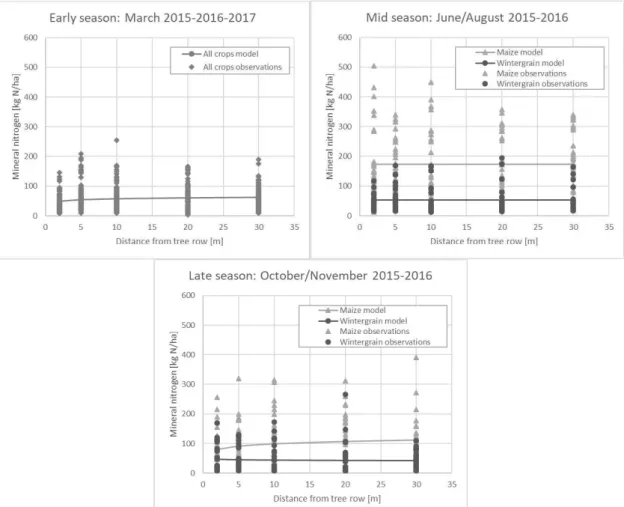
Preliminary results show a significant impact of the trees on the mineral nitrogen content of the soil at 0-90 cm depth, spatially as well as temporally. In Table 3 the results from the linear mixed model are summarized, and Figure 2 shows both the results from the LMM and individual measurements upon which the model is based.
Table 3: Linear mixed model results. Model: Y = a*ln(distance in m) + b. Bold characters indicate significant effect (P-value < 0.05).
Measurements taken in the early season show no significant difference between the different crops on the field at that time (varying between winter wheat, winter grain, and various types of green manure), but do show a significant impact of the distance from the tree row, with plots close to the tree row having a lower nitrogen content (13 kg N/ha lower compared to the plots at 30 meter from the tree row). In the mid season, the two main crops maize and winter grain (both winter wheat and winter barley) differed significantly, but on the other hand no significant differences based on the distance from the tree row were found. Measurements from the late season show again a significant difference between maize and winter grains, and also a significant effect of the distance from the tree row. For maize, the linear-mixed model showed a nitrogen content which was 30 kg N/ha lower at 2 meter from the tree rows, compared to 30 meter. For winter grains the effect of the distance was negligible.
Figure 2: Mineral nitrogen in the soil at 0-90 cm depth as a function of distance from the tree row. Lines represent the result of the LMM analysis, dots represent the individual soil measurements.
Lower soil nitrogen levels close to the tree row can have several causes, such as nitrogen uptake by the tree roots, lower nitrogen uptake by the crop due to a reduction in crop growth, and less (solid) fertilizer received due to non-overlapping fertilizer application patterns at the field edge. Trial harvests carried out at the field plots show a reduction in crop yield close to the tree rows, which was very severe for maize. This, coupled with the fact that in the mid season soil nitrogen levels for maize seem to be unaffected by the distance from the tree row (Figure 2, mid season), indicates that tree uptake of soil nitrogen plays an important role during the late growing season. These results will be further analyzed together with crop yield data and soil water measurements to shed further light on the mechanisms at work.
References
Allen SC, Jose S, Nair PKR, Brecke BJ, Nkedi-Kizza P, Ramsey CL (2004) Safety-net role of tree roots: evidence from a pecan (Carya illinoensis K. Koch) -cotton (Gossypium hirsutum L) alley cropping system in the southern United States. Forest Ecol Manag 192: 395 407.
Allen SC, Jose S, Nair PKR, Brecke BJ, Nair VD, Graetz DA, Ramsey CL (2005) Nitrogen mineralization in a pecan (Carya illinoensis K. Koch) - cotton (Gossypium hirsutum L.) alley cropping system in the southern United States. Biol Fertil Soils 41: 28 37.
ndez ME, Gyenge J, Licata J, Schlichter T, Bond BJ (2008) Belowground interactions for water between trees and grasses in a temperate semiarid agroforestry system. Agrofor Syst 74: 185-197.
Jose S, Gillespie AR, Seifert JR, Mengel DB, Pope PE (2000a) Defining competition vectors in a temperate alley cropping system in the midwestern USA; 3. Competition for nitrogen and litter decomposition dynamics. Agrofor Syst 48: 61 77.
Pardon P, Reubens B, Reheul D, Mertens J, De Frenne P, Coussement T, Janssens P, Verheyen K (2017) Trees increase soil organic carbon and nutrient availability in temperate agroforestry systems. Agr Ecosyst Environ 247: 98-111.
R Development Core Team (2016) R: A Language and Environment for Statistical Computing. R Foundation for Statistical Computing.