___________________________________________
1 Sanitary Engineer, Doctor, Centre for the Research and Technology of Agro-Environmental and Biological Sciences, CITAB, University of Trás-os-Montes and Alto Douro, UTAD, Quinta de Prados, 5000-801, Vila Real, Portugal; and Polytechnic Institute of Viseu, IPV, Agricultural Polytechnic School of Viseu, ESAV, Quinta da Alagoa, 3500-606, Viseu, Portugal, Phone: (+351) 232446600, [email protected].
2 Agricultural Engineer, Doctor, Centre for the Research and Technology of Agro-Environmental and Biological Sciences, CITAB, University of Trás-os-Montes and Alto Douro, UTAD, Quinta de Prados, 5000-801, Vila Real, Portugal, [email protected]. Recebido pelo Conselho Editorial em: 12-9-2012
Aprovado pelo Conselho Editorial em: 5-12-2013
CONTROL OF AMMONIA EMISSIONS IN NATURALLY VENTILATED DAIRY CATTLE FACILITIES IN PORTUGAL
JOSÉ PEREIRA1, HENRIQUE TRINDADE2
ABSTRACT: We conducted a study of the processes associated to NH3 emission in naturally
ventilated dairy cattle facilities, having described factors that regulate NH3 emission, as well as
methodologies for measuring these emissions at these facilities. Appropriate techniques to mitigate NH3 emission in facilities located in regions with warm climates were also identified. The most
effective mitigation techniques with simple implementation include strategies associated to: (i) installation design and flooring, which lead to reduced emissions, (ii) excreta pre-excretion, namely the use of diets with optimized crude protein content and increased milk production at farm level; and (iii) excreta post-excretion, particularly by changing the conditions of environmental monitoring within the premises, practice introduction or additive application in the management of excreta deposited on floors.
KEYWORDS: facilities, gases, methods, floors, mitigation techniques.
CONTROLE DAS EMISSÕES DE AMONÍACO EM INSTALAÇÕES NATURALMENTE VENTILADAS PARA BOVINOS DE LEITE EM PORTUGAL
RESUMO: Efetuou-se um estudo sobre os processos associados à emissão de NH3 em instalações
naturalmente ventiladas para bovinos de leite, tendo sido descritos os fatores que regulam a emissão de NH3, assim como metodologias de medição destas emissões nestas instalações. Foram, também,
identificadas técnicas adequadas de mitigação da emissão de NH3 em instalações localizadas em
regiões com climas quentes. As técnicas de mitigação mais eficazes e de implementação simples incluem estratégias associadas: (i) ao projeto das instalações e pavimentos que conduzam a emissões reduzidas; (ii) à pré-excreção das dejeções, nomeadamente a utilização de dietas com teor otimizado de proteína bruta e o aumento da produção de leite ao nível da exploração; e (iii) à pós-excreção das dejeções, sobretudo pela alteração das condições de controlo ambiental no interior das instalações, introdução de práticas ou aplicação de aditivos no manejo das dejeções depositadas sobre os pavimentos.
PALAVRAS-CHAVE: edifícios, gases, métodos, pavimentos, técnicas de mitigação.
INTRODUCTION
Livestock production is facing increased pressures from society to comply with environmental legislation, so that production systems are exploited in a sustainable and environmentally friendly manner. As a result of Directive 96/61/EC of the European Union (EU) for integrated prevention and control of pollution, each Member State shall prepare and implement the best available techniques for environment protection. More recently, Directive 2001/81/EC on maximum National emission limits, estates that in 2010 each EU Member State should limit gaseous pollutant emissions that lead to acidification and eutrophication, such as ammonia (NH3) and nitric oxide
be reduced by 17% compared to 1990 levels (MELSE et al., 2009). Acidifying pollutant depositions such as NH3 has a number of negative effects on ecosystems and degradation of materials and
existing facilities. Also, NH3 volatilization can cause direct damage to plants/crops grown in the
vicinity of livestock farms (dry deposition) and also the formation of acid rain (wet deposition) that lead to changes in ecosystems. Furthermore, NH3 is also a precursor of nitrous oxide (N2O), which
in turn contributes to increase greenhouse effect and ozone layer depletion.
The NH3 emissions occur at all waste management stages (facilities, storage and soil
application), which represent about 75% of total NH3 emissions in Europe (PEREIRA, 2010).
Livestock facilities have been identified as the largest source of air pollution by agriculture due to contaminant gas emissions (FURTADO et al., 2012). The livestock facility ventilation need leads to gases and polluted air emission in the vicinity of facilities (FURTADO et al., 2010; TOLON et al., 2010), and therefore may present a risk for animal and human health (FURTADO et al., 2012). NH3
emission has as origin the N excreted by animals in urea form and other N organic forms within the premises of facilities or outdoors or in adjacent areas, such as parks, feeding areas, storage tanks, animal traffic areas and waiting areas, for example, milking parlors. The bovine excrete excess of N from the diet in urea form in urine and undigested proteins in feces. This urine urea and existing undigested proteins in feces representing about 70% of total N ingested by cattle, with the remaining 30% excreted in the milk and/or retained in live weight gain, however these excreted levels can vary considerably. The nitrogen compounds such as urea, ammonium N (NH4+), NH3
and undigested proteins are potential sources for NH3 volatilization (HRISTOV et al., 2011).
With the Kyoto Protocol, there was an urgent need to quantify and established practices to reduce gas emissions from livestock facilities emerged, leading to the scientific work development especially in Northern European countries, verifying a very limited number of studies for warmer regions, as with Portugal. The aim of this study was to identify proper techniques to quantify and mitigate NH3 emissions in naturally ventilated facilities of dairy cattle for Portugal conditions.
SUBJECT DESCRIPTION NH3 volatilization
Total ammonia N (NH4+ + NH3) is the source of NH3 emission from animal production
systems which, in turn, in cattle effluent originated mainly from urea hydrolysis present in urine (PEREIRA et al., 2011; 2012). An excess of metabolizable protein compared to the needed amount to achieve required levels of production will reduce the use efficiency by ruminant, resulting in N lost in urea form via urine (PEREIRA et al., 2010). For the N excreted in urine, the larger nitrogenous component is urea which is 50 to 90% of N present compounds (PEREIRA et al., 2012). The potential NH3 volatilization emanating from existing nitrogen compounds in excreta
decreases in the following order: urea > alantoin > uric acid > creatinine > creatine ≈ hippuric acid > xanthine > hypoxanthine. Cattle feces contain low levels of N forms which are rapidly decomposable because only a small percentage of N in fresh manure is in the forms of NH4+ or urea, suggesting that the potential for NH3 volatilization in fresh manure is relatively low
(HRISTOV et al., 2011).
Urea is a diamide which, in a first stage, is converted by the enzyme urease into ammonium carbonate ((NH4)2CO3) [eq. (1)] and, in a second stage, undergoes dissociation into NH4+, CO2
(gaseous) and water [eq. (2)]. The hydrolysis reaction consumes H+ and pH increase occurs, thus leading to imbalance of NH4+/NH3 balance, increasing the NH3 volatilization [eq. (3)]. The urea
hydrolysis follows first order kinetics Michaelis-Menten for conversion in basic enzyme processes (PEREIRA, 2010).
(
)
( )
4 2 3 Urease2 2
2 2H O NH CO
NH
CO +
⇒
(1)O H NH OH
NH4+ + − ⇔ 3↑+ 2 (3)
Feces excreted by animals contain bacteria which produce urease, whereby it is present on the floors of premises and in soils, as well as in the soil of fattening parks and outdoor parks (PEREIRA et al., 2011). In cattle facilities the existence of urease is positively correlated to the surface roughness of the floors, with activity of 1.4 g NH4+ -N m-2 h-1 (PEREIRA et al., 2011). Hydrolysis of urea is affected by the pH value, and the optimal value of this parameter suitable for urease activity is between 6 and 9 (SOMMER et al., 2006). The urease activity on floors is very persistent, and only a thorough cleaning (i.e., with strong acids) can reduce its presence (OGINK & KROODSMA, 1996).Also, urease activity is affected by temperature, being low at temperatures below 5 °C and above 60 °C, increasing exponentially between 5 and 40 ºC (RONG et al., 2009; PEREIRA et al., 2012)
NH3 transport model outward from facilities
The physical process of transporting NH3 from emission sources (i.e., facilities, outdoor
parks, waiting and exercise areas, and storage tanks) can be described using an approach to transport resistance. The calculation of NH3 transport resistance varies between different conditions
of climate control of facilities, as well as in different design situations, storage tanks and exterior fattening parks (such as geometry and position of the inlet and outlet air). The physical and chemical processes leading to NH3 emission from dirty areas with excreta (such as floors, ditch
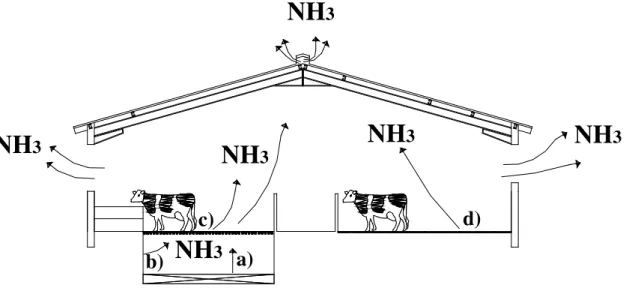
walls for excreta removal, storage tanks, and effluent superficial area which is stored below floors inside premises) may differ; in that for its estimate, it is necessary to determine emissions for each surface (Figure 1). For this purpose, the calculations must take into account the time during which a surface may be an emission source, and it may vary from a few hours at locations where urine was deposited, to continuous emissions. From effluent surface, below the floors, resistances associated with NH3 transport may include the following steps: (i) transport from effluent surface to the floor;
(ii) through the floor (iii) from the floor to the facility’s air outlet and (iv) through air outlet openings to atmospheric air (SOMMER et al., 2006). The NH3 emission from all emission sources
can be calculated by eq. (4).
d)
NH
3NH
3c)
b)
NH
3a)
NH
3NH
3NH
3FIGURE 1. Conceptual model of NH3 transport processes in dairy cattle facilities (adapted from
SOMMER et al., 2006).
In which the total NH3 flux from the facility is given by emissions from each source: (a)
(
3,g 3,A)
n 2
1
NH r r r A NH NH
1 F
3 = + ++ − (4)
where,
FNH3 - total NH3 flow;
A - NH3 emission source surface area;
r1-rn - resistances to NH3 transport between the emitting surface and free atmosphere, which
are affected by ventilation (or wind) and contact surface parameters (roughness); NH3,g - NH3 atmospheric concentration in the air layer immediately above surface, and
NH3, A - NH3 concentration in exterior environment atmosphere. However, it is common to
ignore NH3,A as its concentration is low compared to NH3,g.
NH3emission measurement in naturally ventilated facilities
In recent years a set of techniques for NH3 emission measurement in livestock facilities have
been developed and validated in field conditions, even for facility case where existing NH3
concentrations are low (DORE et al, 2004; NI & HEBER, 2008; SAMER et al., 2011, 2012). Recent studies have suggested that to quantify facility emission, ventilation flow rate and air gas concentrations emitted through the air outlet openings must be known [eq. (5)], and a key aspect to the emission rate determination is to calculate the air exchange rate in the facility (NGWABIE et al., 2009; SAMER et al., 2011). In this perspective, the NH3 emission determination from facilities
with forced ventilation is considered a standard procedure; however, in natural ventilation facilities the determination is more complex, since in forced ventilation the flow rate ventilation determination is simpler than the natural one (e.g. using anemometers) as air flow intake or exhaust are controlled by fans.
(
)
n C C CV
E in out
NH3
−
= (5)
where,
ENH3 - NH3 emission (animal mg h-1);
CV - ventilation flow rate (m3 h-1) obtained for a 24 h period;
Cin and Cout - NH3 concentrations (mg m-3) inside and outside the facility, respectively, and
n - total number of animals housed in the building.
For example, the protocol currently used in Netherlands for NH3 emission measurement from
livestock facilities specifies that they must be performed considering the airflow coming out of the facilities (ventilation flow rate or air exchange rate) and average NH3 atmosphere concentration
with the exiting air in the facilities, the NH3 emission being calculated as the product of ventilation
flow rate and average NH3 concentration (MOSQUERA et al., 2005). In the case of livestock
facilities with forced ventilation, where air emitted is extracted by the ventilation system, the protocol currently used in Netherlands specifies the use of N oxide (NOx) analyzer coupled to a
thermal NH3 converter, or a photo-acoustic gas analyzer with infrared to measure the NH3
concentrations and an airspeed sensor, placed in the ventilation system, for measuring ventilation flow rate.
Several studies have shown that for the NH3 emission measurement from naturally ventilated
livestock facilities we can use methods or techniques that are based on the ventilation flow rate estimate and NH3 concentration emitted in the air, thus obtaining the emission (DORE et al., 2004;
SAMER et al., 2011, 2012 ), or in methods that allow to estimate or quantify the NH3 flow based
on micrometeorological methods, including various configurations of flow sampling passive devices (commonly known as Ferm tubes) have shown robust results (DORE et al., 2004; PEREIRA et al., 2010).
Techniques based on the ventilation flow rate estimate
Several methods for NH3 emission measurement based on ventilation flow rate have been
used and compared, among which those that have shown more effective results and have been accepted as measurement techniques are: (i) tracer gas [eq. (6)], where there is gas application, used as tracers (i.e. krypton -85 (Kr85), sulfur hexafluoride (SF6), sulfur pentafluoride trifluoromethyl
(SF5CF3)); and (ii) mass balance (CO2) [eq. (7)] and energy (heat), in which it is assumed that the
heat and CO2 produced by the animals in the facility can be determined from previously validated
models, and these factors are used to estimate NH3 emissions by comparison (DORE et al., 2004;
TEYE & HAUTALA, 2008; NGWABIE et al., 2009; SAMER et al., 2011, 2012; SCHRADE et al., 2012). The use of tracer gas has been identified as a reliable method for estimating gaseous emissions from naturally ventilated livestock facilities, but the CO2 balance is also commonly used
(SAMER et al., 2011, 2012).
(
)
V T
c In c In
CVT 0 1
−
= (6)
where,
CVT - ventilation flow rate (m3 h-1) estimated using tracer gas (in decay);
c0 - concentration of tracer gas in time 0 (maximum) in ppm;
c1 - concentration of tracer gas in time 1 (minimum and close to detection limit) in ppm;
T - time measurement between c0 and c1 values obtained (in hours), and
V - building volume (m3).
(
)
6out in CO
CO CO
10 C C
ρ
P n CV
2
2 2
−
−
= (7)
where,
CVCO2 - ventilation flow rate (m3 h-1) estimated based on CO2 balance;
n - total number of animals housed in the facility; PCO2 - CO2 individual production by animals (g h-1);
Cin and Cout - CO2 concentrations (g m-3) inside and outside the building, respectively, and ρCO2 = CO2 density.
NH3 flow quantification
The NH3 emission quantifications also been made by using various configurations of
sampling flow passive devices, which are based on measuring NH3 flow in emission sources, for
example in livestock facilities with natural ventilation (DORE et al., 2004; PEREIRA et al., 2010) and parks and other outdoor areas (MISSELBROOK et al., 2006; NI & HEBER, 2008).
The Ferm tubes consist in the use of tube pairs arranged in series or according to the same axis, in which an air flow passes, controlled by a hole in the between the tube pair connection. In each tube a filter paper impregnated with NH3 adsorbent acid (usually sulfuric acid) is previously
introduced, allowing it to capture the NH3 flow from the air in proportion to exposure time (DORE
by numerical integration of NH3 liquid flow values obtained in each sampling area (PEREIRA et
al., 2010). The total emission from each building is calculated as the emission sum from all areas of monitored openings [eq. (8)].
∑
==
n n
0 n
n n
s n
t M a X
A
(8)
In which An (in m2) is the air gap area monitored by the device n, a (in m2) is the hole area on
the device and Xs is the device constant. The reason An/(Xs× a) is the correction factor between the
air gap area and the hole area of each device. Mn (in μg) is the NH3 net value retained on the device
(i.e. the NH3 amount collected in the leaving air flow rate minus the air flow rate entering through
the building ventilation); the NH3 flow to an air opening is given by dividing Mn by the exposure
time tn (in seconds).
Techniques to mitigate NH3 emission
NH3 emission from cattle facilities depends on several key factors including temperature, air
speed, ventilation flow rate, floor type, diet and its composition, and excreta removal system (SOMMER et al., 2006; PEREIRA et al., 2010; SCHRADE et al., 2012). Consequently, the emission originated in cattle facilities, used in livestock production systems of various European countries will be different, and higher values were observed in Portugal compared to Northern Europe countries (PEREIRA et al., 2010) (Table 1).
TABLE 1. NH3 emission factors in naturally ventilated dairy cattle facilities.
Emission Factor Country Author
20,0 g N-NH3 normal-head-1 day-1 Sweden NGWABIE et al., 2009 23,5 g N-NH3 normal-head-1 day-1 Switzerland SCHRADE et al., 2012 43,7 g N-NH3 normal-head-1 day-1 Portugal PEREIRA et al., 2010
The most effective mitigation and simple to implement techniques include associated strategies (i) excreta pre-excretion, including diets with optimized crude protein content, leading to a decrease in the N excreted amount as urea present in urine (HRISTOV et al., 2011), and increased milk production at farm level (PEREIRA, 2010), (ii) and excreta post-excretion, mainly by exchanging conditions in terms of environmental control within the premises (temperature and air speed), use of floors that lead to reduced emissions, practice introduction or additive application in the produced excreta management (SOMMER et al., 2006; NDEGWA et al., 2008; PEREIRA et al., 2013). However, some outlined above actions are sometimes difficult to implement in existing facilities for cattle because they imply high costs, potential production losses and high time and hand labor consumption. An alternative to reduce NH3 emission is periodic additive applications on
the floors/ parks and/ or effluent removal of tanks/ trenches. These additives are effective in reducing NH3 emissions, controlling the following processes: (i) NH4+adsorption capacity during
excreta decomposition, (ii) microorganism activity control through periodic additive applications being effective on excreta pH reduction, and (iii) urease enzyme activity inhibition.
Facility design
The best way to achieve a NH3 emission reduction in cattle facilities is the fast excreta
removal (mainly urine) to storage structures or treatment systems. Studies employing models to the floors scale of naturally ventilated cattle facilities showed that a solid non-angled floor led to higher emissions than slatted floor as it favored the urease enzyme contact with urine urea (PEREIRA et al., 2011).
originated from slatted and the 40% remainder from the channel or tank (OGINK & KROODSMA, 1996). Compared to a slatted floor, the 3% inclination of a solid floor reduces NH3 volatilization in
21%. Though, a solid floor with a double slope (V-shape) to a central drain (which promotes urine drainage) reduces in 50% (BRAAM et al., 1997), as well as the perforation presence in a solid floor (less than 0.5% of total floor area) reduces 46% NH3 volatilization (NDEGWA et al., 2008).
Recently, HAMELIN et al. (2010) noted that in slatted floors, a border insertion on the upper beam surface (along the length) reduces NH3 emission from 23 to 42%, because it decreases the contact
surface area between urine and beam side faces, diverting urine directly to the channel under them. Furthermore, the combination of floor cleaning (scraping and/or washing) and urine drainage to a central drain reduces emission in 65%, when compared to slatted floor (BRAAM et al., 1997, SOMMER et al., 2006). NH3 emission is decreased by about 50% in inclined solid floors, compared
to slatted floor, and in addition, the top coat type applied to the floor surface does not significantly affect these emissions, because it has no effect on urease activity (SWIERSTRA et al., 1995). However, the flat top coat in angled floors can facilitate urine run-off, which may lead to smaller losses by NH3 volatilization.
Changing flooring type or urine-feces separating systems, aiming to reduce NH3 emissions,
must be planned regarding to the farm profitability, because they have great costs, so it seems like a more viable solution to be adopted in new facility designs or rehabilitation of existing ones.
On the other hand, it has been shown, in several studies, that air speed and temperature decrease, or floor cooling, lead to significant NH3 emission reduction from the emitting surface
(floors or tanks), due to these two factors having significant effect on NH3 convective mass transfer
(RONG et al., 2009). Because cattle facilities are naturally ventilated particularly through openings for air renewal of large dimensions, such as it occurs in Portugal. It is very difficult to maintain a regular ventilation flow rate, which does not make practical the air speed control as a NH3 emission
measure reduction (PEREIRA et al., 2010). Similarly, temperature control in naturally ventilated cattle facilities is quite difficult to achieve, because the temperature inside the premises depends on daily and seasonally outdoor fluctuations. However, positioning the air entrance openings, or placing curbs (1-1.5 m high) on floor level to prevent the direct hitting of the air flow and the floors (and/or tanks), can lead to NH3 emission reduction in about 52% of a solid V-shaped floor
(SWIERSTRA et al., 1995).
Effluent management
Studies conducted in dairy cattle facilities of Northwest Portugal (PEREIRA et al., 2010, 2011, 2012) suggest that, for temperature values between 5 and 25 ºC, NH3 emissions are
particularly important at times of the year when high temperatures occur (spring/summer), or in countries with temperate climates (average annual temperature between 15 and 25 ºC). Particularly, PEREIRA et al. (2010) showed that NH3 emissions from uncovered areas of dairy cattle facilities
accounted for between 69 and 92% of housing system total NH3 emissions (indoor and outdoor
areas). Consequently, these same studies suggest that additional mitigation measures should be introduced under these conditions compared to Northern Europe countries.
As ways of reducing NH3 emissions, it appears that frequent excreta scrape of non-inclined
solid floor will have lower effect on NH3 volatilization because a thin film remains, which is a
significant NH3 emission source (KROODSMA et al., 1993; BRAAM et al., 1997). The scraping
followed by washing with pressurized water has been shown very effective to reduce NH3 emission
(MISSELBROOK et al., 2006), but it has the disadvantage of leading to increased effluent volume, unless treated wastewater is reused (partially or fully) for facility washing. Nevertheless, the mix of floor type and cleaning frequency (washing and/or scraping) results in more effective NH3 emission
reduction.
(i) NH4+adsorption capacity during excreta decomposition: clinoptilolite application (zeolite type clay mineral) has a potential for reducing NH3 emissions greater than 60% (NDEGWA et al.,
2008).
(ii) microorganism activity control through periodic additive application effective on (1) reducing excreta pH, in particular: (a) dilute sulfuric acid solution, lowering pH to 5.5, reducing 85% NH3 volatilization (NDEGWA et al., 2008); (b) aluminum sulfate reducing 98% NH3
emissions when applied to floors, and (c) diluted aluminum chloride solution allowing 52% NH3
emission reduction, in addition mitigating odors and phosphorus solubilization (SMITH et al., 2004); or additives effective as (2) disinfectant, reducing microbial activity, as in formaldehyde diluted solution, which when applied to solid and slatted floors (tilted) has a potential to reduce NH3 emissions by 50% and 80%, respectively (OGINK & KROODSMA, 1996).
(iii) inhibition of the urease enzyme activity by periodically applying NBPT solution [N-(N-butyl) thiophosphoric triamide] on the floor, has proven to be a very effective technique for reducing NH3 emission of outdoor parks (around 65%) and dairy cattle facilities (by 40-50%)
(NDEGWA et al., 2008; MISSELBROOK et al., 2006; PEREIRA, 2010).
For effective NH3 emission reductions from dairy cattle facilities in Portugal we suggest that
the implementation of any mitigation measures take place, firstly, in Spring and Summer and in the facility uncovered areas, because they have the largest emission sources. Nonetheless, this reduction must be cautiously made and integrated at farm level, as the emission reduction in one step (facilities, storage or land application) can increase emissions in remaining steps of effluent management or even losses due to nitrate ion leaching.
CONCLUSIONS
NH3 volatilization is the result of biochemical processes of excreta decomposition deposited
on the floors of dairy cattle facilities and NH3 emission results from very complex physical
processes commanded primarily by temperature, surface area, emission source exposure and air speed. Secreted compounds, transformation processes, and NH3 emission regulation mechanisms
identification in facilities allows the control of NH3 losses. NH3 emissions in cattle facilities can be
monitored using tracer gas, Ferm tubes and CO2 balance. The mitigation technique implementation,
identified in this study, will contribute to animal livestock sustainability and applicable regulation compliance; however, there is limited number of studies published for warmer climate conditions than Northern Europe, such as Portugal, in which technical actions to reduce NH3 emissions should
be evaluated.
ACKNOWLEDGEMENTS
This work was supported by European Union Funds (QREN/FEDER), under the project Ovislab ICT-2013-05-004-5314 ID-64757, and by national funds by FCT - Portuguese Foundation for Science and Technology, under the project PEst-OE/AGR/UI4033/2014 and project PTDC/AGR-PRO/119428/2010.
REFERENCES
BRAAM, C.R.; KETELAARS, J.J.M.H.; SMITS, M.C.J. Effects of floor design and floor cleaning on ammonia emission from cubicle houses for dairy cows. Netherlands Journal of Agricultural Science, Wageningen, v.45, n.1, p.49-64, 1997.
DORE, C.J.; JONES, B.M.R.; SCHOLTENS, R.; HUIS IN`T VELD, J.W.H.; BURGESS, L.R.; PHILLIPS, V.R. Measuring ammonia emission rates from livestock buildings and manure stores - Part 2: Comparative demonstrations of three methods on the farm. Atmospheric Environment, Oxford, v.38, n.19, p.3017-3024, 2004.
FURTADO, D.A.; ROCHA, H.P.; NASCIMENTO, J.W.B.; SILVA, J.H.V. Índices de conforto térmico e concentração de gases em galpões avícolas no semiárido Paraibano. Engenharia Agrícola, Jaboticabal, v.30, n.6, p.993-1002, 2010.
HAMELIN, L.; GODBOUT, S.; THÉRIAULT, R.; LEMAY, S.P. Evaluating ammonia emission potential from concrete slat designs for pig housing. Biosystems Engineering, San Diego, v.105, n.4, p.455-465, 2010.
HRISTOV, A.N.; HANIGAN, M.; COLE, A.; TODD, R.; MCALLISTER, T.A.; NDEGWA, P.M.; ROTZ, A. Review: Ammonia emissions from dairy farms and beef feedlots. Canadian Journal of Animal Science, Ontario, v.91, n.1, p.1-35, 2011.
KROODSMA, W.; HUIS IN’T VELD, J.W.H.; SCHOLTENS, R. Ammonia emission and its reduction from cubicle houses by flushing. Livestock Production Science, Amsterdam, v.35, n.3-4, p. 293-302, 1993.
MELSE, R.W.; OGINK, N.W.M.; RULKENS, W.H. Overview of European and Netherlands’ regulations on airborne emissions from intensive livestock production with a focus on the application of air scrubbers. Biosystems Engineering, San Diego, v.104, n.3, p.289-298, 2009. MISSELBROOK, T.H.; WEBB, J.; GILHESPY, S.L. Ammonia emissions from outdoor concrete yards used by livestock - quantification and mitigation. Atmospheric Environment, Oxford, v.40, n.35, p.6752-6763, 2006.
MOSQUERA, J.; MONTENY, G.J.; ERISMAN, J.W. Overview and assessment of techniques to measure emissions from animal houses: The case of the Netherlands. Environmental Pollution, Oxon, v.135, n.3, p.381-388, 2005.
NDEGWA, P.M.; HRISTOV, A.N.; AROGO, J.; SHEFFIELD, R.E. A review of ammonia emission mitigation techniques for concentrated animal feeding operations. Biosystems Engineering, San Diego, v.100, n.4, p.453-469, 2008.
NGWABIE, N.M.; JEPPSSON, K.-H.; NIMMERMARK, S.; SWENSSON, C.; GUSTAFSSON, G. Multi-location measurements of greenhouse gases and emission rates of methane and ammonia from a naturally-ventilated barn for dairy cows. Biosystems Engineering, San Diego, v.103, n.1, p.68-77, 2009.
NI, J.Q.; HEBER, A.J. Sampling and measurement of ammonia at animal facilities. Advances in Agronomy, San Diego, v.98, n.1, p.201-269, 2008.
OGINK, N.W.M.; KROODSMA, W. Reduction of ammonia emission from a cow cubicle house by flushing with water or a formalin solution. Journal of Agricultural Engineering Research, San Diego, v.63, n.3, p.197-204, 1996.
PEREIRA, J.L.S. Emissões de amoníaco e de gases com efeito de estufa erm instalações e gestão de efluentes de bovinicultura no NW de Portugal. 2010. 193 f. Tese (Doutorado em Engenharia Rural) - Universidade de Trás-os-Montes e Alto Douro, Vila Real, 2010.
PEREIRA, J.; BARNEZE, A.S.; MISSELBROOK, T.H.; COUTINHO, J.; MOREIRA, N.; TRINDADE, H. Effects of a urease inhibitor and aluminium chloride alone or combined with a nitrification inhibitor on gaseous N emissions following soil application of cattle urine. Biosystems Engineering, San Diego, v.115, n.4, p.396-407, 2013.
PEREIRA, J.; MISSELBROOK, T.H.; CHADWICK, D.R.; COUTINHO, J.; TRINDADE, H. Ammonia emissions from naturally ventilated dairy cattle buildings and outdoor concrete yards in Portugal. Atmospheric Environment, Oxford, v.44, n.28, p.3413-3421, 2010.
PEREIRA, J.; MISSELBROOK, T.H.; CHADWICK, D.R.; COUTINHO, J.; TRINDADE, H. Effects of temperature and dairy cattle excreta characteristics on potential ammonia and greenhouse gas emissions from housing: A laboratory study. Biosystems Engineering, San Diego, v.112, n.2, p.138-150, 2012.
RONG, L.; NIELSEN, P.V.; ZHANG, G. Effects of air flow and liquid temperature on ammonia emission surface: Experimental study on emission rate. Bioresource Technology, Oxon, v.100, n.20, p.4654-4661, 2009.
SAMER, M.; AMMON, C.; LOEBSIN, C.; FIEDLER, M.; BERG, W.; SANFTLEBEN, P.; BRUNSCH, R. Moisture balance and tracer gas technique for ventilation rates measurement and greenhouse gases and ammonia emissions quantification in naturally ventilated buildings. Building and Environment, Oxford, v.50, n.1, p.10-20, 2012.
SAMER, M.; LOEBSIN, C.; FIEDLER, M.; AMMON, C.; BERG, W.; SANFTLEBEN, P.; BRUNSCH, R. Heat balance and tracer gas technique for air flow rates measurement and gaseous emissions quantification in naturally ventilated livestock buildings. Energy and Buildings,
Lausanne, v.43, n.12, p.3718-3728, 2011.
SCHRADE, S.; ZEYER, K.; GYGAX, L.; EMMENEGGER, L.; HARTUNG, E.; KECK, M. Ammonia emissions and emission factors of naturally ventilated dairy housing with solid floors and an outdoor exercise area in Switzerland. Atmospheric Environment, Oxford, v.47, n.1, p.183-194, 2012.
SMITH, D.R.; MOORE JR., P.A.; HAGGARD, B.E.; MAXWELL, C.V.; DANIEL, T.C.;
VANDEVANDER, K.; DAVIS M.E. Effect of aluminium chloride and dietary phytase on relative ammonia losses from swine manure. Journal of Animal Science, Champaign, v.82, n.2, p.605-611, 2004.
SOMMER, S.G.; ZHANG, G.Q.; BANNINK, A.; CHADWICK, D.; MISSELBROOK, T.; HARRISON, R.; HUTCHINGS, N.J.; MENZI, H.; MONTENY, G.J.; NI, J.Q.; OENEMA, O.; WEBB, J. Algorithms determining ammonia emission from buildings housing cattle and pigs and from manure stores. Advances in Agronomy, San Diego, v.89, n.1, p.261-335, 2006.
SWIERSTRA, D.; SMITS, M.C.J.; KROODSMA, W. Ammonia emission from cubicle houses for cattle with slatted and solid floors. Journal of Agricultural Engineering Research, San Diego, v.62, n.2, p.127-132, 1995.