UNIVERSITY OF BRASILIA
FACULTY OF TECHNOLOGY
DEPARTMENT OF CIVIL AND ENVIRONMENTAL
ENGINEERING
ANALYSIS OF GEOSYNTHETIC ENCASED COLUMNS IN
VERY SOFT SOIL
NIMA ROSTAMI ALKHORSHID
SUPERVISOR: GREGÓRIO LUIS SILVA ARAUJO, DSc
CO-SUPERVISOR: ENNIO MARQUES PALMEIRA, PhD
A THESIS SUBMITTED FOR THE DEGREE OF DOCTOR OF
SCIENCE IN GEOTECHNICS
PUBLICATION: G.TD-133/17
ii
FACULTY OF TECHNOLOGY
DEPARTMENT OF CIVIL AND ENVIRONMENTAL
ENGINEERING
ANALYSIS OF GEOSYNTHETIC ENCASED COLUMNS IN
VERY SOFT SOIL
NIMA ROSTAMI ALKHORSHID
THESES OF PhD SUBMITTED TO THE DEPARTMENT OF CIVIL ENGINEERING OF THE UNIVERSITY OF BRASILIA AS PART OF THE NECESSARY REQUIREMENTS TO OBTAIN THE DEGREE OF DOCTOR OF SCIENCE.
APROVED BY:
_________________________________________ GREGÓRIO LUIS SILVA ARAUJO, D.Sc. (UnB) (SUPERVISOR)
_________________________________________ ENNIO MARQUES PALMEIRA, Ph.D. (UnB) (CO-SUPERVISOR)
_________________________________________
JUAN FELIX RODRIGUEZ REBOLLEDO D.Sc. (UnB) (INTERNAL EXAMINER)
_________________________________________ MARCOS MASSAO FUTAI, D.Sc. (USP)
(EXTERNAL EXAMINER)
_________________________________________ CARLOS MEDEIROS SILVA, D.Sc. (EMBRE) (EXTERNAL EXAMINER)
iii
CATALOGUING DATA
ALKHORSHID, NIMA ROSTAMI
Analysis of Geosynthetic Encased Columns in Very Soft Soil. Distrito Federal, 2017.
xxvii, 147 p., 210x297 mm (ENC/FT/UnB, Doctor of Science, Geotechnics, 2017).
Doctoral thesis – University of Brasilia, Faculty of Technology, Department of Civil and Environmental Engineering.
1. Geosynthetics 2. Granular columns 3. Very soft soil 4. Embankment I. ENC/FT/UnB II. Title (series)
BIBLIOGRAPHIC REFERENCE
ALKHORSHID, N.R (2017). Analysis of Geosynthetic Encased Columns in Very Soft Soil. Tese de Doutorado, Publicação G.TD-133/17, Departamento de Engenharia Civil e Ambiental, Universidade de Brasília, Brasília, DF,128 p.
CESSÃO DE DIREITOS
NOME DO AUTOR: Nima Rostami Alkhorshid
TÍTULO DA TESE DE DOUTORADO: Analysis of Geosynthetic Encased Columns in Very Soft Soil.
GRAU / ANO: Doutor / 2017.
É concedida à Universidade de Brasília a permissão para reproduzir cópias desta dissertação de mestrado e para emprestar ou vender tais cópias somente para propósitos acadêmicos e científicos. O autor reserva outros direitos de publicação e nenhuma parte desta dissertação de mestrado pode ser reproduzida sem a autorização por escrito do autor.
Nima Rostami Alkhorshid
EQN 410/ 411 BLOCO A, Apartamento 86 Bairro: Asa Norte
iv
DEDICATION
To My grandfather, Barani Rostami Alkhorshid, that passed away in 2014, who is always a man that I look up to.
To my love, Mahshid Ghasemi Boroon, that I am everlastingly indebted for all the sacrifices she did during my PhD.
Last but not least, to my parents, Esmaeil Rostami Alkhorshid and Zarin taj Bijani, who are always my role models.
Do not fear to be eccentric in opinion,
For every opinion now accepted was once eccentric.
v
ACKNOWLEDGMENT
It has been a great honor to be part of the geotechnical program at the University of Brasilia. Thus I would like to express my special gratitude for the help I received from the faculty members.
To Prof. Gregório Luis Silva Araujo, my supervisor, for stamina, devotion, friendship, assistance and other qualities that contributed a lot to the development of this thesis. I am thankful for all his suggestions that came from his acquaintance with my study.
To Prof. Ennio Marques Palmeira, my co-supervisor, who has willingly supported my work and gave me precious suggestions throughout this study.
To Prof. Renato Pinto da Cunha, who has been my dear friend since day one in Brazil and I have learned so many things from him. Thanks for being a member of my qualifying exam.
To professors, Juan Felix Rodriguez Rebolledo, Carlos Medeiros Silva, Marcos Massao Futai for their participation and contributions in my defense. Undoubtedly, your suggestions were of paramount importance for the improvement of this thesis.
To the technicians of the laboratory of the department of mechanical engineering, specially to Mr. Artur for making the pieces which were used during this work.
To the technicians of the laboratory of geotechnics, Mr. Adolfo, Saimon, Thiago, Jonas, Mr. João for the help I received from them.
To CNPq and the University of Brasilia, for financial support.
To Huesker LTDA, especially Eng. André Estêvão Silva, for providing the materials that were needed for this study and also for his great help in the development of this work.
To Mr. Moacyr for his assistance on providing the pieces which were needed for starting the laboratory experiments.
vi
ABSTRACT
Soft soils, commonly, can be encountered in coastal areas. Thus, embankment construction on these problematic soil is always a challenge for geotechnical engineers. There are several soil improvement techniques to overcome these challenges. Granular columns is one of the popular techniques for supporting embankments. When it comes to very soft soils, the application of granular columns is almost impossible, because of the low confinement provided by the surrounding soil. Geosynthetic encased granular columns is a recently developed technique that has been successfully used in various embankment projects dealing with soft soils.
This research aimed at studying the performance of encased columns with different types of the encasement and column materials. Instrumented large scale laboratory tests as well as numerical analysis using the Finite Element Method were carried out. Three types of column material (sand, gravel and construction waste) and also three types of woven geotextile (G-1, G-2 and G-3) with different tensile stiffness were tested. The tests were performed with and without encasement to evaluate the efficiency of the former in increasing the load bearing capacity of the columns. The influence of the displacement installation method on the surrounding soil was also studied. In addition, the role of columns in dissipating excess pore water pressures and imposing lateral pressures to the surrounding soil was evaluated. Finally, the back analysis of the laboratory tests and also analysis of a full-scale embankment, using the Finite Element Method, were conducted.
The laboratory tests indicated that the role of encasement in very soft soils is of paramount importance, since it considerably improved the column performance. It was also observed that the displacement installation method generated excess pore water pressures and caused consolidation of the surrounding soil. The back analyzed results showed good agreement with the tests results. Ultimately, the full scale analysis of an embankment indicated that the columns which were close to the middle of embankment presented larger settlements than those under the embankment slope, which were mainly affected by lateral deflection.
vii
RESUMO
De uma forma geral, parte das as áreas costeiras são cobertas por solos moles. Assim, a construção do aterro sobre esses solos problemáticos é sempre um desafio para engenheiros geotécnicos. Existem várias técnicas de melhoria dos solos para superar esses desafios. Nesse contexto, as colunas granulares têm apresentado sucesso para esse tipo de construção. Para solos muito moles, a aplicação de colunas granulares é de difícil execução e rendimento, tendo em vista o baixo confinamento lateral na parte superior da coluna. As colunas granuladas encamisadas com geossintéticos são uma técnica recentemente desenvolvida que tem sido utilizada com sucesso em vários projetos de aterros sobre solos moles.
Esta pesquisa teve como objetivo estudar o desempenho de colunas encamisadas com diferentes tipos de materiais de encamisamento e de preenchimento das colunas. Para realizar isso, foram realizados testes laboratoriais em grande escala e também análises numéricas usando o Método dos Elementos Finitos. Foram utilizados três tipos de material de coluna (areia, brita e resíduos de construção) e também três tipos de geotêxtil tecido (G-1, G-2 e G-3) com diferentes valores de rigidez à tração. Os ensaios foram realizados com e sem encamisamento para avaliar a sua eficiência no aumento da capacidade de carga das colunas. A influência do método de instalação de vibro-deslocamento no solo circundante também foi estudada. Além disso, avaliou-se o papel das colunas na dissipação do excesso de poropressão e na pressão lateral imposta ao solo circundante. Finalmente, foram realizadas as análises dos testes laboratoriais e também a análise de uma simulação em escala real do aterro por meio do Método dos Elementos Finitos.
Baseando-se nos resultados obtidos, os ensaios de laboratório indicaram que o papel do encamisamento em solos muito moles é de grande importância, pois melhorou consideravelmente o desempenho da coluna. Foi observado também que o uso de colunas de brita e de resíduo de construção aumentou a capacidade de carga comparando com a das colunas de areia, que método de instalação de deslocamento gerou excesso de poropressão e causou a densificação do solo circundante. Por sua vez, os resultados das análise numéricas mostraram boa concordância com os resultados obtidos nos ensaios. A análise numérica em escala real de um aterro indicou que as colunas próximas do meio do aterro sofriam mais recalque e que as colunas que estavam sob a talude do aterro foram mais afetadas pela deflexão lateral.
viii
TABLE OF CONTENTS
TABLE OF CONTENTS ... viii
LIST OF TABLES ... xi
LIST OF FIGURES ... xii
1. INTRODUCTION ... 1 1.1. PROBLEM STATEMENT ... 1 1.2. OBJECTIVES OF STUDY ... 2 1.3. THESIS OUTLINE ... 2 2. LITERATURE REVIEW ... 3 2.1. INTRODUCTION ... 3
2.2. INVESTIGATION OF GRANULAR COLUMN ... 5
2.2.1. BASIC CONCEPT (UNIT CELL) ... 5
2.2.2. FAILURE MODES ... 6
2.2.3. SMEAR ZONE ... 8
2.3. GEOSYNTHETIC ENCASED GRANULAR COLUMNS (GEC)... 9
2.3.1. CASE STUDIES (ALEXIEW ET AL., 2015) ... 10
2.3.2. ANALYTICAL METHODS ... 20
2.3.3. EXPERIMENTAL STUDIES ... 24
2.4. INSTALLATION METHOD ... 28
2.4.1. REGULAR INSTALLATION METHODS... 28
2.4.2. SPECIFIC INSTALLATION METHODS ... 29
2.5. NUMERICAL SIMULATIONS ... 30
2.5.1. FINITE ELEMENT METHODS PROGRAM ... 30
3. METHODOLOGY ... 34
3.1. MATERIALS ... 34
3.1.1. COLLECTED SOIL ... 34
ix
3.1.3. GEOTEXTILE ... 43
3.2. SOIL PASTE AND BOX PREPARATION ... 48
3.3. COLUMN INSTALLATION ... 49 3.4. INSTRUMENTATION ... 51 3.4.1. ACQUISITION SYSTEM ... 52 3.4.2. LOAD CELL ... 53 3.4.3. DISPLACEMENT TRANSDUCER ... 54 3.4.4. PRESSURE CELL ... 55 3.4.5. PIEZOMETER ... 56 3.4.6. PREPARATION ... 58 3.5. SMALL COLUMNS ... 58
3.6. LARGE COLUMN LOADING AND TEST COMPLETION ... 60
4. OBTAINED RESULTS OF MODEL TESTS ... 62
4.1. SETTLEMENT AND BEARING CAPACITY ... 62
4.1.1. CONVENTIONAL COLUMN ... 62
4.1.3. ENCASED SAND COLUMN ... 63
4.1.4. ENCASED GRAVEL COLUMN ... 65
4.1.5. ENCASED CW COLUMN ... 67
4.2. LATERAL BULGING ... 70
4.3. LATERAL EARTH PRESSURE... 72
4.4. SMEAR ZONE AND UNDRAINED SHEAR STRENGTH ... 75
4.5. EXCESS PORE WATER PRESSURE ... 80
4.6. FAILURE MECHANISM ... 84
4.7. NUMERICAL SIMILATION (BACK ANALYSIS) ... 88
4.7.1. CONVENTIONAL COLUMN ... 91
4.7.2. ENCASED SAND COLUMNS ... 92
x
4.7.4. ENCASED CW COLUMN ... 93
4.7.5. LATERAL BULGING ... 94
4.7.6. EXCESS PORE WATER PRESSURE ... 95
4.7.7. FAILURE MECHANISM ... 99
4.8. NUMERICAL FULL SCALE ANALYSIS ... 102
4.8.1. SETTLEMENT ... 106
4.8.2. LATERAL DEFLECTION ... 109
4.8.3. EXCESS PORE WATER PRESSURE ... 111
4.8.4. SAFETY FACTOR ... 113
5. CONCLUSIONS AND RECOMMENDATIONS ... 115
5.1. CONCLUSIONS ... 115
5.2. RECOMMENDATIONS ... 117
REFERENCES ... 118
APPENDIX ... 123
A. LOAD CELL CALIBRATION ... 124
B. DISPLACEMENT TRANSDUCER ... 125
C. PIEZOMETER ... 126
xi
LIST OF TABLES
Table 2.1. Parameters of foundation soil (Alexiew et al., 2015). ... 11
Table 3.1. Soil parameters……….36
Table 3.2. Properties of the soil used in model test. ... 36
Table 3.3. Permeability of the soil. ... 37
Table 3.4. Parameters of particle size distribution. ... 40
Table 3.5. Peak friction angle of the column materials. ... 42
Table 3.6. Properties of woven geotextile. ... 44
Table 3.7. Seam properties of G-1. ... 46
Table 3.8. Seam properties of geotextiles. ... 46
Table 4.1. Particle breakage index for the encased gravel and CW column……….88
Table 4.2. Material parameters used in numerical modeling. ... 90
Table 4.3. Scale factors for laboratory large scale tests. ... 103
xii
LIST OF FIGURES
Figure 2.1. Ground improvement methods (modified from Schaefer et al., 2012; Han, 2015). 3 Figure 2.2. Granular column installation; (a) displacement method and (b) excavation method
(Huesker company, 2012). ... 4
Figure 2.3. Arrangement of columns. ... 6
Figure 2.4. The bulging failure of sand column (Hughes & Withers, 1974). ... 7
Figure 2.5. Failure styles of single granular column (Barksdale & Bachus, 1983). ... 7
Figure 2.6. Failure styles of granular columns under embankment (Barksdale & Bachus, 1983). ... 8
Figure 2.7. Smear zone around column. ... 9
Figure 2.8. Embankment with geosynthetic on GEC (Raithel 1999, 2000 and EBGEO 2011). ... 10
Figure 2.9. The sketch of project (Alexiew et al., 2015). ... 11
Figure 2. 10. The settlement on the GEC (Alexiew et al., 2015). ... 12
Figure 2.11. The changes in excess pore water pressure during construction of embankment (Alexiew et al., 2015). ... 12
Figure 2.12. The location of dike and polder (Raithel et al., 2002). ... 13
Figure 2.13. Cross section profile (Raithel et al., 2002). ... 13
Figure 2.14. Ground strata profile (Raithel et al., 2002). ... 14
Figure 2.15. Undrained shear strength measurements (Raithel et al., 2002). ... 15
Figure 2.16. Settlement versus embankment load with time (Alexiew et al., 2015). ... 15
Figure 2.17. Cross section of embankment reinforced by GEC (Alexiew et al., 2015). ... 16
Figure 2.18. Parameters of soil layers (Alexiew et al., 2015). ... 17
Figure 2.19. Settlement of embankment with time (Alexiew et al., 2015). ... 18
Figure 2.20. Railroad cross section (Alexiew et al., 2015). ... 19
Figure 2.21. Settlement development (Alexiew et al., 2015). ... 19
Figure 2.22. Settlement development during and after the construction (Alexiew et al., 2015). ... 20
Figure 2.23. Analytical model for “Geotextile Encased Columns”, simplified picture after Raithel & Kempfert (2000). ... 22
Figure 2.24. Sketch of the load test (Sharma et al., 2004). ... 24
Figure 2.25. Small scale tests (Gniel & Bouazza, 2009). ... 25
xiii
Figure 2.27. (a) Schematic view of the single granular column foundation and (b) schematic view of foundation with group of granular columns. All dimensions are in millimeters (Ali et
al., 2014). ... 27
Figure 2.28. Replacement method (Gniel, 2009). ... 29
Figure 2.29. Displacement Method (Gniel, 2009). ... 29
Figure 2.30. Cast-in place method (Hong et al., 2016). ... 30
Figure 3.1.Particle size distribution of the soil: (a) without dispersing agent and (b) with dispersing agent……….35
Figure 3.2. Consolidation test of soil. ... 37
Figure 3.3. Column materials: (a) gravel and (b) CW. ... 38
Figure 3.4. Particle sized distribution of column materials: (a) sand, (b) gravel and (c) CW. 39 Figure 3.5. Use of non-woven geotextile to seal the bottom of encasement. ... 40
Figure 3.6. Apparatus of medium scale direct shear test. ... 41
Figure 3.7. Direct shear test: (a) sand, (b) gravel and (c) CW. ... 43
Figure 3.8. Sample test preparation for wide strip tensile tests. ... 45
Figure 3.9. Seam types for sewing. ... 45
Figure 3.10. Test results of butterfly seam for G-1. ... 46
Figure 3.11. Test results of flat seam for G-2. ... 47
Figure 3.12. Test results of flat seam for G-3. ... 47
Figure 3.13. Preparation of the box for the tests. ... 48
Figure 3.14. Placing the soft soil into the box. ... 49
Figure 3.15. Installation of Column: (a) pipe insertion and (b) pipe removal. ... 50
Figure 3.16. Use of the wood casing for pipe insertion. ... 50
Figure 3.17. Column preparation and installation procedures. ... 51
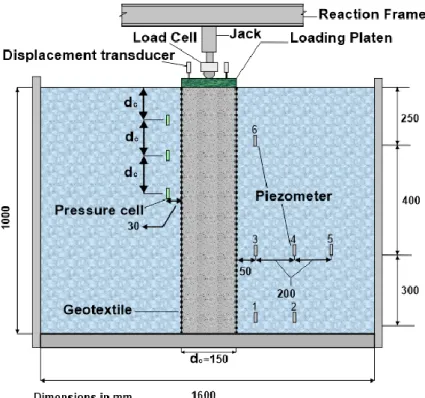
Figure 3.18. Schematic of the load test on GEC. ... 52
Figure 3.19. Acquisition system. ... 53
Figure 3.20. Configuration of the full bridge connection for load cell (Lynx manual, 2005). 53 Figure 3.21. Calibration of load cell. ... 54
Figure 3.22. Load cells: (a) LC-1 and (b) LC-2. ... 54
Figure 3.23. Calibration of Displacement transducer. ... 55
Figure 3.24. (a) Pressure cell calibration, (b) pressure application system and (c) air/water interface. ... 56
Figure 3.25. Calibration of piezometer. ... 57
xiv
Figure 3.27. Porous stone installed into laboratory tubing. ... 57
Figure 3.28. (a) Soft soil surface and (b) soil surface covered by plastic sheets. ... 58
Figure 3.29. Compressibility test (a) G-1 and (b) G-2. ... 59
Figure 3.30. Failure of the small columns due to loading at seam. ... 59
Figure 3.31. Loading test on small columns. ... 60
Figure 3.32. Footing area of the loading tests. ... 61
Figure 3.33. Footing area after loading test: (a) loading platen situation, (b) column surface after removing the loading platen and (c) column surface after removing water. ... 61
Figure 4.1. Settlement behavior of conventional columns under loading……….63
Figure 4.2. Settlement behavior of encased sand column under loading. ... 64
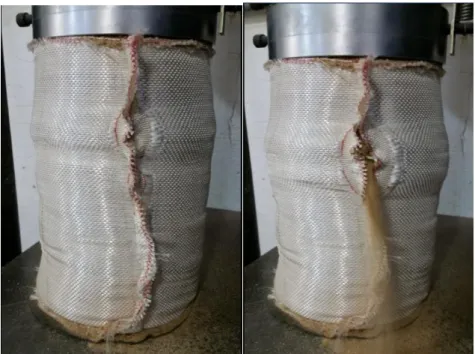
Figure 4.3. Encased column after loading test: (a) G-2 and (b) G-1. ... 64
Figure 4.4. Ultimate bearing capacity for different types of geotextile for encased sand column. ... 65
Figure 4.5. Settlement behavior of encased gravel column under loading. ... 66
Figure 4.6. Ultimate bearing capacity for different types of geotextile for encased gravel column. ... 67
Figure 4.7. Settlement behavior of encased CW column under loading. ... 68
Figure 4.8. Ultimate bearing capacity for different types of geotextile for encased CW column. ... 68
Figure 4.9. Ultimate bearing capacity of the encased and conventional column. ... 69
Figure 4. 10. Bearing capacity at the settlement value (50 mm). ... 69
Figure 4.11. Lateral bulging for different depths: (a) G-1, (b) G-2 and (c) G-3. ... 71
Figure 4.12. Tensile force distribution versus height for sand columns. ... 72
Figure 4.13. (a) Lateral pressure beside the column and (b) coefficient of lateral earth pressure (at depth of 15 cm) for encased sand column. ... 73
Figure 4.14. Lateral earth pressure due to column installation method. ... 74
Figure 4.15. Appearance of soil suction on soil surface; (a) encased sand column and (b) encased gravel column. ... 75
Figure 4.16. Extension rod for vane shear test. ... 76
Figure 4.17. Locations of vane shear tests at four sides of column. ... 77
Figure 4.18. Standard deviation of the vane shear test results: (a) friction, (b) before installation, (c) after installation and (d) after dissipation of excess pore water pressure. ... 79
Figure 4.19. Undrained shear strength for different sets of tests. ... 80
xv
Figure 4.21. Hydrostatic pressure inside soil paste. ... 81
Figure 4.22. Dissipation of excess pore water pressure. ... 83
Figure 4.23. Failure mechanism of encased column. ... 85
Figure 4.24. Sections of the column for sieving. ... 85
Figure 4.25. Particle size distribution of gravel before and after loading. ... 86
Figure 4.26. Particle size distribution of CW before and after loading. ... 86
Figure 4.27. Axisymmetric modeling of the large scale tests: (a) 2D modeling and (b) 3D modeling. ... 89
Figure 4.28. Back analysis results of the loading tests: (a) 2D analysis and (b) 3D analysis. . 91
Figure 4.29. Comparison of the loading tests and numerical results for encased sand column. ... 92
Figure 4.30. Comparison of the loading tests and numerical results for encased gravel column. ... 93
Figure 4.31. Comparison of the loading tests and numerical results for encased CW column. ... 94
Figure 4.32. Maximum lateral bulging for different types of geotextile: (a) 2D analysis and (b) 3D analysis. ... 95
Figure 4.33. Excess pore water pressure during loading test: (a) 2D analysis and (b) 3D analysis. ... 97
Figure 4.34. Prediction of excess pore water pressure around the column by Soft Soil and Cam-Clay model. ... 97
Figure 4.35. Excess pore water pressure around the column and on the soil surface after loading. ... 98
Figure 4.36. Soil surface after the loading test: (a) column surface with the loading platen and (b) column surface after removing the loading platen. ... 99
Figure 4.37. Failure mechanism; (a) horizontal displacement of the column materials, (b) distribution of failure points along the column and (c) shear zones of the column. ... 101
Figure 4.38. Rupture of the soil surface around the column after the loading: (a) tension cut-off points and (b) cracks around the column. ... 102
Figure 4.39. Modelling of embankment reinforced by encased columns. ... 104
Figure 4.40.Generated mesh in PLAXIS 3D. ... 104
Figure 4.41. Reinforcement at the top of the columns. ... 105
xvi
Figure 4.43. (a) Embankment construction stress, (b) Settlement of point A and (c) Settlement
of point B. ... 107
Figure 4.44. (a) Settlement at point A and B for different geotextiles and (b) Difference between settlement on top of column and adjacent soil. ... 109
Figure 4.45. Lateral deflection of encased columns. ... 109
Figure 4.46. Lateral deflection of the columns for G-1. ... 110
Figure 4.47. Maximum lateral deflection for encased and conventional column. ... 111
Figure 4.48. Points of interest for measuring excess pore water pressure. ... 111
Figure 4.49. (a) Development and dissipation of the excess pore water pressure for conventional and encased (G-1) column and (b) Maximum value of excess pore water pressure for encased (G-1, G-2 and G-3) and conventional column. ... 113
Figure 4.50. Safety factor of the embankment for encased and conventional columns. ... 114
xvii
LIST OF ABBREVIATIONS AND SYMBOLS
2D: Two dimensional 3D: Three dimensional
ABNT: Brazilian Association of Technical Standards Ar: Area replacement ratio
Bg: Breakage index of coarse-grained materials
cʹ: Effective cohesion
C4, C5: Material/geometrical constants
Cc: Compression index
cg: Constant coefficient related to columns arrangement
Cs: Swelling index
de: Diameter of the unit cell
DSS: Direct Simple Shear Eʹ: Young’s modulus EA: Tensile stiffness Eoed: Oedometer modulus
Eoed,s: Oedometric modulus of soft soil
fm: Physical measures that are relate to the model
fP: Physical measures that are related to the prototype
FR: Circumferential force
g: Gravity acceleration
GEC: Geosynthetic Encased Columns H: Column height
Jg: Tensile stiffness,
K0,s: Coefficient of lateral earth pressure at rest for soft soil
Ka,c: Coefficient of active earth pressure
Ka,c: Coefficient of active earth pressure of column
Kψ: Dilation constant
L: Encasement length, LC: Load cell
NCL: Normal consolidation line OCL: Over-consolidation line OCR: Over consolidation ratio.
xviii Pgeo: Pressure contributed by the encasemen
PʹL: Effective stress
qA: Applied vertical distributed load
rc: Sand cutting radius, internal to the geotextile
rgeo: Initial radius of geotextile
s: Distance between adjacent columns SE: Seam strength efficiency
SF: Safety factor
Su: Undrained shear strength.
TC: Triaxial Compression TE: Triaxial Extension tg: Encasement thickness
Tg: Tensile strength,
Tseam: Wide width seam strength
UD: User-Defined soil models uz: Final settlement
wL: Liquid limit
wP: Plastic limit
y: Yield z: Depth
βel, βp: Settlement reduction factors
γs: Unit weight of soil
γsat: Saturated unit weight,
Δrgeo: Lateral bulging
Δσ: Applied stress at the top of unit cell Δσv,s: Increase of vertical stress on soft ground
εz (z): Total vertical deformation
κ*: Modified swelling index
λ: Scaling factor
λ*: Modified compression index
νʹ: Poisson’s ratio
νs: Poisson’s ratio of soft soil
ρ: Geosyntheic density
xix σv,0,s: Initial stress on soft soil before loading
φʹ: Effective friction angle, ψ: Dilatancy angle,
1
1. INTRODUCTION
1.1. PROBLEM STATEMENT
Coastal areas usually can be involved with the problem of soft soils. These soils are not usually suitable for supporting desired engineering structures such as buildings, embankments, dams or bridges. Over the years, it is becoming more difficult to find good construction sites for these kind of structures. Considering the need for the improvement of these soils, different types of ground stabilization techniques have been developed in the last fifty years. The type of improvement technique that will be applied on soil depends on the type of the problematic soil existing on site. Granular column reinforcement elements have advantages over other improvement techniques when there is short time for the construction and it is not economically acceptable to let the foundation soil improve its shear strength and compressibility by going through the consolidation process. Based on the stiffness of granular columns, they work like piles (semi-rigid) considering the bearing capacity and also act like vertical drains. The main aim of granular column reinforcement is to increase the bearing capacity and to accelerate the consolidation rate of the soft soil and hence decreases the duration of the settlement process.
Due to the inadequate lateral confinement provided by very soft soils to the columns, the construction and the application of conventional granular columns became difficult. This problem can be solved by the application of geosynthetic encasement that provides lateral confinement to the columns material. The use of the foundation system presented as geotextile encased columns (GEC) has been used successfully and it is well established in engineering practice (Raithel and Kempfert, 2000; Raithel et al., 2002, for instance). The GEC method is considered as a recent improvement technique. Thus, there need be a better understanding of the method and of the principal parameters which are of paramount importance to improve the column behavior. To this end, more researches should be developed.
2
1.2. OBJECTIVES OF STUDY
This research aims to investigate the behavior of single conventional and encased granular column in order to reach a better understanding of its performance. The following aspects are outlined below to achieve these objectives:
I. To study the influence of encasement on the behavior of granular column using large scale laboratory tests and the finite element method;
II. To investigate the effect of column installation method on the soil strength and the pore water pressure of soil;
III. To study different column material and their effect on the bearing capacity;
IV. To investigate the effect of geotextile stiffness and strength as the encasement on the behavior of column.
1.3. THESIS OUTLINE
This study is divided in five chapters: the first chapter deals with a general approach of the subject, reporting potential problems related to the type of work and its solutions, as well as the objectives and justification of the research addressed by this study. The second chapter is the literature review found on the subject, by outlining studies conducted in other researches. Chapter three discusses the materials and methodology used in this research. Chapter four shows and discusses the results of the large scale tests and numerical simulations. In this chapter are shown the results of the laboratory tests; load-settlement curves, lateral bulging of the column, lateral earth pressure due to the installation and loading of the column. Finally, the results of numerical simulations and their comparison with the tests are presented and also numerical simulations were carried out to evaluate a full scale embankment reinforced by encased and conventional columns. The fifth and final chapter presents conclusions obtained from the study and suggestions for future researches.
3
2. LITERATURE REVIEW
2.1. INTRODUCTION
The problem of dealing with soft soils especially in coastal areas can be of major concern for geotechnical projects. In these areas, the water table is so high that in some cases the soil presents high compressibility and low shear strength. Due to the urban development, these areas are becoming increasingly busy and the need to have safe constructions on the very soft soils is increasing every day. In these areas, low bearing capacity and differential and absolute settlement are particular concern to geotechnical engineers. Commonly for soft soil, the two limit states (ultimate limit state and serviceability limit state) should be considered, but generally, it’s the serviceability limit state that governs the project. Thus, for both flexible or non-flexible construction, differential settlement is of major importance. Differential settlement may not fail the construction structurally, but can make it useless. This can cause high maintenance cost to many projects.
There are different methods to improve soft soils behavior. Particle size distribution and soil type are two important factors in choosing the improvement method (Han, 2015). Figure 2.1 shows some improvement method.
4
There are different methods to execute granular columns. The two main methods are a) displacement method and b) excavation method and which can be applied to a wide range of soil types (Figure 2.2). In displacement method, pipe is pushed down by vibration to the rigid layer. The casing tip has two small traps which are closed through driving, resulting in displacement of the surrounding soft soil. Then, the geosynthetic is putted and it is filled up inside. Finally, the pipe is pulled out and two small traps are opened due to the weight of the column content above it. The installation of the displacement method is most widely used for construction of GEC in very soft soils.
(a)
(b)
Figure 2.2. Granular column installation; (a) displacement method and (b) excavation method (Huesker company, 2012).
5
The replacement method uses an open-bottom pipe (casing) equal in diameter to the GEC and this pipe is pushed down until the underlying rigid layer. The soft soil within the pipe is withdrawn using helical auger. The geosynthetic is then placed inside the pipe and filled with the granular material. The material of granular columns consists of sand and gravel. After the geosynthetic encasement has been filled, the pipe is pulled out. The granular column is compacted by vibrating the pipe as long as the pipe is dragged out.
2.2. INVESTIGATION OF GRANULAR COLUMN 2.2.1. BASIC CONCEPT (UNIT CELL)
Most of designs developed by researchers (Aboshi et al., 1979; Goughnour & Bayuk, 1979; Balaam & Booker, 1981; Van Impe & De Beer, 1983; Madhav &Van Impe, 1994; Priebe, 1995; Raithel & Kempfert, 2000; Han and Ye, 2001; Pulko et al, 2011; Castro and Sagaseta, 2011) is based on the unit cell concept. Basically, the unit cell contains two parts (Balaam & Booker, 1981): (i) granular column and (ii) the surrounding soil within the region of effect of the granular column.
The relation between the column spacing and the unit cell diameter is given by:
de = s.cg (2.1)
where,
de = Diameter of the unit cell
s = Distance between adjacent columns
cg = Constant coefficient related to columns arrangement
In triangular arrangement, cg = 1.05, in square arrangement, cg = 1.13, and for hexagonal
6
Figure 2.3. Arrangement of columns.
2.2.2. FAILURE MODES
Hughes & Withers (1974) performed tests on sand columns with the diameter (d) from 12.5 to 38 mm and a length of 150 mm. They showed the bulging failure of sand column as shown in Figure 2.4. They suggested that columns shorter than 4d would fail by punching, as long as the sum of shear stress at the column interface and end-bearing stress are lower than the stress needed to bulge the column. Another interesting finding from this laboratory study is that only the clay within a cylinder of diameter of 2.5d is significantly strained, which suggests that 2.5d may be the maximum distance between consecutive columns.
7
Figure 2.4. The bulging failure of sand column (Hughes & Withers, 1974).
Goughnour and Bayuk (1979) proposed the elasto-plastic examination (incremental procedure) for granular column. In this examination, three assumptions were used:
I. At the beginning, the column is linearly elastic; II. At failure, the column is completely plastic;
They used the unit cell concept with an incremental method for investigating the issue. The application of incremental method is slow and difficult because this method needs to obtain the soil characteristics at high quality.
Barksdale & Bachus (1983) proposed three types of failure styles for granular columns (Figure 2.5), which are: (a) bulging failure, (b) shear failure, (c) punching failure.
8
They stated that, the ultimate bearing capacity of a group of columns per column is slightly greater than an isolated single column. They also concluded that underneath an extensive flexible loading structure like an embankment, the settlement of columns and the soft soil are roughly equal. The failure mode of the granular column group under embankment is illustrated in Figure 2.6.
Figure 2.6. Failure styles of granular columns under embankment (Barksdale & Bachus, 1983).
2.2.3. SMEAR ZONE
The displacement method can cause a smear zone (disturbed zone) around the location of column. This zone was of interest for various studies (Walker and Indraratna, 2006; Weber et al., 2010; Wang, 2009) in order to find the its diameter and the changes that can be occurred due to displacement of soil.
In terms of size of the smear zone, Walker and Indraratna (2006) stated that the radius of smear zone (rs) can be estimated between 2 to 3 times the radius of column (rc).
Weber et al. (2010) supposed rs as double rc and Wang (2009) was assumed rs to be between 1
to 2.5 times rc and also ks/kh equal to 0.1, where ks and kh are permeability of smear zone and
horizontal permeability of soil, respectively. Figure 2.7, illustrates the smear zone around the column after the column installation.
9
Figure 2.7. Smear zone around column.
2.3. GEOSYNTHETIC ENCASED GRANULAR COLUMNS (GEC)
In this improvement technique, since the columns material are aggregates which have no cementation between their particles, the main part of the bearing capacity of columns comes from the lateral support, in this case, provided by the geosynthetic-encasement stiffness and strength. Thus, the higher portion of the surface load is supported by the columns. Once the load is applied, the column material goes through lateral squeezing transferring the stress to the encasement. This is the main difference between GEC and conventional granular column. Figure 2.8 shows the application of encased column for freeways and railways.
10
Figure 2.8. Embankment with geosynthetic on GEC (Raithel 1999, 2000 and EBGEO 2011).
2.3.1. CASE STUDIES (ALEXIEW ET AL., 2015) Railroad embankment at waltershof, 1995
A highly-loaded railroad that goes to the harbor in Hamburg, Germany, was needed to be extended in order to solve the increasing traffic. The embankment height is 5 m and the foundation soft soil is composed by saturated clay and peat to a depth of about 5 to 6 m. The settlement of old embankment over the years was about 1.2–1.5 m. The extension of embankment (new embankment) was decided to be founded on GEC. Figure 2.9 depicts the details of the project. The diameter of GEC was 1.54 m and the area replacement ratio was in the range of 20 to 30%.
11
Figure 2.9. The sketch of project (Alexiew et al., 2015).
The tensile strength and stiffness of the encasement material were equal to 200 kN/m and 1800 kN/m, respectively. Since there was no encasement material, with the desired diameter, available in the market, the encasement was made using seam.
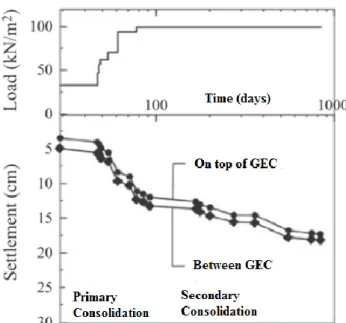
The properties of foundation soil are given in Table 2.1. Figure 2.10 shows the settlement on the top of encased columns during and after the construction of embankment for a period of about three years. The settlement after the construction when the encased columns are under both the load of embankment and the heavy train with iron ore, was measured to be about 5 cm. The increments of settlement tend to zero at the end of measuring period.
Table 2.1. Parameters of foundation soil (Alexiew et al., 2015). Soil layer Position
(m) γ'/γsat (kN/m3) k (m/s) Es (MN/m2) φ' (˚) c' (kN/m2) Clay 0.5 to -0.5 19/19 1E-9 2.6 29 8
Organic clay -0.5 to -2.5 13/13 1.5E-8 0.6 25.5 16 Peat -2.5 to -4.2 11/11 1.4E-7 0.8 20.5 8.5
12
Figure 2. 10. The settlement on the GEC (Alexiew et al., 2015).
The excess pore water was measured under embankment load during the construction process. Figure 2.11 reveals three important points about the performance of GEC in dissipation of excess pore water pressure, according to the authors: (i) the maximum value obtained for the upper clay is less than the half of surface load, (ii) regarding drainage condition, the organic clay is in unfavorable position but it still consolidates quickly, (iii) The excess pore water pressure comes to reduction even before the construction ends and under increments of surface loads.
Figure 2.11. The changes in excess pore water pressure during construction of embankment (Alexiew et al., 2015).
13
Extension of airbus site, 2000–2002
The Airbus company needed to construct a reclamation structure at the Elbe River in Hamburg, Germany, in order to extend the site of company by approximately 140 ha.
The area extension is accomplished by using a 2.4 km long dike surrounding the polder. The location is illustrated in Figure 2.12.
Figure 2.12. The location of dike and polder (Raithel et al., 2002).
This improvement provided the stability of the area by avoiding soft soils to move into the river zone. The dike was supported by almost 60,000 GECs with a diameter of 0.8 m. The distance between the adjacent columns has varied between 1.7 and 2.4 m (Figure 2.13). This improvement technique enabled the dike to be constructed on very soft soil having thickness of between 8 to 14 m and the undrained shear strength between 0.4 to 10 kN/m2 (Figure 2.14).
14
Figure 2.14. Ground strata profile (Raithel et al., 2002).
The soft soil surface along the dike line area was in different situations, from 0.8 m above sea level to 2.5 m below sea level. Displacement method was chosen as an appropriate installation method. Figure 2.15 indicates the measurements of the undrained shear strength (cu) of soil at
different depths of the soft soil before and immediately after installation of the columns. They clearly show the improvement provided by the installation method.
15
Figure 2.15. Undrained shear strength measurements (Raithel et al., 2002).
Figure 2.16 shows the settlements versus surface load applied by the construction of dike. It shows that the settlement increase tends to reduce with time, even when the surface load is increasing. It can be noticed in a very sensible form at day 300, when the surface load increases by two meter of the embankment height and the settlement reduction happens. It also can be observed that for this period the settlement tends to reach around zero.
16
Railroad embankment Bothnia line, 2001–2002
In Sweden, the Bothnia line (a high-speed railway line) goes through a valley covered with soft soil to a depth of about 7.5 m. The embankment of railroad has a height of about 9 to 10 m. In order to reduce the settlement of embankment, the foundation soil was reinforced by GEC with a diameter of 0.8 m. The displacement method was used to install the columns with an area replacement ratio of 15% and the columns were installed in a triangular pattern. Figure 2.17 illustrates the cross section of embankment and columns.
Figure 2.17. Cross section of embankment reinforced by GEC (Alexiew et al., 2015).
The foundation soil consists of different layers of clay and silt. The different layers of soil and their parameters are shown in Figure 2.18. The encasement was provided by a seamless woven geotextile. Due to the availability of coarse crushed rock in the region, the GECs were filled by this type of material. The use of crushed rock can cause damage to the geotextile during installation and compaction, which leads to reduction in the tensile strength.
In order to evaluate the reduction factor (RFinst) due to installation damage, the process of
installation was simulated at the Geotechnical Faculty of the University of Kassel. The outcome of tests gave an average RFinst of about 1.36 and it was applied to the ring tensile strength of the
encasement. In the case of sand, an average RFinst of about 1.05 to 1.15 can be considered. The
settlements of embankment, after its construction, were measured for a period of time of about 250 days.
17
Figure 2.18. Parameters of soil layers (Alexiew et al., 2015).
In addition, the settlements were calculated regarding two different values of friction angle (φ'1
= 37.5˚ and φ'2 = 45˚). It was found that φ'2 gives more reliable results. Figure 2.19 shows that
almost 90% of primary consolidation settlements occurs in a period of about three months after the construction of embankment.
18
Figure 2.19. Settlement of embankment with time (Alexiew et al., 2015).
High-speed rail link, 2002
There is a high-speed railroad that connects Paris to Amsterdam that passes through hundreds of meters of a region used to be a place for waste disposal. This region is covered by a waste layer with the thickness of about 4 to 6 m that lies on a thick layer of sand. The materials of region are contaminated by oil and heavy metals. Figure 2.20 shows the cross section of project.
At the beginning two options were considered as possible solutions for improving the foundation soil. One of them was the removal of waste material and then the replacement by clean sand and the other one was using a slab supported by piles to a depth of 10 m. Additional studies found out that GEC could be a better solution respecting financial, ecological and logistic reasons.
19
Figure 2.20. Railroad cross section (Alexiew et al., 2015).
The GECs used in this project had a diameter of 80 cm and the area replacement ratio of 15%. The encasement was produced by high chemical resistance polyvinylalcohol with the ring tensile strength of 300 and 400 kN/m. Regarding the settlements of improved area, three conditions were of concern: (i) to keep them to a limit of about 10 cm, (ii) to keep them as same as possible regardless of the extreme non-uniformity of waste material, and (iii) to accomplish a quick consolidation during and after the construction. The project was instrumented by horizontal inclinometers at the top of the GECs to measure the settlements developed by the construction of embankment (Figure 2.21 and Figure 2.22).
20
Figure 2.22. Settlement development during and after the construction (Alexiew et al., 2015).
2.3.2. ANALYTICAL METHODS
For the case of granular columns used in very soft soils, in the last years it has developed the encased column technique. For the design of this improvement technique, various analytical methods have been developed recently. At first the calculation process was recommended by Van Impe (1989) and then developed in numerical and analytical models by Raithel (1999) and Raithel & Kempfert (2000, 2005). The confinement provided by geosynthetic in the Geosynthetic Encased Columns (GEC) is considerably greater than the confinement provided by the surrounding soil and consequently the GEC suppots a greater load than the conventional granular column.
The method of Raithel (1999, adopted by EBGEO, 2011) considers the theory of elasticity and identical settlements for both granular column and surrounding soil. Moreover, this method predicts the behavior of unit cell for long-period drained condition when maximum value of bulging and settlement are obtained. The coefficient of active earth pressure (Ka,c) is applied to
the column as the method considers that the column comes to an active lateral pressure condition at final stage.
21
As illustrated in Figure 2.23, there is an equilibrium between the loading on unit cell (Δσ0) and
vertical stresses shared by the column (Δσv,c) and surrounding soil (Δσv,s). In this method, the
ring tensile force can be calculated by: 𝐹𝑅 = 𝐽Δrgeo
𝑟geo (2.2) where, Δrgeo and rgeo are lateral bulging and initial radius of geotextile, respectively.
The model was developed based on the conventional calculation models used for granular columns, which are completed by the effect of geotextile encasement and uses an iterative process, by means of the Equations 2.3, 2.4 and 2.5.
Δr𝑐 = 𝐾𝑎,𝑐. ( 1 𝑎𝐸. Δσ − 1 − 𝑎𝐸 𝑎𝐸 . Δσ𝑣,𝑠+ 𝜎𝑣,0,𝑐) − 𝐾0,𝑠. Δσ𝑣,𝑠− 𝐾0,𝑠. 𝜎𝑣,0,𝑠+ (𝑟geo− 𝑟𝑐). 𝐽 𝑟geo2 𝐸∗ (𝑎 1 𝐸− 1). 𝑟𝑐 + 𝐽 𝑟geo2 (2.3) 𝐸∗= ( 1 1 − 𝜈𝑠 + 1 1 + 𝜈𝑠 . 1 𝑎𝐸 ) .(1 + 𝜈𝑠). (1 − 2𝜈𝑠) (1 − 𝜈𝑠) . 𝐸oed,𝑠 (2.4) {Δσ𝑣,𝑠 𝐸oed,𝑠 − 2 𝐸∗. 𝜈𝑠 1 − 𝜈𝑠 [𝐾𝑎,𝑐. ( 1 𝑎𝐸 . Δσ −1 − 𝑎𝐸 𝑎𝐸 . Δσ𝑣,𝑠+ 𝜎𝑣,0,𝑐) − 𝐾0,𝑠. Δσ𝑣,𝑠− 𝐾0,𝑠. 𝜎𝑣,0,𝑠+ (𝑟geo− 𝑟𝑐). 𝐽 𝑟geo2 −Δr𝑐. 𝐽 𝑟geo2 ]} . ℎ = [1 − 𝑟𝑐 2 (𝑟𝑐+ Δr𝑐)2 ] . ℎ (2.5)
22
Figure 2.23. Analytical model for “Geotextile Encased Columns”, simplified picture after Raithel & Kempfert (2000).
where,
Δσv,s: Increase of vertical stress on soft ground
Eoed,s: Oedometric modulus of soft soil
νs: Poisson’s ratio of soft soil
Ka,c: Coefficient of active earth pressure of column
aE: Area replacement ratio
Δσ: Applied stress at the top of unit cell σv,0,c: Initial stress on the column before loading
K0,s: Coefficient of lateral earth pressure at rest for soft soil
σv,0,s: Initial stress on soft soil before loading
rgeo: Radius of the surrounding geotextile
rc: Sand cutting radius, internal to the geotextile
J: Geotextile tensile stiffness h: Column length
23
Castro and Sagaseta (2011) developed an analytical method based on the unit cell concept. The soft soil was supposed as an elastic material and the column as an elasto-plastic material utilizing the Mohr-Coulomb yield criterion. In this method, encasement material was treated as an elasto-plastic material by considering a limit for tensile strength.
Zhang and Zhao (2014) developed an analytical calculation method for the design of geosynthetic-encased and non-encased granular columns. The analytical method is based on unit cell concept and as compared with the analytical methods presented by Pulko et al. (2011) and Castro and Sagaseta (2011), in the method presented by Zhang and Zhao (2014), the shear stress (slide friction) between the soil and column was taken into account. As the authors pointed out, this method may not be appropriate when high deformation is expected.
Briaud (2013) presented an analytical calculation to predict the load bearing capacity of a single encased column. The method takes into account the influence of geosynthetic tensile stiffness and the water table to estimate the bearing capacity of column. Based on the method the ultimate bearing capacity of the encased column can be calculated by the following equation:
𝑃𝑢 = 𝑘𝑝(𝑃𝐿′+ 𝑃𝑔𝑒𝑜) (2.9)
where,
kp: Passive earth pressure of the column material, that is a function of friction angle of column
material (𝑘𝑝 =1+sin 𝜑
1−sin 𝜑)
PʹL: Effective stress
Pgeo: Pressure contributed by the encasement, obtained by following equation:
𝑃𝑔𝑒𝑜 = 𝐸∆𝑟
𝑟02 (2.10) where,
E: Geotextile tensile stiffness
∆r: Lateral variation r0: Radius of the column
24
2.3.3. EXPERIMENTAL STUDIES
Alexiew et al. (2003) recommended that encased granular column should be installed with an area replacement ratio of 10-20% having diameter of about 0.8 m and installing based on a triangular arrangement with axial distance of 1.7-2 m.
Sharma et al. (2004) carried out a series of laboratory tests on layered granular columns reinforced with horizontal strips of geogrid. The tests were performed on single sand columns of 60 mm in diameter and 300 mm in length (Figure 2.24). The number of geogrid strips and the distances between adjacent strips were different in every model test. The results confirmed the influence of horizontal strips of geogrid on the improvement of bearing capacity and the reduction of lateral bulging.
Figure 2.24. Sketch of the load test (Sharma et al., 2004).
Gniel & Bouazza (2009) conducted a series of small scale tests on encased granular column improved soft soil. The cylinder steel cell used in the tests was of 550 mm height and 150 mm internal diameter (6 mm steel wall thickness). They tested columns with 50.5 mm in diameter and 310 mm in length, to investigate the behavior of geogrid partially encased granular column. They concluded that, by increasing the length of encasing for both isolated single column and
25
group column, in case of partially encased column tests, the results show a steady decrease in vertical strain (Figure 2.25). The bulging occurred directly underneath the base of encasement. According to the methodology, an important rise in column stiffness and more reduction in column strain was achieved for fully-encased columns compared to clay behavior alone.
Figure 2.25. Small scale tests (Gniel & Bouazza, 2009).
Murugesan and Rajagopal (2009) implemented three series of laboratory tests and numerical simulation on encased granular column by varying the diameter of the columns (50 mm, 75 mm and 100 mm). The cylindrical cell used in the tests was of 210 mm diameter and 500 mm high. They concluded that the geosynthetic encasement enhances the bearing capacity of the column and stress-strain curve of the column indicates linear behavior and didn’t show any failure unlike the conventional granular columns.
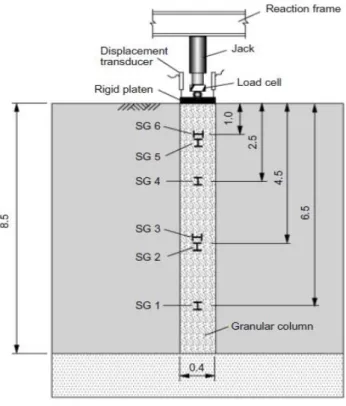
The behavior of geosynthetic-encased column was also analyzed by Araujo et al. (2009) for specific case of stabilization of embankments on a porous collapsible structured unsaturated soil as shown in Figure 2.26. They used different column material (sand and gravel) and different types of geosynthetics (woven geotextile and geogrid) with internal measurements of the strain inside the column by means of Strain Gauges (SG). The behavior of both conventional (sand and gravel) columns and encased (geotextile-encased sand and geogrid-encased gravel) columns were investigated by means of in-situ loading. Throughout testing, the local soil collapse was induced by injection of water from the top of the granular column to investigate the casing influence on the column behavior. The authors reported that depending on the materials used, a significant increase in bearing capacity for encased columns when comparing conventional columns can be obtained. In addition, the influences of foundation collapse by using geosynthetic-encased granular column can also be reduced.
26
Figure 2.26. Schematic of the load test on granular columns (Araujo et al., 2009).
Yoo and Lee (2012) investigated the deformed shape, carrying capacity and settlement reduction of a geogrid-encased column (GEC) using field-scale load tests. Also, the influence of the geogrid encasement length and column strain was investigated. The tests were conducted on columns with two different lengths (L = 5.4 m and 8 m), and 0.76 m in diameter. In addition, isolated GEC behavior was compared to Rammed Aggregate Pier (RAP) and conventional granular column behavior.
RAP is an exclusive installation procedure using helical auger for excavation that after placing column content in stages, employs vertical impact ramming energy, resulting in good strength and stiffness. The authors reported that the encasement provided an additional confinement that reduced the settlement of soft soil and increased the stiffness of the column. Furthermore, the bulging of the encased column has occurred directly underneath the base of the encasement for the case of encasement. They also stated that for both full-encasement and partially-encasement of granular column the improvement of column performance was fund to be significant.
Elsawy (2013) studied embankment construction over Bremerhaven clay using full scale unreinforced and reinforced with ordinary and geogrid-encased granular columns by means of
27
numerical analyses using PLAXIS software. The granular columns were simulated with a diameter of 1.0 m and length of 6.0 m. The results for long-term consolidation analyses indicated that granular column increases bearing capacity of the clay and accelerate the dissipation of excess pore water pressure. As expected, once the granular column is encased, relevant improvement occurs in the performance of granular column. The numerical analyses also showed that the higher stress concentration ratio in the granular columns contributes meaningfully to the acceleration of consolidation process.
Ali et al. (2014) investigated the behavior of GECs using different geosynthetic arrangement. In this study, model tests were carried out on long floating and end-bearing single and groups of columns with and without reinforcement. The tests were performed to evaluate the relative improvement in the failure stress of the composite ground due to different types of reinforcement as shown in Figure 2.27. The exhumed deformed column shapes were used to understand the failure mechanism for different types and configurations of reinforcement. Authors reported that geogrid was the best geosynthetic type for encasement for end-bearing columns; for floating columns, geotextile and geogrid were similarly worthy for laminated columns using horizontal discs of geosynthetic and encasement patterns.
Figure 2.27. (a) Schematic view of the single granular column foundation and (b) schematic view of foundation with group of granular columns. All dimensions are in millimeters (Ali et al., 2014).
28
Chen et al. (2015) presented laboratory tests and numerical simulations of an embankment reinforced with geosynthetic-encased column. The results of the study showed that the encased column failure was caused by the columns bending. The stability of the embankment was evaluated by 2D and 3D simulations. Based on the obtained results, they came to a conclusion that 3D simulations provided closer estimations to the laboratory tests than 2D simulations.
In recent years there have been various studied on the performance of the encased columns considering column length, column arrangement and influence of encasement (Miranda & Costa, 2016; Castro, 2017; Mohapatra et al., 2017; Hong et al., 2017). However, additional studies are necessary.
2.4. INSTALLATION METHOD
2.4.1. REGULAR INSTALLATION METHODS
For column installation, two common methods (replacement or displacement method) may be used. These methods are depicted in the following parts.
The replacement method uses an open-bottom PVC/steel pipe (casing) equal in diameter to the GEC. The casing is pushed down to the underlying rigid layer. The soil within the pipe is withdrawn using a helical auger to form a cavity. The geosynthetic is then placed inside the pipe and the cavity is filled with the granular material. Granular column content broadly consists of either sand or gravel. When the cavity is totally filled, the pipe is pulled out. To achieve the desired relative density of the column material, the column material can be compacted by vibrating the pipe as long as the pipe is dragged out. The replacement method installation is shown in Figure 2.28.
In displacement method pipe is pushed down with/without vibration to the rigid layer. The casing tip has two small traps which are closed through driving, resulting in displacement of the surrounding soft soil. Then, the geosynthetic is placed in the casing and is filled up inside. Finally, the pipe is pulled out and the two small traps are opened due to the weight of the column content above it. This installation method is shown in Figure 2.29. The installation of the displacement method is most widely used for construction of GEC in very soft soils.
29
Figure 2.28. Replacement method (Gniel, 2009).
Figure 2.29. Displacement Method (Gniel, 2009).
2.4.2. SPECIFIC INSTALLATION METHODS
The other installation method, cited by researchers (Ali et al., 2012, 2014; Hong et al., 2015) for laboratory tests, is called cast-in place method (Figure 2.30). In this method, the steel/PVC pipe is placed at the center of a box then the remolded clay is placed in regular small stages to avoid air void. After placing the surrounding soil, the column is formed in layers to reach certain value of relative density.
30
Figure 2.30. Cast-in place method (Hong et al., 2016).
2.5. NUMERICAL SIMULATIONS
After the laboratory tests have been completed, the results were analyzed using back analysis. Numerical analyses were performed using the Finite Element Method (FEM), which is nowadays widely used. Most of the input parameters of the program were defined through laboratory test results.
2.5.1. FINITE ELEMENT METHODS PROGRAM
The PLAXIS (2D and 3D) program was used to analyze the results obtained from laboratory tests with a very friendly graphical user interface. The program allows the use of different types of soil models, construction in stages, possible excavations, the use of beam elements to simulate piles, application of vertical drains, the use of geosynthetic elements to simulate reinforcements, interface elements, besides generating initial pore pressure and excess pore pressure due to the construction (Brinkgreve et al., 2016).
The program consists of two panels: input and output. The first panel models the problem, where its geometry, boundary conditions, material properties and elements that facilitate the analysis such as beam elements, interface, geotextile and vertical drains elements. In addition, the input panel generates the mesh that the user can choose the type of global refinement (very coarse, coarse, medium, fine and very fine) or refine around a point, structural members or further refine along a line of geometry.
31
The problem can be simulated by 6 or 15-noded in PLAXIS 2D and by 10-noded in PLAXIS 3D. These number mean that the model with higher number of nodes can produce greater number of nodes (applicable for displacement and pore pressure, etc.) and of stress points (applicable for stress-strain curve and pore pressure, etc.). In other words, the higher number of nodes can produce higher level of accuracy.
The type of constitutive model must be defined for all soil types. PLAXIS has various constitutive models for different types of soils (Mohr-Coulomb, Soft-Soil model, Hardening-Soil model, Cam-Clay model) and rocks (Hoek-Brown model).
The program also allows to run User-Defined (UD) soil models. This ability allows users to program their specific models using FORTRAN program.
Mohr-Coulomb model is a linearly elastic perfectly plastic. This model can be used for a first approximation of soil behavior, since it uses a constant stiffness for each type of material. Nevertheless, such a model may be useful in identifying plastic regions. The model based on both Hook’s law (linear elastic) and Mohr-Coulomb failure criterion.
Modified Cam-Clay model is used to simulate clays. The overall connection between volume change and pressure in clay can be expressed using the concept of normal consolidation line (NCL) and over-consolidation line (OCL). Passing the intersection with additional stress increase makes the stress state move down along the normal consolidation line. This has similar characteristics to the stress-strain curve of an elasto-hardening plastic model. Hence, the initial linear elastic region of the over-consolidation line can be corresponded to the hardening plastic region of the normal consolidation line.
The material properties of the soil are generally obtained from the one-dimensional consolidation test, such as the Compression index (Cc) and Swelling index (Cs). The
compression index and swelling index are related to the Normal consolidation line slope λ and Over-consolidation line slope κ by the following equations.
𝜆 = 𝐶𝑐
32 𝜅 = 𝐶𝑠
2.303 2.12
Soft-Soil model was developed to simulate highly compressible soils, such as normally consolidated clays, clayey silts and peats. This model is based on the Cam-Clay model. Some features of this model are:
Stiffness dependent on the stress level;
Distinction between primary loading and unloading-reloading; Ability to take into account the stress history;
Failure according to the Mohr-Coulomb criterion.
The modified compression index (λ*) and modified swelling index (κ*) are the principal
parameters of this soil model. They can be calculated by following equations:
{ 𝜆∗ = 𝜆 1 + 𝑒 𝜆∗ = 𝐶𝑐 2.3(1 + 𝑒) 2.13 { 𝜅∗ = 𝜅 1 + 𝑒 𝜅∗≈ 2𝐶𝑠 2.3(1 + 𝑒) 2.14
In the soil properties of PLAXIS, it is also necessary to define the properties of the interface. This is done by means of the definition of the resistance of the material, which can be rigid, in case the interface has the same resistance of the surrounding soil or manual, where it can be taken into account with the interface resistance reduction factor (Rint) using values smaller than
one. The program also allows the definition of interface permeability.
For simulation of reinforcement elements, the program has the geogrid element in which the only required input parameter is the tensile stiffness in one direction (EA1) for isotropic
behavior and the tensile stiffness in two directions (EA1, EA2) for orthotropic behavior. Thus,
this type of element does not resist compression or bending. Defining the geometry and boundary conditions and generating the initial stresses and the mesh, the program at the final
33
step executes the calculation in the input panel. In this step, it is necessary to choose the type of calculation that will be performed according to the type of analysis that is needed to be done.
PLAXIS has five types of analysis. The first type is plastic (plastic analysis), which is used in the analysis of elastoplastic deformations where it is not necessary to include the effects of excessive deformations. This type of analysis is used in several applications in geotechnical engineering.
The second type is the consolidation analysis that is that usually applicable when there need to analyze the time dependent development of excess pore water pressure in a saturated clay type soil. The third one is the safety analysis that can calculate safety factor. Safety factor is calculated as a function of shear strength parameters as following equation:
𝑆𝐹 = tan 𝜑𝑖𝑛𝑝𝑢𝑡 tan 𝜑𝑟𝑒𝑑𝑢𝑐𝑒𝑑 = 𝑐𝑖𝑛𝑝𝑢𝑡 𝑐𝑟𝑒𝑑𝑢𝑐𝑒𝑑 = 𝑆𝑢,𝑖𝑛𝑝𝑢𝑡 𝑆𝑢,𝑟𝑒𝑑𝑢𝑐𝑒𝑑 2.15 where, φ: Friction angle; c: Cohesion;
Su: Undrained shear strength.
The fourth type is dynamic analysis that is related to those problem which are involved with dynamic loadings. The final type of analysis is fully coupled flow-deformation that considers simultaneously the development of deformations and pore pressures in a saturated or partially saturated soil as a result of time-dependent changes of the hydraulic boundary conditions. Thus, this type of analysis can be considered for dams and embankments that are subjected to tidal waves.
PLAXIS Output panel is capable to graphically display the post-processing results. In this part of the program, several types of results can be shown graphically. In addition, there can be selected a cross section and ask the program to draw some kind of displacement, deformation or stress along that section. In this panel, user is able to draw the curves of deformation and excess pore water pressure versus time and also many other results that can be drawn out of the results.
34
3. METHODOLOGY
In this research, the performance of geosynthetic reinforced granular columns was studied by means of a three-stage approach. This includes (a) large-scale laboratory analysis of reinforced column; (b) numerical simulation of the large-scale tests; (c) full-scale numerical modelling to examine the behavior of encased column group.
3.1. MATERIALS
The following part presents the physical properties and behavior of the materials chosen for utilize in large-scale laboratory tests. This part includes the properties of the collected soil and the materials that have been used as the column contents and three types of geotextile (1, G-2, and G-3) that were used as the column reinforcement. The three different types of materials used as the column content were sand, gravel, and Construction Waste (CW). Sand is a typical type of material for geotextile encased column but, in this study, it was decided to use other type of materials in order to find the efficiency of these materials for improvement in the performance of the technique. The use of CW can lead to important economic and environmental benefits. It preserves both energy and resources.
3.1.1. COLLECTED SOIL
To study the behavior of geosynthetic reinforced columns, a very soft soil was necessary to have a better understanding on the proficiency of encased granular column. The soft soil samples were desired to be homogeneous and behave as a reliable material.
Since the size of the test box was quite large, therefore, there was needed to prepare 5 to 7 tons of soil. The collected soil was spread out on a thick plastic sheet and was turned over for 10 days in order to become dry. After dying, the soil was sieved to by the sieve No.10 (2 mm).
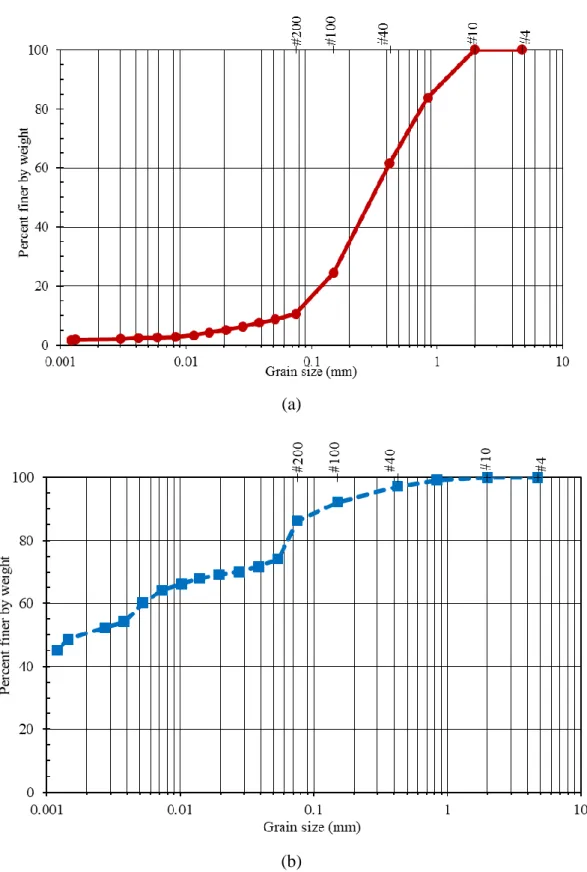
Particle size distribution of the soil, with and without dispersing agent, is presented in Figure 3.1. Before sieving the soil was smashed manually but yet there were many tiny clusters that affect the particle size distribution curve. By pulverizing the soil mechanically or using