Vol.47, n. 2 : pp. 281-290, June 2004
ISSN 1516-8913 Printed in Brazil BRAZILIAN ARCHIVES OF
BIOLOGY AND TECHNOLOGY
A N I N T E R N A T I O N A L J O U R N A L
Influence of Water Level Fluctuation on the Mortality and
Aboveground Biomass of the Aquatic Macrophyte
Eleocharis interstincta (VAHL) Roemer et Schults
Anderson Medeiros dos Santos1∗ and Francisco de Assis Esteves2
1
Núcleo de Pesquisas em Limnologia, Ictiologia e Aquicultura - NUPELIA; Universidade Estadual de Maringá; Avenida Colombo, 5790; 87020-900; Maringá - PR - Brazil. 2 Universidade Federal do Rio de Janeiro; Instituto de Biologia; Departamento de Ecologia; Laboratório de Limnologia; Ilha do Fundão; 21941-590; Rio de Janeiro - RJ - Brazil
ABSTRACT
The goal of this study was to study the biometric alterations of Eleocharis interstincta in response to water level fluctuations in Cabiúnas Lagoon, located on the northern coast of the state of Rio de Janeiro, in the municipality of Macaé. Three quadrats of 0.0625 m2 were harvested every two weeks from June/1997 to June/1998; samples were separated into stems, dead stems (detritus) and rhizome; lenghted, dried and weighted. The water level fluctuated seasonally in the macrophyte stand with two periods of drawdown. The first period occurred naturally at the end of winter and beginning of spring, when rainfall in the area was normally lowest. The second period of drawdown was the result of an artificial breaching of the sandbar that isolate the lagoon from the sea. The breach was made in the summer, at the time of highest rainfall, when the water level in the lagoon reached the maximum value recorded during the study (1.35 m). There was a strongly positive correlation of the water level with stems mean height and aboveground biomass, indicating that water level played an important role in the determination of these parameters. There was a significant difference between stem height (ANOVA; p < 0.001) and biomass (ANOVA; p < 0.001) in each sampling period, ranging from 143.9 cm and 338.8 g dry wt.m-2, before the sandbar opening, to 16.3 cm and 20.2 g dry wt.m-2 respectively after the sandbar breaching. The drastic variation of the water level, leading mass mortality of the stems, together with the lowest mean biomass/stem (0.057 g dry wt.individual-1), recorded after the sandbar breaching, did not represent a strong disturbance for E. interstincta, since the resilience time estimated for this population was about 30 days.
Keywords: Aquatic macrophytes, biomass, coastal lagoon, Eleocharis interstincta, water level fluctuation
∗
INTRODUCTION
Coastal lagoons occur along the entire coast of Brazil, and are one of the most representative country’s continental aquatic ecosystems (Esteves, 1998). Besides their widespread occurrence, coastal lagoons are known for their high productivity, exhibiting values comparable to
those of estuaries and upwelling oceanic regions
(Knoopers, 1994). This high productivity,
reflected in high fishery productivity, led the establishment of early fishing villages, many of which later grew into cities.
climate factors (Panosso et al., 1998). The shallow depths characteristic of these ecosystems result in an extensive littoral region, allowing colonization of large areas by aquatic macrophytes (Esteves, 1998). The seasonality of rainfall in tropical regions causes marked fluctuations in the water level of most continental aquatic ecosystems. Many studies have demonstrated the influence of water level fluctuations on biomass, growth,
production, and distribution of aquatic
macrophytes in both temperate (Linthurst and
Reimold, 1978; Seischab et al.. 1985; Pip and
Sutherland-Guy, 1987; Squires and Van Der Valk, 1992; Froend and McComb, 1994; Rea and Ganf, 1994) and tropical ecosystems (Junk and Piedade,
1993 a, b; Villar et al.. 1996). Some studies have
been done in tropical coastal lagoons (Furtado, 1994; Brum and Esteves, 2001; Santos and Esteves, 2002). However, few investigators have examined the consequences of water level
fluctuations in the biometry of aquatic
macrophytes species. We intended to test the hypothesis that water level was an important driving force in coastal lagoons, like it has been in floodplains ecosystems (Junk and Piedade, 1993 a, b), which determine height and biomass of Eleocharis interstincta. This study had as its goal to measure the biometric changes in this emergent aquatic macrophyte, in response to water level fluctuations.
MATERIALS AND METHODS
Study Area
The Cabiúnas Lagoon has an area of 0.35 km2,
with a high perimeter/volume ratio and a maximum depth of 3.50 m (Fig. 1). It is located on the northern coast of Rio de Janeiro state, between
the municipalities of Macaé and Carapebus (22o to
22o 30’ S and 41o30’ to 42o W). Its origin is
associated with the formation of sandbars in the
last oceanic regression (Esteves, 1998).
Occasionally, the sandbar that separates the coastal lagoon from the ocean is opened, usually artificially with the aim of controlling the effect of floods by lowering the water level and/or allowing the entry of economically important fishes (Faria et al., 1994; Albertoni et al.,1999). The sandbar is about 20 m wide and is occasionally run over by the waves, which bring salt water into the lagoon. However, salinity in the lagoon is usually very low since the water level in the lagoon is above mean sea level. The climate of the region is subhumid/humid, with little or no water deficit, and mesothermal with the heat well-distributed throughout the year. Mean annual relative humidity is 83%. Mean annual temperature is
about 22 oC, with the January (summer) mean
being 25 oC, and the July (winter) mean being 19
o
C. Mean annual precipitation is 1300 mm, concentrated in the spring and summer.
The period with the lowest rainfall is the winter, but there is no pronounced drought.
Winds are predominantly northeasterly throughout the year and to a lesser degree easterly, southeasterly, and southwesterly (Fiderj, 1977). Some littoral zone areas support dense stands of Typha domingensis and Eleocharis interstincta. In the deeper parts of the littoral zone, there are some aquatic macrophytes with floating leaves, such as
Nymphaea ampla and Nymphoides humboldtiana
(Henriques et al., 1988).
Biomass harvest
Sampling was performed every two weeks from June/1997 to June/1998 in the littoral region of
Cabiúnas Lagoon. Three quadrats of 0.0625 m2
were harvested, always in the middle part of E.
interstincta stand, which was marked for further sampling. Twenty centimeters of sediment were removed to collect the aboveground (stems) and bellowground (roots-rhizome) parts of the plants. Water level was measured in each quadrat.
In the laboratory, the samples were washed with running water and separated into stems (more than 50 % of the stem height constituted by green tissue)cand dead stems (less than 50 % of the stem height constituted by green tissue). Stem length
was measured, separated one by one and dried in a
stove at 70 oC to constant weight.
Data analysis
The mean stems height and biomass in each sampling period were compared by one-way ANOVA and means compared using Tukey’s HSD (honest significant difference) test. Density, dead stem, and aboveground biomass were compared by the non-parametric Friedman test, because data were not normally distributed. All analysis were performed using STATISTICA® 5.0 for windows.
RESULTS
Water level
The water level of Cabiúnas Lagoon changed seasonally, with two annual periods of drawdown.
The first event occurred naturally in
September/1997 (late winter - early spring), when rainfall in the region was lowest. During this, the water level gradually dropped until failed to cover the macrophyte stand in October/1997.
0 20 40 60 80 100 120 140 160
05/06 16/08 16/10 17/12/1997 04/03 25/04
Sample date
W
a
te
r
te
v
e
l
(c
m
)
Water level breaching of the
sandbar
natural drawdown
"artificial" drawdown
winter spring summer fall
The second event occurred in February/1998 (summer), the season when rainfall was highest and at that time an uncommon increase in rainfall (398.8 mm) was recorded.
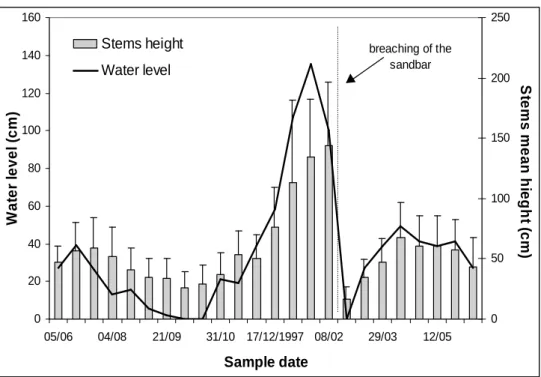
As a consequence, the sandbar, which separated the lagoon from the ocean was artificially breached by local people without government knowledge. Before the breaching, the water level in the stand was 1.35 m, the maximum value recorded during the study. The breaching of the sandbar drastically dropped the water level, which again failed to cover the stand. However, this reduction was abrupt, rather than gradual as in September/1997. After two weeks, the sandbar naturally re-formed and the water level began to rise gradually (Fig. 2).
Biometry
Fig. 3 shows the variation in stems height of E.
interstincta during the study period. There was a significant difference between stems mean height (ANOVA; p< 0.001), ranging from 143.9 cm in February/1998, before the sandbar breaching, to 16.3 cm in the same month, after the sandbar breaching.
The sandbar breaching had a strong impact on this emergent aquatic macrophyte population, leading
a sharp decrease in the stems aboveground biomass (Fig. 4), to the lowest value recorded during the study (Friedman, p< 0.05).
The values of aboveground biomass varied from
338.8 g dry wt.m-2, when the water level reached
its maximum, to 20.2 g dry wt.m-2, after the
sandbar breaching. Stems density (Fig. 5) did not exhibit a pattern similar to those found for height and aboveground biomass. The maximum value recorded occurred in the beginning of spring, when the water level aturally drewdown (Friedman, p< 0.05). The stem density was significantly lower, after the sandbar breaching, compared to the period when the water level was naturally drewdown.
The specific weight of the stems, i. e., the ratio between mean biomass and mean height (Fig. 6),
varied from 5.38 mg dry wt.cm-1, when the water
level was naturally drewdown, to 2.42 mg dry
wt.cm-1 after the sandbar breaching. The mean
biomass/stem (Fig. 7) also was negatively influenced by the sandbar breaching, when it reached the lowest value recorded (ANOVA; p< 0.001) during the study (Tukey’s test; p< 0.05).
0 20 40 60 80 100 120 140 160
05/06 04/08 21/09 31/10 17/12/1997 08/02 29/03 12/05
Sample date
W
a
te
r
le
v
e
l
(c
m
)
0 50 100 150 200 250
S
te
m
s
m
e
a
n
h
ie
g
h
t (
c
m
)
Stems height
Water level
breaching of the sandbar
0 20 40 60 80 100 120 140 160
05/06 04/08 21/09 31/10 17/12/1997 08/02 29/03 12/05
Sample date
W
a
te
r
le
v
e
l
(c
m
)
0 50 100 150 200 250 300 350 400 450
B
io
m
a
s
s
(g
d
ry
w
t m
-2
)
Aboveground biomass
Water level
breaching of the sandbar
Figura 4 - Water level fluctuation and stems aboveground biomass of E. interstincta
during sampling period. The error bar indicates standard deviation.
0 20 40 60 80 100 120 140 160
05/06 04/08 21/09 31/10 17/12/97 08/02 29/03 12/05
Sample date
W
a
te
r
te
v
e
l
(c
m
)
0 200 400 600 800 1000 1200 1400 1600
D
e
n
s
it
y
(n
o
./
m
2
)
Density
Water level
breaching of the sandbar
0 20 40 60 80 100 120 140 160
05/06 04/08 21/09 31/10 17/12/97 08/02 29/03 12/05
Sample date
W
a
te
r
te
v
e
l
(c
m
)
0 0,001 0,002 0,003 0,004 0,005 0,006 0,007
S
p
e
c
if
ic
w
e
ig
h
t (
g
d
ry
w
t c
m
-1
)
Water level
Specific weight
Figure 6 - Water level fluctuation and stems specific weight of E. interstincta during sampling period. The error bar indicates standard deviation.
0 20 40 60 80 100 120 140 160
05/06 04/08 21/09 31/10 17/12/1997 08/02 29/03 12/05
S ample date
W
a
te
r
te
v
e
l
(c
m
)
0 0,1 0,2 0,3 0,4 0,5 0,6 0,7 0,8 0,9 1
M
e
a
n
b
io
m
a
s
s
s
te
m
-1
(
g
d
ry
w
t)
B iomass per stem
W ater level
breac hing of the s andbar
Figure 7 - Water level fluctuation and average biomass per stem of E. interstincta during sampling period. The error bar indicates standard deviation.
The variation of dead stem biomass (Fig. 8) was significantly different throughout the sampling period (Friedman, p< 0.05).
However, unlike the other variables, the dead stem biomass exhibited a different pattern, reaching the
highest value (152.4 g dry wt.m-2) when the water
0 2 0 4 0 6 0 8 0 1 0 0 1 2 0 1 4 0 1 6 0
0 5 /0 6 0 4 /0 8 2 1 /0 9 3 1 /1 0 1 7 /1 2 /1 9 9 7 0 8 /0 2 2 9 /0 3 1 2 /0 5
S ample date
W
a
te
r
te
v
e
l
(c
m
)
0 5 0 1 0 0 1 5 0 2 0 0 2 5 0
D
e
a
d
s
te
m
(
g
d
ry
w
t m
-2
)
D ead stem
W ater level
breac hing of the s andbar
Figure 8 - Water level fluctuation and dead stem (detritus) biomass of E. interstincta
during sampling period. The error bar indicates standard deviation.
R2 = 0.90
R2 = 0.65
0 50 100 150 200 250 300 350 400
0 50 100 150
Water level (cm)
B
io
m
a
s
s
(
g
d
ry
w
t
m
-2 )
0 20 40 60 80 100 120 140 160
H
e
ig
h
t (
c
m
)
Aboveground biomass Stems height
Figure 9 - Correlation of the water level with stems height (p < 0,05) and aboveground biomass (p < 0,05) of E. interstincta.
DISCUSSION
There is considerable evidence in many studies of wetlands water level fluctuations that growth and survival of emergent aquatic macrophytes are dependent on the water level (Neill, 1990; Squires AND Van Der Valk, 1992). The correlation between water level and the mean stem height and
stem aboveground biomass suggested that water level has an important role in determining the size of the stems and, therefore, their aboveground biomass. Fluctuations in water level may induce changes in the productivity and biometry of aquatic macrophytes populations (Froend and
McComb, 1994). Since water level was
E. interstincta decreased. This change in the mean stems height, by mortality (and subsequent growth of new shorter shoots), seemed to be an aspect of the plasticity, typical of emergent aquatic macrophytes, to insure their survival in extreme dynamic environments. The ability of emergent aquatic macrophytes populations to change their
height was also reported for Baumea articulata
and Typha orientalis by Froend and McComb (1994), and for submerged macrophytes by Brock (1991). A similar adaptation was observed in
Baumea arthrophylla, an emergent aquatic
macrophyte that exhibited smaller size classes when the water level was lowered from 50 to 0 centimeters (Rea and Ganf, 1994).
When one focuses on changes in the biometry of emergent aquatic macrophytes, the standing of the plant is of utmost importance. The supporting tissues of aquatic macrophytes were still present but highly reduced, since the aquatic environment provide adequate support (Sculthorpe, 1985). The
adaptations found in E. interstincta for solving the
support problem when their environment assumed terrestrial characteristics were: I) reduction of the mean size of the stems, and II) reduction of the space between each aeriferous lacunae, which was characteristic for this species. The smaller space between each aeriferous lacunae provide highest structural rigidity, and therefore, enhanced support. Although no specific test were done to verify the reduction of the space between aeriferous lacunae, this was observed in field. Data obtained in this study supporting these assertions were that the species had higher values of specific weight (more biomass per unit of height indicating more lacunae contributing to more weight) when the water level was naturally drewdown, although this was not recorded when the drawdown was a result of sandbar breaching. A reduction in plant size and in the proportion of specialized water-adapted tissues like aerenchyma, insuring the support of the plants in the terrestrial phase, was reported by Junk and Piedade (1993 a) in several species of the Amazonian region.
The biometric alteration observed in E. interstincta
stems resulting in the reduction of the stems biomass values after the sandbar breaching, could be attributed to the combination of the following factors: I) the drastic variation of the water level of the lagoon (artificial breaching of the sandbar), leading mass mortality of the aboveground
the stems density was the lowest (357.3
individuals.m-2) after the sandbar artificial
breaching; and II) the lowest value of mean
biomass per stem (0.057 g of dry wt.individual-1).
This meant that after the sandbar artificial breaching, fewer and lighter stems were found (vegetative growth), despite the statistically similar stems mean height between the period in which the water level was naturally lowered (first drawdown) and this period (second drawdown) (Tukey’s test; p> 0.05 - Figs. 3 and 4).
Palma-Silva (1998) found that for Typha domingensis in
Imboassica Lagoon, Macaé, Rio de Janeiro, the density, biomass, height, and mean weight of the stems were all lower after the sandbar breaching. The disturbance caused by the sandbar artificial
breaching in the E. interstincta population was
reflected in the reduction of aboveground biomass, density, and specific weight of the stems. However, this aquatic macrophyte species seemed to be adapted to the rather dynamic environment found in coastal lagoons. The resilience time (here as time necessary for aboveground biomass recovery as when it was before drawdown) for this species was estimated at 30 days, since after this period, the aboveground biomass was statistically similar when compared with the period of natural drawdown.
al.. (1998) reported that coastal lagoons were highly vulnerable to oscillations in climatic factors, as seen in the seasonal variation of the water level in Cabiúnas Lagoon. In the summer (February) of 1998, rainfall reached 398 mm in the region, which was an example of extreme conditions.
The observed pattern in stems height and
aboveground biomass of E. interstincta showed
the important role of water level in the determination of these parameters. Since both stem height and aboveground biomass were positively correlated with the water level, the hypothesis that they were regulated by the water level was corroborated.
ACKNOWLEDGMENTS
We thanks the colleagues of Laboratório de Limnologia of Universidade Federal do Rio de Janeiro for field assistance. We gratefully acknowledge with sincere appreciation the critical comments of Dr. Sidinei M. Thomaz on early versions of manuscript. This study was funded by PETROBRAS, CAPES, CNPq and Pronex/MCT.
RESUMO
O objetivo deste trabalho foi verificar as alterações
biométricas de Eleocharis interstincta em resposta
às variações no nível da água da Lagoa de Cabiúnas, localizada na região norte do Estado do
Rio de Janeiro, no município de Macaé (22o00’ e
22o30’ S, 41o30’ e 42o00’ O). Três quadrados de
0,0625 m2 foram coletados quinzenalmente de
junho/1997 a junho/1998; as amostras separadas em caules, detritos e rizoma; medidas, secas e pesadas. O nível da água variou sazonalmente no estande das macrófitas, apresentando dois períodos de seca. O primeiro período ocorreu naturalmente, no final do inverno e início da primavera, quando a precipitação na região é menor. O segundo período de seca foi resultado da abertura artificial da barra de areia, que separa a lagoa do mar. A abertura da barra foi feita no verão, período de maior precipitação, quando o nível da água registrou o máximo valor durante o período de estudo (1,35 m). Foi encontrada uma forte correlação positiva entre o nível da água com o tamanho médio dos caules e a biomassa aérea,
indicando que o nível da água desempenha um
importante papel na determinação destes
parâmetros. Houve uma diferença significativa no tamanho (ANOVA; p < 0.001) e biomassa aérea dos caules (ANOVA; p < 0.001) entre os períodos amostrais, variando de 143,9 cm e 338,8 g peso
seco.m-2, antes da abertura, a 16,3 cm e 20.2 g
peso seco.m-2 respectivamente depois da abertura
da barra. A drástica variação no nível da água, ocasionando a mortalidade em massa dos caules, juntamente com a menor razão biomassa /caule
(0.057 g de peso seco.individuo-1), registrados
depois da abertura de barra, não representou um
grande distúrbio para E. interstincta, visto que o
tempo de resiliência para esta população foi estimado em 30 dias
REFERENCES
Albertoni, E. F.; Palma-Silva, C. and Esteves, F. A. (1999), Larvae and post-larvae of Penaeidae and Palaemonidae in coastal lagoons of the north of Rio de Janeiro (Macaé, RJ). Rev. Bras. Bio., 59 : (1), 109-117.
Brock, M. A. (1991), Mechanisms for maintaining persistent populations of Myriophyllum variifolium I. J. Hooker in a fluctuating shallow Australian lake.
Aquat. Bot., 39, 211-219.
Brum, P. R. and Esteves, F. A. (2001), Dry weight loss and chemical changes in the detritus of three tropical aquatic macrophyte species (Eleocharis interstincta, Nymphaea ampla and Potamogeton stenostachys) during decomposition. Acta Limnol. Bras., 13 : (1), 61-73.
Esteves, F. A. (1998), Fundamentos de Limnologia. 2. ed. Rio de Janeiro : Interciência - FINEP.
Faria, B. M.; Suzuki, M. S. and Esteves, F. A. (1994),
Alterações no metabolismo da lagoa Imboassica,
Macaé, RJ, associadas à ocorrência de duas sucessivas aberturas artificiais de barra. Paper presented at 2. Congresso de Ecologia do Brasil, 5-9 December, Londrina, Brazil.
FIDERJ (1977), Estudos para o planejamento ambiental. Rio de Janeiro : Fundação Instituto de Desenvolvimento Econômico e Social do Rio de Janeiro.
Furtado, A. (1994), Contribuição das macrófitas aquáticas Typha domingensis (TYPHACEAE) e
Eleocharis cf. fistulosa (CYPERACEAE) para o estoque de nutrientes e energia na lagoa Imboassica (Macaé-RJ). MSc. Thesis, Depto. Ecologia, UFRJ, Rio de Janeiro, Brazil.
Henriques, R. P. B., Araújo, D. S. D., Esteves, F. A., Franco, A. C. (1988), Análise preliminar das comunidades de macrófitas aquáticas da lagoa Cabiúnas, Rio de Janeiro, Brasil. Acta Limnol. Brasil., 2, 783-802.
Hogeland, A. M. and Killingbeck, K. T. (1985), Biomass, productivity and life history traits of Juncus militaris Bigel. in two Rhode Island (U. S. A.) freshwater wetlands. Aquat. Bot., 22, 335-346. Junk, W. J. and Piedade, M. T. F. (1993a), Herbaceous
plants of the Amazon floodplain near Manaus: Species diversity and adaptations to the flood pulse.
Amazoniana, 12 : (3/4), 467-484.
Junk, W. J. and Piedade, M. T. F. (1993b), Biomass and primary-production of herbaceous plant communities in the Amazon floodplain.
Hydrobiologia, 263, 155-162.
Knoopers, B. (1994), Aquatic primary production in coastal lagoons. In: Kjerfve, B. (ed. ). Coastal Lagoon Process. Elsevier Science B. V. Elsevier Oceanography Series 60. pp. 243-286.
Linthurst, R. A. and Reimold, R. J. (1978), Estimated net aboveground primary productivity for selected estuarine angiosperms in Maine, Delaware and Georgia. Ecology, 59 : (5), 945-955.
Maye, P. R., III. (1972), Some important inorganic nitrogen and phosphorous species in Georgia salt marsh. Environmental Resources Center, Georgia Institute of Technology Report Number 272.
Neill, C. (1990), Effects of nutrients and water levels on emergent macrophyte biomass in a prairie marsh.
Can. J. Bot., 68, 1007-1014.
Palma-Silva, C. (1998), Crescimento e produção de
Typha domingensis Pers. na lagoa Imboassica. In: Esteves, F. A. (ed.). Ecologia das Lagoas Costeiras do Parque Nacional da Restinga de Jurubatiba e do Município de Macaé (RJ). NUPEM-UFRJ. pp. 205-220.
Palma-Silva, C., Albertoni, E. F. and Esteves, F. A. (200-), Distribution and net primary production of
Eleocharis mutata (L.) Roem. et Schult. in a tropical coastal lagoon subject to sudden variations in water level, State of Rio de Janeiro, Brazil. Plant Ecol. [in press].
Panosso, R. F.; Attayde, J. L. and Muehe, D. (1998), Morfometria das lagoas Imboacica, Cabiúnas, Comprida e Carapebus: Implicações para seu funcionamento e manejo. In: Esteves, F. A. (ed.).
Ecologia das Lagoas Costeiras do Parque Nacional da Restinga de Jurubatiba e do Município de Macaé
Pip, E. and Sutherland-Guy, C. (1987), Aquatic macrophytes in Shoal Lake (Manitoba-Ontario) I. Diversity, biomass and metabolic status in relation to water depth and light intensity. Arch. Hydrobiol., 76 : (3), 197-222.
Rea, N. and Ganf, G. G. (1994), Water depth changes and biomass allocation in two contrasting macrophytes.
Aust. J. Mar. Freshw. Res., 45, 1459-1468.
Santos, A. M. and Esteves, F. A. (2002), Primary production and mortality of Elocharis interstincta in response to water level fluctuations. Aquat. Bot., 74 : (3), 189-199.
Sculthorpe, C. D. (1985), The biology of aquatic vascular plants. Germany : Koeltz Scientific Books. 610 pp.
Seischab, F. K., Bernard, J. M. and Fiala, K. (1985), Above- and belowground standing crop partitioning of biomass by Eleocharis rostellata Torr. in the Byron- Bergen Swamp, Genesee County, New York.
Am. Midl. Nat., 114 : (1), 70-76.
Squires, L. and Van der Valk, A. G. (1992), Water-depth tolerances of the dominant emergent macrophytes of the Delta Marsh, Manitoba. Can. J. Bot., 70, 1860-1867.
StatSoft, Inc. (2000), STATISTICA for windows [Computer program manual]. Tulsa, OK.
Villar, C. A.; Cabo, L. and Bonetto, C. A. (1996), Macrophyte primary production and nutrient concentrations in a deltaic floodplain marsh of the Lower Paraná River. Hydrobiologia, 330, 59-66. Wetzel, R. G. (1969), Excretion of dissolved organic
compounds by aquatic macrophytes. Bioscience, 19, 539-540.