Received May 26, 2009 and accepted December 2, 2009. Corresponding author: [email protected]
ISSN 1806-9290 www.sbz.org.br
Microbiota of the cecum, ileum morphometry, pH of the crop and
performance of broiler chickens supplemented with probiotics
1Belchiolina Beatriz Fonseca2, Marcelo Emílio Beletti3, Max Siqueira da Silva4, Paulo Lourenço da Silva4, Ivamario Nahas Duarte3, Daise Aparecida Rossi4
1Pesquisa financiada pela Fundação de Amparo à Pesquisa do Estado de Minas Gerais (FAPEMIG).
2Programa de Pós-Graduação em Imunologia e Parasitologia Aplicadas da Universidade Federal de Uberlândia (UFU). 3Instituto de Ciências Biomédicas da UFU.
4Laboratório de Biotecnologia Animal Aplicada; Faculdade de Medicina Veterinária da UFU.
ABSTRACT - It was studied, in this work, the effects of supplementation of probiotics on the performance, on the pH of crop content, on the morphometry of the ileum and on the number of enterobacteria in the cecum of the broilers. Out of the 120 studied birds, 60 belonged to the test group and 60 to the control group. At 1, 7, 12, 18, 23 and 28 days of age, the chickens and rations were weighed and mortality and morbidity were determined. Then, the birds were sacrificed and the pH of the crop content was measured, ileum fragments were collected for morphometric analysis and the enterobacteria in the cecal content were quantified. The mean pH was lower in the group that was given probiotics at 1, 7 and 18 days of age. There were no differences on ration consumption, weight, mortality and morbidity rates. The counts of enterobacteria were lower in the supplemented animals at the ages of 7, 18 and 28 days. The measure of villus of the ileum was higher for the group treated with probiotics at all ages, except for 1 day of age in comparison to the control group. This work proves that supplementation with probiotics reduces the pH of the crop content at the ages of 1, 7 and 18 days and it can contribute to the reduction of pathogenic bacteria on the first days of life by reducing the quantity of enterobacteria in the cecum. In addition, probiotics increase the height of villi in the ileum of the birds.
Key Words: body weights, competitive exclusion, enterobacteria, intestinal villi, ration
Microbiota cecal, morfometria do íleo, pH do inglúvio e desempenho
zootécnico de frangos de corte sob suplementação com probióticos
RESUMO - Neste trabalho foram estudados os efeitos da suplementação de probióticos sobre o desempenho, o pH do conteúdo do papo, a morfometria do íleo e o número de enterobactérias no ceco de frangos de corte. Das 120 aves estudadas, 60 eram pertencentes ao grupo teste e 60 ao grupo controle. Nas idades de 1, 7, 12, 18, 23 e 28 dias, os frangos e a ração foram pesados e a mortalidade e morbidade foram determinadas. As aves foram, então sacrificadas, o pH do papo foi medido, os fragmentos do íleo foram coletados para análise da morfometria e as enterobactérias do ceco foram quantificadas. A média do pH foi menor no grupo que recebeu probióticos nas idades de 1, 7 e 18 dias. Não houve diferença no consumo de ração, no peso das aves, e nas taxas de mortalidade e morbidade. A contagem de enterobactérias foi menor nos animais sob suplementação com probióticos nas idades de 7, 18 e 28 dias. A medida das vilosidades do íleo foi maior no grupo tratado com probióticos em todas as idades, à exceção de 1 dia em relação ao grupo controle. Este trabalho comprova que a suplementação com probióticos diminui o pH do conteúdo do papo nas idades de 1, 7 e 18 dias, e pode contribuir na redução de bactérias patogênicas nos primeiros dias de vida, diminuindo a quantidade de enterobactérias no ceco. Além disso, os probióticos aumentaram a altura dos vilos do íleo das aves.
Palavras-chave: enterobactérias, exclusão competitiva, peso corporal, ração, vilosidade intestinal
Introduction
Over the last few years, there has been an increasing pressure on restricting the use of antibiotics for subtherapeutic doses in feed for animals because of the possibility of causing resistance in human beings. This led to the banning of antibiotics as growth promoters from 2006, and the need to
seek substitutes for these promoters. Among the available options, there is the use of probiotics, live microorganisms that generate benefits when introduced into the gastrointestinal tract.
Competitive exclusion is a way of treatment with probiotics, containing beneficial microorganisms derived from the gastrointestinal flora of an adult. This exclusion
results from competition for colonization sites, production of volatile fatty acids, and stimulation of the immune system of the host and increased peristalsis (Doyle & Erickson, 2006). However, many authors continue to discuss the effects of these products on chickens. For example, the efficacy of excluding important pathogens such as Salmonella has been highly variable (Patterson & Burkholder 2003; Revolledo et al. 2006). Moreover, evidence shows that the probiotics improved performance when compared to diets without antimicrobial growth promoters (Faria Filho et al., 2006). According to Fuller (1988), probiotics do not leave residues in products of animal origin therefore they not produce resistance to drugs
Due to the importance of replacing antibiotic growth promoters and the use of probiotics in chicken feed supplements, the aim of this study was to compare the results of weight gain, ration consumption, mortality, morbidity, crop content pH, morphometry of the ileum and enterobacteria count in the cecum of birds receiving probiotic supplements and a control group.
Material and Methods
Samples were collected from 120 Cobb-Vantress male broiler chickens with the same maternal origin, out of which 60 were test birds and 60 were controls. The birds had the same initial weight on hatching, and from 1 to 28 days of age they remained housed in an experimental fowl run, from June to July, 2007. Two hours after hatching, the animals were housed in separate cages 20 meters away from each other, but within the same farm. The rations, which were manufactured on the experimental farm, were based on sorghum with wheat bran plus other essential micronutrients and free of coccidiostatic or other antibiotic products. The water was filtered, treated and supplied ad libitum, in the same way as it was the ration. The feeding was supplied with a specific feeder for each group (supplemented and not supplemented with probiotic). The environmental temperature and relative humidity of the air was daily recorded.
The test birds received rations with a probiotic supplement containing Lactobacillus plantarum, L . b u l g a r i c u s, L . a c i d o p h i l l u s, L . r h a m n o s u s, Enterococcus faecium, Bifidobacterium bifidus and Streptococcus thermophilus (NOVARTIS®) at the dose of1 g product/ 6.8 kg ration ration. The rations were mixed on the own experimental fowl fun. The probiotic and rations were weighed using a calibrated, high precision analytical
balance (GEHAKA®). The ration was weighed and
separated, identified and put into the cage of each group (supplemented and not supplemented with probiotic). After that, the probiotic was weighed and carefully mixed with the portion of rations to guarantee uniformity. Another portion was not supplemented with probiotic and it was named control group. The probiotic was weighed in laboratory on a balance only used for this purpose. All test and control birds received rations ad libitum from 1 to 28 days of age. The rations were weighed to determine food intake of the birds.
At 1, 7, 12, 18, 23 and 28 days of age, birds from each group were collected for analyses. At the ages from one to seven days, 12 birds were randomly removed every day, at the other ages, nine birds were removed. After removal, the birds were immediately sent to the laboratory and individually weighed.
After weighing, the birds were anesthetized with ether and sacrificed by dislocation of the cervical spine. Then, an incision was made in the crop to measure the internal hydrogenionic potential (pH) (pH-meter TEC-3MP®). The crop pH measurement was taken five minutes after placing the electrode into the organ containing food. It was removed 10 gof the cecal content and serial dilutions were made for counting enterobacteria in MacConkey agar (Merck) incubated for 48 hours at 37ºC (Finney et al., 2003). The histological sections of the ileum were prepared in accordance to the method used by Alvarenga et al. (2004). One fragment of ileum was collected from each one of the broilers. These samples were fixed in 10% formaldehyde and embedded in paraffin. It was obtained three non serial 7-μm thick sections by microtome and stained with hematoxylin and eosin (HE), totaling 30 replicates for each treatment. All the histological cross sections were analyzed through digitized images obtained by a BX 40 Olympus microscope with an objective of 10X, coupled to an Oly 200 Olympus camera connected to a PC microcomputer through a 3153 data Translation card. The morphometric analyses were performed by HL Image software, by measuring five villi per section (Alvarenga et al., 2004).
Results and Discussion
Comparison among the pHs measured in the crops of the test and control birds demonstrated that there were differences (P<0.05) in the measurements obtained from the animals at the ages of 1, 7 and 18 days. However, in the birds at the ages of 12, 23 and 28 days, no significant difference was observed (Table 1).
In birds, pathogenic bacteria attain the digestive tract after overcoming the barrier of the crop. It is important to have an environment with low pH to prevent or diminish the colonization by pathogens in the digestive tract. High Lactobacillus counts and low pH in the crop reduce the occurrence of pathogenic bacteria, such as Salmonella (Hinton et al., 2000). Particularly in the first week of life, the low pH observed in this study could have contributed to the general health of these animals, which did not have a completely formed defense system yet. The normal crop pH has a mean value ranging from 4 to 5, without specifying age (Duke, 1994). The birds started probiotic intake and after 24 hours (1 day age) the crop pH of the supplemented birds was 4.98, in contrast with the value of 6.8 in the non treated birds at the same age. This study could not explain the reason why there was no difference among the pH of the crop content at certain ages in the treated and test birds. This was probably due to the stabilization of the endogenous microbiota, which is also composed by lactic acid producing bacteria, as the birds became older. At 12 days of age, there was no difference between the pH in birds supplemented and not supplemented with probiotics. In this work, other evaluated features did not differ at this age either. It is likely that there were some bias not identified at this age.
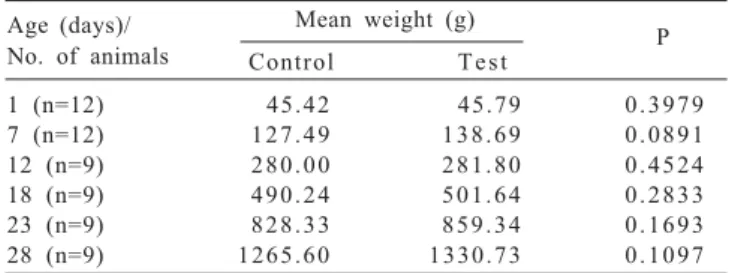
Regarded to weight, there were no differences between the animals supplemented with probiotics and the non supplemented animals (Table 2). The results obtained are in agreement with those related by Loddi et al. (2000) and by Panda (2000) who also did not find any differences on the weight of birds fed probiotics. Different levels of supplementation did not result in significant effects on
weight gain and conversion (Campos, 2002). Alvarez et al. (1994) also obtained no significant improvement in the weight gain of the birds. The authors attributed this result to the fact that the intestinal tracts of the animals were not colonized by undesirable microorganisms sufficiently enough to reduce the consumption of the rations. These data are in disagreement with Jin et al. (1998) and Loddi et al. (2000) who observed that birds receiving a probiotic supplement presented better final body weights.
In the animals treated with probiotics, the total ration consumption was 0.621 kg per broiler in the supplemented group, and in the control group, it was 0.622 kg. No statistical difference in consumption was observed between the two groups. Suida (1994) and Zuanon et al. (1995) also observed no difference in feed consumption with the probiotic added to the feed. However, Loddi et al. (2000) observed lower feed consumption in supplemented birds.
There was no bird mortality in this study, neither was morbidity observed in both of the groups. The results about mortality and morbidity are in disagreement with Campos (2002) who, working with various levels of probiotic inclusion in the rations (0; 50; 100; 150 and 1000), observed a reduction in the mortality rate.
At 7, 23, 18 and 28 days of age, the control group presented a higher enterobacteria count in the cecum, when compared with the test group (P<0.05). At 12 days of age, there was no difference, but there could have been some bias not identified at this age (Tabela 3). At one day of age, it was not possible to count the bacteria because of the impossibility on obtaining a weight of 10g of cecal content at this age. There is a vast undesirable microbiota in the cecum of normal chickens, and this is specially regarded to specimens from the family Enterobacteriaceae. Frequently, microorganisms such as Salmonella, Shigella and Yersinia are responsible for enteritis in birds (Zhu et al., 2002). According to Bourlioux et al. (2003) enterobacteria can cause damage to the intestinal cells. In addition, they have commensal behavior, and under propitious conditions, they become pathogenic.
Age (days)/ Mean weight (g) P
No. of animals Control T e s t
1 (n=12) 4 5 . 4 2 4 5 . 7 9 0 . 3 9 7 9
7 (n=12) 1 2 7 . 4 9 1 3 8 . 6 9 0 . 0 8 9 1
12 (n=9) 2 8 0 . 0 0 2 8 1 . 8 0 0 . 4 5 2 4
18 (n=9) 4 9 0 . 2 4 5 0 1 . 6 4 0 . 2 8 3 3
23 (n=9) 8 2 8 . 3 3 8 5 9 . 3 4 0 . 1 6 9 3
28 (n=9) 1 2 6 5 . 6 0 1 3 3 0 . 7 3 0 . 1 0 9 7
Table 2 - Mean weight (g) of the birds control and receiving probiotic supplement, at different ages
There was no significant differences (P<0.05).
Age (days)/ pH of crop P
No. of animals Control T e s t
1 (n=12) 6.80a 4.98b 0.0162
7 (n=12) 4.39a 2.98b 0.033
12 (n=9) 3.37a 3.06a 0.1984
18 (n=9) 5.71a 3.88b 0.0005
23 (n=9) 4.58a 4.11a 0.0956
28 (n=9) 4.86a 4.55a 0.4239
Table 1 - The mean pH measured in the crops of birds treated with probiotics, and non treated birds (controls), at different ages
Determining the number of enterobacteria in the cecal content allows the evaluation on the influence of the probiotics on the endogenous microbiota of this intestinal segment. In this study, there was a difference between the counts performed in the test and control groups. The group treated with probiotics presented a smaller population (P<0.05) of enterobacteria at the ages of 7, 18 and 28 days. The microorganisms present in the probiotic were probably able to inhibit or to control the multiplication of the endogenous microbiota. At 7 (seven) and 18 days of age there was a lower pH value with a lower enterobacteria count in the cecum. This suggests that colonization by Lactobacillus reduced the pH, and consequently, the colonization of enterobacteria in the cecum, contributing to their control.
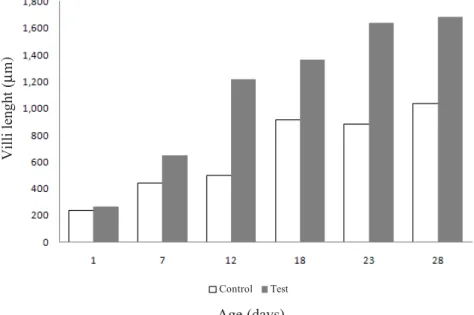
At all ages, except for 1 day of age, all the means of the test group were higher than those of the control group (P<0.05) (Figure 1).
Pelicano et al. (2003) found no differences on the length of villi in broilers at slaughter age after adding probiotics to the rations of birds in the following four treatments: control, with Bacillus subtilis, Bacillus subtilis + Bacillus licheniformis and Saccharomyces cerevisiae. The type of bacterium in the probiotics used (Lactobacillus plantarum, L. bulgaricus, L. acidophillus, L. rhamnosus, Enterococcus faecium, Bifidobacterium bifidus and Streptococcus thermophilus) could have been the cause of the divergent results obtained in the present study.
It is very important to measure the villi of the ileum because, in birds, many cell membrane carriers are located in the ileum, making it the main site of amino acid absorption, unlike the duodenum, in which amino acid hydrolysis is
still incomplete, therefore their absorption is quite limited in it. (Rutz, 2002).
Continuous cell turnover is important for the maintenance of the length of villi and consequently, for the absorption capacity (Pluske et al., 1997). This turnover is guaranteed by the balance the between the mitosis of undifferentiated cells located in the crypts and the villi, and the loss of the cells that occurs at the top of the villus (Uni et al., 1998; Applegate et al., 1999; Uni et al., 2000). When the intestine responds to some agent with an unbalanced turnover, the length and perimeter of the villi are modified (Pluske et al., 1997). According to Ribeiro et al. (2002), bacteria from viable probiotics compete with pathogenic microorganisms for adhesion sites in the intestinal mucosa, promoting an improvement in nutrient absorption, which intervenes directly in the regeneration of the intestinal mucosa, increasing the length of the villi.
Murakami et al. (2007) verified that in broilers, the duodenum was completely developed at 21 days of age, while the jejunum and ileum presented an increase in villi up to 41 days of age.
Age (days) Enterobacteria Counts (cfu.g) P
Control T e s t
7 (n=12) 1.7 x 10⁹a 7.7 x 10⁸b 0.002
12 (n=9) 5.6 x 10⁹a 2.2 x 10⁹a 0.2045
18 (n=9) 1.4 x 10⁹a 2.3 x 10⁸b 0.0001
23 (n=9) 8.3 x 10⁸a 6.4 x 10⁷b 0.0476
28 (n=9) 1.4 x 10⁸a 2.6 x 10⁶b 0.0129
Table 3 - Mean enterobacteria counts (cfu.g) in the cecal content of birds receiving probiotic supplement and control birds, at different ages
a, b - Different letters on the same line indicate significant difference (P<0.05).
Figure 1 - Morphometry of the villi of the ileum at the different ages, in treated with probiotics and control chickens.
Villi lenght
(
µ
m
)
Age (days)
Conclusions
It is concluded in this study that the use of probiotics reduces the pH of the crop content at the ages of 1, 7 and 18 days and contributes to decrease the enterobacteria in the cecum and it is showed that the length of the villi is increased, which probably could lead to a greater food absorption.
Acknowledgements
This study was financed by Fundação de Amparo a Pesquisa de Minas Gerais (FAPEMIG) (Minas Gerais Research Support Foundation), Brazil.
References
ALVARENGA, B.O.; BELETTI, M.E.; FERNANDES, E.A. et al. Efeitos de fontes alternativas de fósforo nas rações de engorda e abate sobre a morfologia intestinal de frangos de corte.
Bioscience Journal, v.20, p.55-59, 2004.
ALVAREZ, L.C.; BARRERA, E.M.; GONZÁLES, E.A. Evaluación d e p r o m o t o r e s D e l c r e c i m i e n t o p a r a p o l l o s d e e n g o r d a .
Veterinary México, v.24, p.2-2, 1994.
APPLEGATE, T.J.; DIBNER, J.J.; KITCHELL, M.L. et al. Effect of turkey (Meleagridid gallopavo) breeder hen age and egg s i z e o n p o u l t d e v e l o p m e n t . 2 . I n t e s t i n a l v i l l u s g r o w t h , enterocyte migration and proliferation of the turkey poult.
C o m p a r a t i v e B i o c h e m i s t r y P h y s i o l o g y, v. 1 2 4 ( B ) , p . 3 8 1 - 389, 1999.
BOURLIOUX, P.; KOLETZKO, B.; GUARNER, F.V. The intestine and its microflora are partners for the protection of the host: report on the Danone Symposium: “The Intelligent Intestine”, h e l d i n P a r i s . A m e r i c a n J o u r n a l o f C l i n i c a l N u t r i t i o n, v.78, p.675-83, 2003.
C A M P O S , D . M . B . N í v e i s d e i n c l u s ã o d e p r o b i ó t i c o s o b r e o d e s e m p e n h o d e f r a n g o s d e c o r t e . R e v i s t a B r a s i l e i r a d e Ciências Avícolas, v.4, p.36, 2002.
D O Y L E , M . P. ; E R I C K S O N , M . C . R e d u c i n g t h e c a r r i a g e o f f o o d b o r n e p a t h o g e n s i n l i v e s t o c k a n d p o u l t r y. P o u l t r y Science, v.85, p.960-973, 2006.
DUKE, G.E. Physiology of digestion and metabolism. Zootec Internacional, v.17, p.50-53, 1994.
FA R I A F I L H O , D . E . ; TO R R E S , K . A . A . ; FA R I A , D . E . e t a l . Probiotics for broiler chickens in Brazil: Systematic Review and Meta-Analysis. Brazilian Journal of Poultry Science, v.8, n.2, p.89-98, 2006.
FINNEY, A.M.; SMULLENA, J.; FOSTER, H.A. et al. Evaluation o f C h r o m o c u l t c o l i f o r m a g a r f o r t h e d e t e c t i o n a n d enumeration of Enterobacteriaceae from faecal samples from healthy subjects. Journal of Microbiological Methods, v.54, p . 3 5 3 - 3 5 8 , 2 0 0 3 .
FULLER, R. Basis and efficacy of probiotics. World’s Poultry Science Journal, v.44, p.69-70, 1988.
HINTON JR., A.; BUHR, R.J.; INGRAM, K.D. Reduction of
Salmonella in the crop of broiler chickens subjected to feed
withdrawal. Poultry Science, v.79, p.1566-1570, 2000. J I N , L . Z . ; H O , Y. W.; A B D U L L A H , N . G r o w t h p e r f o r m a n c e ,
intestinal microbial populacions, and serum cholesterol of broilers fed diets containing Lactobacillus cultures. Poultry Science, v.77, p.1259-1265, 1998.
LODDI, M.M.; GONZALES, E.; TAKITA, T.S. Effect of the use of probiotic and antibiotic on the performance, yield and carcass quality of broilers. Revista Brasileira de Zootecnia, v.29, n.4, p.1124-1131, 2000.
MURAKAMI, A.E.; SAKAMOTO, M.I.; NATALI, M.R.M. et al. S u p p l e m e n t a t i o n o f g l u t a m i n e a n d v i t a m i n E o n t h e morphometry of the intestinal mucosa in broiler chickens.
Poultry Science, v.86, n.3, p.488-495, 2007.
PA N D A , A . K . G r o w t h , C a r c a s s c h a r a c t e r i s t i c s , i m m u n o c o m p e t e n c e a n d r e s p o n s e t o E s c h e r i c h i a c o l i o f broilers fed diets with various levels of probiotic. Archiv Für Geflügelkunde, v.64, n.4, p.152-156, 2000.
PATTERSON, J.A.; BURKHOLDER, K.M. Application of prebiotics and probiotics in poultry production. Poultry Science, v.82, p.627-631, 2003.
PELICANO, E.R.L.; SOUZZA, P.A.; OBAB, A. et al. Morfometria e ultra-estrutura da mucosa intestinal de frangos de corte a l i m e n t a d o s c o m d i e t a s c o n t e n d o d i f e r e n t e s p r o b i ó t i c o s .
R e v i s t a P o r t u g u e s a d e C i ê n c i a s Ve t e r i n á r i a s, v. 9 8 , p.125- 134, 2003.
P L U S K E , J . R . ; H A M P S O N , D . J . ; W I L L I A M S , I . H . F a c t o r s influencing the stricture and function of the small intestine en t h e w e a n e d p i g : a r e v i e w. P r o d u c t i o n S c i e n c e, v. 5 1 , p . 2 1 5 - 236, 1997.
REVOLLEDO, L.; FERREIRA, A.J.P.; MEAD, G.C. Prospects in Salmonella control: competitive exclusion, probiotics, and enhancements of avian intestinal immunity. Journal Applied Poultry Research, v.16, p.341-351, 2006.
RIBEIRO, P.R.; KRONKA, R.N.; THOMAZ, M.C. et al. Adicão do ácido fumárico nas rações de suínos e seus efeitos nas fases inicial, crescimento e terminação. Ars Veterinaria, v.18, p.70-77, 2002.
R U T Z , F. P r o t e í n a s : d i g e s t ã o e a b s o r ç ã o . I n : M A C A R I , M . ; F U R L A N , R . L . ; G O N Z A L E S , E . e t a l . ( E d s . ) . Fisiologia aviária aplicada a frangos de corte. 2.ed. Jaboticabal: Funep, 2002. p.135-141.
SUIDA, D. Estimulantes do desempenho de galinhas poedeiras e de frangos de corte. 1994. 59f. Dissertação (Mestrado em Zootecnia) - Universidade Federal de Viçosa, Viçosa, MG. UNI, Z.; GANOT, S.; SJLAN, D. Posthach development of mucosal
function in the broiler small intestine. Poultry Science, v.77, p.75-82, 1998.
UNI, Z. Vitamin A deficiency interferes with proliferation and maturation of cells in the chickens’ small intestine. British Poultry Science, v.41, p.410-415, 2000.
ZHU, X.Y.; ZHONG, T.; PANDYA, Y. 16S Rrna-Based analysis of m i c r o b i o t a f r o m c e c u m o f b r o i l e r c h i c k e n s . A p p l i e d Environment Microbiology, v.68, n.1, p.124-137, 2002. ZUANON, J.A.S.; FONSECA, J.B.; ROSTAGNO, H.S. et al.