Original Article
Artigo Original
Prototype app for voice therapy: a peer
review
Protótipo de aplicativo para terapia vocal:
análise por pares
Paula Lavaissiéri1
Paulo Eduardo Damasceno Melo2
Keywords
Speech, Language and Hearing Sciences Speech Therapy Voice Voice Training
Software
Cell Phones
Descritores
Fonoaudiologia Fonoterapia Voz Treinamento da Voz Software Telefones Celulares
Correspondence address: Paula Lavaissiéri
Rua Dr. Cesário Mota Júnior, 61, São Paulo (SP), Brazil, CEP: 01221-020. E-mail: [email protected]
Received: December 15, 2015
Accepted: June 16, 2016
Study carried out at Faculdade de Ciências Médicas da Santa Casa de São Paulo - São Paulo (SP), Brazil.
1 Santa Casa de Misericórdia de São Paulo - São Paulo (SP), Brazil.
2 Faculdade de Ciências Médicas da Santa Casa de São Paulo - São Paulo (SP), Brazil.
Financial support: Scholarship of Faculdade de Ciências Médicas da Santa Casa de São Paulo. Conlict of interests: nothing to declare.
ABSTRACT
Purpose: Voice speech therapy promotes changes in patients’ voice-related habits and rehabilitation. Speech-language therapists use a host of materials ranging from pictures to electronic resources and computer tools as aids in this process. Mobile technology is attractive, interactive and a nearly constant feature in the daily routine of a large part of the population and has a growing application in healthcare. To develop a prototype application for voice therapy, submit it to peer assessment, and to improve the initial prototype based on these assessments. Methods: a prototype of the Q-Voz application was developed based on Apple’s Human Interface Guidelines. The prototype was analyzed by seven speech therapists who work in the voice area. Improvements to the product were made based on these assessments. Results: all features of the application were considered satisfactory by
most evaluators. All evaluators found the application very useful; evaluators reported that patients would ind it
easier to make changes in voice behavior with the application than without it; the evaluators stated they would use this application with their patients with dysphonia and in the process of rehabilitation and that the application offers useful tools for voice self-management. Based on the suggestions provided, six improvements were made to the prototype. Conclusion: the prototype Q-Voz Application was developed and evaluated by seven judges and subsequently improved. All evaluators stated they would use the application with their patients undergoing rehabilitation, indicating that the Q-Voz Application for mobile devices can be considered an auxiliary tool for voice speech therapy.
RESUMO
Objetivo: A terapia fonoaudiológica vocal promove mudanças de hábitos relacionados à voz do paciente, assim
como sua reabilitação. O fonoaudiólogo pode utilizar desde materiais como iguras até recursos eletrônicos e
de informática como instrumentos facilitadores durante esse processo. A tecnologia móvel é atrativa, interativa e presente em tempo quase integral na rotina de parte da população e apresenta-se crescente na área da saúde. Desenvolver um protótipo de aplicativo para terapia vocal, submetê-lo à análise por pares e aprimorar o protótipo inicial a partir das apreciações. Método: foi desenvolvido um protótipo do aplicativo Q-Voz com base nas Diretrizes de Interface Humana da Apple. O protótipo foi analisado por sete fonoaudiólogos que atuam na área de voz e, a partir das apreciações, foram realizadas melhorias no produto. Resultados: todos os recursos do aplicativo foram considerados muito satisfatórios pela maioria dos avaliadores. Todos os avaliadores consideraram o aplicativo muito útil; referiram acreditar que os pacientes terão mais facilidade em realizar mudanças no
comportamento vocal com o aplicativo que sem ele; que usariam esse aplicativo com seus pacientes disfônicos
em reabilitação; e consideraram que o aplicativo apresenta ferramentas úteis para o autogerenciamento vocal. A partir das sugestões, foram realizadas seis melhorias no protótipo. Conclusão: o protótipo do Aplicativo Q-Voz
desenvolvido foi avaliado por sete fonoaudiólogos e aprimorado. Todos os avaliadores airmaram que usariam
INTRODUCTION
Voice speech therapy involves techniques for promoting physiological changes that modify the use of the voice system and raise patient awareness of the factors causing or contributing toward the persistence of dysphonia(1). During therapeutic
sessions, speech therapists dedicate most time to balanced oral
production and tend to vary their approach for speciic aspects
that promote voice changes(2).
Speech therapists can employ instruments to aid the therapeutic
process. In recent years, the eficacy of voice techniques using
plastic straw(3), resonance tube(4,5) and silicon tube(6) has been
shown. Electronic technology has also proven useful for voice speech therapy through visual feedback with acoustic analysis software(7), videos with correct models of voice techniques
on portable MP4 players(8), video games as aids for voice
techniques(9)
, neuromuscular electrical stimulation
(10) and therapy
via teleconferencing(11).
Another fast growing area is mobile technology applied to health. A comprehensive literature review noted that, among the 27 articles selected on the topic, only three were centered on patient support: two addressing drug treatment and one assisting mobility of visually impaired individuals in urban environments. The authors highlighted the importance of developing these instruments to help patients become more involved in aspects related to their own health(12).
In view of the beneits of the advances in mobile technology
in the health area and the fact that it is an attractive and almost constant feature of the daily routine of a contingent of the population, it follows that the use of such applications as instruments during the voice therapy process can facilitate healthy voice-related
choices by patients. However, the irst stage in the development
of any application is devising a prototype with an emphasis on functionality that allows experimentation for tests(13).
The objectives of the present study were to develop a prototype application for voice therapy, submit this for peer review, and to improve the initial prototype based on the critical feedback provided.
METHODS
The study was approved by the Research Ethics Committee of the institution (Approval no. 1.031.309 and CAAE: 32622914.0.0000.5479).
Seven female speech therapists aged 22-50 years providing therapy to patients with dysphonia took part in the study. All participants signed the Free and Informed Consent Form.
The application (app) for mobile devices was designed to assist patients undergoing speech voice therapy that had problems implementing daily changes for dysphonia. The app provides instruments to remind patients on the times for practicing the techniques and about healthy voice habits recommended by speech therapists, and also has features to help perform the techniques properly, raise awareness about voice care and control performance on the tasks proposed in therapy.
The app is called Q-Voz and has the following features: user
proile, task schedule with focus on voice habits and techniques,
voice recorder, video camera, timer, notepad, scoring and graphs displaying the tasks performed, information on voice care and instructions manual.
The app protocol was devised based on Apple´s Human Interface Guidelines(13). The protocol was developed with a total
of 150 app screens designed on Adobe Illustrator software using the Visual Basic programming language. The prototype was produced for use on personal computers and notebooks running the Windows Operating System to simulate the interaction of a user with the app via browsing among all screens, yet without functionality or the Multi-Touch resource.
The prototype was submitted to the seven evaluators for review. The evaluators met with the researchers to analyse the product. Each evaluator was provided with a notebook on which the protocol was installed and ready for use. The evaluators used the prototype freely and assessed it. Subsequently, evaluators answered a questionnaire comprising three questions on the use and familiarity of the evaluators with smartphones and/or tablets; six questions on ease of use and satisfaction regarding the app features, answering on a Likert(14) scale with four levels (not at
all, not very, fairly and very satisfactory); four questions on the usefulness and applicability of the product; and one question reserved for remarks and recommendations.
Modiications were then made to improve the app based on
evaluators´ comments and suggestions.
RESULTS
Regarding the analysis of the prototype, the data indicated that, for use and familiarity with smartphones and/or tablets, 100% of the evaluators were users of smartphones or tablets; 71% installed apps to personalize smartphones or tablets; 57% installed apps as professional tools on their smartphone or tablet; 86% were familiar with the Android operating system; and 29% with the iOS operating system.
Concerning the analysis of each prototype feature, all were deemed satisfactory by most of the evaluators. The questionnaire was answered on a Likert scale with the following levels: very satisfactory, fairly satisfactory, not very satisfactory and not at all satisfactory. The app interface and information on voice care were rated as very satisfactory by 71% of evaluators and fairly satisfactory by 29%. The schedule alerts, sound recording functions and notes tool were rated as very satisfactory by 86% of the sample and fairly satisfactory by 14%. The timer was considered very satisfactory by all evaluators.
With regard to the usefulness and applicability of the product, 100% of the evaluators deemed the app very useful; reported
that patients would ind it easier to implement changes in voice
behavior with the app than without; stated that they would use the app for their patients with dysphonia undergoing rehabilitation and that the app offered useful tools for voice self-management.
Besides the quantitative questions, seven out of the fourteen questions were of the open type for dissertation answers, as shown in Chart 1. The evaluators provided comments on the accessibility of the app, replacement of therapy by the app, patient motivation and reliance on the app (Chart 2). Suggestions were
Chart 1. Responses and complementary comments to multiple-choice answers
QUESTIONS AND RESPECTIVE RESPONSES Are the schedule alerts satisfactory for the purpose?
“Yes. Need to be adapted to the patient profile. many tasks proposed and/or not concluded may generate anxiety.”
Is the information on Vocal Care satisfactory for the purpose?
“Fairly satisfactory. The information could be more concise – I thought it was very long, a lot of information to be assimilated.”
“Fairly satisfactory. Suggestion: emphasize the “strategies” heading to highlight the change from concept to practice. Perhaps figures could help remembering the concepts.”
Is the app a useful tool for voice therapy?
Very useful. Because it is motivational and helps organize patients´ everyday routine, but the patient needs to be motivated.”
Do you believe that patients will be able to make voice behavior changes more easily with the app than without it? Justify your answer. “Yes. It will be a further instrument available for use. However, provided they are previously or minimally motivated and aware.”
“Yes. With the work routine and daily tasks, it can alert about the need to practice the exercises, remind about how to perform the technique, the function of each technique and the importance and function of each voice care or habit.”
“Yes because the use of mobiles is now increasingly accessible, the device has been used for many different things. I believe that proposing an App as an aid in voice therapy will contextualize voice training within the patient´s routine.”
“Yes. Because it will be like a daily contact with the responsibility of “Being Accountable.”
“Yes. The app helps in the maintenance of the exercises and clarifies any doubts about voice care and habits.”
“Yes, because this app facilitates exposure to highly relevant information about habits. Patients do not need to search for the information, when they can often be erroneously referred to information sources. In the app, this information is scientifically based.”
“Yes. Perhaps...it depends on the profile of the patient and the level of awareness about the problem and degree of self-knowledge and openness to change.”
Would you use this app for your patients with dysphonia undergoing rehabilitation? “Yes. If it was accessible to the patient and they were adept app users.”
“Yes. For the same reasons as item 11 (preceding question) and the practicality of interaction between therapist and patient.”
“Yes. Certainly, to extend and emphasize the guidance on voice care and techniques beyond the therapeutic setting.”
“Yes. The schedule, voice care, and reminders on times to practice take out the “I forgot” element. As it can be used as an alarm and to set times.”
“Yes. Because the maintenance and frequency of the exercises is of extreme importance in therapy, and by using the app the patient has more control over the execution and timing of these.”
“Yes. It is an excellent reminder for all aspects of therapy. The patient is informed and also reminded about when, how many times and how the exercises should be performed.”
“Yes. I think that in medicine today, technological resources should be increasingly used. It allows closer monitoring of training between patient and therapist. Notes are easier to store and carry. It transfers the ‘memory’ function over to the device. It motivates using graphics. It organizes homebased work into time x purpose. It allows models to be recorded and registers training for future correction. It allows progress to be registered. It aids patient x therapist x otolaryngologist communication.”
Does the app have useful tools voice self-management?
“Yes. Because it allows the inclusion of items that are required for each patient.”
“Yes, because patients are aware of which techniques to practice, their applications and functions, it shows whether the frequency and practice are done effectively, the voice quality in the assessment can be compared with earlier assessments to check whether there has been improvement or not.”
“Yes, because the user (patient) has access to the graphs and reports produced containing information on the frequency of exercises performed, besides reminders and remarks about the proper care concerning diet and voice.”
“Yes. I think the possibility of patients being able to record, listen to and compare their voice is stimulating for behavior change.”
“Yes. Same as 12.” (preceding question)
“Yes. It provides the means for patients to create a certain independence when performing exercises, since they all have models of how they should be performed, and become aware of voice habits, because they all have explanations.”
“Yes. Same as 12.” (preceding question)
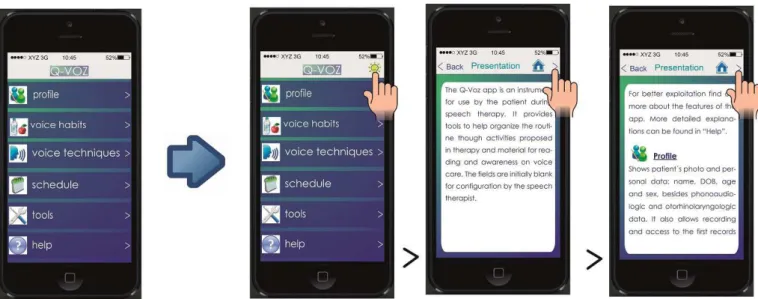
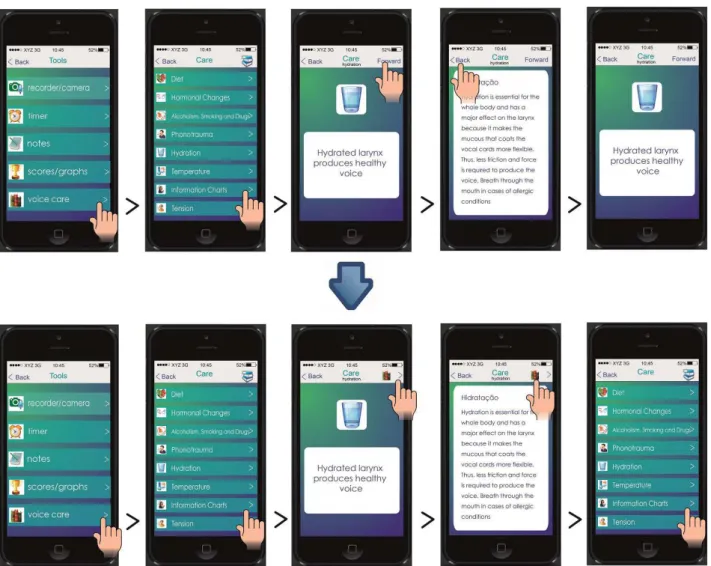
the following changes: inclusion of a tutorial (Figure 1), visual highlighting of the “Strategies” headings in the explanatory text on voice care (Figure 2), inclusion of browsing by content in texts on voice care and help (Figure 3), inclusion of a feature to allow viewing of previous days in the schedule (Figure 4), inclusion of a feature allowing patients to change the information on performing tasks in the schedule in the event of not having performed what was previously stated (Figure 5), inclusion of
a text box to provide a reason for not having performed the schedule task (Figure 6).
DISCUSSION
The app interface conforms to Apple standards for the
iOS operating system. Of the seven evaluators, ive reported
not being familiar with this system, a fact which may lead
QUESTIONS AND RESPECTIVE RESPONSES Write remarks or recommendations for the prototype app:
“I believe it´s necessary to have a start page with general and specific instructions on how to use the app, this would aid initial and immediate use. The HELP topic holds this information but it is necessary to read the whole item – perhaps something condensed like a tutorial. Summarize the “Theories” part of the information on the ‘Voice care’ screen – a lot of information for patients who are not good readers. There could be a suggestion on how therapists can make best use of the app – in as far as optimizing and broadening its use to encompass all the app can offer. It is a really well produced and functional tool.”
“Correction in the ‘tongue.g’ vibration technique. Screens are clear and easy to understand. In the schedule, the ability to view techniques, or habits or care performed on other days.”
“Suggestions: - Only the therapist has permission to delete the techniques outlined. - Upon clicking ‘no’ for the alarm reminding to perform the techniques, patient put a brief reason to serve as a reminder when explaining to the therapist. - Change title on the ‘tools’ menu given the association with colors and general appearance settings of the app. - Correct ‘cn’ to ‘can’ on the ‘help’ menu. - Correct the words ‘stores’ to ‘stored’ in the ‘help -> notes’ menu. - put the term ‘tension’ in the topic on the ‘help -> voice care’ menu. Positive feedback: I thought the idea of the app was excellent. It´s going to help voice therapy generally, it´s going to help both patient and therapist by encompassing all the important aspects that should be addressed in therapy, besides extending and reinforcing the care and guidance on techniques beyond the therapeutic setting.”
“Caution required to ensure patients do not think that use of the app replaces face-to-face therapy. Recommended for high socioeconomic level. Useful for patients willing to change that have a busy daily routine. Must not use the app as an excuse for non-adherence. If the person forgets to charge the mobile for example, they need to know that they cannot become reliant on the app.”
“Recommendations: If possible, integration in the app whereby the therapist can access the patient´s therapeutic information without necessarily depending on the sending of the report. Another suggestion would be the part selected by the patient to perform the training of the exercise – when clicking on Yes the patient must perform the training - if the training is not performed, the option automatically returns to no! Correction: Help-> Points/graphs -> Display scores and graphs -> daily scores (‘daily’)”
“I suggest that an option be created allowing an explanation to be exited (each item of voice and care habits) at the end of it (an ‘x’, for example), not having to go back page by page through this explanation to return to the main menu. The app is highly explanatory and complements the advice given to patients during therapy.”
“I liked the font. Is the idea to produce the least number of pages? If so, fair enough. If not, could the font be a little larger? Highlight titles to stand out more. Add figures for the voice care concepts. Well done! Nice job.”
Source: Produced by authors
Chart 1. Continued...
Chart 2. Comments of evaluators regarding the prototype app
COMMENTS OF EVALUATORS Regarding accessibility of the app:
“Recommended for high socioeconomic level.”
(Question “Would you user this app for your patients with dysphonia undergoing rehabilitation?”) “Yes. If it was accessible to the patient and they were adept app users.”
Regarding replacing therapy with the app:
“Caution required to ensure patients do not think that use of the app replaces face-to-face therapy.”
Regarding patient motivation
“It will be a further instrument available for use. However, provided they are previously or minimally motivated and aware.”
“It depends on the profile of the patient and the level of awareness about the problem and degree of self-knowledge and openness to change.”
“Useful for patients willing to change that have a busy daily routine.”
Regarding reliance on the app:
“If the person forgets to charge the mobile for example, they need to know that they cannot become reliant on the app.”
to problems using it. Despite this lack of familiarity, most of the evaluators rated the interface as very satisfactory. These ratings indicate the interface was easy to use and learn, irrespective of prior experience of the user on the operating system standards.
The “schedule alerts” section was considered very satisfactory by six evaluators, all of whom commented that this feature allows patients to be reminded to perform the techniques and about healthy voice habits, and also transfers the task of remembering over to the device. One evaluator rated the schedule alerts as fairly satisfactory and commented on the need to adapt these
to the proile of the patient, while avoiding too many tasks.
The “schedule” tool of the prototype has sixteen programmed tasks, but it was probably unclear that the schedule is devoid of data upon installation, i.e. empty. The tasks are added by the speech therapist when setting up voice techniques and habits
as part of therapeutic planning. Thus, the tool is conigured to suit the proile of the patient by the therapist.
The “recorder” was considered a source of independence and awareness by allowing recording of correct models of voice techniques for subsequent practice. No comments were made about shortcomings of this feature and therefore no light was shed on points for potential improvement.
The “notes” tool was considered useful in that it helped storing and carrying notes. No comments about problems or suggestions for alterations were made for this section.
The timer was considered very satisfactory by all evaluators, allowing greater control over the execution and duration of the exercises.
Positive comments were made on the fact that the information about “voice care” was based on specialized books from the area, preventing patients from seeking this information from unreliable sources. However, two evaluators rated the information as fairly satisfactory, citing it as too detailed. The aim of this section is to provide material for use by speech therapists during voice therapy. Therapists are responsible for guiding the patient on the
Figure 1. Modification to the prototype app: new button on Start Screen for accessing tutorial content. Source: Produced by authors
Figure 3. Modification to the prototype app: the “forward” button on the Browsing bar was represented in the form of an arrow and the “Voice care” button providing access to the menu was added. Source: Produced by authors
use of the tool, emphasizing the most relevant parts according to their individual needs. Consequently, it was decided to keep
the full length texts in order to cover the speciics of each case.
Suggestions were also made to highlight the titles and include
igures in the “voice care” section. The content was divided into
eight sub-topics, where each was attributed an illustrative igure
and a short phrase for memorizing. More illustrations related to the concepts may promote a greater number of associations and thereby aid their recall. Therefore, this suggestion may lead to
future changes in the inal app. With regard to the “Strategy” Figure 5. Modification to the prototype app: new screens for changing status of schedule activities. Source: Produced by authors
titles, the suggestion was considered pertinent, given that highlighting this section may help the patient locate it in the event of doubts. The headings were therefore improved.
The evaluators made comments on the accessibility of
the app. Because the app is for daily use by patients, the irst
requirement is that they own a compatible smartphone and are adept users. Given the app is a prototype, the likely cost has not
yet been deined. In the event the app is not free of charge, the
possibility of this investment should also be taken into account by therapists when recommending the product. Currently,
smartphones, as well as paid apps, are inancially accessible to
individuals of all socioeconomic levels, with models available at a range of prices plus the option to purchase by installments. If the app is made available for the iOS operating system only, accessibility will be limited, since Apple does not offer low-cost devices. However, if the app is also produced for the Android operating system it will be more accessible.
Another point cited by the evaluators was the possibility of replacing face-to-face therapy with the app. The use of the app is not intended to replace the speech therapist or face-to-face treatment. The app is designed as a tool to complement the therapeutic process and cannot be used by the patient alone
because it was developed to be regularly conigured by the
speech therapist according to the therapeutic planning. Upon installation, the app contains no programmed data, with all
ields blank. Without the therapist, patients only have access to
information about voice care. There are no techniques described to prevent patients from performing them incorrectly without guidance. Techniques and healthy voice habits must be gradually
introduced into patient´s schedules as seen it by the therapist.
This should make patients aware that face-to-face therapy is not supposed to be replaced by the app.
The evaluators considered motivation an important factor for use of the app as a tool. Patients must feel motivated in order to achieve good results from the speech voice therapy. Patient motivation involves complex aspects such as emotional state, awareness of the problem, willingness to change and
self-conidence(15). In the therapeutic process, speech therapist
can identify the state of motivation and help patients improve based on their needs. The app is a motivational instrument given its features promoting changes in habits, tools providing the correct model for performing techniques and tracking voice improvements (sound and video recordings), besides displaying performance graphs, virtual rewards (stars and trophies) and the ability to share performance via facebook. The virtual rewards are based on standards adopted in gaming apps for all ages. Also, as an instrument, its applicability should be assessed by
the therapist considering patient proile.
The evaluators voiced concerns about patient reliance on the app. The instrument was developed as an aid to the therapeutic process and requires full time use, not least to remind patients about times to perform voice techniques and about some healthy habits. However, when these new behaviors become habits, patients no longer need to use the app. Therefore, concerns over dependence should be limited to improper use during the therapeutic process. Patients should be advised to always keep
their smartphone battery charged and the device close at hand in order to hear the alarms with reminders on the techniques and voice habits. In cases where this is not possible, the instrument should not be recommended because patients might use the device as an excuse for not making the changes required.
Of the suggested modiications to the prototype, four were
rejected. The suggestions and reasons for non-acceptance are given below: (1) “increase the font size of texts”, rejected because, although the prototype analyzed did not have these features,
the inal product is to include a “zoom” and feature allowing
change to the horizontal position to provide better viewing by users; (2) “add a feature preventing patients from deleting the techniques set up by the therapist”, not accepted because the app is a tool for the patient´s smartphone (main user) and because this content is not necessary to guarantee success of the therapy. Even if patients delete some techniques, accidently
or otherwise, the therapist can reconigure them during the next
session; (3) “change title of tools menu”. The heading was retained as the menu is for the tools: Recorder, Timer, Notepad, Scoring control and Information on Voice Care. The suggestion
to change the title was justiied by the possible association with
the visual and auditory settings of the app, which are designated as “adjustments” under the iOS standard; (4) “add a feature allowing therapists to access patient performance”. Although the idea of including this feature was raised during the initial planning of the app, it was rejected for increasing programming and maintenance costs of the app.
them from performing the tasks and to facilitate the resolution of these issues (Figure 6).
CONCLUSION
The prototype Q-Voz App was assessed by seven speech therapists that treated patients with dysphonia, allowing improvements to the product. All evaluators stated that they would use the app with their patients undergoing rehabilitation. Therefore, the Q-Voz App for mobile devices can be considered an auxiliary tool for speech voice therapy.
ACKNOWLEDGEMENTS
We are grateful to Faculdade de Ciências Médicas da Santa Casa de São Paulo, for the opportunity of the enriching learning and for the institutional scholarship granted.
REFERENCES
1. Ruotsalainen JH, Sellman J, Lehto L, Jauhiainen M, Verbeek JH. Interventions for treating functional dysphonia in adults. Cochrane Database Syst Rev. 2007;18(3):1-29. PMid:17636842.
2. Gartner-Schmidt JL, Roth DF, Zullo TG, Rosen CA. Quantifying component parts of indirect and direct voice therapy related to different voice disorders. J Voice. 2013;27(2):210-6. PMid:23352061. http://dx.doi.org/10.1016/j. jvoice.2012.11.007.
3. Guzman M, Higueras D, Fincheira C, Muñoz D, Guajardo C, Dowdall J. Immediate acoustic effects of straw phonation exercises in subjects with dysphonic voices. Logoped Phoniatr Vocol. 2013;38(1):35-45. PMid:23350916. http://dx.doi.org/10.3109/14015439.2012.731079. 4. Paes SM, Zambon F, Yamasaki R, Simberg S, Behlau M. Immediate
effects of the finnish resonance tube method on behavioral dysphonia. J Voice. 2013;27(6):717-22. PMid:24119641. http://dx.doi.org/10.1016/j. jvoice.2013.04.007.
5. Kapsner-Smith MR, Hunter EJ, Kirkham K, Cox K, Titze IR. A randomized controlled trial of two semi-occluded vocal tract voice therapy protocols. J Speech Lang Hear Res. 2015;58(3):535-49. PMid:25675335. http://dx.doi. org/10.1044/2015_JSLHR-S-13-0231.
6. Andrade PA, Wood G, Ratcliffe P, Epstein R, Pijper A, Svec JG. Electroglottographic study of seven semi-occluded exercises: LaxVox, straw, lip-trill, tongue-trill, humming, hand-over-mouth, and tongue-trill combined with hand-over-mouth. J Voice. 2014;28(5):589-95. PMid:24560003. http:// dx.doi.org/10.1016/j.jvoice.2013.11.004.
7. Mora R, Jankowska B, Guastini L, Santomauro V, Dellepiane M, Crippa B, et al. Computerized voice therapy in hypofunctional dysphonia. J Otolaryngol Head Neck Surg. 2010;39(5):615-21. PMid:20828528. 8. van Leer E, Connor NP. Use of portable digital media players increases voice
therapy patient motivation and practice frequency. J Voice. 2012;26(4):447-53. PMid:21840169. http://dx.doi.org/10.1016/j.jvoice.2011.05.006. 9. King SN, Davis L, Lehman JJ, Ruddy BH. A model for treating voice
disorders in school-age children within a video gaming environment. J Voice. 2012;26(5):656-63. PMid:22209055. http://dx.doi.org/10.1016/j. jvoice.2011.08.002.
10. Guzmán M, Rubin A, Cox P, Landini F, Jackson-Menaldi C. Neuromuscular electrical stimulation of the cricothyroid muscle in patients with suspected superior laryngeal nerve weakness. J Voice. 2014;28(2):216-25. PMid:24315659. http://dx.doi.org/10.1016/j.jvoice.2013.09.003.
11. Rangarathnam B, McCullough GH, Pickett H, Zraick R, Tulunay-Ugur O, McCullough K. Telepractice versus delivery of voice therapy in-person for primary muscle tension dysphonia. Am J Speech Lang Pathol. 2015;24(3):386-99. PMid:25836732. http://dx.doi.org/10.1044/2015_AJSLP-14-0017. 12. Tibes CMS, Dias JD, Zem-Mascarenhas SH. Aplicativos móveis desenvolvidos
para a área da saúde no Brasil: revisão integrativa da literatura. REME Rev Min Enferm. 2014;18(2):471-8.
13. Apple Inc. [Internet]. iOS human interface guidelines. 2014 [citado em 2014 Out 10 ]. Disponível em: https://developer.apple.com/library/ios/ documentation/UserExperience/Conceptual/MobileHIG/
14. Likert R. A technique for the measurement of attitudes. Arch Psych. 1932;140:1-55.
15. Van Leer E, Hapner ER, Connor NP. Transtheoretical model of health behavior change applied to voice therapy. J Voice. 2008;22(6):688-98. PMid:18082367. http://dx.doi.org/10.1016/j.jvoice.2007.01.011.
Author contributions
PL and PEDM participated in the conception of manuscript, analysis and data interpretation; writing or critical review of the article; read and approved the