UDC 691.335-022.532, 004.942
KOROLEV Evgenij Valerjevich, Doctor of Engineering, Professor, Director of the Research and Educational Center «Nanomaterials and Nanotechnology», Moscow State University of Civil Engineering; Yaroslavskoye hw. 26, Moscow, Russian Federation, 129337, [email protected]; SMIRNOV Vladimir Alexeevich, Ph.D. in Engineering, Associate Professor, Leading Research Officer of the Research and Educational Center «Nanomaterials and Nanotechnology», Moscow State University of Civil Engineering; Yaroslavskoye hw. 26, Moscow, Russian Federation, 129337, [email protected];
EVSTIGNEEV Alexandr Viktorovich, postgraduate, Moscow State University of Civil Engineering; Yaroslavskoye hw. 26, Moscow, Russian Federation, 129337, [email protected]
NANOSTRUCTURE OF MATRICES FOR SULFUR CONSTRUCTIONAL
COMPOSITES: METHODOLODY, METHODS AND RESEARCH TOOLS
2Complex of operational properties of sulfur-based and sulfur-extended building materials may lead both to economical efficiency of construction and to reduced load on the environment. The feasibility of the sulfur-extended materi-als is primarily caused by properties, availability and low cost of sulfur. Before the development of building material it is necessary to examine the supramolecu-lar structure of the matrix in detail. Material science of sulfur is still with several «white spots» which have to be filled with sound knowledge and reproducible data. New level of the research in constructional material science can be achieved with help of system analysis. The key prerequisite for successful application of system analysis in material science is the determination of primary interactions which, in turn, define applicable modeling methods. Several investigation methods can be used at the nanoscale level – traditional experimental methods, quantum chemistry modeling, molecular dynamics. The methodology of research depends on objectives and also on acceptable values of time and resource consumption. Requirements for precision and reproducibility, together with demands for new scientific data must also be taken into consideration. In the present work we have presented different strategies of investigation: case for dominance of practice, case for high demands for new scientific data and the case for high demands for precision, reliability and reproducibility. The latest case is the preferable one, and it was used during investigation of the nanostructure of sulfur binder. Three different methods of research were applied: Raman spectroscopy, quantum chem-istry simulation and molecular dynamics. It was demonstrated again that
broad-2 This work is supported by the Ministry of Science and Education of Russian Federation, job No 2014/107,
ly available technical sulfur corresponds to orthorhombic allotrope; at the same time, comparative analysis of the Raman spectra reveals that bending of long sulfur chains in technical sulfur takes place in less constrained conditions. For the quantum chemistry computations three different software tools are used; the capabilities of accompanying pre- and post-processing tools are discussed. It is shown during analysis of quantum chemistry calculations that verification of the experimental Raman spectra should not be performed with results obtained for isolated S8 molecule. Results of simulation performed for the sulfur crystal are close to the experimental measurements; such correspondence is an important proof of conformity between lattices of real crystal and model. During molecular dynamics simulations it is found that such methods can successfully be used only on the spatial scales starting from 10 nm, whereas on the lower scale the quan-tum effects must be taken into account.
Key words: nanotechnology, constructional material science, computational chemistry, molecular dynamics.
here is a strong need of advanced building materials in modern civ-il engineering and special construction. Using the materials with poor operational properties leads to low service life and high operational costs of constructions. In turn, due to low service life of the construction there is an increase of environmental loads; this is because requirements for production of extra amount of building materials.
Both structure and properties of any constructional composite are in great dependence on type of matrix material. Among other promising ma-trices for composites there are sulfur-based and sulfur-modified ones. High operational properties of sulfur-extended building materials lead to eco-nomical efficiency of constructions and reduce load on the environment. For example, application of sulfur-extended paving material [1, 2] allows to increase the mobility of the mix during laying and escalating the values of operational properties – most notably compressive strength and resis-tance to rutting. The application of such material decreases environmental load in regions near the oil and gas industry enterprises.
The feasibility of the sulfur-extended materials primarily caused by properties, availability and low cost of sulfur. Moreover, there are many
sulfur dumps near the oil industry enterprises. Such dumps consumes a lot of area which otherwise could be occupied by vegetation, contributing to the improvement of the environmental situation. Incorporation of sul-fur in bulk building materials contributes to decrease of load to the envi-ronment [2]. There are numerous advantages of sulfur composites: cheap binder, quick structure forming, high chemical resistance [3].
There exist numerous ways to improve the operational properties of concretes based on sulfur. By means of application of polymers distributed on the surface of fine filler it is possible to outcome several drawbacks of the traditional material with thermoplastic matrix [4, 5]. Obviously, na-noscale layer of high-molecular substance significantly alters structure forming process near the phase boundary. But details of supramolecular structure of such intermediate layer are still unknown [6].
Despite the progress which has been made during the last decades in the understanding of the sulfur allotropes, material science of sulfur [7, 8] and sulfur-enhanced composites is still with several «white spots» which have to be filled with sound knowledge and reproducible data. As it already mentioned, the structure of the nanoscale layers at the phase boundaries is of considerable interest. At the same time it is evident that examination of inter-boundary layer must be preceded by deep investiga-tion of sulfur. Of cause, a lot of research work is already done. Structure of the most common sulfur allotrope was determined in 1935 [9], authors presented a crystallographic data which is currently in public domain [10]. During the XX century, crystal structure of other sulfur allotropes [11–13], molecular structure of sulfur vapor and structure of sulfur com-pounds are of interest [7, 8].
With help of system analysis the new level of the research in construc-tional material science can be achieved [5, 14, 15]. The prerequisites for successful application of system analysis in material science are already formulated, and the key point is the determination of bounds for spatial scales of interest and corresponding list of possible interactions – which, in turn, define applicable modeling methods [5, 15].
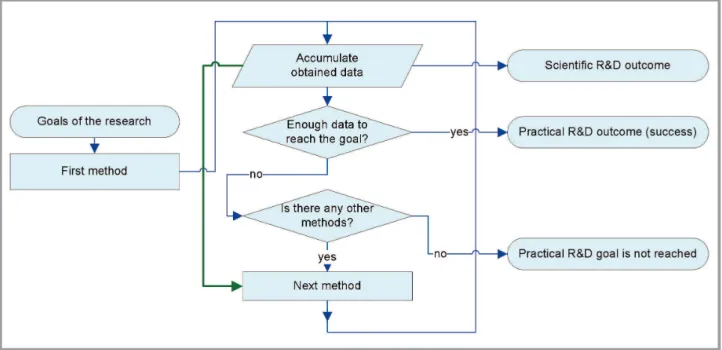
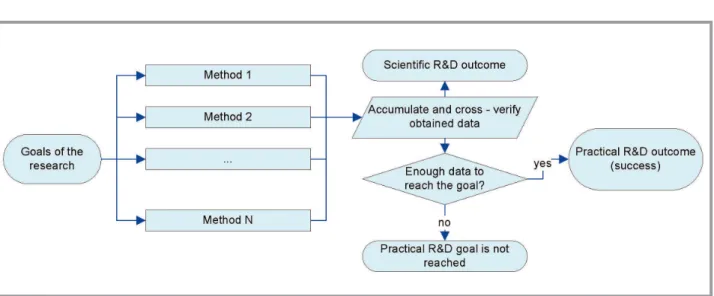
on «practical» goals of the research (development of the building material with required values of operational properties), but also on allowed time and resource consumption, requirements for precision and reproducibility, demands for new scientific data with high predictive potential (Fig. 1–3).
Fig. 1. Possible methodology of research during investigation of nanostructure in case when practical goal is dominant
The scheme on Fig. 1 is the most simple; we just all available methods one by one until the goal is reached or methods are depleted. The results obtained during application of n–1-th method are not used at all during
applying of the n-th method. This scheme may lead to the lower time and resource consumption if: a) practical goal is dominant; b) the most useful method is known with great assurance. The condition «b» reveals obvious deficiency of the scheme: if useful method is uncertain, then most data ob-tained during research will be wasted.
The scheme on Fig. 2 is the direct modification of the previous one, and it is made for elimination of the mentioned deficiency. Regardless of the methods’ order, all data obtained on the n-th step will be at least accu-mulated for further research. In principle, nothing prevents the usage of data obtained on steps 1...n during application of n+1-th method (green
arrow on Fig. 2). Even if the research goal is not reached, there will be a lot of new theoretical and/or experimental data; because of this, scheme on Fig 2 is often used during preparation of qualification works (thesis, dissertations etc.).
Both Fig. 1 and 2 represent sequential type of research. Though scheme on Fig. 1 can easily be parallelized (there is no dependence on data from previous step), such parallelization in average will cause both reduction of time and increase of resource consumption (if proper sorting of methods was performed). This, depending on type and amount of available resource, can be considered either as positive or negative feature.
To eliminate dependence on data from second scheme and allow paral-lelization, we have to exclude the path indicated by green arrow on Fig. 2. The negative effect of such elimination (inability to use data obtained in previous methods) is compensated by possibility to perform cross-verifica-tion of the results, obtained by different methods – if there are more then one method leads to the goal (Fig 3).
In real research work neither of these three schemes are used as is; it is common in practice to combine some parts from different schemes. Some methods (both experimental and theoretic) provide a lot of «scientific» information (IR-, Raman and NMR spectroscopy, adsorptive porometry, XRD, quantum chemistry methods based on density functional theory) which is hard to utilize entirely during applied research. Such methods are often used as a source of data for verification. Outcomes of other meth-ods may be single scalar values (viscosimetry, X-ray scattering, simulation methods based on thermodynamics). Such methods are mostly suitable for routine work, and values obtained are subjects for verification by means of other methods.
Moreover, many methods can be verified in more then one way – for ex-ample, results of Raman spectroscopy can be verified by means of density functional theory (DFT) and molecular dynamics (MD) calculations; in case of DFT, there can be simulations with different basis and type of self-consis-tent field; in case of MD, there can be simulations with different pair-wise potential (force field). On the contrary, many methods can be used for verifi-cation of others. It is evident from last example that both DFT and MD simu-lation can be used during verification of Raman spectra; but these methods can also be used for verification of IR spectra and – in case of MD – even macroscopic properties of the building materials [16, 17]. The verification of computational algorithms and numerical software is a separate task not related to the material science; albeit, by means of using different software tools it is possible to assure correctness of the results obtained.
To illustrate the application of scheme #3 we will fit into it the excerpt from real research work concerning structure and properties of nanomodi-fied sulfur-based building materials. Purposes of the research are numer-ous, but there is a part which involves both experimental (preparation of reference samples, Raman spectroscopy) and numerical (quantum chemis-try simulation) subparts.
crystal (the quantum mechanics gives relevant equations) and structural models (a lot is already developed in XX century). During experimental studies we are planning to use Raman spectroscopy extensively, thus ref-erence samples were prepared and refref-erence spectral data was obtained. It was stated [15] that software tools for neighbor spatial scales can be utilized during investigation of nanostructure. To justify this statement, both DFT and MD-based simulation algorithms have to be applied. Series of numeri-cal experiments was performed for determination of the applicability, se-lection of appropriate numerical quantum chemistry method and suitable numerical software for quantum chemistry and MD.
The methods (second column on Fig. 3) are: 1. Raman spectroscopy.
2. Hartree–Fock (SCF) method [18].
3. DFT with generalized gradient approximation [19]. Numerical software:
1. DMol3 quantum chemistry tool [20]. 2. CASTEP quantum chemistry tool [21]. 3. GAMESS quantum chemistry tool [22]. 4. Our special-purpose MD codes [23, 24].
Together with quantum chemistry software we are also using sever-al pre- and post-processing tools [25–28]; the software will be discussed later.
The comparative analysis (third column on Fig. 3) was performed on data obtained in real and numerical experiments. The outcome is basically a decisions concerning applicability of the methods and software tools, by several practical conclusions were also made.
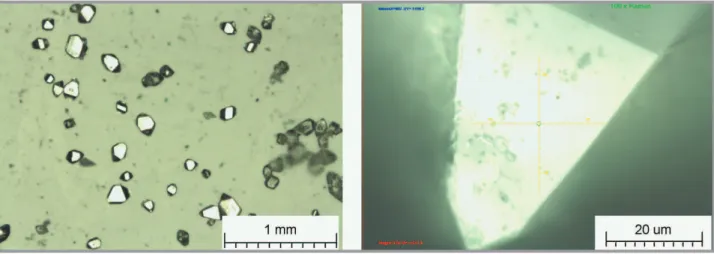
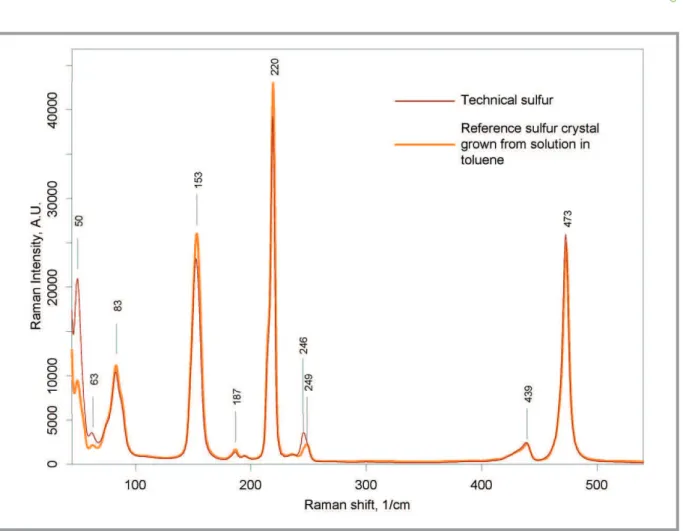
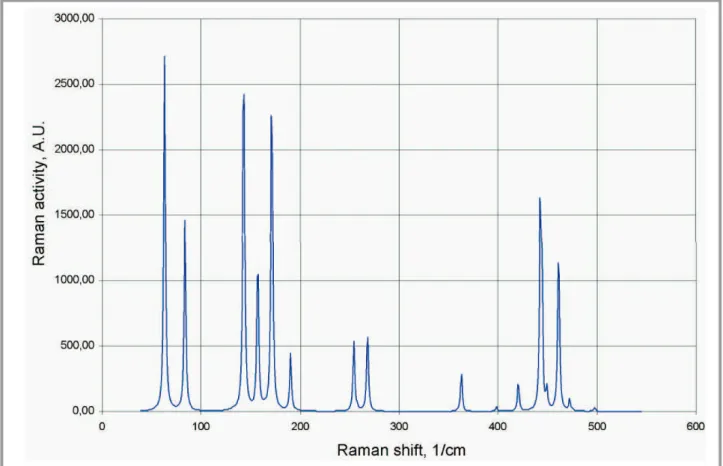
Early in research process we have analyzed the structure of low-cost technical sulfur (Fig. 4) and sulfur crystals (Fig. 5) grown specifically for reference purposes. The primary tool during analysis was Raman spectros-copy. Suitability of this method is due to high Raman activity of sulfur al-lotropes and sulfur-based compounds. The experimentally obtained spectra are shown on Fig. 6.
The crystals shown on Fig 5 were grown from saturated solution in toluene. Time of growth was 30 min, evaporation rate was 0.1 cm3/min.
The Raman spectra were obtained on SENTERRA spectrometer. The exper-imental conditions were as follows: room temperature, laser wavelength 532 nm, laser power at the sample 0.2 mW, spectral resolution 3 cm–1,
Fig. 4. Particle of technical sulfur
Fig. 5. Sulfur crystals which will be used as reference samples during investigation of nanoscale modification of sulfur binder
As it follows from Fig. 6, the Raman spectra of technical sulfur and reference sulfur crystal are almost identical. No toluene peak near 510 cm–1
for technical sulfur; this line corresponds to fundamental component of crystal vibrational symmetry ag [29]. Raman shifts for line near 250 cm–1
are slightly different. This line corresponds to the S–S–S bending; since the shift for technical sulfur is lower (corresponds to lower energy), it can be stated that bending of long sulfur chains in technical sulfur takes place in less constrained conditions.
At present, there are many software tools and packages which can be used to perform quantum chemistry computations. Some of them [20, 21] are proprietary and expensive, while the other (for example, [22]) are open-source and available for anyone at no cost.
The DMol3 and CASTEP tools are integrated in BIOVIA Materials
Stu-dio – integrated environment for computational materials science. This in-tegrated environment can be used in advanced research of various materi-als, including building materials; there are modules not only for quantum chemistry, but also for MD and other simulations. Integrated environment
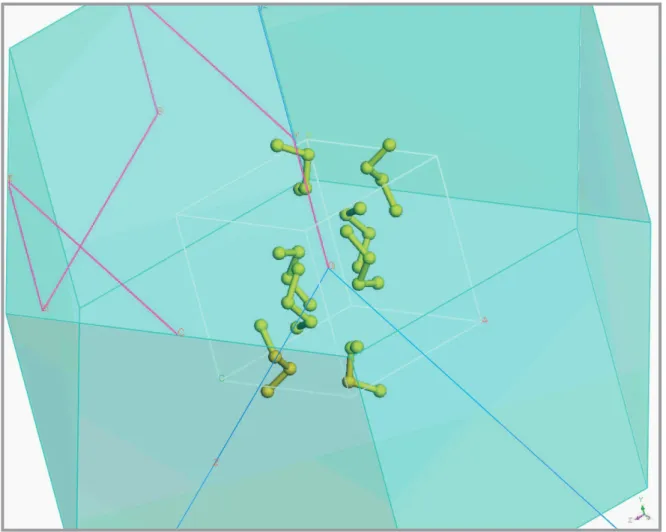
includes tools for pre- and post-processing, including molecular and crystal construction and visualization (Fig. 7). The price of the perpetual license for environment with all modules is tens of thousands euro; probably, this is the limiting factor.
As a rule, open-source scientific software (including our code [23] for MD simulation) is designed with so-called «UNIX Way» in mind – only one specific task is implemented (for example, solver for DFT or MD), and for solution of other tasks researcher must rely on different software tools. The GAMESS [22] is pure quantum chemistry solver which must be con-trolled from command line, with text input files of specific format. Pre- and post-processing tasks have to be solved with different tools. This can be difficult at first, and often requires deep knowledge of POSIX operat-ing systems. Nevertheless, such an approach for numerical simulation is broadly accepted in science.
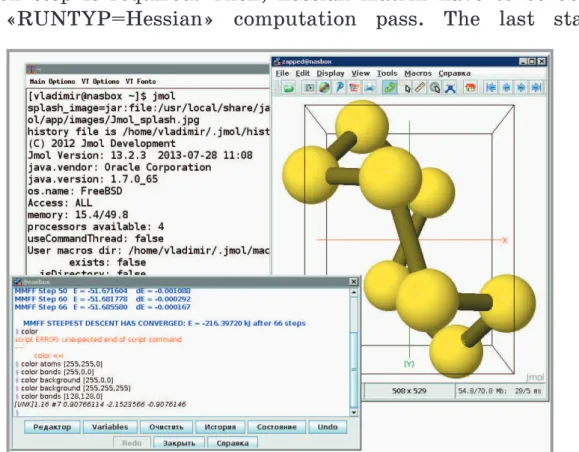
Selection of accompanying tools is the matter of choice and individual preferences. The Jmol [25] is a quite simple tool and can be used only for visualization (Fig. 8) of molecular structures (strictly speaking, there is a tool for geometry optimization, but this tool is of relatively low useful-ness).
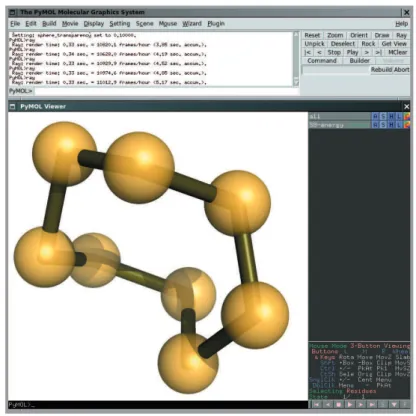
The PyMOL [26] molecular graphics system (Fig. 9) can be used not only for visualization (still images rendered interactively with OpenGL and offline with raytracing; animations can be produced), but also for molecu-lar editing. Visualization tools in PyMOL allow to produce detailed high-quality images; covers of «Nature» journal are the places where these im-ages are usually reside.
The next two quantum chemistry software tools – Gabedit [27] and Avogadro [28] – are very useful because they directly implement pre-processing to GAMESS input file (and many other input formats, too; Fig. 10, 11).
Computing of Raman data with GAMESS is multi-step process. If the geometry (atomic structure) is build manually, the geometry op-timization step is required. Then, hessian matrix have to be obtained during «RUNTYP=Hessian» computation pass. The last stage is
Fig. 9. PyMOL console and main window with raytraced image
«RUNTYP=Raman» pass for input file with «$HESS» matrix extracted from output of the previous stage.
The results of quantum chemistry calculations of Raman activities (not intensities; activities are independent from both temperature and excita-tion wavelength) for isolated S8 molecule (DM, GAMESS) and orthorhom-bic sulfur crystal (CAS) are summarized in Table 1. Intensity correspond-ing to second column is shown on Fig 12.
As it follows from Table 1 and Fig. 12, the values of Raman shifts for isolated S8 molecule very roughly correspond to the shifts of sulfur crystal. The computed frequencies for three low-energy modes are close to each oth-er and to the expoth-erimental data. Modes #4, 6, 10 and 11 eithoth-er do not cor-respond to any degree of freedom in crystal or Raman inactive. Intensities of high-frequency modes (Fig. 12), when calculated from Table 1, do not correspond to the intensities of real spectrum (Fig. 6). Results of
tion performed for the crystal (fourth column of Table 1) are much close to the experimental measurements. Such correspondences (along with XRD data) are important proofs of conformities between unknown lattice of real crystals (or molecular structure) and model of the lattice which is used dur-ing quantum chemistry simulation.
Concerning nanostructure of the composite, the quantum chemistry methods are methods from «lower» spatial level; on the upper levels MD methods dominate. Such methods can be successfully used for modeling the nanostructure of sulfur composites.
Both for numerical solution of MD equations and for visualization of the simulation results the software [23] was used. The algorithm of simula-tion was previously described in [24].
Mo-de #
DM GAMESS CAS Experimental
Freq., cm–1 Act, A.U. Freq., cm–1 Act, A.U. Freq., cm–1 Act, A.U. Freq., cm–1 Act, A.U.
1 – – 50.98 8710 51.47 9643 50.00 8883
2 63.10 5046 64.00 5760 60.45 3574 65.00 2017
3 83.40 3757 80.98 3710 85.14 4587 83.00 10980
4 142.70 13786 142.60 13580 – – – –
5 157.40 6523 156.54 10780 154.89 15794 153.00 26022
6 171.00 15246 172.87 9810 – – – –
7 190.60 2752 191.61 3970 192.45 4975 187.00 1370
8 224.50 4630 224.73 18380 224.89 17683 220.00 43040
9 267.90 5911 265.31 8880 258.11 6749 250.00 2047
10 362.60 3863 360.15 11980 – – – –
11 420.20 3580 423.52 17530 – – – –
13 443.20 27736 444.10 33840 445.67 7918 439.00 2191
14 461.20 22116 463.18 28450 471.27 25948 473.00 24862
Table 1
The geometry and thermodynamics of filled sulfur-based binder allow do determine [30] parameters of the pair-wise potential in equation which is used as a model of the system:
mi i – ki( i–vi) = ∇Ui, i = , (1)
where mi, ri = (xi,yi,zi) – mass and position of the i-th particle, k – fac-tor of dissipation, vi – velocity of the environment at the point ri, Ui – po-tential at the point ri.
The model (1) can be transformed info the set of 6N first-order ordi-nary differential equations (where N is a number of particles) and then
solved numerically. For the solution of the system we have used embedded Runge-Kutta method. During modeling, the Lennard-Jones form of pair-wise potential was used.
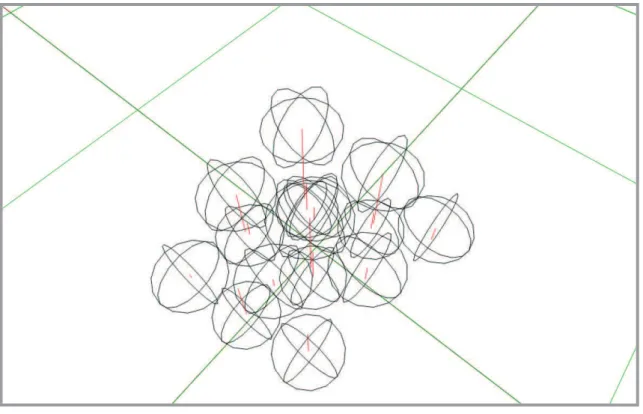
The results of simulation of the structure formation are presented on Fig 13 and 14.
Fig. 13. Average distance between atoms
Similar simulations were previously performed during investigation of cluster-forming process in sulfur and epoxy composites. The obtained results were in good agreement with experimental data.
As it follows from Fig. 13 and 14, adequacy of modeling on the na-noscale level decreases if quantum effects are not taken into account: the asymptotic value of average distance between sulfur atoms is about twice as large as real value (both for S8 molecule and sulfur crystal this distance is near 0.2 nm). It is clean from Fig. 14 that Van der Waals spheres do not even crossing with each other; this is, definitively, wrong. Thus, while molecular dynamics can successfully be used on the spatial scales starting from 10 nm, on the lower scale the quantum effects must be taken into ac-count.
DEARCOLLEAGUES!
THE REFERENCETOTHIS PAPERHAS THEFOLLOWING CITATIONFORMAT:
Korolev E.V., Smirnov V.A., Evstigneev A.V.Nanostructure of matrices for sul-fur constructional composites: methodolody, methods and research tools. Nan-otehnologii v stroitel’stve = Nanotechnologies in Construction. 2014, Vol. 6, no. 6, pp. 106–148. DOI: dx.doi.org/10.15828/2075-8545-2014-6-6-106-148
References:
1. Kiselev D.G., Korolev E.V., Smirnov V.A. Structure formation of sulfur-based com-posite: the model. Advanced Materials Research. 2014, Vol. 1040, pp. 592–595. doi:10.4028/www.scientific.net/AMR.1040.592
2. Gladkikh V.A., Korolev E.V., Smirnov V.A. Modeling of the sulfur-bituminous con-crete mix compaction. Advanced Materials Research. 2014, Vol. 1040, pp. 525– 528. doi:10.4028/www.scientific.net/AMR.1040.525
3. Korolev E.V., Kiselev D.G., Smirnov V.A. Kinetics of Destruction of Nanomodified Sulfir Composites. Nanotehnologii v stroitel’stve = Nanotechnologies in Construc-tion. 2013, Vol. 5, no. 6, рр. 31–43. Available at: http://nanobuild.ru/en_EN/ (Accessed 30 Nov 2014).
4. Korolev E.V., Bazhenov Ju.M., Albakasov A.I. Radiation-protective and Chemical Resistant Sulfur Construction Materials. Penza-Orenburg: IPK OGU, 2010. 364 p. 5. Korolev E.V., Samoshin A.P., Smirnov V.A., Koroleva O.V., Grishina A.N. Methods
and synthesis algorithms of new-generation radiation-protective materials. Penza: PGUAS, 2009. 132 p. (in Russian)
6. Smirnov V.A., Korolev E.V. Nanomodified Epoxy Composites. Nanotehnologii v stroitel’stve = Nanotechnologies in Construction. 2012, Vol. 4, no. 4, pp. 61–69. Available at: http://www.nanobuild.ru/en_EN (Accessed 30 Nov 2014). (In Rus-sian)
7. Steudel R. Elemental Sulfur and Sulfur-reach compounds I. Berlin: Springer, 2003. 227 p.
8. Steudel R. Elemental Sulfur and Sulfur-reach compounds II. Berlin: Springer, 2003. 269 p.
9. Warren B.E., Burwell J.T. The Structure of Rhombic Sulphur. Journal of Chemical Physics. 1935, no. 3, pp. 6–8.
10. Crystallography Open Database: Information card for 1011160. [Electronic source] / URL: http://www.crystallography.net/1011160.html?cif=1011160 (Ac-cessed 30 Nov 2014)
11. Watanabe Y. The Crystal Structure of Monoclinic Gamma-sulfur Locality: Synthet-ic. Acta Crystallographica, Section B. 1974, Vol. 30, pp. 1396–1401.
12. Gallacher A.C., Pinkerton A.A. A Redetermination of Monclinic γ-sulfur. Acta Crys-tallographica Section C. 1993, Vol. 49, pp. 125–126.
13. David W.I.F., Ibberson R.M., Cox S.F.J., Wood P.T. Order-disorder Transition in Monoclinic Sulfur: a Precise Structural Study by High-resolution Neutron Powder Diffraction. Acta Crystallographica, Section B. 2006, Vol. 62, pp. 953–959.
15. Smirnov V.A., Korolev E.V., Evstigneev A.V. The review of the modeling methods and numerical analysis software for nanotechnology in material science. Nanotehnolo-gii v stroitel’stve = Nanotechnologies in Construction. 2014, Vol. 6, no. 5, рр. 34– 58. Available at: http://nanobuild.ru/en_EN/ (Accessed 30 Nov 2014). – DOI: dx.doi.org/10.15828/2075-8545-2014-6-5-34-58
16. Korolev E.V., Smirnov V.A., Proshin A.P., Danilov A.M. Modeling of Evolution of Liophobic Disperse Systems. News of Higher Educational Institutions. Construc-tion. 2004, no. 8, pp. 32–38. (in Russian)
17. Proshin A.P., Danilov A.M., Korolev E.V., Smirnov V.A. Kinetic model of the floccu-lation in low-viscosity disperse systems. News of Higher Educational Institutions. Construction. 2003, no. 4, pp. 53–57. (in Russian)
18. Hartree D. The calculation of atomic structures. Wiley, 1957. 181 p.
19. Perdew J.P., Burke K., Ernzerhof M. Generalized Gradient Approximation Made Simple. Physical Review Letters. 1996, Vol. 77, no. 18, pp. 3865–3868
20. Delley B. DMol3 DFT Studies: from Molecules and Molecular Environments to Sur-faces and Solids. Computational Materials Science. 2000, Vol. 17, no. 2–4, pp. 122– 126.
21. Segall M.D., Lindan Ph.J.D., Probert M.J., Pickard C.J., Hasnip P.J., Clark S.J., Payne M.C. First-principles Simulation: Ideas, Illustrations and the CASTEP code. Journal of Physics: Condensed Matter. 2002, Vol. 14, no. 11, pp. 2717–2744. 22. Gordon Group/GAMESS. http://www.msg.ameslab.gov/gamess (Accessed 30 Nov
2014)
23. LibV framework library [Электронный ресурс] / URL: http://libv.org (Accessed 30 Nov 2014)
24. Smirnov V.A., Korolev E.V., Inozemtcev A.S. Dynamic Simulation of Nanoscale Sys-tems. Nanotehnologii v stroitel’stve = Nanotechnologies in Construction. 2012, Vol. 4, no. 3, pp. 26–34. Available at: http://www.nanobuild.ru/en_EN (Accessed 30 Sep 2014). (In Russian)
25. Jmol: an Open-source Java Viewer for Chemical Structures in 3D. [Электронный ресурс] / URL: http://www.jmol.org (Accessed 30 Nov 2014)
26. The PyMOL Molecular Graphics System, Version 1.5.0.4 Schrоdinger, LLC. [Электронный ресурс] / URL: http://www.pymol.org (Accessed 30 Nov 2014) 27. Hanwell M.D., Curtis D.E., Lonie D.C., Vandermeersch T., Zurek E., Hutchison G.R.
Avogadro: an Advanced Semantic Chemical Editor, Visualization, and Analysis Platform. Journal of Cheminformatics. 2012, Vol. 4, no. 1, pp. 101–117.
28. Allouche A.R. Gabedit – A Graphical User Interface for Computational Chemistry Softwares. Journal of Computational Chemistry. 2011, Vol. 32, no. 1, pp. 174–182. 29. Venkateswarlu K. Raman Spectrum of Sulfur. Proceedings of the Indian Academy
of Sciences – Section A. 1940, Vol. 12, no. 5, pp. 453–461.