Jan WARCZEK
Silesian University of Technology, Faculty of Transport ul. Krasi skiego 8, 40-019 Katowice
Corresponding author. E-mail [email protected]
APPLICATION OF TIME SHIFT FOR NONLINEAR DAMPING
CHARACTERISTIC IDENTIFICATION
Summary. The symptom of stiffness or damping element wear is change of their characteristic. In paper presented new identification method of dynamic parameters flexible elements of suspension. The determining of damping characteristic was carried out during routine operation. Developed procedure can be used both in internal and external systems of diagnostic.
WYKORZYSTANIE PRZESUNI CIA CZASOWEGO DO IDENTYFIKACJI
NIELINIOWEJ CHARAKTERYSTYKI TŁUMIENIA
Streszczenie. Objawem zu ywania si elementu spr ystego lub tłumi cego jest zmiana kształtu jego charakterystyki. W pracy przedstawiono now metod identyfikacji parametrów dynamicznych elementów podatnych zawieszenia. Wyznaczanie charakterystyki tłumienia odbywa si w warunkach normalnej eksploatacji. Opracowana procedura mo e by zastosowana zarówno w wewn trznych jak i zewn trznych systemach diagnostycznych.
1. INTRODUCTION
Nonlinear flexible elements are always in contemporary car suspension. Their technical condition changes influence on safety and comfort of travelling. The symptom of stiffness or damping element wear is change of their characteristic. Estimation of that characteristic allow to formulate opinion of technical condition. It was assumed that the method of identification characteristic flexible elements build in suspension will be base in selected signals of vibration analysis. To describes shock-absorber characteristic of damping usefull was fact influence damping force value at vibration signals sprung and un-sprung masses time shift. Preliminary validation of proposal thesis was conducted by making many of simulation researches.
2. SIMULATING RESEARCH
0
0
1 2 2 1 1 1 1 1 2 2 1 1 1 2 2 1 2 2 2 2=
−
−
−
+
−
+
−
−
=
−
+
−
+
• • • • • • • • • •)
z
z
(
C
)
h
z
(
C
)
h
z
(
K
)
z
z
(
K
z
m
)
z
z
(
C
)
z
z
(
K
z
m
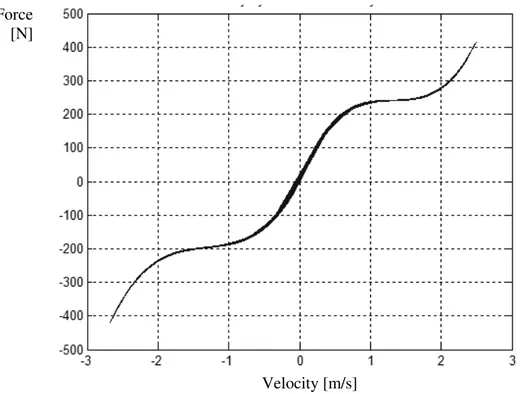
(1)At this quartet model of car to definite of damping and stiffness characteristics was used nonlinear mono-argument mathematical functions. During simulating researches applied different characteristics of damping. Exemplary characteristic of damping shows at fig. 1. Used characteristics not always was that as real damping or stiffness elements.
Force [N]
Velocity [m/s]
Fig. 1. The example characteristic of damping used in simulating researches
Rys. 1. Przykładowa charakterystyka tłumienia wykorzystywana w badaniach symulacyjnych
During investigations it was applied different excitations as a result it was get reply frequencies variable. At the moment, when suspension spring deflection is even to static deformation, dynamic force value mz••2 is grade to damping force. The base of determine instantaneous damping forces is
relative displacement sprung and unsprung masses. While performance condition z2-z1=0 store is
dynamic force value • •
2
z
m . It was the base to determine instantaneous damping forces in relation to the
Force [N]
velocity [m/s]
Fig. 2. Determined image of damping characteristic Rys. 2. Wyznaczony obraz chatrakterystyki tłumienia
Accepted assumptions of the model taking constant value of sprung mass let us to accept proportionality of forces and accelerations of sprung masses. Therefore, it is possible to ascertain, that utilization of value of instantaneous acceleration is possible for appointment of shape damping characteristic. This is advantageous in case of research of real object.
3. INVESTIGATIONS OF REAL OBJECT
Force [N]
-400 -300 -200 -100 0 100 200 300 400
-0.7 -0.5 -0.3 -0.1 0.1 0.3 0.5 0.7
pr dko [m/s]
s
ił
a
[
N
]
velocity [m/s]
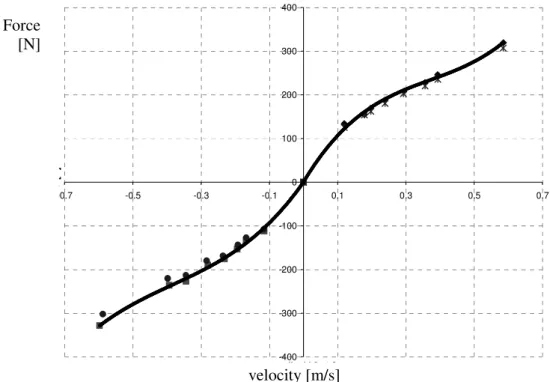
Fig. 3. Characteristic of shock-absorber for sphere on nominal pressure p0=5,5 MPa Rys. 3. Charakterystyka amortyzatora dla sfery o ci nieniu nominalnym p0=5,5 MPa
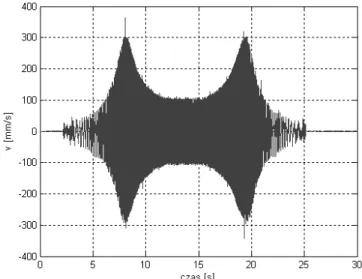
The characteristic of damping un-mount hydro-pneumatic strut indicated on indicatory stand. Characteristic presented on figure 3 has been separately polynomials approximation for compression and extension. The indentify technical condition strut mount in suspension and excitation to vibrations by the high force excitatory. Amplitude displacement of vibrations was constant, equal to 6 [mm]. Regulation length of time excitation cycles are possibility by frequency converter in control system. Recording signals: vibrations accelerations of sprung mass in point of fix hydro-pneumatic strut and relative displacement wheel and bodies. The example of those signals presented on fig. 4 and 5.
Fig. 4. The example body vibrations of acceleration signal
Fig. 5. The example relative vibrations of displacement signal
Rys. 5. Przykładowy przebieg czasowy przemieszcze wzgl dnych koła i nadwozia
In the next step low pass filtering of recording signals was done. Relative displacement signal was differentiated by time. It enabled to relative velocity vibration sprung and un-sprung masses determine (fig. 6).
Fig. 6. Relative velocity of vibrations sprung and un-sprung masses Rys. 6. Przebieg pr dko ci wzgl dnych mas resorowanej i nieresorowanej
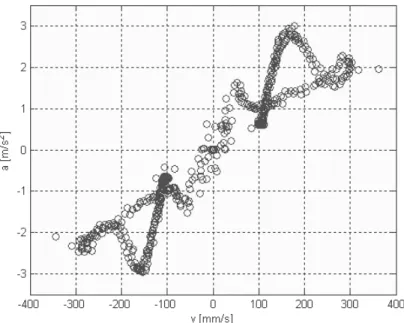
Fig. 7. Determined image of damping characteristic Rys. 7. Wyznaczony obraz charakterystyki tłumienia
Empirically determined image shows some similarity to the real characteristics of the damping hydro-pneumatic strut. Apparent differences arise primarily from the variable value of the parts of body weight per wheel excitation vibration.
4. CONCLUSION
The results confirmed the correctness of the proposed methods of identifying the parameters of dynamic element susceptible built in suspension. Images of the characteristics of the damping set for the real object does not fully coincide with the results obtained for the un-mounted element. The reasons for this should be read into the variable value of the parts of body weight per wheel car. The aim of further research is to develop methods for estimating the value of the temporary mass involved in the various vibration: amplitude and frequency.
References
1. Gardulski J.: Bezstanowiskowa metoda oceny stanu technicznego zawiesze samochodów osobowych. Wyd. Inst. Technologii Eksploatacji, Radom, 2003.
2. Gardulski J., Warczek J.: Badania zawieszenia aktywnego w aspekcie bezpiecze stwa podró owania. VI Konferencja, TiBT'06. Katowice, T. 2: Bezpiecze stwo transportu. Wydaw. Katedry Systemów Informatycznych Transportu, 2006, s. 96-103.
3. Konieczny Ł.: Wpływ zmian stanu technicznego zawieszenia hydropneumatycznego samochodu osobowego na jego charakterystyki dynamiczne. Rozprawa doktorska. Katowice, 2006, Politechnika l ska. Wydział Transportu.
4. Osi ski Z.: Tłumienie drga mechanicznych. PWN, Warszawa, 1979.
5. Reipell J., Betzler J.: Podwozia samochodów – podstawy konstrukcji. WKiŁ Warszawa, 2001. 6. Warczek J.: Sygnały drganiowe jako miary diagnostyczne amortyzatorów samochodów osobowych. Rozpr.