The Brazilian Journal of
INFECTIOUS DISEASES
w w w . e l s e v i e r . c o m / l o c a t e / b j i d
Original article
Association between toll-like receptor2 Arg677Trp and
597T/C gene polymorphisms and pulmonary tuberculosis in
Zahedan, Southeast Iran
Mohammad Naderi
a, Mohammad Hashemi
b,c,∗, Leylisadat Hazire-Yazdi
a,
Mohsen Taheri
d, Abdolkarim Moazeni-Roodi
a, Ebrahim Eskandari-Nasab
c,
Gholamreza Bahari
caResearch Center for Infectious Diseases and Tropical Medicine, Zahedan University of Medical Sciences, Zahedan, Iran bCellular and Molecular Research Center, Zahedan University of Medical Sciences, Zahedan, Iran
cDepartment of Clinical Biochemistry, School of Medicine, Zahedan University of Medical Sciences, Zahedan, Iran dGenetics of Non-Communicable Disease Research Center, Zahedan University of Medical Sciences, Zahedan, Iran
a r t i c l e
i n f o
Article history: Received 22 June 2012 Accepted 21 December 2012 Available online 2 July 2013
Keywords: Tuberculosis TLR2
Single nucleotide polymorphism
a b s t r a c t
Background:It is well known that toll-like receptor 2 (TLR2) mediates responses of both innate and adaptive immunity to microbial pathogen, including mycobacteria. Single-nucleotide polymorphisms (SNPs) in the TLR2 gene that impair its function may be associated with the development of pulmonary tuberculosis (PTB). The aim of this study was to evaluate the possible association between TLR2 Arg677Trp and 597T/C polymorphisms and PTB in a sample of Iranian population.
Materials and methods:This case–control study was performed on 174 PTB and 177 healthy subjects. Tetra amplification refractory mutation system-polymerase chain reaction (T-ARMS-PCR) was used to detect the SNPs.
Results:There was no significant difference in the polymorphism of Arg677Trp of the TLR2 gene among PTB and control groups (p> 0.05). The results showed that there was a signifi-cant difference between case and control groups regarding 597T/C polymorphism (2= 12.21,
p= 0.002). The TC and CC genotypes were found to be associated with the risk of PTB (OR = 2.13, 95% CI = 1.25–3.62,p= 0.005 and OR = 4.88, 95% CI = 1.56–15.26,p= 0.007, respec-tively).
Conclusion:Our data suggest that 597T/C polymorphism, but not Arg677Trp polymorphism, of the TLR-2 gene is a risk factor for susceptibility to PTB in a sample of Iranian population. © 2013 Elsevier Editora Ltda. All rights reserved.
∗ Corresponding author.
Introduction
Tuberculosis, caused byMycobacterium tuberculosis, is a global public health problem throughout the world especially in Asia and Africa. Approximately nine million new cases were reported in 2008 worldwide (with an incidence of 139/100,000 inhabitants), of which more than one million died.1 It can affect almost all of the body, including the brain, the kidneys and the bones, but predominately manifests itself in the lungs where it is named pulmonary tuberculosis. One-third of the earth’s population is infected with tuberculosis (TB) but only 10% of infected individuals will develop the disease. Increasing evidence indicates that host genetic factors play an important role in susceptibility to TB.2
Toll-like receptors (TLRs) are important mediators of the inflammatory response in the first line of host defense by recognition of many pathogen-related molecules and endoge-nous proteins associated with immune activation.3–7 TLRs are classified as members of the IL-1R super-family based on a shared cytoplasmic region known as the TIR (Toll/IL-1R) domain.8 TLRs are cell-surface receptors that induce a sig-nal in the affected cell, involving a number of proteins, such as MyD88, IL-1 receptor-associated with extracellular leucine-rich domains and an intracellular signaling domain and are found in monocytes, macrophages and neutrophils.9 TLRs have been implicated in the activation of macrophage by a variety of chemically diverse bacterial products (lipopolysac-charide (LPS), lipoproteins and peptidoglycans)10,11and kinase and p38 mitogen-activated protein kinase (MAPK).12–15 This signaling cascade leads to NF-B activation, which induces
the secretion of several proinflammatory cytokines16and has been reported to be the chief mediator of macrophage acti-vation in response to mycobacteria.17 In vitro studies have revealed that TLR2 activation directly leads to intracellu-lar killing ofM. tuberculosisby alveolar macrophages.18High susceptibility to M. tuberculosis infection of TLR2-deficient mice19,20 suggests that mutations affecting TLR2 expression may impair host response to this pathogen. In contrast, Sug-awara et al. have found that TLR2 does not play an important role in the pathogenesis of murine tuberculosis, though it is important for defense against mycobacterial infection.21 In addition it has been reported that MyD88 deficiency did not influence the development of murine tuberculosis.22
To date, there is little and controversial data regarding the impact of TLR2 polymorphism and susceptibility to PTB. It has been shown that TLR2 gene (Arg677Trp, Arg753Gln) poly-morphisms were not associated with susceptibility to TB.23 Ben-Ali et al.24have found that TLR2 Arg677Trp polymorphism is a predisposing risk factor for PTB. A significant associa-tion between TLR2 597T/C polymorphism and tuberculosis has been found.25Therefore, the present study aimed to evaluate
the possible association between Arg677Trp and 597T/C poly-morphisms of TLR2 and pulmonary tuberculosis in a sample of Iranian population.
Materials and methods
This case–control study was performed in the Research Center for Infectious Diseases and Tropical Medicine, Bou-Ali Hos-pital, Zahedan, Iran. A total of 174 patients with pulmonary tuberculosis and 177 unrelated healthy subjects were enrolled in the study. The groups were matched for sex and age. The subjects who underwent treatment for PTB and newly diag-nosed PTB cases were enrolled in the study within the case group. The diagnosis of PTB was based on clinical, radiologi-cal, sputum Acid Fast Bacillus (AFB) smear positivity, culture, and response to antituberculosis chemotherapy as described previously.26,27Controls were selected from the Zahedan pop-ulation who participated in a metabolic syndrome project and have no recent signs, symptoms or history of pulmonary tuberculosis.
The project was approved by the local Ethics Committee of the Zahedan University of Medical Sciences, and writ-ten informed consent was taken from all participants. Blood samples were collected in Na-EDTA tubes from patients and healthy controls and stored at−20◦C until DNA extraction.
Genomic DNA extraction from blood samples was car-ried out as described previously.28SNPs genotyping of TLR2 Arg677Trp and 597T/C polymorphisms were performed using tetra-ARMS-PCR, which is a simple and rapid method for detection of SNP.29–32 In this method two external primers (control band) and two inner primers (allele specific primers) are used as shown in Table 1.
For TLR2 Arg677Trp polymorphism the product sizes were: 199 bp for T allele, 264 bp for C allele and 419 bp for two outer primers (control band). The product sizes for detection of 597T/C polymorphism were: 173 bp for C allele, 228 bp for T allele and 349 bp for control band.
Polymerase chain reaction (PCR) was performed using commercially available PCR premix (AccuPower PCR PreMix, BIONEER, Daejeon, South Korea) according to the manu-facturer recommended protocol. Into a 0.2-mL PCR tube containing the AccuPower PCR Pre-Mix, 1L template DNA
(∼100 ng/L), 1L of each primer (10M) and 15L DNase-free
water were added.
The PCR cycling condition for 597T/C was 5 min at 95◦C followed by 30 cycles of 30 s at 95◦C, 30 s at 53◦C and 30 s at 72◦C. The PCR condition for detection of Arg677Trp polymor-phism was 95◦C for 5 min followed by 30 cycles, consisting of denaturation at 95◦C for 40 s, annealing at 55◦C for 20 s, and extension at 72◦C for 45 s with a final step at 72◦C for 10 min to allow for complete extension of all PCR fragments. The PCR
Table 1 – Primers used for polymorphism determination of TLR2.
Primers C2029T (Arg677Trp) 597T/C (rs3804099)
500 bp
A B
400 bp
400 bp 300 bp
300 bp 200 bp
200 bp
100 bp 100 bp
M
CC
CC
CT
CC
CT
CT
M
CC
TC
TC
TT
Fig. 1 – Photograph of the PCR products of the TLR2 Arg677Trp (rs1695 A/G) gene (A) and 597T/C polymorphism (B). M, DNA marker.
products were analyzed by electrophoresis on a 2% agarose gel containing 0.5g/ml ethidium bromide and visualized by
transillumination with UV light and photograph was taken (Fig. 1). We regenotyped approximately 20% of the samples to verify the initial results. The check confirmed the previous genotyping results by 100%.
Statistical analysis
The statistical analysis of the data was performed using the SPSS 18.0 software. Demographics and biochemical param-eters between the groups were analyzed by independent samplet-test for continuous data and2test for categorical
data. The associations between genotypes and PTB were esti-mated by computing the odds ratio (OR) and 95% confidence intervals (95% CI) from logistic regression analyses.
Results
Of the 174 study patients, 110 (63.2%) were female and 64 (36.8%) male. In uninfected group, 97 (54.8%) were female and 80 (45.2%) were male. The mean±SD ages for cases and con-trols were 50.17±20.47 and 46.88±15.45, respectively. There was no significant difference among the groups regarding sex and age (p> 0.05).
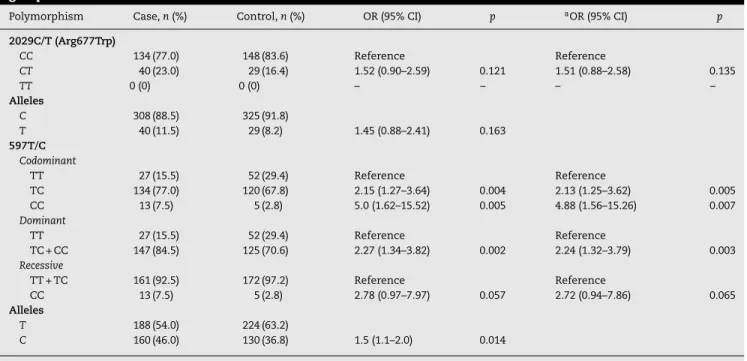
The genotype and allele frequencies of TLR2 polymor-phisms in patient and control groups were summarized in Table 2.
The wild-type genotype 677 Arg/Arg was observed in 134 (47.0%) of the patients, whereas 40 (23.0%) were heterozygous (677 Arg/Trp). In the control group, the frequencies of geno-types were 148 (83.6%) for Arg/Arg and 29 (16.4%) for Arg/Trp. No one in either group was homozygous for the mutant geno-type (Trp/Trp). No significant association was found between the groups regarding 677 Arg/Trp (C/T) polymorphism of TLR2 (OR = 1.52, 95% CI = 0.88–2.58,p= 0.135).
Our finding showed that there was a significant dif-ference between case and control groups regarding TLR2 597T/C polymorphism (2= 12.21,p= 0.002). The TLR2 597T/C
polymorphism was a risk predisposing factor for PTB in codominant (OR = 2.13, 95%CI = 1.25–3.62,p= 0.005, TT vs TC; OR = 4.88, 95% CI = 1.56–15.26,p= 0.007, TT vs CC) and dom-inant (OR = 2.24, 95% CI = 1.32–3.79, p= 0.003, TT vs TC-CC) tested inheritance models (Table 2).
Allele frequencies for T and C were found to be 0.54 and 0.46 in the PTB group and 0.63 and 0.37 in the control group, respectively. The C allele was a predisposing risk factor for PTB (OR = 1.5, 95% CI = 1.1–2.0,p= 0.014).
Discussion
In the present study, we have investigated the impact of TLR2 polymorphisms at position 597T/C and missense mutation affecting the intracellular domain of human TLR2 Arg677Trp (C2029T) and susceptibility to PTB in a sample of Iranian population. A significant difference was found between patients with PTB and healthy controls regarding TLR2 597T/C polymorphism genotype and allelic distribution. No significant difference was found between the groups con-cerning Arg677Trp (C2029T) polymorphism in our population. In agreement with our finding Xue et al.23have found no asso-ciation between Arg677Trp polymorphism of TLR2 and PTB in the southeastern Chinese population. On the other hand, Schroder et al.33have shown that no individual was identified carrying the Arg677Trp polymorphism in Germany. In contrast to our findings Ben-Ali et al.24have found that TLR2 Arg677Trp polymorphism (C2029T) is a predisposing risk factor for PTB. In line with the present study, they found no subject in either group to be homozygous for the mutant genotype (Trp/Trp).
Concerning the 597T/C, Thuong et al.25 have found that 597CC genotype was associated with tuberculosis in Vietnam. Our results are consistent with their finding. The 597TC and CC genotypes were found to be associated with PTB risk in our population.
Caws et al.34 have found that individuals with the 597C allele of TLR-2 were more likely to have tuberculosis caused by the East-Asian/Beijing genotype than other individuals.
Table 2 – The genotypes and allele distribution of TLR2 polymorphism in case (pulmonary tuberculosis) and control groups.
Polymorphism Case,n(%) Control,n(%) OR (95% CI) p aOR (95% CI) p
2029C/T (Arg677Trp)
CC 134 (77.0) 148 (83.6) Reference Reference
CT 40 (23.0) 29 (16.4) 1.52 (0.90–2.59) 0.121 1.51 (0.88–2.58) 0.135
TT 0 (0) 0 (0) – – – –
Alleles
C 308 (88.5) 325 (91.8)
T 40 (11.5) 29 (8.2) 1.45 (0.88–2.41) 0.163 597T/C
Codominant
TT 27 (15.5) 52 (29.4) Reference Reference
TC 134 (77.0) 120 (67.8) 2.15 (1.27–3.64) 0.004 2.13 (1.25–3.62) 0.005 CC 13 (7.5) 5 (2.8) 5.0 (1.62–15.52) 0.005 4.88 (1.56–15.26) 0.007 Dominant
TT 27 (15.5) 52 (29.4) Reference Reference
TC + CC 147 (84.5) 125 (70.6) 2.27 (1.34–3.82) 0.002 2.24 (1.32–3.79) 0.003 Recessive
TT + TC 161 (92.5) 172 (97.2) Reference Reference
CC 13 (7.5) 5 (2.8) 2.78 (0.97–7.97) 0.057 2.72 (0.94–7.86) 0.065 Alleles
T 188 (54.0) 224 (63.2)
C 160 (46.0) 130 (36.8) 1.5 (1.1–2.0) 0.014
a Adjusted for age and sex.
residue 753 (Arg753Gln) that leads to a decreased response of macrophages to bacterial peptides, resulting in an atten-uated immune response in the host. It has previously been demonstrated that the TLR2 polymorphism results in a decreased ability of macrophages to respond to several bac-terial peptides.35
Ogus et al.36have found that Arg753Gln polymorphism of the TLR2 gene influences the risk of developing tuberculosis. There is no clear explanation for these discrepancies, but may reflect differences in genetic background among the study populations.
Tuberculosis kills more people each year than any other single infectious disease. It has been proposed that develop-ment of tuberculosis disease depends on interaction between the pathogen, environment, and the host. Many studies sup-port that the differences in host immune genes accompanies susceptibility/resistance to TB.37,38
The host’s immune response toM. tuberculosis is mainly mediated by a TLR2 signaling in macrophages, which leads to direct bactericidal effect by suppressing the prolifera-tion of M. tuberculosisor induction of apoptosis of infected macrophages.39
The findings of this study might be limited by the relatively small sample size and therefore our limited statistical power analysis.
In conclusion, our findings in a sample of Iranian popu-lation provide evidence that 597T/C polymorphism, but not Arg677Trp polymorphism, of the TLR-2 gene is a risk factor for susceptibility to pulmonary tuberculosis.
Conflict of interest
The authors declare no conflict of interest.
Acknowledgements
This work was supported by dissertation grant from Zahedan University of Medical Sciences. The authors thank the patients and healthy subjects who willingly participated in the study.
r e f e r e n c e s
1. Orcau A, Cayla JA, Martinez JA. Present epidemiology of tuberculosis. Prevention and control programs. Enferm Infecc Microbiol Clin. 2011;29 Suppl 1:2–7.
2. Stein CM. Genetic epidemiology of tuberculosis susceptibility: impact of study design. PLoS Pathog. 2011;7:e1001189. 3. Akira S, Takeda K, Kaisho T. Toll-like receptors: critical
proteins linking innate and acquired immunity. Nat Immunol. 2001;2:675–80.
4. Underhill DM, Ozinsky A. Toll-like receptors: key mediators of microbe detection. Curr Opin Immunol. 2002;14:103–10. 5. Medzhitov R. Toll-like receptors and innate immunity. Nat
Rev Immunol. 2001;1:135–45.
6. Schnare M, Barton GM, Holt AC, et al. Toll-like receptors control activation of adaptive immune responses. Nat Immunol. 2001;2:947–50.
7. Ozinsky A, Underhill DM, Fontenot JD, et al. The repertoire for pattern recognition of pathogens by the innate immune system is defined by cooperation between toll-like receptors. Proc Natl Acad Sci U S A. 2000;97:13766–71.
8. Misch EA, Hawn TR. Toll-like receptor polymorphisms and susceptibility to human disease. Clin Sci (Lond).
2008;114:347–60.
9. Medzhitov R, Preston-Hurlburt P, Janeway Jr CA. A human homologue of the Drosophila Toll protein signals activation of adaptive immunity. Nature. 1997;388:394–7.
tuberculosis-induced macrophage responses. J Immunol. 2001;166:4074–82.
11. Supajatura V, Ushio H, Nakao A, et al. Differential responses of mast cell Toll-like receptors 2 and 4 in allergy and innate immunity. J Clin Invest. 2002;109:1351–9.
12. Beutler B. Tlr4: central component of the sole mammalian LPS sensor. Curr Opin Immunol. 2000;12:20–6.
13. Sabroe I, Jones EC, Usher LR, et al. Toll-like receptor (TLR)2 and TLR4 in human peripheral blood granulocytes: a critical role for monocytes in leukocyte lipopolysaccharide responses. J Immunol. 2002;168:4701–10.
14. Sabroe I, Parker LC, Wilson AG, et al. Toll-like receptors: their role in allergy and non-allergic inflammatory disease. Clin Exp Allergy. 2002;32:984–9.
15. Medzhitov R, Preston-Hurlburt P, Kopp E, et al. MyD88 is an adaptor protein in the hToll/IL-1 receptor family signaling pathways. Mol Cell. 1998;2:253–8.
16. Vancurova I, Miskolci V, Davidson D. NF-kappa B activation in tumor necrosis factor alpha-stimulated neutrophils is mediated by protein kinase Cdelta. Correlation to nuclear Ikappa Balpha. J Biol Chem. 2001;276:19746–52.
17. Underhill DM, Ozinsky A, Smith KD, et al. Toll-like receptor-2 mediates mycobacteria-induced proinflammatory signaling in macrophages. Proc Natl Acad Sci U S A. 1999;96: 14459–63.
18. Thoma-Uszynski S, Stenger S, Takeuchi O, et al. Induction of direct antimicrobial activity through mammalian toll-like receptors. Science. 2001;291:1544–7.
19. Drennan MB, Nicolle D, Quesniaux VJ, et al. Toll-like receptor 2-deficient mice succumb toMycobacterium tuberculosis infection. Am J Pathol. 2004;164:49–57.
20. Reiling N, Holscher C, Fehrenbach A, et al. Cutting edge: Toll-like receptor (TLR)2- and TLR4-mediated pathogen recognition in resistance to airborne infection with Mycobacterium tuberculosis. J Immunol. 2002;169:3480–4. 21. Sugawara I, Yamada H, Li C, et al. Mycobacterial infection in
TLR2 and TLR6 knockout mice. Microbiol Immunol. 2003;47:327–36.
22. Sugawara I, Yamada H, Mizuno S, et al. Mycobacterial infection in MyD88-deficient mice. Microbiol Immunol. 2003;47:841–7.
23. Xue Y, Zhao ZQ, Wang HJ, et al. Toll-like receptors 2 and 4 gene polymorphisms in a southeastern Chinese population with tuberculosis. Int J Immunogenetics. 2010;37:
135–8.
24. Ben-Ali M, Barbouche MR, Bousnina S, et al. Toll-like receptor 2 Arg677Trp polymorphism is associated with susceptibility to tuberculosis in Tunisian patients. Clin Diagn Lab Immunol. 2004;11:625–6.
25. Thuong NT, Hawn TR, Thwaites GE, et al. A polymorphism in human TLR2 is associated with increased susceptibility to tuberculous meningitis. Genes Immun. 2007;8:
422–8.
26. Naderi M, Hashemi M, Kouhpayeh H, et al. The status of serum procalcitonin in pulmonary tuberculosis and nontuberculosis pulmonary disease. J Pak Med Assoc. 2009;59:647–8.
27. Naderi M, Hashemi M, Mehdizadeh A, et al. Serum adenosine deaminase activity and total antioxidant capacity of plasma in pulmonary tuberculosis and non-tuberculosis pulmonary disease. Turk J Med Sci. 2010;40:701–6.
28. Hashemi M, Moazeni-Roodi AK, Fazaeli A, et al. Lack of association between paraoxonase-1 Q192R polymorphism and rheumatoid arthritis in southeast Iran. Genet Mol Res. 2010;9:333–9.
29. Hashemi M, Moazeni-Roodi AK, Fazaeli A, et al. The L55M polymorphism of paraoxonase-1 is a risk factor for rheumatoid arthritis. Genet Mol Res. 2010;9:1735–41. 30. Ye S, Dhillon S, Ke X, et al. An efficient procedure for
genotyping single nucleotide polymorphisms. Nucleic Acids Res. 2001;29:E88–98.
31. Naderi M, Hashemi M, Karami H, et al. Lack of association between rs1024611 (−2581 A/G) Polymorphism in CC-chemokine ligand 2 and susceptibility to pulmonary tuberculosis in Zahedan. Southeast Iran Prague Med Rep. 2011;112:272–8.
32. Hashemi M, Hoseini H, Yaghmaei P, et al. Association of polymorphisms in glutamate-cysteine ligase catalytic subunit and microsomal triglyceride transfer protein genes with nonalcoholic fatty liver disease. DNA Cell Biol. 2011;30:569–75. 33. Schroder NW, Hermann C, Hamann L, et al. High frequency of
polymorphism Arg753Gln of the Toll-like receptor-2 gene detected by a novel allele-specific PCR. J Mol Med (Berl). 2003;81:368–72.
34. Caws M, Thwaites G, Dunstan S, et al. The influence of host and bacterial genotype on the development of disseminated disease with Mycobacterium tuberculosis. PLoS Pathog. 2008;4:e1000034.
35. Lorenz E, Mira JP, Cornish KL, et al. A novel polymorphism in the toll-like receptor 2 gene and its potential association with staphylococcal infection. Infect Immun. 2000;68:6398–401. 36. Ogus AC, Yoldas B, Ozdemir T, et al. The Arg753GLn
polymorphism of the human toll-like receptor 2 gene in tuberculosis disease. Eur Respir J. 2004;23:219–23. 37. Sharma S, Kumar V, Khosla R, et al. Association of P2X7
receptor +1513 (AC) polymorphism with tuberculosis in a Punjabi population. Int J Tuberc Lung Dis. 2010;14: 1159–63.
38. Hashemi M, Sharifi-Mood B, Nezamdoost M, et al. Functional polymorphism of interferon-gamma (IFN-gamma) Gene +874T/A polymorphism is associated with pulmonary tuberculosis in Zahedan. Southeast Iran Prague Med Rep. 2011;112:38–43.