Correlation of Vocal Intensity with
Velopharyngeal Closing Mechanism in
Individuals with and without Complaint of
Velopharyngeal Dysfunction
Karina Girelli
1Sady Selaimen de Costa
2Marcus Vinícius Martins Collares
3Silvia Dornelles
41Master’s Degree in Health of Children and Adolescents, Universidade Federal do Rio Grande do Sul, Porto Alegre, Rio Grande do Sul, Brazil 2Department of Ophthalmology and Otorhinolaryngology,
Universidade Federal do Rio Grade do Sul, Porto Alegre, RS, Brazil 3Department of Surgery, Universidade Federal do Rio Grade do Sul,
Porto Alegre, Rio Grande do Sul, Brazil
4Department of Health and Human Communication, Universidade Federal do Rio Grade do Sul, Porto Alegre, Rio Grande do Sul, Brazil
Int Arch Otorhinolaryngol 2016;20:18–24.
Address for correspondence Karina Girelli, MSc in Health of Children and Adolescents, Rua Júlio de Castilhos, 940, Centro, Farroupilha, 95180-000, Rio Grande do Sul, Brazil (e-mail: [email protected]).
Keywords
►
velopharyngeal
sphincter
►
voice
►
cleft lip
►
cleft palate
►
physiology
Abstract
Introduction
Velopharyngeal sphincter is a portion of the muscle of the
palatophar-yngeal arch that is capable of separating the oral cavity from the nasal cavity. It has not
been determined yet whether voice intensity has an in
fl
uence on this capacity.
Velopharyngeal sphincter closure is accomplished by elevating and retracting the
soft palate at the same time as the nasopharyngeal walls are constricted.
Objective
This study aims to correlate voice intensity with velopharyngeal sphincter
closure in individuals without velopharyngeal dysfunction and patients with cleft lip and
palate.
Methods
We conducted a cross-sectional, comparative, and contemporary study. The
sample consisted of 16 individuals in the control group and 16 individuals in the study
group. Patients underwent instrumental assessment, which we subsequently analyzed
using a computer program, and a brief medical history review. The mean age of the
control group was 27.6 years, whereas the mean age of the case group was 15.6 years.
Results
Cases showed higher voice intensity in regular and weak fricative sentences
when compared with controls. There was no agreement on the analysis of the
instrumental assessment between the assessors and the computer program. Regardless
of voice intensity, the computer program demonstrated a similar closure pattern.
Conclusion
The computer program showed similar closure pattern for the three levels
of intensity. There was no agreement between the three assessors and the closure
pattern determined by the computer program. There was no statistically signi
fi
cant
correlation between voice intensity and degree of velopharyngeal sphincter closure.
received January 28, 2015 accepted August 31, 2015 published online November 24, 2015
DOI http://dx.doi.org/ 10.1055/s-0035-1567809. ISSN 1809-9777.
Copyright © 2015 by Thieme Publicações Ltda, Rio de Janeiro, Brazil
Introduction
The velopharyngeal sphincter functions as a valve that closes like a sphincter. It extends along the lateral and posterior pharyngeal walls and its anterior boundary is close to the soft palate.1–5Velopharyngeal sphincter closure is accomplished by elevating and retracting the soft palate at the same time as the nasopharyngeal walls are constricted.3,6,7The primary function of the velopharyngeal sphincter is to ensure the physiological maintenance of this region.1,8
Speech may be affected in different ways when the velophar-yngeal closure pattern is disturbed. The most common symp-toms of velopharyngeal inadequacy are hypernasality, nasal air escape, and articulation problems. However, all these symptoms depend on how much the soft palate has been affected.9
Malfunctioning of the velopharyngeal closure mechanism, which constitutes the velopharyngeal dysfunction, may be associated with several underlying diseases such as neuro-logical disorders, sequelae from surgical interventions, struc-tural changes, etc. Malformations in the palate region lead to physiological abnormalities in the velopharyngeal sphincter, such as characteristics of cleft lip and palate.10
The speech and voice inadequacy caused by velopharyngeal insufficiency is a major stigma of patients with cleft palate.11 Several abnormal characteristics that impair communication can be detected in the speech of such individuals.12Primary and secondary speech disorders relate to velopharyngeal dysfunc-tion. Hypernasality and nasal air escape are primary disorders, whereas compensatory articulation and its associated facial movement are secondary disorders.13
Velopharyngeal dysfunction is a term used to describe abnormalities in the velopharyngeal mechanism in general; nevertheless, different terms are common to describe different disorders. Velopharyngeal insufficiency has a structural cause; the soft palate movement is normal, but it is too short to accomplish velopharyngeal closure. Another type of velophar-yngeal dysfunction is velopharvelophar-yngeal incompetence, which is caused by a neuromotor disorder; the soft palate has a normal structure, although it does not move sufficiently to achieve velopharyngeal closure.5,14–16Failure of velopharyngeal closure may persist even after surgical repair of the palate.17
Understanding the physiology of the craniofacial structures affected by this disease is essential to choose the most appropri-ate therapeutic modality. The region of the velopharyngeal sphincter is the most difficult for understanding the pathophys-iology of the functional changes present in this malformation.8 There are few studies in literature correlating velophar-yngeal closure with regular, weak, or strong voice intensity. Therefore, the objective of the present study was to evaluate this association, comparing the three voice intensities produced by patients without velopharyngeal dysfunction and patients with cleft lip and palate.
Methods
We conducted a cross-sectional, comparative, and contemporary study. The Scientific Committee and Research Ethics Committee evaluated and approved the project (protocol no. 13–0360).
Considering a 95% confidence level, an estimated standard deviation at 7% of the percentage of velopharyngeal closure, and a margin of error of 5%, we included 27 individuals in each group. This sample size calculation was based on the disser-tation by Dornelles. Nevertheless, we evaluated 32 individu-als in the control group; however, 16 tests were not properly recorded due to technical equipment failure. In the case group, we could not achieve the size initially calculated for the sample because of the long period of routine patient care. Therefore, after applying the inclusion and exclusion criteria, we selected 16 patients for the control group and 16 patients for the case group. The participants voluntarily agreed to participate in the study.
According to the inclusion criteria, we included in the control group female and male participants without velo-pharyngeal dysfunction, whose age ranged from 18 to 50 years old. The case group included female and male participants with velopharyngeal dysfunction and cleft lip and palate, aged 7 to 51 years, who had undergone repair surgeries and were receiving follow-up at the Outpatient Clinic of Otolaryngology and Cleft Lip and Palate between March and July 2014.
We excluded individuals who (or whose guardians) did not agree to participate in the study by not signing the informed consent form, as well as patients with cognitive and/or behavioral disorders with associated syndromes, individuals with dysphonia, use of nasoenteric tube that could prevent or hinder the performance of videonasoendo-scopy, and patients with anatomical and functional abnor-malities that prevented the performance of routine examinations and clinical follow-up.
assessors were supposed to rate each sentence according to the appropriate closure (similar closure pattern, large gap, small gap, and moderate gap). Next, we analyzed images using a computer program that is under improvement, used only in research aiming to analyze their actual contributions in the same. We used a computational model for the analysis of the wall motion of the velopharyngeal sphincter.
The quantitative variables were expressed as mean and standard deviation, whereas the qualitative variables were expressed as absolute and relative frequencies. We used student’st-test and Fisher’s exact test to compare the means between the groups. To calculate the clinical estimate of the velopharyngeal sphincter closure, we reached agreement between the analyses of the three assessors considering the whole sample. As there was no agreement using the Kappa test, we used the analysis of the assessors with greater scientific and technical knowledge in thefield as a reference for data analysis. We also evaluated the agreement produced by the computer program using the Kappa test. We per-formed the interpretation of Kappa coefficients as proposed by Landis and Koch. Kappa values may range from 1 (perfect agreement) to<0 (no agreement). The authors proposed a
six-level scale so that the values<0 indicated no agreement,
the values from 0.00 to 0.20 showed very poor agreement, from 0.21 to 0.40 showed poor agreement, from 0.41 to 0.60 showed moderate agreement, from 0.61 to 0.80 showed good agreement, and from 0.81 to 1.00 showed perfect or almost perfect agreement. We evaluated the association between the intensity of the sentences of velopharyngeal sphincter closure between the assessors and the computer program using Spearman’s correlation coefficient. We compared the propor-tions between groups using Pearson’s chi-square test and Fisher’s exact test. In both analyses, we used a significance level of 5%, and the SPSS version 18.0 for the analyses.
Results
Thirty-two individuals participated in the study: 16 in the control group and 16 in the case group. In the control group, 12 (75%) participants were female and four (25%) were male; their mean age was 27.6 years (9.5), ranging be-tween 18 and 51 years old. In the case group, eight (50%) participants were female and eight (50%) were male; their mean age was 15.6 years (11.5), ranging between 7 and 50 years old.
In the case group, the participants had cleft lip and palate. Based on the classification suggested by Brazil Cleft, we found higher prevalence of unilateral cleft lip and palate (7; 43.75%) and lower frequency of unilateral cleft lip (0; 0%), followed by full cleft palate (4; 25%), bilateral cleft lip and palate (3; 18.75%), and bilateral cleft lip and incomplete cleft palate (1; 6.25%). All participants had undergone previous surgery. Eleven (68.75%) underwent nose and lip repair surgery, 15 (93.75%) underwent palate repair surgery, and one (6.25%) underwent pharyngealflap surgery.
►Table 1shows the characteristics of the sample. Controls
were significantly older than cases. There was no difference between the groups in terms of gender.
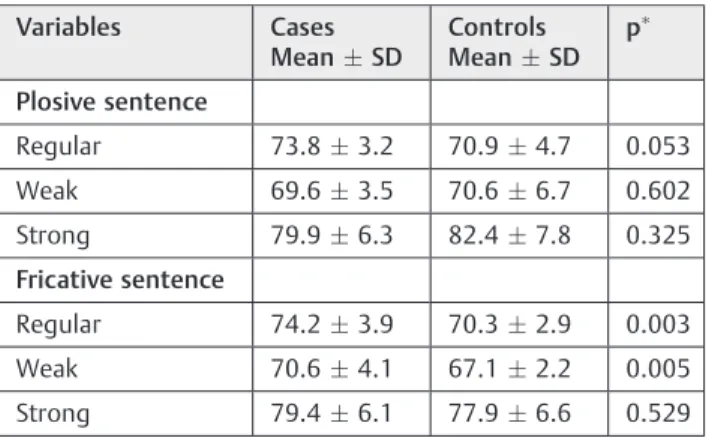
►Table 2shows that patients had higher voice intensity
(which was measured using a decibel meter) in the regular and weak fricative sentences when compared with the control group, showing a statistically significant relationship.
►Table 3shows the agreement between the assessors in
terms of intensity and velopharyngeal sphincter closure. There was significant agreement between assessors 2 and 3 considering the plosive sentence at regular and strong intensity. However, these agreements were weak according to Landis and Koch. There was also significant agreement between assessors 1 and 3 regarding all intensities of the plosive sentence and in terms of the regular intensity of the fricative sentence. Of the four variables showing agreement, one (25%) was very weak, two (50%) were weak, and one (25%) was moderate (plosive sentence at strong intensity).
►Table 4shows the association between the intensity of
the sentences and the closure according to assessor 1 and the computer program. There was no significant association between the intensity of the sentences and closure both according to the assessors and the computer program; that is, regardless of the intensity, closure remained similar.
►Table 5 shows data on the agreement between the
assessors and the computer program in terms of velophar-yngeal sphincter closure. There was no significant agreement between the assessors and the computer program.
Table 1 Characteristics of the sample
Variables Cases Controls p
Age (years)
- MeanSD
15.611.5 27.69.5 0.003
Gender–n (%) 0.273
Male 8 (50.0) 4 (25.0)
Female 8 (50.0) 12 (75.0)
Student’st-test; Fisher’s exact test.
Table 2 Comparison of voice intensity between cases and controls according to the decibel meter
Variables Cases
MeanSD
Controls
MeanSD
p
Plosive sentence
Regular 73.83.2 70.94.7 0.053
Weak 69.63.5 70.66.7 0.602
Strong 79.96.3 82.47.8 0.325
Fricative sentence
Regular 74.23.9 70.32.9 0.003
Weak 70.64.1 67.12.2 0.005
Strong 79.46.1 77.96.6 0.529
Table 3 Agreement between assessors
Comparisons SCP/LG/SG/MG % Agreement (%) Kappa p
Assessor 1 versus Assessor 2
Plosive sentence
Regular intensity 65.6/0/21.9/12.5 versus 56.3/12.5/21.9/9.4 15/32¼46.8% 0.13 0.377
Weak intensity 68.8/12.5/6.3/12.5 versus 46.9/15.6/18.8/18.8 13/32¼40.6% 0.05 0.647
Strong intensity 53.1/28.1/18.8/0 versus 40.6/34.4/15.6/9.4 16/32¼50.0% 0.29 0.033
Fricative sentence
Regular intensity 68.8/6.3/12.5/12.5 versus 40.6/18.8/18.8/21.9 17/32¼53.1% 0.29 0.003
Weak intensity 71.9/12.5/15.6/0 versus 53.1/9.4/31.3/6.3 19/32¼59.3% 0.18 0.161
Strong intensity 75/12.5/3.1/9.4 versus 40.6/40.6/6.3/12.5 15/32¼46.8% 0.16 0.109
Assessor 2 versus Assessor 3
Plosive sentence
Regular intensity 56.3/12.5/21.9/9.4 versus 56.3/12.5/25/6.3 17/32¼53.1% 0.23 0.050
Weak intensity 46.9/15.6/18.8/18.8 versus 53.1/12.5/12.5/21.9 15/32¼46.8% 0.20 0.059
Strong intensity 40.6/34.4/15.6/9.4 versus 46.9/34.4/6.3/12.5 17/32¼53.1% 0.30 0.008
Fricative sentence
Regular intensity 40.6/18.8/18.8/21.9 versus 25/6.3/37.5/31.3 7/32¼21.8% 0.04 0.649
Weak intensity 53.1/9.4/31.3/6.3 versus 28.1/15.6/28.1/28.1 6/32¼18.7% 0.11 0.244
Strong intensity 40.6/40.6/6.3/12.5 versus 25/53.1/9.4/12.5 12/32¼37.5% 0.06 0.630
Assessor 1 versus Assessor 3
Plosive sentence
Regular intensity 65.6/0/21.9/12.5 versus 56.3/12.5/25/6.3 18/32¼56.2% 0.32 0.027
Weak intensity 68.8/12.5/6.3/12.5 versus 53.1/12.5/12.5/21.9 18/32¼56.2% 0.25 0.021
Strong intensity 53.1/28.1/18.8/0 versus 46.9/34.4/6.3/12.5 19/32¼59.3% 0.47 0.001
Fricative sentence
Regular intensity 68.8/6.3/12.5/12.5 versus 25/6.3/37.5/31.3 13/32¼40.6% 0.20 0.022
Weak intensity 71.9/12.5/15.6/0 versus 28.1/15.6/28.1/28.1 12/32¼37.5% 0.22 0.067
Strong intensity 75/12.5/3.1/9.4 versus 25/53.1/9.4/12.5 11/32¼34.3% 0.10 0.193
Abbreviations: LG, Large gap; MG, Moderate gap; SCP, Similar closure pattern; SG, Small gap.
Table 4 Association between sentence intensity and closure according to the assessor and the computer program using Spearman’s correlation coefficient
Intensity of the sentences Case group Control group
Assessor Computer program Assessor Computer program
Plosive sentence
Regular 0.120 0.196 0.320
Weak 0.029 0.214 0.181
Strong 0.296 0.169 0.416
Fricative sentence
Regular 0.267 0.206 0.197
Weak 0.049 0.235 0.072
Strong 0.085 0.185 0.366
Discussion
The velopharyngeal closure is the result of the action of a set of muscles. That is, it consists of a mechanism that works in a coordinated and synergic manner to alternately bring together or separate the oropharyngeal and nasopharyngeal cavities.18,19This mechanism is essential for the production of vowels and consonants; therefore, it has a profound impact on speech intelligibility. Several clinical populations, such as children with a history of cleft lip and palate or individuals with dysarthria, have velopharyngeal dysfunctions that cause speech production difficulties.20
The main objective of the present study was to compare voice intensity and velopharyngeal sphincter closure. Our sample consisted of individuals with and without velophar-yngeal dysfunction and patients with cleft lip and palate. The most frequent dysfunction was unilateral cleft lip and palate. Given that we used a random sample and there was no case of unilateral cleft lip, we regrouped the types of cleft. The most prevalent cases were cleft lip and palate. Such data are consistent with the literature.21–23The second most common type was cleft lip, and the least prevalent type was cleft palate. Our findings demonstrated that controlpatients were significantly older than patients. The control grouṕs mean age was 27.6 years, whereas the case grouṕs mean age was 15.6 years. The velopharyngeal sphincter is critical for successful feeding and communication. Motor activities, such as speech, sucking, swallowing, gag reflex, and breathing, need a point of maximum closure during the movement against the walls.2,24–26We could notfind many studies describing aspects of voice, swallowing, and hearing including anatomical and functional signs and functional decline in the literature. However, previous studies have not found deterioration of velopharyngeal functions with aging.27,28
We assessed all patients using videonasoendoscopy. We used a decibel meter to measure the voice intensity of the fricative and plosive sentences. We found that cases had higher intensities in regular and weak fricative sentences when compared with controls. Fricative and plosive
phonemes are included in the protocol because they require greater intraoral pressure; therefore, they evidence the articulation difficulties of patients with cleft.29,30
The authors,31 in their study on the variation of voice intensity, found mean voice intensity of 63.4 dB at regular emission and 72.5 dB at high emission. Suchfindings are not in agreement with the present study. In our study, the mean intensities were higher. The participants of the case group had mean voice intensities of 73.8 and 79.9 dB for the plosive sentence, and 74.2 and 79.4 dB for the fricative sentence; whereas, the participants of the control group showed mean intensities of 70.9 and 82.4 dB for the plosive sentence and 70.3 and 77.9 dB for the fricative sentence.
With the purpose of achieving the objectives of the study, we calculated the agreement between the assessors for the velopharyngeal sphincter closure patterns using the Kappa coefficient of agreement by pairing thefindings of an assessor with each of the other assessors, thus resulting in three pairs (12, 23, 13). We only found six variables showing agreement; and of these, one had very weak intensity, one had moderate intensity, and four had weak intensity. Assess-ments of auditory perception are known to be unreliable32 and are not necessarily correlated with the functioning of the velopharyngeal sphincter.33–35Therefore, the decisions of the auditory perception regarding the velopharyngeal function are often complemented by instrumental evaluation.20
As demonstrated in the present study, there was no statistically significant relationship between the intensity of the sentences and velopharyngeal sphincter closure, regardless of the fact that the intensity of the closure pattern remained similar. In another study, the authors have reported that the orifice of the velopharyngeal sphincter does not become smaller when there is increased intensity.36 There-fore, this may indicate that the speaker is already using the physiological mechanisms to achieve maximum closure. These authors also stated that these results demonstrate the use of high voice intensity as a strategic behavior for individuals with poor performance of the velopharyngeal sphincter and/or hypernasality.36 The authors26performed a study of 21 assessments aimed at investigating whether the
Table 5 Agreement between assessors and computer program
Comparisons SCP/LG/
SG/MG %
Agreement (%) Kappa p
Assessors versus Computer program
Plosive sentence
Regular intensity 65.6/0/21.9/12.5 versus 93.8/3.1/3.1/0 20/32¼62.5% 0.07 0.586
Weak intensity 68.8/12.5/6.3/12.5 versus 93.8/0/3.1/3.1 22/32¼68.7% 0.18 0.131
Strong intensity 53.1/28.1/18.8/0 versus 93.8/6.3/0/0 17/32¼53.1% 0.06 0.634
Fricative sentence
Regular intensity 68.8/6.3/12.5/12.5 versus 93.8/0/3.1/3.1 21/32¼65.6% 0.02 0.838
Weak intensity 71.9/12.5/15.6/0 versus 93.8/3.1/0/3.1 22/32¼68.7% 0.06 0.713
Strong intensity 75/12.5/3.1/9.4 versus 93.8/6.3/0/0 23/32¼71.8% 0.06 0.678
nasal emission test showed compatibility with the video-nasoendoscopyfindings in the evaluation of the velophar-yngeal mechanism. They found that the participants did not show articulatory compensation and had large gaps in most productions of phonemes, tending to maintain the same gap size in both plosive and fricative sentences. This is an interestingfind because it shows that it is possible to produce sounds without compensation, even when there is velophar-yngeal incompetence or insufficiency.
Although videonasoendoscopy allows us to view the velopharyngeal sphincter during speech, the test has some limitations. It is an invasive method and has the disadvantage of being subjective because it does not provide quantitative data, with arbitrary inference of velopharyngeal gap size.37In the present study, there was not agreement between the assessors and the computer program. The velopharyngeal sphincter closure assessed by the computer program was similar in both groups, with no difference between the proportions found. However, it is worth noting that the only two patients who had no such closure pattern were in the case group. Therefore, it is important to standardize the assessment, so that more objective data can be collected regarding the evaluation of the motion of the velopharyngeal sphincter.
Many researchers have concluded that the velopharyngeal mechanism is highly complex and, thus, it can only be understood if several images are combined due to the difficulties in getting a general view of the area.38,39 The need for accurate information about the closure patterns is considered vital for planning surgical intervention40,41and enabling the assessment of the advances of surgical methods.42
With respect to the sample size, we performed calcula-tions. However, we could not include it due to the routine care front upon which the project depended and the deadline for completion of the work. Nevertheless, we believe that it has not generated a false negative, based on clinical experience coupled with years of observation. We believe that our study may help to understand the velopharyngeal function by providing more reliable clinical evaluation tools.
Conclusions
When the three voice intensities (regular, strong, and weak) related to velopharyngeal sphincter closure, regardless of whether the patient had velopharyngeal dysfunction, the computer program showed similar closure pattern. Thus, it proved to be a useful tool in clinical practice to assess the functioning of the velopharyngeal sphincter.
There was no statistically significant correlation between voice intensity of speech and degree of velopharyngeal sphincter closure in both groups. Based on our results, there was no agreement between the three assessors regarding the velopharyngeal sphincter closure pattern. Because perceptual analysis are often not reliable, there is need for standardiza-tion of a protocol or a tool to assist in this assessment.
We could not establish a correlation between the groups with and without velopharyngeal dysfunction in terms of
closure mechanism and voice intensity. It was not possible correlate thefindings in both groups with clinical practice. Therefore, we suggest using a larger sample size to check our
findings. In addition, further studies should be conducted on this topic to contribute to increase scientific knowledge.
References
1 Altmann EBC. Anatomia efisiologia do esfíncter velofaríngeo. In: Altmann EBC. Fissuras labiopalatinas. 4 ed. Carapicuíba: Pró-Fono; 1997:133–156
2 Camargo LOS, Rodrigues CM, Avelar JA. Oclusão velofaríngea em indivíduos submetidos à nasoendoscopia na Clínica de Educação para Saúde (CEPS). Salusvita. 2001;20(1):35–47
3 Souza MCQ. . Características espectrais da nasalidade [Disserta-tion]. São Paulo: Universidade de São Paulo; 2003
4 Carrara -de Angelis E. Voz nos distúrbios neurológicos. In: Ferreira LP, Befi-Lopes DM, Limongi SCO. Tratado de Fonoaudiologia. São Paulo: Roca; 2005:75–90
5 Kummer AW. Speech evaluation for patients with cleft palate. Clin Plast Surg 2014;41(2):241–251
6 Zemlin WR. Princípios de Anatomia e Fisiologia em Fonoaudiolo-gia. São Paulo: Artmed; 2002
7 Cheng N, Zhao M, Qi K, Deng H, Fang Z, Song R. A modified procedure for velopharyngeal sphincteroplasty in primary cleft palate repair and secondary velopharyngeal incompetence treat-ment and its preliminary results. J Plast Reconstr Aesthet Surg 2006;59(8):817–825
8 Silva DP, Dornelles S, Paniagua LM, Da Costa SS, Collares MVM. Aspectos patofisiológicos do esfíncter velofaríngeo nasfissuras palatinas. Int Arch Otorhinolaryngol. 2008;12(3):426–435 9 Trindade IEK, Trindade Junior AS. Avaliação funcional da
inad-equação velofaríngea. In: Carreirrão S, Lessa S, Zanini AS. Trata-mento dasfissuras labiopalatinas. 2 ed. Rio de Janeiro: Revinter; 1996
10 Brunner MB, Stellzig-Eisenhauer A, Pröschel U, Verres R, Komposh G. The effect of nasopharngoscopic biofeedback in patients with cleft palate and velopharyngeal dysphunction. Clef Palate –
Craniofacial J. 2005:649–657
11 Araujo Netto BC, Cervantes O. Estudo comparativo entre pacientes
fissurados portadores de insuficiência velofaríngea tratados com fonoterapia e faringoplastia. . Rev Bras Cir Plast. 2011;26(4): 631–638
12 Palandi BBN, Guedes ZCF. Aspectos of speech of subjects with cleft palate corrected in different ages. Rev CEFAC 2011;13(1): 8–16
13 Henningsson G, Kuehn DP, Sell D, Sweeney T, Trost-Cardamone JE, Whitehill TL; Speech Parameters Group. Universal parameters for reporting speech outcomes in individuals with cleft palate. Cleft Palate Craniofac J 2008;45(1):1–17
14 Trost-Cardamone JE. Coming to terms with VPI: a response to Loney and Bloem. Cleft Palate J 1989;26(1):68–70
15 Trindade IEK, Yamashita RP, Gonçalves CGA. Diagnóstico Instru-mental da disfunção velofaríngea. In: Trindade IEK, Silva Filho OG. Fissuras labiopalatinas: uma abordagem interdisciplinar. São Paulo: Editora Santos; 2007:123–143
16 Pegoraro-Krook MI, Dutka-Souza JCR, Magalhães LCT, Feniman MR. Intervenção fonoaudiológica nafissura palatina. In: Ferreira LP, Befi-Lopes DM, Limongi SCO. Tratado de fonoaudiologia. 2ed. São Paulo: Roca; 2010:439–455
17 Mituuti CT, Piazentin-Penna SHA, Brandão GR, Bento-Gonçalves CGA. Characterization of the speech of individuals submitted to primary palatoplasty. Rev Soc Bras Fonoaudiol. 2010;15(3): 355–361
Palate Speech Management: A Multidisciplinary Approach. St Louis: Mosby; 1995:45–58
19 Tabith Junior A. Lesões congênitas de lábio e palato –fissuras labiopalatinas. . In: Tabith Junior A. Foniatria: disfonias,fissuras labiopalatais e paralisia cerebal. 6ª ed. São Paulo: Cortez; 1997 20 Bunton K, Hoit JD, Gallagher K. A simple technique for determining
velopharyngeal status during speech production. Semin Speech Lang 2011;32(1):69–80
21 Monlleó IL, Fontes MIB, Ribeiro EM, De Souza J, Leal GF, Félix TM, Fett-Conte AC, Bueno BH, Magna LA, Mossey PA, Gil-da Silva-Lopes V. Implementing the Brazilian Database on Orofacial Clefts. Plastic Surgery International 2013;2013:1–10
22 Souza J, Raskin S. Clinical and epidemiological study of orofacial clefts. J Pediatr (Rio J) 2013;89(2):137–144
23 Martelli DR, Machado RA, Swerts MSO, Rodrigues LAMR, Aquino SN, Martelli Júnior H. Non syndromic cleft lip and palate: relation-ship between sex and clinical extension. Braz J Otorhinolaryngol 2012;78(5):116–120
24 Nóbrega ESS. Fissuras Palatais. In: Mélega JM. Cirurgia Plástica–
Fundamentos e Arte–Cirurgia reparadora da cabeça e pescoço. Rio de Janeiro Medsi 2002:110–125
25 Mourão D, Souza GS, Torres LV, Vaz RN, Prado SG. Estudo sobre desenvolvimento fonológico emfissurados: implicações na fala e na linguagem. Estudos 2006;33(5/6):425–441
26 Penido FA, Noronha RM, Caetano KI, Jesus MS, Di Ninno CQ, Britto AT. Correlação entre os achados do teste de emissão de ar nasal e da nasofaringoscopia em pacientes com fissura labiopalatina operada. Rev Soc Bras Fonoaudiol 2007;12(2): 126–134
27 Hoit JD, Watson PJ, Hixon KE, McMahon P, Johnson CL. Age and velopharyngeal function during speech production. J Speech Hear Res 1994;37(2):295–302
28 Zajac DJ. Velopharyngeal function in young and older adult speak-ers: evidence from aerodynamic studies. J Acoust Soc Am 1997; 102(3):1846–1852
29 Eckelmann D, Baldridge P. Speech training for a child with cleft palate. J Speech Disord 1945;10:137–149
30 Trost JE. Articulatory additions to the classical description of the speech of persons with cleft palate. Cleft Palate J 1981;18(3): 193–203
31 Koishi HU, Tsuji DH, Imamura R, Sennes LU. Variação da intensi-dade vocal: estudo da vibração das pregas vocais em seres humanos com videoquimografia. Rev Bras Otorrinolaringol (Engl Ed) 2003;69(4):464–470
32 Bradford LJ, Brooks AR, Shelton RL Jr. Clinical judgments of hyper-nasality in cleft palate children. Cleft Palate J 1964;35:329–335 33 Mayo R, Dalston RM, Warren DW. Perceptual assessment of
resonance distortion in unoperated clefts of the secondary palate. Cleft Palate Craniofac J 1993;30(4):397–400
34 Warren DW, Dalston RM, Mayo R. Hypernasality and velophar-yngeal impairment. Cleft Palate Craniofac J 1994;31(4):257–262 35 Watterson T, Emanuel F. Observed effects of velopharyngeal orifice
size on vowel identification and vowel nasality. Cleft Palate J 1981; 18(4):271–278
36 Young LH, Zajac DJ, Mayo R, Hooper CR. Effects of vowel height and vocal intensity on anticipatory nasal airflow in individuals with normal speech. J Speech Lang Hear Res 2001;44(1):52–60 37 Yamashita RP, Oliva TRT, Fukushiro AP, Brustello CMB, Trindade
IEK. Efeito da velopastia intravelar sobre o fechamento velofar-íngeo avaliado por meio da técnicafluxo-pressão. Rev Soc Bras Fonoaudiol. 2010;15(3):362–368
38 Skolnick ML, McCALL GN, Barnes M. The sphincteric mechanism of velopharyngeal closure. Cleft Palate J 1973;10:286–305 39 Shprintzen RJ. An invited commentary on the preceding article by
Ibuki, Karnell and Morris. Cleft Palate J 1983;20:105–107 40 Pigott RW, Makepeace AP. Some characteristics of endoscopic and
radiological systems used in elaboration of the diagnosis of velopharyngeal incompetence. Br J Plast Surg 1982;35(1):19–32 41 Croft CB, Shprintzen RJ, Rakoff SJ. Patterns of velopharyngeal valving
in normal and cleft palate subjects: a multi-view videofluoroscopic and nasendoscopic study. Laryngoscope 1981;91(2):265–271 42 Havstam C, Lohmander A, Persson C, Dotevall H, Lith A, Lilja J.