ARTIGO ORIGINAL
The Epidemiology of Dementia and Alzheimer
Disease in Portugal: Estimations of
Prevalence and Treatment-Costs
Epidemiologia da Demência e da Doença de Alzheimer em Portugal:
Estimativas da Prevalência e dos Encargos Financeiros com a Medicação
1. Centro de Neurociências e Biologia Celular. Universidade de Coimbra. Coimbra. Portugal. 2. Departamento de Neurologia. Faculdade de Medicina. Universidade de Coimbra. Coimbra. Portugal. 3. Consulta de Demência. Serviço de Neurologia. Centro Hospitalar e Universitário de Coimbra. Coimbra. Portugal. 4. Serviço de Reumatologia. Centro Hospitalar do Baixo Vouga. Aveiro. Portugal.
5. Centro de Investigação. Núcleo de Estudos e Intervenção Cognitivo Comportamental (CINEICC). Universidade de Coimbra. Coimbra. Portugal. 6. Departamento de Epidemiologia e Medicina Preventiva. Faculdade de Medicina. Universidade de Coimbra. Coimbra. Portugal.
7. Departamento de Saúde Mental e Psiquiatria. Faculdade de Ciências Médicas. Universidade Nova de Lisboa. Lisboa. Portugal. 8. Programa de Saúde Mental. Direcção Geral de Saúde. Lisboa. Portugal.
Recebido: 24 de Novembro de 2014 - Aceite: 25 de Janeiro de 2015 | Copyright © Ordem dos Médicos 2015
Isabel SANTANA1,2,3, Filipa FARINHA4, Sandra FREITAS1,5, Vítor RODRIGUES6, Álvaro CARVALHO7,8
Acta Med Port 2015 Mar-Apr;28(2):182-188 RESUMO
Introdução: A incidência e prevalência de demência e de Doença de Alzheimer aumentam com a idade, duplicando a cada cinco anos
após a sexta década de vida. Portugal é um país envelhecido, previsivelmente com um número crescente de casos de demência. No entanto, os dados epidemiológicos são escassos e os estudos sobre os custos da doença praticamente inexistentes. Propomo-nos apresentar uma estimativa actualizada da prevalência de demência/ Doença de Alzheimer em Portugal e inferir, a partir da prescrição específica para demência, o número de diagnósticos efectivos e os encargos financeiros com esses medicamentos.
Material e Métodos: À população residente em Portugal (2013), aplicámos os valores de prevalência de demência para a Europa
Ocidental (estudo da Alzheimer’s Disease International). A estimativa dos diagnósticos efectivos de Doença de Alzheimer e dos encar-gos financeiros com medicação específica baseou-se nas informações do Intercontinental Marketing Services Health (IMSH) – 2013.
Resultados: O número estimado de Portugueses com mais de 60 anos e com demência foi 160287, o que corresponde a 5,91% deste
universo populacional. Sabendo que a Doença de Alzheimer representa 50-70% dos casos, inferimos que existirão entre 80144 e 112201 doentes. Por outro lado, os dados da IMSH indicam que estarão diagnosticados e a receceber anti-demenciais 76250 doentes, representando um encargo financeiro de 37 M€/ano.
Conclusão: O envelhecimento da população incrementa o número de casos de demência. Aparentemente, nem todos os doentes
com Doença de Alzheimer recebem a medicação aconselhada, sugerindo que esta condição ainda está sub-diagnosticada. A evolução tem sido positiva, com incremento do número de doentes tratados e redução dos custos com fármacos específicos.
Palavras-chave: Custos do Tratamento; Demência; Doença de Alzheimer; Portugal; Prevalência.
ABSTRACT
Introduction: The incidence and prevalence of global dementia and Alzheimer’s disease (AD) increase with age, almost doubling
every five years after the sixth decade of life. Demographic aging is a reality in Portugal, being expectable that the number of dementia cases also increases. Even so, dementia-epidemiological data in Portugal is scarce and cost-of-illness studies are almost inexistent. Our aims were to obtain up-to-date information about the prevalence of dementia/ Alzheimer’s disease in Portugal, to estimate the number of cases effectively diagnosed as Alzheimer’s disease and to determine illness-costs with specific dementia treatment.
Material and Methods: The numbers of age-adjusted prevalence of dementia obtained for Occidental Europe (Alzheimer’s Disease
International study), where applied to the resident population in Portugal (2013). Estimations related to diagnosis and treatment-costs were based in data provided by the Intercontinental Marketing Services Health (IMSH) – 2013.
Results: The estimated number of Portuguese people with dementia among those aged ≥ 60 years, is 160287, representing 5.91%
of this population-stratum. Knowing Alzheimer’s disease is responsible for 50-70% of all cases, we might conclude there are between 80144 and 112201 patients. According to IMSH-data, 76250 receive anti-dementia drugs and the costs of this kind of medication is 37 M€/year.
Conclusions: As a consequence of the demographic aging, also the number of dementia cases increases. Aparentely, not all
Alzheimer’s disease patients receive the recommended medication, suggesting this condition is still under-diagnosed. However, figures indicate a positive progression with an increment of treated cases and a reduction of medication-costs.
Keywords: Alzheimer Disease; Cost of Illness; Dementia; Portugal; Prevalence.
INTRODUCTION
Dementia is a clinical manifestation of several disease processes. Alzheimer’s disease (AD) is the most prevalent illness and corresponds to 50-70% of the patients. There is an increasing incidence and prevalence of dementia with ageing, almost doubling every five years.1-9
ARTIGO ORIGINAL Santana I, et al. Epidemiologia da demência em Portugal, Acta Med Port 2015 Mar-Apr;28(2):182-188
1 new patient every 4 seconds.11 As regards prevalence
and according to a recent meta-analysis, the prevalence of dementia above 60 years of age varies between 5-7%, higher in Latin America (8.5%) and lower in Sub-Saharan Africa (2-4%).12 As such, it is expected that, at present,
there are 35.6 million people with dementia worldwide and projections suggest that this figure may double every 20 years, to 65.7 million by 2030 and 115.4 million by 2050.11,12 However, recent studies suggest a stabilization or
even reduction in the incidence of dementia in developed countries, associated to lifestyle improvement and reduction in cardiovascular diseases; in addition, control of risk factors will lead to a reduction in mortality and therefore it seems difficult to predict their real impact on dementia’s prevalence.13-16
According to the World Health Organization (WHO), in 2004 dementia was the sixth major cause of death in developed countries and AD was considered as the fifth more frequent cause of death in 2006.17,18 Nevertheless,
dementia-associated morbidity is perhaps more relevant than mortality. In this regard, when considering disability measured in years of life in people aged above 60, it is estimated that dementia may contribute with more than 11.9%, a higher figure than the one calculated for stroke (9.5%), cardiovascular diseases (5.0%) or cancer (2.4%).11,19 This high morbidity, associated to dementia’s chronicity, involves very high direct and indirect costs, reflected in a huge overload to national health systems in addition to a significant impact on family economy.20-23
As ageing is the major risk factor to dementia, any epidemiological approach made in Portugal in this regard implies knowledge of national demographic characteristics. The recent demographic tendencies in Portugal are defined by a sustained increase in the average life expectancy at birth, a reduction in child mortality, an increase in emigration, a steep decline in fertility and ensuing population ageing.24
The increase in the average life expectancy at birth is one of the most relevant factors contributing to population ageing. Regarding 2011-2013, the average life expectancy at birth was 80.0 years in the population living in Portugal (82.79 years in women and 76.91 in men), having increased about three years over the last decade (3.36 years more for men and 2.58 for women) according to the 2001-2003 estimates (73.55 and 80.21 years for men and women, respectively).
24 The projections of the National Institute of Statistics
(Instituto Nacional de Estatística [INE]) establish that the
average life expectancy at birth in Portugal will reach 84.21 years in men and 89.88 years in women, by 2060.24
The percentage of people aged 65 or above has doubled over the last few decades from 8% of the total Portuguese population by 1960 to 17% in 2005 and 19% in the 2011 census. This reflects the deep changes in the age structure of the population living in Portugal, with a reduction in younger population and narrowing the base of the age pyramid, with an increase in the elderly population widening the top of the age pyramid. Therefore, there is an increase in population ageing, a current reality with a
chronic tendency. The last estimates for the population living in Portugal confirm the double demographic ageing with an increase in the number of elderly and a reduction in the number of young and working age people. The ageing index of 102 that was found in 2001 means that for each 100 young people there were 102 elderly people. Ten years later the index rose to 128 by 2011 and to 136 by 2013. It is therefore estimated that the elderly population will continue to rise in Portugal over the next decades, reaching 36 to 43% of the population by 2060, corresponding to an ageing index of 287 to 464 elderly per each 100 young people.24
There are few studies published in Portugal regarding dementia’s epidemiology and there are no direct data on prevalence of the different forms of dementia.
A projection of dementia and AD prevalence for the Portuguese population was published in 199425 based on
data obtained from the studies of the EURODEM group26
and from the 1991 population census. In 1991, for age above 30, Garcia et al. have extrapolated a total of 92,470
patients with dementia and 48,706 with AD in Portugal .25
The first population-based study was carried out in Portugal between 2003 and 2008, to assess the prevalence of dementia and mild cognitive impairment (MCI).27 This
two-stage study involved a group of patients aged between 55 and 79 from two communities from the North of Portugal: a first stage (Stage I) for case detection through an interview, using classification scales and neuropsychological tests and a second stage of clinical validity, through interview and clinical examination carried out by a neurologist (Stage II). In Stage 1, 88 patients meeting dementia criteria were found. Stage II, with a compliance rate of just 56.2%, showed a 2.7% global prevalence of dementia. Overall, a 12.3% MCI prevalence was found.27,28
There are several indirect indicators of the prevalence of a specific disease or nosological group, beyond epidemiological data obtained by population-based studies or by extrapolating from European meta-analysis. These are data obtained from family doctor, hospital or Emergency clinical records, as well as diagnosis obtained from residential institutions, death certificates and also from the consumption of specific medications for a certain disease.29 As regards dementia, most data sources are unreliable, firstly due to the complexity of dementia’s diagnosis, involving resources poorly accessible to some populations and secondly due to misdiagnosis by healthcare providers; for these reasons, it is surely underdiagnosed in primary healthcare; in addition, as it is a chronic situation with high morbidity, although rarely directly attributed as cause of death, it is probably under-identified in death certificates. In fact, the INE’s 2000 data found 616 deaths related to AD, in total, corresponding to about 41% of deaths caused by central nervous system diseases in that same year.30 More recent data from 201231 found an official record of 1,740
ARTIGO ORIGINAL
with a 16.6 deaths per 100,000 people gross mortality rate and 66.7 per 100,000 standardized mortality rate in people aged 65 or above.
Data regarding the use of specific medications is more interesting and presumably more reliable, as medication for cognitive symptoms is only used in individuals with dementia and mainly in AD treatment. It may therefore provide a rough estimate of diagnosis and the direct costs involved in such prescriptions.29
With the progressive demographic ageing it is likely that the number of patients with dementia has risen over the last few years. Our study aims to obtain a more updated estimate of the prevalence of dementia in Portugal, using a projection for the Portuguese population from prevalence rates for dementia found in Western Europe in the study by Ferri et al.10 and the most recent data from the INE according
to the 16th June 2014 Resident Population Estimates.32
These results were compared to the estimate of patients identified in Portugal (actual diagnosis), calculated from the consumption of specific medications for dementia. This assessment allows for an estimate of expenditure for the SNS as well as for patients/family, which will correspond to a share of the direct costs assigned to dementia.
MATERIAL AND METHODS
The values of age-adjusted prevalence of dementia were calculated from the study by Ferri et al.,10 carried out
by “Alzheimer’s Disease International” (the methodology of this study is shown in Appendix 1). In our study we used the estimates of dementia prevalence for the EURO A region, where Portugal is included, and applied these to the resident population living in Portugal, according to the most recent (16th June 2014) Resident Population Estimates.32 Estimated prevalences were calculated within
95% confidence intervals. 33
The estimate of the AD diagnosis and financial costs related to the specific medication was based on data provided by the Intercontinental Marketing Services Health for 2009-2013. The following formula was used to calculate the number of treated patients, itself an indicator of current diagnosis:
[Number of Tablets x (Tablet dosage / Recommended Daily Dosage / 365].
RESULTS
According to the most recent (16th June 2014) Resident Population Estimates32 pointing to a total population of
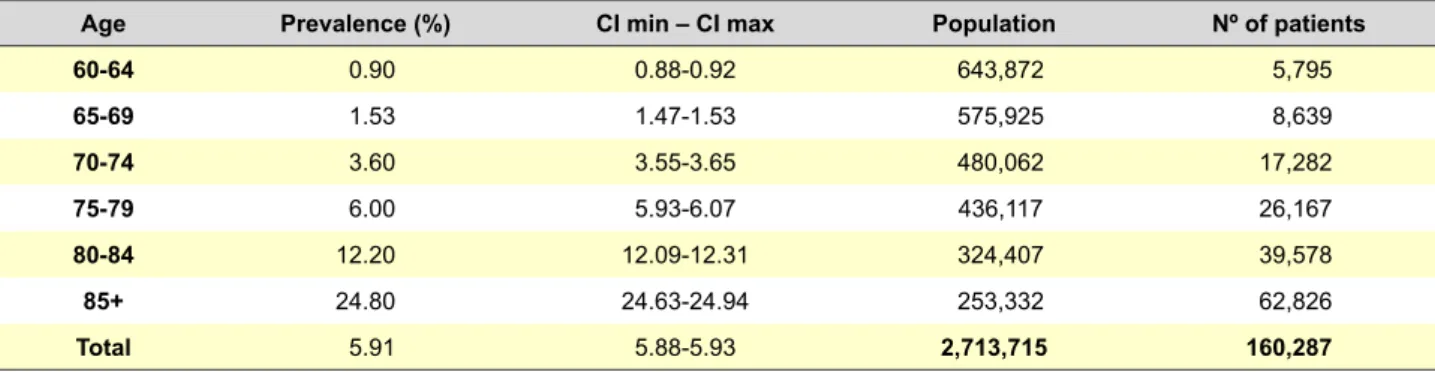
10,427,301 people, from which 2,713,715 are aged above 60, the estimated prevalence of dementia for the EURO A region applied to the Portuguese population revealed that, in 2013 there are 160,287 people with dementia, corresponding to 5.91% of the population aged above 60. The estimates by age group are shown in Table 1. In the 60-64 age group there are 5,795 patients, the figure rising to approximately 62,826 above the age of 85.
The same calculation procedure was applied to the values derived from the Resident Population Estimates for 2003 and 2008 in order to obtain a longitudinal estimate measure. In 2003, there were an estimated 120,506 people with dementia in Portugal and that value had increased to 138,390 people in 2008, a 17,884 increment between both years, i.e. a 3,577 annual average increase. When we compared the estimated number of people with dementia in 2008 with the estimated value in 2013, we found a new increment by 21,879 patients, i.e. a 4,377 annual average increase. The longitudinal results by age group are shown in Figure 1.
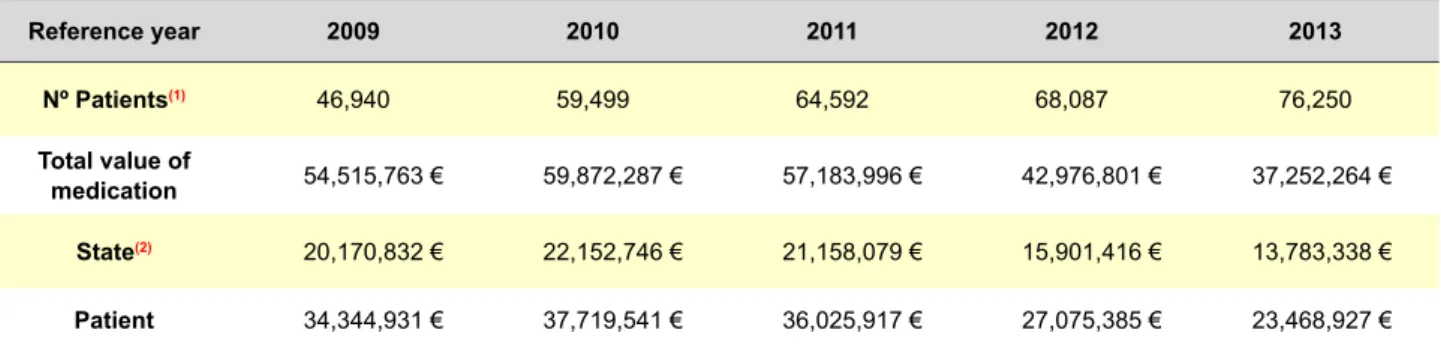
Based on the value of 160,287 patients with dementia in Portugal and knowing that 50 to 70% of these are associated to AD, we may estimate that in 2013 there would exist between 80,144 and 112,201 patients with AD in Portugal. In addition, in 2013, data from the IMSH show that 76,250 patients would have been diagnosed and would be receiving specific medication, corresponding to a financial cost of 37 M€ per year (Table 2). According with the same IMSH estimates, there has been a positive evolution, as the number of patients receiving medication for dementia has increased from 47,940 patients in 2009 to 76,250 patients in 2013. In addition, a total of 60M€ per year in costs was recorded in 2010, from which 22M were assigned to the SNS and 38M to the patients (Table 2). Despite the increasing number of medications taken, suggesting a rise in the number of patients under treatment, there was a reduction in the total cost associated to medication consumption, from approximately 60M€ per year in 2010 to 37 M recorded in 2013.
Table 1 - Estimate of the prevalence of dementia in Portugal. in 2013
Age Prevalence (%) CI min – CI max Population Nº of patients
60-64 0.90 0.88-0.92 643,872 5,795
65-69 1.53 1.47-1.53 575,925 8,639
70-74 3.60 3.55-3.65 480,062 17,282
75-79 6.00 5.93-6.07 436,117 26,167
80-84 12.20 12.09-12.31 324,407 39,578
85+ 24.80 24.63-24.94 253,332 62,826
Total 5.91 5.88-5.93 2,713,715 160,287
CI = Confidence Interval
ARTIGO ORIGINAL Santana I, et al. Epidemiology of dementia in Portugal, Acta Med Port 2015 Mar-Apr;28(2):182-188
DISCUSSION
Due to the lack of a sufficiently comprehensive Portuguese population-based study, European estimates are probably the most reliable and objective grounds to know the Portuguese situation. The study by Ferri et al,10 in which our projection was based, used the Delphi method and an agreement was reached regarding the age–adjusted prevalence of dementia for every region of the world (defined by the WHO). The Delphi method aims to obtain quantitative estimates through a qualitative analysis of data, allowing for the analysis of methodologically very different studies. When the published information is scarce, it allows for inferences by experts in consensus boards, using comparable context data. Estimates by all experts are grouped and delivered anonymously to each participant, allowing the latter to review initial responses vs. responses
by the group. As the group does not need to meet, this method ensures anonymity, allowing for a free expression of opinions.10 The application of estimates of consensus to the Portuguese population assume that the results of this study are valid and that the prevalence of dementia in Portugal is in line with the other Western European countries. The study by Ferri has some limitations as, for some regions, epidemiological data are scarce and therefore the estimates may not be valid. However, for the EURO A region, in which Portugal is included, there are several studies with good methodological quality. The two studies carried out in Spain should be specifically mentioned,34,35 a culturally similar
country to Portugal. In addition, the degree of agreement
between the experts within the Delphi board was excellent at the very first stage10 and therefore the estimate is expected to be valid.
We found that in 2013 approximately 160,287 people would be expected to suffer from dementia in Portugal, corresponding to 5.91% of the people included in these age groups. We should recall that in 1991 an equivalent estimate calculated from studies by the group EURODEM, proposed a 4.6% rate,25 suggesting an increase in prevalence
over the last decade. We assume that this increase in dementia prevalence above the age of 60 between 1991 and 2013 may be explained by the increased percentage of very elderly people in Portugal, according to the INE’s data. These are in line with most of the population-based studies in which dementia’s prevalence increases almost exponentially with age.13-16 In fact, this corresponds to 5,795 patients in the age group 60-64 increasing to 62,826 over the age of 85, where most patients are found. Of note, the 5.91% prevalence is much above the previous 2.7% rate suggested by the only population-based study carried out in Portugal until now.27,28 We should nevertheless mention
that Nunes et al. have restricted their study to a population
aged between 55 to 79, excluding many elderly people and, according to our estimate, more than 64% of the patients with dementia are aged above 80.
In addition, the more recent data from the IMSH (2013) show that 76,250 people would follow a treatment in Portugal with medication specifically targeted to cognitive impairment in dementia (cholinesterase inhibitors and memantine). The Figure 1 - Longitudinal perspective of the estimate of the number of people with dementia in Portugal
0 60-64 65-69 70-74 75-79 80-84 84+
2003
2008
2013
10,000 20,000 30,000 40,000 50,000 60,000 70,000
Number of people with dementia
ARTIGO ORIGINAL
Table 2 - Estimate of the number of patients and financial charges with specific medication
Reference year 2009 2010 2011 2012 2013
Nº Patients(1) 46,940 59,499 64,592 68,087 76,250
Total value of
medication 54,515,763 € 59,872,287 € 57,183,996 € 42,976,801 € 37,252,264 €
State(2) 20,170,832 € 22,152,746 € 21,158,079 € 15,901,416 € 13,783,338 €
Patient 34,344,931 € 37,719,541 € 36,025,917 € 27,075,385 € 23,468,927 €
(1) Calculation of the Number of Patients: [Nº of Tablets x (Dosage of tablets / Recommended Daily Dosage)] / 365.
(2)A value of 37% of total state budget was considered as State value; it was not possible to obtain reliable values for the Special Social Security Scheme.
Note: Data from Intercontinental Marketing Services Health (IMSH) – 2013.
extrapolation of these figures to AD diagnosis is acceptable, due to several reasons: 1) According to literature, this is a methodology applicable to neurodegenerative disorders and to AD, although the study suggests a tendency to underestimate the number of diagnosis when compared to assessments made through health administrative databases,29 2) this class of drugs is somewhat restricted to AD, when we exclude the recommendation to be used in epidemiologically less relevant situations like Lewy body dementia and dementia associated to Parkinson’s disease; 3) the prescription of these two classes of drugs covers the entire severity rank of dementia as cholinesterase inhibitors are indicated for mild and moderate forms and memantine is mainly used in severe cases. However, we should mention that our estimate may over-estimate the patients with AD actually identified/treated, not only because the patients with other forms of dementia were excluded from our assessment but also because the two classes of drugs are sometimes used in association. The comparison between this result of 76,250 patients and the absolute number of patients with AD suggested by the estimate based in the European study (80,144 and 112,201) shows that the disease is still underdiagnosed and undertreated. This is a very relevant conclusion in order to assess the quality of the healthcare provided in Portugal to the patients with this form of dementia. The efficacy of these drugs in controlling symptoms and their association with an improvement in the quality of life of patients and their carers has been repeatedly demonstrated in robust randomized and double-blind clinical trials. In addition, these drugs are formally recommended for the treatment of AD in Portugal, as established by the Norm 053/2011 from 27/12/2011 issued by the Health Directorate General “Abordagem Diagnóstica e Terapêutica das
Alterações Cognitivas (Demências; Doença de Alzheimer)”
(http://www.dgs.pt/?cr=21530).36 Reliable institutions such
as the American Academy of Neurology37 or the European
Federation of Neurological Societies38,39 have issued clear indications on the use of these drugs regarding the proven benefits in the different symptoms of the disease. According to the described estimates there is a positive evolution, as the number of patients receiving pharmacological therapy for dementia has almost doubled in 5 years. In addition, there has been a reduction in total costs associated to the
consumption of specific drugs for dementia, from about 60M€ shown in 2010 to about 37M€ shown in 2013. This cost reduction is probably due to the progressive introduction of generic medicines in the national prescriptions. Also, based on informations from the INFARMED - Autoridade Nacional do Medicamento e Produtos de Saúde, I. P. (INFARMED),
we found that in 2011, 22.19% of the charges of the Serviço
Nacional de Saúde (SNS) were accounted for by Central
Nervous System medication and that this group of drugs was the second with higher charges, only overcome by Cardiovascular medications (29.85% of the charges). Three from the drugs used to treat AD (rivastigmine, donepezil and memantine) were amongst the 100 active substances with higher charges to the SNS, each one of them with more than 100 thousand packets sold in 2011.40
When assessing the financial charges regarding diseases, the costs with medication are included amongst the direct costs (associated to treatment, professional fees, clinical tests, hospital stays, external service expenses required to support daily healthcare to the patient, among others). In dementia, so called indirect costs (exemplified by patient’s early dropout from work, informal carer’s absenteeism/professional dropout, increase in carer’s morbidity, amongst others) have an even higher impact on the family economy and the health system.20-22 The world’s estimates of expenses with dementia reached 604 billion dollars in 2010. In developed countries, 45% of these expenses were assigned to informal care, 40% to formal care and only 15% to direct medical costs.11 In addition, the
data obtained by several studies show a wide variation of financial charges with dementia, which obviously relate to the quality of healthcare but also to early institutionalization and presence of family support vs. formal care networks.41It
is also consensual and confirmatory from these studies that there is a direct relationship between expenses and related variables with the severity of the disease, namely with severity of cognitive impairment, degree of functional disability, prevalence of psychopathological changes and carer’s burnout.23
ARTIGO ORIGINAL Joël Ménard, Professor Emeritus in Public Health at the
Faculty of Medicine Paris-Descartes, ex-Health General Director in France, President of the drafting committee of the “Plane Alzheimer France 2008-2012” and President of the International Advising Board of the Fondation pour la
Maladie d’Alzheimer et les Maladies Apparentées, as group
leader. The 2nd seminar took place at the end of 2014, in which the initiatives that were promoted in the meantime were analysed. These included research projects with financial support by the PNSM, aimed to increase the production of Portuguese scientific evidence in which the planned national intervention program in dementia will be based on; the future National Program for Healthcare of the Elderly (Programa Nacional para a Saúde das Pessoas
Idosas [PNSPI]), ratified by ministerial decree and planned
to be reactivated linked to the National Program for Mental Health (Programa Nacional para a Saúde Mental).
CONCLUSION
The growth of the Portuguese elderly population seems to be followed by an increase in the number of patients with dementia. It is expectable this number will increase as, according to our estimate, more than 64% of patients with dementia are aged above 80. In addition, the extrapolation of the number of actual diagnosis of AD obtained from its
specific medication suggests that dementia is still an under-diagnosed situation. Even so, there has been a positive evolution, as the number of treated patients almost doubled in 5 years and the costs with medication have almost halved. The recognition of the importance of dementia in the current epidemiological scenario is a mandatory starting point for the definition of institutional strategies of support and treatment of patients with dementia in Portugal and cannot be overemphasised.
ACKNOWLEDGEMENTS
The authors wish to acknowledge IMSH Consulting as data source regarding the number of patients treated with anti-dementia drugs as well as the costs of these medications; also Ana Alberto from Novartis Pharma Portugal, that kindly promoted our contact with IMSH.
CONFLICTS OF INTEREST
The authors declare that there were no conflicts of interest in writing this manuscript.
FINANCIAL SUPPORT
The authors declare that there was no financial support for writing this manuscript.
Santana I, et al. Epidemiology of dementia in Portugal, Acta Med Port 2015 Mar-Apr;28(2):182-188
REFERENCES
1. Hofman A, Rocca WA, Brayne C, Breteler MB, Clarke M, Cooper B, et al. The prevalence of dementia in Europe: a collaborative study of 1980-1990 findings. Int J Epidemiol. 1991;20:736-48.
2. Jorm AF, Jolley D. The incidence of dementia: a meta-analysis. Neurol. 1998;51:728-33.
3. Fratiglioni L, De Ronchi D, Agüero-Torres H. Worldwide prevalence and incidence of dementia. Drug Aging. 1999;15:365-75.
4. von Strauss E, Viitanen M, De Ronchi D, Winblad B, Fratiglioni L. Aging and the ocurrence of dementia. Arch Neurol. 1999;56:587-92. 5. Fratiglioni L, Launer LJ, Andersen K, Breteler MM, Copeland JR,
Dartigues JF, et al. Incidence of dementia and major subtypes in Europe: a collaborative study of population-based cohorts. Neurology. 2000;54:S10-5.
6. Lobo A, Launer LJ, Fratiglioni L, Andersen K, Di Carlo A, Breteler MM, et al. Prevalence of dementia and major subtypes in Europe: a collaborative study of population-based cohorts. Neurology. 2000;54:S4-9.
7. Bermejo-Pareja F, Benito-León J, Vega S, Medrano MJ, Román GC. Incidence and subtypes of dementia in three elderly populations of central Spain. J Neurol Sci. 2008;264:63-72.
8. Corrada MM, Brookmeyer R, Berlau D, Paganini-Hill A, Kawas C. Prevalence of dementia after age 90: results from the 90+ Study. Neurology. 2008;71:337-43.
9. Kawas CH. The oldest old and the 90+ study. Alzheimers Dement. 2008;4:S56-9.
10. Ferri CP, Prince M, Brayne C, Brodaty H, Fratiglioni L, Ganguli M, et al. Global prevalence of dementia: a Delphi consensus study. Lancet. 2005;366:2112-7.
11. World Health Organization. Dementia: a public health priority. Genebra: WHO; 2012.
12. Prince M, Bryce R, Albanese E, Wimo A, Ribeiro W, Ferri CP. The global prevalence of dementia: a systematic review and metaanalysis. Alzheimers Dement. 2013;9:63-75.
13. Wu YT, Matthews FE, Brayne C. Dementia: time trends and policy responses. Maturitas. 2014;79:191–5.
14. Matthews FE, Arthur A, Barnes LE, Bond J, Jagger C, Robinson L, et al. A two-decade comparison of prevalence of dementia in individuals aged 65 years and older from three geographical areas of England: results of the Cognitive Function and Ageing Study I and II. Lancet. 2013;382:1405–12.
15. Larson EB, Yaffe K, Langa KM. New insights into the dementia epidemic. N Engl J Med. 2013;369:2275–7.
16. Jacqmin-Gadda H, Alperovitch A, Montlahuc C, Commenges D, Leffondre K, Dufouil C, et al. 20-Year prevalence projections for dementia and impact of preventive policy about risk factors. Eur J Epidemiol. 2013;28:493–502.
17. Federal Interagency Forum on Aging-Related Statistics. Older americans 2010: key indicators of well-being. Washington: Government Printing Office, Federal Interagency Forum on Aging-Related Statistics; 2010.
18. World Health Organization. The top ten causes of death. Genebra: WHO; 2008.
19. World Health Organization. World health report 2003: shaping the future. Genebra: WHO; 2003.
20. Bassuk SS, Wypij D, Berkman LF. Cognitive impairment and mortality in the community-dwelling elderly. Am J Epidemiol. 2000;151:676-88. 21. Rice DP, Fillit HM, Max W, Knopman DS, Lloyd JR, Duttagupta S.
Prevalence, costs, and treatment of Alzheimer’s disease and related dementia: a managed care perspective. Am J Manage Care. 2001;7:809-18.
22. Lurders SL, Storani MS. Demência: Impacto para a família e a sociedade. In: Netto MP, editor. Gerontologia: A velhice e o envelhecimento em visão globalizada. Rio de Janeiro: Editora Atheneu; 2002. p. 146-59. 23. Handels RL, Wolfs CA, Aalten P, Verhey FR, Severens JL. Determinants
of care costs of patients with dementia or cognitive impairment. Alzheimer Dis Assoc Dis. 2013;27:30-6.
24. Instituto Nacional de Estatística. Dia mundial da população. Lisboa: INE; 2014.
25. Garcia C, Costa C, Guerreiro M, Leitão O, Mendonça A, Umbelino J. Estimativa da prevalência da demência e da Doença de Alzheimer em Portugal. Acta Med Port. 1994;7:487-91.
26. Rocca W, Hofman A, Brayne C, Breteler M, Clarke M, Copeland J, et al. Frequency and distribution of Alzheimer’s Disease in Europe: a collaborative study of 1980-1990 prevalence findings. Ann Neurol. 1991;30:381-90.
27. Nunes B, Silva RD, Silva MC. Prevalência de defeito cognitivo e demência: resultados de estudo em duas populações do Norte de Portugal. Sinapse. 2008;8:77.
ARTIGO ORIGINAL
Santana I, et al. Epidemiology of dementia in Portugal, Acta Med Port 2015 Mar-Apr;28(2):182-188
and pattern of cognitive impairment in rural and urban populations from Northern Portugal. BMC Neurol. 2010;10:42.
29. Chini F, Pezzotti P, Orzella L, Borgia P, Guasticchi G. Can we use the pharmacy data to estimate the prevalence of chronic condictions? A comparison of multiple data sources. BMC Public Health. 2011;11:688. 30. Instituto Nacional de Estatística. Destaque: Óbitos pela Doença de
Alzheimer, 2000. Lisboa: INE; 2001.
31. Instituto Nacional de Estatística. Risco de morrer 2012. Lisboa: INE; 2014.
32. Instituto Nacional de Estatística [homepage na Internet]. Lisboa: INE, IP; Portal de Estatísticas Oficiais; [consultado 2014 Ago 26]. Disponível em: http://www.ine.pt.
33. Bernard PM, Lapointe C. Mesures statistiques en épidémiologie. Québec: Presses de l´Université du Québec; 1987.
34. Lobo A, Saz P, Marcos G, Dia JL, De-la-Camara C. The prevalence of dementia and depression in the elderly community in a Southern European Population: the Zaragoza Study. Arch Gen Psychiat. 1995;52:497-506.
35. Manubens JM, Martínez-Lage JM, Lacruz F, Muruzabal J, Larumbe R, Guarch C, et al. Prevalence of Alzheimer’s Disease and other dementing
disorders in Pamplona, Spain. Neuroepidemiol. 1995;14:155-64. 36. Direção Geral da Saúde. Abordagem terapêutica das alterações
cognitivas. Lisboa: Ministério da Saúde; 2011 [consultado 2014 Set 2]. Disponível em: http://www.dgs.pt/?cr=21530.
37. Doody RS, Stevens JC, Beck C, Dubinski RM, Kaye JA, Gwyther L, et al. Practice parameter: management of dementia (an evidence-based review). Report of the Quality Standards Subcommittee of the American Academy of Neurology. Neurology. 2001;56:1154-66.
38. Horta JT, Brienb O, Gainottic G, Pirttilad T, Popescue BO, Rektorovaf I, et al. EFNS guidelines for the diagnosis and management of Alzheimer’s disease. Eur J Neurol.2010;17:1236-48.
39. Waldemar G, Dubois B, Emre M, Georges J, McKeith IG, Rossor M, et al. Recommendations for the diagnosis and management of Alzheimer’s disease and other disorders associated with dementia: EFNS guideline. Eur J Neurol. 2007;14:1-26.
40. INFARMED. Estatística do Medicamento 2011. Lisboa: Autoridade Nacional do Medicamento e Produtos de Saúde, IP; 2011.
Isabel SANTANA, Filipa FARINHA, Sandra FREITAS, Vítor RODRIGUES, Álvaro CARVALHO