Brazilian Journal of Microbiology (2012): 923-930 ISSN 1517-8382
CARRIAGE FREQUENCY, PHENOTYPIC AND GENOTYPIC CHARACTERISTICS OF Staphylococcus aureus ISOLATED FROM DIALYSIS AND KIDNEY TRANPLANT PATIENTS AT A HOSPTIAL IN NORTHERN PARANÁ
Luciana Borges Giarola1*,Rosiane Ribeiro dos Santos1, Maria Cristina Bronharo Tognim2, Sueli Donizete Borelli3, João Bedendo4
1
Universidade Estadual de Maringá, Enfermagem, Maringá, PR, Brasil; 2Departamento de Microbiologia, Universidade Estadual
de Maringá, Maringá, PR, Brasil; 3Departamento de Imunologia, Universidade Estadual de Maringá, Maringá, PR, Brasil;
4
Departamento de Enfermagem, Universidade Estadual de Maringá, Maringá, PR, Brasil.
Submitted: March 16, 2011; June 07, 2012.
ABSTRACT
The objective of the present study was to determine the frequency of Staphylococcus aureus nasal carriage
among dialysis and kidney transplant patients, to identify the antimicrobial resistance profile of these strains
and to verify their genetic profiles with the RW3A primer. The study included 159 individuals, comprising
111 dialysis and 48 kidney transplant patients. Of the 48 transplant patients, 75% were positive for S.
aureus, whereas 49% of the 111 dialysis patients were carriers. Two samples yielded conflicting results for
oxacillin sensitivity between the disk diffusion and minimum inhibitory concentration (MIC) assays: both
were sensitive by the disk diffusion assay and resistant by MIC (4 μg/ml). In the antibiogram by disk
diffusion, ten samples were resistant to cefoxitin, among which eight were also resistant to oxacillin. The
resistance of the ten samples to cefoxitin by the disk diffusion assay was confirmed by MIC. Of the ten
oxacillin-resistant samples, eight harbored the mecA gene. All samples were sensitive to vancomycin, and
most were resistant to penicillin and demonstrated high rates of resistance to the other antimicrobials tested.
The samples from dialysis patients exhibited a more homogenous genetic profile. Among the samples with a
high percent similarity, no correlation with sensitivity or resistance to oxacillin was observed. According to
the results of this study, the implementation of prevention and control measures, such as increased
restrictions on prescriptions for antimicrobial drugs and nasal decontamination prior to high-risk procedures,
is recommended.
Key words:Staphylococcus aureus, nasal carrier, resistance, mecA gene, genetic typing.
INTRODUCTION
Nasal colonization by Staphylococcus spp. begins soon
after birth, increases during infancy and decreases in adulthood
(9). Colonized individuals can develop endogenous infections
with strains that disseminate from the nasopharynx, which
constitute 80% of cases of invasive Staphylococcus aureus
infection. Approximately 20% of adults are carriers of S.
aureus in the nasopharynx, 30% are intermittent carriers, and
50% are non-carriers (15, 45).
Staphylococcus aureus and coagulase-negative
Staphylococcus spp. are among the most prevalent pathogens
of dialysis and kidney transplant patients (1, 17). These
individuals possess risk factors for colonization and infection
with multidrug-resistant S. aureus because of their frequent and
prolonged use of antimicrobials. Moreover, these patients
undergo frequent admission to the hospital and invasive
procedures and maintain contact with colonized patients and
professionals. Kidney transplant recipients are at additional risk
due to the use of immunosuppressive therapies, which are
initiated soon after transplant (19, 36).
S. aureus is highly versatile in acquiring antimicrobial
resistance, especially to beta-lactam drugs such as oxacillin (4,
26). Beta-lactam resistance is encoded by the mecA gene,
which is located on the staphylococcal cassette chromosome
mec (SCCmec). SCCmec confers resistance to oxacillin and is
transferable between species of Staphylococcus (12). In
addition to the mecA gene, other resistance mechanisms can be
involved, such as enzymatic degradation of antimicrobials,
alterations in membrane permeability and active site alteration
(5).
Polymerase chain reaction (PCR) using specific primers
(40) is one of several molecular techniques utilized for
bacterial studies. It is possible to detect antimicrobial resistance
genes, differentiate samples with identical phenotypes,
establish dissemination routes, relate isolates from different
sources and compare the genotypes of samples dispersed in the
environment using PCR (23).
PCR amplification of repetitive sequences (REP-PCR) can
be used to better understand the evolutionary relationships
between S. aureus clones that are resistant to oxacillin (ORSA)
(10) and to trace and identify the transmission source. The
RW3A primer is a repetitive sequence that permits the genetic
distinction of phenotypically equivalent strains of S. aureus
(35).
Considering the importance of nasal carriage of S. aureus
in the epidemiology of staphylococcal infection and that a
significant percentage of these infections are of endogenous
origin (29), the following objectives were proposed for this
study: to investigate the frequency of nasal carriage of S.
aureus among dialysis and kidney transplant patients, to
identify the resistance profiles of these isolates for commonly
used antimicrobial therapies; to verify the presence of the
mecA gene in oxacillin-resistant samples and to identify the
genetic profile of the samples and correlate the findings.
MATERIALS AND METHODS
Study site and population
This correlational, exploratory and descriptive study
included patients who were treated at the Santa Casa de
Maringá hospital dialysis center, including those undergoing
dialysis and those who received a kidney transplant. The study
population was composed of 159 individuals, including 111
dialysis patients and 48 kidney transplant recipients. Of the
dialysis patients, 54,1% (60/111) were male and 45.9%
(51/111) were female, and age varied between 15 and 93 years
old. Among the kidney transplant patients, 64.5% (31/48) were
male and 35.4% (17/48) were female, and age varied between
18 and 64 years old. One sample per patient was collected
during the period from June to November 2009.
Laboratory procedures
Collection, identification and storage of biological material: Samples from the nares were obtained with sterile swabs that were subsequently placed into tubes containing
Trypticase Soy Broth (TSB)with 6.5% NaCl, incubated for 24
hours in an incubator and plated on Petri dishes containing
mannitol salt agar (MSA) (Becton, Dickinson and Company,
BD Diagnostic Systems, USA) (13). After incubation at 37°C
for 24-48 hours, Gram staining (41) was performed on
Giarola, L.B. et al. Phenotypic and genotypic characteristics of S. aureus
Gram-positive cocci were subjected to the coagulase test (22).
After identification, samples were stored in TSB medium
containing 20% glycerol at -20º C.
Antimicrobial sensitivity
Disk diffusion assay: Disk diffusion assays were performed according to the standards recommended in
document M2-A10 from the Clinical and Laboratory
Standards Institute (CLSI) (5) with the following
antimicrobials: 1 μg oxacillin, 30 μg cefoxitin, 10 μg
gentamicin, 30 μg tetracycline, 10 μg penicillin G, 15 μg
azithromycin, 2 μg clindamycin, 75 μg
trimethoprim/sulfamethoxazole, 30 μg doxycycline, 5 μg
rifampin, 30 μg teicoplanin or 5 μg ofloxacin. S. aureus control
samples were obtained from the American Type Culture
Collection (ATCC). One sample was sensitive (ATCC 25923)
and one was resistant to oxacillin (ATCC 43300). Halo
diameters were compared with those described in Table 1,
document M100-S20 of the Clinical and Laboratory Standards
Institute (6). Results that were interpreted as intermediate were
considered to be resistant.
Determination of Minimum Inhibitory Concentration (MIC): MIC was determined for oxacillin and vancomycin by the agar dilution method following the methodology proposed
in document M7-A8 from the Clinical and Laboratory
Standards Institute (7). ATCC samples 29213 and 43300 were
used as positive controls. Readings of results were performed
according to standards described in Table 1 of document
M100-S20 from the Clinical and Laboratory Standards
Institute (6).
Polymerase Chain Reaction
DNA Extraction: For PCR with various primers, DNA
was extracted from S. aureus samples with
cetyltrimethylammonium bromide (CTAB) (14).
Identification of the mecA gene and genotyping: The
mecA gene was identified in oxacillin-resistant samples with
primers MRS1- 5’ TAGAAATGACTGAACGTCCG 3’ and
MRS2- 5’ TTGCGATCAATGTTACCGTAG 3’ (38, 43). The
amplified products were visualized with gel electrophoresis on
a 1.5% agarose gel stained with ethidium bromide. A 154-base
pair (bp) amplicon indicated the presence of the mecA gene.
Genetic typing of the samples was performed with PCR
using the RW3A primer (5’- TCGCTCAAAACAACGACACC
3’) (44). The amplified product was analyzed after separation
on a 1.5% agarose gel stained with ethidium bromide. Analysis
of the standards was performed visually, and the degree of
similarity between the samples was obtained using NT SYS,
and the results are presented in a dendrogram.
Ethical Considerations
This study observed and respected all of the rules
contained in the 196/96 Resolution of the National Council of
Health and was approved by the Permanent Committee for
Ethics in Research Involving Human Subjects (Comitê
Permanente de Ética em Pesquisa Envolvendo Seres Humanos
- COPEP) of the UEM, under registration number 212/2009
(3).
RESULTS AND DISCUSSION
Among the 48 kidney transplant recipients, 36 (75%) were
positive for S. aureus in their nares, whereas 55 (49%) of the
111 dialysis patients were carriers. These high rates of nasal
colonization are comparable with other reports that show
similar rates (33). Palos (34) found a S. aureus carriage rate of
84.7% among health care professionals. In the general
population, an average rate of 37.2% was observed by
Kluytmans et al. (23), who found higher carriage frequencies
among patients who were repeatedly subjected to skin
puncture, such as patients receiving hemodialysis or continuous
ambulatory peritoneal dialysis. Because the carriage of this
bacterium appears to be a predictor of infection, its
identification has become a necessary prevention strategy (18).
Ten samples were resistant to cefoxitin, among which
antibiogram. The CLSI (6) recommends combining oxacillin
and cefoxitin resistance results so that readings are more
precise and reliable. The identification of oxacillin resistance is
epidemiologically important because this drug is a marker of
resistance to other groups of beta-lactam antibiotics that target
the bacterial cell wall. Changes in penicillin binding proteins
(PBPs) diminish their affinity for the antimicrobial (28).
Nosocomial and community-associated penicillinase-producing
staphylococci may also be resistant to other classes of
antimicrobials, such as macrolides, aminoglycosides,
streptomycin and tetracycline (24).
The observed resistance rate for oxacillin (11%) and the
total sensitivity to vancomycin correspond to the results
obtained by Faria (16). The complete sensitivity to vancomycin
among the samples observed in this study was expected
because in Brazil, few studies have reported the isolation of
samples resistant to this drug (24, 30, 32). Studies have warned
of the need for policies to prevent the inappropriate or
unnecessary use of the glycopeptides vancomycin and
teicoplanin and to reduce the opportunity for the emergence
and spread of resistant or insensitive strains (8).
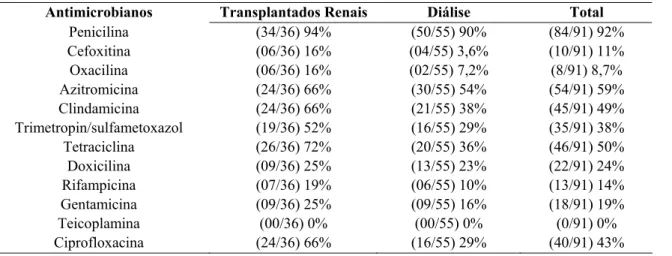
We observed 100% sensitivity to teicoplanin and
approximately 90% resistance to penicillin, 14% to rifampin
and 59% to azithromycin. High rates of resistance to penicillin
among S. aureus strains have been observed since 1959, when
this frequency was 80%, which has since extended to
amoxicillin and to ampicillin (27). The prevalence of resistance
to rifampicin (14%) and gentamicin (19%) and the complete
sensitivity to teicoplanin observed in this study are similar to
results obtained by Menegoto and Picoli (31). Table 1 lists the
results of antimicrobial susceptibility testing by the disk
diffusion assay for S. aureus samples isolated from dialysis and
kidney transplant patients from the Santa Casa de Maringá
hospital in 2009.
Table 1. Distribution of antimicrobial resistance by disk diffusion to S. aureus isolated from dialysis and kidney transplant patients at Santa Casa hospital of Maringá, 2009.
Antimicrobianos Transplantados Renais Diálise Total
Penicilina (34/36) 94% (50/55) 90% (84/91) 92%
Cefoxitina (06/36) 16% (04/55) 3,6% (10/91) 11%
Oxacilina (06/36) 16% (02/55) 7,2% (8/91) 8,7%
Azitromicina (24/36) 66% (30/55) 54% (54/91) 59%
Clindamicina (24/36) 66% (21/55) 38% (45/91) 49%
Trimetropin/sulfametoxazol (19/36) 52% (16/55) 29% (35/91) 38%
Tetraciclina (26/36) 72% (20/55) 36% (46/91) 50%
Doxicilina (09/36) 25% (13/55) 23% (22/91) 24%
Rifampicina (07/36) 19% (06/55) 10% (13/91) 14%
Gentamicina (09/36) 25% (09/55) 16% (18/91) 19%
Teicoplamina (00/36) 0% (00/55) 0% (0/91) 0%
Ciprofloxacina (24/36) 66% (16/55) 29% (40/91) 43%
MIC determination was utilized to confirm the oxacillin
resistance profile observed by disk diffusion and to test for
vancomycin resistance. The ten samples that were resistant to
cefoxitin by disk diffusion were confirmed by MIC, which
varied between 4 μg/ml and 256 μg/ml. Approximately 30%
(3/10) of the samples demonstrated a MIC of 4 μg/ml, 10%
(1/10) exhibited a MIC of 8 μg/ml, 20% (2/10) showed a MIC
of 16 μg/ml, and 40% (4/10) demonstrated a MIC of 256
μg/ml. For two samples, the results of the disk diffusion assay
differed from those of the MIC test for oxacillin resistance.
Both samples exhibited sensitivity by disk diffusion and
resistance by MIC, with values equal to the 4-μg/ml threshold.
These results support the proposal of the CLSI (5), which
Giarola, L.B. et al. Phenotypic and genotypic characteristics of S. aureus
diffusion assay with those of the MIC test using standard
strains (ATCC) that are known to be sensitive and resistant.
The results of antimicrobial susceptibility testing
demonstrated that of the ten samples resistant to oxacillin by
MIC, six (60%) exhibited a MIC of 2 μg/ml and four (40%)
demonstrated a MIC of 1 μg/ml for vancomycin, with all
defined as vancomycin-sensitive. Combining the results of
sensitivity testing (MIC) for oxacillin and vancomycin did not
reveal an association, independent of the observed values,
because all of the samples were sensitive to vancomycin.
S. aureus antimicrobial resistance may be chromosomally
encoded or mediated by plasmids. With respect to oxacillin
resistance, the hyperproduction of beta-lactamases, changes in
the binding capacity of PBPs or the presence of an altered PBP
known as PBP2a may be observed (42). This altered PBP is
encoded by a chromosomal gene known as mecA, which is
responsible for the intrinsic resistance of staphylococci to
oxacillin and all of the beta-lactam antibiotics (11).
The presence of the mecA gene was identified in eight of
the ten samples (80%) that were resistant to oxacillin by MIC.
A previous study by Faria (16) reported similar percentages in
samples from the community. More recent studies have
demonstrated the efficacy of the disk diffusion assay for
cefoxitin as a substitute marker for the detection of oxacillin
resistance by the mecA gene (2, 39).
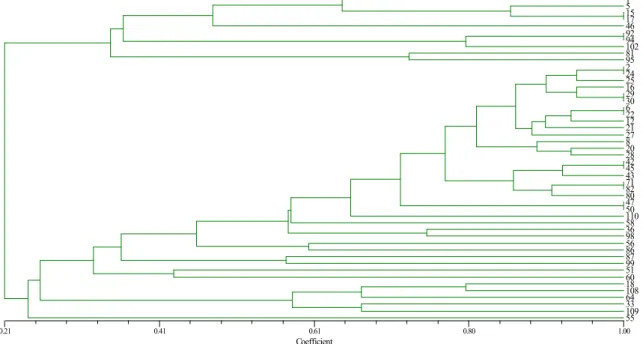
The degree of similarity between 48 of the 55 samples
isolated from the group of dialysis patients was evaluated using
PCR with the RW3A primer. No amplification product was
obtained from seven of the samples. Among the 48 typed
samples, 27 had a degree of similarity greater than 80%, and
the remaining isolates (21) exhibited a degree of similarity that
varied between 20% and 80%.
Comparisons among 16 of the 48 samples revealed eight
genotypes, and distinct profiles were observed for the
remaining samples. This result signifies the presence of strains
with identical genotypes; however, no one single genotype was
dispersed throughout the dialysis unit of this institution. The
results of the genetic similarity analysis with the RW3A primer
of the S. aureus samples isolated from dialysis patients are
presented in Figure 1.
Coefficient
0.21 0.41 0.61 0.80 1.00
102
1 5 15 17 46 92 94 102 81 95 2 24 25 16 29 30 6 22 12 21 27 8 20 28 42 45 43 71 82 80 47 50 110 58 36 98 56 86 87 99 51 60 18 108 64 33 109 55
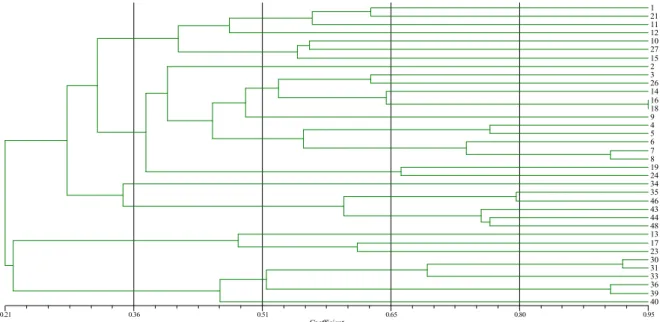
The results of genetic similarity testing revealed that of the
36 S. aureus samples isolated from kidney transplant patients, two exhibited 95% similarity, eight demonstrated approximately 90%
similarity, and the remaining samples (28) showed less than 80%
similarity. Similar to the dialysis group, a single genotype that was
disseminated throughout the institution was not identified among
kidney transplant recipients, as 100% similarity was not observed.
The results of genotyping with the RW3A primer for the analysis
of genetic similarity among the S. aureus samples isolated from
transplant patients are presented in Figure 2.
Coefficient
0.21 0.36 0.51 0.65 0.80 0.95
10
1 21 11 12 10 27 15 2 3 26 14 16 18 9 4 5 6 7 8 19 24 34 35 46 43 44 48 13 17 23 30 31 33 36 39 40
Figure 2. Analysis of similarity results for S. aureus samples isolated from kidney transplant patients, using Numerical Taxonomy System software (NTSYS).
With genetic typing, a more homogenous profile was
observed among the samples isolated from dialysis patients
than among those isolated from kidney transplant patients. Few
studies have reported using the RW3A primer for typing S.
aureus samples isolated from humans. A study performed by
Santos and Darini (37) identified little similarity among S.
aureus isolates from children and employees of a hospital;
however, the authors emphasized the important role of
genotyping in the research design because the antibiogram
alone did not provide sufficient criteria for sample distinction
(37).
Among the sixteen S. aureus samples isolated from
dialysis patients, eight genotypes that grouped in pairs were
identified. In seven of these eight genotypes, fourteen samples
were sensitive to oxacillin, and in one genotype, two isolates
exhibited different profiles, with one oxacillin-sensitive and
one oxacillin-resistant sample. Among the samples isolated
from transplant patients, only two exhibited 95% similarity,
and both were sensitive to oxacillin. Establishing a correlation
between antimicrobial resistance and dissemination of clonal S.
aureus groups is an important tool during outbreaks or in
endemic settings. Jones et al. (20) demonstrated using PCR
with the RW3A primer the existence of clones among
mupirocin-resistant samples of MRSA from the nares of
patients admitted to the Surgical Intensive Care Unit. In our
study, no correlation was observed between genetic similarity
and oxacillin sensitivity and resistance.
Giarola, L.B. et al. Phenotypic and genotypic characteristics of S. aureus
multidrug resistance profile of the samples demonstrated in this
study, we recommend the implementation of prevention and
control measures, including decontamination of nasal carriers,
restricted use of the antimicrobials commonly used in clinical
practice to which resistance is most frequent, active search for
carriers among contacts, tracking of dissemination sources and
a detailed study of antimicrobial resistance with reliable
methodologies. Moreover, the susceptibility to mupirocin
needs to be determined with greater methodological rigor, and
its use in the nasal decontamination of carriers of
multidrug-resistant strains should be evaluated.
REFERENCES
1. Alonso-Morquecho, A.; Flores-Preciado, H.; Martínez-García, M.C. (2000). Prevalence of infection in patients with central venous catheters. Revista Enf. IMSS. 8 (3), 139-143.
2. Anand, K.B.; Agrawal, P.; Kumar, S.; Kapila, K. (2009). Comparison of cefoxitin disc diffusion test, oxacillin Screen Agar, and PCR for mecA gene for detection of MRSA. Indian J Med Microbiol. 27 (1), 27-29. 3. Brasil. Ministério da Saúde. Conselho Nacional de Saúde. Resolução nº
196/96 - Diretrizes e normas regulamentadoras de pesquisas envolvendo seres humanos. Brasília, DF: MS/FIOCRUZ, 1996.
4. Brasil. Detecção e identificação de bactérias de importância médica. Brasília, DF, 2004a.
5. Clinical and Laboratory Standards Institute. Performance Standards for antimicrobial disk susceptibility tests: approved standard. CLSI. 10. ed. M02-A10. Wayne, PA, 2009a.
6. Clinical and Laboratory Standards Institute. Performance Standards for antimicrobial susceptibility testing: nineteenth informational supplement. CLSI. Document M100-S20. Wayne, PA, 2010b.
7. Clinical and Laboratory Standards Institute. Methods for dilution antimicrobial susceptibility tests for bacteria that grow aerobically: approved standard. CLSI. 8. ed. Document M07-A8. Wayne, PA, 2009c. 8. Coia, J.; Duckworth, G.; Edwards, D.; Farrington, M.; Fry, C.;
Humphreys, H.; Mallaghan, C.; Tucker, D. (2006). Guidelines for the control and prevention of methicillin-resistant Staphylococcus aureus (MRSA) in healthcare facilities. J. Hosp. Infect. 63, 1-44.
9. Datta, F.; Erb, T.; Heininger, U.; Gervaix, A.; Schaad, U.B.; Berger, C.; Vaudaux, B.; Aebi, C.; Hitzler, M.; Kind, C.; Gnehm, H.E.; Frei, R. (2008). A multicenter, cross-sectional study on the prevalence and risk factors for nasal colonization with Staphylococcus aureus in patients admitted to children's hospitals in Switzerland. Clin Infect Dis. 47 (7), 923-926.
10. De Lencastre, H.; Wu, S.W.; Pinho, M.G.; Ludovice, A.M.; Filipe, S.; Gardete, S.; et al. (1999). Antibiotic resistance as a stress response: complete sequencing of a large number of chromosomal loci in
Staphylococcus aureus strain COL that impact on the expression of
resistance to methicillin. Microbial Drug Resistance. 5 (3), 163-175. 11. De Lencastre, H.; Oliveira, D.; Tomasz, A. (2007). Antibiotic resistant
Staphylococcus aureus: a paradigm of adaptive power. Current Opinion
in Microbiology. 10 (5), 428-435.
12. Deurenberg, R.H.; Stobberingh, E.E. (2008). The evolution of
Staphylococcus aureus. Infection, Genetics and Evolution. J. Clin.
Microbiol. 8 (6), 747-763.
13. Dias Filho BP, Abreu Filho BA, Cardoso CL, Nakamura CV, Garcia LB, Guilhermetti M, Tognin MCB, Nakamura TU. Manual de aulas práticas: Enfermagem. Maringá: Universidade Estadual de Maringá. Departamento de Análises Clínicas, 2001.
14. Doyle, J.J.; Doyle, J.L. (1990). Isolation of plant DNA from fresh tissue. Focus. 12 (1), 13-15.
15. Fabiano, T.L.T.; Ávila, B.H.P.; Dias, C.C.; Maluta, R.P.; Ávila, F.A. (2008). Genetic similarity between Staphylococcus sp isolated from human and hospital settings, and susceptibility to different antimicrobials. Braz. J. Microbiol. 39 (4), 652-657.
16. Faria, S.T. (2009). Staphylococcus aureus entre estudantes de enfermagem saudáveis. Maringá, Paraná, Brasil, 57p. (M.Sc. Dissertation. Programa de Pós-graduação em Enfermagem, Universidade Estadual de Maringá. UEM).
17. Ferreira, V.; Andrade, D.; Santos, C.B.; Neto, M.M. (2005). Infection in patient with temporary double-lumen catheter for hemodialysis. Rev Panam Infectol. 7 (2), 16-21.
18. Gold, I.M. (2005). The clinical significance of methicillin-resistant
Staphylococcus aureus. Journal of Hospital Infection. 61 (4), 277-282.
19. Hong, F.; Goran, H. (2006). Use of cefoxitin-based selective broth for improved detection of methicillin-resistant Staphylococcus aureus. J. Clin. Microbiol. 44 (2), 592-594.
20. Jones, J.C.; Rogers, T.J.; Brookmeyer, P.; Dunne Junior, W.M.; Storch, G.A.; Coopersmith, C.M.; et al. (2007). Mupirocin Resistance in Patients Colonized with Methicillin-Resistant Staphylococcus aureus in a Surgical Intensive Care Unit. Clinical Infectious Diseases. 45, 541-547. 21. Kluytmans, J.; Van Belkum, A.; Verbrugh, H. (1997). Nasal carriage of
Staphylococcus aureus: epidemiology, underlying, mechanisms, and
associated risks. Clin Microbiol Rev. 10 (3), 505-520.
22. Koneman, E.W. et al. (2008). Diagnóstico Microbiológico: texto e atlas colorido. 6. ed. Rio de Janeiro: Medsi.
24. Lowy, F.D. (2003). Antimicrobial resistance: the example of
Staphylococcus aureus. J. Clin. Invest. 111(9), 1265-1273.
25. Lutz, L.; Machado, A.; Kuplich, N.; Barth, A.L. (2003). Clinical failure of vancomycin treatment of Staphylococcus aureus infection in a tertiary care hospital in southern Brazil. Braz J Infect Dis. 7 (3), 224-228. 26. Lutz, L.; Barth, A.L. (2006). Susceptibility of Staphylococcus aureus
isolates to vancomycin at a university hospital in southern Brazil. Braz. J. Microbiol. 37, 244-246.
27. Mamizuka, E. (2005). Projeto de resistência microbiana em serviços de saúde, Staphylococcus. Agência Nacional de Vigilância Sanitária, ANVISA. http//:www.anvisa.gov.br
28. Mandell, G.L.; Bennett, J.E.; Dolin, R. (2005). Mandell, Douglas, and Bennett's Principles and Practice of Infectious Diseases. 6. ed. Philadelphia: Elsevier Churchill Livingstone, 2005.
29. Martins Júnior, P.O.; Porto, E.R.; Silva, R.N.; Pinhati, H.M.S. (2009). Prevalence of meticilin resistent Staphylococcus aureus isolated in blood cultures of hospitalized patients in Some Hospitals at Distrito Federal-Brazil. Brasília Med. 46 (2), 125-130.
30. Melo, G.B.; Melo, M.C.; Gama, A.P.; Carvalho, K.S.; Jesus, T.C.; Bonetti, A.M.; Gontijo Filho, P.P. (2005). Analysis of the genetic diversity of vancomycin-resistant Staphylococcus aureus. Braz. J. Microbiol. 36 (2), 126-130.
31. Menegotto, F.R.; Picoli, S.V. (2007). Staphylococcus aureus oxacilina resistente (MRSA): incidência de cepas adquiridas na comunidade (CA-MRSA) e importância da pesquisa e descolonização em hospital. Rev. Bras. Anal. Clin. 39 (2), 147-150.
32. Oliveira G.A.; Dell'Aquila, A.M.; Masiero, R.L.; Levy, C.E.; Gomes, M.S.; Cui, L.; Hiramatsu, K.; Mamizuka, E.M. (2001). Isolation in Brazil of nosocomial Staphylococcus aureus with reduced susceptibility to vancomycin. Infect Control Hosp Epidemiol. 22(7): 443-448. 33. Padoveze, M.C. (2004). Estudo das infecções hospitalares em pacientes
com HIV/AIDS hospitalizados e da colonização nasal pos
Staphylococcus aureus em pacientes com HIV/AID não hospitalizados.
Campinas, São Paulo, Brasil, 135p. (Tese de doutorado. Programa de Pós-graduação em Clínica Médica, Faculdade de Ciências Médicas, Universidade Estadual de Campinas, Campinas).
34. Palos, M.A.P. (2006). Staphylococcus aureus e Staphylococcus aureus meticilina resistentes (MRSA) em profissionais de saúde e as interfaces com as infecções nosocomiais. São Paulo, Brasil, 184p. (Tese de doutorado. Escola de Enfermagem de Ribeirão Preto, Universidade de São Paulo, Ribeirão Preto).
35. Reinoso, E.; Bettera, S.; Odierno, L.; Bogni, C.; et al. (2007). Rep-PCR
of Staphylococcus aureus strains isolated from bovine mastitis in
Argentina. Braz. J. Vet. Res. Anim. Sci. 4: 115-121. Suplemento. 36. Ricardo, S.B. (2004). Emergência de S. aureus Meticilina-Resistente
(MRSA) na comunidade. Prática Hospitalar. 34, 131-134.
37. Santos, B.M.O.; Darini, A.L.C. (2002). Colonization by Staphylococcus aureus in healthy carriers from a nursery in a university hospital. Medicina, Ribeirão Preto. 35 (2), 160-172.
38. Siripommongcolchain, T. et al. (2002). Evolution of different primers for detecting mecA genes by PCR in comparison with phenotypic methods for discrimination of meticillin-resistant Staphylococcus aureus. Southeast Asian J. Trop. Med. Public. Health. 33 (4), 758-763.
39. Swenson, J.M.; Lonsway, D.; McAllister, S.; Thompson, A.; Jevitt, L.; Patel, J.B. (2007). Detection of mecA-mediated resistance using cefoxitin disk diffusion (DD) in a collection of Staphylococcus aureus expressing borderline oxacillin MICs. Diagn Microbiol Infect Dis. 58 (1), 33-39.
40. Tenover, F. C.; Arbeit R.; Archer, G.; Biddle, J.; Byrne, S.; Goering, R.; Hancock, G.; Hébert, G.A.; Hill, B.; Hollis, R. (1994). Comparison of traditional and molecular methods of typing isolates of Staphylococcus aureus. J. Clin. Microbiol. 32 (2), 407-415.
41. Toledo, M. R. F. (1989). Staphylococcus. In: TRABULSI, L. R. Microbiologia. 2. ed. Rio de Janeiro: Atheneu, 105-109.
42. Tomasz, A.; Drugeon, H.B.; Lencastre, H.M.; Jabes, D.; McDougal, L.; Bille. J. (1989). New mechanism for methicillin-resistance in S. aureus: clinical isolates that lack the PBP2a gene and contain normal penicilin-bindig proteins with modified penicillin binding capacity. Antimicrob Agents Chemother. 33, 1869-1874.
43. Unal S, Hoskins J, Flokowitsch JE, Wu CY, Preston DA, Skatrud PL. Detection of Methicillin-Resistant Staphylococci by Using the Polymerase Chain Reaction. J.Clin.Microbiol 1992; 30(7): 1685- 1691. 44. Van Belkum, A.; Kluytmans, J.; Van Leeuwen, W.; Bax, R.; Quint, W.;
Peters, E.; et al. (1995). Multicenter evaluation of arbitrarily primed PCR for typing of Staphylococcusaureus strains. J. Clin. Microbiol. 33 (6), 1537-1547.
45. Wertheim, H.; Vos, M.; Ott, A.; Van Belkum, A.; Voss, A.; Kluytmans, J.; Van Keulen, P.; Vandenbroucke-Grauls, C.; Meester, M.; Verbrugh, H. (2004). Risk and outcome of nosocomial Staphylococcus aureus bacteraemia in nasal carriers versus non-carriers. Lancet. 364 (9435), 703–705.