Variability among inbred lines and RFLP mapping of sunflower isozymes
Alicia D. Carrera
1, G. Pizarro
1, M. Poverene
1, S. Feingold
2,4, A.J. León
2and S.T. Berry
31
Universidad Nacional del Sur, Departamento de Agronomía y CERZOS (CONICET) Bahía Blanca,
Argentina.
2
Advanta Semillas, Centro de Biotecnología, Balcarce. Argentina.
3
SES-Europe NV/SA, Advanta Biotechnology Laboratory, Tienen, Belgium.
4Present address: Laboratorio de Biotecnología Agrícola, INTA Balcarce, Argentina.
Abstract
Eight isozyme systems were used in this study: acid phosphatase (ACP), alcohol dehydrogenase (ADH), esterase (EST), glutamate dehydrogenase (GDH), malate dehydrogenase (MDH), phosphoglucoisomerase (PGI), 6-phosphogluconate dehydrogenase (PGD), and phosphoglucomutase (PGM). The polymorphism of these enzyme systems was studied in 25 elite inbred lines. A total of 19 loci were identified, but only eight of them were polymorphic in the germplasm tested. The polymorphic index for the eight informative markers ranged from 0.08 to 0.57, with a mean value of 0.36.
Five isozyme loci were mapped in F2:3populations with existing RFLP data.Est-1, Gdh-2 and Pgi-2 were mapped to
linkage groups 3, 14 and 9, respectively. As in previous reports, an ACP locus and a PGD locus were found to be linked, both located in linkage group 2 of the public sunflower map.
Key words: isozyme, polymorphisms, RFLP markers, sunflower, linkage map,Helianthus annuus. Received: March 5, 2002; accepted: March 25, 2002.
Introduction
Sunflower (Helianthus annuusL.) is a diploid (2n = 34) species, which is second only to soybean in its impor-tance as an annual oil seed crop. Despite its economic value, the number of simply inherited genes identified in sunflower is relatively small (Miller, 1992), and there is no classical genetic map for this species. Several sunflower RFLP linkage maps were published recently (Berryet al., 1995; Gentzbittelet al., 1995, 1999; Janet al. 1998), but unfortunately the relationship between these different maps is unknown, because the vast majority of the markers are not publicly available. The mapping of major gene loci, such as theRf1locus (Gentzbittelet al., 1995; Berryet al., 1997; Janet al., 1998), the downy mildew resistance gene cluster (Vearet al., 1997),Orobancheresistance (Luet al., 2000) and the Hyp-1locus (Leónet al., 1996), as well as protein markers, such as seed storage proteins (Serreet al., 2001) and isozymes, will provide landmarks allowing the alignment of some linkage groups.
Isozymes have been used to assess genetic variation in both domesticated and wild sunflower populations (Dry
and Burdon, 1986; Rieseberget al., 1990; Cronn et al., 1997), as well as to establish phylogenetic relationships and speciation mechanisms within the genus Helianthus
(Rieseberget al., 1991; 1998). They have also been used to study intra specific variation in both wild (Carrera and Poverene, 1995; Carreraet al., 1996) and cultivated sun-flowers (Carrera and Poverene, 1991; Quilletet al., 1992), as well as to identify interspecific hybrids (Carreraet al., 1996). In cultivated sunflower, Quilletet al. (1992) demon-strated that eight polymorphic isozyme loci could discrimi-nate between distantly related inbred lines, whereas Tersac
et al. (1994) were able to group cultivated populations ac-cording to their geographic origin by using isozyme data. Unfortunately, the relatively small number of isozyme sys-tems limits their use in genetic mapping studies. However, isozymes are still routinely used by seed companies for seed purity testing of both inbred and hybrid seed lots, be-cause, in comparison with RFLP markers, the assays are relatively cheap and quick to run. Therefore, knowledge about the linkage arrangement of isozyme loci would allow a more even sampling of the sunflower genome.
Berryet al., (1997) released a RFLP sunflower map for public research, comprising 81 loci covering all 17 link-age groups. To date, two classical genetic markers, the CMS restorationRf1gene (Kinman, 1970) and theHAG-5
www.sbg.org.br
gene controlling 2S albumin (Allenet al., 1987), were in-cluded in this public map. The objectives of this study were: i) to investigate the level of genetic variation of isozymes in 25 elite sunflower inbred lines, and ii) to map polymorphic isozyme loci onto the public RFLP linkage map of cultivated sunflower.
Materials and Methods
Plant material
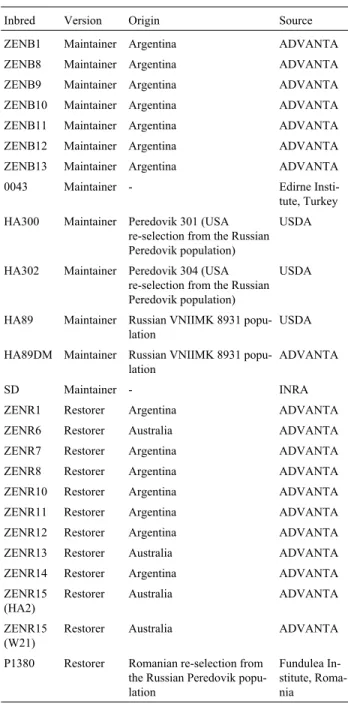
Twenty-five inbred lines were studied by electropho-retic assay (Table I), including the parents of four F2:3
popu-lations, which had previously been used for RFLP mapping studies. Ten seeds from each inbred line were analysed, in order to test for uniformity within the lines. The genotype of each F2plant was re-created by bulking 8-9 seeds from
their F3progenies obtained by selfing.
Isozyme electrophoresis
Samples were prepared from seeds soaked for 24 h (48 h for PGM) (using) in a 0.1 M Tris-HCl-mercapto-ethanol buffer (pH 7.5). The following enzymes were as-sayed: acid phosphatase (ACP), alcohol dehydrogenase (ADH), esterase (EST), glutamate dehydrogenase (GDH), malate dehydrogenase (MDH), phosphoglucoisomerase (PGI), 6-phosphogluconate dehydrogenase (PGD), and phosphoglucomutase (PGM). The isozymes were resolved on 12% horizontal starch gel; the buffer systems and stain-ing methods are described in Carrera and Poverene (1995), after Soltiset al. (1983). The number of loci and alleles were interpreted according to Torres (1983), Kahler and Lay (1985), Rieseberg and Soltis (1989), and Carrera and Poverene (1991, 1995). Loci were designated by giving the number 1 to the most anodally migrating isozyme and se-quentially numbering the additional loci in a decreasing order of electrophoretic mobility. The most anodally mi-grating allozyme was designated by the letter `a’.
Data analysis and map construction
The genetic similarity between two inbred lines was estimated according to Nei (1987), using the BIOSYS-1 program (Swofford and Selander, 1981) The genetic dis-tance matrix was used to construct a phenogram by the UPGMA clustering method. The reliability of the UPGMA tree was examined using bootstrap resampling analysis, through a new version of the same BIOSYS-2 program, to construct a consensus tree through Phylip3.5C (Felsens-tein, 1995). Various standard measures of genetic variation were also calculated, including the proportion of polymor-phic loci (P), the mean number of alleles across all loci (A), the mean number of alleles per polymorphic locus (Ap),
and the polymorphic index (PI; defined as 1 -Σpi2, where
“pi” is the frequency of the ithallele).
The isozyme loci were mapped onto the public RFLP sunflower map. To construct this map, 81 genomic and cDNA probes were selected, and detected loci covering ap-proximately 1200 cM of the sunflower genome, arranged into 17 linkage groups, as was demonstrated by segregation data from nine different F2populations (Berryet al., 1997).
Isozyme linkage maps were constructed using data from four out of nine F2 populations. The F2 plants were
self-pollinated to produce F2:3families, which were used as
mapping populations (Table III).
Table I- Origin of the sunflower inbred lines used in this study.
Inbred Version Origin Source
ZENB1 Maintainer Argentina ADVANTA
ZENB8 Maintainer Argentina ADVANTA
ZENB9 Maintainer Argentina ADVANTA
ZENB10 Maintainer Argentina ADVANTA
ZENB11 Maintainer Argentina ADVANTA
ZENB12 Maintainer Argentina ADVANTA
ZENB13Maintainer Argentina ADVANTA
0043Maintainer - Edirne
Insti-tute, Turkey
HA300 Maintainer Peredovik 301 (USA re-selection from the Russian Peredovik population)
USDA
HA302 Maintainer Peredovik 304 (USA re-selection from the Russian Peredovik population)
USDA
HA89 Maintainer Russian VNIIMK 8931 popu-lation
USDA
HA89DM Maintainer Russian VNIIMK 8931 popu-lation
ADVANTA
SD Maintainer - INRA
ZENR1 Restorer Argentina ADVANTA
ZENR6 Restorer Australia ADVANTA
ZENR7 Restorer Argentina ADVANTA
ZENR8 Restorer Argentina ADVANTA
ZENR10 Restorer Argentina ADVANTA
ZENR11 Restorer Argentina ADVANTA
ZENR12 Restorer Argentina ADVANTA
ZENR13Restorer Australia ADVANTA
ZENR14 Restorer Argentina ADVANTA
ZENR15 (HA2)
Restorer Australia ADVANTA
ZENR15 (W21)
Restorer Australia ADVANTA
P1380 Restorer Romanian re-selection from the Russian Peredovik popu-lation
The segregation of the alleles at each locus was checked against the expected ratios for a codominant marker in a F2population, using a chisquare test with a
sig-nificance level of 5%. The linkage analyses were (per-formed with) made using Mapmaker version 3.0 (Landeret al., 1987). A constant LOD score of 3.0 was used. The Haldane function was used to obtain the cM values. The isozyme loci were placed in the map by using the “try” command. The “error detection” command was used to check for mistakes in scoring and data entry, and for double crossover events. Linkage group and RFLP loci are named according to Berryet al. (1997).
Results
Polymorphism and genetic distance
The eight enzyme systems assayed revealed 19 loci, with a total of 28 alleles (A = 1.47). The average number of alleles per polymorphic locus (Ap) was 2.125. All
polymorphic loci were bi-allelic, except forEst-1, which was tri-allelic.Eleven loci were monomorphic in the tested lines(Adh-1, Adh-2, Gdh-1, Mdh-2, Mdh-3, Pgd-1, Pgd-2,
Pgi-1,Pgm-2,Pgm3,Pgm-4), and eight loci were found to be polymorphic (Acp-1, Est-1, Gdh-2, Mdh-1, Mdh-4,
Pgd-3,Pgi-2,Pgm-1). The proportion of polymorphic loci (P) was therefore 0.42. There were 17 different genotypes, 12 (48%) of which were unique within this set of material (Table II). The PI ranged from 0.08 forPgi-2to 0.57 for
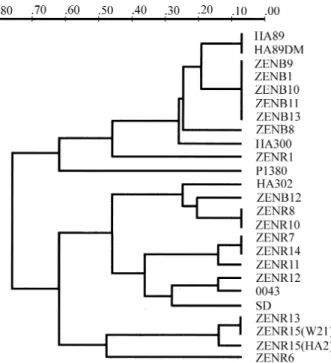
Est-1, the only system revealing three alleles, with a mean value of 0.36. No intra-line heterogeneity was observed, except for ZENR15 (W21), which had two Acp-1 geno-types. The isozyme data were used according to Nei (1987), to calculate the genetic distance between all possible pairs of lines, and the result was used to construct the phenogram shown in Figure 1. The consensus tree, obtained by 100 bootstrap resampling of loci (not shown), resembled the original topology showed in Figure 1. Major groups of re-storer and maintainer lines were similar in both the UPGMA and the consensus tree, although groups were re-solved with low bootstrap values.
Table II- Allozyme genotypes observed in 25 sunflower lines and the polymorphic index (PI) value for each of the isozyme marker loci.
Inbred Acp-1 Est-1 Gdh-2 Pgd-3 Pgi-2 Pgm-1 Mdh-1 Mdh-4
ZENB1 bb cc bb Bb aa bb bb bb
ZENB8 bb cc bb Bb aa aa bb bb
ZENB9 bb cc bb bb aa bb bb bb
ZENB10 bb cc bb bb aa bb bb bb
ZENB11 bb cc bb bb aa bb bb bb
ZENB12 bb cc bb bb aa bb aa bb
ZENB13bb cc bb bb aa bb bb bb
HA89 bb cc bb aa aa bb bb bb
HA89DM bb cc bb aa aa bb bb bb
HA300 bb aa bb bb aa bb bb bb
HA302 bb aa bb bb aa bb aa aa
0043bb bb aa bb aa bb aa aa
SD bb cc aa aa aa bb aa aa
ZENR1 bb bb bb bb bb bb bb bb
ZENR6 bb bb aa bb aa aa aa bb
ZENR7 bb bb bb aa aa bb aa aa
ZENR8 bb cc bb bb aa bb aa aa
ZENR10 bb cc bb bb aa bb aa aa
ZENR11 bb bb bb aa aa bb aa bb
ZENR12 bb bb aa aa aa bb aa aa
ZENR13aa bb bb bb aa aa aa aa
ZENR14 bb bb bb aa aa bb aa aa
ZENR15(HA2) bb bb bb bb aa aa aa aa
ZENR15(W21) aa/bb bb bb bb aa aa aa aa
P1380 aa bb aa bb aa bb bb bb
Zymograms
Pgd-3 zymograms obtained from artificial bulks showed that a given genotype could be detected even in samples with a 1:8 ratio. The sensitivity of the method was lower for the other enzymes, and so three bulks of three seeds for each F2:3family were used. The patterns of the
Mdh-1,Mdh-4andPgm-1loci could not be resolved in the F2:3populations. These enzymes are under the genetic
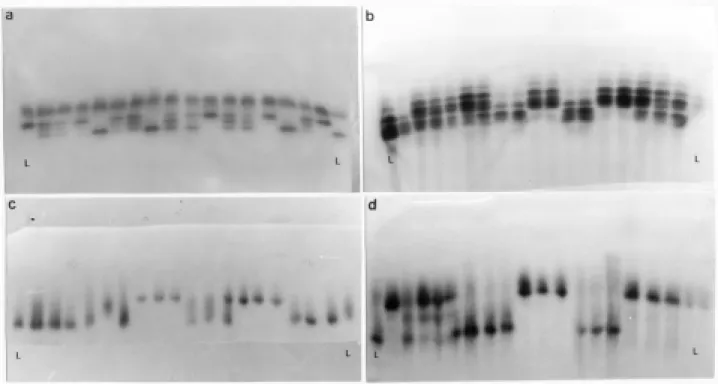
con-trol of several loci encoding for cytoplasmic and organelle variants. Moreover, enzyme monomers coded by different genes can combine to produce intergenic heterodimers, making the identification of homo- and heterozygous indi-viduals uncertain. The following five loci were selected for linkage analysis:Acp-1,Est-1,Gdh-2,Pgd-3, andPgi-2. Examples of zymograms obtained in the F2:3 mapping
populations are shown in Figures 2 and 3. The number, spacing and relative intensity of bands of heterozygous in-dividuals were in agreement with the expected quaternary structure of active enzymes and the ploidy level. Acp-1,
Pgd-3 and Pgi-2 presented either a single band or a three-banded pattern consistent with a dimeric structure.
Gdh-2patterns had one or multiple bands according to a tetrameric structure, but low resolution was observed in heterozygotes at this locus, due to the small distance be-tween the bands.Est-1patterns were particularly complex, with single alleles coding for multiple bands, but allelic variants could be unambiguously identified.
Mapping
The five polymorphic loci (Acp-1, Est-1, Gdh-2,
Pgd-3, and Pgi-2) showed co-dominant expression, and their segregation in the F2populations fitted the expected
1:2:1 ratio (Table III). These isozyme loci were mapped to linkage groups 2, 3, 9, 14 of the public RFLP map (Figure 4). The Acp-1 and Pgd-3 loci were found linked to the marker ZVG0005 on group 2, and the distance between these loci was estimated to be 11.3cM. TheEst-1locus mapped to group 3, in the interval flanked by ZVG0009 and ZVG0010, and this position was confirmed in two separate mapping populations (Table III).Gdh-2was located 2 cM above ZVG0062 in group 14, andPgi-2mapped to group 9, between ZVG0040 and ZVG0041.
Discussion
Genetic variation at sunflower isozyme loci
The following 15 isozyme systems have been re-ported to reveal useful polymorphism in cultivated sun-flower germplasm: aconitase (ACO), acid phosphatase (ACP), alcohol dehydrogenase (ADH), esterase (EST), glutamate dehydrogenase (GDH), glutamate oxaloacetate transaminase (GOT), isocitrate dehydrogenase (IDH), leu-cine aminopeptidase (LAP), malate dehydrogenase (MDH), malic enzyme (ME), peroxidase (PRX), phospho-gluconate dehydrogenase (PGD), phosphoglucoisomerase (PGI), phosphoglucomutase (PGM) and shikimate dehy-drogenase (SKDH) (Layet al., 1988; Quilletet al., 1992; Tersac et al., 1994; Cronn et al., 1997; Mestries et al., 1998). Eight of these systems were screened in this study, revealing nineteen loci, eight of which were polymorphic. The observed values of P (0.42), A (1.47) and Ap (2.125) were very similar to those reported by Cronnet al. (1997), who studied isozyme polymorphism in 700 plants from both oilseed and confectionary sunflower accessions. Ex-cept forMdh-3, the loci that were found to be monomorphic in the 25 elite inbred lines had previously also been found to be monomorphic in cultivated sunflower germplasm (Car-rera and Poverene, 1991, 1995; Quilletet al., 1992).
Table III- The segregation ratio of the five polymorphic isozyme marker loci in the F2:3mapping populations
Locus F2:3
populations
N. of plants
Observed ratios P
aa ab bb
Acp-1 ZENR11 x ZENR13121 22 71 28 0,10
Est-1 ZENR1 x ZENR8 137 28 70 39 0,30
ZENB13x SD 77 12 43 22 0,10
Gdh-2 ZENB13x SD 77 20 40 17 0,80
Pgd-3 HA89 x ZENB8 150 34 82 34 0,50
ZENR11 x ZENR13113 26 62 25 0,50
Pgi-2 ZENR1 x ZENR8 138 34 69 35 0,99
Chi-square probability compared to the expected 1 :2: 1 segregation ratio.
In comparison with the results obtained by Quilletet al. (1992), this set of isozyme markers was far less in-formative. Quilletet al., (1992) were able to distin-guish 45 out of 52 lines (86.5%) by using eight systems, whereas, in this survey, only 12 out of 25
lines (48%) could be uniquely distinguished. This apparent reduction in discriminatory power was prob-ably due to a narrower sampling of the sunflower germplasm represented by this small set of inbred lines (Table I).
Figure 2- Isozyme banding paterns and the genotypes assigned in the segregating F2:3populations. A and B = the parental homozygotes, H = heterozygote. a. PGD; b. PGL; c. Est; d. ACP; e. GDH.
Comparison between isozyme and RFLP markers in
sunflower
The mean number of isozyme alleles per polymorphic locus (Ap = 2.125) was lower than the values reported for RFLP markers (Berryet al., 1994; Zhanget al., 1995). A number of closely related lines was used in this study (e.g., all the B lines in the cluster ZENB8 to HA89 are sister lines derived from a cross between these two females). This nar-row sampling of germplasm (would) could reduce the level of polymorphism at the isozyme loci studied. One allelic form was found to predominate at each isozyme locus (Ta-ble II), as reported by Cronnet al. (1997) in a much larger germplasm survey. This is reflected by the low PI values for each isozyme marker (Table II), which made it necessary to use a number of different F2:3populations, in order to map
as many loci as possible (Table III).
Cluster analysis (both UPGMA and bootstrap) of the isozyme fingerprinting data (Figure 1) revealed that the eight polymorphic loci were capable of separating the ma-jority of CMS maintainer (B) lines from the restorer (R) lines. What makes the statistical separation possible are the differences in allele frequency between the B and R germplasm pools. For example, theEst-1aallele was only found in the B lines. However, the discrimination between males and females was not absolute. For (example) in-stance, the males ZENR8 and ZENR10 clustered more closely with the females, (and) whereas SD and 0043clus-tered with the males. This undoubtedly reflects the narrow-ness of the germplasm used, the low level of isozyme polymorphism, and the poor genome coverage offered by the eight polymorphic isozyme systems. Studies with large numbers of molecular markers (Berryet al., 1994, Zhanget al., 1995; Hongtrakulet al., 1997) give a better resolution and tend to reflect the pedigree more closely.
Genetic mapping
There have been several reports on the inheritance of isozyme loci in populations of both wild and cultivated sun-flower (Kahler and Lay, 1985; Torres, 1983; Rieseberget al., 1993and 1995; Quilletet al., 1995), and several pairs of loci have been found to be linked (Table IV ). Mestrieset al. (1998) were the first authors who reported the mapping of a number of isozyme loci onto a proprietary RFLP linkage map. These authors mapped the following 6 isozyme loci to five different linkage groups in a single F2 population:
Got-1,Idh-I,Me,Pgd-2,Pgi-3andSdh.Pgi-3andIdh-1
were found to be linked (Table IV). However, the present report is the first one on the mapping of sunflower isozyme loci onto a public linkage map, comprising 17 linkage groups. The five polymorphic isozyme loci,Acp-1,Est-1,
Gdh-2,Pgd-3, andPgi-2,mapped to four different linkage groups, withAcp-1andPgd-3linked to group 2. Genetic linkage between an acid phosphatase locus (Acp-1) and a phosphogluconate dehydrogenase locus (Pgd-1) was origi-nally reported by Layet al. (1988), with a recombination fraction of 0.05. This value of 0.05 equates to approxi-mately 5 cM, using either Kosambi or Haldane mapping functions (Lynch and Walsh, 1998), and is similar to the figure of 11.3cM determined in this study. However, Layet al. (1988) used a different nomenclature system to code their isozyme loci, which is an important consideration when comparing loci in different publications. Thus, it is possible, for example, that the PGD and PGI loci mapped by Mestries et al. (1998) are the same as those reported here.
Several isozyme systems revealed duplicated loci (Fi-gure 2) in the sunflower genome, but unfortunately none of these duplications could be mapped in the F2:3populations.
RFLP markers also detect duplicated loci (Berry et al., 1996), and these observations are consistent with the hy-pothesis that sunflower is an ancient polyploid (Jackson and Murray, 1983).
Table IV - Isozyme loci mapped in both intra- and inter-specific
Helianthuspopulations.
Reference Mapped isozyme loci Linked isozyme loci
Torres and Diedenhoffen (1976)
Adh-1, Adh-2, Acp-1
Kahler and Lay (1985) Layet al. (1988)
Prx-3, Mdh-1, Idh-2, Gpi -2, Pgm-4, Pgd-1, Acp-1, Acp-2, Sdh-3
Prx-3 & Pgm-4 Acp-1 & Pgd-1
Rieseberget al. (1993) Acp-1
Quilletet al. (1995)
Mdh-1,Mdh-2,Pgm-1,
Sdh-1,Acp-1,Me-1
Mdh-1 & Sdh-1
Mestrieset al. (1998)
Got-1,Idh-I,Me,Pgd-2,
Pgi-3,Sdh
Idh-1 & Pgi-3
This study Acp-1,Pgd-3,Est-1,
Pgi-2,Gdh-2
Acp-1 & Pgd-3
The adoption of a standard nomenclature system for isozyme loci in sunflower, and the continued mapping of additional loci onto existing RFLP linkage maps, will pro-vide an additional set of freely available public markers. Mapped isozyme loci, along with classical genetic markers and public microsatellites, will certainly help to integrate the various published sunflower maps.
References
Allen RD, Cohen EA, Von der Haar RA, Adams CA, Ma, D.P., Nessler CL and Thomas TL (1987) Sequence and expres-sion of a gene encoding an albumin storage protein in sun-flower. Mol. Gen. Genet. 210:211-218.
Berry ST, Allen RJ, Barnes SR and Caligari PDS (1994) Molecu-lar analysis ofHelianthus annuusL. 1. Restriction fragment length polymorphism between inbred lines of cultivated sunflower. Theor. Appl. Genet. 89:435-441.
Berry ST, León AJ, Hanfrey CC, Challis P, Burkholz A, Barnes SR, Rufener GK, Lee M and Caligari PDS (1995) Molecular marker analysis ofHelianthus annuusL. 2. Construction of an RFLP linkage map for cultivated sunflower. Theor. Appl. Genet. 91:195-199.
Berry ST, Leon AJ, Challis P, Livini C, Jones R, Hanfrey CC, Griffiths S and Roberts A (1996) Construction of a high den-sity, composite RFLP linkage map for cultivated sunflower (Helianthus annuusL.). Proceedings: 1155-1160. 14THInt. Sunflower Conf. v. 2, Beijing/Shenyang, China.
Berry ST, León AJ, Peerbolte R, Challis P, Livini C, Jones R and Feingold S (1997) Presentation of the Advanta sunflower RFLP linkage map for public research. Proceedings: 113-118. 19THSunflower Res. Workshop, Fargo, USA. Carrera A, and Poverene M (1991) Variabilidad genética en
gi-rasol mediante marcadores isoenzimáticos. Investigación Agraria (Spain) 6:281-293.
Carrera A, and Poverene M (1995) Isozyme variation in
Helianthus petiolarisand sunflower,H. annuus. Euphytica 81: 251-257.
Carrera A, Poverene M and Rodriguez RH (1996) Isozyme vari-abilityin Helianthus argophyllus. Its application in crosses with cultivated sunflower. Helia 19:19-28.
Cronn R, Brothers M, Klier K, Bretting PK, and Wendel JF (1997) Allozyme variation in domesticated annual sunflower and its wild relatives. Theor. Appl. Genet. 95:532.545. Dry PJ and Burdon JJ (1986) Genetic structure of natural
popula-tions of wild sunflowers (Helianthus annuusL.) in Austra-lia. Aust. J. Biol. Sci. 39:255-270.
Felsenstein J (1995) PHYLIP (Phylogeny Inference Package) Version 3.5c. University of Washington. http://evolution. genetics.washington.edu/phylip/getme.html.
Gentzbittel L, Vear F, Zhang Y-X, Bervillé A and Nicolas P (1995) Development of a consensus linkage RFLP map of cultivated sunflower (Helianthus annuusL.) Theor. Appl. Genet. 90:1079-1086.
Gentzbittel L, Mestries E, Mouzeyar S, Mazeyrat F, Badaoui S, Vear F, Tourvieille de Labrouhe D, and Nicolas P (1999) A composite map of expressed sequences and phenotypic traits of the sunflower (Helianthus annuusL.) genome. Theor. Appl. Genet. 99:218-234.
Hongtrakul V, Huestis GM, and Knapp SJ (1997) Amplified frag-ment length polymorphisms as a tool for DNA
fingerprint-ing sunflower germplasm: genetic diversity among oilseed inbred lines. Theor. Appl. Genet. 95:400-407.
Jan CC, Vick BA, Miller JF, Kahler AL and Butler ET (1998) Construction of an RFLP linkage map for cultivated sun-flower. Theor. Appl. Genet. 96:15-22.
Jackson RC and Murray B (1983) Colchicine induced quadriva-lent formation in Helianthus: evidence for ancient poly-ploidy. Theor. Appl. Genet. 64:219-222
Kahler A and Lay L (1985) Genetics of electrophoretic variants in the annual sunflower. J. Hered. 76:335-340.
Kinman ML (1970) New developments in the USDA and state ex-perimental station breeding programmes. Proceedings: 181-183. 4THInt. Sunflower Conf., Int. Sunflower Assoc., Toowoomba, Qld, Australia.
Lander ES, Green P, Abrahamson J, Barlow A, Daly MJ, Lincoln SE and Newburg L (1987) MAPMAKER: An interactive computer package for constructing primary genetic linkage maps of experimental and natural populations. Genomics 1:174-181
Lay C, Gerdes J, Kahler A, Whalen R (1988) Inheritance and link-age of nine electrophoretic variants inHelianthus annuusL. Proceedings: 411. 12THInt. Sunflower Conf., Novi Sad, Yu-goslavia.
León AJ, Lee M, Rufener GK, Berry ST and Mowers RP (1996) Genetic mapping of a locus (hyp) affecting seed hypodermis color in sunflower. Crop Sci. 36:1666-1668.
Lu YH, Melero-Vara JM, Garcia-Tejada JA, Blanchard P (2000). Development of SCAR markers linked to the geneOr5 con-ferring resistance to broomrape (Orobanche cumanaWallr.) in sunflower. Theor. Appl. Genet. 100:625-632.
Lynch M and Walsh B (1998) Genetics and Analysis of Quantita-tive Traits. Sinauer Associates, Inc. Publishers, MA, USA. Mestries E, Gentzbittel L, Tourvieille de Labrouhe D, Nicolas P
and Vear F (1998) Analyses of quantitative trait loci associ-ated with resistance toSclerotinia sclerotiorumin sunflower (Helianthus annuus L.) using molecular markers. Mol. Breed. 4:215-226.
Miller JF (1992) Update on inheritance of sunflower characteris-tics. Proceedings: 905-945. 13THInt. Sunflower Conf. vol.2, Pisa, Italy.
Nei M (1987) Molecular and evolutionary genetics. Columbia University Press, New York.
Quillet MC, Vear F and Branlard G (1992) The use of isozyme polymorphism for identification of sunflower (Helianthus annuus) inbred lines. J. Genet. Breed. 46:795-804. Quillet MC, Madjidian N, Griveau Y, Serieys H, Tersac M,
Lorieux M and Bervillé A (1995) Mapping genetic factors controlling pollen viability in an interspecific cross in
Helianthus sect. Helianthus. Theor. Appl. Genet. 91:1195-1202.
Rieseberg L (1991) Phylogenetic and systematic inferences from chloroplast DNA and isozyme variation inHelianthussect.
Helianthus(Asteraceae). Sys. Bot. 16:50-76.
Rieseberg L and Soltis D (1989) Assessing the utility of isozyme number for determining ploidal level: Evidence from
HelianthusandHeliomeris(Asteraceae). Aliso 12:277-286. Rieseberg L and Seiler G (1990) Molecular evidence and the
ori-gin and development of the domesticated sunflower (Helianthus annuus, Asteraceae). Econ. Bot. 44:79-91. Rieseberg LH, Choi H, Chan R and Spore C (1993) Genomic map
Rieseberg L, Van Fossen C and Desrochers A (1995) Hybrid speciation accompanied by genomic reorganization in wild sunflowers. Nature 375:313-316.
Rieseberg L, Baird SJE and Desrochers AM (1998) Patterns of mating in wild sunflower hybrid zones. Evolution 52:713-726.
Serre M, Feingold S, Salaberry T, Leon A, and Berry S (2001). The genetic map position of the locus encoding the 2S albu-min seed storage proteins in cultivated sunflower (Helianthus annuusL.). Euphytica (in press).
Swofford DL and Selander RB (1989) BIOSYS-1. A computer program for the analysis of allelic variation in population ge-netics and biochemical systematics. Illinois Natural History Survey.
Soltis D, Haufler C, Darrow D and Gastony G (1983) Starch gel electrophoresis of ferns: A compilation of grinding buffers, gel and electrode buffers, and staining schedules. Amer. Fern J. 73:9-27.
Tersac M, Blanchard P, Brunel D and Vincourt P (1994) Relation-ships between heterosis and enzymatic polymorphism in populations of cultivated sunflowers (Helianthus annuus
L.). Theor. Appl. Genet. 88:49-55.
Torres A (1983) Sunflower (Helianthus annuusL.). In: Tanksley SD and Orton TJ (eds) Isozymes in Plant Genetics and Breeding, Part B. Elsevier Science Publishers B.V., Amster-dam, pp. 329-338.
Torres AM and Diedenhoffen U (1976) The genetic control of sunflower seed acid phosphatase. Canadian J. Genet. Cytol. 18:709-716.
Vear F, Gentzbittel L, Philippon J, Mouzeyar S, Mestries E, Roeckel-Drevet P, Tourvielle De Labrouhe D and Nicolas P (1997) The genetics of resistance to five races of downy mil-dew (Plasmopara halstedii) in sunflower (Helianthus annuusL.). Theor. Appl. Genet. 95:584-589.