Easy and Fast Preparation of TiO
2- based Nanostructures Using Microwave Assisted
Hydrothermal Synthesis
Bruna Andressa Bregadiollia*, Silvia Leticia Fernandesa,b, Carlos Frederico de Oliveira Graefb,c
Received: September 17, 2016; Revised: February 22, 2017; Accepted: March 10, 2017
TiO2 derivatives with distinct morphologies have been successfully obtained by microwave assisted hydrothermal synthesis in acidic and alkaline medium using mild conditions. Titanium tetraisopropoxide
(TTIP) was used as precursor in diferent environmental conditions under low temperatures, inferior to 150 °C, and short synthesis times, from 2 to 60 min. X ray difraction (XRD), scanning electron
microscopy (SEM), transmission electron microscopy (TEM) and N2 adsorption at 77 K (BET) were used to characterize the microstructural properties of the oxides. In the acidic synthesis the reaction time
and temperature are not accompanied by signiicant changes in the structure of the material. However,
in the basic conditions, the concentration of Na+ ions strongly inluences the particle morphology and
growth. The morphology of the nanoparticles shows irregular spheres in acidic conditions, while in alkaline medium, needle like structures are formed as well as aggregated nanotube-like structures
synthesized in only 30 min. Besides the diference in the morphology and structure, in both systems,
high surface area was obtained.
Keywords: nanostructures, titanium dioxide, microwave assisted hydrothermal synthesis, crystal growth
* e-mail: [email protected]
1. Introduction
Nanocrystalline titania (TiO2) has been intensively
investigated due to its numerous applications in many ields
such as photocatalysis, photovoltaic cells and gas sensors.1 It
is cheap, abundant, chemically stable and a multi-functional material. There are three natural polymorphs of TiO2: rutile, brookite and anatase. Anatase has a low electron hole recombination rate and due to its high photoactivity is believed to be the most favorable phase for solar energy conversion2
and photocatalysis.3 It is an n-type semiconductor with an
indirect band gap of 3.2 eV.4 Particle size has great inluence
on the structure and properties of TiO2. In the nanometric regime, anatase is the most stable polymorph.5 For example in dye sensitized solar cells (DSSC), small particle sizes are
desired since greater surface area increases the contact of the nanoparticles with the dye and thus optimizes charge transfer and decreases charge recombination.6
For each application, careful tailoring of speciic properties
such as phase composition, surface area and morphology is requested. So, several TiO2 nanostructures such as spheres,5
nanorods7 and nanotubes8,9 have been synthesized using diferent techniques including sol-gel, electrochemical,
sonochemical and hydrothermal.8,10 Hydrothermal synthesis is
an environmentally friendly methodology used to synthesize
nanostructured materials.11 The starting material, synthesis conditions and processing can drastically change the inal product.
For example, Kim et al.,12 obtained well-deined spherical
mesoporous TiO2 prepared from titanium tetraisopropoxide (TTIP). Kasuga et al.13 have obtained titanates nanotubes from
TiO2 nanopowder with high concentrations of NaOH. The hydrothermal synthesis is typically done using an autoclave
with Telon liners under controlled temperature and/or
pressure in aqueous solutions.1,2,14,15 Despite its advantages, the
synthesis can take several hours to be completed.16 Microwave
assisted approach has been used to synthesize many classes of materials such as oxides and hybrid materials.17-19 This
technique provides uniform distribution of energy inside the sample, better reproducibility and excellent control over experimental parameters.21 Microwave reactions were found
to reduce the hydrothermal synthesis time of TiO2 by typically
1/3,16,22-25 and in addition can produce single crystals, with
less waste and lower temperatures. TTIP is commonly used in conventional and microwave assisted hydrothermal synthesis of TiO2 under acid conditions,1,3,8-10,26 but less in alkaline.27
Most of the titanate nanotubes synthesis using microwave have TiO2 nanopowders as precursor, as a consequence, higher temperatures and times are needed.9,22,23 Wu et al.24
synthesized multiwall structured titanate nanotubes from
powders at high NaOH concentration (8–12 M) for 90 min.
a POSMAT, Universidade Estadual Paulista “Júlio de Mesquita Filho”, Av. Eng. Luiz Edmundo C.
Coube 14-01, 17033-360, Bauru, SP, Brazil
b Instituto de Química de Araraquara, Universidade Estadual Paulista “Júlio de Mesquita Filho” Prof.
Francisco Degni 55, 14800-060, Araraquara, SP, Brazil
c Departamento de Física, Universidade Estadual Paulista “Júlio de Mesquita Filho”, Av. Eng. Luiz
2. Experimental
Titanium tetraisopropoxide (TTIP) (Alfa-Aesar 97%), HNO3 (Dinâmica) and NaOH (Synth) were used as received. For the
acidic synthesis, 12 mL (0.4 mol) of TTIP was added dropwise
in a 0.01 M HNO3 solution. For the alkalyne synthesis, 12 mL (0.4 mol) of TTIP was added dropwise in NaOH solutions with diferent concentrations: 0.1, 1 and 10 M. The solution volume used was ixed at 40 mL in a 100 mL autoclave. In both cases,
the precursor solution was stirred for 6 h at 80 °C. The solution
was poured into a Telon autoclave placed inside a modiied
domestic microwave oven (Panasonic Piccolo 800 W) coupled with an external temperature controller (Incon CNT120). The pressure of the system was not externally controlled and reached a maximum of 10 bar. The synthesis temperature varied from 110 to 150 °C and the synthesis time from 2 to 60 min. Subsequent to the synthesis, the colloidal solution was washed with water.
Notice that the alkaline synthesis at 10 M (sample HMB150-30-10) was washed with HCl 0.1 M in order to remove the
remaining Na+ ions.13 The solutions were centrifuged at 2500
rpm and dried in an oven at 60 °C. The samples were named as
follow: HM (for the acidic medium) or HMB (for the alkaline
medium), followed by the temperature and synthesis time. For the
HMB samples, in addition the NaOH concentration is presented. Details about the synthesis parameters used are presented in the Supplementary Material, Table S1. X-ray difraction (XRD) was done in a Rigaku RINT2000 difractometer with CuKα radiation, using 40 kV and 20 mA. Scanning electron
microscopies (SEM) were performed using a FEI Inspect F50 and a Philips XL30-FEG. The size of the nanoparticles was measured using transmission electron microscopy (TEM) using a Philips CM120 and 200 kV. The surface area and pore size
were determined by Brunauer–Emmett–Teller (BET) adsorption
of nitrogen at 77K in a Micromeritics ASAP 2010. The surface area was calculated from the adsorption isotherm.
3. Results and discussion
3.1 Acidic medium
Table S1 summarizes the results of the acidic medium synthesis as the morphology and the yield for all times and
Supplementary Material, Figure S1.
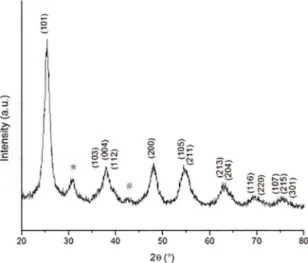
Figure 1: Typical XRD patterns of TiO2 nanoparticles synthesized
in acidic conditions, in this case the for the sample HM110-5min.
The crystallites size was estimated using the Scherrer equation30 and it was found to be close to 6.0 nm for all
materials analysed; for this purpose the most intense peak
at 2θ = 25.49 º was used, see Table S2 in the Supplementary Material. The intensity of the difraction peak is correlated
to the volume of the phase and crystallite size. For very small crystallites, the peaks are broad as can be seen in Figure 1.
No clear dependence on the particle size or its morphology was observed according with the synthesis parameters used, as observed in SEM and TEM images, Figure 2 and 3. Analyzing the images, it is possible to note that the particles are agglomerated. Aggregation is expected due to
the presence of a Ti(OH)n amorphous phase, due to the lack of a sintering step. In Figure 2, SEM images of HM110-15 and HM150-60 are presented, for other samples see Figure
S2 in the Supplementary Material.
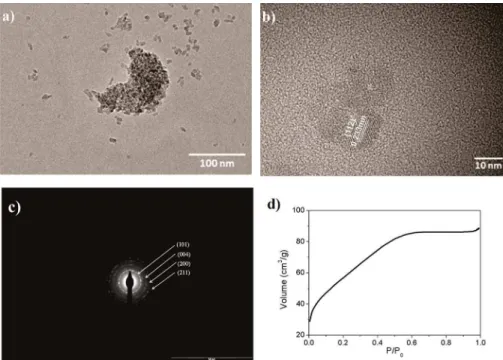
On the order hand, analyzing the TEM images, Figure 3a and 3b, it is possible to observe that the nanoparticles have
sizes between 10 and 15 nm (sample HM150-30), which was conirmed from the size distribution study, made using
Figure 2: SEM images of samples prepared at a) HM110-15 and, b) HM150-60.
Figure 3: TEM images obtained with diferent magniications (a) and (b), Electron Difraction Pattern (c)
and BET adsorption curve (d) for sample HM150-30.
Electron Difraction Pattern (SAED) in Figure 3c shows in agreement with the X-ray difraction that the samples are
predominantly crystalline. The surface area from BET for this
sample is 207 m²/g. The adsorption curve shown in Figure
3d is typical for a microporous material with relatively small external surface.31
In summary, the synthesis parameter used do not afect
the morphology, crystallite size and crystalline phase
however, they do inluence the nanoparticles synthesis yield.
For short times, 2 and 5 minutes, the yield obtained were lower than 30% even at the highest temperature. Whereas the synthesis yields at 150 °C and 30 min was 93%. For the yield determination, each reaction was repeated at least 3 times and the yields presented in Table S1 are the average values fond.
The best yields were obtained for synthesis from 30 to
60 min at 150 °C. In order to understand the diferent yields
observed and the small dependence of the nanoparticles obtained on synthesis parameters, we shall start discussing the nanoparticles synthesis reaction. The precursor solution is formed with the loss of the organic groups from TTIP and hydrolysis, which leds to the formation
of Ti(OH)x(OCHCH3)4-x species. The hydrolysis reaction
of titanium alkoxide is a fast process and dominates the
morphology and inal particle size, for that reason the
precursor solution was slowly dropped into water and kept under vigourous stirring at 80 °C when a whitish transparent solution was obtained. In the second step, the addition of
HNO3 acts as a peptizing agent forming crystallites with
low crystallinity by hydrolysis.3 In aqueous medium,
protonated surfaces of TiO6 octahedra easily combine with hydroxyl groups of other TiO6 octahedra to form Ti–O–Ti bonds by water elimination,14 resulting in amorphous
microwave heating, is responsible for the small crystallites and nanoparticles obtained as well as its aggregation. The crystalline materials formed exhibits the predominance of the anatase phase with some brookite nanoparticles formed due to the pressures inside the autoclave. Normally the simplest way to control the crystal size is by microwave synthesis
time. However, in our results there is no clear diference in
the size of the nanoparticles depending on time. The crystal growth mechanism observed is compatible to an oriented aggregation of small primary subunits.41 We observed the
highest yields for the highest temperature and times higher than 30 min. Thus, it is assumed that in this system, 30 min is the minimum synthesis time for the nucleation and growth of
the nanoparticles. For times higher than 30 min no diference
in yield is observed which can be attributed to the Ostwald ripening process, in which the particles re-dissolve after a critical time, thus the yield is basically time independent after this time.42 Notice that in microwave hydrothermal
synthesis high internal surface areas are expected,43 in our case 207 m²/g.
3.2 Alkaline medium
Similarly, the syntheses under alkaline environments
were performed in diferent conditions. The temperature
was 110, 130 and 150 °C, using 5, 15, 30 and 60 min of treatment time for the concentration of 1 and 10 M
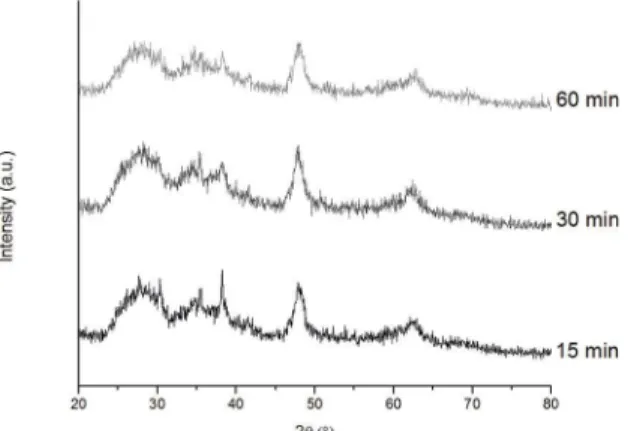
We shall start with the efect of the synthesis time in the 1M precursor solution. The XRD patterns for these samples
are presented in Figure 4 (see also Figure S4 for 110, 130 and
150 °C). The difraction patterns are similar for all the synthetic
conditions. They have shown a preferred orientation in the
direction of the peak at 2θ = 48.1 ° which can be attributed
to Na2Ti6O13 (JCPDS 73-1398).32 Analogous to the acidic system, the synthesis time did not inluence the crystalline phase and morphology. However, the time inluences the
yield of the synthesis and the optimum yield, > 90 %, was obtained after 30 min of synthesis.
The inluence of Na+ in the crystal growth was addressed using diferent NaOH concentrations during the synthesis.
In Figure 5 the XRD patterns for the powders prepared using 10 M (HMB150-30-10) and 0.1 M (HMB150-30-0.1)
Figure 4: XRD patterns for the syntheses material using 1 M NaOH
at 150 ° C, using diferent times 15, 30 and 60 min.
Figure 5: XRD patterns for the samples HMB150-30-10 and
HMB150-30-0.1.
are shown. It can be seen that the sample with the highest
concentration of NaOH follows the same difraction pattern
of the titanates, in this case Na2Ti3O7 (JCPDS 31-1329).33
The lower concentration shows the anatase phase, similarly to Figure 1. Notice that the peak of the brookite phase in
2θ = 31° is observed for the sample HMB150-30-0.1.
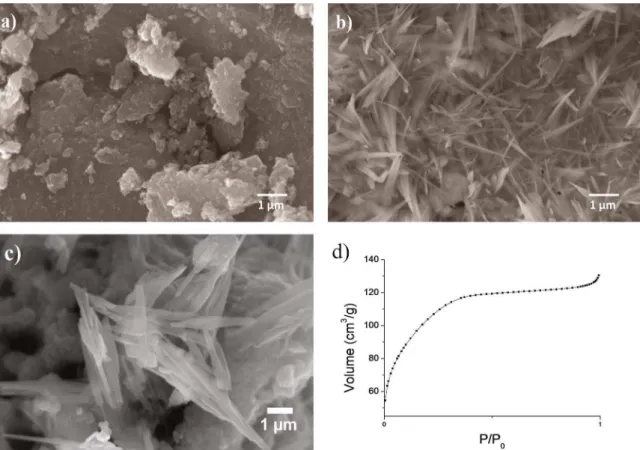
From SEM images, Figure 6, it was possible to observe
that the samples with low concentration of NaOH and the
samples synthesized in acidic medium (Figure 2 and 6a) present similar morphology and the samples synthetized
using 10 M NaOH (Figure 6b) present morphology dominated
by needle-like structures. The SEM image of the samples
HMB150-30-1(Figure 6c)presents a mixture of needle like structures and irregular spheres as observed in lower
concentrations of NaOH.
The BET adsorption curve, Figure 6d, shows a steep increase in the isotherm, followed by a plateau which indicates a microporous material with relatively small external surface. The plateauis reached as soon as the surface is completely covered.31 Due the diference on
the morphology of the nanoparticles synthetized in acid and alkaline medium, the surface area value of the sample
Figure 6: SEM images for the samples a) HMB150-30-0.1, b) HMB150-30-10, c) HMB150-30-1 and d) HMB150-30-10 BET adsorption
curve.
The SEM images of the samples synthesized at 110 °C present sphere-like aggregated that are composed
by nanosheets, observed in higher magniications, Figure
S6a and Figure S6b. The samples synthesized at 130 °C presented a mixture of nanocables and nanoparticles, and the same trend of nanosheets observed in lower temperature of treatment, Figure S6c, Figure S6d and Figure S6e. The sample synthesized at 150 °C present a mixture of needle like structures and irregular spheres as observed in lower
concentrations of NaOH, Figure S6f, Figure S6g and Figure
S6h. It is important to note that the same trend of morphologies were observed in the various temperatures, however, the samples treated at 5 min, presented the most heterogeneous and bigger nanoparticles, Figure S6g.
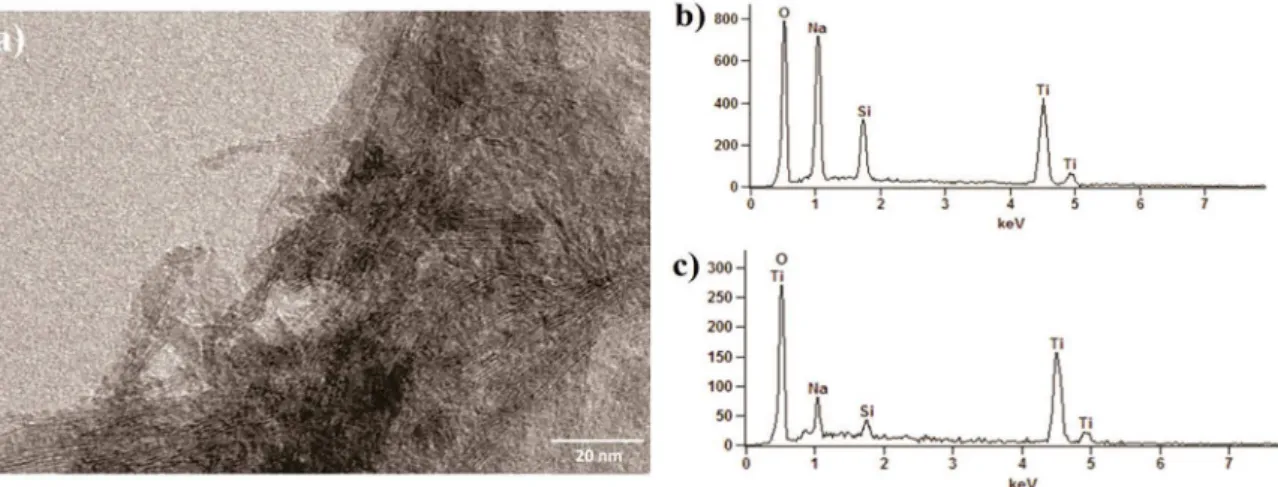
TEM image of the sample HMB150-30-10 after HCl
washing is shown in Figure 7a. It is possible to observe aggregated nanotube-like structures. Na+ ions are detected by EDX in both samples, as synthetized and after washing, as presented in Figure 7b and 7c. However, the sample
after washing, Figure 7c, has the peak attributed to Na+ ions
decreased to 0.2 of initial value, suggesting that the Na+ ions are removed by HCl washing. The peaks of Si are coming from the substrate used for the EDX measurements.
In the hydrothermal synthesis the morphology and phase formation are more related with the pressure and temperature
inside the reactor45 during the polycondensation step. The TiO 2 formation is weakly afected by the additive, HNO3 or NaOH when it is close to the neutral condition, i.e. 0.01 M HNO3 and 0.1 M NaOH,46 which explains the higher crystallinity for HMB150-30-0.1 compared to HMB150-30-10. On the other hand, at high NaOH concentrations, 1 M and 10 M, remarkable diferences were observed, needle-like titanates were synthesized, probably due to the inluence of Na+ ions
on the formation of the crystalline structure.
In the literature few works are dedicated to investigate
the inluence of acidic and alkaline environments using
TTIP as precursor on the nanoparticles formation. Zhao et al.46 have study the inluence of the NaOH and HCl on the formation of nanostructures with diferent crystalline
phase and morphologies using hydrothermal synthesis and tetrabutyl titanate as precursor. They obtained analogous materials as we did, i.e. anatase with brookite for the lowest concentrations of additives, or in conditions closest
to neutral. For high NaOH concentrations, they obtained titanate nanoribbons. The diference between our material
morphology and theirs can be attributed to the precursor used and synthesis technique. The ability of microwaves to
inluence the dissolution rate of various precursors (due to diferent dielectric properties) strongly afects the nucleation
Figure 7: a) TEM image and b) EDX for the sample HMB150-30-10 as synthetized and c) EDX for the sample HMB150-30-10 after
HCl washing.
reactions that are responsible for supplying the ‘‘monomers’’ for nucleation and growth of the inorganic nanoparticles,47
which can be related to the pronounced shape anisotropy observed in Figure 5. In this way, the reaction proposed for the formation of the needle-like structures is based on the most accepted mechanism for nanotubes formation starting from TiO2 spherical nanoparticles. Ti – O –Ti bonds are broken
by NaOH to create an intermediate containing Ti – O – Na and Ti – OH bonds,9 which grows in preferential directions.
Instead, in our case the hydrolyses of TTIP directly on the solution forms intermediates that have the format of sheets due to the interaction of the TiO layers with Na+ and H+. The
growth generates layered titanate structure with intercalated Na+ ions.46 As shown in Figure 7b and 7c, some of the
Na+ ions can be removed by HCl rinsing.13 Here, we have
obtained aggregated nanotube-like structures in 30 min of treatment using TTIP as precursor with high surface areas, of
375 m²/g.
From the point of view of applications, Dar et al.5
obtained anatase nanostructures ~ 7 nm using microwave solvothermal technique using titanium thiobenzoate complexes as precursor at 200 °C and fabricated from this materials
DSSC with eiciencies of 6.5%. Shen and coworkers, used
also TTIP as precursor, and did their synthesis at 220 °C for 30 min. They obtained anatase nanoparticles with ~ 20 nm in diameter and surface area of 152 m2/g which were used in DSSC with conversion eiciency of 7.8%.25 Thus our
results indicate that the synthesized nanoparticles with up to 375 m2/g of surface area have great potential in DSSC.
4. Conclusions
Nanostructured titanium oxide was successfully synthesized by the microwave assisted hydrothermal technique. The nanoparticles were obtained at mild conditions using low temperatures and short synthesis times, as low as 2 minutes.
The XRD patterns show that the TiO2 nanocrystals are
predominantly in the anatase crystal phase though brookite crystalites are also present. The crystallite sizes in acidic solutions have 5 to 6 nm in diameter and aggregate into particles of 15 nm. The reaction time and temperature do
not change signiicantly the structure of the material. In the presence of high concentration of NaOH the morphology
and phase are changed to titanates nanotube-like structures, obtained after 30 min of synthesis. The structures obtained, that resemble needles, have the crystalline phase of Na2Ti6O13 and Na2Ti3O7. For lower NaOH concentrations aggregated nanoparticles were obtained similar to the ones obtained
using HNO3 as peptizing agent. In both systems, high surface
areas were obtained which indicates that these materials are suited for photovoltaics or catalysis.
5. Acknowledgements
The authors would like to thank the inancial support of FAPESP (2011/02205-3), CEPID-FAPESP (2013/07296-2),
INCT, CNPq and CAPES.
6. References
1. Chen X, Mao SS. Titanium Dioxide Nanomaterials: Synthesis, Properties, Modiications, and Applications. Chemical Reviews.
2007;107(7):2891-2959. DOI: 10.1021/cr0500535.
2. Chen D, Huang F, Cheng YB, Caruso RA. Mesoporous Anatase
TiO2 Beads with High Surface Areas and Controllable Pore Sizes:
A Superior Candidate for High-Performance Dye-Sensitized
Solar Cells. Advanced Materials. 2009;21(21):2206-2210.
DOI: 10.1002/adma.200802603.
3. Ismail AA, Bahnemann DW. Mesoporous titania photocatalysts:
4. Tang H, Lévy F, Berger H, Schmid PE. Urbach tail of anatase
TiO2. Physical Review B. 1995;52 (11):7771-7774.
5. Dar MI, Chandiran AK, Grätzel M, Nazeeruddin MK, Shivashankar
SA. Controlled synthesis of TiO2 nanoparticles and nanospheres using a microwave assisted approach for their application in dye-sensitized solar cells. Journal of Materials Chemistry A.
2014;2(6):1662-1667. DOI: 10.1039/C3TA14130F.
6. Mbonyiryivuze A, Zongo S, Diallo A, Bertrand S, Minani E, Yadav LL, et al. Titanium Dioxide Nanoparticles Biosynthesis for Dye Sensitized Solar Cells application: Review. Physics and Materials Chemistry. 2015;3(1):12-17. DOI: 10.12691/
pmc-3-1-3.
7. Melcarne G, De Marco L, Carlino E, Martina F, Manca M,
Cingolani R, et al. Surfactant-free synthesis of pure anatase TiO2 nanorods suitable for dye-sensitized solar cells. Journal of Materials Chemistry. 2010;20(34):7248-7254. DOI: 10.1039/
C0JM01167C.
8. Bavykin DV, Friedrich JM, Walsh FC. Protonated Titanates and
TiO2 Nanostructured Materials: Synthesis, Properties, and Applications. Advanced Materials. 2016;18(21):2807-2824.
DOI: 10.1002/adma.200502696.
9. Liu N, Chen X, Zhang J, Schwank JW. A review on TiO2-based
nanotubes synthesized via hydrothermal method: Formation mechanism, structure modification, and photocatalytic applications. Catalysis Today. 2014;225:34-51. DOI: 10.1016/j. cattod.2013.10.090.
10. Ou HH, Lo SL. Review of titania nanotubes synthesized via the hydrothermal treatment: Fabrication, modiication, and application.
Separation and Puriication Technology. 2007;58(1):179-191.
DOI: 10.1016/j.seppur.2007.07.017.
11. Mao Y, Park TJ, Zhang F, Zhou H, Wong SS. Environmentally
Friendly Methodologies of Nanostructure Synthesis. Small.
2007;3(7):1122-1139. DOI: 10.1002/smll.200700048. 12. Kim DS, Kwak SY. The hydrothermal synthesis of mesoporous
TiO2 with high crystallinity, thermal stability, large surface area, and enhanced photocatalytic activity. Applied Catalysis A: General. 2007;323:110-118. DOI: 10.1016/j.apcata.2007.02.010.
13. Kasuga T, Hiramatsu M, Hoson A, Sekino T, Niihara K. Formation
of Titanium Oxide Nanotube. Langmuir.
1998;14(12):3160-3163. DOI: 10.1021/la9713816.
14. Jiang B, Yin H, Jiang T, Jiang Y, Feng H, Chen K, et al. Hydrothermal synthesis of rutile TiO2 nanoparticles using
hydroxyl and carboxyl group-containing organics as modiiers. Materials Chemistry and Physics. 2006;98(2-3):231-235. DOI: 10.1016/j.matchemphys.2005.09.044.
15. Nakahira A, Kubo T, Numako C. Formation Mechanism of TiO2-Derived Titanate Nanotubes Prepared by the Hydrothermal Process. Inorganic Chemistry. 2010;49(13):5845-5852. DOI:
10.1021/ic9025816.
16. Corradi AB, Bondioli F, Focher B, Ferrari AM, Grippo C,
Mariani E, et al. Conventional and Microwave-Hydrothermal
Synthesis of TiO2 Nanopowders. Journal of the American Ceramic Society. 2005;88(9):2639-2641. DOI:
10.1111/j.1551-2916.2005.00474.x.
17. Kumar R, Singh RK, Vaz AR, Moshkalev SA. Microwave-assisted synthesis and deposition of a thin ZnO layer on microwave-exfoliated graphene: optical and electrochemical evaluations. RSC Advances. 2015;5(83):67988-67995. DOI:
10.1039/C5RA09936F.
18. Kumar R, Singh RK, Singh DP, Savu R, Moshkalev SA.
Microwave heating time dependent synthesis of various dimensional graphene oxide supported hierarchical ZnO nanostructures and its photoluminescence studies. Materials & Design. 2016;111:291-300. DOI: 10.1016/j.matdes.2016.09.018.
19. Kumar R, Singh RK, Savu R, Dubey PK, Kumar P, Moshkalev
SA. Microwave-assisted synthesis of void-induced graphene-wrapped nickel oxide hybrids for supercapacitor applications.
RSC Advances. 2016;6(32):26612-26620. DOI: 10.1039/
C6RA00426A.
20. Kumar R, Singh RK, Dubey PK, Singh DP, Yadav RM. Self-Assembled Hierarchical Formation of Conjugated 3D Cobalt Oxide Nanobead–CNT–Graphene Nanostructure Using Microwaves for High-Performance Supercapacitor Electrode. ACS Applied Materials & Interfaces. 2015;7(27):15042-15051.
DOI: 10.1021/acsami.5b04336.
21.Kumar R, Dubey PK, Singh RK, Vaz AR, Moshkalev SA.
Catalyst-free synthesis of a three-dimensional nanoworm-like gallium
oxide–graphene nanosheet hybrid structure with enhanced
optical properties. RSC Advances. 2016;6(21):17669-17677.
DOI: 10.1039/C5RA24577J.
22. Manfroi DC, dos Anjos A, Cavalheiro AA, Perazolli LA,
Varela JA, Zaghete MA. Titanate nanotubes produced from microwave-assisted hydrothermal synthesis: Photocatalytic and structural properties. Ceramics International. 2014;40(9
Pt A):14483-14491. DOI: 10.1016/j.ceramint.2014.07.007.
23. Cui L, Hui KN, Hui KS, Lee SK, Zhou W, Wan ZP, et al.
Facile microwave-assisted hydrothermal synthesis of TiO2 nanotubes. Materials Letters. 2012;75:175-178. DOI: 10.1016/j. matlet.2012.02.004.
24. Wu X, Jiang QZ, Ma ZF, Fu M, Shangguan WF. Synthesis of titania nanotubes by microwave irradiation. Solid State Communications. 2005;136(9-10):513-517. DOI: 10.1016/j.
ssc.2005.09.023.
25. Shen PS, Tai YC, Chen P, Wu YC. Clean and time-efective
synthesis of anatase TiO2 nanocrystalline by microwave-assisted solvothermal method for dye-sensitized solar cells.
Journal of Power Sources. 2014;247:444-451. DOI: 10.1016/j. jpowsour.2013.08.104.
26. Pang YL, Lim S, Ong HC, Chong WT. A critical review on the
recent progress of synthesizing techniques and fabrication of TiO2-based nanotubes photocatalysts. Applied Catalysis A: General. 2014;481:127-142. DOI: 10.1016/j.apcata.2014.05.007.
27. Saponjic ZV, Dimitrijevic NM, Tiede DM, Goshe AJ, Zuo X,
Chen LX, et al. Shaping Nanometer-Scale Architecture Through Surface Chemistry. Advanced Materials. 2005;17(8):965-971.
DOI: 10.1002/adma.200401041.
28. Di Paola A, Bellardita M, Palmisano L. Brookite, the Least
Known TiO2 Photocatalyst. Catalysts. 2013;3(1):36-73. DOI:
Rb2Ti6O13 and the alkali metal titanates. Acta Crystallographica.
1962;15:194-201. DOI: 10.1107/S0365110X62000511. 33. Yang J, Li D, Wang X, Yang X, Lu L. Study on the synthesis
and ion-exchange properties of layered titanate Na2Ti3O7
powders with diferent sizes. Journal of Materials Science.
2003;38(13):2907-2911. DOI: 10.1023/a:1024401006582.
34. Brinker CJ. Hydrolysis and condensation of silicates: Efects
on structure. Journal of Non-Crystalline Solids.
1988;100(1-3):31-50. DOI: 10.1016/0022-3093(88)90005-1.
35. Yin H, Wada Y, Kitamura T, Kambe S, Murasawa S, Mori H, et al. Hydrothermal synthesis of nanosized anatase and rutile TiO2
using amorphous phase TiO2. Journal of Materials Chemistry.
2001;11(6):1694-1703. DOI: 10.1039/B008974p.
36. Wilson GJ, Will GD, Frost RL, Montgomery SA. Eicient
microwave hydrothermal preparation of nanocrystalline anatase TiO2 colloids. Journal of Materials Chemistry.
2002;12(6):1787-1791. DOI: 10.1039/B200053A.
37. Hearne GR, Zhao J, Dawe AM, Pischedda V, Maaza M, Nieuwoudt MK, et al. Efect of grain size on structural transitions in anatase
TiO2: A Raman spectroscopy study at high pressure. Physical Review B. 2004;70:134102.
38. Hazem R, Izerrouken M, Sari A, Kermadi S, Msimanga M,
Benyagoub A, et al. Radiation damage induced by swift heavy ions in TiO2 sol–gel ilms nanocrystallines. Nuclear Instruments
and Methods in Physics Research Section B: Beam Interactions with Materials and Atoms. 2013;304:16-22. DOI: 10.1016/j.
nimb.2013.03.037.
42. Wilson GJ, Matijasevich AS, Mitchell DRG, Schulz JC, Will GD. Modiication of TiO2 for Enhanced Surface Properties:
Finite Ostwald Ripening by a Microwave Hydrothermal Process. Langmuir. 2006;22(5):2016-2027. DOI: 10.1021/la052716j.
43. Chen P, Peng JD, Liao CH, Shen PS, Kuo PL. Microwave-assisted hydrothermal synthesis of TiO spheres with eicient
photovoltaic performance for dye-sensitized solar cells. Journal of Nanoparticle Research. 2013;15:1465. DOI: 10.1007/
s11051-013-1465-0.
44. Bacsa RR, Grätzel M. Rutile Formation in Hydrothermally
Crystallized Nanosized Titania. Journal of the American Ceramic Society. 1996;79(8):2185-2188. DOI:
10.1111/j.1151-2916.1996.tb08956.x.
45. Aruna ST, Tirosh S, Zaban A. Nanosize rutile titania particle synthesis via a hydrothermal method without mineralizers.
Journal of Materials Chemistry. 2000;10(10):2388-2391. DOI: 10.1039/B001718N.
46. Zhao B, Lin L, He D. Phase and morphological transitions of titania/titanate nanostructures from an acid to an alkali
hydrothermal environment. Journal of Materials Chemistry A.
2013;1(5):1659-1668. DOI: 10.1039/C2TA00755J.
47. Bilecka I, Niederberger M . Microwave chemistry for inorganic nanomaterials synthesis. Nanoscale. 2010;2(8):1358-1374.
DOI: 10.1039/B9NR00377K.
Supplementary material