
*e-mail: [email protected]
Article presented at the XV CBECIMAT, Natal - RN, November/2002
Synthesis and Preliminary Characterization of Octakis
(Chloropropyldimethylsiloxy) Octasilsesquioxane
Devaney Ribeiro do Carmoa, Newton Luiz Dias Filhob, Nelson Ramos Stradiottoa*
aUniversidade Estadual Paulista, UNESP, Instituto de Química
PO Box 355, 14801-970 Araraquara - SP, Brazil
bFaculdade de Engenharia de Ilha Solteira (UNESP), Departamento de Física e Química
Av. Brasil Centro 56, 15385-000 Ilha Solteira - SP, Brazil
Received: February 13, 2003; Revised: May 4, 2004
Octakis (hydridodimethylsiloxy) octasilsesquioxane was hydrosilated with allyl chloride us-ing Spiers catalyst (H2PtCl6). This reaction was monitored using FT-IR spectroscopy. The synthe-sized product was characterized by 13C, 29Si NMR (MAS), SEM, FT-IR, Thermogravimetric tech-niques. The three propyl groups α , β , γ , (to the terminal silicon atom), associated of an allyl chlo-ride, were clearly seen in the 13C NMR (α-CH
2 at 31.8; β-CH2 at 37.7; γ-CH2 at 50.1 ppm). In addition, the 29Si NMR spectrum of the final product, exhibits three Q signals for Q type silicon attributed to Q2 (-90.1) Q3 (-100.2) and Q4 (-111.3ppm). The presence of allyl chloride substitutes in octameric cube confers a relative porosity and thermal stability to the material.
Keywords:Octakis (chloropropyldimethylsiloxy) octasilsesquioxane, spherosiloxane
1. Introduction
Silsesquioxanes are a class of three-dimensional oligo-meric organosilane compounds from the general form ula (RSiO1.5)n where n is an even number and R can be any of a large number of groups (typically, methyl, halogen, vinyl or phenyl) which are of considerable theoretical and practi-cal interest1,3. These compounds are considerably interest-ing because the remarkable molecular architecture and the great structural variety that makes possible as the nature of the pendant group to be varied. Synthetic routes to silsesquioxane generally involve hydrolysis/condensation of trifunctional monomers RSiX32 where R is chemically stable organic substitute and X is a highly reactive substi-tute such as Cl or alkoxy, which in the presence of water with an acid or base as a catalyst agent, leads to products generically called poly(silsesquioxanes) or silsesquioxanes (SSOs). Recently, these compounds have been used as well defined molecular model for silica surfaces4,6. Unfortunately, most of the routes employ multi step procedures using large excess of silane, long reaction times and such routes only result in very low yields of the desired products.
This paper describes the utilization of new synthetic
strat-egies for the preparation of octakis
(chloropro-pyldimethylsiloxy) octasilsesquioxane that are a new
fam-ily of silsesquioxane called spherosilicates of the general formula (SinO3n/2). These compounds processing a reactive exo cage functionality which allow easy conversion into a variety of derivatives via nucleofilic substitution10 and are ideal candidates as precursor for three dimensional structure formation3,7-9. In the recent literature Provattas14 and Dittimar15 synthesized octakis (bromopropryldimethylsiloxy) octasilsesquioxane and octa (chloropropril) silsesquioxane respectively. The first author employed the new synthetic route and the second employed sol gel method (reaction of hydroly-sis of trimethoxisilane methanol/HCl media), however, curi-ously there is no literature about Octakis (chloropropryldimethylsiloxy) octasilsesquioxane synthesis employing both routes. The new synthetic route strategy, employed in this work has not only drastically reduced re-action times and the number of steps involved, but it also has considerably improved the product yield.
was the preparation of octakis (hydridodimethylsiloxy) octasilsesquioxane and subsequent hydrosilylation with al-lyl chloride following its usual preliminary characterization. This material synthesized in this way serves as precursor for a series of others composites by means of substitution reactions. In this context, our interest in silsesquioxanes is the development of this type of material for electroanalytical application.
2. Material and Methods
2.1.Reagents
Allyl chloride, hexachloroplatinic acid, and H2PtCl6 were obtained from Aldrich. Others reagents and solvents were of analytical grade (Merck) and were used as purchased.
2.2. Synthesis
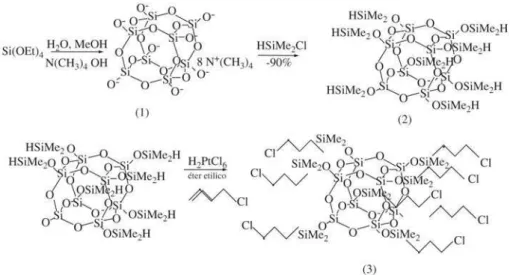
Octakis (hydridodimethylsiloxy) octasilsesquioxane (2) was synthesized in a two-step reaction, by following approxi-mately the literature11.The Fig. 1 shows a scheme for the syn-thesis of these composites.
2.2.1. Tetrametilammonium silicate “Octanion” (1)
A solution of tetramethylammonium silicate was prepared by adding 1000 mL (9.5 mol) of tetramethylammonium hy-droxide in methanol (25%) and 364 mL (20.2 mol) of dis-tilled water to 506 ml (2.26 mol) of tetraethoxysilicate. The resulting colorless solution was maintained over stirring for 24 h. at room temperature.
2.2.2. Octakis (hydridodimethylsiloxy) octasilsesquioxane “Cubes” (2)
Tetramethylammonium silicate (1000 mL) was dropped
wise to a mixture of chlorodimethylsilane 436.0 (4.0 mol) and Hexane (2600 mL) under a slow continuous nitrogen purge. The mixture was stirring for 4 h. The two phases formed were separated. The hexane phase was dried with Na2SO4, filtered and the solvent (hexane) was removed in vacuum to give a white solid. This solid was washed with methanol and the residual methanol was removed in vacuum, and the solid resultant was dried at 80 °C for 4 h.
2.2.3. Octakis (chloropropyldimethylsiloxy) octasilsesquioxane (3)
The hydrosilylation was accomplished by a step process as shown in Scheme 1.To a stirred solution of (2) ( 3.3 g, 9.7 mmol) in anhydrous diethyl ether (15 mL) and three drops of 1% solution of H2PtCl6 (Spiers catalyst) in dimethylformamide was slowly added allyl chloride (5.97g, 0.078 mol) via a sy-ringe over a period of 6 h.
The mixture was allowed to reflux over 32 h. The mix-ture was cooled, filtered through a celite bed, washed with methanol and dried in vacuum to give a white solid (yield 48.3%). Residual allyl chloride and organic solvent were re-moved first under N2 stream, and then under vacuum. 2.3. Techniques
2.3.1. Fourier transform infrared spectra
Fourier transform infrared spectra were recorded on a Nicolet 5DXB FT-IR 300 spectrometer. About 600 mg of KBr was ground in a mortar with a pestle, and enough solid sample was ground with KBr to make a 1wt. (%) mixture for making KBr pellets. After the sample was loaded, the sam-ple chamber was purged with nitrogen for a minimum of 10 min. before data collecting. A minimum of 32 scans was col-lected for each sample at a resolution of ±4 cm-1.
2.3.2. Nuclear Magnetic Ressonance analyses (NMR)
All solid state analyses of 29Si (59.5 MHz) and 13C-NMR (75.4 MHz) were recorded on a Varian INOVA 300 spectrometer. The samples were packed in zirconia rotors and spun at the magic angle at 4500Hz, a relaxation delay of 10.0 and 6.0 s for 29Si and 13C respectively. All chemical shifts are reported in parts per million ppm (δ) with+ reference to exter-nal tetramethylsilane (TMS).
2.3.3. Microscopy
The scanning electronic microscopy of the materials were obtained using JEOL JSM T-300 microscope.The samples were adhered over aluminum holders and covered with a thin layer (20 –30 nm) of gold in Sputter Coater Bal-Tec SCD-050.
2.3.4. Thermal analyses
The Thermogravimetry was performed with a Mettler 181 thermoanalyser. The samples (5-10 mg) were placed in plati-num samples holders. The runs were performed under nitro-gen stream (50 ml/min) under still air. The samples were heated at a ramp of 10 °C/min to the final temperature of 1000 °C.
3. Results and Discussion
The identity of 2 ( Fig. 1) was confirmed on the basis of the infrared spectrum and NMR solid state 13C and 29Si data, which provided consistent data near to the assigned structure reported in literature4,9,11. A sharp, strong, and assymmetric Si-O-Si stretching peak [ns(Si-O)] at 1100 cm-1 typical of silsesquioxane cages was presented in all spectra and was used as an internal
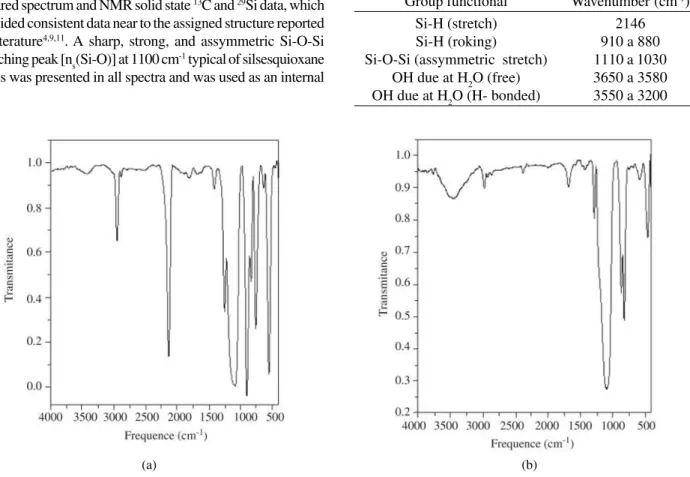
reference. The consistent presence of this peak demonstrates that the initial structure is maintained during hydrosililation process. If the cube structure was degraded, one would ob-serve a transformation to asymmetric broad peaks more typi-cal of silica. Therefore, in agreement to the previously exposed, the 1140-1080 cm-1 region is characteristic of strong assymmetric Si-O-Si stretches in cubic architectures. Other bands can be assigned asSi-H stretching (2146 cm-1),Si-H rocking (910-880 cm-1) and silsesquioxane skeletal deforma-tion vibradeforma-tions (580-560 cm-1). The main infrared absorption characteristic behavior of silsesquioxanes is summarized in Table 1. In Table 1, the selected vibrational frequencies ex-pected for silsesquioxanes groups, are listed and ascribed12.
In the hydrosilylation of cubes, the infrared spectroscopy was used, because it indicates the progress of the reaction by monitoring the loss of Si-H absorption at 2146 cm-1 (see Fig. 2a). The Fig. 2b has shown the total absence of the Si-H absorption band in IR spectrum at 2146 cm-1confirmed the completeness of the hydrosililation reaction.
In order to better elucidate the siloxane chemistry4, the symbols M, D, T, Q represent R3SiO1/2, R2SiO2/2, RSiO3/2,
Figure 2. Infrared for composites: a) Cubes; b) octakis (chloropropyldimethylsiloxy) octasilsesquioxane.
Table 1. Selected vibration frequencies for cubes.
Group functional Wavenumber (cm-1)
Si-H (stretch) 2146
Si-H (roking) 910 a 880
Si-O-Si (assymmetric stretch) 1110 a 1030
OH due at H2O (free) 3650 a 3580
OH due at H2O (H- bonded) 3550 a 3200
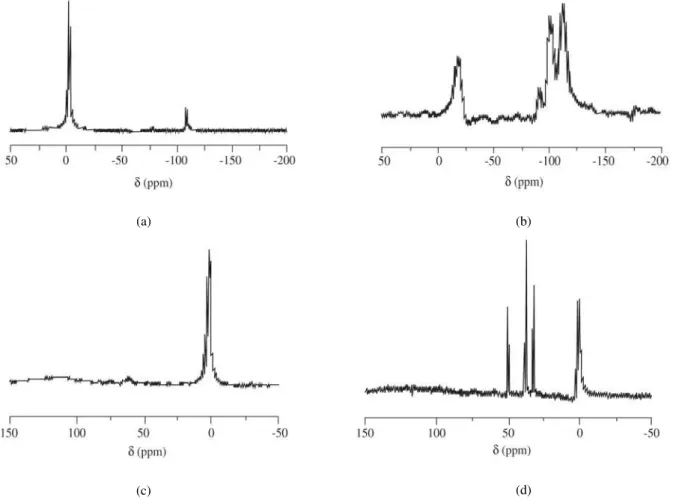
SiO4/2 units respectively. Superscripts are used to designate functional groups on the silicon. Final characterization was accomplished by 13C and 29Si NMR. According to the FT-IR spectroscopy, the corresponding Si-H resonance in the29Si-NMR spectrum at - 3.0 ppm Fig. 3a disappears (Fig. 3b). The three propryl groups α , β , γ (to the terminal silicon atom), associated to an allyl chloride, absent in cubes (Fig. 3c) were clearly seen in the 13C NMR (α-CH
2 at 31.8; β-CH2 at 37.7 ; γ-CH2 at 50.1 ppm) (see Fig.3d).
Most hydrosilylations produce two products (-SiCH(CH3)CH2-, 10-20%) and -Si(CH2)3-, 80-90%). Bassindale and Gentle13 have reported that vinyl/ H exchange on the silicon atom may possibly be occurring. Such vinyl/ H exchange will form an additional product, which would be an octopus dimmer, in which two silsesquioxane cores are jointed by ethylene linkage bridging the two cores to-gether. In this study this idea is not supported by 29Si NMR due to the presence of D type silicon in the product9 at -18.4 ppm. Interestingly Hasegawa9 verified the presence of D sites type as subproduct of dimerization of octanion precur-sor, but in this study the D sites type can be associated with
sub-product formed of hydrolysis reaction of Si-H bonding (in 2). This fact is in agreement with appreciable amount of this species exibhit by 29Si NMR. The 29Si NMR spectrum of the final product, exhibits three Q signals for Q type sili-con attributed at Q2 (-90.1), Q3 (-100.2) and Q4 (- 111.3ppm) (Fig. 3b). The existence of these signals (Q2 and Q3) beyond the last one (Q4) means that an appreciable amount of this sub-product with open structure exists.
This assumption has led us to tentatively attribute the peak at - 90.1 and - 100.2 ppm to SiO2/2 (OH)2 and SiO3/2OH groups respectively.
Differently of analogous composite synthesized by Provattas14 no evidence by NMR spectroscopy was observed for M type silicon M(CH2)3Cl. Instead, Dittimar15 have not reported in the synthesis of octa (chloropropyl) octasilsesquioxane this M type silicon, but a signal at - 60 ppm was reported.
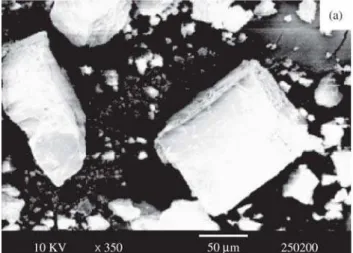
Scanning Electronic Microscopy (SEM) measurements were performed in order to see whether the heat treatment of the cubes changes the surface.
Examination of the octacube and octakis
(chloropropyl-Figure 3.29Si NMR solide state for : a) cubes; b) octakis (chloropropyldimethylsiloxy) octasilsesquioxane; c) 13C NMR solide state for:
cubes; d) octakis (chloropropyldimethylsiloxy) octasilsesquioxane.
(a) (b)
Figure 4. Scanning electron micrograph of: a) cubes, × 350; b) cubes, × 5000; c) octakis (chloropropyldimethylsiloxy) octasilsesquioxane × 5000.
dimethylsiloxy) octasilsesquioxane with scanning electronic microcopy revealed that the material precursor (cubes) is formed from aggregates of cubic particles highly porous (see Fig. 4a and 4b). After reaction with allyl chloride, a new scanning electronic microcopy exhibits the disappear-ance of the majority of pores (Fig. 4c).
The thermogravimetric analysis, TG, for all the com-posites were obtained in both nitrogen and synthetic air at-mospheres. The TG curves for cubes, under synthetic air (Fig. 5a) shows that the compound is anhydrous. The first mass loss step between 172.3 and 280.6 °C (24.47%) may be due to the loss of counter ion with an exothermic peak at 250.5 °C. The mass loss between 281.2 and 824.3 °C (8.41%) can be ascribed to the decomposition of the residual Si-CH3 groups, and octanion cage corresponding to the exothermic peak at 429.8 °C with SiO2 formation as oxide residue at 1200 °C. Under nitrogen atmosphere (Fig. 5a), the cubes partially sublime7 (95.70%) between 187.7 and 280.1°C without marked decomposition showing an endothermic peak at 264.1°C and a carbonaceous residue at 350.0 °C.
The Fig. 5b, shows the behavior of [(ClCH2CH2CH2Me2 -SiO)SiO1.5]8, studied with termogravimetric analysis under nitrogen and synthetic air atmospheres.
Under inert and air atmospheres the decomposition starts at about 84°C and beyond 800 °C a leveling of weight loss is observed.
Three weight losses recorded up to the end were veri-fied for both atmospheres. The first weight loss was of 5% ascribed to the residual water. The second weight loss (4.8%) starts at 135 °C ascribed to the residual organic compounds included in the products decomposition. The third decompo-sition, which starts at 402 °C with weight loss of 9.2% was ascribed to the decomposition of residual Si-CH3. The total of weight losses recorded up to the end of these decomposi-tions were 18%.
As shown in Fig. 5b, the composite is more stable in ni-trogen than air, which is similar as the analogue thermal deg-radation behavior16. Under nitrogen, the thermal cleavage of C-Si and C-C bonds result from allyl chain reaction is more stable even at higher temperature or just decomposes very slowly17, as a result the residue (SiO
2 mainly) is higher. Nev-ertheless, under air, both the thermal cleavage and oxidizing of Si-R (R = (CH2)3Cl) is influenced by air oxygen and resi-due is lower.
4. Conclusion
cube, as monomer or dimmer confers a relative thermal sta-bility to the material. The material could be employed as start-ing reagent for synthesis of hybrid compounds.
Acknowledgement
Financial support for this research was supplied by Fundação de Amparo à Pesquisa do Estado de São Paulo (FAPESP) (Proc. 01/04494-0).
References
1. Baney, R.H.; Itoh, M.; Sakakibara, A.; Suzuki, T. Chem. Rev., v. 95, p. 1409-1430 1995.
2. Voronkov, M.G.; Lavrentyev, V.L. Top. Curr. Chem., v. 102, p. 199-236, 1982.
3. Zhang, C.; Laine, R.M. J. Organomet. Chem., v. 521, 189-201, 1996.
4. Provatas, A.; Matisons, J.G. Trends. Polym. Sci., p. 327-332, 1997.
5. Feher, F.J.; Newman, D.A.; Walzer J.F. J. Am. Chem. Soc., v. 111, p. 1741-1748, 1989.
6. Kadama, K.; Sugimura, M.; Yuda H. Japanese Patent, n. 6, v. 271 p. 771.
7. Harrison, P.G. J. Organomet. Chem., v. 542, p. 141-183, 1997.
8. Hasegawa, I.; Motojima, S. J. Organomet. Chem., v. 441,
Figure 5. a) TG curves for cubes; b) [(ClCH2CH2CH2Me2-SiO)SiO1.5]8,under atmospheres: synthetic air (___________) and nitrogen (……….….).
(a) (b)
p. 373-380, 1992.
9. Hasegawa, I. Trends in Organometallic Chemistry, v. 1, p. 131-142,1994.
10. Lucke S.; K- Langner, K. Applied Surface Science, v. 144, p. 713- 715, 1999.
11. Laine, R.M.; Asuncion, M.; Baliat, S.N.; Dias Filho N.L.; Harcup J.; Sutorik, A.C.; Viculis, L.; Yee, A.F.; Zhang, C.; Zhu, Q. “Organic/Inorganic Molecular Hy-brid Materials From Cubic Silsesquioxanes,” in Or-ganic/Inorganic Hybrid Materials, MRS Symp. Ser., Klein, L., De Guire, M.; Lorraine,F.; Mark, J. v. 576, 2000.
12. Denq, B.L.; Hu, Y.; Chen, I.; Chiu, W.; Wu, T. J. Appl. Polym. Sci., v. 74, p. 229-237, 1999.
13. Bassindale, A.R.; Gentle,T. J. Organomet. Chem,. v. 521, p. 391-393, 1996.
14. Provatas, A.; Luft, M.; Mu, J.C.; White, A.L.; Matisons, J.G.; Skelton, B.W. J. Organomet. Chem., v. 565, p. 159-164, 1998.
15. Dittmar, U.; Hendan, B.J.; Florke, U.; Marsmann, H.C. J.Organomet.Chem., v. 489, p. 185-194, 1995. 16. Morán M.; C.M. Casado, I. Cuadrado, Organomettalics,
v. 12, p. 4327-4333,1993.
![Figure 5. a) TG curves for cubes; b) [(ClCH 2 CH 2 CH 2 Me 2 -SiO)SiO 1.5 ] 8 ,under atmospheres: synthetic air ( ___________ ) and nitrogen ( ……….…](https://thumb-eu.123doks.com/thumbv2/123dok_br/18876308.421501/6.892.98.803.138.364/figure-curves-cubes-clch-sio-atmospheres-synthetic-nitrogen.webp)
