Detection of Ultra High-Energy Tau-Neutrinos with Fluorescence Detectors
C. A. Moura Jr. and M. M. Guzzo Instituto de F´ısica “Gleb Wataghin” - UNICAMP
13083-970 Campinas SP, Brazil
Received on 6 January, 2007
We calculate the possible number of Extensive Air Showers originated by tau neutrinos in Fluorescence Detectors like the ones of the Pierre Auger Observatory. We consider models of production of electron and muon neutrinos in extra galactic objects and Topological Defects, as well as the possibility of neutrino flavor change in the propagation of the neutrinos between the source and the Earth. The neutrino cross section was calculated by the extrapolation of the standard model parton distribution functions until energies of the order of 1021eV. However, due to uncertainties in the extrapolation for energies higher than 1012 eV the results are not robust. We conclude that, depending on the relation between flux and cross section, there is a strict range of energy for the tau neutrinos to generate double extensive air showers detectable in Fluorescence Detectors. The tau neutrino energy must be approximately 1018eV and the event rate can vary some orders of magnitude around one event per year, depending on the flux-cross section relation and detector characteristics.
Keywords: Neutrinos; Air showers; Pierre Auger Observatory
I. INTRODUCTION
It is believed that ultra-high energy (UHE) cosmic neutri-nos may play an important role to explain the origin of cos-mic rays with energies beyond the GZK limit of about 5× 10¹⁹eV [1, 2], given that neutrinos hardly interact with cos-mic cos-microwave background or intergalactic magnetic fields, keeping their original energy and direction of propagation for very long distances. Even if they have masses or magnetic moments, or travel distances of the order of the visible uni-verse, those characteristics do not change very much. Possible sources of these UHE neutrinos, like Active Galactic Nuclei and Gamma Ray Bursts, are typically located at thousands of Mpc [3, 4].
Considering that neutrinos come from pions produced via the processγ+p→N+π[4], that there is an additionalνe
flux due to escaping neutrons and that about 10% of the neu-trino flux is due to prompt decays, the proportionality of dif-ferent neutrino flavors at the source results: νe:νµ:ντ= 0.6 : 1.0 :<0.01 [5]. Nevertheless, observation of solar [6] and atmospheric [7] neutrinos present compelling evidence of neutrino flavor oscillations. Such oscillations have been independently confirmed by terrestrial experiments. Kam-LAND [8] observed ¯νe disappearance confirming (assuming
CPT invariance) what has been seen in solar neutrino detec-tions and K2K [9, 10] observedνµ/ν¯µconversion
compati-ble with what has been detected through atmospheric neu-trino observations. When neuneu-trino flavor oscillations are taken into consideration the flavor proportion will be modified to νe:νµ:ντ∼1 : 1 : 1 [11]. Therefore one expects a consider-able number ofντ’s arriving at the Earth.
We investigate the possibility of detecting UHE cosmicντ by means of a process in which a double Extensive Air Shower (EAS) is identified, the so-called Double-Bang (DB) Phenom-enon. In that kind of event a ντ interacts with a quark via charged current creating one cascade of hadronic particles and a tau lepton which subsequently decays producing a second cascade. DB Phenomenon was first proposed for detectors in
which the neutrino energy should be around 1 PeV [5]. It does not happen with neutrinos different fromντ. While the electron generated by anνeinteracts immediately after being
created, the muon generated by aνµ travels a much longer
distance than the size of the detector before interacting or even decaying. In fact, a muon with energy of the order of 1 EeV will lose 36% of its initial energy after having crossed 36000 g/cm2in iron [12]. So we do not expect to have DB events from them.
In order to identify a DB Phenomenon in the atmosphere, an optical detector must be used to probe the longitudinal de-velopment of EAS’s, recording the light emitted by the ex-cited nitrogen molecules of the Earth’s atmosphere when the EAS passes through it. A DB is triggered when two EAS’s come from the same direction inside the field of view (f.o.v.) of the detector, i.e., in the physical space around the detec-tor in which an event can be observed. We conclude that the features of optical detectors like the Fluorescence Detectors (FD’s) used by the Pierre Auger Observatory [13] favor the observation of DB events withντenergies around 3 EeV. The estimated number of DB events to be observed in these FD’s varies from a hundred in a year to few events in hundreds of years depending mainly on the assumed primaryντ flux and cross section.
II. THE ULTRA-HIGH ENERGY DOUBLE-BANG
Studying the characteristics of FD’s such as their efficiency and f.o.v., and the characteristics of the DB events generated by UHEντ’s, one can estimate the rate of this kind of event expected in that kind of detector.
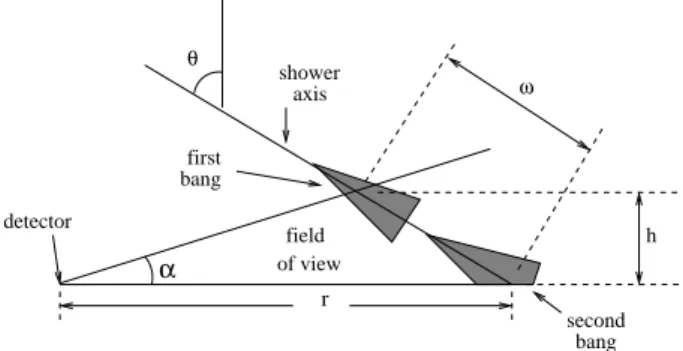
horizontal (α≃2o) andα≃30o, and a maximum radiusrof approximately 30 km. The approximate maximal height from where the DB can be triggered by the FD is h andω is its projection along the DB propagation axis. The zenith angle is represented byθ.
ω
h
θ
first
second axis
bang
bang detector
shower
field of view
r
α
FIG. 1: A schematic view of a Double-Bang and the f.o.v. of the Fluorescence Detector. See text in Section II for details.
The total amount of light emitted by the first EAS is re-lated to the energy transfered to the quark at the moment of the firstντinteraction, which we define asE1. The neutrino energy Eν is divided into the tau energy Eτ and E1, i. e., Eν=E1+Eτ. For charged current interactions above 0.1 EeV, approximately 20% of the neutrino energy is transfered to the quark [14] and in our calculations we considered it constant. The second EAS, resulting from the tau decay, carries an en-ergyE2of approximately 2/3Eτand may be specially visible when the tau decay is hadronic, which happens with a branch-ing ratio of around 63% [15]. Therefore, very roughly, we havehE1i ∼1/5EνandhE2i ∼2/3hEτi ≈8/15Eνand the re-lation betweenE1andE2is given by: E2/E1∼158Eν/15Eν≈ 2.67. The distance traveled by the tau before decaying in laboratory frame isL=γctτ, whereγ=Eτ/mτ andtτis the tau mean lifetime, which is presented in Ref. [15] with an error of approximately 0.4%. Therefore, L≃ Eτ
[EeV]×49 km
≃ Eν
[EeV]×39.2 km.
Now we compare the tau decay length with its attenuation length in the Earth’s atmosphere. The energy loss had been calculated [16] including bremsstrahlung, e+e− par produc-tion and deep inelastic scattering based on a model of the form −dE/dx=a+b(E)E where a is the ionization en-ergy loss andb is the sum of the other contributions due to radiative processes. The second term is dominant above a few 100 GeV. So we obtain an attenuation length for the tau in the atmosphereLa= (ρ
∑
i
bi)−1≃33600 km wherebb=
0.08×10⁻⁷,b
pp=1.4×10⁻⁷andbdis=1.0×10⁻⁷g−1cm2
from bremsstrahlung, pair production and deep inelastic scat-tering contributions respectively, andρ=1.2×10⁻³g cm−3. Therefore, the attenuation length (La) is much longer than the
decay length (L) and we do not consider energy loss for the tau propagation.
III. EVENT RATE
To calculate the possible number of events in a FD, we con-sider, for simplicity, one Pierre Auger-like FD with a f.o.v. of 360o. We can write the equation for the DB event rate:
dNevents
dt =
Z ∞
Eth
dEνΦν(Eν)
A
(Eν) (1)whereEthis the minimum detectable energy according to the
efficiency of the FD,Eν is the ντ energy, Φν is the flux of UHEντat the Earth (which depends on the model of the extra galactic source of high-energy cosmic rays considering maxi-mal mixing), and
A
(Eν) = ZΩ,A
dΩdA Pint(Eν,θ)Ftrig(Eτ,r,θ)Σ(E1,r) (2) is the acceptance. Ω andA are the solid angle covered by the detector and the area under the f.o.v. of the detector re-spectively. Pint(Eν,θ) is the probability of the ντ to inter-act in a given point of the atmosphere,Ftrig(Eτ,r,θ)indicates the probability of triggering a DB signal andΣ(E1,r)is the efficiency of the FD. We considered only showers moving away from the detector since, otherwise, a large amount of
ˇ
Cerenkov light comes with the fluorescence light, spoiling the data analysis [17].
The interaction probability is given approximately by:
Pint(Eν,θ) =σCCνN(Eν)NT(χ), (3)
whereσνN
CC(Eν)is the average charged current cross section
of the neutrino-nucleon interaction andNT(χ)is the average
total number of nucleons per squared centimeter at the inter-action point in the atmosphere. NT(χ) =2NAχ(θ), whereNA
is the Avogadro’s number andχ(θ)is the slant depth of the atmosphere within the points where the neutrino must interact to generate a DB event inside the f.o.v. of the FD.
Considering the Earth’s curvature, the atmospheric slant depth can be approximately written as:
χ(θ,l) =
Z
λρ(
H=lcosθ+(lsinθ)
2
2R )dλ, (4) whereλis the path along the arrival direction from the source until the interaction point in the atmosphere, ρ is the at-mospheric density,Hthe vertical height,lis the distance be-tween the interaction point and the ground, along the axis of the EAS (the slant height), andθ, the zenith angle.
probably will reach the ground before its maximal develop-ment. To calculate the number of events presented in Sec-tion IV we consider the first interacSec-tion occurring in a point within 50 km and 30 km faraway from the detector.
As the cross section of UHE neutrinos is unknown, usually one adopts the extrapolation of parton distribution functions and Standard Model (SM) parameters far beyond the reach of experimental data. In this way, one can estimate a value for the cross section of the neutrino-nucleon interaction of about 10−32cm2, for energies around 1 EeV. Some authors say that this extrapolation gives a too high neutrino-nucleon cross sec-tion [18] but others use models that increase this same cross section to typical hadronic cross section values [19]. In this work we use the following cross section parametrization:
σνN
CC= (5.53+5.52)×10−36
µ E
ν [GeV]
¶0.363
cm2, (5)
which is the SM extrapolation for the neutrinos plus anti-neutrinos and nuclei cross section in charged current inter-actions , which have 10% accuracy within the energy range 10−2<E(EeV)<103when compared with the results of the CTEQ4-DIS parton distributions [20].
We define the trigger factor as:
Ftrig(Eτ,r,θ) =PhadPL ω(r,θ)
L(Eτ) (6)
where Phad is the hadronic branching ratio of tau decay
(Phad≃0.63 [15]),PLis the mean percentage of taus that
de-cay within their dede-cay length in laboratory frameL(Eτ)and ω(r,θ), as can be seen in Fig. 1, is the approximate size of the shower axis inside the f.o.v. of the detector where the verti-cal plane containing the shower axis passes through the cen-ter of the FD. In Eq. 6, we are imposingω(r,θ)/L(Eτ) =1 if ω(r,θ)>L(Eτ) so that we have a conservative estima-tion of the trigger factor. Since we are using a fixed value of the decay length L(Eτ) for a given energy, correspond-ing to the length traveled by the tau in one lifetime, we find PL=1−e−1≃0.63, because it is expected that a fraction 1/e
of the taus do not decay within the lengthL. The efficiency of the FD was estimated as:
Σ(E1,r) =ϒ Σ′(E1)Σ′′(r) (7) whereϒ is the fraction of the time the fluorescence detector operates (ϒ≃0.1 because the fluorescence detector can only operate in clear moonless nights),Σ′(E
1)is the efficiency de-pending on the energy of the first EAS of the DB Phenom-enon, that is less energetic than the second one, andΣ′′(r)is the efficiency depending on the distance from the FD to the EAS core where it reaches the ground. Σ′(E
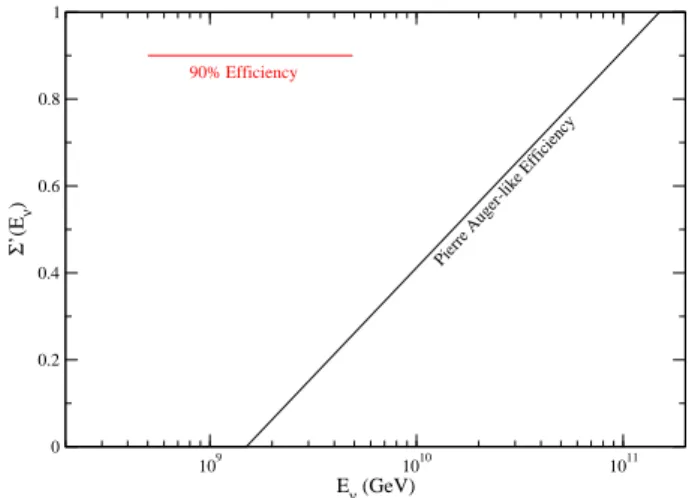
1)andΣ′′(r) de-pend on the characteristics of each detector. ForΣ′′(r)we used a Gaussian distribution centered atr=12.5 km faraway from the detector and variance of 5.0 km. We analyze twoΣ′(E1) cases. For the first one we considerΣ′(E1)rising logarithmi-cally from 0 to 1 in the energy range between approximately 0.3 EeV <E1< 30 EeV. This situation is consistent with the characteristics of a Pierre Auger-like FD. In the second case
we consider 90% efficiency (Σ′(E
1) =0.9) for neutrino ener-gies between 0.5 and 5 EeV. The behavior ofΣ′(E
1)can be seen in Fig. 2 in terms ofEνfor both cases presented above.
109 1010 1011
Eν (GeV)
0 0.2 0.4 0.6 0.8 1
Σ
’(E
ν
)
90% Efficiency
Pierre Auger-like Efficiency
FIG. 2: Efficiency as a function of the neutrino energy. The Pierre Auger-like efficiency was used to calculate the event rate shown in columnsN1,N2andN3of Table I, and the 90% efficiency was used to calculate the number of events for two FD’s with 60of.o.v. shown in the last column of Table I.
IV. RESULTS
Using Eq. 1 with all the phenomenological considerations given above, we calculate the expected DB event rate which can be seen in Table I for different models and limits of UHE cosmic ray flux, and in different energy intervals. The last column of Table I shows the event rate in a hypothetical case with 90% efficiency in the more relevant energy range for DB events (0.5 EeV<Eν<5 EeV), using 2 FD’s withα=60o (see Fig. 1).
From Table I one can learn which is the energy interval which is relevant to detect DB events with a Pierre Auger-like FD. The models WB [24] and MPR [25] are limits for the UHE neutrino flux based on cosmic ray observation. Both consider the neutrinos coming from the interactions of protons and photons in the sources generating pions that will decay into muons, electrons and neutrinos. The basic difference is that the authors of the WB limit state that the sources are com-pletely transparent to the protons and on the other hand the authors of MPR limit say that the sources might have some opacity to the protons that generate neutrinos in the interac-tions with the ambient light in the source. So there could be some neutrino flux that arrive at the earth but it might not be associated with the cosmic ray flux observation. A reason-able flux model might predict an event rate between these two limits.
TABLE I: Number of events in the Pierre Auger-like FD during a period of one year, calculated in different regions of the energy spec-trum and for different models and limits of cosmic ray flux. The last column was calculated with different considerations on the FD characteristics. See text for details. TD-92 stands for the model in reference [21]; TD-96 for the model in reference [22]; AGN-95J for the model in [23]; WB for [24] and MPR for [25].
Models N1a N2b N3c N4d
TD-92(0) 1.83 0.46 0.03 118
TD-92(0.5) 0.03 0.01 0.001 1.46 MPR 0.005 9.0×10⁻⁴ 3.7×10⁻⁵ 0.48 TD-92(1.0) 0.004 0.002 3.2×10⁻⁴ 0.093 TD-92(1.5) 0.002 7.1×10⁻⁴ 1.3×10⁻⁴ 0.037 AGN-95J 6.1×10⁻⁴ 1.1×10⁻⁴ 4.7×10⁻⁶ 0.060 WB 1.1×10⁻⁴ 2.0×10⁻⁵ 8.4×10⁻⁷ 0.011 TD-96 4.7×10⁻⁸ 4.8×10⁻⁹ 8.3×10⁻¹¹ 9.0×10⁻⁶
aE
ν>1.0 EeV
bE
ν>10 EeV
cE
ν>100 EeV
dTwo FD’s withα=60oand 90% efficiency for energies 0.5 EeV<E
ν<5
EeV.
0 15 30 45 60 75 90
θ (deg)
0 40 80 120 160
Acc. (
θ
)
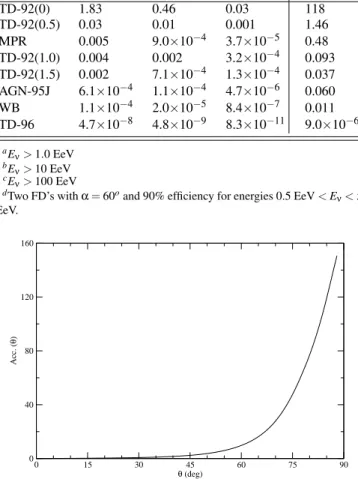
FIG. 3: Dependence of the acceptance with the zenith angle. The energy and vertical axis scale are arbitrary.
V. BACKGROUND EVENTS
We consider here the possibility of a particle of the cosmic radiation to masquerade a DB event depending on the accu-racy of the detector. The probability of a proton, for exam-ple, to generate two EAS’s and masquerade the DB gener-ated by a neutrino depends mainly on two possibilities: 1) the primary proton interaction generates some fragment that will give rise to a secondary shower deep in the atmosphere with energy higher than the first one. 2) another shower created by some independent particle interacts deep in the atmosphere masquerading the second EAS of the DB.
In the possibility 1, the second EAS will be created by the decay or interaction of the fragment deep in the atmosphere. Usually the primary proton generating an EAS loses roughly half of its energy to the secondary particles that constitute the
EAS and therefore it is unlikely that a second EAS has more energy than the first one. There may be some cases where the proton loses only a few amount of its initial energy to the EAS and that a high-energy fragment created by the proton decays or interacts creating a second EAS with energy higher than the first one. It could generate a possible background for DB events with angles between 60oand 70o, so it has to be carefully studied. Now, taking into account that for energies of the order of 1 EeV we have a cosmic ray flux of less than 1 particle per km2 per year and that the only particles that could probably interact deep in the atmosphere are neutrinos, generating the second independent EAS near the detector, the chance that the primary particle and this second independent neutrino come from the same solid angle direction, in a time interval of the tau mean lifetime in the laboratory frame of γtτ≈131×[EeV]Eτ µs is approximately 1 in 10
12, which ex-cludes the possibility 2. The direction of the two EAS’s can be identified specially if two FD’s trigger the same DB event (with only one detector, it is difficult to know the direction of the EAS in the plane that contains the EAS and the detector).
Based on these assumptions,E2/E1may be a good para-meter to identify DB events if the measured energies from the two EAS’s are accurate enough. The error in the energy mea-sured by a FD depends mainly on the atmospheric conditions but hardly will exceed 50%. One can be optimistic when try-ing to identify a DB because the relation between the energies of the two EAS’s is more important than the absolute energy of each EAS. We can make a conservative estimation of the error in the average ratioE2/E1considering the error in the absolute energy of 50%. This will give a relative error to the energy ratio of 70%. Even considering such an error the en-ergy ratioE2/E1>1 cover all the events withE2/E1≈2.67, the energy relation expected for DB events as deduced in Sec-tion II. ThenE2/E1>1 could be one minimal condition to identify DB events.
Finally, we have to mention that low energyντ’s will gen-erate taus which decay before the complete development of what would be the first EAS. In such a situation the so called DB event looks like a single EAS generated by a proton. We estimate that events withEEAS∼0.1 EeV can fall into this
possibility and have to be studied carefully.
VI. CONCLUSION
Taking into consideration neutrino oscillations, one expects that one third of the high-energy neutrino flux arriving at the Earth should be composed ofντ’s. These neutrinos can inter-act in the Earth’s atmosphere generating a DB event. Many recent papers [16, 26–30] analyze the potential of the Pierre Auger Observatory and other experiments to detect almost horizontal air showers generated by UHE neutrinos. We in-vestigate the potential of a Pierre Auger-like FD to observe DB events.
For the Pierre Auger-like efficiency case, only the topologi-cal defect model TD-92(0) predicts a significant number of DB events, of 1.83 per year for neutrino energy bigger than 1 EeV. On the other hand, assuming the very feasible config-uration with 2 FD’s and 90% efficiency for neutrino energies between 0.5 and 5 EeV, models like TD-92(0), TD-92(0.5) and also MPR limit can be tested predicting, respectively, 118, 1.46 and 0.48 events per year.
DB events have very particular characteristics. Different from the neutrino events in surface detectors, DB events do not need to come from the very near-horizontal angles. De-spite the low probability of interacting at the top of the at-mosphere, we can also haveντ’s creating DB events with inci-dent angle of approximately 60oor larger. In the Pierre Auger
Observatory DB events may also have a lower primary neu-trino energy, around 1 EeV, different from the energies around 50 EeV and beyond expected for an ordinary EAS generated by the highest energy cosmic rays.
The energy range where the DB can be detected is very strict. For EAS energies less then 0.3 EeV the efficiency of the Pierre Auger Observatory FD may be too low and forντ ener-gies greater then 20 EeV the two EAS’s are too separated. In theντenergy range between approximately 2 EeV and 10 EeV a considerable part of the two EAS’s that characterize a DB
may be detected and then we could have a DB trigger on the Auger Observatory. An alternative method to study some as-pects as possible background events and the expected shape of this kind of phenomenon is using Monte Carlo simulations with tau andντ. This would account, for example, for fluctu-ations in the EAS maximum that would make the observation of DB events even more difficult.
Despite of the fact the DB Phenomenon may be very rare, it is very important to be prepared for its possible detection, specially in case the Pierre Auger ground array detects near-horizontal air showers which points to the presence of elec-tron and/or muon neutrinos. Consequently oscillations imply a considerable number ofντtoo. With such a motivation, the Auger Observatory trigger could be calibrated to be more sen-sitive for energies around 1 EeV. With good efficiency in this energy range, more detectors and more years collecting data, we could have more significant statistics.
Acknowledgments
Conselho Nacional de Desenvolvimento Cient´ıfico e Tec-nol´ogico - CNPq, scholarship 140241/2001-9.
[1] K. Greisen, Phys. Rev. Lett.16, 748 (1966).
[2] G. T. Zatsepin and V. A. Kuz’min, JETP Letters4, 78 (1966). [3] F. Halzen and D. Saltzberg, Phys. Rev. Lett.81, 4305 (1998). [4] F. Halzen, Lectures on neutrino astronomy: Theory and
ex-periment, Lectures presented at the TASI School (1998), astro-ph/9810368.
[5] J. G. Learned and S. Pakvasa, Astropart. Phys.3, 267 (1995). [6] P. C. Holanda and A. Y. Smirnov, Phys. Rev. D 66, 113005
(2002).
[7] G. L. Fogli, E. Lisi, and A. Marrone, Phys.Rev. D64, 093005 (2001), hep-ph/0105139.
[8] K. Eguchi et al., Phys. Rev. Lett.90, 021802 (2003). [9] S. H. Ahn et al., Phys. Lett. B511, 178 (2001). [10] S. H. Ahn et al., Phys. Rev. Lett.90, 041801 (2003). [11] H. Athar, Chin. J. Phys.42, 1 (2004), hep/ph-0308188. [12] S. Eidelman et al., Phys. Lett. B592, 251 (2004), pdg. [13] Pierre auger project design report (1997),
http://www.auger.org/admin/DesignReport/index.html. [14] C. Quigg, M. H. Reno, and T. P. Walker, Phys. Rev. Lett.57,
774 (1986).
[15] S. Eidelman et al., Phys. Lett. B592, 414 (2004), pdg. [16] X. Bertou et al., Astropart. Phys. 17, 183 (2002),
astro-ph/0104452.
[17] J. A. Bellido, Tech. Rep. GAP-98-027, Auger Co-laboration (1998), http://www.auger.org/admin-cgi-bin/woda/gap notes.pl/.
[18] A. Kusenko and T. Weiler, Phys.Rev.Lett.88, 161101 (2002), hep-ph/0106071 v2.
[19] A. Jain et al., Int. J. Mod. Phys. A17, 533 (2002), hep-ph/0011310 v2.
[20] R. Gandhi, C. Quigg, M. H. Reno, and I. Sarcevic, Phys. Rev. D58, 093009 (1998).
[21] P. Bhattacharjee, C. T. Hill, and D. N. Schramm, Phys. Rev. Lett.69, 567 (1992).
[22] G. Sigl, Space Science Reviews.75, 375 (1996). [23] K. Mannheim, Astropart. Phys.3, 295 (1995).
[24] J. Bahcall and E. Waxman, Phys. Rev. D64, 023002 (2001), hep-ph/9902383 v2.
[25] J. P. Rachen, R. J. Protheroe, and K. Mannheim, Phys. Rev. D 63, 023003 (2001), astro-ph/9812398 v3.
[26] K. S. Capelle et al., Astropart. Phys. 3, 321 (1998), astro-ph/9801313.
[27] H. Wilczy´nski, Tech. Rep. GAP-00-020, Auger Co-laboration (2000), http://www.auger.org/admin-cgi-bin/woda/gap notes.pl/.
[28] M. Ave et al., Astropart. Phys. 14, 109 (2000), astro-ph/0003011.
[29] J. L. Feng et al., Phys. Rev. Lett. 88, 161102 (2002), hep-ph/0105067.