614 Brazilian Journal of Physics, vol. 34, no. 2B, June, 2004
Shubnikov-de Haas Oscillations in Digital Magnetic
Heterostructures
Henrique J. P. Freire and J. Carlos Egues
Departamento de F´ısica e Inform´atica, Instituto de F´ısica de S˜ao Carlos,Universidade de S˜ao Paulo, C.P.369, 13560-970 S˜ao Carlos-SP, Brazil
Received on 8 March, 2003
In this paper we theoretically investigate the magnetic-field and temperature dependence of the Shubnikov-de Haas oscillations in group II-VI modulation-doped Digital Magnetic Heterostructures. We self-consistently solve the effective-mass Schr¨odinger equation within the Hartree approximation and calculate the electronic structure and the magneto-transport properties. Our results showi) a shift of the Shubnikov-de Haas minima to lower magnetic fields with increasing temperature, andii) an anomalous oscillation which develops when two opposite Landau levels cross near the Fermi energy. Both of these are consistent with recent magneto-transport measurements in such heterostructures [R. Knobelet al., Phys. Rev. B65, 235327 (2002)].
1
Introduction
Digital Magnetic Heterostructures (DMHs) are semiconduc-tor heterostructures where magnetic monolayers are incor-porated using the digital-alloy technique [1, 2]. The s-d
exchange interaction in such systems is responsible for a magnetic–field- and temperature-dependent giant spin split-ting of the electronic bands [3], thus giving rise to strong spin-dependent effects. This giant splitting is up to two orders of magnitude larger than the ordinary Zeeman ef-fect and is easily observed by magneto-photoluminescence [4]. The successful achievement of high doping carrier densities in such magnetic layered structures [5] has en-abled magneto-transport and magneto-photoluminescence measurements in these systems [1, 5]. More recently, thes-d
exchange enhanced spin-splitting has been used to align op-posite spin Landau levels near the Fermi level [6, 7], reveal-ing strikreveal-ing features in the electronic structure and magneto-transport properties of such two-dimensional electron sys-tems.
In Ref. 6 magnetization and magneto-transport measure-ments in n-ZnSe/(Zn,Cd,Mn)Se DMHs were performed in the quantum Hall regime for a wide range of temperatures and carrier densities. In this paper we focus our analy-sis on two particular features of the experimental results, namelyi) a shift of the Shubnikov-de Haas (SdH) peaks to lower magnetic fields as the temperature is raised andii) an anomalous peak in theρxxdata nearB ∼3.2 T. We
self-consistently solve the effective-mass Schr¨odinger equation within the Hartree approximation. Our results reproduce the reported temperature dependence of the SdH peaks and the anomalous oscillation. In the following sections we present our model and results.
2
Model and Approach
The system we study consists of a modulation doped dig-ital magnetic quantum well [6]. One 1/16 monolayer of MnSe is inserted every 7 monolayers in a 105 A (˚ ∼ 35 monolayers) wide Zn0.87Cd0.13Se quantum well. The well is surrounded by two 120 A intrinsic ZnSe spacers, each˚ followed by a 200 ˚An-doped ZnSe layer. The measured low-field two-dimensional density is ns = 2.8 × 10¹¹
cm−2
. The strong Coulomb repulsion between confined electrons, which deforms the potential profile, is treated within the Hartree approximation. We self-consistently solve the effective-mass Schr¨odinger equation
·
−2~m∂z∂2 +v
σx
ef f(z;B, T)
¸
χσz
i (z) =ε σz
i χ σz
i (z), (1)
wherem = 0.145m0 is the electron effective mass, i =
1,2, . . .is the subband index, andσz=±1denotes the spin
components. The effective potential is
vσx
ef f(z;B, T) =v0(z) +vb(z) +vsσ−zd(z;B, T) +vh(z),
(2) wherev0(z)is the the quantum well profile with band offset of 210 meV [8];vb(z)is the Mn barrier profile with an
as-sumed height of800xpmeV [9],xpbeing the nominal Mn
concentration;vσz
s−d(z;B, T)is thes-dexchange
contribu-tion given by [10]
vσz
s−d(z;B, T) =
σz
2 N0αx(z) 5 2B5/2
· 5µ
BB
kB(T+T0) ¸
,
Henrique J. P. Freire and J. Carlos Egues 615
by solving the Poisson equation. Each Landau level energy is then given by
εσz
i,n=ε σz
i +
µ
n+1 2

~ωc+σz
2 g
∗µ
BB, (4)
wherenis the Landau level index,~ωcis the cyclotron en-ergy, andg∗ = 0.4[13] is the effective Land´e factor of the Zeeman term.
We use gaussian broadened Landau levels with a density of states (DOS) for each spin subband given by
gi,σz(ε) =
eB h
X
n
1 Γ√2πexp
"
−(ε−εi,n,σz) 2
2Γ2 #
, (5)
whereΓis the broadening width. Using this DOS together with the Fermi functionf(ε) ={1 + exp[(ε−µ)/kBT]}−1 we self-consistently calculate the chemical potential by solving the 2D density
ns=
X
i,σz Z ∞
−∞
gi,σz(ε)f(ε) dε (6)
forµ.
We calculate the longitudinal conductivity using [14]
σxx=
e2 ~π2
Z ∞
−∞ −
µ∂f(ε)
∂ε

× X
i,n,σz µ
n+1 2

exp
" −
µ
ε−εi,n,σz
Γσz ext
¶2#
dε, (7)
whereΓσz
extis the width of the extended states region within eachΓ-broadened Landau level. The transversal conductiv-ity is given by the Drude modelσxy=−ens/B. To
calcu-late the resistivities we simply invert the conductivity tensor
ρ=σ−1.
3
Results
The electronic structure and magneto-transport calculations were performed at four different temperatures T. We use
xp = 0.093 and ns = 2.8 ×1011 cm−2 (the low field
measured areal density [6]) to obtain a good agreement with the experimental findings. For the other parameters we use
T0= 1.55K,Γ = 0.36B 1/2
meVT−1/2
,Γ↓ext= 0.25 meV, andΓ↑ext= 0.05 meV, the same values as in Ref. 6.
(h/e²)
ρ xx
0 0.05 0.1 0.15 0.2 0.25 0.3 0.35
0 1 2 3 4 5 6
B (T) 4.2 K
2.5 K
1.0 K
0.36 K
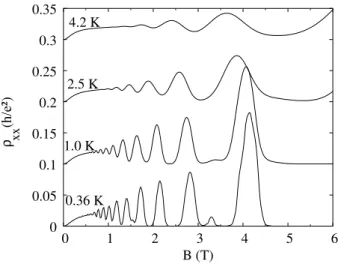
Figure 1. Calculated Shubnikov-de Haas oscillations for differ-ent temperatures. Oscillations inρxxshift to lower fields asT
in-creases. An anomalous peak develops atBc∼3.2T forT = 0.36
K and atBc ∼3.4T forT = 1.0K. The shift to lower fields of
the SdH peak atB∼4T fromT = 1.0K toT = 2.5K is bigger than fromT = 0.36K toT = 1.0K, in accordance to exper-iment [6]. The Fermi function softens the oscillations for higher temperatures, thus making them wider. The offset between curves is0.1h/e2.
Figure 1 shows the theoretical magnetic field and tem-perature dependencies ofρxx. In accordance with the
exper-imental results [6], our calculated SdH oscillationsi)shift to lower magnetic fields as the temperature increases, andii)
show an anomalous peak atBc∼3.2T.
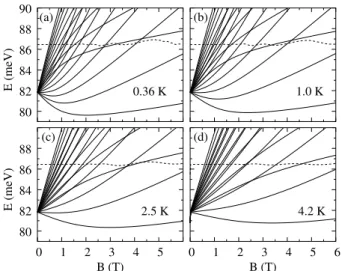
The temperature dependence of the Mn magnetization [Brillouin function in Eq. (3)] is responsible for the SdH shift, as pointed out in Ref. 6. As the temperature rises, the
s-denhanced spin splitting decreases and the spin down en-ergy increases (Fig. 2), crossing the Fermi enen-ergy at a lower
Bfield. Note that temperature also plays a role via the Fermi distribution, which smooths the SdH oscillations as T in-creases (Fig. 1). However, its effect on the SdH shift within the investigated temperature range is small when compared to thes-dexchange contribution.
The anomalous peak that develops atBc∼3.2T (Fig. 1,
T = 0.36K) is a result of a Landau level crossing near the Fermi energy [Fig. 2(a)]. AtT = 0.36K, just belowBc, a
616 Brazilian Journal of Physics, vol. 34, no. 2B, June, 2004
80 82 84 86 88 90
(a)
E (meV) 0.36 K
80 82 84 86 88
0 1 2 3 4 5
B (T) (c)
E (meV) 2.5 K
(b)
1.0 K
0 1 2 3 4 5 6
B (T) (d)
4.2 K
Figure 2. Landau level fan diagrams for different temperatures. In (a) and (b) the Fermi level crosses the|3,↓iLandau level just after the crossing of|3,↓iand|0,↑i, thus giving rise to an extra Shubnikov-de Haas oscillation shown in Fig. 1. AtT = 2.5K (c) the|2,↓iand|0,↑ilevels cross atB ∼3.7T near the Fermi energy, thus originating a wide oscillation shifted to lowerBfields.
4
Discussions and Conclusions
We have done a self-consistent calculation of the electronic structure and magneto-transport properties of a modulation-doped DMH. Our results not only reproduce the experimen-tal findings, but also justify the phenomenological model used in Ref. 6. Since the quantum well is very deep, the main effect of the Hartree contribution is to increase the sub-band energy by ∼ 57meV, leaving the subband structure almost unchanged.
Note that the value of the fitting parameterxp = 0.093
is greater than the nominal onexp= 0.0625. A possible
ex-planation for this discrepancy is that we have neglected the contribution of the exchange-correlation energy of the 2D electron gas. Its inclusion may enhance the spin splitting [15] thus allowing the use of a smaller value forxp, closer
to the experimental one [16].
It is worth mentioning that neither the experimental nor our theoretical results show any sign of an itinerant ferro-magnetic phase transition [17] at the Landau level crossings. Reference 7 suggests that the effects observed by Knobelet al.[6] take place in a regime above a critical temperatureTc.
Here we note, in addition, thatBc = 3.2T corresponds to
a filling factor of3.6, which deviates from the integer filling factor favoring quantum Hall ferromagnetism [18]. The in-clusion of exchange and correlation effects should allow us to study the possibility of quantum Hall ferromagnetic states in these magnetic heterostructures [16].
Acknowledgments
This work was supported by FAPESP (Brazil). HJPF acknowledges Klaus Capelle for useful discussions and R. Knobel for providing additional details on the samples used in Ref.[6].
References
[1] S. A. Crooker, D. A. Tulchinsky, J. Levy, D. D. Awschalom, R. Garcia, and N. Samarth, Phys. Rev. Lett.75, 505 (1995).
[2] D. D. Awschalom and N. Samarth, J. Magn. Magn. Mater. 200, 130 (1999).
[3] J. K. Furdyna, J. Appl. Phys.64, R29 (1988).
[4] I. P. Smorchkova, N. Samarth, J. M. Kikkawa, and D. D. Awschalom, Phys. Rev. Lett.78, 3571 (1997).
[5] I. P. Smorchkova and N. Samarth, Appl. Phys. Lett.69, 1640 (1996).
[6] R. Knobel, N. Samarth, J. G. E. Harris, and D. D. Awschalom, Phys. Rev. B65, 235327 (2002).
[7] J. Jaroszynski, T. Andrearczyk, G. Karczewski, J. Wr ´obel, T. Wojtowicz, E. Papis, E. Kami´nska, A. Piotrowska, D. Popovi´c, and T. Dietl, Phys. Rev. Lett.89, 266802 (2002).
[8] F. Liaci, P. Bigenwald, O. Briot, B. Gil, N. Briot, T. Cloitre, and R. L. Aulombard, Phys. Rev. B51, 4699 (1995).
[9] J. C. Egues and J. W. Wilkins, Phys. Rev. B 58, R16012 (1998).
[10] J. A. Gaj, R. Planel, and F. Fishman, Solid State Commun. 29, 435 (1979).
[11] J. A. Gaj, W. Grieshaber, C. Bodin-Deshayes, J. Cibert, G. Feuillet, Y. M. d’Aubign´e, and A. Wasiela, Phys. Rev. B50, 5512 (1994); H. J. P. Freire and J. C. Egues (unpublished).
[12] Sincexpis very small the effective Mn concentration is rather
insensitive to the actual profile so thatx =xp(1−xp)4is
a good first approximation to it. We actually use a segrega-tion profile with characteristic length of 5 ˚A [11]. A diffusion profile gives similar results.
[13] R. G. Knobel, Ph.D. thesis, Pennsylvania State University, 2000.
[14] T. Ando and Y. Uemura, J. Phys. Soc. Japan36, 959 (1974).
[15] H. J. P. Freire and J. C. Egues, Braz. J. Phys.32, 327 (2002); 33, 166(E) (2003).
[16] A similar calculation including exchange and correlation ef-fects will be presented elsewhere.
[17] G. F. Giuliani and J. J. Quinn, Phys. Rev. B31, 6228 (1985); S. M. Girvin, Phys. Today53, 39 (2000).