ABSTRACT
Thyroid cancer in children is usually rare, but in the individuals exposed to radiation risk of disease increases considerably. After the Chernobyl acci-dent in 1986, an over 10-fold maximal elevation in the incidence of thyroid cancer was registered about a decade later, cumulatively resulting in more than a thousand of newly diagnosed cases in children who lived in the ter-ritories of Belarus, Russia, and Ukraine affected by radioactive fallouts. Experience from the epidemic substantially promoted knowledge in clini-cal pediatric oncology, pathology and basic sciences. This article overviews epidemiology, clinical features, results of treatment and follow-up of childhood patients with radiation-induced Chernobyl thyroid cancer in comparison to sporadic cases diagnosed at present. In addition, we dis-cuss general issues of pathology and molecular findings in childhood thy-roid carcinomas. (Arq Bras Endocrinol Metab 2007;51/5:748-762) Keywords: Childhood thyroid cancer; Chernobyl; Surgery; Radioiodine; Histotype; Molecular genetics
RESUMO
Câncer de Tiróide na Infância na Bielorússia, Rússia, e na Ucrânia, Após Chernobil e Atualmente.
O câncer de tiróide é habitualmente raro em crianças, mas em indivíduos expostos a radiação o risco da doença aumenta consideravelmente. Cerca de uma década após o acidente de Chernobil, em 1986, foi registrado um aumento de mais de 10 vezes na incidência de câncer de tiróide, resultan-do cumulativamente em mais de mil novos casos diagnosticaresultan-dos em cri-anças que viviam nos territórios da Bielorrússia, Russia, e Ucrânia, afe-tadas pela chuva radioativa. A experiência com essa epidemia resultou em conhecimento substancial de oncologia pediátrica clínica, patologia e ciências básicas. Este artigo analisa a epidemiologia, os achados clínicos, os resultados do tratamento e a evolução de pacientes pediátricos com câncer de tiróide induzido pela radiação de Chernobil, em comparação com casos esporádicos diagnosticados atualmente. Adicionalmente, serão discutidos tópicos de patologia e achados moleculares no carcinoma de tiróide infantil. (Arq Bras Endocrinol Metab 2007;51/5:748-762) Descritores: Câncer de tiróide infantil; Chernobil; Cirurgia; Radioiodo; Histotipo; Genética molecular
revisão
YURIE. DEMIDCHIK VLADIMIRA. SAENKO SHUNICHIYAMASHITA
Department of Oncology, Belarusian State Medical Univer-sity and Thyroid Cancer Center (YED), Minsk, Belarus, Depart-ment of International Health and Radiation Research (VAS & SY) and Department of Molecular Medicine, Atomic Bomb Disease Institute (SY), Nagasaki University, Graduate School of Biomedical Sciences, Nagasaki, Japan.
T
HYROID CANCER AFFECTS EVERYyear 0.1–2.2indi-viduals per million of all aged under 15 years old worldwide. Exposure to external or internal radiation at young age, however, increases risk of thyroid malig-nancy dramatically.
After the accident on April 26, 1986, at the Chernobyl nuclear power station, which is located at the north of Ukraine close to the borders of Belarus and Russia, over 1018Bq of radioactivity were released into the environment (1). Due to changeable weather conditions, radioactive pollutions have been detected to some extent in many European countries and even in the North America, but the heaviest contamination occurred in Belarus, Ukraine, and western parts of Russia (figure 1). The spectrum of ejected isotopes included over four hundred of different radionuclides with large amounts of radiologically important 131I and 137Cs.
Although inhalation of some radionuclides from air was possible in the affected regions, the main route of radioactive iodine entry into the human body has been primarily through ingestion of contaminated milk. In total, millions of peoples including hundreds of thousand children were exposed. According to the estimates, only in Belarus several thousand children have accumulated 131I thyroid doses exceeding 2 Gy (1). Given the thyroid in children is particularly radiosensitive compared to adults (2), a group of risk included cumulatively a very large number of young individuals.
There has been a sharp increase in the incidence of thyroid cancer in exposed children in 1990–1993 (3-12) that peaked about a decade ago in the three most affected countries displaying an order-scale raise. Since the phenomenon of Chernobyl, childhood thyroid can-cer has been recognized by the international medical and scientific communities, numerous epidemiological, clinical and molecular studies have been done. These investigations have established a compelling link of dis-ease with radioactive iodines reldis-eased to the environ-ment, and addressed distinctive features of clinicopatho-logical characteristics and underlying molecular changes of Chernobyl tumors. An unprecedented increase in the number of diagnosed childhood thyroid cancers led to a rapid accumulation of experience in the treatment of this otherwise rare malignancy.
Nowadays, 20 years after the Chernobyl tragedy, incidence of thyroid cancer in children in the affected countries decreased to the levels just some-what elevated compared to the pre-accident rate. There are no justified reasons to suspect radiation eti-ology of thyroid cancer in the individuals born in 1987 or later around Chernobyl, and such newly diagnosed cases are considered sporadic. Since the number of young patients with sporadic thyroid cancer is current-ly approaching the score of a hundred oncurrent-ly in Belarus, it seemed to be timely to compare the clinical course and other relevant peculiarities of these cases to those observed earlier in patients with radiation-induced cancer.
Figure 1.(Left panel) Geographical location of the Chernobyl nuclear power plant. (Right panel) Surface ground contamination
EPIDEMIOLOGY OF CHILDHOOD THYROID CANCER
The most detailed information on the incidence of thyroid malignancies in childhood was published by the International Agency for Research on Cancer (IARC) in 1999 (13). It included data from major world cancer registries except Belarus, Russia, and Ukraine, which were affected by radioactive fallouts at the time of the Chernobyl accident. The total number accounted for less than a thousand of pediatric patients and, according to the results obtained, the crude and age standardized incidence rate (ASR) for sporadic thyroid carcinomas in the age group under 15 years old was 0–2.2 per one million (table 1). Of note, pooled data included only 21 pediatric patients less than 5 years old, while the majority of patients were aged more than 10 years.
Similar observations were done in the EURO-CARE II study that included series from 45 cancer reg-istries of 17 countries (14). For the period between 1978 and 1989, 165 childhood thyroid cancer cases were diag-nosed in Western Europe. Of them, 134 (81%) patients were 10–14 years old and the remaining thyroid malig-nancies were diagnosed in younger individuals.
In a recent series published by Steliarova-Foucher et al., the estimated rate for childhood thy-roid cancer ranged between 0.3 and 2.0 per million depending on region and patients’ gender (15). These data were based on 151 cases diagnosed during 1988–1997 as collected from 61 European cancer reg-istries excluding Belarus. The cumulative mean ASR was 0.5 per million.
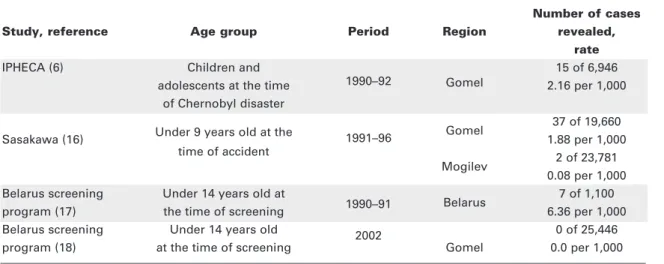
Incidence of disease in Belarus, northern Ukraine, and western regions of Russian Federation was comparable to that determined in the above-mentioned studies before the Chernobyl disaster (4,7,8). Only five childhood patients with thyroid malignancies were diag-nosed in Belarus between 1978 and 1985, while a slight annual increase of primary adult cases was observed. Since 1990, a sharp elevation in the number of patients was documented, initially in the southern, mostly cont-aminated, regions of the country. In 1993, the crude incidence in Gomel and Brest regions (located closer to the Chernobyl nuclear power plant) reached 9.4 and 6.7 per 100,000, respectively (4). It was recognized as the highest worldwide, but firstly these observations were attributed to the undertaken screening programs (table 2). Indeed, the mass application of thyroid ultra-sonography and fine-needle aspiration biopsy in early years after Chernobyl disaster revealed an unexpectedly great number of childhood patients with thyroid
malig-nancies. One of the concerns about these findings was that these carcinomas had been diagnosed before than they would have manifested in older ages. However, subsequent screening of children born after the accident in the same regions demonstrated the absence of cancer in this age group.
Examination of the geographical distribution of diagnosed cases and the estimates of absorbed thyroid doses left no doubts that childhood thyroid cancer cases are associated with exposure to radiation, in par-ticular with intake of 131I (19,20).
The increasing number of primary childhood can-cer cases in Belarus was documented during seven years after the accident with the peak in 1996 (figure 2A). It is interesting to note that the major impact on the increased incidence of the short-latency cases (i.e. those diagnosed during the first decade after the accident) could be attributed to children diagnosed for cancer at the age below 10 years old (figure 2B). Since 1996, the incidence in children was gradually decreasing (figure 2A), and from 2001 only sporadic cases occurred in the age group under 15 (5). In total, 740 childhood patients with proven thyroid carcinomas from Belarus were reported for the period between 1986 and 2003 (21).
It is necessary to emphasize that the Belarusian experience with childhood thyroid cancers has been more substantial as compared to that in Ukraine and affected regions of Russian Federation, especially in terms of the total number of diagnosed cases. For instance, Ukrainian series of patients aged 0–14 years at diagnosis reported by Tronko et al. included 472 cases mostly from six north-ern regions that were heavily contaminated by iodine iso-topes at the time of accident (9). In it, the crude inci-dence exceeded the average pre-Chernobyl level 11.4 times (1.9 per 100,000 children in 1996, peak) and had the dose-dependent pattern. Lushnikov et al. (22) pub-lished a series of 51 patients under 15 years old from the most affected Bryansk region of Russian Federation with the peak of incidence 12.6 per 100,000 in 1998. The reported cases from the three countries contaminated by radioactive fallouts are shown in table 3.
Table 1.Thyroid cancer incidence in childhood according to IARC (13).
Number of cases Rates per million (age group, years old) (age group, years old)
Period 0–4 5–9 10–14 All 0–4 5–9 10–14 Crude /
Countries and regions ASR
Algeria, Setif 1986–95 0 0 0 0 — — — —
Egypt, Alexandria 1980–89 0 1 4 5 — 0.2 1.0 0.4 / 0.4
Malawi 1991–95 0 0 0 0 — — — —
Mali, Bamako 1987–95 0 1 2 3 — 1.1 2.3 1.0 / 1.0
Namibia 1983–92 0 1 0 1 — 0.6 0 0.2 / 0.2
Nigeria, Ibadan 1985–92 0 0 1 1 — — 0.7 0.2 / 0.2
South Africa: black 1988–91 1 3 8 12 ? ? ? ?
white 1 2 14 17
Uganda, Kampala 1992–95 0 0 2 2 — — 3.8 1.1 / 1.1
Zimbabwe, Harare 1990–94 0 0 0 0 — — — —
Brazil, Belém 1987–91 0 0 0 0 — — — —
Brazil, Goiânia 1989–94 0 0 0 0 — — — —
Columbia, Cali 1982–91 0 0 3 3 — — 2.2 0.7 / 0.6
Costa Rica 1984–92 1 2 3 6 0.3 0.8 1.0 0.7 / 0.7
Cuba 1986–90 1 1 13 15 0.2 0.3 2.8 1.2 / 1.0
Ecuador, Quito 1985–92 0 2 3 5 — 2.0 3.2 1.7 / 1.6
Peru, Lima 1990–91 0 0 1 1 — — 0.8 0.3 / 0.2
Puerto Rico 1983–91 0 6 5 11 — 2.1 1.7 1.3 / 1.2
Uruguay 1988–92 1 1 4 6 0.8 0.7 3.2 1.5 / 1.4
Canada 1982–91 1 19 58 78 0.1 1.1 3.5 1.6 / 1.4
USA, Delaware Valley: 1980–89 0 3 12 15 — 0.6 2.4 1.0 / 0.9
white
USA, Los Angeles: hispanic 1984–92 0 6 5 11 — 2.6 2.4 1.6 / 1.5
white 0 1 11 12 — 0.5 6.3 2.1 / 2.0
black 0 1 1 2 — 1.4 1.4 0.9 / 0.9
USA, New York: white 1983–91 1 7 39 47 0.1 0.9 4.7 1.9 / 1.7
black 0 1 2 3 — 0.5 0.9 0.5 / 0.4
USA, SEER: white 1983–92 1 6 65 72 0.1 0.5 5.2 1.9 / 1.7
black 0 1 4 5 — 0.5 1.9 0.8 / 0.7
USA, Hawaii: hawaiian 1973–92 0 1 2 3 — 2.2 4.8 2.2 / 2.1
Bangladesh, CERP 1982–92 0 0 1 1 — — ? ?
China, Tianjin 1981–92 0 3 1 4 — 1.2 0.5 0.5 / 0.5
Hong Kong 1980–89 0 2 11 13 — 0.5 2.5 1.0 / 0.9
India, Bangalore 1982–92 0 1 15 16 — 0.2 3.3 1.2 / 1.0
India, Bombay 1980–92 1 2 8 11 0.1 0.2 0.7 0.3 / 0.3
India, Delhi 1988–92 0 1 4 5 — 0.2 0.9 0.3 / 0.3
India, Madras 1982–92 0 1 3 4 — 0.2 0.7 0.3 / 0.3
India, Poona 1980–92 0 0 0 0 — — — —
Israel: jews 1980–89 2 3 9 14 0.5 0.8 2.7 1.3 / 1.3
non jews 0 1 2 3 — 0.9 2.0 0.9 / 0.9
Japan 1980–92 1 1 17 19 0.1 0.1 1.1 0.5 / 0.4
Japan, Osaka 1981–89 0 0 5 5 — — 0.8 0.3 / 0.2
Korea, Seoul 1992–94 0 2 9 11 — 0.9 3.2 1.5 / 1.2
Kuwait: kuwaiti 1983–93 0 1 2 3 — 1.0 2.4 1.0 / 1.0
non kuwaiti 0 0 1 1 — — 1.4 0.4 / 0.4
Pakistan, Islamabad 1987–94 0 0 0 0 — — — —
Pakistan, Karachi 1984–93 0 0 8 8 — — ? ?
Philippines, Manila & Rizal 1983–92 1 5 17 23 0.1 0.6 2.1 0.8 / 0.8
Singapore: chinese 1983–92 0 1 7 8 — 0.6 4.4 1.7 / 1.5
malay 1968–92 0 1 2 3 — 1.0 2.1 1.0 / 0.9
Table 1.Continuação
United Arab Emirates, Al Ain 1984–93 0 0 0 0 — — — —
Viet Nam, Hanoi 1991–94 0 0 1 1 — — 1.1 0.4 / 0.3
Bulgaria 1980–89 0 4 10 14 — 0.6 1.5 0.7 / 0.6
Croatia 1987–90 0 0 2 2 — — 1.5 0.5 / 0.4
Czech Republic 1980–89 1 3 22 26 0.1 0.4 2.7 1.1 / 0.9
Denmark 1983–91 0 3 4 7 — 1.1 1.3 0.8 / 0.7
Estonia 1980–89 0 0 0 0 — — — —
Finland 1980–89 1 4 9 14 0.3 1.3 2.8 1.5 / 1.3
France 1983–92 0 9 18 27 — 1.4 2.7 1.4 / 1.2
France, Lorraine 1983–92 0 2 5 7 — 1.2 2.9 1.4 / 0.5
France, PACA & Corsica 1984–92 0 6 8 14 — 2.4 3.2 1.9 / 1.7
Germany, former GDR 1981–89 2 8 30 40 0.2 0.8 3.2 1.4 / 1.3
Germany, former FRG 1985–90 1 3 16 20 0.1 0.2 0.9 0.4 / 0.3
Germany 1991–95 2 11 16 30 0.1 0.5 0.7 0.5 / 0.4
Hungary 1985–90 0 3 1 4 — 0.7 0.2 0.3 / 0.3
Iceland 1960–89 0 1 0 1 — 1.5 — 0.5 / 0.5
Italy 1980–91 0 2 12 14 — 0.5 2.4 1.1 / 0.9
Italy, Piedmont 1982–89 0 1 2 3 — 0.5 0.9 0.5 / 0.4
The Netherlands 1989–92 0 1 4 5 — 0.3 1.1 0.5 / 0.4
Norway 1980–89 0 2 10 12 — 0.7 3.3 1.4 / 1.2
Poland 1980–89 0 0 3 3 — — 1.7 0.5 / 0.5
Portugal 1989–92 0 1 6 7 — 0.7 3.3 1.5 / 1.2
Slovakia 1980–89 0 4 5 9 — 0.9 1.2 0.7 / 0.6
Slovenia 1981–90 0 0 2 2 — — 1.4 0.5 / 0.6
Spain 1980–91 0 4 25 29 — 0.8 4.6 2.0 / 1.6
Spain, Valencia 1983–90 0 0 7 7 — — 4.9 1.9 / 1.4
Sweden 1983–89 1 1 16 18 0.3 0.3 4.3 1.7 / 1.4
Switzerland 1980–92 0 0 8 8 — — 3.4 1.2 / 1.0
UK, England & Walles 1981–90 0 6 48 54 — 0.2 1.4 0.6 / 0.5
UK, Scotland 1981–90 0 1 5 6 — 0.3 1.4 0.6 / 0.5
Australia 1982–91 0 9 24 33 — 0.7 1.8 0.9 / 0.8
New Zeland: maori 1970–92 0 0 2 2 — — 2.4 0.8 / 0.7
non maori 1980–92 0 2 6 8 — 0.7 1.9 0.9 / 0.8
Papua New Guinea 1979–88 0 0 1 1 — — ? ?
Table 2.Thyroid cancer screening programs in Belarus.
Number of cases Study, reference Age group Period Region revealed,
rate
IPHECA (6) Children and
1990–92 Gomel
15 of 6,946
adolescents at the time 2.16 per 1,000
of Chernobyl disaster
Sasakawa (16) Under 9 years old at the 1991–96 Gomel
37 of 19,660
time of accident 1.88 per 1,000
Mogilev 2 of 23,781
0.08 per 1,000
Belarus screening Under 14 years old at
1990–91 Belarus 7 of 1,100
program (17) the time of screening 6.36 per 1,000
Belarus screening Under 14 years old 0 of 25,446
CLINICAL COURSE OF CHILDHOOD PATIENTS WITH THYROID CANCER
Thyroid carcinomas in childhood are usually asympto-matic with clinical signs of disease seen in only about 20% of cases. The prevalent manifestation of thyroid malignancy is neck mass with or without lymph node enlargement or palpable thyroid nodules. Advanced disease can be accompanied by hoarseness and some-times labored breathing as a sign of recurrent laryngeal nerve or tracheal wall involvement, respectively. Other symptoms in young patients are rather occasional (25-31). Thyroid carcinomas in childhood do not cause hypo- or hyperthyroidism, the majority of patients are generally euthyroid. A moderate prevalence of disease in female patients is common.
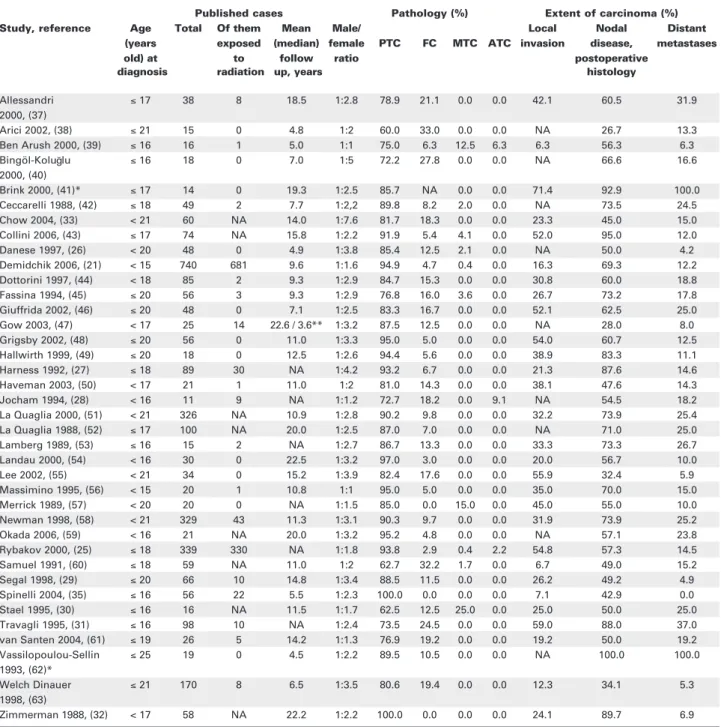
As shown in table 4, papillary thyroid carcinoma is the major histological type of malignancy while fol-licular, medullary or undifferentiated cancers are rare.
Childhood thyroid carcinomas are frequently locally invasive, positive neck lymph nodes can be found in up to 90% of the cases vs. 35% in adults (32). Data avail-able from the literature also demonstrate a higher fre-quency of lung metastases in children as compared with adult cases (32). In a recent series, Chow et al. found pulmonary metastases in 15% of patients aged less than 21 years and 7.8% in the older individuals (33). In our experience, children with lung metastases usually have nodal disease with large thyroid nodules accessible by palpation without labored breathing in most instances. Pulmonary foci are frequently very small or diffuse that makes them virtually undetectable by routine chest X-ray or CT scan. Metastatic disease can be found as “snow storm” radiographs in isolated cases. Bone metastases in children are uncommon and usually associate with lung lesions.
Neck ultrasonography and fine-needle aspira-tion biopsy of thyroid nodules or enlarged lymph
Table 3.Childhood cases of thyroid carcinomas in Belarus, Ukraine, and Bryansk region of Russia after the Chernobyl accident.
Published cases
Country, Period With the history of Sporadic History of radiation Total reference radiation exposure exposure unknown
Belarus (21) 1986–2003 681 47 12 740
(91.9%) (6.3%) (1.6%) (100%)
Ukraine (9) 1986–2000 442 30 — 472
(93.6%) (6.4%) (100%)
Russian Federation,
1986–2003 49 2 51
Bryansk region (22) (96.1%) (3.9%) — (100%)
Figure 2. (A)Incidence of thyroid cancer in patients of different age groups in Belarus between 1986–2006. Peak incidence of childhood cases was registered in 1996, ten years after the Chernobyl accident. The adolescent group displayed the maximal incidence later, in 2001, and then declined. In young adults, incidence of thyroid cancer displays a tendency for a steady increase
till nowadays. (B) Incidence of thyroid cancer in pediatric patients of different age groups in Belarus diagnosed between
1986–2006. Note a pronounced prevalence of primary disease in the individuals aged less than 10 years during the first post-Chernobyl decade.
nodes are widely accepted methods of primary diagno-sis of thyroid cancer. Distant metastases can be most correctly identified by whole-body scanning after total thyroidectomy.
Besides certain differences between clinico-pathological characteristics of thyroid cancers in chil-dren and adults, there is a question whether some fea-tures may be specific to radiation-induced or sporadic pediatric tumors. Pacini et al. (34) performed a
com-parative study of Chernobyl thyroid carcinomas and sporadic thyroid malignancies from France and Italy. It was found that Belarusian cases developed during the first decade after exposure had the greater aggres-siveness at presentation and were diagnosed at the younger age. Spinelli et al. (35) compared radiogenic and sporadic childhood cases of papillary thyroid car-cinomas to demonstrate the frequency of recurrences of 64% and 3% in patients exposed and not exposed to
Table 4.Major clinico-pathological observations in childhood and adolescent thyroid carcinomas published between 1988–2006.
Published cases Pathology (%) Extent of carcinoma (%)
Study, reference Age Total Of them Mean Male/ Local Nodal Distant
(years exposed (median) female PTC FC MTC ATC invasion disease, metastases
old) at to follow ratio postoperative
diagnosis radiation up, years histology
Allessandri ≤17 38 8 18.5 1:2.8 78.9 21.1 0.0 0.0 42.1 60.5 31.9 2000, (37)
Arici 2002, (38) ≤21 15 0 4.8 1:2 60.0 33.0 0.0 0.0 NA 26.7 13.3 Ben Arush 2000, (39) ≤16 16 1 5.0 1:1 75.0 6.3 12.5 6.3 6.3 56.3 6.3 Bingöl-Kolu lu ≤16 18 0 7.0 1:5 72.2 27.8 0.0 0.0 NA 66.6 16.6 2000, (40)
Brink 2000, (41)* ≤17 14 0 19.3 1:2.5 85.7 NA 0.0 0.0 71.4 92.9 100.0 Ceccarelli 1988, (42) ≤18 49 2 7.7 1:2,2 89.8 8.2 2.0 0.0 NA 73.5 24.5 Chow 2004, (33) < 21 60 NA 14.0 1:7.6 81.7 18.3 0.0 0.0 23.3 45.0 15.0 Collini 2006, (43) ≤17 74 NA 15.8 1:2.2 91.9 5.4 4.1 0.0 52.0 95.0 12.0 Danese 1997, (26) < 20 48 0 4.9 1:3.8 85.4 12.5 2.1 0.0 NA 50.0 4.2 Demidchik 2006, (21) < 15 740 681 9.6 1:1.6 94.9 4.7 0.4 0.0 16.3 69.3 12.2 Dottorini 1997, (44) < 18 85 2 9.3 1:2.9 84.7 15.3 0.0 0.0 30.8 60.0 18.8 Fassina 1994, (45) ≤20 56 3 9.3 1:2.9 76.8 16.0 3.6 0.0 26.7 73.2 17.8 Giuffrida 2002, (46) ≤20 48 0 7.1 1:2.5 83.3 16.7 0.0 0.0 52.1 62.5 25.0 Gow 2003, (47) < 17 25 14 22.6 / 3.6** 1:3.2 87.5 12.5 0.0 0.0 NA 28.0 8.0 Grigsby 2002, (48) ≤20 56 0 11.0 1:3.3 95.0 5.0 0.0 0.0 54.0 60.7 12.5 Hallwirth 1999, (49) ≤20 18 0 12.5 1:2.6 94.4 5.6 0.0 0.0 38.9 83.3 11.1 Harness 1992, (27) ≤18 89 30 NA 1:4.2 93.2 6.7 0.0 0.0 21.3 87.6 14.6 Haveman 2003, (50) < 17 21 1 11.0 1:2 81.0 14.3 0.0 0.0 38.1 47.6 14.3 Jocham 1994, (28) < 16 11 9 NA 1:1.2 72.7 18.2 0.0 9.1 NA 54.5 18.2 La Quaglia 2000, (51) < 21 326 NA 10.9 1:2.8 90.2 9.8 0.0 0.0 32.2 73.9 25.4 La Quaglia 1988, (52) ≤17 100 NA 20.0 1:2.5 87.0 7.0 0.0 0.0 NA 71.0 25.0 Lamberg 1989, (53) ≤16 15 2 NA 1:2.7 86.7 13.3 0.0 0.0 33.3 73.3 26.7 Landau 2000, (54) < 16 30 0 22.5 1:3.2 97.0 3.0 0.0 0.0 20.0 56.7 10.0 Lee 2002, (55) < 21 34 0 15.2 1:3.9 82.4 17.6 0.0 0.0 55.9 32.4 5.9 Massimino 1995, (56) < 15 20 1 10.8 1:1 95.0 5.0 0.0 0.0 35.0 70.0 15.0 Merrick 1989, (57) < 20 20 0 NA 1:1.5 85.0 0.0 15.0 0.0 45.0 55.0 10.0 Newman 1998, (58) < 21 329 43 11.3 1:3.1 90.3 9.7 0.0 0.0 31.9 73.9 25.2 Okada 2006, (59) < 16 21 NA 20.0 1:3.2 95.2 4.8 0.0 0.0 NA 57.1 23.8 Rybakov 2000, (25) ≤18 339 330 NA 1:1.8 93.8 2.9 0.4 2.2 54.8 57.3 14.5 Samuel 1991, (60) ≤18 59 NA 11.0 1:2 62.7 32.2 1.7 0.0 6.7 49.0 15.2 Segal 1998, (29) ≤20 66 10 14.8 1:3.4 88.5 11.5 0.0 0.0 26.2 49.2 4.9 Spinelli 2004, (35) ≤16 56 22 5.5 1:2.3 100.0 0.0 0.0 0.0 7.1 42.9 0.0 Stael 1995, (30) ≤16 16 NA 11.5 1:1.7 62.5 12.5 25.0 0.0 25.0 50.0 25.0 Travagli 1995, (31) ≤16 98 10 NA 1:2.4 73.5 24.5 0.0 0.0 59.0 88.0 37.0 van Santen 2004, (61) ≤19 26 5 14.2 1:1.3 76.9 19.2 0.0 0.0 19.2 50.0 19.2 Vassilopoulou-Sellin ≤25 19 0 4.5 1:2.2 89.5 10.5 0.0 0.0 NA 100.0 100.0 1993, (62)*
Welch Dinauer ≤21 170 8 6.5 1:3.5 80.6 19.4 0.0 0.0 12.3 34.1 5.3 1998, (63)
Zimmerman 1988, (32) < 17 58 NA 22.2 1:2.2 100.0 0.0 0.0 0.0 24.1 89.7 6.9 g
radiation, respectively. In this work, the higher preva-lence of distant metastases and recurrent local relapses were recognized to be particularly associated with the radiogenic thyroid malignancies.
In our recent study, comparison of patients with radiogenic (n= 686) and sporadic (n= 66) thyroid cancer did not reveal statistically significant difference in tumor size, and distributions of histological types and tumor stages between the two groups (36). With regard to dis-ease relapse, in a series that included the greatest number of patients with radiation-related thyroid cancer, the fre-quency of local failures was registered in 9.9% cases, dis-tant in 12.2% and a combination of local and disdis-tant recurrences in 5.5% (21). In a group of childhood thy-roid cancers from Ukraine, a similar rate of distant (14.5%) and cervical relapses (6.8%) was demonstrated (25). Our analysis indicates that these data do not sig-nificantly differ from those cumulatively found in spo-radic childhood thyroid carcinomas worldwide. Thus, at a moment there is no clear evidence that etiologically distinct childhood thyroid carcinomas are presented with different clinical course but this problem undoubtedly requires further investigations.
Despite childhood thyroid cancers frequently have advanced stage at diagnosis and recurrence rate may be high, 10- and 15-years cause-specific survival exceeds 95%.
TREATMENT STRATEGIES FOR CHILDHOOD THYROID CANCER
Surgery is the principal method of choice for the treatment of thyroid malignancies. Since the progno-sis in childhood patients with well-differentiated thy-roid cancer is excellent in most cases, extent of removal has been a matter of debate for many years. Clinicians generally consider lumpectomy insufficient but hitherto there is no valid evidence that survival rates are significantly different in individuals undergo-ing primary total thyroidectomy or lesser extracapsu-lar resections (52,56).
The rationale for organ preserving surgery is a very low operative morbidity and good condition of patients after partial thyroidectomy at follow-up. By now, the accepted indications for thyroid lobectomy are cases of minimally invasive follicular carcinomas or encapsulated papillary microcarcinomas without intraglandular dissemination, nodal disease and histo-ry of exposure to radiation.
However, a safe surgical procedure frequently results in recurrences in thyroid remnants or lymph
node involvement. In the Belarusian series every fourth patient had to undergo completion thyroidectomy for local relapse or residual carcinoma after primary lobec-tomy or subtotal thyroideclobec-tomy (21). Indeed, lymph node or thyroid remnant recurrence, especially diag-nosed shortly after primary surgery, is likely to develop from malignant foci that initially were not removed. Since 1998, we routinely recommend total thyroidecto-my, central compartment removal with simultaneous bilateral selective neck dissection for all childhood patients. Such a strategy ensures an overall curative ben-efit with a very low frequency of local relapses, improved staging and accurate diagnosis of metastases using whole body scanning and meaningful serum thyroglob-ulin measurements. In table 5 we summarized the major results of treatment approaches and associated compli-cation and failures available from the literature.
A classical radical neck dissection is now uncom-mon and could be acceptable only for advanced medullary or poorly differentiated carcinomas, as well as in very rare cases with resectable anaplastic malignancies. The highly aggressive nature of such tumors normally requires extensive excision but fortunately such opera-tions are exceptionally rare, if any, in young patients.
Successful ablation of thyroid remnants usually requires one or two courses of radioiodine therapy whereas elimination of distant metastases could be achieved after three to five courses (21,60). Some patients with lung metastases in our series received a total of about 50 GBq during the period of more than ten years and still the complete response is not confirmed.
L-thyroxine suppressive therapy with the mean dose of 2.5 µg/kg bodyweight is recommended after radioiodine ablation. Although a comprehensive assessment of the results of lifelong treatment with L-thyroxine has not been done yet to our knowledge, in our experience stable serum TSH equal to or lesser than 0.1 mU/l could hardly be reached in childhood patients. TSH levels appear quite changeable depend-ing on body weight of a growdepend-ing organism and, per-haps, other individual characteristics. Our preliminary estimates indicate a quite low efficacy of suppressive therapy during which only 46% childhood patients in Belarusian series had permanently suppressed TSH at
careful follow-up. Since hypothyroidism is significant-ly associated with the disease recurrence, issues of opti-mization of TSH suppression in children remain urgent and require further investigation.
PATHOLOGICAL CHARACTERISTICS OF CHILDHOOD THYROID CANCER
The WHO histological classification of thyroid tumors, 2004, indicates 12 types of thyroid carcino-mas of which papillary, follicular, medullary, and undifferentiated carcinomas are the main entities (65). In children, the differentiated types of thyroid carcinomas, i.e. papillary, follicular, and medullary, carcinomas are strongly prevalent compared with poorly differentiated and undifferentiated cancers. Childhood thyroid cancers are often presented with multifocal growth, frequent nodal disease, extraglan-dular invasion and distant metastases indicative of their
Table 5.Therapeutic options, permanent complications and local recurrences in childhood thyroid cancer.
Therapeutic options (%) Permanent Local/regional morbidity (%) relapse (%) TT + NTT Neck Radio Hypopara- Recurrent Thyroid Lymph Study, reference dissection iodine thyroidism nerve bed or nodes
therapy palsy remnants
Arici 2002, (38) 60.0 26.7 66.7 6.7 6.7 0.0 0.0
Ben Arush 2000, (39) 93.8 43.8 31.3 0.0 0.0 0.0 6.3
Bingöl-Kolu lu 2000, (40) 100.0 66.7 72.2 5.6 0.0 11.1 33.3
Collini 2006, (43) 76.2 90.5 30.9 26.2 9.5 21.4
Demidchik 2006, (21) 57.6 82.0 62.7 12.3 6.2 2.4 14.2
Dottorini 1997, (44) 70.6 71.8 88.2 8.2 3.5 65.9
Fassina 1994, (45) 83.1 96.4 78.6 3.6 1.8 1.8 1.8
Giuffrida 2002, (46) 100.0 100.0 43.8 4.2 0.0 0.0 35.4
Grigsby 2002, (48) 85.7 21.4 82.1 7.1 0.0 NA NA
Hallwirth 1999, (49) 94.4 66.7 100.0 0.0 16.7 0.0 16.7
Harness 1992, (27) 88.8 30.3 82.0 6.7 5.6 1.1 7.9
Haveman 2003, (50) 100.0 52.4 100.0 0.0 0.0 0.0 4.8
La Quaglia 2000, (51) 66.3 60.2 100.0 12.0 1.2 13.2
La Quaglia 1988, (52) 46.0 75.0 22.0 15.0 14.0 54.0
Landau 2000, (54) 40.0 80.0 43.3 NA NA 40.0 30.0
Lee 2002, (55) 79.4 26.5 52.9 14.8 1.6 8.8 20.6
Massimino 1995, (56) 70.0 80.0 NA 36.0 IN 0.0 30.0
Merrick 1989, (57) 76.4 52.9 29.4 23.5 0.0 0.0 11.8
Newman 1998, (58) 54.1 56.2 43.5 11.9 2.1 4.0 21.6
Rybakov 2000, (25) 67.0 57.3 75.5 5.6 12.3 2.8 4.0
Segal 1998, (29) 83.6 49.2 100 9.9 9.9 4.9 0.0
Spinelli 2004, (35) 100.0 60.7 NA 7.1 5.3 NA 19.6
Stael 1995, (30) 100.0 37.5 75.0 6.3 12.5 0.0 0.0
Van Santen 2004, (61) 100.0 57.7 46.2 36.4 27.3 0.0 18.2
Zimmerman 1988, (32) 36.2 60.3 3.4 24.1 0.0 12.0 30.0
more aggressive clinical course compared with disease in adults. Cases diagnosed in the Chernobyl countries, either those radiation-related or sporadic, correspond well with these observations.
Papillary thyroid carcinoma is the most com-mon histological type (60–97% cases, mean 85%) observed in childhood patients with both sporadic and radiation-induced thyroid cancer. Morphological diag-nosis of papillary thyroid carcinoma is based on specif-ic features of tumor epithelial cells, first of all such as enlarged overlapping nuclei with ground glass appear-ance, nuclear grooves and pseudoinclusions, and psammoma bodies. Papillary thyroid carcinomas are usually non-encapsulated or partly encapsulated tumors except for the follicular variant of papillary car-cinoma, which may be frequently seen as a nodule sur-rounded by a fibrous capsule. The main way of papil-lary thyroid cancer dissemination is lymphatic, mani-festing in a high rate of regional lymph node involve-ment. Vascular invasion is observed in up to 30% of cases (43) with distant metastases documented in a somewhat lesser proportion (table 4).
There is an apparent age-dependent trend in the distribution of morphological patterns of sporadic papillary thyroid carcinomas in pediatric patients. In older children, classical papillary morphology is more frequent while the solid-type tumors are more charac-teristic for patients aged below 10 years (66). Papillary carcinomas with the solid growth pattern were found with an exceedingly high frequency (> 70%) in the Chernobyl patients diagnosed for thyroid cancer dur-ing the first decade after the catastrophe (67-72). However, in contrast to sporadic papillary thyroid car-cinomas, in these radiation-induced cases solid mor-phology did not display a strict correlation with patients’ age. Instead, there has been a pronounced association with the shorter period of latency (72).
Follicular thyroid carcinoma, similarly to papil-lary carcinoma, develops from the follicular cells. It is diagnosed in 3–33% (12%, median) of childhood thy-roid cancers and tends to occur in older children (73). From the adult thyroid cancer series it is known that follicular carcinoma is relatively more prevalent in the iodine-deficient areas (74). It is unclear, however, if it applies to childhood cases. For example in some series in Japan (iodine-rich region), the follicular cancer accounted for 12% (69), in England, Wales, and Italy (iodine sufficient) for 11–12% (26,66) and for 4–6% in the Chernobyl countries (mild iodine deficiency) (5,9). Most tumors are solitary, all encapsulated. Main route of dissemination is hematogenous with metas-tases occurring in the lungs, bones, liver, and brain.
The morphologic criteria of follicular carcinoma include capsular and vascular (the blood vessels in or beyond the capsule only) invasion. Upon comparison, follicular thyroid carcinoma appears less advanced at presentation than papillary cancer in childhood patients (75) and its prognosis is favorable.
Medullary thyroid carcinoma occurs in about 2% of all childhood thyroid cancers but variations in some series may occur due to sampling bias or screenings (30,66). In adults, sporadic medullary carcinoma is diagnosed in 70–80% cases and 20–30% of cancers are hereditary, occurring either as familial medullary cancer or as a part of multiple endocrine neoplasia type 2 (MEN2) syndromes (76). Onset of the sporadic medullary cancer is usually observed in the patients aged over 30 years. Therefore, the proportion of inherited form of the disease in children may be expected to be substantially higher. Sporadic medullary cancer is usual-ly presented with a solitary nodule. Inherited forms are often multifocal, C-cell hyperplasia beyond the tumor nodule(s) is prominent. Children operated on for medullary cancer, including those with MEN2 who have undergone prophylactic thyroidectomy, have more favorable prognosis compared with adults.
Poorly differentiated and undifferentiated thy-roid carcinomas are exceptionally rare in young patients with only isolated instances reported in the lit-erature (5,69,77,78).
ISSUES OF TUMOR STAGING
limit should not be used to define papillary microcar-cinoma in childhood patients until a study correlating tumor size and other features to the disease prognosis is undertaken (81). Indeed, papillary microcarcinoma for many instances is an incidental pathological finding in the thyroid tissue removed for the reasons other than thyroid cancer. By contrast, carcinomas measur-ing less than 1 cm in diameter often display extrathy-roid invasion and metastases in children. Thus, there may be a need for further revision of UICC classifica-tion for childhood thyroid malignancies in the future.
MOLECULAR PATHOGENESIS
In the papillary thyroid carcinoma, oncogenic RET/PTC,
NTRK1, and AKAP9/BRAFgene rearrangements and point mutations of the BRAF gene and RAS family members are the best known molecular changes. There is a pronounced trend in the distribution of oncogenes among patients of different ages: rearrangement-type alterations are largely prevalent in childhood cancers whereas point mutations occur infrequently.
RET/PTC rearrangements have been reported with a frequency of 11–43% in sporadic papillary thyroid cancers (about 40% on average in childhood cases) and 38–87% in patients with a history of radiation exposure. A strong link between rearrangement type of and tumor morphology was found in pediatric series. It has been shown that RET/PTC1 and RET/PTC3 associate with papillary thyroid carcinomas with the classic papil-lary and solid architecture, respectively (71,82,83). Interestingly, in children affected by the Chernobyl acci-dent, RET/PTC3 was predominant (60% of all rearrangements) in the tumors developed during the first decade after the accident, while in those developed after the longer latency the most frequent rearrangement was
RET/PTC1 (65%) (71). This observation corresponds well with the higher prevalence of papillary thyroid car-cinomas with solid morphology developed after the shorter period of latency and an increasing proportion of tumors with classic papillary architecture observed in the later-onset cases. Some similarity in tumor genotype-phenotype correlations could be seen in sporadic child-hood papillary thyroid carcinomas diagnosed in patients of different ages (84), but further investigations are nec-essary to clarify age-molecular-(clinico)pathological rela-tionships including the prognostic value of gene rearrangements.
In a relatively small series of sporadic childhood papillary thyroid carcinomas diagnosed between 2001–2006 (n= 25, patients’ age 7–15 years old) that
was available for molecular studies we found a 28%
RET/PTCrearrangement rate and a 16% frequency of BRAF mutations (manuscript in preparation). Although based on a limited sample size, these obser-vations are supportive of two characteristics of sporadic childhood papillary thyroid carcinomas: the greater prevalence of gene rearrangements compared to point mutations and the lower frequency of gene rearrange-ments compared to the radiation-induced cancers.
In the follicular variant of papillary carcinoma, one of the frequent gene abnormalities is the PAX8-PPARγ fusion arising as a result of a translocation between chromosomes 2 and 3. In adults this gene alteration has been reported in 38–50% of correspond-ing tumors (85,86) but its prevalence in childhood fol-licular variant of papillary carcinoma, which is observed in about one-fifth of patients, remains to be established. Point mutations of the RAS family genes [detected in 0–6% cases (87-89)], BRAF[0–16% (89-94)], GNAS [not detected (95)], and TP53 [0–23% (89,96-98)] genes are quite rare in childhood papillary thyroid carcinoma. Perhaps such an imbalance between rearrangement-type gene alterations and point mutations, more prevalent in pediatric and adult papillary thyroid carcinoma, respectively, may be a part of the explanation of the difference in the prognosis of disease in patients of different age.
Follicular thyroid carcinoma is associated with point mutations of the RAS genes and PAX8-PPARγ rearrangement. In adult patients, prevalence of these genetic alterations is some 20–50% (99-102) and 14–35% (99,103-106), respectively. In childhood series, the frequency of these events remains to be determined. Molecular pathogenesis of medullary thyroid cancer is associated with point mutations of the RET
gene. More than 95% of patients with heritable form of medullary cancer have germline point mutations in the RET gene that enables prospective screening of individuals at risk. In sporadic medullary cancer, a somatic mutation at codon 918 may be expected in 25–50% cases in adults. In pediatric patients with spo-radic medullary cancer, prevalence of point mutations in RETis not known exactly, but there is no reason to assume it will be too different from the elderly cases.
CONCLUSION
The vast majority of thyroid cancers registered in young patients were papillary adenocarcinomas. Comparison of radiation-related and sporadic cases demonstrated that, despite short-latency Chernobyl cancers have been more aggressive with a high rate of local lymph node involvement and elevated incidence of distant metastases, there is no clear evidence of the main difference in clinical course and prognosis on the whole. Radical thyroid surgery including total thy-roidectomy combined with neck dissections followed by radioiodine ablation could be recommended as the method of choice for the eradication of tumor. Clini-cal approaches for radiation-induced childhood thy-roid cancer could adequately be transferred and used in young patients with sporadic thyroid malignancy.
It is necessary to remember that cumulatively sev-eral million individuals have been exposed to radioactive fallouts in the affected countries during their childhood and adolescence. Although those who were even new-borns at the time of the accident are not children or ado-lescents at present, risk of development of thyroid cancer remains elevated in such people for the lifespan. There-fore, further surveillance and thorough clinical, patholog-ical, and molecular studies, such as those performed by the Chernobyl Tissue Bank (http://www.cher-nobyltissuebank.com, ref. 107), will be essential to clarify the late effects of Chernobyl in order to be better pre-pared for a superior medical care to both childhood and adult patients with thyroid cancer in the future.
ACKNOWLEDGEMENTS
This work was supported in part by Nagasaki Univer-sity 21st Century COE Program, International Con-sortium for Medical Care of Hibakusha and Radiation Life Sciences.
REFERENCES
1. United Nations Scientific Committee on the Effects of Atomic Radiation. Sources, Effects and Risks of Ionizing Radia-tion. New York: United Nations, 2000.
2. Ron E, Lubin JH, Shore RE, Mabuchi K, Modan B, Pottern LM, et al. Thyroid cancer after exposure to external radiation: a pooled analysis of seven studies. Radiat Res 1995;141:259-77. 3. Kazakov VS, Demidchik EP, Astakhova LN. Thyroid cancer
after Chernobyl. Nature 1992;359:21.
4. Demidchik EP, Kazakov VS, Astakhova LN, Okeanov AE, Demidchik YuE. Thyroid cancer in children after the Cher-nobyl accident: clinical and epidemiological evaluation of 251 cases in the Republic of Belarus. In: Nagataki S, (ed). Sym-posium on Chernobyl: update and future. Excerpta Med-ica. International Congress Series 1074. Amsterdam / Lau-sanne / New York / Oxford / Shannon / Tokyo: Elsevier, 1994. pp. 21-30.
5. Demidchik EP, Demidchik YuE, Gedrevich ZE, Kondratovich VF, Mrochek AG, Ostapenko VA, et al. Thyroid cancer in Belarus. In: Yamashita S, Shibata Y, Hoshi M, Fujimura K, (eds). Chernobyl: Message for the 21st Century. Excerp-ta Medica. International Congress Series 1234. Amsterdam / London / New York / Oxford / Paris / Shannon / Singapore / Tokyo: Elsevier, 2002. pp. 69-75.
6. World Health Organization. Medical consequences of the Chernobyl accident. Scientific Report by International Pro-ject “IPHECA”. Geneva: WHO, 1996.
7. Tronko N, Epstein Ye, Oleinik V, Bogdanova T, Likhtarev I, Gulko G, et al. Thyroid gland in children after the Chernobyl accident (yesterday and today). In: Nagataki S, (ed). Sympo-sium on Chernobyl: update and future. Excerpta Medica. International Congress Series 1074. Amsterdam / Lausanne / New York / Oxford / Shannon / Tokyo: Elsevier, 1994. pp. 31-46. 8. Tronko MD, Bogdanova TI, Komissarenko IV, Epstein OV, Oliynyk V, Kovalenko A, et al. Thyroid carcinoma in children and adolescents in Ukraine after the Chernobyl nuclear acci-dent: statistical data and clinicomorphologic characteristics.
Cancer 1999;86:149-56.
9. Tronko ND, Bogdanova TI, Likhtarev IA, Kairo IA, Shpak VI. Sum-mary of the 15-year observation of thyroid cancer among Ukran-ian children after the Chernobyl accident. In: Yamashita S, Shi-bata Y, Hoshi M, Fujimura K, (eds). Chernobyl: Message for the 21st Century. Excerpta Medica. International Congress Series 1234. Amsterdam / London / New York / Oxford / Paris / Shannon / Singapore / Tokyo: Elsevier, 2002. pp. 77-83. 10. Williams D. Epidemiology. Chernobyl, eight years on. Nature
1994;371:556.
11. Williams ED. Fallout from Chernobyl. Thyroid cancer in chil-dren increased dramatically in Belarus. BMJ 1994;309:1298; author reply 1300.
12. Williams D. Cancer after nuclear fallout: lessons from the Chernobyl accident. Nat Rev Cancer 2002;2:543-9. 13. Parkin DM, Kramárová E, Draper GJ, Masuyer E, Michaelis J,
Neglia J, et al. (eds). International incidence of child-hood cancer. IARC Scientific Publication No 144. Lyon: IAR-CPress, 1999.
14. Storm HH, Plesko I. Survival of children with thyroid cancer in Europe 1978–1989. Eur J Cancer 2001;37:775-9.
15. Steliarova-Foucher E, Stiller CA, Pukkala E, Lacour B, Plesko I, Parkin DM. Thyroid cancer incidence and survival among European children and adolescents (1978–1997): report from the Automated Childhood Cancer Information System pro-ject. Eur J Cancer 2006;42:2150-69.
16. Yamashita S, Shibata Y, (eds). Chernobyl: a decade: Pro-ceedings of the 5th Chernobyl Sasakawa Medical Cooperation Symposium. Excerpta Medica International Congress Series 1156. Amsterdam: Elsevier Science, 1997. 17. Drozd VM. Screening is an effective method of thyroid
pathology early diagnostics in persons suffered from the influence of ionizing radiation after Chernobyl accident. In: Shevchuk VE, Gurachevski VL, Kolbanov VV, (eds). 17 years after Chernobyl: problems and decisions. Minsk: Com-mittee on the Problems of the Consequences of the Catastro-phe at the Chernobyl NPP under the Belarusian Council of Ministers, 2003. pp. 25-7.
18. Krysenko NA. Efficiency of introduction of medical technolo-gies on rendering medical assistance to population suffering from Chernobyl catastrophe in Gomel region. In: Shevchuk VE, Gurachevski VL, Kolbanov VV, (eds). 17 years after Chernobyl: problems and decisions. Minsk: Committee on the problems of the consequences of the catastrophe at the Chernobyl NPP under the Belarusian Council of Ministers,
2003. pp. 39-45.
19. Jacob P, Bogdanova TI, Buglova E, Chepurniy M, Demidchik Y, Gavrilin Y, et al. Thyroid cancer risk in areas of Ukraine and Belarus affected by the Chernobyl accident. Radiat Res 2006;165:1-8.
21. Demidchik YE, Demidchik EP, Reiners C, Biko J, Mine M, Saenko VA, et al. Comprehensive clinical assessment of 740 cases of surgically treated thyroid cancer in children of Belarus. Ann Surg 2006;243:525-32.
22. Lushnikov EF, Tsyb AF, Yamashita S, (eds). Thyroid cancer in Russia after Chernobyl. Moscow: Meditsyna, 2006. 23. Cardis E, Kesminiene A, Ivanov V, Malakhova I, Shibata Y,
Khrouch V, et al. Risk of thyroid cancer after exposure to 131I in childhood. J Natl Cancer Inst 2005;97:724-32.
24. Cardis E, Howe G, Ron E, Bebeshko V, Bogdanova T, Bouville A, et al. Cancer consequences of the Chernobyl accident: 20 years on. J Radiol Prot 2006;26:127-40.
25. Rybakov SJ, Komissarenko IV, Tronko ND, Kvachenyuk AN, Bogdanova TI, Kovalenko AE, et al. Thyroid cancer in children of Ukraine after the Chernobyl accident. World J Surg 2000;24:1446-9.
26. Danese D, Gardini A, Farsetti A, Sciacchitano S, Andreoli M, Pontecorvi A. Thyroid carcinoma in children and adolescents.
Eur J Pediatr 1997;156:190-4.
27. Harness JK, Thompson NW, McLeod MK, Pasieka JL, Fuku-uchi A. Differentiated thyroid carcinoma in children and ado-lescents. World J Surg 1992;16:547-53; discussion 553-4. 28. Jocham A, Joppich I, Hecker W, Knorr D, Schwarz HP.
Thy-roid carcinoma in childhood: management and follow up of 11 cases. Eur J Pediatr 1994;153:17-22.
29. Segal K, Shvero J, Stern Y, Mechlis S, Feinmesser R. Surgery of thyroid cancer in children and adolescents. Head Neck 1998;20:293-7.
30. Stael AP, Plukker JT, Piers DA, Rouwe CW, Vermey A. Total thyroidectomy in the treatment of thyroid carcinoma in child-hood. Br J Surg 1995;82:1083-5.
31. Travagli JP, Schlumberger M, De Vathaire F, Francese C, Par-mentier C. Differentiated thyroid carcinoma in childhood. J Endocrinol Invest 1995;18:161-4.
32. Zimmerman D, Hay ID, Gough IR, Goellner JR, Ryan JJ, Grant CS, et al. Papillary thyroid carcinoma in children and adults: long-term follow-up of 1,039 patients conservatively treated at one institution during three decades. Surgery 1988;104:1157-66. 33. Chow SM, Law SC, Mendenhall WM, Au SK, Yau S, Mang O,
et al. Differentiated thyroid carcinoma in childhood and ado-lescence-clinical course and role of radioiodine. Pediatr Blood Cancer 2004;42:176-83.
34. Pacini F, Vorontsova T, Demidchik EP, Molinaro E, Agate L, Romei C, et al. Post-Chernobyl thyroid carcinoma in Belarus children and adolescents: comparison with naturally occur-ring thyroid carcinoma in Italy and France. J Clin Endocrinol Metab 1997;82:3563-9.
35. Spinelli C, Bertocchini A, Antonelli A, Miccoli P. Surgical therapy of the thyroid papillary carcinoma in children: experience with 56 patients ≤16 years old. J Pediatr Surg 2004;39:1500-5. 36. Demidchik YuE, Demidchik EP, Saenko VA, Reiners C, Biko J,
Mankovskaya SV, et al. Childhood thyroid cancer in Belarus. In: Shibata Y, Namba H, Suzuki K, Tomonaga M, (eds). Radi-ation Risk Perspectives. International Congress Series 1299. Amsterdam / London / New York / Oxford / Paris / Shan-non / Singapore / Tokyo: Elsevier, 2006.
37. Alessandri AJ, Goddard KJ, Blair GK, Fryer CJ, Schultz KR. Age is the major determinant of recurrence in pediatric differentiated thyroid carcinoma. Med Pediatr Oncol 2000;35:41-6. 38. Arici C, Erdogan O, Altunbas H, Boz A, Melikoglu M,
Karayal-cin B, et al. Differentiated thyroid carKarayal-cinoma in children and adolescents. Clinical characteristics, treatment and outcome of 15 patients. Horm Res 2002;57:153-6.
39. Ben Arush MW, Stein ME, Perez Nahum M, Zidan J, Kuten A. Pediatric thyroid carcinoma: 22 years of experience at the Northern Israel Oncology Center (1973-1995). Pediatr Hematol Oncol 2000;17:85-92.
40. Bingol-Kologlu M, Tanyel FC, Senocak ME, Buyukpamukcu N, Hicsonmez A. Surgical treatment of differentiated thyroid car-cinoma in children. Eur J Pediatr Surg 2000;10:347-52. 41. Brink JS, van Heerden JA, McIver B, Salomao DR, Farley DR,
Grant CS, et al. Papillary thyroid cancer with pulmonary metastases in children: long-term prognosis. Surgery 2000;128:881-6; discussion 886-7.
42. Ceccarelli C, Pacini F, Lippi F, Elisei R, Arganini M, Miccoli P, et al. Thyroid cancer in children and adolescents. Surgery 1988;104:1143-8.
43. Collini P, Massimino M, Leite SF, Mattavelli F, Seregni E, Zuc-chini N, et al. Papillary thyroid carcinoma of childhood and adolescence: a 30-year experience at the Istituto Nazionale Tumori in Milan. Pediatr Blood Cancer 2006;46:300-6. 44. Dottorini ME, Vignati A, Mazzucchelli L, Lomuscio G,
Colom-bo L. Differentiated thyroid carcinoma in children and ado-lescents: a 37-year experience in 85 patients. J Nucl Med 1997;38:669-75.
45. Fassina AS, Rupolo M, Pelizzo MR, Casara D. Thyroid cancer in children and adolescents. Tumori 1994;80:257-62. 46. Giuffrida D, Scollo C, Pellegriti G, Lavenia G, Iurato MP,
Pezzin V, et al. Differentiated thyroid cancer in children and adolescents. J Endocrinol Invest 2002;25:18-24.
47. Gow KW, Lensing S, Hill DA, Krasin MJ, McCarville MB, Rai SN, et al. Thyroid carcinoma presenting in childhood or after treatment of childhood malignancies: An institutional experi-ence and review of the literature. J Pediatr Surg 2003;38:1574-80.
48. Grigsby PW, Gal-or A, Michalski JM, Doherty GM. Childhood and adolescent thyroid carcinoma. Cancer 2002;95:724-9. 49. Hallwirth U, Flores J, Kaserer K, Niederle B. Differentiated
thyroid cancer in children and adolescents: the importance of adequate surgery and review of literature. Eur J Pediatr Surg 1999;9:359-63.
50. Haveman JW, van Tol KM, Rouwe CW, Piers do A, Plukker JT. Surgical experience in children with differentiated thyroid carcinoma. Ann Surg Oncol 2003;10:15-20.
51. La Quaglia MP, Black T, Holcomb GW, 3rd, Sklar C, Azizkhan RG, Haase GM, et al. Differentiated thyroid cancer: clinical characteristics, treatment, and outcome in patients under 21 years of age who present with distant metastases. A report from the Surgical Discipline Committee of the Children’s Can-cer Group. J Pediatr Surg 2000;35:955-9; discussion 960. 52. La Quaglia MP, Corbally MT, Heller G, Exelby PR, Brennan
MF. Recurrence and morbidity in differentiated thyroid carci-noma in children. Surgery 1988;104:1149-56.
53. Lamberg BA, Karkinen-Jaaskelainen M, Franssila KO. Differ-entiated follicle-derived thyroid carcinoma in children. Acta Paediatr Scand 1989;78:419-25.
54. Landau D, Vini L, A’Hern R, Harmer C. Thyroid cancer in chil-dren: the Royal Marsden Hospital experience. Eur J Cancer 2000;36:214-20.
55. Lee YM, Lo CY, Lam KY, Wan KY, Tam PK. Well-differentiat-ed thyroid carcinoma in Hong Kong Chinese patients under 21 years of age: a 35-year experience. J Am Coll Surg 2002;194:711-6.
56. Massimino M, Gasparini M, Ballerini E, Del Bo R. Primary thy-roid carcinoma in children: a retrospective study of 20 patients. Med Pediatr Oncol 1995;24:13-7.
57. Merrick Y, Hansen HS. Thyroid cancer in children and ado-lescents in Denmark. Eur J Surg Oncol 1989;15:49-53. 58. Newman KD, Black T, Heller G, Azizkhan RG, Holcomb GW,
3rd, Sklar C, et al. Differentiated thyroid cancer: determinants of disease progression in patients < 21 years of age at diag-nosis: a report from the Surgical Discipline Committee of the Children’s Cancer Group. Ann Surg 1998;227:533-41. 59. Okada T, Sasaki F, Takahashi H, Taguchi K, Takahashi M,
Watanabe K, et al. Management of childhood and adolescent thyroid carcinoma: long-term follow-up and clinical charac-teristics. Eur J Pediatr Surg 2006;16:8-13.
60. Samuel AM, Sharma SM. Differentiated thyroid carcinomas in children and adolescents. Cancer 1991;67:2186-90. 61. van Santen HM, Aronson DC, Vulsma T, Tummers RF,
Gee-nen MM, de Vijlder JJ, et al. Frequent adverse events after treatment for childhood-onset differentiated thyroid carcino-ma: a single institute experience. Eur J Cancer 2004;40:1743-51.
62. Vassilopoulou-Sellin R, Klein MJ, Smith TH, Samaan NA, Frankenthaler RA, Goepfert H, et al. Pulmonary metastases in children and young adults with differentiated thyroid cancer.
63. Welch Dinauer CA, Tuttle RM, Robie DK, McClellan DR, Svec RL, Adair C, et al. Clinical features associated with metastasis and recurrence of differentiated thyroid cancer in children, adolescents and young adults. Clin Endocrinol (Oxf) 1998;49:619-28.
64. Reiners C, Demidchik YE. Differentiated thyroid cancer in childhood: pathology, diagnosis, therapy. Pediatr Endocrinol Rev 2003;1(suppl 2):230-5; discussion 235-6. 65. DeLellis RA, Lloyd RV, Hetz PU, Eng C, (eds). WHO
Classifi-cation of Tumors. Pathology and Genetics of Tumors of Endocrine Organs. Lyon: IARC Press, 2004.
66. Harach HR, Williams ED. Childhood thyroid cancer in England and Wales. Br J Cancer 1995;72:777-83.
67. Furmanchuk AW, Averkin JI, Egloff B, Ruchti C, Abelin T, Schappi W, et al. Pathomorphological findings in thyroid can-cers of children from the Republic of Belarus: a study of 86 cases occurring between 1986 (“post-Chernobyl”) and 1991.
Histopathology 1992;21:401-8.
68. Nikiforov Y, Gnepp DR. Pediatric thyroid cancer after the Chernobyl disaster. Pathomorphologic study of 84 cases (1991–1992) from the Republic of Belarus. Cancer 1994;74:748-66.
69. Shirahige Y, Ito M, Ashizawa K, Motomura T, Yokoyama N, Namba H, et al. Childhood thyroid cancer: comparison of Japan and Belarus. Endocr J 1998;45:203-9.
70. Nikiforov YE, Gnepp DR. Pathomorphology of thyroid gland lesions associated with radiation exposure: the Chernobyl experience and review of the literature. Adv Anat Pathol 1999;6:78-91.
71. Rabes HM, Demidchik EP, Sidorow JD, Lengfelder E, Beim-fohr C, Hoelzel D, et al. Pattern of radiation-induced RET and NTRK1 rearrangements in 191 post-Chernobyl papillary thy-roid carcinomas: biological, phenotypic, and clinical implica-tions. Clin Cancer Res 2000;6:1093-103.
72. Williams ED, Abrosimov A, Bogdanova T, Demidchik EP, Ito M, LiVolsi V, et al. Thyroid carcinoma after Chernobyl latent period, morphology and aggressiveness. Br J Cancer 2004;90:2219-24.
73. Hung W, Sarlis NJ. Current controversies in the management of pediatric patients with well-differentiated nonmedullary thyroid cancer: a review. Thyroid 2002;12:683-702. 74. Segal K, Arad A, Lubin E, Shpitzer T, Hadar T, Feinmesser R.
Follicular carcinoma of the thyroid. Head Neck 1994;16:533-8.
75. Farahati J, Bucsky P, Parlowsky T, Mader U, Reiners C. Char-acteristics of differentiated thyroid carcinoma in children and adolescents with respect to age, gender, and histology. Can-cer 1997;80:2156-62.
76. Brandi ML, Gagel RF, Angeli A, Bilezikian JP, Beck-Peccoz P, Bordi C, et al. Guidelines for diagnosis and therapy of MEN type 1 and type 2. J Clin Endocrinol Metab 2001 ;86:5658-71.
77. Hassoun AA, Hay ID, Goellner JR, Zimmerman D. Insular thy-roid carcinoma in adolescents: a potentially lethal endocrine malignancy. Cancer 1997;79:1044-8.
78. Yusuf K, Reyes-Mugica M, Carpenter TO. Insular carcinoma of the thyroid in an adolescent: a case report and review of the literature. Curr Opin Pediatr 2003;15:512-5.
79. Farahati J, Reiners C, Demidchik EP. Is the UICC/AJCC classi-fication of primary tumor in childhood thyroid carcinoma valid? J Nucl Med 1999;40:2125.
80. Drozd V, Polyanskaya O, Ostapenko V, Demidchik Y, Biko I, Reiners C. Systematic ultrasound screening as a significant tool for early detection of thyroid carcinoma in Belarus. J Pediatr Endocrinol Metab 2002;15:979-84.
81. Williams ED. Guest editorial: Two proposals regarding the terminology of thyroid tumors. Int J Surg Pathol 2000;8:181-3.
82. Nikiforov YE, Rowland JM, Bove KE, Monforte-Munoz H, Fagin JA. Distinct pattern of ret oncogene rearrangements in morphological variants of radiation-induced and sporadic thyroid papillary carcinomas in children. Cancer Res 1997;57:1690-4.
83. Thomas GA, Bunnell H, Cook HA, Williams ED, Nerovnya A, Cherstvoy ED, et al. High prevalence of RET/PTC rearrange-ments in Ukrainian and Belarussian post-Chernobyl thyroid papillary carcinomas: a strong correlation between RET/PTC3 and the solid-follicular variant. J Clin Endocrinol Metab 1999;84:4232-8.
84. Nakazawa T, Kondo T, Kobayashi Y, Takamura N, Murata S, Kameyama K, et al. RET gene rearrangements (RET/PTC1 and RET/PTC3) in papillary thyroid carcinomas from an iodine-rich country (Japan). Cancer 2005;104:943-51.
85. Castro P, Rebocho AP, Soares RJ, Magalhães J, Roque L, Tro-visco V, et al. PAX8-PPARγ rearrangement is frequently detected in the follicular variant of papillary thyroid carcino-ma. J Clin Endocrinol Metab 2006;91:213-20.
86. Castro P, Roque L, Magalhães J, Sobrinho-Simões M. A sub-set of the follicular variant of papillary thyroid carcinoma har-bors the PAX8-PPARγ translocation. Int J Surg Pathol 2005;13:235-8.
87. Suchy B, Waldmann V, Klugbauer S, Rabes HM. Absence of RAS and p53 mutations in thyroid carcinomas of children after Chernobyl in contrast to adult thyroid tumours. Br J Cancer 1998;77:952-5.
88. Fenton C, Anderson J, Lukes Y, Dinauer CA, Tuttle RM, Fran-cis GL. Ras mutations are uncommon in sporadic thyroid can-cer in children and young adults. J Endocrinol Invest 1999;22:781-9.
89. Lima J, Trovisco V, Soares P, Maximo V, Magalhães J, Sal-vatore G, et al. BRAF mutations are not a major event in post-Chernobyl childhood thyroid carcinomas. J Clin Endocrinol Metab 2004;89:4267-71.
90. Kumagai A, Namba H, Saenko VA, Ashizawa K, Ohtsuru A, Ito M, et al. Low frequency of BRAFT1796A mutations in child-hood thyroid carcinomas. J Clin Endocrinol Metab 2004;89:4280-4.
91. Penko K, Livezey J, Fenton C, Patel A, Nicholson D, Flora M, et al. BRAF mutations are uncommon in papillary thyroid cancer of young patients. Thyroid 2005;15:320-5.
92. Powell N, Jeremiah S, Morishita M, Dudley E, Bethel J, Bog-danova T, et al. Frequency of BRAF T1796A mutation in pap-illary thyroid carcinoma relates to age of patient at diagnosis and not to radiation exposure. J Pathol 2005;205:558-64. 93. Rosenbaum E, Hosler G, Zahurak M, Cohen Y, Sidransky D,
Westra WH. Mutational activation of BRAF is not a major event in sporadic childhood papillary thyroid carcinoma.
Mod Pathol 2005;18:898-902.
94. Nikiforova MN, Ciampi R, Salvatore G, Santoro M, Gandhi M, Knauf JA, et al. Low prevalence of BRAF mutations in radia-tion-induced thyroid tumors in contrast to sporadic papillary carcinomas. Cancer Lett 2004;209:1-6.
95. Waldmann V, Rabes HM. Absence of G(s)αgene mutations in childhood thyroid tumors after Chernobyl in contrast to spo-radic adult thyroid neoplasia. Cancer Res 1997;57:2358-61. 96. Hillebrandt S, Streffer C, Reiners C, Demidchik E. Mutations in the p53 tumour suppressor gene in thyroid tumours of chil-dren from areas contaminated by the Chernobyl accident. Int J Radiat Biol 1996;69:39-45.
97. Nikiforov Y, Gnepp DR, Fagin JA. Thyroid lesions in children and adolescents after the Chernobyl disaster: implications for the study of radiation tumorigenesis. J Clin Endocrinol Metab 1996;81:9-14.
98. Smida J, Zitzelsberger H, Kellerer AM, Lehmann L, Minkus G, Negele T, et al. p53 mutations in childhood thyroid tumours from Belarus and in thyroid tumours without radiation histo-ry. Int J Cancer 1997;73:802-7.
99. Nikiforova MN, Lynch RA, Biddinger PW, Alexander EK, Dorn GW, 2nd, Tallini G, et al. RAS point mutations and PAX8-PPARγrearrangement in thyroid tumors: evidence for distinct molecular pathways in thyroid follicular carcinoma. J Clin Endocrinol Metab 2003;88:2318-26.
101.Lemoine NR, Mayall ES, Wyllie FS, Williams ED, Goyns M, Stringer B, et al. High frequency of Ras oncogene activation in all stages of human thyroid tumorigenesis. Oncogene 1989;4:159-64.
102.Namba H, Matsuo K, Fagin JA. Clonal composition of benign and malignant human thyroid tumors. J Clin Invest 1990;86:120-5.
103.Sobrinho-Simões M, Preto A, Rocha AS, Castro P, Maximo V, Fonseca E, et al. Molecular pathology of well-differentiated thyroid carcinomas. Virchows Arch 2005;447:787-93. 104.Dwight T, Thoppe SR, Foukakis T, Lui WO, Wallin G, Hoog A,
et al. Involvement of the PAX8/peroxisome proliferator-acti-vated receptor gamma rearrangement in follicular thyroid tumors. J Clin Endocrinol Metab 2003;88:4440-5. 105.Marques AR, Espadinha C, Catarino AL, Moniz S, Pereira T,
Sobrinho LG, et al. Expression of PAX8-PPARγ1 rearrange-ments in both follicular thyroid carcinomas and adenomas. J Clin Endocrinol Metab 2002;87:3947-52.
106.Cheung L, Messina M, Gill A, Clarkson A, Learoyd D, Del-bridge L, et al. Detection of the PAX8-PPARγfusion oncogene in both follicular thyroid carcinomas and adenomas. J Clin Endocrinol Metab 2003;88:354-7.
107.Thomas GA, Williams ED, Becker DV, Bogdanova TI, Demid-chik EP, Lushnikov E, et al. Chernobyl tumor bank. Thyroid 2000;10:1126-7.
Address for correspondence:
Vladimir A. Saenko
Department of International Health and Radiation Research Atomic Bomb Disease Institute
Nagasaki University Graduate School of Biomedical Sciences 1-12-4 Sakamoto, Nagasaki 852-8523, Japan
Fax: (81-95) 849-7169