Interfaial Instabilities in Conned Ferrouids
JoseA. Miranda
Laboratoriode FsiaTeoriae Computaional,Departamento deFsia,
UniversidadeFederaldePernambuo,Reife,PE50670-901Brazil
Reeivedon7November,2000
Weinvestigate theowoftwoimmisible,visousuids intheonnedgeometryofaHele-Shaw
ell. Weonsiderthatoneoftheuidsisaferrouidandthatanexternalmagnetieldisapplied.
The interfaial instabilities whih arise between the uids are studied for various situations: (a)
dierent ell geometries (radial, retangular); (b)frontal and parallel ows; () distint applied
eldongurations(tangential,perpendiular,normal)and(d)motionlessandrotating ells. The
interplay betweenappliedmagneti eldand several otherdestabilizing/stabilizing fators in
de-terminingtheinterfaebehaviorisanalyzed. Stabilityanalysisandnumerialsimulationsareused
todesribelinearandnonlinearstagesoftheinterfaeevolution.
I Introdution
The formation of patterns and shapes in the natural
world has long been a soure of fasination for both
sientistsand laymen [1, 2℄. Nature providesan
end-lessarrayofpatternsformedbydiversephysial,
hem-ialandbiologialsystems. Thesalesofsuhpatterns
range from the growthof baterialolonies [3℄ to the
large-salestrutureoftheuniverse[4℄. Thisenormous
rangeofsalesoverwhihpatternformationoursand
theintriguingfatthattheyemergespontaneouslyfrom
an orderless and homogeneous environment aptivate
ourimagination.
Interfae dynamis plays a major role in pattern
formation. It determines the shapes of objets, and
therefore,ithasimportantappliationsinawiderange
of interdisiplinaryelds: hydrodynamis [5℄
(onve-tionpatternsandshapesofboundariesbetweenuids),
metallurgy [6℄ (dendritishapesof rystals),and
biol-ogy [3, 7℄ (shapes of plants, ells, et.). Despite the
great variety and rihness of this immense set of
pat-ternformationsystems,inthisworkwefousonafew
speiexamplesofinterfaialpatterns, whihariseat
the interfae separatingtwovisous uids, when they
owinverynarrow,quasi-two-dimensionalpassages.
The outline of the work is the following:
se-tion II introdues the Saman-Taylorproblem, whih
addresses uid ow in a onned devie alled
Hele-Shaw ell. Flow of both nonmagneti and magneti
uids (ferrouids) are disussed. Setion III
onsid-ersowofferrouidsin rotatingHele-Shawells. The
ombinedeetsofexternal,appliedmagnetieldand
rotationontheshapeoftheinterfaialpatternsare
ana-lyzed. Itisshown,throughalinearstabilitystudy,that
anin-plane, azimuthal magneti eld is able to
stabi-lizetheuid-uidinterfae. Numerialsimulationsare
usedto examineinterfae behaviorunder
perpendiu-lar applied eld. Setion IV studies the situation in
whihtheuidsowparallelto eahother, forvarious
magneti eld ongurations. We show that
depend-ingontheeld diretion itanstabilize ordestabilize
theinterfae. Forsuh parallel ows, solitons arise at
the interfae. We suggest magneti fores may
intro-due new and interesting behaviors related to soliton
interations. Finally,setionV presentsouronluding
remarksandperspetives.
II Fluid ow in onned
geome-try
A. The Saman-Taylor problem and the
Hele-Shaw ell
TheSaman-Taylorproblem[8,9℄addressesmotion
oftwovisousimmisibleuidsinthenarrowspae
be-tweentwoplates,knownasaHele-Shawell[10℄. When
auidoflowvisositydisplaesauidofhigher
visos-ity, the interfaebetween them beomes unstable and
starts to deform. Dynami ompetition in suh
on-nedenvironmentleadsultimatelytotheformationof
beautiful ngeringpatterns[9℄.
The original Hele-Shaw ell (that has little to do
withtheurrentversion)wasrstutilizedabouta
en-turyagobyaBritishnavalarhitetofthatname[10℄.
Alongandnarrowhannelontainingauidwasused
to study the ow of water around the hull of a ship.
Theellmadeitsreappearaneinthe1950's[8,11,12℄,
inthestudyoftheproblemofoilreoveryfromporous
media. The proess involvedpumping waterdownan
oil well in order to pushtrapped oilinto surrounding
wells whereit ouldbereovered. Itturned outto be
aquitefrustratingexperiene,asthewaterwouldtend
topropagateviaabranhingtypeofdeformation,
leav-ingasubstantialfrationoftheoilbehind. Thevisous
ngeringinstability madeoil reoveryineÆient. The
Hele-Shaw ell was modied to study this kindof
in-stability: atopplatewasaddedtothehannelandtwo
uidswereintrodued.
To this day, investigations of the visous ngering
instabilityhave foundtheHele-Shawellto be a
sim-pleyetelegantdevieinthestudyofinterfaialpattern
formation. Nowadaysexperimentsandtheoryfouson
twobasiHele-Shawowgeometries(i)retangular[8℄
and (ii) radial [13℄. In retangular geometry ellsthe
less visous uid is pumped against the more visous
onealongthediretionof theplates. A gravity-driven
owisalsopossible,ifwetilttheellandallowgravity
toat. Meanwhile,intheradialgeometryase,theless
visousuidisinjetedtoinvadethemorevisousone,
throughaninlet loatedon thetopglass plate.
Typi-alexamplesofvisousngeringpatternsanbeseenin
referene[9℄: retangularellsprodue patterns
show-ing \ngers" of the less visous uid inside the more
visous one,whileradialellsleadto theformationof
\fan-like",branhedstrutures.
Forbothgeometries,theinitialdevelopmentsofthe
interfaeinstabilitytrakthepreditionsoflinear
sta-bility theory [8, 9℄. After the initial surfae
deforma-tion,astheunstablemodesofperturbationgrow,they
beome oupled in a weakly nonlinearstage of
evolu-tion[14, 15℄. Finally, the systemevolves to a
ompli-atedlatestage,haraterizedbyformationofngering
strutures,in whihnonlineareetsdominate[9℄.
Theuidsaredrivenbypressuregradientorgravity,
anditisasimplifying featureoftheHele-Shaw
geome-trythattheuidveloityissimplyproportionaltothe
pressuregradient[8,9℄. Inthisase,theLaplae
equa-tion applies. Atrst glane, it mayseem very simple
tosolveLaplaeequation. Thebasiequationsforthe
Hele-Shaw system are indeed simple. However, their
solutions are denitely not so simple. The diÆulty
of solving the Laplae's equation lies in the existene
of movingboundaryonditions, whih involvea
fun-alledafreeboundaryproblem,whihisingeneralnot
possibleto besolvedanalytiallyin alosedform.
Thebasiphysialaspetsleadingtovisousngers
an be summarized as follows: in the Saman-Taylor
problem, ifaforwardbump is formedon theinterfae
between the uids, it enhanes the pressure gradient
and the loal interfae veloity. Beause the veloity
of apoint ontheinterfae isproportionalto theloal
pressure gradient, the bump grows faster than other
parts on the interfae. On the other hand, the eet
of surfae tension ompetes with this diusive
insta-bility. Surfae tension ats to redue the pressure at
highly urved parts of an interfae, and sharp bumps
are foredbak. Asa resultwe havetheformationof
thengeringpatternsmentionedabove.
B. Conned ferrouids
Aninterestingvariationofthetraditional
Saman-Taylorproblemistoonsiderthesituationinwhihone
oftheuidsintheHele-Shawellismagneti. Magneti
uidsarealsoknownasferrouids[16℄. Roughly
speak-ing,aferrouidanbedenedasaolloidalsuspension
oftinymagnetipartilesinanonmagnetisolvent. It
is omposed of 3 15 nmpartiles ofsolid, magneti,
single-domain material partiles oated with a
mono-layerof surfatantmoleules and suspended in auid
arrier. Althoughthesolidpartilesareferromagneti,
aferrouidis atually paramagnetibeausethe
indi-vidual partile magnetizations are randomly oriented.
Thermal agitation keeps the partiles suspended
be-ause of Brownian motion, and the oating prevents
the partilesfrom stikingto eah other. In ioni
fer-rouids oating is replaed by eletrostati repulsion.
Sinethemagnetipartilesaremuhsmallerthanthe
Hele-Shaw ell thikness, we neglet their partiulate
nature and onsider a ontinuous paramagneti uid.
For the present work, we will be interested solely in
desribingthe generalmehanismsleadingtothe very
nie labyrinthine strutures in ferrouids. The reader
anndmuhmoreinformationaboutthesefasinating
omplexuidsinRosensweig'slassibook [16℄.
Weproeed by disussingthe owof ferrouidsin
the onned Hele-Shaw geometry for both
retangu-lar and radialsetups. First,suppose we havea
verti-al,retangularHele-Shawell,inwhihtheupperless
dense and lessvisous uid is nonmagneti, while the
lower,moredenseandmorevisousoneisaferrouid.
Instead of pumping the less visous uid against the
morevisousonebyapplyinganexternalpressure
gra-dient,letsusonsiderthesituationinwhihweapplya
fae is at and gravitationally stable. When we turn
ontheuniformmagnetield,interestingthingsbegin
to happen. The externallyapplied eld tendsto align
thetinymagnetimomentsinadiretionnormaltothe
plates. Consequently,thesemagnetimomentsstartto
repeleahotherwithin theplaneoftheHele-Shawell
andtheinterfaebeginstodeform. Thesurfaetension
betweenthe two uids tries to stabilize the interfae.
Gravityisalsostabilizingifthemoredenseuidis on
the bottom. If the eld intensity is inreased, ngers
starttodevelopandbegintosplitattheirtips. Finally,
by inreasing the eld even further, a labyrinth-type
patternisformed[17,16℄. Thesepatternsarequite
dif-ferent from those that arise when nonmagneti uids
owinretangularHele-Shawells.
Similar branhing labyrinth patterns our in a
radial geometry setup, in whih an initially
iru-lar ferrouid droplet is surrounded by a nonmagneti
uid [18, 19, 20, 21, 22, 23℄. Inthe abseneof an
ap-pliedmagnetield,theequilibriumferrouidshapeis
determined by surfae tension, resulting in a irular
droplet. Interfaial instability isdrivenbythe
ompe-tition between apillary and magneti fores. Surfae
tensionatstominimizethelengthoftheinterfae
be-tweentheuidsandfavorsompatdomainshapes. In
ontrast, the repulsive dipole-dipole interation tends
to maximize the distane between dipoles and favors
extended domainshapes. Eventually,asaresultofthe
ompetition, multiplybifuratedlabyrinthine patterns
are formed. The branhed patterns are quite distint
from the \fan-like" patterns obtained for radial ow
with nonmagnetiuids. So,for bothretangularand
radial geometries, as a resultof the ferrouid
intera-tionwiththeexternaleld,theusualvisousngering
instability [8, 9℄ is supplemented by a magneti uid
instability[16℄, resultingin avarietyofnewinterfaial
behaviors.
In the following setions we revisit the tradiional
radialandretangularmagnetiliquidsetupsdisussed
above,byaddingmodiationsintothesystem: (a)in
the radial ase, instead of onsidering the ell at rest
(motionlessHele-Shaw ell),weassumethatitisunder
rotationaroundtheaxispassingthroughtheenterof
the ell(rotating Hele-Shaw ell);(b) in the
retangu-larase,insteadofanalyzingthesituationinwhihone
uid is pushed bythe other (frontal ow), we
investi-gatetheaseinwhihtheuidsowsidebyside,with
their owveloitiespointingalong theinitially
unper-turbed, at interfae separating them (parallel ow).
Forthese twonew situations weexaminethe relevant
eetsatingontheinterfae,duetoappliedmagneti
eld,byemployinglinearstability theoryand
numeri-III Ferrouid ow in rotating
Hele-Shaw ells
Inreentyears,reseahershavebeenstudyinganumber
ofmodiationsofthelassiSaman-Taylorsetup[9℄.
An interesting variation of the traditional
visosity-drivenngeringinstabilityistheinvestigationofradial
Hele-Shawowsin the preseneofentrifugaldriving.
The inlusion of entrifugal fores an be onsidered
by rotating the ell, with onstant angular veloity,
aroundanaxisperpendiulartothe planeoftheow.
Inthisase,theinterfaeinstabilityanalsobedriven
by the density dierene between the uids [24, 25℄.
Inontrast to the\fan-like" patternsobtained in
mo-tionless Hele-Shaw ells,whih show ngersthat split
at their tips, rotatingell eets make the initial
ir-ular droplet to throw out attahed droplets, whih
subsequently throwoutngersthat form a setof new
droplets[25℄,leadingtowhatweouldalla
\hammer-headshark"pattern.
Inthissetionweanalyzethesituationinwhihone
oftheuidsisaferrouidsandstudytheeetsonthe
uid-uid interfae when magneti eld and rotation
aresimultaneouslypresent[26℄. Weonsiderthe
situa-tionin whiha non-uniform,azimuthal,in-plane eld
isapplied. Theompetitionbetweenrotationand
mag-netieldisanalyzed. Weshowtheazimuthalmagneti
eldprovidesanewmehanismforstabilizingthe
inter-fae. Thedestabilizingeet of perpendiular applied
eldisstudiedthroughnumerialmethods.
ConsideraHele-Shawellof thiknessbontaining
twoimmisible,inompressible,visousuids(seeFig.
1). Weassumethat bis smallerthananyotherlength
salein the problem, andtherefore thesystem is
on-sidered to be eetively two-dimensional. Denote the
densitiesand visosities of the inner and outer uids,
respetivelyas
1 ,
1 and
2 ,
2
. The ows in uids
1and 2 are assumed to be irrotational. Between the
twouidsthere existsasurfaetension. Weassume
thattheinneruidistheferrouid(magnetization ~
M),
whiletheouter uidis nonmagneti. Duringtheow,
theuid-uidinterfaehasaperturbedshapedesribed
asR=R+(;t),where representsthepolarangle,
andR isthe radiusof theinitially unperturbed
inter-fae.
Theell rotates, withonstantangular veloity ,
about an axis perpendiular to the plane of the ow
(Fig. 1). Anexternalmagnetield ~
H,produed bya
long,straightwirearryingaurrentI,isdiretedalong
theaxisofrotation. CurrentI produesanazimuthal
whereristhedistanefromthewire,and ^
istheunit
vetorpointinginthediretionofinreaseof.
Figure1. ShemationgurationoftherotatingHele-Shaw
ellwithferrouid.
Following the standard approximations used by
Rosensweig[16℄andothers[19,22,23℄weassumethat
theferrouidmagnetization ~
Misollinearwiththe
ex-ternal eld ~
H and that theinuene ofthe
demagne-tizing eld is negleted. It is also assumed that the
ferrouid is eletrially nononduting and that the
displaementurrent is negligible. For thequasi
two-dimensional geometry of a Hele-Shaw ell, the three
dimensional ow may be replaed with an equivalent
two-dimensionalow~v(x;y)byaveragingoverthez
di-retionperpendiulartotheplaneoftheHele-Shawell.
Imposing no-slipboundaryonditionsand aparaboli
veloity prole one derives Dary's law for ferrouids
in aHele-Shawell[23,27℄,whihmustbeaugmented
byinludingentrifugalfores,
~v= b
2
12 (
~
rp 1
b Z
+b=2
b=2
0 (
~
M ~
r) ~
Hdz
2
rr^ )
; (1)
d
where p is the hydrodynami pressure,
0
is the
free-spaepermeability,andr^denotesaunitvetorpointing
radiallyoutward. Equation(1) desribesnonmagneti
uidsbysimplydroppingthetermsinvolving
magneti-zation.
It is onvenientto rewriteequation(1) in termsof
veloity potentials, sine the veloity eld ~v is
irrota-tional. We write~v = ~
r, where denesthe
velo-itypotential. Similarly, werewritethemagnetibody
foreinequation(1)as
0 (
~
M ~
r) ~
H =
0 M
~
rH= ~
r ,
wherewehaveintroduedthesalarpotential
=
0 Z
M(H)dH=
0 H
2
2
; (2)
with M =M(H)=H, being aonstantmagneti
suseptibility.
With the denitions of and we notie that
bothsides of equation (1) arereognized asgradients
of salar elds. After integrating both sides of
equa-tion (1), we evaluate it for eah of the uids on the
interfae. Then, we subtrat the resulting equations
from eahother, anddividebythesumofthetwo
u-ids' visositiesto gettheequationofmotion
A
2 +
1
2
+
2
1
2
=
b 2
12(
1 +
2 )
(
+
1
2 (
2
1 )
2
r 2
)
: (3)
d
Toobtain(3) we haveused thepressureboundary
onditionp
1 p
2
=attheinterfae,wheredenotes
theinterfaialurvatureintheplaneoftheHele-Shaw
ell[26℄. Thesignonventionfortheurvatureissuh
thatairularinterfaehaspositiveurvature. The
di-mensionless parameterA =(
2
1 )=(
2 +
1 )is the
visosityontrast.
a small perturbation of the initially irular interfae
oftheform(;t)=
n
(t)exp(in)withn=0;1;2;:::,
to derivethelineardispersionrelation(n)dened by
d=dt=(n)
n
. KnowingthatobeysLaplae's
equa-tion and expressingit in terms of throughthe
leadsto[26℄
(n)= b
2
n
12(
1 +
2 )R
3
N
N
B (n
2
1)
: (4)
WedenethedimensionlessparametersN
=[R
3
(
1
2 )
2
℄=,and N
B =
0 I
2
=(4 2
R ) as therotational
andmagnetiBondnumbers,respetively.
Inspetingequation (4)weobservetheinterplayof
rotation, magneti eld and surfae tension in
deter-miningtheinterfaeinstability. If(n)>0the
distur-bane grows, indiating instability. The ontribution
omingfrom thesurfaetensiontermhasastabilizing
nature. N
maybeeitherpositiveornegative,
depend-ing on therelativevaluesof thedensities. If
1 >
2 ,
N
>0androtationplaysadestabilizingrole. In
on-trast, N
B
alwaystendsto stabilize theinterfae. This
indiates that the rotation-driven instability ould be
delayedoreven preventedifasuÆientlystrong
mag-netieldisapplied.
Thestabilizingroleofthemagnetieldanbe
ex-plained by its symmetry properties and non-uniform
harater. Notie that suh a eld possessesa radial
gradient. Themagnetield inueneismanifestedas
theexisteneofabodyforeduetoeldnonuniformity.
Theeldproduesaforediretedradiallyinward,that
tendstomovetheferrouidtowardtheurrent-arrying
wire (regionsofhigher magnetield). This fore
op-poses the entrifugal fore and favors interfae
stabi-lization. Thiseet issimilartothegradient-eld
sta-bilizationmehanismdisussedbyRosensweig[16℄.
A quantity of importane an be extrated from
(n): thefastestgrowingmoden
,givenbythelosest
integer to the maximum of equation (4) with respet
to n
n
max =
r
1
3
[1+(N
N
B
)℄: (5)
n
is strongly orrelated to the number of ripples
present in the early stages of pattern formation. By
equation (5) we verify that, for positive N
,
inreas-ingly largervaluesofN
B
tendto dereasethenumber
of interfae ripples. Theazimuthalmagneti eld an
be seenasa ontrol parameterto disiplinethe
num-berofinterfaeundulations. Thisfat isillustratedin
Fig.2.
Theeet of auniform magnetield applied
per-pendiular to the rotating ell is worth investigating
as well. Linear stability analysis of the perpendiular
eldongurationhasbeenarriedoutinreferene[26℄.
Asexpeted,theperpendiulareldhasadestabilizing
role. It isofinterestto studytheombinedroleof
ro-tationandperpendiulareldinmoreadvanedstages
of the interfae evolution. Intensive numerial
simu-lations, based on onformal mapping tehniques [23℄,
ordertoinvestigaterotatingellferrouidpatterns,
un-der perpendiular eld, in the fully nonlinear regime.
Representativeexamplesofsuhnumerialsimulations
areshowninFig. 3.
50
100
150
200
2
4
6
8
10
(a)
(b)
(c)
n
max
N
B
(a)
(b)
(c)
N
Ω
=50
N
Ω
=100
N
Ω
=200
Figure2. Plot of n
max
as afuntionof N
B
for inreasing
valuesofN.Theseurvesareobtainedusingequation(5).
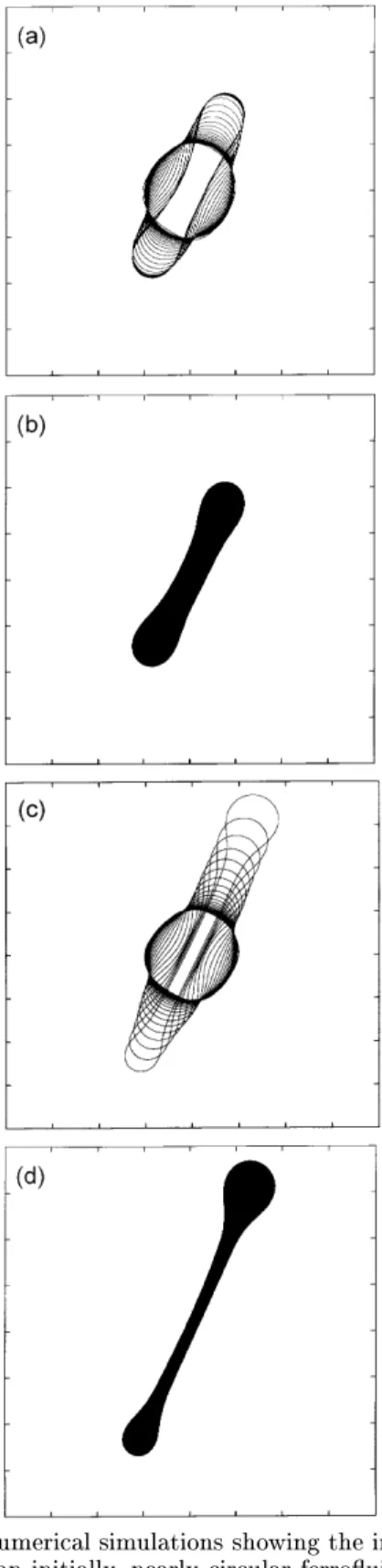
Fig. 3(a) depits the interfae evolution of an
initially, nearly irular ferrouid droplet of radius
R=2m,under theinueneof aperpendiulareld
(N
B
=0:575), in amotionless Hele-Shawellof
thik-nessb =0:4 m. Theoverlaidontours shown in Fig.
3(a)haveapproximatelyequaltimestepsandthetotal
\numerialexperiment"time t=5s . Weuseda
ran-dominitialondition[23℄: wesplinkledasmallamount
ofrandomnoise(amplitude <0.05R )in therstfour
Fouriermodesasaninitialondition. Fig. 3(b) shows
theferrouiddropletshapeatt=5s,whenthedroplet
omes to rest. The dumbbell-shaped struture shown
inFig. 3(b)issimilartotheonesimulatednumerially
by Tsebers and Zemitis [29℄, who used boundary
in-tegralequation tehniques. Related numerial studies
fordropletsinmotionlessellshavebeenarriedoutin
referenes[30,31℄.
Figs. 3() and 3(d) are obtained using the same
physialparametersasthoseusedin3(a)and3(b),but
nowrotationisadded(N
=0:6)andthetotal
numer-ial experiment time t = 2 s. The ferrouid droplet
now evolves, under perpendiular eld, in a rotating
bothrotationandappliedeldaredestabilizingeets.
In ontrastto Fig. 3(), the dropletin 3(d) is not at
rest. Theinterfaeongurationin3(d)orrespondsto
someintermediate state for themotion of the droplet
duetoentrifugalfores atingonitsperiphery.
Figure3. Numerialsimulationsshowingtheinterfaial
in-stabilityof aninitially, nearlyirularferrouid dropletin
a Hele-Shawell, inthe preseneof a perpendiular
mag-netield: (a)and(b)motionlessell;()and(d)rotating
obtained in time evolution (a) and (), respetively. The
physialparametersaregiveninthetext.
We summarize our preliminary numerial results [28℄
as follows: (i) without rotation, the droplet omes to
rest in anal ngered stage. With rotationinluded,
there is no nal stage. This is an unstable situation
and the droplet ends up shooting o to one side or
theotherafterenoughtime. Apossibleexplanationto
suhbehaviorsisthefatthattheFouriermoden=1,
thatorrespondstoatranslationoftheirle,is
unsta-ble(stable)forrotating(motionless)ells;(ii)rotation
leadsto morebulbousendsandtoathinner(although
reasonablyonstantthikness) onnetingarm.
IV Parallel ow with onned
ferrouids
Most ofexperimental and theoretial investigationsof
the Saman-Taylor problem in theliterature onsider
uid motion in onnedHele-Shawells under frontal
ow. Inontrast,weonsidertheso-alledparallelow
whih ours when the uids ow parallel to the
ini-tiallyunperturbedinterfaeseparatingthem.
Reentstudies [32, 33,34℄ examined thedynamis
ofuidinterfaesunderparallelowinHele-Shawells.
ZeybekandYortsos[32,33℄studied,boththeoretially
and experimentally, parallel owin ahorizontal
Hele-Shawellinthelargeapillarynumberlimit. Fornite
apillarynumberandwavelength,linearstability
anal-ysis indiates that small perturbations deay, but the
rate of deay vanished in the limit of large apillary
numbersandlargewavelength. Furthermore,aweakly
nonlinear analysis of the problem found Korteweg-de
Vries (KdV) dynamis leading to stable nite
ampli-tude soliton solutions. Solitons were indeed observed
experimentally. GondretandRabaud[34℄inorporated
inertial terms into the equation of motion in a
Hele-ShawellandfoundaKelvin-Helmholtzinstabilityfor
invisiduids. Forvisousuidstheyderiveda
Kelvin-Helmholtz-Daryequationandfoundthethresholdfor
instability was governed by inertial eets, while the
waveveloitywasgovernedbytheDary'slawowof
visous uids. Their experimental results supported
theirtheoretialanalysis.
Hereweperformthelinearstabilityanalysisfor
par-allelowin whih oneuidis aferrouidand a
mag-neti eld is applied [35℄. We onsider three separate
eld ongurations: (a) tangential, for in-plane elds
tangent to the unperturbed interfae; (b) normal, for
in-planeappliedeldsnormaltotheunperturbed
inter-fae;()perpendiular, whentheeldis perpendiular
to theplane dened bytheHele-Shawellplates. We
showthemagnetieldprovidesadditionalmehanisms
qualita-magnetield. Wenegletinertialtermsbeausethey
arenotneededtounderstandtheinterfaialinstability.
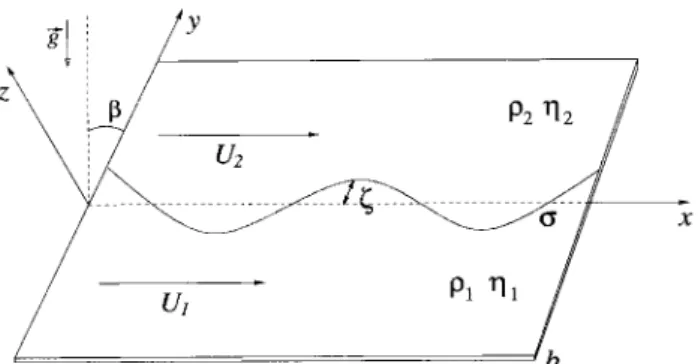
As we did in setion III let us briey desribe the
physialsystemof interest. Considertwosemi-innite
immisiblevisousuids,owingwithveloitiesU
1 and
U
2
, along thex diretion, in a retangularHele-Shaw
ell(seeFig. 4). Toahievesteady-stateparallelow
Figure 4. Shemati ongurationof the parallel ow
ge-ometry. Thelower uidis aferrouid,and the upperone
nonmagneti. Theexternalmagnetieldmaybeoriented
alongthex,yorz axis.
the veloities and visosities must obey the ondition
1 U 1 = 2 U 2
. We assume that the lower uid is the
ferrouid(magnetization ~
M), while the upper uid is
nonmagneti. In order to inlude the aeleration of
gravity~g, wetilt theellso that they axisliesat
an-gle from thevertialdiretion. Toinlude magneti
fores, we apply a uniform magneti eld ~
H
0 , whih
may point along the x, y orz axis. Duringthe ow,
theuid-uidinterfaehasaperturbedshapedesribed
asy=(x;t) (solidurvein Fig. 4).
As was the ase for the rotating ell ase studied
in setion III the starting pointof ouranalysis is the
generalizedDary's law [23, 27℄. By applying similar
onditionsasthose used in setion III weend up
get-tingtheequationofmotion
A 2 + 1 2 + 2 1 2 = b 2 12( 1 + 2 ) ( + 1 b Z +b=2 b=2 ( ~ M ~
r ')dz+(
2
1
)gos y )
;
(6)
d
wherewehaveintroduedthesalarmagnetipotential
'= Z
S ~
M~n 0
j~r ~r 0 j d 2 r 0 (7)
and the loal eld ~
H = ~
r'. Demagnetizing eets
arenegleted. Theunprimedoordinates~rdenote
arbi-trarypointsinspae. Theprimedoordinates~r 0
are
in-tegrationvariableswithinthemagnetidomainS,and
d 2
r 0
denotestheinnitesimalareaelement. Thevetor
~ n 0
representstheunit normalto themagnetidomain
inonsideration.
WeperturbtheinterfaewithasingleFouriermode
(x;t) =
k
exp[i(!t kx)℄, where k denotes a wave
number. Following linear stability analysis standard
proedures, werst onsider that the veloity
poten-tialforuid i,
i
, obeys Laplae'sequation r 2
i =0
andvanishesasy !1. Then,weusethekinemati
boundary ondition [16℄ to express
i
in terms of the
perturbation amplitudes to obtainthe dispersion
rela-tionforgrowthof theperturbation(x;t)
!=k 1 U 1 + 2 U 2 1 + 2 ijkj 12( 1 + 2 ) N B I j (k) (kb) 2 (k 0 b) 2 (8) d where N B = 2M 2
b= is the magneti Bond number
andk 0 = p [( 1 2
)gos℄=. Therealpartof!isk
times thephaseveloity,and is thevisosity-weighted
averageofthetwouidveloities. Notethat the
mag-netielddoesnotalterthephaseveloityofthewaves.
growth or deay of the wave amplitude, does inlude
eets of the magneti eld. Exponential (unstable)
growthours when the imaginary part of ! is
nega-tive.
Terms ontaining I
j
(k) originatefrom the Fourier
transformsof
M 2
I
j (x)
1
b Z
+b=2
b=2 M
j '
r
j
dz; (9)
the magneti ontribution to equation (6). The
sub-sript j = x;y;z indiates the tangential, normal
and perpendiular magneti eld ongurations,
re-spetively. Aftersomealgebrawendrelativelysimple
integralexpressionsforthemagnetitermsI
j (k)[35℄
I
x
(k)= 2 Z
1
0
sin
[ p
(kb) 2
+ 2
℄d; (10)
I
y (k)=4
Z
1
0
sin
2
[ p
(kb=2) 2
+ 2
℄ d; (11)
and
I
z (k)=4
Z
1
0 sin
2
"
1
1
p
(kb=2) 2
+ 2
#
d: (12)
d
Considerthestabilityoftheuid-uidinterfaefor
the dierenteld ongurations. Theinitially at
in-terfaeisunstableto perturbations withwavenumber
kwhenN
B I
j
(k) (kb) 2
(k
0 b)
2
ispositive. Ifthe
heav-ieruidis belowthelighteruid,(
1 >
2
),thenboth
gravityandsurfaetensionstabilizethesystemandk
0
is real. Therefore, in theabsene of applied magneti
eld (N
B
= 0), the temporal growth rateof any
per-turbation is negative and waves are damped. On the
otherhand,iftheexternalmagnetieldisnonzero,the
stability of the interfae will depend onthe eld's
di-retion. Fig. 5illustrateshowthemagnetiterms(10),
(11)and (12)vary with reduedwavenumberkb.
In-spetingFig. 5andtheimaginarypartofthedispersion
relation (8)wenote that atangenteld onguration
(I
x
(k)<0),makesthegrowthrateevenmorenegative
than when the eld is absent. So atangent external
eld hasastabilizingnature, reinforingtheeets of
gravity and surfae tension. In ontrast, sine I
y (k)
and I
z
(k) arebothpositivequantities,ifasuÆiently
strongmagnetieldisappliednormaltotheuid-uid
interfae,orperpendiulartotheellplates,thegrowth
ratemaybeomepositive,leadingtoapossible
destabi-lizationoftheinterfae. Weonludethatthemagneti
eldandestabilizetheinterfaeevenintheabseneof
inertialeets. Theseeetsanbeexplainedvery
sim-ply: fornormalandperpendiularelds, theferrouid
spreadsoutintheHele-Shawplaneduetomagneti
re-pulsion, leadingto interfaedeformation. Inontrast,
foratangenteld, anyinterfaeperturbationtendsto
bestabilized,dueto magnetiattration.
1
2
3
4
5
-10
-5
0
5
10
15
(a)
(c)
(b)
I
j
(k)
kb
Figure5. PlotofIj(k)asafuntionofkbfor(a)tangential,
ongura-Inadditiontotheinterfaestabilityissuedisussed
above,itisofinteresttostudytheationoftheapplied
magneti eld on the solitons that appear in parallel
ow in Hele-Shawells. We suggest that thesolitons
maybeonsideredasloalizedperturbationsontheat
interfae. Whenmagnetieldsarepresentthesolitons
aquirenetdipolemomentsequaltothemagnetization
of the uid multiplied by the integrated area of the
soliton. Dipole interations arelong-ranged,fallingo
as 1=x 3
formoments separatedby adistane x. This
ontrastswiththeuid-dynamiinterationofsolitons
whih deaysexponentiallywithseparation. An
inter-estingadditionalfeatureofthedipole-dipoleinteration
is its variation with the relative orientation of dipole
moments and the vetorjoining them. In the aseof
solitons with parallel moments m~
1
and m~
2
displaed
from eah otheralong thex axis,the interationswill
be attrating, with strength 2m
1 m
2
, when the
mag-netizations lie alongthe x axis(tangetial) but will be
repelling,withstrengthm
1 m
2
whenthemagnetizations
lie alongthe y (normal) orz (perpendiular)axes. In
thissenseparallelowwithferrouidsouldbeusedas
anovelsystemtoinvestigatesolitoninterations.
V Conluding remarks and
per-spetives
In this work we reviewed the basi aspets related to
interfaial pattern formation in Hele-Shaw ows, and
disussed modiationsregardingowofferrouidsin
suhonnedgeometry:freeboundarymotionin
rotat-ingradialellsandtheinterfaebehaviorunderparallel
owinretangularellswithferrouids.
First,weaddressedtheinterplay between
entrifu-gal and magneti fores in determining the instability
of the uid-uid interfae in rotating ells. The
lin-earstabilityanalysisoftheproblemshowsthata
non-uniform, azimuthal magneti eld, applied tangential
to the ell, tends to stabilize the interfae. We
veri-edthat maximumgrowthrateseletionofinitial
pat-ternsisinuenedbytheapplied eld,whihtendsto
derease the number of interfae ripples. Numerial
simulations were presented in relation to the ase in
whih auniform magneti eld is applied normallyto
theplane dened bytherotatingHele-Shawell. Ina
future work weplantoinvestigatenumeriallythe
dy-namialompetitionbetweenrotation(whihpushthe
ngers\sideways")andmagnetield (whihtendsto
bifuratethengertips)inthehighlynonlinearpattern
formationstage. Wepointoutthat,todate, there are
noexperimentsonrotatingellswithferrouids.Sine
itwouldbeofonsiderableinteresttoperformsuh
ex-perimentswhih arelikelytoleadtonewand exiting
interfaialpatterns in the highly nonlinearregime. It
would be nie to ompare numerial simulations with
realexperiments.
Finally,wepresentedthelinearstabilityanalysisfor
parallelowinaHele-Shawellwhenoneoftheuids
isaferrouid. Weshowedthat thedispersionrelation
governingmodegrowthismodiedsothatthemagneti
eldandestabilizetheinterfaeevenintheabseneof
inertialeets. However, we found that the magneti
elddoesnotaet thespeedofwavepropogationfor
agiven wavenumber. We pointed outthat magneti
eld reates an eetive interation between the
soli-tons. M.WidomandIplantoinvestigatetheinuene
of the magneti eld on the shape of the solitons in
amorequantitativefashion,byperformingtheweakly
nonlinearanalysisofthesystem.
Aknowledgments
ItisapleasuretothankR.PerzynskiandF.Tourinho
forinvitingmetogiveatalkrelatedtothisworkatthe
InternationalWorkshop onMagneti Fluids(Braslia
-DF,2000). I thankH. Nazareno (diretorof
ICCMP-Unb,Braslia-DF)forhiskindhospitality. Ialsothank
M. Widom and D. P. Jakson for ongoing
ollabora-tions. ThisworkwaspartiallysupportedbyCNPqand
FINEP(BrazilianAgenies).
Referenes
[1℄ D'AryW. Thompson, On Growth and Form
(Cam-bridgeUniversityPress, Cambridge,1944).
[2℄ P. S. Stevens, Patterns in Nature (Little Brown,
Boston,1974).
[3℄ H.Meinhardt,ModelsofBiologialPatternFormation
(AademiPress, NewYork,1982).
[4℄ J.BinneyandS.Tremaine,GalatiDynamis
(Prine-tonUniversityPress,Prineton,1987).
[5℄ S.Chandrasekhar, Hydrodynami andHydromagneti
Stability(OxfordUniversity,London,1961).
[6℄ B. Chalmers,Priniples of Solidiation(Wiley,New
York,1964).
[7℄ L.A.Segel,MathematialModelsofMoleularand
Cel-lularBiology(CambridgeUniversityPress,Cambridge,
1980).
[8℄ P.G.SamanandG.I.Taylor,Pro.R.So.London
Ser.A245,312(1958).
[9℄ For reviewartiles on this subjet, see D. Bensimon,
L.P.Kadano,S.Liang,B.I.Shraiman,andC.Tang,
Rev.Mod.Phys.58,977(1986);G.Homsy,Ann.Rev.
[10℄ H. S. Hele-Shaw, Trans. Inst. Naval Arh. 40, 21
(1898).
[11℄ R. L. Chuoke, P. vanMeurs and C. vander Poel, J.
Pet.Tehnol.11,64(1959).
[12℄ R.L.Chuoke,P.vanMeursandC.vanderPoel,Petrol.
Trans.AIME216,188(1959).
[13℄ L.Paterson,J.FluidMeh.113,513(1981).
[14℄ J. A. Miranda and M. Widom, Int. J. Mod.Phys.B
12,931(1998).
[15℄ J. A. Miranda and M. Widom, Physia D 120, 315
(1998).
[16℄ R. E. Rosensweig, Ferrohydrodynamis (Cambridge
University Press, Cambridge, 1985), and referenes
therein.
[17℄ A.O.Tsebersand M.M. Maiorov,
Magnetohydrody-namis16,126(1980).
[18℄ A.O.Tsebersand M.M. Maiorov,
Magnetohydrody-namis16,231(1980).
[19℄ A.O.Tsebersand M.M. Maiorov,
Magnetohydrody-namis16,21(1980).
[20℄ A.G.Boudouvis,J.L.Puhalla,L.E.Sriven,J.
Col-loidInterfaeSi.124,688(1988).
[21℄ A. J. Dikstein, S. Erramilli, R. E. Goldstein, D. P.
JaksonandS.A.Langer,Siene261,1012 (1993).
[22℄ S.A.Langer,R.E.GoldsteinandD.P.Jakson,Phys.
Rev.A.46,4894(1992).
[23℄ D.P.Jakson,R.E.GoldsteinandA.O.Cebers,Phys.
Rev.E50,298(1994).
[24℄ L.W.Shwartz,Phys.FluidsA 1,167(1989).
[25℄ Ll. Carrillo, F. X. Magdaleno, J. Casademunt and J.
Ortn,Phys.Rev.E54,6260(1996).
[26℄ J.A.Miranda,Phys.Rev.E62,2985 (2000).
[27℄ A.O.Tsebers,Magnetohydrodynamis17,113(1981).
[28℄ D.P.JaksonandJ.A.Miranda,unpublished(2000).
[29℄ A. O. Tsebers and A. A. Zemitis,
Magnetohydrody-namis19,360(1983).
[30℄ A. Cebers and I. Drikis, Magnetohydrodynamis 32,
11(1996).
[31℄ A.G.PapathanassiouandA.G.Boudouvis,
Magneto-hydrodynamis35,314(1999).
[32℄ M. Zeybek and Y. C. Yortsos, Phys. Rev. Lett. 67,
1430(1991).
[33℄ M.ZeybekandY.C.Yortsos,J.FluidMeh.241,421
(1992).
[34℄ P. Gondret and M. Rabaud, Phys. Fluids 9, 3267
(1997).
[35℄ J.A.MirandaandM.Widom,Phys.Rev.E61,2114