Determination of Partile Size Distribution
by FMR Measurements
Walter S. D. Follyand Ronaldo S.de Biasi
Departamento deEngenhariaMe^aniaede Materiais
InstitutoMilitardeEngenharia
PraaGeneralTib urio,80
22290-270Riode Janeiro, RJ,Brazil
E-mail: walfollyhotmail.om
Reeivedon21Deember,2000
Knowledgeofpartilesizedistributionisveryimportantforthestudyofmagnetiuids,magneti
powdersand othermagnetisystems. Inthiswork,we desribe asimplemethodfor its
determi-nationfromFMRmeasurements. ThemethodwasappliedtotheaseofMgFe2O4 preipitatesin
(Mg,Fe)O.
I Introdution
When a magneti system is an ensemble of partiles
of several sizes, the FMR spetrum measured at
in-termediatetemperaturesis thesum oftwoabsorption
spetra[1℄,oneduetosuperparamagnetipartilesand
anotherduetoferromagnetipartiles;inaddition,the
anisotropyofthespetrumduetoferromagneti
parti-lesinreasesasthetemperatureisdereased. At
suÆ-ientlylowtemperatures,thesuperparamagneti
spe-trum vanishesand onlytheferromagnetispetrumis
observed,sineallpartileshavetheirmagnetidipole
momentsbloked. At hightemperatures,allthe
mag-neti dipole momentsare unbloked and only the
su-perparamagnetispetrumisobserved. Measuringthe
relativeintensitiesofthetwospetraandtheanisotropy
eld oftheferromagnetispetrumasfuntionsofthe
temperature, is possibleto determine thepartile size
distributionofthesystem.
II Theory
Ourmethodisbasedontheassumptionthatthe
inten-sityofthesuperparamagnetispetrumisproportional
to thenumber of partiles whose volumes are smaller
thanaritialvalue,whihistemperaturedependent.
Thus, wehave:
Z
D
(T)
0 D
3
P(D)dD=CI
SP
(1)
wereP(D)isthepartilesizedistribution,D
(T)isthe
ritialdiameter,I
SP
(T)istheintensityof
superpara-magneti absorption peak and C is a proportionality
onstant.
Aording to the model proposed by de Biasi and
Devezas[2℄,theanisotropyeldofanensembleofsmall
magnetipartilesis,intheaseofubilatties,given
by:
H SP
A =H
A f
(x) (2)
where
f
(x)=
1 10x 1
oth(x)+45x 2
105x 3
oth(x)+105x 4
oth(x) x 1
(3a)
x= I
S V H
kT
whereI
S
istheintrinsimagnetizationofthepartiles,
V isthepartilevolumeandH istheappliedmagneti
eld. Fig. 1showsaplot ofEq. (3a)asafuntion of
x.
Assuming spherial partiles and onsidering Eq.
(3b), Eq. (1) an be rewritten in the following
dif-ferentialform:
P(D
(T))=C I S H 0 2x k " 1 1 T I S I S T T # I S H 0 6x kT 1=3 I SP T T (4) d
Figure1. Thefuntionf
(x).
If the intrinsi magnetization I
S
remains
approxi-mately onstant in the temperaturerange of interest,
wemayassume:
I
S
T 0
andEq. (4)anbesimplied to
P(D
(T))=C I S H 0 2x k I S H 0 6x kT 1=3 I SP T T (5) whereH 0
isthesuperparamagnetiresonaneeldand
x
isgivenby:
x = I S H 0 <D>
3
6k<T
>
(6)
Inorderto ndthevalue of<D >in Eq. (6), we
tthefuntion
H SP A =H A f A T (7)
totheexperimentalmagnetianisotropydataand
sub-stitutethevalueofonstantAinthefollowingequation:
<D>= 6kA I S <H ferr > 1=3 (8)
Thevalueof averageritialtemperature,<T
>,
may bealulated from the experimental data on the
intensityofthesuperparamagnetispetrumusingEqs.
(9)and(10):
<T >= R 1 0
TP(T)dT
R
1
0
P(T)dT
(9)
where
P(T)=C 1 T 1=3 I SP T T (10)
One thevalue ofx
isdetermined, wean to
on-vert P(T) to P(D
(T)) P(D) using the following
equation:
D
(T)=
6x kT I S H 0 1=3 D (11)
The last step is the normalization of the partile
sizedistribution bythedetermination of
proportional-ity onstant C that appears in Eq. (10), using a
nor-malizationequationsuhasEq. (12),
Z
1
0
P(D)dD=1 (12)
III Studyof magnesioferrite
par-tiles in magnesiowustite
We used the method above to investigate the size
distributionofmagnesioferrite(MgFe
2 O
4
)preipitates
in magnesiowustite (Mg,Fe)O [3℄. The average
parti-le sizes measured in this system ranged from a few
nanometerstotenthsofnanometers,dependingon
tem-peratureandannealingtime.
Inthepresentwork,magnesiowustite(Mg,Fe)Owas
preparedbypakingasinglerystalofMgOina
MgO-Fe
2 O
3
powder mixture ontaining 2,2 mol%Fe, ring
at1673Kfortwoweeksandquenhingintooldwater.
Thesinglerystalwasremoved,leaned andannealed
(MgFe
2 O
4
) phase. Thepreipitatesare oherentwith
the(Mg,Fe)O matrix.
Magneti resonane spetra were measured in the
temperaturerangefrom18Kto 300KusingaBruker
X-band spetrometer and a Displex ooling system.
Theintensityofthesuperparamagnetispetrawas
al-ulated from experimental data taking theprodut of
the square of the linewidth by the amplitude of the
spetrum[4℄. Theanisotropyeld was obtained from
theferromagnetispetraby omputingthedierene
of theresonaneelds with themagneti eld aligned
alongthe[100℄and[110℄rystaldiretions.
Thetemperaturedependeneoftheintensityofthe
superparamagneti is shown in Fig. 2. Figs. 3 and
4show, respetively, theritialtemperature
distribu-tion[seeEq. (10)℄and theanisotropyeldofpartiles
versusinversetemperature.
Theurveshownin Fig. 4wasobtainedbytting
Eq. (7)to theexperimental data,takingAand H
A as
adjustableparameters.
Figure2. Temperaturedependeneof the intensityof the
superparamagnetispetrum.
Figure4. Temperaturedependeneoftheanisotropyeld.
ThesolidlineinFig. 4orrespondstothefuntion:
H SP
A =H
A f
A
T
with
A=780K ; H
A
=1930Oe
AordingtoEqs. (8)and(9), wehave:
<D>=5:86nm <T
>=152:15K
Substituting thesevaluesinEq. (6),wend:
x
=5:13
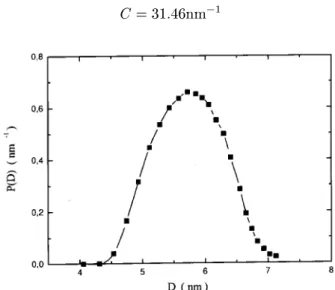
Now,weanalulatetheritialdiametersrelative
to eah temperatureusingEq. (11),obtainingthe
un-normalized partilesize distribution P(D). Using the
normalization equation [Eq. (12)℄, we obtainthe
nor-malizedpartilesizedistributionshowninFig. 5. The
alulatedvalueoftheonstantC is:
C=31:46nm 1
IV Conlusions
Theresultsreportedaboveareinagreementwiththose
reportedbyWirtzandFine[3℄whousedthetehnique
ofeletronmirosopytodeterminepartilesize
distri-butions inthissamesystemofmagnetipartiles.
Referenes
[1℄ R.S. de Biasi and T.C. Devezas, Proeedings of the
NinthInternationalColloquiumonMagnetiFilmsand
Surfaes,Poznan,Poland,p.38(1979).
[2℄ R.S.de Biasiand T.C. Devezas, J. Appl. Phys. 49, 4
(1978).
[3℄ G.P.WirtzandM.E.Fine,J.Am.Ceram.So.51,402
(1968).
[4℄ J.E.Wertzand J.R. Bolton, Eletron Spin Resonane,