A
r
ti
c
le
0103 - 5053 $6.00+0.00
*e-mail: [email protected]
Adsorption of Metal Ions on Novel 3-
n
-Propyl(Methylpyridinium) Silsesquioxane Chloride
Polymers Surface. Study of Heterogeneous Equilibrium at the Solid-Solution Interface
Hérica A. Magosso,a Natália Fattori,a Yuriy V. Kholinb and Yoshitaka Gushikem*,a
aInstitute of Chemistry, State University of Campinas, UNICAMP, P.O. Box 6154, 13083-970 Campinas-SP, Brazil
bMaterials Chemistry Department, V.N. Karazin Kharkiv Na tio nal University, 4 Svoboda Square,
Kharkiv, 61077, Ukraine
Os polímeros Si3Py+Cl- (A) e Si4Py+Cl- (B), cloretos de 3-n-propil(3-metilpiridínio)
silsesquioxano e 3-n-propil(4-metilpiridínio)silsesquioxano respectivamente, foram preparados pelo
método de síntese sol-gel. Os valores de capacidade de troca iônica (mmol g-1) foram iguais a 0,90 e
0,81 para (A) e (B), respectivamente. Considerando a reação nSiPy+Cl
-(s) + M 2+
(sln) + 2Cl
-(sln)
(SiPy+) nMCl2+n
n-
(s), as constantes de equilíbrio calculadas para cada etapa foram: (A): Cu
II, logK (2)
1=
4,14(0,03), logK(2)
2= 2,91(0,04); ZnII, logK
(2)
1= 3,3(0,3), logK
(2)
2= 4,9(0,3); (B): CuII, logK
(2) 1=
3,82(0,03), logK(2)2= 3,00(0,04); ZnII, logK
(2)
1= 3,93(0,03), logK
(2)
2= 3,55(0,08), onde K
(2) 1 e K
(2) 2
correspondem às constantes de equilíbrio de adsorção das espécies MCl42- e MCl
3
-, respectivamente.
No caso da adsorção de ZnII sobre Si3Py+Cl-, em que K
(2) 2 > K
(2)
1, uma cooperatividade positiva é
observada, ou seja, a adsorção da espécie MCl4
2- facilita a adsorção da espécie MCl
3
-. Nos demais
casos, K(2) 1> K
(2)
2, o que indica que a adsorção da espécie MCl
4
2- dificulta a adsorção da espécie
MCl3- na superfície dos adsorventes, indicando uma cooperatividade negativa.
Polymers Si3Py+Cl- (A) and Si4Py+Cl- (B), 3-n-propyl(3-methylpyridinium)silsesquioxane and
3-n-propyl(4-methylpyridinium)silsesquioxane chlorides, respectively, were prepared by the sol-gel
processing method. The ion exchange capacities (mmol g-1) were 0.90 and 0.81 for (A) and (B)
respectively. Considering the reaction nSiPy+Cl
-(s) + M 2+
(sln) + 2Cl
-(sln) (SiPy +)
nMCl2+n
n-(s),
the values of the stepwise equilibrium constants obtained were: (A) CuII: logK
(2)
1= 4.14(0.03),
logK(2)2= 2.91(0.04); ZnII, logK (2)
1= 3.3(0.3), logK
(2)
2= 4.9(0.3); (B) CuII:logK (2)
1= 3.82(0.03),
logK(2)
2= 3.00(0.04); ZnII, logK (2)
1= 3.93(0.03), logK
(2)
2= 3.55(0.08), being K
(2) 1 and K
(2) 2 the
equilibrium constants for adsorption of the species MCl4
2- and MCl
3
-, respectively. For adsorption
of ZnII on Si3Py+Cl-, K (2)
2 > K (2)
1, indicating positive cooperativity, i.e., the adsorption of
MCl42- enhances the adsorption of MCl
3
- species on the adsorbent surface. For the other cations,
K(2)1 > K (2)
2, indicating that adsorption of MCl
4
2- depresses the adsorption of MCl
3
- species, indicating
negative cooperativity.
Keywords: methylpyridinium, silsesquioxane modified polymer, adsorption, stability constants at heterogeneous surface, solid-solution interface
Introduction
In recent years the use of solids, modified or not with functional groups, presenting affinities towards several metal ions in solution phase has been reported. A large variety of materials such as zeolite, alumina and silica have been commonly used in metal adsorption processes. Other materials such as activated carbon, fly ash and red mud, calcium hydroxyapatite and modified amberlite have also been used in preconcentration and separation processes.1-7
organofunctionalized materials has been obtained by using the sol–gel processing method. This method is based on polycondensation reactions of functionalized alkoxysilane in the presence of tetralkylorthosilicate, in order to obtain a chemically modified silsesquioxane polymer.21-25 Prepared hybrid xerogels, in almost all solids obtained, present homogeneous distribution of the organic groups throughout the matrix volume. They have shown to be very promising as high capacity and efficient adsorbent materials.26-29
Despite the several works on the use of these modified solids reported in the literature, a better understanding of the adsorption mechanism on the surface of these solids is necessary. Normally, the model used has been the ideal process where interactions between the adsorbed species on the surfaces are neglected.30,31 Only in recent years the quantification and the mechanism of adsorption on these heterogeneous surfaces have been subject of detailed study.32-34 Methods based on this model of non ideal character have enabled the determination of stoichiometric composition and affinity constants of the species in equilibrium at the solid-solution interface.35
The present work describes two new hybrid materials obtained by sol-gel synthesis, denominated as 3-n -propyl-(3-methylpyridinium) silsesquioxane chloride (Si3Py+Cl-) and 3-n-propyl-(4-methylpyridinium) silsesquioxane chloride (Si4Py+Cl-), aiming at their use as adsorbent materials. They were applied in the adsorption processes of CuII and ZnII from ethanol solution. The mechanism of interaction between the adsorbed species on the solid surface is discussed in detail.
Experimental
Preparation of Si3Py+Cl- and Si4Py+Cl
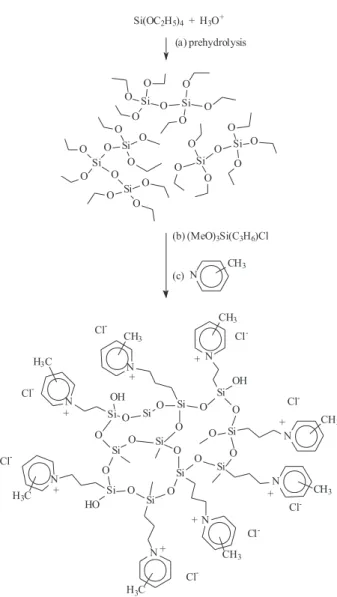
-The materials were prepared according to a previously described method.36 The idealized structure of the ion exchanger polymers Si3Py+Cl- and Si4Py+Cl- is shown in Figure 1.
Briefly, tetraethylorthosilicate (TEOS), ethanol and aqueous HCl solution were mixed in a round bottomed flask, and the resulting solution was stirred for 2.5 h at room temperature (298 K, step (a) in Figure 1). To this solution 3-n-chloropropyltrimethoxysilane, CPTS, was added, and the solution stirred for 2 h at room temperature (step (b)). The temperature of the solution was raised to 328 K and the mixture was allowed to stand for 60 h open to the ambient atmosphere until the gelation process occurred. The resulting gel was powdered, washed with ethanol and then dried under vacuum (133 x 10-3 Pa) at room temperature. The dry gel was immersed in a round
bottomed flask containing a solution prepared by mixing pure 3-methylpyridine or 4-methylpyridine and dry toluene (step (c)). Each mixture was heated at the reflux temperature of the solvent for approximately 3 h. The solids were filtered, washed with ethanol and dried for 2 h under vacuum (133 x 10-3 Pa) at room temperature.
Chemical analyses
The elemental analyses were carried out on a Perkin-Elmer model 2400 CHN analyzer. Triplicate measurements were made for each sample.
To determine the concentration of exchangeable chloride ions, approximately 0.050 g of material was immersed into 30 mL of 0.1 mol L-1 HNO
3 aqueous solution. The chloride ions released to the solution phase were titrated with standard 0.01 mol L-1 AgNO
3 solution, using the potentiometric titration method.
Figure 1. Fluxogram of the preparation of SiPy+Cl- by the sol-gel
Physical measurements
The CP-MAS 13C NMR spectra of the samples were obtained on a Bruker AC 300P spectrometer. A pulse sequence with contact time of 1ms, interval between pulses of 2 s and acquisition time of 133 ms was used.
The thermogravimetric analyses were made on a Dupont TGA 2050 apparatus. About 10 mg of each material was heated with a heating rate of 10 K min-1 in the temperature range between 298 and 1243 K, under nitrogen atmosphere.
MCl2 adsorption isotherms
The adsorption of CuCl2 and ZnCl2 from ethanol solutions by Si3Py+Cl- and Si4Py+Cl- was studied at 298 K by the batch technique. Solutions (50 mL) containing variable concentrations of the metal and about 50 mg of the adsorbent solid were shaken for 3 h at 298 K. The amount of metal ion adsorbed by the solid phase was calculated by applying the equation:
Nf = (Ni-Ns)/m
where Ni is the initial mole number of metal added, Ns is the mole number of the metal in the solution phase in equilibrium with the solid phase, and m is the mass of the solid phase. Ns was determined by complexometric titration using 0.01 mol L-1 standard edta solution.
Results and Discussion
Characteristics of the material
The results of elemental analyses and determination of exchangeable chloride ions in SiPy+Cl- are summarized in Table 1.
The results for N and Cl- contents indicate that the materials were prepared with good yield (practically 100%),
i.e., in step (c) of Figure 1, practically all metylpyridine reacted with the chloropropyl pendant groups. The molar ratios N/Cl- obtained from experimental data are 1.07 and 0.99 for Si3Py+Cl- and Si4Py+Cl-, respectively.
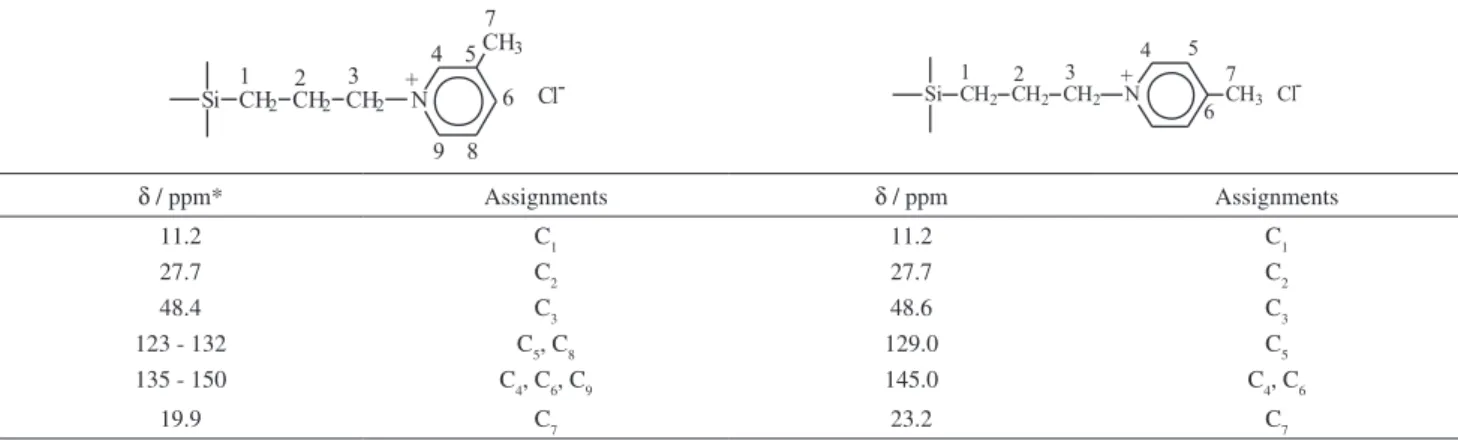
The 13C NMR spectral data for Si3Py+Cl- (a) and for Si4Py+Cl- (b) are summarized on Table 2. The chemical shifts observed fit those reported for similar materials.37-42
Infrared spectra of both samples showed two medium intensity absorption bands at 1635 and 1511 cm-1 (Si3Py+Cl-) and at 1636 and 1447 cm-1 (Si4Py+Cl-), assigned respectively to the ring coupled stretching vibration (νCC + νCN) and the deformation mode of the methyl group (δCH3)of the pyridinium group attached to the silsesquioxane framework (IR spectra are not shown).43
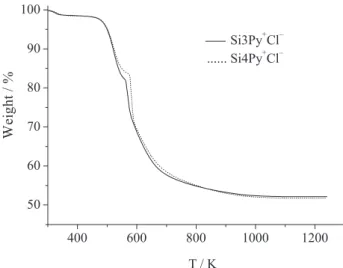
The results of thermogravimetric analyses (Figure 2) show that the materials are stable up to 522 K, decomposing above this temperature with loss of methyl pyridine molecules.
Adsorption isotherms
Figure 3 shows the adsorption isotherms for CuCl2 and ZnCl 2 on Si3Py+Cl- and Si4Py+Cl-,obtainedfrom ethanol solutions, at 298 K.
The adsorption process occurs according to the equilibrium reaction described by equation (1). The metal Table 1. Results of elemental analyses (C,H,N) and determination of ionized chloride (Cl-)
Material C / wt% H / wt% N / wt% Cl– / mmol g-1
Si3Py+Cl– 21.0 4.4 1.36 0.90
Si4Py+Cl– 22.0 4.2 1.11 0.80
Table 2. CP-MAS 13C NMR data for 3-n-propyl(3-methylpyridinium)silsesquioxane and for 3-n-propyl(4-methylpyridinium)silsesquioxane chlorides
δ / ppm* Assignments δ / ppm Assignments
11.2 C1 11.2 C1
27.7 C2 27.7 C2
48.4 C3 48.6 C3
123 - 132 C5, C8 129.0 C5
135 - 150 C4, C6, C9 145.0 C4, C6
19.9 C7 23.2 C7
Figure 3. Adsorption isotherms of MCl2 from ethanol solutions at 298 K: (a) CuCl2 and (b) ZnCl2 on Si3Py+Cl-; (c) CuCl
2 and (d) ZnCl2 on Si4Py +Cl. ()
experimental data, (---) calculated values by the bidentate binding model.
ion diffuses into the solid-solution interface followed by the counterion Cl-, forming the MCl
2+n
n- complex on the
surface, in order to keep the electroneutrality:
(1)
where SiPy+Cl- represents the 3-n -propyl(3-methyl-pyridinium) or 3-n-propyl(4-methylpyridinium) chloride pendant functional groups attached to the silica framework, n is number of the pendant groups in the reaction site and (s) and (sln) are the solid and solution phases, respectively. If n > 1, the pendant functional groups act as a set of spatially oriented polydentate cationic ligands. The dissociation and autocomplexation of MCl2 in solution phasecan be neglected, since they do not distort the main conclusions about the adsorption processes.44
Figure 2. Thermogravimetric analyses of the materials: (a) Si3Py+Cl- and
To describe quantitatively the adsorption equilibrium, one has to estimate the adsorption capacity of the material, tQ (in mol g-1), in respect to MCl
2 and constants of adsorption equilibria. The concentration of active binding groups (“effective capacity”) may differ significantly from the experimental capacity found by elemental analyses of Nf or from the ion exchange capacities determined by the ionized chloride. It depends on the stoichiometry of interactions of MCl2 with the active surface groups SiPy+Cl-, accessibility to sorption centers, their affinity by metal chlorides, nature of solvent and other factors. Therefore, this quantity should be determined together with the composition of surface complexes and their thermodynamic stability. All these tasks are solved by means of application of meaningful models for describing experimental adsorption isotherms.
In the simplest case, adsorption of metal chlorides may be described as a reaction between a sorbate entity S and an active sorption center:
(2)
where S is MCl2(sln), Q is the fixed active center (SiPy– +Cl -(s)), —
SQ ((SiPy+) nMCl2+n
n-(s)) is the surface complex, and β is the heterogeneous global or overall stability constant. When complexes —SQ of only one type are formed, all sorption centers Q are energetically homogeneous and lateral – interactions are absent, the sorption is of ideal character and can be described by the Langmuir equation in the linear form, represented by equation 3:
(3)
where [—SQ] is the specific concentration of adsorbed species S (in mol g-1), [S] is the equilibrium concentration (mol L-1), D-1 is the reciprocal of the distribution coefficient (in g L-1).
If the plot of D-1 versus [S] is linear, the model of ideal sorption is considered to be valid.45 The values of unknown parameters of the model, tQ and β, are calculated from the coefficients of a linear D-1versus [S] dependence.
Unfortunately, this simple model did not fit properly the experimental adsorption isotherms of MCl2. At the lower CuCl2 and ZnCl2 concentrations, deviation of the experimental D-1 values from the straight lines is observed (Figure 4), pointing to the non-ideal character of the adsorption process.
This non-ideal character of adsorption was interpreted in terms of the cooperativity effect, which will be discussed in detail at the end of this section. The affinity of the MCl2+n n-for the cationic pendant groups may be enhanced (positive cooperativity) or depressed (negative cooperativity) by a previous occupation of the site by a metal complex.46 The description of the non-ideality in terms of cooperativity effects was performed with the aid of the model of polidentate binding.47 According to it, the surface of a sorbent is considered as an assemblage of independent centers containing several SiPy+ cations and the respective number of Cl- ions as counterions. The simplest version, the model of bidentate binding, represents the adsorption process by the following equilibrium reactions:
(4)
(5)
where M = CuII or ZnII, β1 (2) and β
2
(2) are the global or overall stability constants:
Figure 4. Plots of D-1 versus [MCl
2] on Si3Py
+Cl- (A) and Si4Py+Cl- (B) in ethanol solution. () CuCl
(6)
and
(7)
where { } and [ ] indicate the concentrations in solid and solution phases.
The relation between β(2)1 and β (2)
2 is β (2)
2= K (2)
1K (2)
2 and
β(2) 1≡ K
(2)
1, where K (2)
i are the stepwise stability constants.
K(2)2 is defined as:
(8)
In the equations, the subscript corresponds to the number of functional groups −Py+Cl- included into one sorption center (in the present case, two sorption sites in each center) and the superscript is the order of the constant, i.e., the number of MCl2 entities attached to a sorption center. In equation (1) we observe that M2+ and Cl -dissociated species are adsorbed as neutral species MCl2, since in the diffusion process of MII into the solid-solution interface it is followed by the counterions.
The occupation of all sorption centers with MCl2 was not achieved in any case even at the highest MCl2 concentration studied. Because of this, the maximum reached Nf values gave only rough estimations of the adsorption capacity, tQ. Therefore, it was necessary to estimate simultaneously all fitting parameters of the model, i.e., tQ, β(2)1 and β
(2) 2.
The possible values of sorption capacities tQ were scanned, and for each tested tQ value, the values of fitting parameters β(2)1 and β
(2)
2 were calculated through
minimization of the criterion:
(9)
where k is the kth experimental points, ∆ = N f calc - N
f exp, and
wk is the statistical weight assigned as
(10)
with σr = 0.05 (5%) as the relative random error in the Nf determination. The global criterion χ2 was applied to test the statistical adequacy of the models. The models were assumed to be adequate if the following inequality was fulfilled:
, (11)
where χ2 (5%) is the 5% point of the chi-squared distribution with f degrees of freedom (f = N-Z, where Z is the number of unknown equilibrium constants and N is the total number of experimental points). The tQ value (and the corresponding values of equilibria constants), which resulted in the minimum value of χ2
exp, was accepted as the most trustworthy estimations that provided the best fit of the measured sorption isotherm. All calculations for the model of bidentate binding were performed with the aid of the CLINP 2.1 software program.48,49 The results of simulations are summarized in Table 3. The calculated isotherms (dotted lines) are shown in Figure 3.
In order to have a better understanding of the adsorption mechanism, and taking into account that all stepwise constants were calculated, the distribution coefficients,
αi,were determined for S1, S2 and S3 species by applying the equation:
(12)
where
(13)
The dependencies of the distribution coefficients, αi,, of the surface complex species, MCl42-(S
2) and MCl3 -(S
3), and the corresponding concentration of the free pendant center SiPy+Cl- (S
1) are shown in Figure 5.
The calculated values of αi for CuCl2 adsorption on Si3Py+Cl- and Si4Py+Cl- (Figure 4a and 4c) and for ZnCl
2 adsorption on Si4Py+Cl- (Figure 4d) indicate that both species MCl42- and MCl
3
- are adsorbed on the adsorbents
surface over the whole concentration range of MCl2 in solution. The correlation between stepwise equilibrium constants for these three cases (Table 3) is K2
(2) < K 1
(2), showing that the negative cooperativity effect is operating. In this case, the formation of MCl42- species (S
Figure 5. Plots of distribution coefficients, αi,of species (S1), (S2) and (S3) versus MCl2 concentrations in ethanol solutions: (a) CuCl2 and (b) ZnCl2 on Si3Py+Cl-; (c) CuCl
2 and (d) ZnCl2 on Si4Py
+Cl-.
Table 3. Calculated values of the adsorption capacity, tQ, global stability constants, β(2)i , and stepwise stability constants, K (2)
i,based on the bidentate
binding center model
Si3Py+Cl- Si4Py+Cl
-CuCl2 ZnCl2 CuCl2 ZnCl2
tQ / mmol g-1 0.41 0.32 0.44 0.48
log β(2)1≡ logK (2)
1 4.14 (0.03)* 3.3 (0.3) 3.82 (0.03) 3.93 (0.03)
log β(2)
2 7.05 (0.03) 8.22 (0.06) 6.82 (0.08) 7.48 (0.07)
log K(2)2 2.91 (0.04) 4.9 (0.3) 3.00 (0.09) 3.55 (0.08)
* The values in parenthesis are the standard deviations of parameters.
is depressed. For adsorption of ZnCl2 on Si3Py+Cl- (Figure 4b), Table 3 shows that K2
(2) > K 1
(2), indicating a positive cooperativity effect, i.e., adsorption and formation of MCl3 -is enhanced in the presence of MCl42- in the adsorption site. ZnCl3- species is formed predominantly over the whole concentration range of ZnCl2 in the solution phase.
Conclusions
spectra, thermogravimetric and elemental analyses and by ionized chloride determination.
Adsorption of ZnCl2 and CuCl2 from ethanol solutions on the sorbent materials occurred considering that each center of adsorption was formed by two neighboring SiPy+Cl- functional groups spatially orientated as a bidentate ligand. Considering the ability of copper and zinc chlorides in forming MCl2+nn- complexes,46 the values of t
Q and the two stepwise equilibrium constants were calculated for MCl2 adsorption on both Si3Py+Cl- and Si4Py+Cl- solid surfaces. The simulations demonstrated that, for systems where the negative cooperativity effects are observed, both MCl3- and MCl
4
2-species can coexiston the surface,
except for ZnCl2 adsorption on Si3Py+Cl-, where positive cooperativity is observed.
Taking into account the high affinity shown by both materials, Si3Py+Cl- and Si4Py+Cl-,to CuII and ZnII chlorides, the novel silsesquioxane polymers modified with 3- and 4-methylpyridinium chloride are potentially useful in adsorption processes of these metals and extensible for other similar metal halides.
Acknowledgments
HAM is indebted to FAPESP for a pos-doctoral fellowship, NF to PIBIC-CNPq for an undergraduate student fellowship, and YG to FAPESP for financial support (grant 00-11103-5).
References
1. El-Naggar, I. M.; Abou-Mesalam, M. M.; J. Hazard. Mater.
2007, 149, 686.
2. Pavan, F. A.; Costa, T. M. H.; Benvenutti, E. V.; Colloids Surf., A 2003, 226, 95.
3. Valcárcel, M.; Cárdenas, S.; Simonet, B.M.; Moliner-Martínez, Y.; Lucena, R.; Trends Anal. Chem. 2008, 27, 34.
4. Goyal M.; Rattan, V. K.; Aggarwal, D.; Bansal, R. C.; Colloids Surf. 2001, 190, 229.
5. Wang, S.; Boyjoo, Y.; Choueib, A.; Zhu, Z. H.; Water Res. 2005,
39, 129.
6. Yasukawa, A.; Yokoyama, T.; Kandori, K.; Ishikawa, T.;
Colloids Surf., A 2007, 299, 203.
7. Baytak, S.; Turker, A. R.; Microchim. Acta 2005, 149, 109. 8. Sirola, K.; Laatikainen, M.; Paatero, E.; Colloids Surf., A 2007,
296, 158.
9. Dias Filho, N. L.; Gushikem, Y.; Sep. Sci. Technol. 1997, 32, 2535.
10. Moreira, J. C., Gushikem, Y., Anal. Chim. Acta 1985, 176, 263. 11. Dias Filho, N. L.; Carmo, D. R.; Rosa, A. H.; Electrochim. Acta
2006, 52, 965.
12. Dias Filho, N. L. in: Encyclopedia of Surface and Colloid Science, vol. 1, 2nd ed., Taylor & Francis: New York, 2006, p.
229.
13. Dias Filho, N. L.; Carmo, D. R.; in Encyclopedia of Surface and Colloid Science, vol. 1, 2nd ed., Taylor & Francis: New York,
2006, p. 209.
14. Dias Filho, N. L.; Carmo, D. R.; Rosa, A. H.; Sep. Sci. Technol.
2006, 41, 733.
15. Fonseca, M. G.; Espínola, J. G. P.; Oliveira, S. F.; Santos, L. C. R.; Souza, A. G.; Airoldi, C.; Colloids Surf., A 1998, 133, 205.
16. Gomes, L. A. M.; Padilha, P. M.; Moreira, J. C.; Dias Filho, N. L.; Gushikem, Y.; J. Braz. Chem. Soc. 1998, 9, 494.
17. Deschler, U.; Kleinschmit, P.; Panster, P.; Angew. Chem. Int. Ed. Engl. 1986, 25, 236.
18. Alfaya, R. V. S.; Gushikem, Y.; J. Colloid Interface Sci. 1999,
213, 438.
19. Lazarin, A. M.; Gushikem, Y.; J. Braz. Chem. Soc. 2002, 13, 88. 20. Splendore, G.; Benvenutti, E. V.; Kholin, Y. V.; Gushikem, Y.;
J. Braz. Chem. Soc. 2005, 16, 147.
21. Pavan, F. A.; Franken, L.; Moreira, C. A.; Costa, T. M. H.; Benvenutti, E. V.; Gushikem, Y., J. Colloid Interface Sci. 2001,
241, 413.
22. Shea, K. J.; Loy, D. A.; Chem. Mater. 2001, 13, 3306. 23. Pavan, F. A.; Hoffmann, H. S.; Gushikem, Y.; Costa, T. M. H.;
Benvenutti, E. V.; Mater. Lett. 2002, 55, 378.
24. Schubert, U.; Hüsing, N.; Lorenz, A.; Chem. Mater. 1995, 7, 2010.
25. Im, H. J.; Yang, Y.; Allain, L. R.; Barnes, C. E.; Dai, S.; Xue, Z.; Environ. Sci. Technol. 2000, 34, 2209.
26. Lee, B.; Kim, Y.; Lee, H.; Yi , J.; Microporous Mesoporous Mater. 2001, 50, 77.
27. Gushikem, Y.; Benvenutti, E. V.; Kholin, Y. V.; Pure Appl. Chem.
2008, 80, 1593.
28. Burleigh, M. C.; Dai, S.; Hagaman, E. W.; Lin, J. S.; Chem. Mater. 2001, 13, 2537.
29. Vaghetti, J. C. P.; Zat, M.; Bentes, K. R. S.; Ferreira, L. S.; Benvenutti, E. V.; Lima, E. C.; J. Anal. At. Spectrom. 2003, 18, 376. 30. Gushikem, Y.; Moreira, J. C.; J. Colloid Interface Sci. 1985,
107, 70.
31. Gushikem, Y.; Moreira, W. C.; Colloids Surf. 1987, 25, 155. 32. Alfaya, R. V. S.; Fujiwara, S. T.; Gushikem, Y.; Kholin, Y. V.;
J. Colloid Interface Sci. 2004, 269, 32.
33. Pissetti, F. L.; Magosso, H. A.; Yoshida, I. V. P.; Gushikem, Y.; Myernyi, S. O.; Kholin, Y. V.; J. Colloid Interface Sci. 2007,
314, 38.
34. Lucho, A. M. S.; Panteleimonov, A. V.; Kholin, Y. V.; Gushikem, Y.; J. Colloid Interface Sci. 2007, 310, 47.
35. Kholin, Y.; Zaitsev, V.; Pure Appl. Chem. 2008, 80, 1561. 36. Gushikem, Y.; Magosso, H. A.; Fattori, N.; Br PI 0703801-1,
37. Yang, J.; El-Nahhal, I.; Maciel, G. E.; J. Non-Cryst. Solids 1996,
204, 105.
38. Bayer, G.; Albert, K.; Reiners, J.; Nieder, M.; J. Chromatogr.
1983, 264, 197.
39. Maciel, G. E.; Sindorf, D. W.; Bartuska, V. J.; J. Chromatogr.
1981, 205, 438.
40. Silverstein, R. M.; Bassler, G.C.; Morrill, T.C.; Identificação Espectrométrica de Compostos Orgânicos, 6th ed., Livros Técnicos e Científicos: Rio de Janeiro, 2000.
41. Selvakumar, K.; Vancheesan, S.; Polyhedron 1995, 14, 2091. 42. Giovagnini, L.; Marzano, C.; Bettio, F.; Fregona, D.; J. Inorg.
Biochem. 2005, 99, 2139.
43. Kova´cs, A.; J. Mol. Struct. 1999, 482, 397.
44. Lazarin, A. M.; Landers, R.; Kholin, Y. V.; Gushikem, Y.;
J. Colloid Interface Sci. 2002, 254, 31.
45. Adamson, A. W.; Gast, A. P.; Physical Chemistry of Surfaces,
6th ed., Wiley-Interscience: USA, 1997.
46. Braibanti, A., Fisicaro, E.; Compari, C.; Ghiozzi, A.; Rao, R. S.; Rao, G. N.; React. Funct. Polym. 1998, 36, 245.
47. Lucho, A. M. S., Panteleimonov, A. V., Kholin, Y. V.; Gushikem, Y.; J. Colloid Interface Sci. 2007, 310, 47.
48. Merny, S. A.; Konyaev, D. S.; Kholin, Y. V.; Kharkov University Bulletin 1998, 420, 112.
49. http://www.bestnet.kharkov.ua/kholin/clinp.html, accessed in April 2008.
Received: November 12, 2008
Web Release Date: April 30, 2009
![Figure 4. Plots of D -1 versus [MCl 2 ] on Si3Py + Cl - (A) and Si4Py + Cl - (B) in ethanol solution](https://thumb-eu.123doks.com/thumbv2/123dok_br/18993526.461473/5.892.69.794.113.395/figure-plots-versus-mcl-si-py-ethanol-solution.webp)