486 J. Cabral Ribeiro, L. Sousa, C. Calaza et al.
Case Reports
Arch. Esp. Urol. 2009; 62 (6): 486-488ACUTE SEGMENTAL RENAL INFARCTION DUE TO FACTOR V LEIDEN
Jorge Cabral Ribeiro, Lemos Sousa, Carlos Calaza1
and Américo Santos.
Department of Urology and Imunohemotherapy1. Hospital São Marcos. Braga. Portugal.
@
CORRESPONDENCE
Jorge Cabral Ribeiro
Servicios de Urologia e Imunohemoterapia
Hospital de São Marcos
Apartado 2242
4701-965 Braga. Portugal
[email protected]
Accepted for publication: July 25th, 2008.
Resumen.- OBJETIVO: El infarto renal es raro y la pre-sentación clínica inconstante causa dificultades diagnós-ticas. Aunque la mayoría de los infartos renales son cau-sados por factores tromboembólicos obvios, algunos sólo se explican por una trombofilia hereditaria o adquirida. Los autores presentan un caso de infarto renal segmentario asociado al factor V Leiden.
MÉTODO/RESULTADOS: Hombre de 48 anos presentó con síntomas sugestivos de cólico nefrítico pero la resis-tencia a analgesia resultó en la realización de un TAC renal que reveló un infarte segmentario del riñón derecho. Lo estudio fue solamente positivo para a presencia de lo Factor V de Leiden. A pesar del diagnóstico y tratamiento el retraso resultó en atrofia del área renal afectada. CONCLUSIONES: El infarto renal puede ser la presenta-ción de una trombofilia y ésta debería ser pesquisada en la ausencia de factor embolico evidente. La utilización del TAC renal facilita lo diagnóstico y pronto tratamiento.
Palabras clave: Infarto renal. Infarto renal segmen-tario. Trombofilia. Factor V Leiden.
Summary.- OBJECTIVE: Renal infarction is rare and has variable clinical presentations causing diagnostic difficulties. Although most renal infarctions are caused by an obvious thromboembolic factor some are only explained by heredita-ry or acquired thrombophilia. The authors present a case of segmental renal infarction associated with factor V Leiden.
Keywords: Renal infarction. Segmental renal infarction. Prothrombotic disorders. Factor V Leiden.
INTRODUCTION
Acute loin pain frequently caused by renal stone disea-ses can rarely be the presentation of renal vascular oc-clusions. Renal infarct remains a late and underdiagno-sed entity in spite of the knowledge of the clinical picture and of the predisposing factors.
We report a segmental renal infarct caused by inherited prothrombotic disorder.
METHODS/ RESULTS: A 48-year-old man presented with right flank pain that was unresponsive to analgesia for re-nal colic. CT scan was performed revealing a partial rere-nal infarction. The etiologic study was only positive to factor V Leiden. In spite of the diagnosis and treatment it resulted in atrophy of the affected renal area.
CASE REPORT
A 48-year male patient presented to ED with severe acu-te right loin pain, nausea and vomiting. In spiacu-te of unre-markable past medical history even for stone disease a prompt clinical diagnosis of renal colic was undertaken and he started intravenous analgesia.
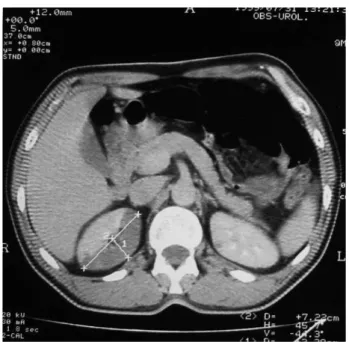
For persisting and aggravating pain further work-up was entertained. Blood analyses revealed left shift leucocito-sis, elevation of alanine and aspartate aminotransfera-ses (ALT and AST) and of the serum lactic desydrogenase (LDH - 3xN) and normal renal function. Facing a normal ultrasound we performed a contrast enhanced CT scan that revealed absence of perfusion territory of the poste-rior segmentary right renal artery (Figure 1).
He began systemic hypo coagulation with intravenous heparin and maintained warfarin for six months. After a transient hyperthermia he became totally asymptomatic on the third day. Analytical changes resolved progres-sively.
A thorough search for a cause of the vascular occlusion excluded all embolic risk factors compelling a screen for a thrombophylia (Table I). This was positive for a resistance to activated C protein, due to heterozygocy to factor V of Leiden.
The patient remains asymptomatic and on ticlopidin hydrochloride. Control CT scan reveal atrophy of the posterior aspect of the right kidney.
DISCUSSION
The renal infarct is a rare event accounting for 0,004 to 0,007% of all admissions to the emergency department (1). The increasing awareness of the clinical presentation and predisposing factors and mainly by improvements in renal imaging is becoming more efficiently diagnosed. But still remains a missed diagnosis in over half of cases at initial ED visit that leads often to a extended diagnos-tic delay (2 to 336h) (1,2).
The intense sharp lumbar aggravating pain unresponsi-ve to therapy is the most frequent symptom (61%), ac-companied of nauseas and vomiting (3). But it can be totally asymptomatic or with atypically located pain to the superior quadrants of the abdomen, back, or thorax, thus causing diagnostic difficulties with colecistitis, pan-creatitis or acute myocardial infarct (4).
The physical exam reveals a distressed patient with pain to the percussion of the flank. Analytically they present leucocytosis, elevation of the sedimentation rate and of the enzymatic values of AST, ALT, and LDH. LDH is the most sensitive marker (1,2,4). The triad of pain, elevated LDH and proteinuria and/or hematuria is present in over 80% of cases (1,5).
Although renal ultrasound can detect changes in the re-nal tissue perfusion with use of Doppler, the contrasted enhanced renal CT scan is the most reliable and easily obtained method of diagnosis in ED (4,5).
The heart diseases accounts for more than 90% of the cases of renal embolism. Other rarer causes include the displasia of the renal artery, aneurysms, connective tis-sue diseases, vasculitis, cholesterol embolism and trauma (4,5). The hipercoagulability states, typically associated with vein thrombosis are becoming more accounted by arterial vascular events (1,7,8).
The factor V of Leiden is the most common inherited thrombophilia in Caucasians (5% of population). It is characterized by a genomic substitution that maintains unaffected clothing activity but it becomes resistant to the inactivation by the activated C protein, thus favouring thrombosis.
Therapeutic guidelines have not yet been established but the aim of treatment is to preserve (re-establish renal per-fusion) renal function and the treatment of the underlying cause. The therapeutic options include conservative measures with systemic anticoagulation, early use of (90
487 ACUTE SEGMENTAL RENAL INFARCTION DUE TO FACTOR V LEIDEN
to 180 min from onset of symptoms) fibrinolitic agents (intra-arterial or in situ associated with an angioplasty), and surgical embolectomy (1,2,4,5).
The emergence of trombolytic therapy (streptokinase, urokinase or tissue plasminogen activator factor) (5) associated to intra-arterial use the balloon angioplasty, makes possible a renal salvation in the order of 70-86% with low morbidity.
As renal viability depends on the precocity of diagnosis, the collateral renal circulation and the efficacy of treat-ment, a high clinical suspicion is necessary for prompt diagnosis mainly in the absence of underlying heart di-sease. Segmental renal infarction can be the presenta-tion of a trombofilia and should de addressed in the absence of evident embolic factor. Contrasted renal CT scan provides a fast diagnosis and enables the preco-cious use of the thrombolytic treatment associated with anticoagulation.
Hereditary thrombophylia
Protein C deficiency
Protein S deficiency
Antothrombin III deficiency
Factor V Leiden (activated protein C resistance)
Hyperhomocysteinemia
Dysfibrinogenemia
Plasminogen activator inhibitor deficiency
Acquired thrombophylia
Dislipidemia
Antiphospholipid antibody sindrome
Sifilis
Vasculitis (LES, poliartritis nodosa)
Malignancy
Multiple mieloma
Lupus anticoagulant
Anticardiolipin antibody
Nephrotic syndrome TABLE I. HEREDITARY AND ACQUIRED THROMBOPHYLIA.
Huang CC, Lo HC, Huang HH, et al. ED presen-tations of acute renal infarction. Am J Emerg Med 2007, 25:164-9
Chu PL, Wei YF, Chen SI, Chu TS, Wu KD. Clinical characteristics of patients with segmental renal in-farction. Nephrology 2006, 11:336-40
López AB, Lema PL, Lorenzo J, López CB, et al. El infarto renal en l valoración de dolores lumbares. Arch Esp Urol 2008; 61(5):646-9
Gasparini M, Hofmann R, Stoller M. Renal artery embolism: Clinical features and therapeutic options. J Urol 1992;147:567-572
Xambre L, Cerqueira M, Silva V, Almeida M, et al: Isquemia renal aguda – causa rara de lumbalgia. Ac-tas Urol Esp 2005; 29(3)322-31
Lummerman JH, Hom D, Eiley D, Smith AD. Heig-htened suspicion and rapid evaluation with CT for early diagnosis of partial renal infarction. J Endourol 1999, 13:209-14
Le Moine A, Chauveau D, Grunfeld JP. Acute re-nal artery thrombosis associated with factor V Lei-den mutation. Nephrol Dialysis Transplant 1996, 11,2067-9
Kirchgatterer A, Lugmayar H, Aspock G, et al. Re-nal infarction due to combination of fibromuscular dysplasia and factor V Leiden mutation. Nephrol Dial Transplant 2004, 19:512
**1. *2. 3. **4. **5. *6. 7. 8.
REFERENCES AND RECOMENDED READINGS (*of special interest, **of outstanding interest)