Case Report
Key words
Aortic valve / abnormalities; aortic valve insufficiency; echocardiography.
A 55-year-old woman seeks medical attention with palpitations, atypical chest pain and dyspnea upon exertion, lasting for 12 months. ECG showed left ventricular hypertrophy.
Transthoracic Doppler echocardiogram confirmed hypertrophy of the left chambers and showed a quadricuspid aortic valve, with equal-sized cusps, in addition to a moderate regurgitant central flow.
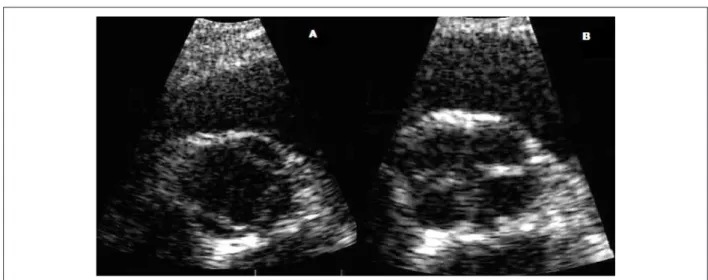
Upon echocardiography, the quadricuspid valve is identified by its characteristic “X” form during diastole and rectangular aspect during systole. Heart failure symptoms are presumably caused by valve insufficiency due to abnormal leaflet coaptation.
Considering the possibility of progressive regurgitation, follow up on the patient was performed with periodic echocardiographic control. Symptoms responded to treatment.
Quadricuspid Aortic Valve by Transthoracic Echocardiography
Erlon Oliveira de Abreu Silva
1, Alessandro Giralde Iglesias
2, Erlon de Abreu Silva
2Complexo Hospitalar Santa Casa de Porto Alegre1, Centro de Diagnóstico Cardiológico2, Porto Alegre, RS, Lages, SC - Brazil
Mailing Address: Erlon Oliveira de Abreu Silva•
Rua Casemiro de Abreu, 725/302, Rio Branco, 90420-001, Porto Alegre, RS - Brazil
E-mail: [email protected]
Manuscript received August 7, 2007; revised manuscript received September 5, 2007; accepted September 26, 2007.
Introduction
Quadricuspid aortic valve is a rare finding, with an incidence varying between 0.008 and 0.033%1, and, in general, is not associated with other conditions. The first related cases were based on necropsy, aortographic or perioperativefindings2.
More recently, echocardiography, especially with Doppler, has facilitated early diagnosis of four-cusp aortic valves, evaluation of their function and follow-up.
Our purpose is to report the incidental finding of a quadricuspid aortic valve by transthoracic Doppler echocardiography in a case of valve regurgitation.
Case Report
A 55-year-old woman seeks medical attention with palpitations, atypical chest pain and dyspnea upon exertion, for the 12 previous months. There is no prior history of
rheumatic fever, hypertension or other comorbidities. Upon examination, heart rate was 84, blood pressure 130x80mmHg, and there was a diastolic murmur at the aortic position (3+/6+). Chest radiograph revealed augmented cardiac area and the 12-lead ECG showed left ventricular hypertrophy.
Transthoracic echocardiogram revealed moderate left ventricular enlargement and preserved ejection fraction. The mitral valve had a minimum prolapse of the anterior leaflet, with no dysfunction. Tricuspid and pulmonary valves were normal. The aortic valve had four equal-sized cusps (Figures 1), and a moderate regurgitant central flow on Doppler (Figure 2).
Clinical follow -up was indicated with periodic echocardiographic control. Symptoms responded to beta-blocker therapy.
Discussion
Semilunar valve alterations are among the most common cardiac malformations. In contrast to bicuspid aortic valve – present in 2% of population – the finding of a quadricuspid aortic valve is extremely rare, with an incidence between 0.008 and 0.033%1, 3, 4.
The first report of a quadricuspid aortic valve, in 1862, comes from necropsy data; and the first echocardiographic finding is from 19843. Since then, the frequency of this diagnosis has been increasing.
Normally, it presents itself as an isolated condition but may be associated with interventricular septum defect, patent ductus arteriosus, coronary ostium alterations and other valvular defects as well1, 4.
Aortic regurgitation, caused by abnormal leaflet coaptation, is common. Some authors suggest fibrous thickening1,4, while others propose unequal distribution of transvalvar stress – because of the fourth cusp1 –, as the pathophysiological mechanism for valvular insufficiency. Stenosis is rare.
On echocardiography, the quadricuspid valve is identified by its characteristic “X” configuration during diastole (different from the “Y” of normal tricuspid aortic valve) and rectangular aspect during systole1,3,4. According to the Hurwitz and Roberts’5 classification, considering the size of leaflets, only 12% of quadricuspid aortic valves have four equal-sized leaflets.
There is no agreement about which, transthoracic or transesophageal, is the best echocardiographic technique for this diagnosis. However, it is known that the use of Doppler has made the examination more sensitive in
Case Report
De Abreu Silva et al Quadricuspid aortic valve
Arq Bras Cardiol 2008; 91(2) : e21-e24
Figure. 1 -Quadricuspid aortic valve during systole, showing the typical rectangular aspect (A); and during diastole, demonstrating the “X” coniguration of the four
closed lealets (B).
Figure 2 -Doppler image of regurgitant low.
demonstrating the retrograde flow through the valve, even when there is no clinical repercussion, facilitating early diagnosis of aortic regurgitation.
Taking into account the technological development of echocardiographic equipment, and its availability as a non-invasive diagnostic tool, it is feasible to detect, follow and diagnose possible complications of quadricuspid aortic valves even in asymptomatic individuals.
Potential Conflict of Interest
No potential conflict of interest relevant to this article was reported.
Sources of Funding
There were no external funding sources for this study.
Study Association
This study is not associated with any graduation program.
Case Report
References
1- Feldman BJ, Khanderia BK, Warnes CA, Seward JB, Taylor CL, Tajik AJ. Incidence, description and functional assessment of isolated quadricuspid aortic valves. Am J Cardiol. 1990; 65: 937-8.
2- Robicsek F, Sanger PW, Daugherty HK, Montgomery CC. Congenital quadricuspid aortic valve with displacement of the left coronary orifice. Coll Works Cardiopulm Dis. 1968; 14: 87-90.
3- Charandrasekaran K, Tajik AJ, Edwards WD, Seward JB. Two-dimensional
De Abreu Silva et al Quadricuspid aortic valve
Arq Bras Cardiol 2008; 91(2) : e21-e24
echocardiografic diagnosis of quadricuspid aortic valve. Am J Cardiol. 1984; 53: 1732-3.
4- Barbosa MM, Motta MS. Quadricuspid aortic valve and aortic regurgitation diagnosed by Doppler echocardiography: report of two cases and review of the literature. J Am Soc Echocardiogr. 1991; 4: 69-74.
5- Hurwitz LE, Roberts WC. Quadricuspid semilunar valve. Am J Cardiol. 1973; 31: 623-6.