319
Radiol Bras. 2012 Nov/Dez;45(6):319–325
Whole-body MRI: comprehensive evaluation on a 48-channel
3T MRI system in less than 40 minutes. Preliminary results
*
RM de corpo inteiro: avaliação de protocolo em equipamento 3T com 48 canais em menos de 40 minutos. Resultados preliminares
Mateus de Andrade Hernandes1, Richard C. Semelka2, Jorge Elias Júnior3, Saraporn Bamrungchart1, Brian M. Dale4, Clifton Stallings5
Objective: To evaluate a comprehensive MRI protocol that investigates for cancer, vascular disease, and degenerative/ inflammatory disease from the head to the pelvis in less than 40 minutes on a new generation 48-channel 3T system. Materials and Methods: All MR studies were performed on a 48-channel 3T MR scanner. A 20-channel head/neck coil, two 18-channel body arrays, and a 32-channel spine array were employed. A total of 4 healthy individuals were studied. The designed protocol included a combination of single-shot T2-weighted sequences, T1-weighted 3D gradient-echo pre- and post-gadolinium. All images were retrospectively evaluated by two radiologists independently for overall image quality. Results: The image quality for cancer was rated as excellent in the liver, pancreas, kidneys, lungs, pelvic organs, and brain, and rated as fair in the colon and breast. For vascular diseases ratings were excellent in the aorta, major branch vessel origins, inferior vena cava, portal and hepatic veins, rated as good in pulmonary arteries, and as poor in the coronary arteries. For degenerative/inflammatory diseases ratings were excellent in the brain, liver and pancreas. The inter-observer agreement was excellent. Conclusion: A comprehensive and time efficient screening for important categories of disease processes may be achieved with high quality imaging in a new generation 48-channel 3T system. Keywords: Whole-body MRI; Screening; Protocol; Preliminary results; 3 tesla.
Objetivo: Avaliar protocolo de RM para investigação de neoplasia, doenças vascular e degenerativa/inflamatória da cabeça à pelve em menos de 40 minutos em equipamento 3T com 48 canais. Materiais e Métodos: Todos os exa-mes foram realizados em equipamento 3T com 48 canais. Foram utilizadas bobinas de cabeça/pescoço (20 canais), duas de corpo interligadas (18 canais) e uma de coluna (32 canais). Quatro voluntários saudáveis foram estudados. Foi utilizado protocolo com sequências single shot pesadas em T2 e gradiente-eco 3D pesadas em T1 pré e pós-ga-dolínio. Todas as imagens foram avaliadas quanto à qualidade, retrospectivamente, por dois radiologistas de forma independente. Resultados: A qualidade da imagem foi classificada como excelente para o fígado, pâncreas, rins, pulmões, órgãos pélvicos e encéfalo, e como adequada para cólon e mamas. Para as doenças vasculares as imagens foram classificadas como excelentes para aorta e seus ramos principais, veia cava inferior, veias porta e hepáticas, como boas para artérias pulmonares, e como inadequadas para coronárias. As classificações para doenças degene-rativas/inflamatórias foram excelente no encéfalo, fígado e pâncreas. A concordância interobservador foi excelente. Conclusão: Um rastreamento abrangente de importantes categorias de doenças pode ser realizado utilizando ima-gens de alta qualidade obtidas em uma nova geração de equipamento 3T com 48 canais.
Unitermos: RM de corpo inteiro; Screening; Protocolo; Resultados preliminares; 3 tesla. Abstract
Resumo
* Study developed at Department of Radiology, University of North Carolina, Chapel Hill, NC, USA.
1. MDs, Research Fellows, Department of Radiology, Univer-sity of North Carolina, Chapel Hill, NC, USA.
2. MD, Professor, Department of Radiology, University of North Carolina, Chapel Hill, NC, USA.
3. MD, PhD, Professor, Imaging and Medical Physics Center, School of Medicine of Ribeirão Preto, University of São Paulo, Ribeirão Preto, SP, Brazil.
4. PhD, Siemens Medical Solutions USA, Inc., Cary, NC, USA. 5. RTS, MRI Chief Technologist, Department of Radiology, University of North Carolina, Chapel Hill, NC, USA.
Mailing Address: Richard C. Semelka. The University of North Carolina at Chapel Hill, Campus Box# 7510, 2001 Old Clinic Bldg, Chapel Hill, NC 27599-7510. Email: [email protected] Received February 5, 2012. Accepted after revision Septem-ber 11, 2012.
Hernandes MA, Semelka RC, Elias Jr J, Bamrungchart S, Dale BM, Stallings C. Whole-body MRI: comprehensive evaluation on a 48-channel 3T MRI system in less than 40 minutes. Preliminary results. Radiol Bras. 2012 Nov/Dez;45(6):319–325.
Since its early description, whole-body MRI has been considered a promising tool for detection of disease. The greater intrin-sic soft tissue contrast resolution and greater sensitivity for intravenous contrast of MRI over CT, allied with the lack of radiation exposure and safer contrast ma-terials, make MRI an excellent choice for screening purposes. However, whole-body MRI with surface coils and conventional sequences is time consuming and costly. The introduction of faster gradient MRI systems, parallel acquisition strategies, re-INTRODUCTION
mote control of table motion, together with interconnection of multiple multichannel phased-array coils, has improved the spa-tial resolution and speed of data acquisi-tion, and rendered whole-body MRI diag-nostically accurate and fast(3–5). It remains important, however, to select the diseases that are of interest for screening because it is still not practicable to study the entire body with dedicated high-spatial-resolu-tion MR sequences due to time constraints. Other authors have shown the useful-ness of whole-body MRI to screen for a variety of diseases, mostly evaluating ves-sels with MR angiography technique, and in the detection of metastatic cancer(6–12). These strategies, however, do not evaluate the whole body in a comprehensive fash-ion for the majority of important diseases, including cancer, vascular and degenera-tive/inflammatory diseases.
Therefore, the aim of our study was to prospectively evaluate the feasibility of a comprehensive, less than 40 minutes, whole-body MRI protocol, employing a
combination of sequences to evaluate a full range of disease processes on a 48-channel 3.0T MR system, with the injection of in-travenous gadolinium-based contrast and multiple interconnected regional coils. We describe the strengths of this approach, and the areas where further work is necessary.
MATERIALS AND METHODS
Patients
The study population was comprised of 4 individuals (3 males and 1 female; age range of 28–50 years; mean age of 40 years). Signed informed consent was obtained in accordance with the Institutional Review Board requirements. All subjects were healthy, worried well individuals undergo-ing screenundergo-ing procedure.
Imaging technique
All MR studies were performed on a new generation 3T MR scanner equipped with 48 channels (Skyra; Siemens, Malvern, PA). A 20-channel head/neck coil, two
18-channel body arrays, and a 32-18-channel spine array were employed in all subjects. Patients were supine and placed head first in the scanner. Sequences employed were either breath hold or breathing inde-pendent.
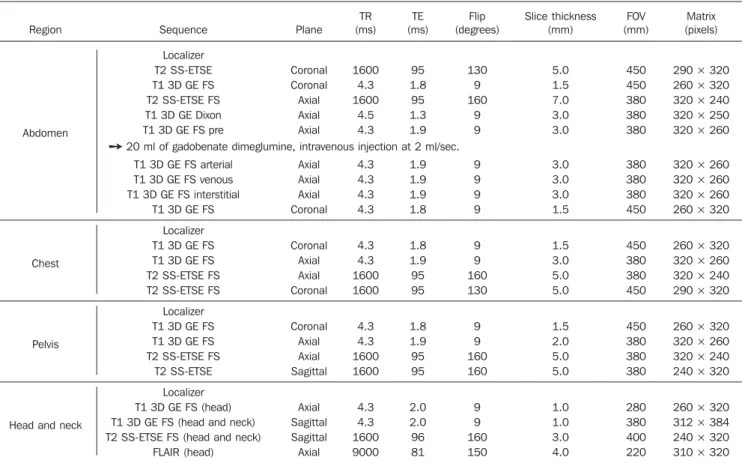
The protocol was designed to screen for cancer, vascular disease and inflammatory/ degenerative diseases. A combination of single-shot echo-train spin-echo (SS-ETSE) T2-weighted sequences, three-dimensional gradient-echo (3D-GE) T1-weighted pre-and post-gadolinium sequences, with fsuppression (FS) images, and a fluid at-tenuated inversion recovery (FLAIR) se-quence (head only) were employed. Four regional stations were acquired in the fol-lowing order: abdomen, chest, pelvis, head and neck. The sequences parameters and the order of sequence acquisition in the four stations are showed in Table 1.
The abdominal images were acquired before and after intravenous administration of 0,1 mmol/kg of gadobenate dimeglumine (MultiHance; Bracco Diagnostics Inc.,
Table 1 Whole-body MRI protocol.
Region
Abdomen
Chest
Pelvis
Head and neck
Sequence
Localizer T2 SS-ETSE T1 3D GE FS T2 SS-ETSE FS T1 3D GE Dixon T1 3D GE FS pre
T1 3D GE FS arterial T1 3D GE FS venous T1 3D GE FS interstitial
T1 3D GE FS
Localizer T1 3D GE FS T1 3D GE FS T2 SS-ETSE FS T2 SS-ETSE FS
Localizer T1 3D GE FS T1 3D GE FS T2 SS-ETSE FS
T2 SS-ETSE
Localizer T1 3D GE FS (head) T1 3D GE FS (head and neck) T2 SS-ETSE FS (head and neck)
FLAIR (head) Plane Coronal Coronal Axial Axial Axial Axial Axial Axial Coronal Coronal Axial Axial Coronal Coronal Axial Axial Sagittal Axial Sagittal Sagittal Axial TR (ms) 1600 4.3 1600 4.5 4.3 4.3 4.3 4.3 4.3 4.3 4.3 1600 1600 4.3 4.3 1600 1600 4.3 4.3 1600 9000 TE (ms) 95 1.8 95 1.3 1.9 1.9 1.9 1.9 1.8 1.8 1.9 95 95 1.8 1.9 95 95 2.0 2.0 96 81 Flip (degrees) 130 9 160 9 9 9 9 9 9 9 9 160 130 9 9 160 160 9 9 160 150 Slice thickness (mm) 5.0 1.5 7.0 3.0 3.0 3.0 3.0 3.0 1.5 1.5 3.0 5.0 5.0 1.5 2.0 5.0 5.0 1.0 1.0 3.0 4.0 FOV (mm) 450 450 380 380 380 380 380 380 450 450 380 380 450 450 380 380 380 280 380 400 220 Matrix (pixels)
290 × 320 260 × 320 320 × 240 320 × 250 320 × 260
320 × 260 320 × 260 320 × 260 260 × 320
260 × 320 320 × 260 320 × 240 290 × 320
260 × 320 320 × 260 320 × 240 240 × 320
260 × 320 312 × 384 240 × 320 310 × 320 ➙ 20 ml of gadobenate dimeglumine, intravenous injection at 2 ml/sec.
Princeton, NJ, USA). Abdominal post-con-trast images were acquired during the he-patic arterial dominant phase, portal venous phase and hepatic interstitial phase(13). All sequences of other stations were acquired after intravenous contrast had been admin-istered.
Image analysis
All images of the different anatomical regions were retrospectively evaluated by two radiologists, with 16 years and greater than 20 years experience with MRI, respec-tively. Both readers independently re-viewed all exams evaluating the image quality and the ability of this MRI tech-nique to evaluate mass lesions, metastases or vascular disease of major vessels. The MR image evaluation included: 1) the over-all image quality; and 2) comparative as-sessment of image quality with a priori knowledge of gold standard diagnostic imaging studies. This approach is similar to the approach used by several groups to assess image quality, both for similar appli-cations and more generally(7,9,14–17).
A checklist (Table 2) was created for the overall image quality assessment. Follow-ing this checklist, image quality of each station were subjectively graded in terms of diagnostic evaluation for cancer, vascular and degenerative/inflammatory diseases using a 4-point scale, as follows: 1 = poor; 2 = fair; 3 = good; 4 = excellent.
For the comparative assessment rating, the diagnostic image quality of each station was compared with the diagnostic quality of optimal imaging studies on MR (abdo-men, pelvis, head and neck) or CT (chest) based on the previous knowledge of two experienced radiologists. Each set of
im-ages was then subjectively graded using another 4-point scale, where a score of 1 = poor quality, not diagnostic, a score of 2 = moderately inferior but still adequate qual-ity, a score of 3 = slightly inferior but ad-equate quality, and a score of 4 = equiva-lent to optimal quality diagnostic studies. Kappa (κ) analysis was performed to de-termine the extent of agreement between the two readers. The level of agreement was defined by κ values as follows: < 0, no agreement; 0–0.40, poor agreement; 0.41– 0.75, good agreement; and 0.76–1.0, excel-lent agreement.
RESULTS
None of the subjects in this study had a prior history of malignancy. Abnormalities detected included liver cysts (1 subject), kidney cysts (2 subjects), degenerative disc disease (2 subjects) and benign prostatic hyperplasia (1 subject). No subject demon-strated lung/chest, brain abnormalities or major vascular disease, nor did any dem-onstrate a malignancy.
The “in bore” magnet time of studies ranged from 30 to 44 minutes (mean, 38 minutes).
The image quality for cancer was rated as excellent in the brain, lungs, liver, pan-creas, kidneys, pelvic organs and rectum, rated as good in bone structures and rated as fair in the esophagus, small bowel and colon, and breast. For vascular diseases ratings were excellent in the aorta and major branches origins, iliac vessels, supe-rior/inferior vena cava, hepatic portal sys-tem, hepatic veins and renal veins, and rated as good in pulmonary arteries (suc-cessful for the main vessels and at least
second order branches), carotid arteries and intracranial vessels, but poor for the coro-nary arteries. For degenerative/inflamma-tory disease, ratings were excellent in the brain, liver and pancreas, good in bone structures (spine, hip joints and shoulder joints), and rated as fair in the heart and lungs. The agreement between the two readers for the overall image quality ratings was excellent (κ = 1.0).
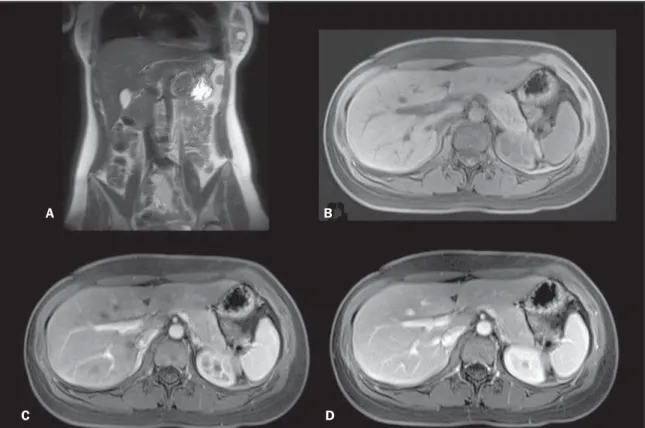
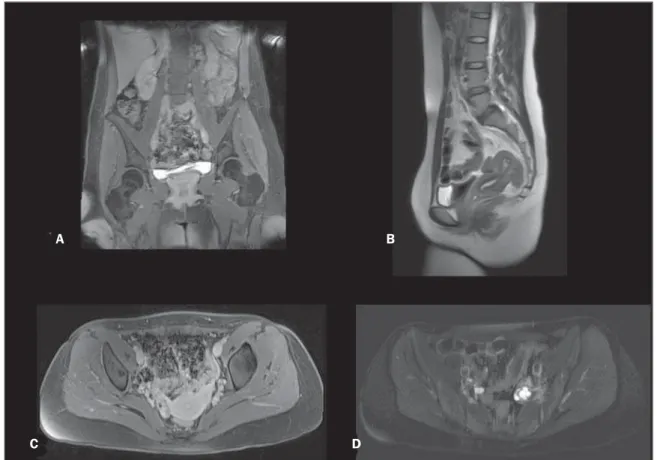
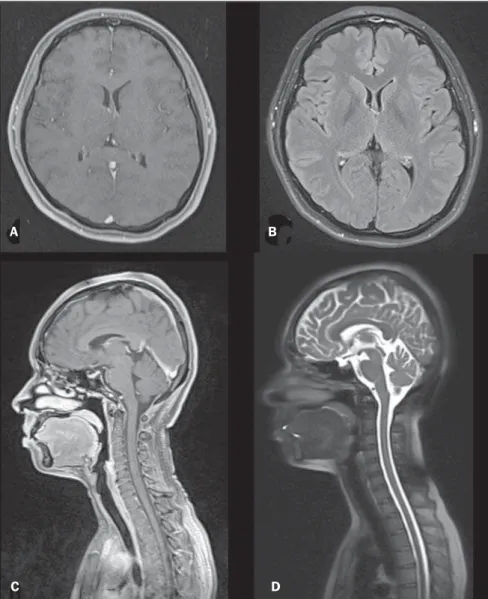
For the diagnostic image quality com-parison with reference dedicated exams of the same region, all studies of the abdomen were rated as 4, and pelvis were rated as 3. Chest, head and neck were rated as 2. No studies were rated as 1 in any region. The inter-observer agreement was excellent (κ = 1.0). Figures 1–4 show representative images illustrating the standard image qual-ity of the sequences employed in this study.
DISCUSSION
Screening for major diseases through-out the body has been of interest with im-aging studies for at least a decade, follow-ing the advent of faster imagfollow-ing. The prob-lem with most strategies for imaging screening, is that the procedure itself may be risky (whole-body CT, PET and PET/ CT) and also most approaches have had limited ability to detect a full range of dis-eases, since their protocols were individu-ally dedicated to the evaluation of me-tastases or vascular diseases(6–8,10,18–20).
In this study, a fast MR screening ap-proach that screens for major disease catego-ries of cancer, vascular, and degenerative/ inflammatory disease was developed. The results show that using this protocol, im-ages of the abdomen are of high diagnostic
Table 2 Checklist.
Cancer
Brain
Lungs
Liver
Pancreas
Kidneys
Esophagus, small bowel and colon
Rectum
Pelvic organs
Bone structures
Breast (female)
Vascular diseases
Intracranial vessels
Carotid arteries
Coronary arteries
Aorta and major branches origin
Hepatic portal system
Hepatic veins
Iliac veins
Superior vena cava, inferior vena cava
Inflammatory/degenerative
Brain
Heart
Lungs
Figure 1. Abdominal region. Coronal T2-weighted single-shot echo-train spin-echo without fat-suppression (A), axial T1-weighted 3D gradient-echo fat-sup-pressed unenhanced (B), and gadolinium-enhanced on hepatic arterial dominant phase (C) and on interstitial phase (D).
A B
C D
Figure 2. Thoracic region. Gadolinium-enhanced T1-weighted 3D gradient-echo fat-suppressed coronal (A) and axial (C). T2-weighted single-shot echo-train spin-echo without fat-suppression coronal (B) and fat-suppressed axial (D).
B A
quality in all subjects, therefore evaluation of upper abdominal organs with this tech-nique is optimally performed. The abdomen was selected as the first region to be scanned in order to acquire post-contrast hepatic arterial dominant phase images(13), that is the single most important abdominal data set when using nonspecific extracellular gadolinium chelate contrast agent(21). This technique is essential for imaging the liver, spleen, pancreas, and it provides useful information on the kidneys, adrenals and vessels. Therefore, the timing for this phase of enhancement is the only timing for post-contrast sequences that is crucial.
In the pelvis, sequences of lesser spatial resolution were employed, especially the T2-weighted sequences, compared to op-timal dedicated MR pelvic studies(22). Op-timal diagnostic quality T2-weighted se-quences are performed with a 512 matrix using a breathing averaged echo-train spin-echo sequence, compared to the 256 matrix of the single-shot T2-weighted echo-train spin-echo in our study, and for this reason pelvic studies were rated as 3 when
com-pared with reference dedicated exams. This protocol is clearly not ideal for small lonic polyps but may be of value for co-lonic masses greater than 1.0 cm. All pel-vic studies demonstrated consistent image quality, which we anticipate that may be adequate to screen for cancer, vascular and degenerative/inflammatory diseases.
MRI of the lung has been limited in the past because of long imaging times, mag-netic susceptibility effects and motion ar-tifacts. However, with faster sequences, advanced hardware and high-field-strength MR systems, the image quality has signifi-cantly improved. The lack of ionizing ra-diation exposure make MRI of the lungs ideal for those who must undergo serial imaging, pediatric patients, and as a poten-tial screening tool, which is the aim of our study. One of the sequences used in this protocol was single-shot T2-weighted echo-train spin-echo, since it is generally motion insensitive, has little magnetic sus-ceptibility or phase artifacts, and has been documented to be useful for evaluating the lung parenchyma(9,23,24).
Gadolinium-en-hanced images are also necessary for MR assessment of the lungs. The 3D gradient-echo T1-weighted sequence with fat sup-pression used in this protocol show dimin-ished phase artifact in the retrocardiac re-gion in comparison to two-dimensional gradient-echo T1-weighted images, allow-ing for better evaluation of all portions of the lung(14,17,25). The pulmonary vasculature can also be evaluated with this sequence because of its high spatial resolution, which enables high-quality multiplanar recon-struction. Additionally, gadolinium has a larger window of visibility in the pulmo-nary vessels than iodine on CT images, rendering timing of data acquisition less critical, what is particularly true with the contrast agent employed (gadobenate dimeglumine)(20). Inflammatory changes in interstitial lung disease, mediastinal and hilar adenopathy, and pulmonary nodules can be evaluated with these two sequences combined(26–31), especially with 3.0 T scan-ners. Nodules as small as 4 mm can be seen with MRI(28,30,32), and tiny nodules that are missed on MR but seen on CT, are often Figure 3. Pelvic region. Gadolinium-enhanced T1-weighted 3D gradient-echo fat-suppressed coronal (A) and axial (C). T2-weighted single-shot echo-train spin-echo without fat-suppression sagittal (B) and fat-suppressed axial (D).
B A
calcified or scarred (fibrotic), showing low proton density and low signal. The chest studies were consistent in image quality, but were rated as 2, using a priori knowl-edge of CT as comparison because MRI cannot yet depict interstitial lung disease or detect smaller, 2 mm, nodules. However, for the purposes of screening this protocol may be sufficient.
The fat-suppressed 3D gradient-echo sequences used for studying the head and neck, are likely sufficient for mass lesion and inflammatory disease detection, and can be reformatted into different planes if necessary. Less common and more subtle diseases, such as multiple sclerosis plaques, likely would require more sensitive
se-quences such as FLAIR(33), which was in-cluded in our protocol and can also be used for detecting and grading degenerative and microvascular disease, combined with single-shot echo-train spin-echo T2 se-quence. Lauenstein et al.(9) reported on the use of gadolinium-enhanced 3D gradient-echo alone in the evaluation of the brain, the addition of the FLAIR and T2-weighted image sequences should provide more complete diagnostic information than they had described.
The neck and carotid arteries were in-cluded in this study. The importance of carotid artery disease was the major reason for including the neck. Further optimiza-tion may be needed.
Regarding the vascular system, large and medium size vessels were adequately evaluated with post-contrast 3D technique. If the patient has symptomatic vascular disease then it would not be a part of a screening study, but would require a more detailed MR angiographic protocol.
One limitation of this study is the small and healthy study population and the result-ing lack of targeted pathology. Thus it should be considered a proof of concept study. However, the sequences employed here have been used for many years as the core of dedicated high-resolution regional protocols. Therefore, we anticipate that this limitation reflects a truly disease-free pa-tient population rather than a failure of the protocol itself. The lesions detected dem-onstrated the typical characteristics, con-spicuity, and quality expected from these sequences when used as part of a dedicated high-resolution protocol. One potentially more severe limitation of this study is the lack of dedicated cardiac sequences, par-ticularly in light of the fact that heart dis-ease is the most common cause of mortal-ity and morbidmortal-ity(34). However, the se-quences used in this protocol are sensitive to vascular disease in general. It is reason-able to expect that vascular disease in the coronary arteries is likely to be correlated with vascular disease elsewhere(35). This screening protocol is not recommended for patients with any specific indications of heart disease, and a patient with such indi-cation may require a follow-up with a dedi-cated cardiac imaging exam.
This proof of concept study shown that comprehensive whole-body MRI exams can be performed in a less than 40-minute period. Based on the experience of the pri-mary investigator the completeness of di-agnostic interrogation was considered as follows. The abdominal sequences em-ployed resulted in fully diagnostic studies. Our technique of breast MRI was limited because it did not include serial thin sec-tion imaging to generate enhancement curves. However it did show morphologi-cal detail, which is important for breast imaging(36) and also can reveal dilated veins that have been reported as consistently present in breast cancer(37). It should also be feasible to add a more dedicated breast MR study, including a second injection of Figure 4. Head and neck regions. Gadolinium-enhanced T1-weighted 3D gradient-echo fat-suppressed
axial (A) and sagittal (C). Axial FLAIR (B) and sagittal T2-weighted single-shot echo-train spin-echo fat-suppressed (D).
A B
gadolinium contrast. No dedicated cardiac sequences were employed. Therefore, pa-tients with suspected heart disease may require a follow-up with dedicated cardiac imaging exam. 3.0T MRI has been shown to demonstrate 4 mm pulmonary nodules consistently, which is sufficient for detec-tion of primary cancer and also sufficient for metastases. This protocol is likely not effective for interstitial lung disease. For patients with specific disease or a strong suspicious, more detailed studies would be required for: colon cancer, breast cancer and coronary artery disease.
In summary, our preliminary results show that a comprehensive whole-body MRI study can be acquired in less than 40 minutes. Both for this study, and for other whole-body screening approaches the strengths and weaknesses should be ac-knowledged and described to patients.
REFERENCES
1. Semelka RC, Armao DM, Elias J Jr, et al. Imag-ing strategies to reduce the risk of radiation in CT studies, including selective substitution with MRI. J Magn Reson Imaging. 2007;25:900–9. 2. Brenner DJ, Hall EJ. Computed tomography – an
increasing source of radiation exposure. N Engl J Med. 2007;357:2277–84.
3. Griswold MA, Jakob PM, Heidemann RM, et al. Generalized autocalibrating partially parallel ac-quisitions (GRAPPA). Magn Reson Med. 2002; 47:1202–10.
4. Pruessmann KP, Weiger M, Scheidegger MB, et al. SENSE: sensitivity encoding for fast MRI. Magn Reson Med. 1999;42:952–62.
5. Sodickson DK, McKenzie CA, Li W, et al. Con-trast-enhanced 3D MR angiography with simul-taneous acquisition of spatial harmonics: a pilot study. Radiology. 2000;217:284–9.
6. Barkhausen J, Quick HH, Lauenstein T, et al. Whole-body MR imaging in 30 seconds with real-time true FISP and a continuously rolling table platform: feasibility study. Radiology. 2001;220: 252–6.
7. Brauck K, Zenge MO, Vogt FM, et al. Feasibility of whole-body MR with T2- and T1-weighted real-time steady-state free precession sequences during continuous table movement to depict metastases. Radiology. 2008;246:910–6. 8. Horvath LJ, Burtness BA, McCarthy S, et al.
To-tal-body echo-planar MR imaging in the staging of breast cancer: comparison with conventional methods – early experience. Radiology. 1999; 211:119–28.
9. Lauenstein TC, Goehde SC, Herborn CU, et al.
Whole-body MR imaging: evaluation of patients for metastases. Radiology. 2004;233:139–48. 10. Schmidt GP, Schoenberg SO, Reiser MF, et al.
Whole-body MR imaging of bone marrow. Eur J Radiol. 2005;55:33–40.
11. Lauenstein TC, Semelka RC. Emerging tech-niques: whole-body screening and staging with MRI. J Magn Reson Imaging. 2006;24:489–98. 12. Nava D, Oliveira HC, Luisi FA, et al. Whole-body magnetic resonance imaging for staging and fol-low-up of pediatric patients with Hodgkin’s lym-phoma: comparison of different sequences. Radiol Bras. 2011;44:29–34.
13. Goncalves Neto JA, Altun E, Elazzazi M, et al. Enhancement of abdominal organs on hepatic ar-terial phase: quantitative comparison between 1.5- and 3.0-T magnetic resonance imaging. Magn Reson Imaging. 2010;28:47–55. 14. Bader TR, Semelka RC, Pedro MS, et al.
Mag-netic resonance imaging of pulmonary parenchy-mal disease using a modified breath-hold 3D gra-dient-echo technique: initial observations. J Magn Reson Imaging. 2002;15:31–8.
15. Lauenstein TC, Freudenberg LS, Goehde SC, et al. Whole-body MRI using a rolling table platform for the detection of bone metastases. Eur Radiol. 2002;12:2091–9.
16. Lauenstein TC, Goehde SC, Herborn CU, et al. Three-dimensional volumetric interpolated breath-hold MR imaging for whole-body tumor staging in less than 15 minutes: a feasibility study. AJR Am J Roentgenol. 2002;179:445–9. 17. Semelka RC, Cem Balci N, Wilber KP, et al.
Breath-hold 3D gradient-echo MR imaging of the lung parenchyma: evaluation of reproducibility of image quality in normals and preliminary obser-vations in patients with disease. J Magn Reson Imaging. 2000;11:195–200.
18. Domingues RC, Carneiro MP, Lopes FCR, et al. Whole-body MRI and FDG PET fused images for evaluation of patients with cancer. AJR Am J Roentgenol. 2009;192:1012–20.
19. Walker R, Kessar P, Blanchard R, et al. Turbo STIR magnetic resonance imaging as a whole-body screening tool for metastases in patients with breast carcinoma: preliminary clinical expe-rience. J Magn Reson Imaging. 2000;11:343–50. 20. Nael K, Fenchel M, Krishnam M, et al. High-spa-tial-resolution whole-body MR angiography with high-acceleration parallel acquisition and 32-channel 3.0-T unit: initial experience. Radiology. 2007;242:865–72.
21. Semelka RC, Helmberger TK. Contrast agents for MR imaging of the liver. Radiology. 2001;218: 27–38.
22. Brown ED, Kubik-Huch RA, Reinhold C, et al. Uterus and cervix. In: Semelka RC, editor. Ab-dominal-pelvic MRI. 2nd ed. Hoboken, NJ: Wiley-Liss; 2006. p. 1251–331.
23. Hatabu H, Gaa J, Tadamura E, et al. MR imaging of pulmonary parenchyma with a half-Fourier single-shot turbo spin-echo (HASTE) sequence. Eur J Radiol. 1999;29:152–9.
24. Yamashita Y, Yokoyama T, Tomiguchi S, et al. MR imaging of focal lung lesions: elimination of flow and motion artifact by breath-hold ECG-gated and black-blood techniques on T2-weighted turbo SE and STIR sequences. J Magn Reson Imaging. 1999;9:691–8.
25. Karabulut N, Martin DR, Yang M, et al. MR im-aging of the chest using a contrast-enhanced breath-hold modified three-dimensional gradient-echo technique: comparison with two-dimen-sional gradient-echo technique and multidetector CT. AJR Am J Roentgenol. 2002;179:1225–33. 26. Kim HY, Yi CA, Lee KS, et al. Nodal metastasis in non-small cell lung cancer: accuracy of 3.0-T MR imaging. Radiology. 2008;246:596–604. 27. Vogt FM, Herborn CU, Hunold P, et al. HASTE
MRI versus chest radiography in the detection of pulmonary nodules: comparison with MDCT. AJR Am J Roentgenol. 2004;183:71–8. 28. Yi CA, Jeon TY, Lee KS, et al. 3-T MRI:
useful-ness for evaluating primary lung cancer and small nodules in lobes not containing primary tumors. AJR Am J Roentgenol. 2007;189:386–92. 29. Chung MH, Lee HG, Kwon SS, et al. MR
imag-ing of solitary pulmonary lesion: emphasis on tu-berculomas and comparison with tumors. J Magn Reson Imaging. 2000;11:629–37.
30. Schäfer JF, Vollmar J, Schick F, et al. Detection of pulmonary nodules with breath-hold magnetic resonance imaging in comparison with computed tomography. Rofo. 2005;177:41–9.
31. Hasegawa I, Eguchi K, Kohda E, et al. Pulmonary hilar lymph nodes in lung cancer: assessment with 3D-dynamic contrast-enhanced MR imaging. Eur J Radiol. 2003;45:129–34.
32. Biederer J, Schoene A, Freitag S, et al. Simulated pulmonary nodules implanted in a dedicated por-cine chest phantom: sensitivity of MR imaging for detection. Radiology. 2003;227:475–83. 33. Herskovits EH, Itoh R, Melhem ER. Accuracy for
detection of simulated lesions: comparison of fluid-attenuated inversion-recovery, proton den-sity-weighted, and T2-weighted synthetic brain MR imaging. AJR Am J Roentgenol 2001;176: 1313–8.
34. Anderson RN, Smith BL. Deaths: leading causes for 2002. Natl Vital Stat Rep. 2005;53:1–89. 35. Kafetzakis A, Kochiadakis G, Laliotis A, et al.
Association of subclinical wall changes of ca-rotid, femoral, and popliteal arteries with obstruc-tive coronary artery disease in patients undergo-ing coronary angiography. Chest. 2005;128:2538– 43.
36. Schnall MD, Blume J, Bluemke DA, et al. Diag-nostic architectural and dynamic features at breast MR imaging: multicenter study. Radiology. 2006;238:42–53.