296 Rev Bras Med Esporte – Vol. 18, No 5 – Set/Out, 2012
COMPARISON OF THE PHYSIOLOGICAL VARIABLES IN
THE SIX-MINUTE WALK TEST AND STAIR-CLIMBING
TEST IN PATIENTS WITH CHRONIC OBSTRUCTIVE
PULMONARY DISEASE
ORIGINAL ARTICLECintia Stumpf Mazzocchi1
Cássia Cinara da Costa1
Dáversom Bordin Canterle1
Luciane Dalcanale Moussalle1
Caroline Colombo1
Paulo José Zimermann Teixeira2
1. Feevale University, Novo Hamburgo, Rio Grande do Sul. 2. Feevale University, Assistant Professor of the Medical Clinic Department of the Federal University of Health Sciences of Porto Alegre.
Mailing address:
Cássia Cinara da Costa
Rua Flores da Cunha, 111, Ap. 504, Pátria Nova - 93410110
Novo Hamburgo, RS, Brasil. E-mail: [email protected]
EXERCISE AND SPORTS MEDICINE CLINIC
ABSTRACT
Introduction: Exercise intolerance interposes daily life activities in chronic obstructive pulmonary diseases (COPD); hence, the evaluation of this functional limitation becomes fundamental. Objec-tive: To compare the six-minute walk test (HR6peak) with the stair-climbing test (SCT) in patients
with COPD. Methods: prospective analysis of twenty-one patients with COPD who were part of the - Pulmonary Rehabilitation Program - (PRP). Patients were evaluated from July to October, 2008 when they performed the HR6peak and SCT, analyzing the physiological variables (HR, PSO2), and the
modified Borg scale before and after each test. The distance was measured at the end of the tests. Results: Comparing the timing (early versus late) of physiological and subjective perception of exer-tion (RPE) from Borg, we can observe that all changes were statistically significant (p <0.001) tests. However, when the physiological changes were compared, the PSO2 obtained presented similar reduction (p = 0.912) in both tests, the HR increased significantly in SCT (p = 0.006) and on Borg RPE (p <0.001). Regarding the walking distance performed, the HR6peak (p <0.001), allowed participants to
advance to a distance significantly longer than the SCT. Conclusion: the tests expressed important physiological and subjective perception of effort (RPE) from Borg (p <0.001).
Keywords: dyspnea, psychological adaptation, respiratory disorders.
INTRODUCTION
It is known that patients with chronic obstructive pulmonary disease (COPD) present harm in their quality of life due to pro-gressive worsening in pulmonary function, which determines lower tolerance to exercise and consequent decrease in performance in activities of daily living (ADLs)1.
During exercise, the active musculature receives blood flow higher than when at rest, and therefore, the oxygen consumption (VO2) is higher and is able to lead to early muscular fatigue, limiting
physical activity2. An individual when walking performs a
well-defi-ned task, since it transports its own body for a given distance and during a certain period of time. The six-minute walk test (TC6’) has been used in the dynamic evaluation of the COPD patients, in an attempt to express the exercise capacity. In this test, the distance completed is used as the main parameter for performance evalu-ation3,4. In the stair climbing test (SCT), the work against gravity
and the use of muscular groups not frequently used in the daily life makes the metabolic and ventilatory demands more intense, with maximal thresholds being frequently reached in parameters such as heart rate (HR), systemic blood pressure (BP), scores of dyspnea per-ception and oxygen saturation, measured by wrist oximetry (SpO2)5.
In a study which evaluated physical aptitude in patients with cystic fibrosis, the authors observed that the SCT produced more remarkable increase in BP and in the adapted Borg scale for dyspnea when compared with the TC6’. In the same study, the decrease in SpO2 was similar between tests, and the authors concluded that
both the SCT and the TC6’ are considered submaximal tests which
evaluate the capacity of the patient to perform daily tasks6.
Despite being a low cost test of easy application, the SCT, ini-tially described in 1955, has not been suitably standardized until now 7.Both the TC6’and the SCT are considered submaximal tests,
since the patient is told to perform the activity at the highest ve-locity possible, with standard verbal encouragement7,8.
The present study had the aim to compare the TC6’ and the SCT in COPD patients, analyzing the behavior of the physiological variables, the distance completed and the dyspnea perception in both tests.
METHODS
Twenty-one COPD patients whose diagnosis was established according to the GOLD (Global Initiative for Chronic Obstrutive Lung Disease)9 using their clinical history, physical examination and
pul-monary function test were invited to participate in the study. Spirometry was performed with a spirometer (Microlab®, Micro-medical, Kent E4 England) following the criteria recommended by the Brazilian Guidelines of Pulmonary Function 10. Confirmation of
obstruction of air flow was performed through the ratio of forced expiratory volume on the first second (FEV1) by the forced vital
ca-pacity (FVC) lower than 70% of the expectation, obtained through spirometry after the use of bronchodilatator. All patients from the study presented moderate to severe COPD defined by a FVC1 <
297
Rev Bras Med Esporte – Vol. 18, No 5 – Set/Out, 2012
The TC6’ consisted in walking as fast as possible during 6min on a 30-meter long corridor of flat surface and marks at every 10 meters, under standard verbal encouragement. The HR and SpO2 were measured with a wrist oximeter brand name Oxímetro
(Morrya®
model 1001 Ipiranga São Paulo, Brazil). Moreover, the subjective perceived exertion (RPE) was rated through the modified Borg scale. It is a scale of 10 points where the dyspnea sensation is felt at the moment of investigation from “no breathlessness” to “maximal breathlessness”. During the TC6’ test the researcher always walked behind the volunteer, following the rhythm determined by him/her. At the end of the six minutes, the variables were taken not of through the measurement of the distance completed in meters with the use of a measuring tape open at 20m.
The SCT was applied on a ladder with 15 steps, rubber platform and side handles. The patient was told to climb up and down all the steps during the time set, under verbal encouragement so that he/she continued the test and the same parameters of TC6’were measured. Each step was 27cm deep and 13cm high. In order to calculate the distance completed the Pythagoras’ theorem was used (hypotenuse² = a² + b²), where: step area = (step height)2 + (step
depth)2 (figure 1).
The volunteers were individually told to wear proper clothes, avoiding hence any discomfort which could interfere in the test during the activities performed. All individuals performed the two tests, with interval of 48 hours between them in order to provide rest to the patient. Had one of the tests been interrupted, it was repeated 48 hours later and in case any problem occurred, he/she was excluded from the study.
The study protocol was approved by the Ethics Committee of the Institution under the number 4.08.03.08.990 and all patients signed the Free and Clarified Consent Form added to instructions about the proposed protocol.
Descriptive Statistics was used to present the results through arithmetic means and their respective standard deviations. The in-tragroup comparisons (initial versus final) were performed with the Student’s t test for paired samples, while the intergroup compari-sons (stair climbing test versus walk test) were performed with the Student’s t test for independent samples. All statistical procedures were performed in the SPSS software (version 11.5), with critical level set in p ≤ 0.05.
RESULTS
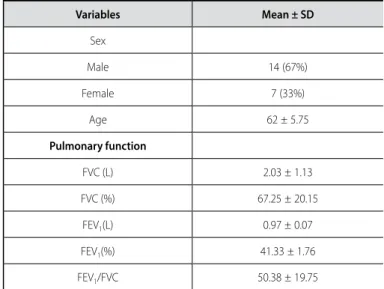
The 21 patients with COPD diagnosis had mean age of 62 ± 5.75
years and were predominately women 14 (67%) versus seven (33%) men. The majority of the patients presented moderate to severe disease (table 1).
Table 2 describes the physiological variables measured in the beginning and end of the TC6’ and SCT. It can be observed that in the TC6’ performance the patients presented decrease in the SpO2 variable similar to in the SCT, demonstrating hence that both
tests caused desaturation. BP analysis demonstrates that, in both tests this variable significantly increased; however, in a more intense manner in the SCT. The Borg RPE during the tests presented very close values, evidencing increase in the dyspnea sensation during its performance; however, a more significant variation was observed in the SCT. Nevertheless, when the delta of the alterations of the physiological alterations and of the RPE between the SCT and the TC6’ was compared, it was observed that the heart rate variation, of the RPE by the Borg scale and the completed distance, obtained statistically significant alterations (p < 0.001).
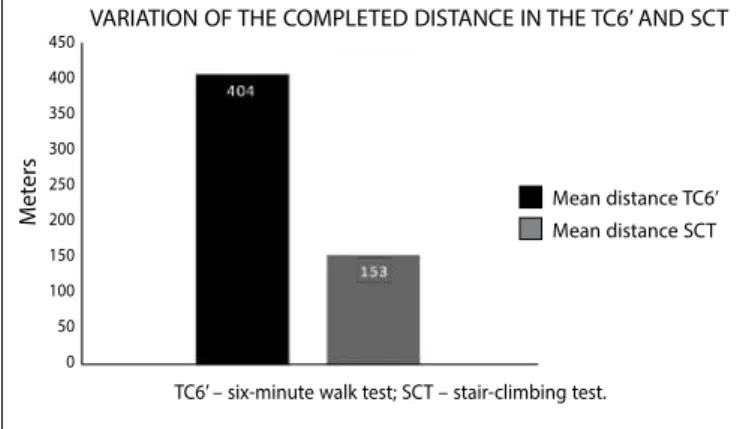
Figure 2 demonstrates the results obtained in the variation of the completed distance in the TC6’and in the SCT, in which the patients completed a longer distance in the TC6’ when compared with the distance completed in the SCT and this difference being statistically significant (p < 0.001).
Table 1. Basal characteristics of the 21 COPD patients.
Variables Mean ± SD
Sex
Male 14 (67%)
Female 7 (33%)
Age 62 ± 5.75
Pulmonary function
FVC (L) 2.03 ± 1.13
FVC (%) 67.25 ± 20.15
FEV1(L) 0.97 ± 0.07
FEV1(%) 41.33 ± 1.76
FEV1/FVC 50.38 ± 19.75
FVC – forced vital capacity; FEV1 – forced expiratory volume (at the first second).
Figure 1. Pythagoras’ theorem for calculation of the completed distance in the SCT.
h2 = 132 + 272
h2 = 169 + 729
h2 = 898
h = 29.96cm
h= 29.966
27cm 13cm
Table 2. Comparison between the moments (initial versus final) of the physiological variables and Borg’s rating of perceived exertion (RPE).
Test Variables Moment t p Initial Final
TC6’
SpO2 94.9 ± 2.2 90.4 ± 5.0 4.774 < 0.001
HR 81.1 ± 2.6 98.4 ± 4.4 4.779 < 0.001
RPE Borg 0.5 ± 0.8 3.6 ± 2.5 5.857 < 0.001
SCT
SpO2 94.7 ± 2.5 90.1 ± 4.5 6.741 < 0.001
HR 86.9 ± 18.8 119.3 ± 14.5 6.568 < 0.001
298 Rev Bras Med Esporte – Vol. 18, No 5 – Set/Out, 2012
(from the thigh to the lower part of the leg). Moreover, it should be added that surpassing the 90ºangle in the knee flexion in ascending and descending movements makes the biomechanical action more difficult and exposes the individuals to higher risk of injury.
Concerning the exertion perception, our patients when per-forming the SCT obtained mean of 7 ± 2.3, which is considered
very strong by the dyspnea subjective scale; however, in the TC6’, thy obtained mean of 3.6 ± 2.5, which is considered not very strong.
The dyspnea present in these patients limits tolerance to exercise, determining interruption of exertion at lower workloads, leading to progressive deconditioning, harming performance of the peripheral and respiratory muscles15,16.
Casas et al. (2005) conducted a study which compared four test protocols with eight patients with moderate to severe COPD (all with walks, among these, the TC6’and the SCT) and concluded that the physiological alterations which occurred were similar and corresponded to approximately 90% of maximum VO2 of these
patients17. Nevertheless, another study which assessed 20 COPD
patients, compared the results of the same physiological variables in the TC6’and SCT, verifying that performance in both was similar, concluding hence that the SCT could substitute the TC6’ when it was not possible to perform it in hospitals or even for space suitability 18.
When the physiological variations obtained in our study are verified, it was possible to observe that the alterations between methods (initial versus final) of the HR, SpO2 variables and of the Borg rating
of perceived exertion (RPE) were significantly at the end of the test. However, when the deltas of the variations of the analyzed parameters are considered, both in the TC6’ and the SCT, despite the differences completed in the TC6’ having been significantly higher than in the SCT (404.4 ± 58.3m versus 153.2 ± 37.9; p < 0.001), the HR variations
and of the perceived exertion were significantly higher in the SCT. The mean of the completed distance in the TC6’ by the patients of the present study was similar to the one verified in another study with COPD patients, whose mean was 499.37 ± 44.59m19.
However, in the SCT this distance is not defined, since the test is not standardized concerning the number of steps climbed nor the time of application, variables which have been well-established in the TC6’20.Nevertheless, in this same study, the mean of completed
steps in the SCT was 147.5 ± 33.5m, a value very close to the one
found in the present study which was 153.2 ± 37.9m. A fact to be considered is the use of motivational phrases by the examiner, which may have positively influenced on the patients’ performance. However, the walk tests inform on the real completed distance, an important variable to be discussed and which has significant cor-relation with the maximal VO2. On the other hand, the SCT does not
evidence this fact due to its vertical component to be considered.
CONCLUSION
The data of the present study evidence that the SCT may be used in the evaluation of exercise capacity in COPD patients, being an incremental, submaximal test of easy application and low cost which does not require the use of sophisticated devices. However, further investigation is still necessary in order to standardize it.
All authors have declared there is not any potential conflict of interests concerning this article.
Figure 2. Variation of the completed distance in the TC6’ and SCT.
DISCUSSION
The present study compared the physiological responses of pa-tients with COPD when submitted to two tests considered submaxi-mal, one very much applied – namely the six-minute walk test – and another less frequently applied – namely the stair climbing test. It was possible to observe that both tests promoted significant physio-logical alterations, but that the SCT, even with a significantly shorter distance, imposed significantly higher overload and work perception. Considering that the presence of COPD decreases the exercise capacity, climbing stairs is one of the initial limitations in the activities of daily living reported by the patients. Studies published show that the SCT is characterized as an incremental test which presents values very close to the maximal ones when compared with maximal incremental tests which use ergometers7.
When we analyze the SpO2 alterations, it is verified that mean was
of 93% in the TC6’ and 92% in the SCT, where significant decrease was not observed during the test or at resting basal situation. A study conducted with COPD patients of moderate to severe obs-truction demonstrated that they can develop transitory decrease in SpO2 (SpO2 < 90%) during the activities of daily living, associated to
physical exertion or dyspnea sensation, in many factors which may influence on the oxygen consumption values11.
Significant decrease in the circulating levels of oxygen during exertion may be associated with alveolar hypoventilation, limitation in the diffusion, pulmonary shunt, non-homogeneous ventilation/ perfusion ratio, or by the low oxygen pressure12.
The data in the present study evidenced that the BP variation was considerably higher in the SCT, reaching to mean of 103bpm when compared with the 90bpm in the TC6’. According to a study carried out which analyzed hemodynamic variables and efficiency in the stair test, they can be influenced by the stages of the progressive load during the climbing up and down. During exercise, the active mus-culature receives greater blood flow and the heart receives greater stimulation, comparing with rest. In the SCT there is high participa-tion of the lower limbs musculature and joints, besides the evident involvement of different angles which are able to cause alterations in the response of the physiological variables during exercise13.
Souza and Pellegrinotti (2003) observed that the minimum oxygen consumption is evident in a 20 to 25 ups and downs /min rhythm14. Such exertion rhythm comes about when the individual
performs the task on the bench between 40 and 50cm, height at which a flexion angle of 47-60º is produced in the knee joint
TC6’ – six-minute walk test; SCT – stair-climbing test.
VARIATION OF THE COMPLETED DISTANCE IN THE TC6’ AND SCT 450
400 350 300 250 200 150 100 50 0
M
et
ers
299
Rev Bras Med Esporte – Vol. 18, No 5 – Set/Out, 2012
REFERENCES
1. Zanchet R C, Viegas CAA, Lima, T. A eficácia da reabilitação pulmonar na capacidade de exercício, força da musculatura inspiratória e qualidade de vida de portadores de doença pulmonar obstrutiva crônica. J Bras Pneumol 2005;31:118-4.
2. Palange P, Ward AS, Carlsen K-H, Casaburi R, Gallagher CG, Gosselink R, et al. Recomendações sobre o uso dos testes de exercício na pratica clínica.Rev Port de Pneumol 2007;31:628-2.
3. Bauerle O, Chrusch CA, Younes M. Mechanisms by which COPD affects exercise tolerance. Am J Respir Crit Care Med 1998;157:57-8.
4. ATS Statement: Guidelines for the six-minute walk test.AmJ Respir Crit Care Med 2002;166:111-7. 5. Sociedade Brasileira de Tisiologia e Pneumologia. Teste da Caminhada e do Degrau, 2007; São Paulo,
dez 2007. Disponível em:http://www.sbpt.org.br/
6. Chaves, CRMM, Oliveira CQ, Britto JAA, Elsas MICG. Exercício aeróbico, treinamento de força muscular e testes de aptidão física para adolescentes com fibrose cística: revisão da literatura.Rev Bras Saúde Mater Infant 2007;7:245-0.
7. Cataneo DC, Cataneo AJ M. Acurácia do teste de escada utilizando o consumo máximo de oxigênio como padrão-ouro.J Bras Pneumol 2007;33:128-3.
8. Rosa F W, Camelier A, Mayer A, Jardim JR. Avaliação da capacidade de exercício em portadores de doença pulmonar obstrutiva crônica: comparação do teste de caminhada com carga progressiva com o teste de caminhada com acompanhamento.J Bras Pneumol 2006;32:106-3.
9. Global Strategy for the Diagnosis, Management and Prevention of Chronic Obstructive Pulmonary Disease (GOLD). Up Dated 2009. Disponível em www.goldcopd.org.
10. Jornal Brasileiro de Pneumologia. Diretrizes para Testes de Função Pulmonar.Disponívelem:http:// www.jornaldepneumologia.com.br/portugues/suplmentos.
11. Neder JA, Nery LE. Teste de exercício cardiopulmonar. J Bras Pneumol 2002;28(Supl 3):166-6. 12. Santos RS, Donadio MVF. O efeito da suplementação de oxigênio durante o exercício com pacientes
DPOC não hipoxêmicos. Revista Ciência & Saúde 2008;1:43-8.
13. Sousa MSC, Silva JMFL, Gomes ERM, Silva JA,Torres MS, Cirilo JO. Freqüência cardíaca e pressão arterial em diferentes cargas no ergômetro banco de cirilo em mulheres ativas. Rev Saúde Com2007;6:156-1.
14. Souza MSC, Pellegrinotti IL. Validação de protocolo e instrumento banco na ergometria. Rev Bras Ciên Saúde 2003;7:265-2.
15. Borghi AS. Efeitos agudos da aplicação do bipap sobre a tolerância ao exercício físico em pacientes com doença pulmonar obstrutiva crônica (DPOC). Rev Bras Fisioter 2005;9:273-80.
16. Regueiro EMG, Lorenzo VAP, Parizotto APD, Negrini F, Sampaio LMM. Análise da demanda metabólica e ventilatória durante execução de atividades de vida diária em indivíduos com doença pulmonar obstrutiva crônica. Rev Latino-Am Enfermagem 2006;14:41.
17. Casas A, Vilaro J, Rabinovich R, Mayer A, Barnerá JÁ, Roisin RR et al. Encouraged 6-min walking test indicates maximum sustainable exercise in COPD. Chest 2005;128:55-1.
18. Machado NC, Natali V,Squassoni SD, Santana VTS, Baldin AC, Fiss E. et al. Estudo comparativo entre os resultados do teste de caminhada de seis minutos e do teste do degrau de seis minutos em pacientes com Doença Pulmonar Obstrutiva Crônica. Arq de Med ABC 2007;32(Supl 2):7-50.
19. Schnaider J, Karsten M. Testes de tolerância ao exercício em programa de fisioterapia hospitalar após exacerbação da doença pulmonar obstrutiva crônica. Fisioter. mov. 2006;19:119-6.