421
Rev Bras Med Esporte – Vol. 21, No 6 – Nov/Dez, 2015
AN INEXPENSIVE METHOD TO MEASURE KNEE
EXTENSORS’ POWER IN OLDER ADULTS
MÉTODO ACESSÍVEL PARA MEDIÇÃO DE POTÊNCIA DE EXTENSÃO DE JOELHO EM IDOSOS
MÉTODO ACCESIBLE PARA MEDIDA DE POTENCIA EN LA EXTENSIÓN
DE LA RODILLA EN ANCIANOS
João Pedro Pinho1 (Educador Físico)
Bruno Mezêncio1 (Educador Físico) João Gustavo Oliveira Claudino1 (Educador Físico)
Rafael Soncin1 (Educador Físico) Arnaldo José Hernandez2 (Médico) Júlio Cerca Serrão1 (Educador Físico) Alberto Carlos Amadio1
(Educador Físico)
1. Universidade de São Paulo, Escola de Educação Física e Esporte, Laboratório de Biomecânica, São Paulo, SP, Brasil. 2. Universidade de São Paulo, Faculdade de Medicina, Hospital das Clínicas, Instituto de Ortopedia e Traumatogia, São Paulo, SP, Brasil.
Correspondência:
Avenida Professor Mello Moraes, 65 - Cidade Universitária. 05508-030, São Paulo, Brasil.
ABSTRACT
Introduction: Measuring knee extensors’ power in elderly population is crucial but not accessible to everyone. Objective: To provide a method to calculate knee extensors’ power in a conventional knee extension machine. Method: Thirteen sedentary elderly women (69.3±4.1 years) performed six knee extensions as fast as possible. Kinematic data, an anthropometric model and Newtonian mechanics was used to write movement equations that allowed calculating knee extensors’ power and work. The reliability was assessed by variables’ coefficient of variation, intraclass correlation coefficient and standard measurement error. Results: Knee extensors’ peak power and work values obtained were in agreement with the literature. We found high intraclass ICC values for both
variables (93% and 97%, respectively) and low normalized SEM (10.13% and 2.09%, respectively).Conclusion:
We provided an inexpensive method to assess a major physical dysfunction indicator in older adults which can also be used to evaluate the progression of an intervention.
Keywords: aged, muscle strength, quadriceps muscle, knee.
RESUMO
Introdução: Avaliar a potência de extensão de joelhos na população idosa é crucial, porém não acessível a todos. Objetivo: Propor um método para calcular a potência de extensão de joelhos em uma cadeira extensora conven-cional. Métodos: Treze idosas sedentárias (69.3±4.1 anos) realizaram seis extensões de joelho na maior velocidade possível. Dados cinemáticos, um modelo antropométrico e mecânica Newtoniana foram aplicados para elaborar as equações do movimento que permitiram o cálculo do trabalho e da potência de extensão de joelhos. A confia-bilidade foi avaliada pelo coeficiente de variação, pelo coeficiente de correlação intra-classe e pelo erro padrão de medida. Resultados: Os valores do trabalho e do pico de potência de extensão de joelhos encontrados corroboram com os relatados na literatura. Foi encontrado uma alta correlação intra-classe para ambas variáveis (97% e 93%, respectivamente) e baixo erro padrão de medida (2.09% e 10.13%, respectivamente). Conclusão: Foi proposto um método acessível para avaliar o principal indicador de disfunção física de idosos, que pode ser utilizado igualmente para o acompanhamento dos resultados de uma intervenção.
Palavras-chave: idoso, força muscular, músculo quadríceps, joelho.
RESUMEN
Introducción: Evaluar el poder de la extensión de rodilla en los ancianos es fundamental, pero no es asequible para todos. Objetivo: Desarrollar un método para calcular la potencia de la extensión de rodilla en una extensión convencional pierna. Métodos: Trece mujeres mayores sedentarias (69,3 ± 4,1 años) realizaron seis extensiones de rodilla con la mayor velocidad posible. Datos cinemáticos, un modelo antropométrico y la mecánica newtoniana fueron aplicados para derivar las ecuaciones de movimiento que permitieron el cálculo del trabajo y la potencia de la extensión de rodilla. La fiabilidad se evaluó mediante el coeficiente de variación, el coeficiente de correlación intraclase y el nivel de error de medición. Resultados: Los valores encontrados para el trabajo y la potencia máxima en la extensión de rodillas corroboran con los reportados en la literatura. Un alto ICC para ambas variables fue en-contrado (97% y 93%, respectivamente) y un bajo EPM (2,09% y 10,13%, respectivamente). Conclusión: Se demostró un método económico para evaluar el indicador primario de la disfunción física en los ancianos, que puede ser utilizado tanto para el monitoreo de la disfunción como para la intervención.
Palabras clave:anciano, fuerza muscular, músculo cuádriceps, rodilla.
ORIGINAL ARTICLE
ARTIGO ORIGINAL
ARTÍCULO ORIGINAL
Artigo recebido em 06/04/2015 aprovado em 05/08/2015. DOI: http://dx.doi.org/10.1590/1517-869220152106147232
INTRODUCTION
The aging process has a profound deteriorative effect in the elderly’s ability to perform everyday tasks such as those that ensure an independent life (e.g., walking, sitting/lying down, working activity,
recreation/sports/entertainment, up and down stairs). Indeed, the main cause of death in this population is due to falls; event that frequently
happens during the performance of those tasks1. Additionally, muscle
422 Rev Bras Med Esporte – Vol. 21, No 6 – Nov/Dez, 2015 the ability to produce knee extensors’ power seems to be related with
the elderly’s inefficient gait and increased risk of fall2.
Therefore, measuring knee extensors’ power is crucial to identify the older adults that have greater risk of fall. For this purpose,
isokine-tic dynamometer has been widely used3,4. However, its use has been
questioned due to its lack of resemblance to the limbs’ acceleration and deceleration patterns of everyday movements. Even its use in the sports
performance field has been questioned5-7. Furthermore, the use of an
isokinetic dynamometer to measure this dysfunction indicator is res-tricted to major clinical facilities not affordable to everyone who needs. Therefore, our purpose was to obtain knee extensors’ power in a conventional knee extension machine as well as to verify its reliability.
MATERIALS AND METHODS
The sample was selected among the female older adults that re-plied to the study’s public advertising. Twenty five candidates signed up to participate in the project although 12 were excluded based in the study functional inclusion criteria. Participants reported absence of cardiac and musculoskeletal problems like knee or hip osteoarthritis diagnosticated, as well as absence of arterial hypertension. Thus, 13 sedentary elderly women aged between 65 and 75 years old (69.3 ±
4.1 years) and homogeneous Body Mass Index (26.1 ± 2.5 Kg/m2) took
part in the study. The participants were previously informed of all of the operational procedures and gave their Written Consent informing that their involvement in the study was voluntary. The study was approved by the local Ethics Committee (31199114.0.000.539). Baecke
question-naire8 modified and validated for older adults9 was used to assess their
physical activity level ensuring that all were sedentary.
The experiments were conducted in a conventional knee extensors machine (Gervasport Fitness Equipment - Pleven, Bulgaria) (figure 1) and a digital video camera (Casio EX-ZR10) with a sample rate of 240Hz and a shutter speed of 1/2000s recorded the trials. The sample rate allowed recording 138,240 pixels (432X320 pixels) per frame. Experimental procedures: ensuring that the participants’ trunk and thigh remained immovable, with the knee axis aligned with the leg extensor machine axis, a sub-maximal test was conducted in order
to estimate the participants’ maximum knee extensors load. After
es-timating the maximum load effort by Brzycki10 equation 50% of that
maximum was calculated and used (equation 1).
Equation 1: 1RM = m ∙ 36/((37-reps))
Where 1RM is the estimated maximum load (kilograms), is the mass
lifted in the trial (kilograms) and reps is the number of repetitions that
the participant was able to produce with that load.
This maximum load estimation protocol was conducted so that the number of repetitions was below ten. Indeed, all participants were able to achieve that goal within two trials, being given 10 mi-nutes rest between trials. The participants executed 6 repetitions with the concentric phase of the knee extension movement as quickly as possible. Between each repetition 30 to 45 seconds rest were given. Reflexive markers (20 millimeters diameter) were attached to the participants’ lateral malleolus of the ankle and lateral condyle of the knee. Such markers allowed assessing knee angle in relation to the machine’s initial position. These data were used to calculate knee concentric angular velocity and acceleration as well as to determine the eccentric cam axis position.
All mathematical procedures were performed in MatLab v.R2010a (Mathworks, Inc - Natick, Massachusetts, U.S.A.). SkillSpector 1.3.2 (Vi-deo4Coach, Inc - Odense, Denmark), a free available motion analysis software, was used to digitize the two markers. After the digitalization process, the spatial coordinates were smoothed with an 8Hz low-pass Butterworth filter. The knee extension machine used, as well as the ones commonly found, had an eccentric cam. His purpose is to im-pose different efforts along the knee angular excursion to attend to the muscle length/tension demand. To calculate the machine’s radius a high resolution photo (12.1 Megapixels) of the cam was taken and a hundred equidistant virtual markers were placed along the cam’s edge (where the machine’s belt passed). A general Fourier series model was used to adjust the data (equation 2).
Equation 2: rKE = 0.21 + 0.01 ∙ cos (x ∙ 0.03) + 0.01 ∙ sin (x ∙ 0.03)
Where is the machine’s radius given by the distance in meters between the eccentric cam axis and the tangent point of the machine’s belt and is the angle in relation to the initial position.
Net knee extensors torque was calculated assuming the knee ex-tensor machine’s torque equality (equation 3).
Equation 3: τnet= τKEm
Where is the net knee extensors’ torque and is the knee extension machine’s torque, given in N∙m (Newton∙meter).
Therefore, to calculate the knee extensors’ torque equation 4 was used.
Equation 4: τnet = mKE ∙ rKE ∙ (αKE + g) + wa ∙ ra ∙ cosΦa + mS&F ∙ ωa ∙
I2
S&F + wS&F ∙ rS&F ∙ cosθS&F
Where is the mass lifted by the subject, is the mass’s linear
acce-leration, is the gravitational constant (9.81 m∙s-2), is the machine’s arm
weight, is the distance between the machine’s axis and the center of mass of the machine’s arm, is the cosine of the angle formed by the horizontal, the machine’s axis and the machine’s arm center of mass, is the shank and foot’s mass, is the machine’s arm angular acceleration, is square distance of the proximal radius of gyration in relation to the knee
423
Rev Bras Med Esporte – Vol. 21, No 6 – Nov/Dez, 2015
axis, is the shank and foot weight, is the distance in meters between the knee axis and the shank and foot’s center of mass and is the sine of the angle formed by the horizontal, the knee axis and the shank and foot’s center of mass. Information about the segment parameters was
provided by Dempster’s anthropometric model11.
It should be noticed that the equation’s first term corresponds to the machine’s load torque; the second term corresponds to the machine’s arm torque and the third and fourth terms corresponds to the shank and foot’s torque. Finally, to calculate the knee extensors’ power and work equation 5 and 6 were used.
Equation 5: Po = 2 ∙ π ∙ RPSKE ∙ τnet
Where is the knee extensors’ power output given in w (Watts) and is the number of the machine’s arm revolutions per seconds.
Equation 6: Wm = ∫if Podt
Where is the mechanical work done by the knee extensors in the movement’s concentric phase expressed in joules (J) and is the integral of the power output curve between the initial and final moments of the movement’s concentric phase. This mechanical work cannot be related to the total work performed by the subject due to the impossibility to
assess the mechanics efficiency of the muscle contraction12.
Statistical Procedures
SigmaStat 3.5 (Dundas Software, Ltd - Toronto, Canada) was used to conduct all statistical procedures. Initially, individual trials’ coefficient of variation (CV) of the two variables was calculated. Then, an analysis of variance with participants and trials as factors was conducted in order to obtain the factors’ mean squares. Intraclass correlation
coeffi-cient (ICC) was calculated according to Weir13 (equation 7). Standard
error of measurement (SEM) was obtained by taking the square root of the ANOVA’s residual mean square. Normalized standard error of
measurement (SEMnorm) was calculated dividing the SEM by the mean.
Equation 7: ICC=
Where is the mean square due to the participants’ variation, is the mean square error and is the number of participants.
RESULTS
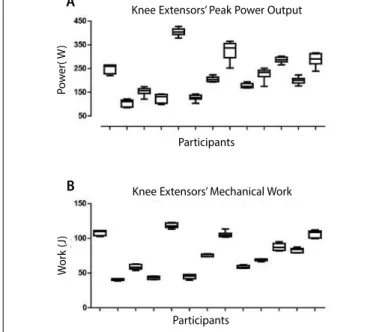
We found total knee extensors’ peak power output values around 221.4 ± 87.1 W with a total range interval of 85.1 – 427.8 W and an inter-quartile range of 153.2 – 280.8 W; and total knee extensors’ mechanical work around 76.9 ± 26.3 J with a total range interval of 38.5 – 122.8 J and an interquartile range of 56.5 – 102.7 J. Individual distributions’ box-plots are presented in figure 2.
Plotted in figure 3 are the individual coefficients of variation. Whereas six out of thirteen knee extensors’ peak power output CVs were above 10% all of the knee extensors’ mechanical work CVs were under 7.2%.
The reliability indicators used are expressed in table 1.
DISCUSSION
Our main purpose was to develop an inexpensive way to calculate knee extensors’ power output in older women. Applying basic Newto-nian mechanics to knee kinematics in a conventional knee extension machine we were able to reliably calculate knee extensors’ power ou-tput and mechanical work. To the best of our knowledge this is the
first study to propose such method as well as the first study to show the selected variables’ reliability in it.
The validity of our method is given by the assumptions made by Newtonian mechanics and the anthropometric models used. It is our belief that the movement equations formulated for this particular purpose attended all demands, making unnecessary a gold standard comparison. Furthermore, based in concentric knee isokinetic power’s
predictive equations proposed by Neder et al.14 we found that our
values are similar to the ones presented in that study. Adjusted for sex, age, height and weight of our sample such equations showed a total mechanical work of 86.32 J, close to what we found (76.9 J).
Being able to measure knee extensors’ power output in the elderly population is an essential condition to assess the older adult’s risk of fall
and, in a general way, their functional level15. Furthermore, assessing
an individual knee extensors’ power output over time allows making inferences about the employed intervention protocol. Therefore, a phy-sical education teacher or a physiotherapist would be able to conduct their intervention based on this fundamental physical function indicator without needing expensive or inaccessible clinical evaluations.
Table 1. Mains results of the reliability statistics used: intraclass coefficient correlation (ICC), standard error of measurement (SEM) and the mean normalized standard error of measurement (SEMnorm).
ICC (%) SEM SEMnorm(%)
Knee extensors' peak power output 0.93 16.6 W 10.13
Knee extensors' mechanical work 0.97 3.3 J 2.09
MSparticipant - MSresidual
MSparticipant + (k-1)MSresidual
Figure 2.Box-plots representing Knee extensors’ peak power output (A) and me-chanical work (B) individual distributions.
Knee Extensors’ Peak Power Output
Participants
Participants
Knee Extensors’ Mechanical Work
W
or
k (
J)
P
o
w
er( W
)
A
B
Figure 3. Graphical representation of knee extensors’ peak power output (A) and mechanical work (B) individual coefficients of variation.
B A
Participants Participants
Knee Extensors’ Mechanical Work Knee Extensors’ Peak Power Output
C
oefficien
ts of
V
ar
ia
tion (%)
C
oefficien
ts of
V
ar
ia
424 Rev Bras Med Esporte – Vol. 21, No 6 – Nov/Dez, 2015 In order to trust the obtained results and use them as progression
or functional indicators it is imperative that such measures are highly reliable. We found that individual coefficients of variation were under 15% when assessing peak power output and under 8% when assessing mechanical work. Although not able to compare those values with ones from another study due to the method’s originality we believe that they are indeed reliable. This statement is partially supported by intraclass
correlation coefficients’ high values founded. Similarly, Hartmann et al.16
found an ICC of 0.94 when measuring intrarater knee extensors torque reliability in an isokinetic dynamometer at 120⁰/s of 24 independently
living elderly subjects (18 women). Symons et al.17 found a knee extensors’
mechanical work ICC of 0.93 when measuring 25 older women without a familiarization session also in an isokinetic dynamometer.
An ICC of 0.93 could be interpreted as: the proportion of variance between total knee extension trials that is attributed to the true indivi-dual trial variance is 93%. Thus, only 7% is attributed to error. However,
Weir13 call attention to the fact that between-subjects variability could
mask ICC values. Therefore, high ICC values could be obtained even in the presence of low reliability if a heterogenic sample was taken,
in other words if between-subjects’ variability is high13. Although high
ICC values were found we believe our sample was not homogeneous (figures 1 and 2) making us unsure about making reliability inferences. Conversely, the typical error of measurement (SEM) quantifies the precision of individual trials, in other words, the reliability within in-dividual subjects. We found the knee extensor’s peak power output
normalized typical error of measurement value (SEMnorm)similar to the
SEMnorm values of knee extensors’ peak torque obtained by Hartmann
et al.16 and Symons et al.17 - 10.1% in contrast with 9.3% and 9.24%,
res-pectively. However, regarding knee extensor’s mechanical work SEMnorm
we observed a significantly lower value – 2.1% in contrast with 9.0% and 20.50%. This means that knee extensor’s peak power measured by our method is as reliable as the knee extensor’s peak torque measured by isokinetic dynamometer.
Nevertheless, knee extensor’s mechanical work reliability measured by our method is higher suggesting it as a feasible indicator to as-sess differences between time spaced trials. High individual variability would be expected for a peak variable making even more reasonable to expect larger inter-subject variability. Therefore, it was no surprise to find lower reliability in knee extensor’s peak power output than in knee extensor’s mechanical work. Being less variable the knee extensor’s
mechanical work true value would lay within a short confidence interval (small typical error) making small changes easy to be detected and, consequently, a best intervention progression indicator.
Notwithstanding, it is the knee extensors’ peak power output that
have a strong association with functional performance and disability18,19.
Indeed, to evaluate older adults’ physical function knee extensors’ power output should be assessed as a prime indicator. The proposed method showed that without an isokinetic dynamometer, in a conventional knee extension machine and in a 6 repetitions’ protocol with 30 seconds rest it was possible to reliable measure knee extensors’ power output. Further-more, we strongly believe that assessing knee extensors’ power without controlling movement’s velocity is a more functional evaluation.
Isokinetic dynamometer allows safely measuring muscle strength and power in older adults because the speed and range of motion are
computer-controlled17. Although it is indeed a safe measure procedure
in the elderly’s everyday life rarely or never a constant angular velocity is required. For instance, the elderly’s gait cycle velocity curve is far from being constant, with velocity changing by the millisecond. After the initial contact the older adult has about 0.161 seconds to generate an eccentric muscle contraction to decelerate more than his entire body weight (1.2 times their body weight), with a knee flexion velocity of 145⁰/s. Afterwards, in the stance phase, he has about 0.193 seconds to generate a quadriceps contraction to propel is body weight with a knee
extension velocity of 85⁰/s20. Not accounting for movement specificity
makes the power value obtained by the isokinetic dynamometer, in our point of view, misleading. We believe that although not able to fully reproduce the functional ability needed in everyday life our method is closely related with the elderly functional tasks.
CONCLUSION
The results of this study showed that in order to evaluate elderly’s knee extensors’ power output one does not need expensive or inac-cessible instruments. Our method provided knee extensors’ power ou-tput and mechanical work values close to the ones showed in related literature. Moreover, we found high intra-subjects reliability in both variables studied suggesting this approach’s feasibility.
All authors have declared there is not any potential conflict of interests concerning this article.
REFERENCES
1. Berg WP, Alessio HM, Mills EM, Tong C. Circumstances and consequences of falls in independent community-dwelling older adults. Age Ageing. 1997;26(4):261-8.
2. Iwamoto J, Suzuki H, Tanaka K, Kumakubo T, Hirabayashi H, Miyazaki Y, et al. Preventative effect of exercise against falls in the elderly: a randomized controlled trial. Osteoporos Int. 2009;20(7):1233-40. 3. Keskin D, Borman P, Ersöz M, Kurtaran A, Bodur H, Akyüz M. The risk factors related to falling in elderly
females. Geriatr Nurs. 2008;29(1):58-63.
4. Winters-Stone KM, Li F, Horak F, Luoh SW, Bennett JA, Nail L, Dieckmann N. Comparison of tai chi vs. strength training for fall prevention among female cancer survivors: study protocol for the GET FIT trial. BMC Cancer. 2012;12:577.
5. Abernethy P, Wilson G, Logan P. Strength and power assessment. Issues, controversies and challenges. Sports Med. 1995;19(6):401-17.
6. Knuttgen HG. Strength training and aerobic exercise: comparison and contrast. J Strength Cond Res. 2007;21(3):973-8.
7. Cronin J, Sleivert G. Challenges in understanding the influence of maximal power training on improving athletic performance. Sports Med. 2005;35(3):213-34.
8. Baecke JA, Burema J, Frijters JE. A short questionnaire for the measurement of habitual physical activity in epidemiological studies. Am J Clin Nutr. 1982;36(5):936-42.
9. Voorrips LE, Ravelli AC, Dongelmans PC, Deurenberg P, Van Staveren WA. A physical activity questio-nnaire for the elderly. Med Sci Sports Exerc. 1991;23(8):974-9.
10. Brzycki M. Strength testing-Predicting a one-rep max from reps-to-fatigue. J Phys Educ Recreat Danc. 1993;68:88–90.
11. Dempster, W.T. Space Requirements of the Seated Operator. Geometrical, Kinematic, and Mechanical
Aspects of the Body With Special Reference to the Limbs. (Technical Report WADC-TR-55-159) 1955, Aero Medical Laboratory, Wright Air Development Command, United States Air Force, Wright-Patterson Air Force Base, Ohio, USA); 1955.
12. .di Prampero PE. Energetics of muscular exercise. Rev Physiol Biochem Pharmacol. 1981;89:143-222. 13. Weir JP. Quantifying test-retest reliability using the intraclass correlation coefficient and the SEM. J
Strength Cond Res. 2005;19(1):231-40.
14. Neder JA, Nery LE, Shinzato GT, Andrade MS, Peres C, Silva AC. Reference values for concentric knee isokinetic strength and power in nonathletic men and women from 20 to 80 years old. J Orthop Sports Phys Ther. 1999;29(2):116-26.
15. Foldvari M, Clark M, Laviolette LC, Bernstein MA, Kaliton D, Castaneda C, et al. Association of muscle power with functional status in community-dwelling elderly women. J Gerontol A Biol Sci Med Sci. 2000;55(4):M192-9.
16. Hartmann A, Knols R, Murer K, de Bruin ED. Reproducibility of an isokinetic strength-testing protocol of the knee and ankle in older adults. Gerontology. 2009;55(3):259-68. 18997454.
17. Symons TB, Vandervoort AA, Rice CL, Overend TJ, Marsh GD. Reliability of isokinetic and isometric knee-extensor force in older women. J Aging Phys Act. 2004;12(4):525-37.
18. Bean JF, Kiely DK, Herman S, Leveille SG, Mizer K, Frontera WR, et al. The relationship between leg power and physical performance in mobility-limited older people. J Am Geriatr Soc. 2002;50(3):461-7. 19. Cuoco A, Callahan DM, Sayers S, Frontera WR, Bean J, Fielding RA. Impact of muscle power and force on gait speed in disabled older men and women. J Gerontol A Biol Sci Med Sci. 2004;59(11):1200-6. 20. Winter DA. The Biomechanics and motor control of human gait: normal, elderly and pathological. 2nd