ABSTRACT
Introduction: Eccentric training and jump tests are widely used to recover and measure deficits in knee strength and functionality after anterior cruciate ligament (ACL) reconstruction. Objective: To correlate knee extension and flexion torque generated by eccentric isokinetic training, with functional jump tests in subjects with reconstructed ACL. Method: Sixteen men with unilateral ACL reconstruction were assessed before and after 12 weeks of eccentric isokinetic training of knee flexors and extensors (3x10 MVC, 2x/week) at 30o/s for
extension and flexion torque (isometric; concentric and eccentric at 30 and 120o/s) and functional jump tests
(single, triple, cross and figure of 8). Inter- and intra-limb pre- and post-training mean peak torque (MPT), dis-tance and jump test times were compared along with the correlations between these variables, considering P≤0.05. Results: The affected limb (AL) showed significant gain of extension and flexion torque (P<0.01) in the different test categories and velocities evaluated. In the non-affected limb (NAL), this only occurred in the ec-centric category (30 and 120o/s), in the extension (P<0.01) and flexion (P<0.05 and P<0.01) torques, respectively.
In the jumps, there was an increase in distance (single and triple; P<0.05) and a decrease in time (crossed and figure of 8; P<0.01), however, MPT x Jump correlations were weak (r<0.3) in the pre and post-training period in both limbs. Conclusion: Despite the gain in knee extension and flexion torque and jumping performance, the expected correlation was not satisfactory, suggesting that knee functionality involves other variables inherent to motor control. Level of Evidence IV; Type of study: Case series.
Keywords: Muscle strength; Performance tests; Rehabilitation.
RESUMO
Introdução: O treino excêntrico e testes de saltos são muito utilizados para recuperar e aferir déficits de força e funcionalidade do joelho, após reconstrução do ligamento cruzado anterior (LCA). Objetivo: Correlacionar o torque extensor e flexor do joelho, gerados pelo treino isocinético excêntrico, com testes funcionais de saltos em sujeitos com LCA reconstruído. Método: Foram avaliados 16 homens, com reconstrução unilateral do LCA, antes e depois de 12 semanas de treino isocinético excêntrico de extensores e flexores do joelho (3 x 10 CEVM, 2x/semana) a 30º/s, quanto ao torque extensor e flexor (isométrico; concêntrico e excêntrico a 30o/s e 120o/s) e aos testes funcionais de saltos (simples, triplo, cruzado e figura em 8). As médias dos picos de torque (MPT), a distância e os tempos dos testes de salto inter e intramembros, pré e pós-treino foram comparados, além das correlações entre essas variáveis, considerando P≤ 0,05. Resultados: O membro acometido (MA) mostrou ganho significativo de torque extensor e flexor (P< 0,01) nos modos e velocidades avaliados. No membro não acometido (MNA), isso ocorreu apenas para o modo excêntrico (30º/s e 120º/s), do torque extensor (P< 0,01) e flexor (P< 0,05 e P<0,01), respectivamente. Nos saltos, houve aumento da distância (simples e triplo; P< 0,05) e diminuição do tempo (cruzado e figura em 8; P< 0,01), porém, as correlações entre MPT e saltos mostraram-se fracas nos dois membros (r< 0,3) antes e depois do treino. Conclusão: Apesar do ganho no torque extensor e flexor do joelho e no rendimento dos saltos, a correlação esperada não foi satisfatória, sugerindo que a funcionalidade do joelho envolve outras variáveis inerentes ao controle motor. Nível de evidência IV; Tipo de estudo: Série de casos.
Descritores:Força muscular; Provas de rendimento; Reabilitação.
RESUMEN
Introducción: El entrenamiento excéntrico y las pruebas de saltos son muy utilizados para recuperar y medir los déficits de fuerza y funcionalidad de la rodilla, después de la reconstrucción del ligamento cruzado anterior (LCA). Objetivo: Correlacionar el torque extensor y flexor de la rodilla, generados por el entrenamiento isocinético excéntrico, con pruebas funcionales de saltos en sujetos con LCA reconstruido. Método: Fueron evaluados 16 hombres, con re-construcción unilateral del LCA, antes y después de 12 semanas de entrenamiento isocinético excéntrico de extensores y flexores de la rodilla (3x10 CEVM, 2x/semana) a 30º/s, cuanto al torque extensor y flexor (isométrico, concéntrico y excéntrico a 30 y 120o/s) y a las pruebas funcionales de saltos (simple, triple, cruzado y figura en 8). Se compararon promedios de los picos de torque (MPT), distancia y tiempos de las pruebas de salto, inter e intra-miembros, pre y
CORRELATION BETWEEN ECCENTRIC TRAINING AND
FUNCTIONAL TESTS IN SUBJECTS WITH RECONSTRUCTED ACL
CORRELAÇÃO ENTRE TREINO EXCÊNTRICO E TESTES FUNCIONAIS EM SUJEITOS COM
LCA RECONSTRUÍDO
CORRELACIÓN ENTRE ENTRENAMIENTO EXCÉNTRICO Y PRUEBAS FUNCIONALES EN SUJETOS
CON LCA RECONSTRUIDO
Heleodório Honorato Santos1,2 (Physiotherapist and Physical Education Professional) Catarina de Oliveira Sousa3 (Physiotherapist)
Christiane Lanatovitz Prado Medeiros4
(Physiotherapist) José Angelo Barela5
(Physical Education Professional) Ana Maria Forti Barela6 (Physical Education Professional) Tania de Fatima Salvini7 (Physiotherapist)
1. Universidade Federal da Paraíba (PAPGEF-UPE/UFPB), Associated Physical Education Graduate Studies Program, João Pessoa, PB, Brazil. 2. Universidade Federal da Paraíba (UFPB), Department of Physiotherapy, João Pessoa, PB, Brazil.
3. Universidade Federal do Rio Grande do Norte (UFRN), Physiotherapy Graduate Studies Program, Natal, RN, Brazil. 4. Universidade Federal de São Carlos (UFSCar), Department of Physiotherapy, São Carlos, SP, Brazil. 5. Universidade Estadual Paulista Júlio de Mesquita Filho (Unesp), Department of Physical Education, Rio Claro, SP, Brazil.
6. Universidade Cruzeiro do Sul (Unicsul), Health Sciences Graduate Studies Program, São Paulo, SP, Brazil. 7. Universidade Federal de São Carlos (UFSCar), Physiotherapy Graduate Studies Program, São Carlos, SP, Brazil.
Correspondence:
Heleodório Honorato dos Santos Av. Mons. Odilon Coutinho, 191/402, Cabo Branco, João Pessoa, PB, Brazil. 58045-120.
ORIGINAL ARTICLE
472
post-entrenamiento, además de las correlaciones entre estas variables, considerando P≤0,05. Resultados: El miem-bro acometido (MA) mostró aumento significativo del torque extensor y flexor (P<0,01) en los modos y velocidades evaluados. En el miembro no acometido (MNA), eso ocurrió sólo para el modo excéntrico (30 y 120º/s), del torque extensor (P<0,01) y flexor (P<0,05 y P<0,01), respectivamente. En los saltos, hubo aumento en la distancia (simple y triple; P<0,05) y disminución del tiempo (cruzado y figura en 8; P<0,01), sin embargo, las correlaciones MPT x saltos se mostraron débiles (r<0,3) en el pre y post-entrenamiento, en los dos miembros. Conclusión: A pesar del aumento en el torque extensor y flexor de la rodilla y en el rendimiento de los saltos, la correlación esperada no fue satisfactoria, sugiriendo que la funcionalidad de la rodilla involucra otras variables inherentes al control motor. Nivel de evidencia IV; Tipo de estudio: Serie de casos
Descriptores: Fuerza muscular; Pruebas de rendimiento; Rehabilitación.
Article received on 08/18/2017 accepted on 07/10/2018 DOI: http://dx.doi.org/10.1590/1517-869220182406184218
INTRODUCTION
Both ACL injury and reconstruction promote decreased trophism and strength of the knee extensor apparatus1, which may remain for to up
seven years2. Eccentric training can trigger key morphological changes
in thigh muscles during post-surgical ACL rehabilitation3.
Recently, in addition to isokinetic tests used to evaluate the knee joint torque, hop tests are considered good indicators of the combined knee joint and lower limb function because acceleration, deceleration and thrust movements are performed in sports3-8.
Although hop tests provide safety and efficiency parameters8 and are
considered fairly reliable (>80%) and sensitive (>82%), their correlation with knee extensor and flexor torque is still controversial9,10. This study
aimed to correlate possible gains in knee extensor and flexor torque generated by eccentric isokinetic training with some types of long jumps in subjects with reconstructed ACLs, given the hypothesis that knee extensor and flexor strengthening should improve the performance of functional hop tests.
METHOD
Sample
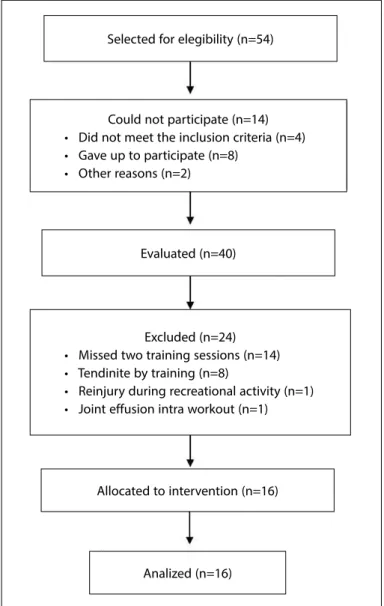
Of the 54 eligible subjects in this study, 40 were evaluated for com-pliance with the following inclusion criteria: 20 to 50 years; BMI≤28 kg/
m2; unilateral ACL reconstruction; patellar tendon graft; two and five
years post-reconstruction; post-operative rehabilitation ≥ six months; without knee pain or edema; having resumed the practice of sports; and availability to participate in the study.
After conducting the initial evaluations (dynamometry and functional hop tests) and training protocol, so 16 subjects (30.6±9.3 years; 78.1±12.1 kg; 1.75±0.1 m; BMI=25.5±3.0 kg/m2; injury time=50.4±34.9 months;
surgery time=27.0±23.7 months) completed the study.
Sample size was determined by software G* Power 3.1.0 adopting a power of 0.8, considering 5% level of significance, 0.5 coefficient of cor-relation, and a 0.5 size effect, based on a pilot study11 and 16 subjects was
computed with size sufficed to provide 81.7% statistical power. (Figure 1) The study was approved by the Research Ethics Committee of the Federal University of São Carlos (REC/UFSCar Opinion no. 350/2006),
and all subjects freely signed an Informed Consent Form, according to Resolution 196/96 of the National Health Council.
Dynamometry
Knee extensor and flexor torque were evaluated using an isokinetic dynamometer (Biodex Multi-Joint System 3, Shirley, NY-USA) 72 hours pre- and post-isokinetic training, and all subjects were evaluated by the same examiner, always starting with the non-affected limb (NAL) followed by the affected limb (AL)3: 1) isometric; 2) concentric; and 3)
eccentric test at 30 and 120°/s.
After five minutes of warm-up on an bicycle at 20 km/h (75 W)6 and
then, the subjects sat on the isokinetic dynamometer with trunk and knees flexed at 85 and 90°, respectively, with the trunk, pelvis and distal aspect of the thigh stabilized by straps.
The test consisted of three maximal voluntary isometric contractions (MVIC) of five seconds, with one minute interval between them6 at 60°
for extensors and 30° for flexors. Concentric and eccentric tests (30°/s and 120°/s) consisted of five consecutive maximal voluntary contractions (MVC), with three minutes rest between tests and calculated the MPT in each test6.
Could not participate (n=14) • Did not meet the inclusion criteria (n=4) • Gave up to participate (n=8)
• Other reasons (n=2)
Excluded (n=24) • Missed two training sessions (n=14) • Tendinite by training (n=8)
• Reinjury during recreational activity (n=1) • Joint effusion intra workout (n=1)
Selected for elegibility (n=54)
Evaluated (n=40)
Allocated to intervention (n=16)
Analized (n=16)
Functional tests
A total of 72 hours after the isokinetic evaluations (pre- and pos-t-training), the subjects performed five minutes warm-up, running at low speed followed by four hop tests: single/SH, triple/TH), crossover/ CH and Figure-8 hops/F8H.
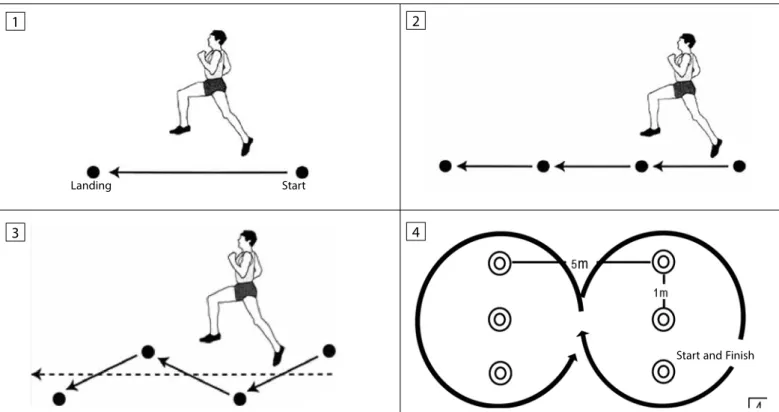
In the SH and TH (Figures 2.1; 2.2), the distance covered using the same foot was measured from the starting to the landing point (heel)3.
In the CH, the subjects hopped over six meters x 15 cm straight line from one side to the other (Figure 2.3), using the same foot12. In the F8H, there
were two rows of three cones each, with one meter between the cones and five meters between the rows (Figure 2.4) and they completed a circuit hopping around both rows, in the shape of the number eight4.
The time spent (in seconds) to complete the whole circuit was clocked in both the CH and F8H3.
The horizontal thrust tests were performed in the same order (SH, TH, CH and F8H) and starting with the NAL, similarly to the torque evaluations12, pre- and post-training.
Isokinetic training
After warm-up, the subjects completed an eccentric isokinetic training program, exclusively using the AL, at 30°/s (3x10 MVEC; interval between sets: three minutes; interval between sessions: 48 hours; frequency: 2x/week; duration: 12 weeks) for knee flexors and extensors3. Only, the subjects performed normal ADLs,
inclu-ding their recreational activities. The same physiotherapist guided the training to maintain a uniform exposure to verbal commands during the 24 sessions.
Data analysis
Statistical procedures were performed in the SPSS (20.0) using the Shapiro-Wilk, Student’s t (paired and independent) and Pearson’s corre-lation test. The following data were compared: 1) MPT; 2) time and hop distance means between the AL and NAL; and 3) MPT versus hop tests correlations for each limb in the pre- and post-training. The classification adopted for the correlation analysis was according Albuquerque et al.13,
considering a 5% significance level for all comparisons.
RESULTS
Isokinetic dynamometry
In the pre-training evaluation, the inter-limb comparison of knee extensor MPT showed a deficit in the AL in the: isometric (14%; P<0.01), concentric at 30°/s (19%; P<0.01), and 120°/s (14%; P<0.05) and eccentric at 30°/s (10%; P<0.01).
In the post-training, except in the eccentric mode at 30°/s (P=0.42), deficits were still observed (isometric=9%, P<0.05; concentric at 30°/ s=11%, P<0.01; concentric at 120°/s=13%, P<0.01; and eccentric at 120°/ s=15%, P<0.01). The knee flexors showed a 14% and 10% increase in the AL compared with the NAL in the eccentric mode at 30 and 120°/s (P<0.01), respectively.
There was 9% gain in the isometric (P<0.05) and concentric modes at 30°/s (P<0.01); 7% in the concentric at 120°/s (P<0.05) and 19% in the eccentric mode at 30°/s (P<0.01) of the AL, and 13% and 19% in the eccentric mode at 30 and 120°/s (P<0.01), respectively, of the NAL, when comparing the pre- and post-training (intra-limb) knee extensor MPT.
Gains also occurred in the: isometric mode (11%; P<0.01), concentric mode at 30°/s (10%; P<0.01), eccentric mode at 30°/s (24%; P<0.01) and at 120°/s (19%; P<0.01) of the AL. There were 9% and 11% gains in the eccentric mode at 30°/s (P<0.05) and 120°/s (P<0.01), respectively, of the NAL in the knee flexors.
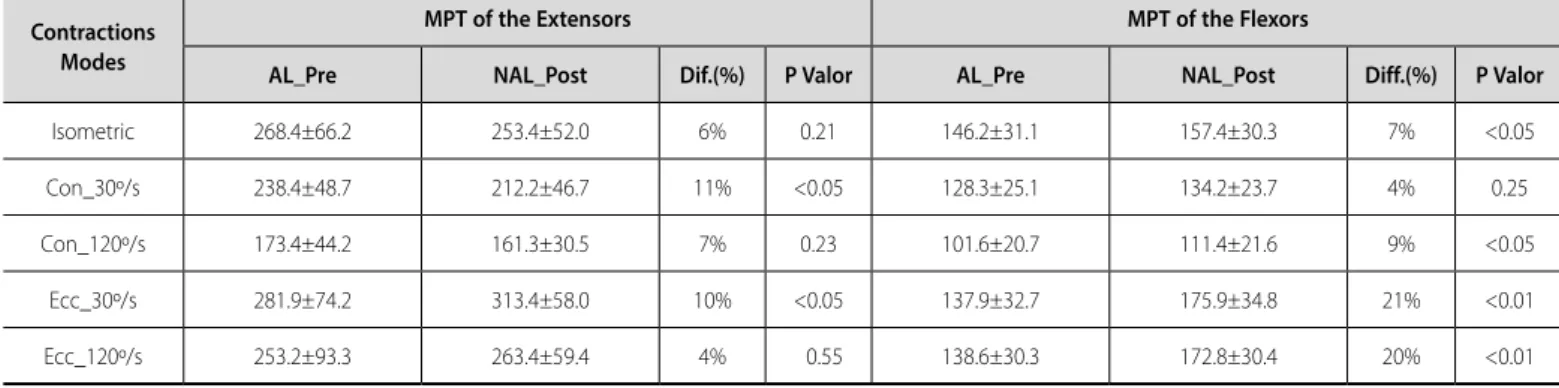
Comparing the MPT of NAL extensors pre- versus the AL post-training, an 11% deficit (P<0.05) occurred in the concentric mode at 30°/s, and a 10% increase (P<0.01) in the eccentric mode at 30°/s (Table 1).
A widespread and significant increase (isometric: 7%, P<0.05; concen-tric at 120°/s: 9%, P<0.05; eccenconcen-tric at 30°/s: 21%, P<0.01; and eccenconcen-tric at 120°/s: 20%, P<0.01) of the knee flexors occurred when comparing with the extensors, which surpassed the pre-training values of the NAL.
Functional tests
Three hop tests (SH, TH and F8H) showed a significant increase (P<0.01, P<0.01 and P<0.05, respectively) in the pre-training period (Table 2), whereas only the SH and TH showed improved performance (P<0.01) in the post-training, in the inter-limb comparison.
Figure 2. Functional tests: single hop (1); triple hop (2); crossover hop (3); figure-8 hop (4).
Landing Start
Start and Finish
1 2
474
Also showed a significant increase in performance in all tests con-ducted (SH and TH: P<0.05; CH and F8H: P<0.01) in the AL and in the CH (P<0.05) and F8H (P<0.01) in the NAL, when comparing the pre- and post-training (intra-limb) means.
A significant improvement in CH and F8H performance occurred in the AL (P<0.05) when comparing the pre-training NAL versus post--training AL values.
The correlations (MPT versus functional tests) regarding the knee ex-tensors and flexors were mostly weak (r<0.3) in the pre- and post-training, in the AL and NAL. However, the correlations for the knee extensors were moderate (0.31<r<0.6) and strong (0.61<r<0.9) in the: SH (pre- and post-training), in the AL and NAL; TH (all pre-training comparisons, some post-training AL comparisons and in the concentric mode at 120°/s in the pre-training NAL); CH (concentric and eccentric modes at 30°/s in the post-training AL, in the concentric mode at 30°/s and in the eccentric mode at 30 and 120°/s the pre-training) in NAL; and F8H (concentric and eccentric modes at 30 and 120°/s) in the AL .
The correlations regarding the knee flexors were moderate (0.31<r<0.6) in the SH: concentric at 120°/s, pre-training; concentric at 30°/s and 120°/s and eccentric at 120°/s, in the post-training AL and eccen-tric at 30 and 120°/s in the pre-training NAL; TH: isomeeccen-tric and ecceneccen-tric at 30°/s, pre-training; concentric at 30 and 120°/s in the post-training AL and in the concentric and eccentric at 30 and 120°/s in the pre-training AL; and F8H: eccentric at 120°/s pre-training, in the concentric at 30 and 120°/s in the post-training AL and in the isometric and concentric at 30°/s and eccentric at 30 and 120°/s in the post-training NAL (Table 3).
DISCUSSION
Eccentric Isokinetic Training
The deficit in pre-training AL extensor torque shown in all tested modes and speeds may be attributed to two factors: 1) decline in gamma motor neuron activation, resulting in efferent Ia attenuation, leading to quadriceps weakness and dyskinesia, after ACL rupture14; and 2) predominant
quadri-ceps atrophy after ACL reconstruction15, which persists for years, with a 10
to 20% loss of strength, despite the efforts focused on rehabilitation14,16.
These results corroborate Keays et al.17 because they also found
differences (28 and 22%) when comparing the knee extensor torque inter-members, 6 months after ACL reconstruction, at 60 and 120°/s, respectively. The extensor torque deficit in the AL was expected be-cause the tested sample consisted of subjects with chronic injuries (50.4 ± 34.9 months), and the longer the injury time is, the greater the impairment will be18.
The most significant post-training gains, in both extensor and flexor torque, reached in training mode and speed (Ecc_30°/s), demonstrate the principle of specificity introduced by Santos et al.3 and Santos et al.6
when testing resistance training programs at various modes and speeds. Furthermore, the fact that flexor post-training AL values mostly surpassed the pre-training NAL values was expected because no difference was found when comparing pre-training inter-limbs. However, the increase in flexor torque (Ecc_30 and 120°/s) in NAL may be explained by the crossover edu-cation effect19,20. Unilateral resistance training may activate neural circuits Table 1. Comparisons of PTA (Nm) between the AL_Post and NAL Pre- training of the extensors and flexors knee.
Contractions Modes
MPT of the Extensors MPT of the Flexors
AL_Pre NAL_Post Dif.(%) P Valor AL_Pre NAL_Post Diff.(%) P Valor
Isometric 268.4±66.2 253.4±52.0 6% 0.21 146.2±31.1 157.4±30.3 7% <0.05
Con_30º/s 238.4±48.7 212.2±46.7 11% <0.05 128.3±25.1 134.2±23.7 4% 0.25
Con_120º/s 173.4±44.2 161.3±30.5 7% 0.23 101.6±20.7 111.4±21.6 9% <0.05
Ecc_30º/s 281.9±74.2 313.4±58.0 10% <0.05 137.9±32.7 175.9±34.8 21% <0.01
Ecc_120º/s 253.2±93.3 263.4±59.4 4% 0.55 138.6±30.3 172.8±30.4 20% <0.01
PTA = Peak torque average; Nm = Newton.metro; Con = concentric; Ecc = eccentric; AL = affected limb; NAL = non affected limb; MPT = mean peak torque; Diff = difference. t Student (independent) test.
Table 2. Comparison of the averages of functional tests pre and post-isokinetic eccentric training of the extensors and flexors knee.
Hop kinds
Pre-training Post-training
AL NAL P Valor AL NAL P Valor
Single hop (m) 1.71±0.29 1.90±0.20 <0.01‡ 1.84±0.21 1.98±0.19 <0.01‡
Triple hop (m) 5.36±0.81 5.83±0.63 <0.01‡ 5.63±0.68 5.97±0.63 <0.01‡
Crossover hop (s) 2.61±0.59 2.44±0.48 0.06‡ 2.21±0.37 2.16±0.27 0.23‡
Figure-8 hop (s) 7.49±0.73 7.16±0.50 <0.05‡ 6.85±0.56 6.76±0.48 0.13‡
AL NAL
Pre-training Post-training P Valor Pre-training Post-training P Valor
Single hop (m) 1.71±0.29 1.84±0.21 <0.05† 1.90±0.20 1.98±0.19 0.06†
Triple hop (m) 5.36±0.81 5.63±0.68 <0.05† 5.83±0.63 5.97±0.63 0.13†
Crossover hop (s) 2.61±0.59 2.21±0.37 <0.01† 2.44±0.48 2.16±0.27 <0.05†
Figure-8 hop (s) 7.49±0.73 6.85±0.56 <0.01† 7.16±0.50 6.76±0.48 <0.01†
with consequent increase the neural drive (cortico-spinal projections) of untrained muscles and resulting in strength gain, onto the opposite limb. In general, the training program had the desired effect, since, ex-cept in the extension torque Con_30º/s, conversely, the torques were statistically equivalent and even surpassed (Ecc_30º/s) the pre-training NAL values in the other tested modes and speeds.
Corroborating the study of Tomiya et al.21, the current results show
that the eccentric resistance training is more efficient in the torque gain than isometric or concentric resistance training at the respective tested speeds (30°/s and 120°/s).
Gerber et al.22, also observed that the extensor PT in the AL of the
eccentric exercise group was higher than in the standard rehabilitation group, after ACL reconstruction.
Functional tests
Before training, the AL versus NAL comparison showed deficits regar-ding three of the hops tested (SH, TH, F8H) in the AL. In the post-training period, deficits regarding the NAL remained, despite the increase in SH and TH values. The comparison between pre- and post-training values in the AL showed an increase in SH and TH (> distance) and CH and F8H (< runtime) performance. The decreased CH and F8H runtime with the NAL may be attributed to the crossed education effect during isokinetic training because the NAL was not trained20,21, which was expressed in the
functional tests. Lastly, the comparison between the means of functional tests and pre-training NAL versuspost-training AL conditions suggests that the Ecc_30o training improved the performance in the functional
tests because it matched the distance reached in the SH and TH and decreased the CH and F8H runtimes.
Gerber et al.22, comparing two protocols of post-ACL reconstruction,
observed interaction between extensor PT and SH of the AL showing
that eccentric training directly affected the performance in the functional hop test, corroborating, in part, our results.
Santos et al.3, also observed a weak correlation (r<0.5) between PT
and SH and a moderate correlation (0.51 ≤ r ≤ 0.75) between PT and TH for both knee flexors and extensors, when analyzing 20 young and healthy subjects who underwent 6 weeks of eccentric isokinetic training at 30°/s, especially when performing the test in the same training mode (eccentric) and at a speed similar to that of the task (120°/s).
Conversely, Vasconcelos et al.12 founded strong correlations (-0.78 ≤
r ≤ -0.90) with extensor PT, despite having observed weak correlations between knee flexor PT (concentric at 60 and 180°/s) and SH and CH hop distances, among post-ACL reconstruction subjects using semi-tendinosus and gracilis graft (ST+Gr). However, these correlations were negative, indicating that these variables moved in opposite directions. According to several studies23-26, hop distance (SH, TH and CH) is the
most commonly used test to assess functional parameters of return to sports because it measures lower limb power3 and expresses the effect
of the integrity of neuromuscular control, strength generation capacity and confidence in the limb27. However, the evidence is still conflicting on
which muscle group is more involved in knee functional activities. It is noteworthy that these correlations were classified from weak to strong (from r=0.25 to r=0.62) for both flexors and extensors in the present study. Jang et al.5 reported that isokinetic strength tests fail to quantify
knee functionality because they are an open kinetic chain exercise and therefore do not faithfully reproduce the functional range of motion of the joint. This assertion may partly explain the weak and moderate correlations between isokinetic PT and functional tests found in the present study.
On the other hand, Kollock et al.28, analyzing 62 recreational athletes
of both sexes, concluded that hop tests alone did not provide enough
Table 3. Correlations between PTA and hops (single, triple, crossover and figure-8) in the AL and NAL, pre- and post-isokinetic eccentric training of the extensors and flexors knee.
PTA Extensors X Hop tests
Limbs PTA Flexors
X Hop tests
Limbs
AL NLA AL NLA
Pre Post Pre Post Pre Post Pre Post
Isom X SH 0.47 0.47 0.36 0.25 Isom X SH 0.27 0.26 0.21 0.11
Con 30º/s X SH 0.57 0.58 0.30 0.31 Con 30º/s X SH 0.19 0.39 0.13 0.13
Con 120º/s X SH 0.66 0.63 0.17 0.42 Con 120º/s X SH 0.41 0.51 0.21 0.27
Ecc 30º/s X SH 0.40 0.29 0.32 0.36 Ecc 30º/s X SH 0.27 0.29 0.41 0.27
Ecc 120º/s X SH 0.59 0.52 0.48 0.31 Ecc 120º/s X SH 0.23 0.38 0.48 0.15
Isom X TH 0.42 0.28 0.27 0.09 Isom X TH 0.34 0.22 0.30 0.09
Con 30º/s X TH 0.45 0.40 0.27 0.17 Con 30º/s X TH 0.28 0.40 0.31 0.08
Con 120º/s X TH 0.51 0.42 0.33 0.27 Con 120º/s X TH 0.24 0.54 0.33 0.21
Ecc 30º/s X TH 0.40 0.08 0.22 0.23 Ecc 30º/s X TH 0.39 0.25 0.37 0.20
Ecc 120º/s X TH 0.40 0.39 0.29 0.19 Ecc 120º/s X TH 0.29 0.31 0.37 0.05
Isom X CH -0.06 0.20 0.05 0.14 Isom X CH 0.07 -0.15 -0.28 0.01
Con 30º/s_CH -0.03 0.32 0.31 0.13 Con 30º/s_CH 0.26 0.03 -0.07 0.11
Con 120º/s_CH -0.20 0.14 0.26 0.06 Con 120º/s_CH -0.02 0.08 0.14 -0.01
Exc 30º/s_CH 0.18 0.38 0.48 0.09 Exc 30º/s_CH -0.12 0.26 -0.19 0.06
Exc 120º/s_CH 0.07 0.30 0.47 0.16 Exc 120º/s_CH 0.07 -0.01 0.21 0.07
Isom X F8H -0.27 0.14 -0.19 -0.02 Isom X F8H -0.18 -0.18 -0.46 -0.09
Con 30º/s X F8H -0.39 0.02 -0.29 -0.13 Con 30º/s X F8H -0.28 -0.35 -0.42 -0.10
Con 120º/s X F8H -0.35 -0.07 -0.21 -0.16 Con 120º/s X F8H -0.03 -0.41 -0.28 -0.13
Ecc 30º/s X F8H -0.47 0.23 -0.21 -0.12 Ecc 30º/s X F8H -0.40 -0.11 -0.56 -0.18
Ecc 120º/s X F8H -0.34 -0.11 -0.14 -0.11 Ecc 120º/s X F8H -0.21 -0.18 -0.35 -0.05
476
information to make evidence-based decisions about lower extremity strength inisolated muscle groups.
Indeed, the success of ACL reconstruction may be explained mainly by a good joint functionality. This is supported by studies reporting poor functional results, despite satisfactory joint mechanics and vice-versa, according to Anders et al.29. Furthermore, Feller and Webster30 reported
that not only surgical and rehabilitation details but also age and injury and surgery times are involved in knee function, vice-versa to return to sports activities.
Most studies addressing the correlation of PT with functional tests exclusively assess SH, complicating the discussion of data. Although they were recorded by the same examiner, the manual timing of CH and F8H tests recorded, may have affected the results for being an examiner-dependent measure.
CONCLUSION
Although the training program proved effective in knee torque gain and functional hop tests, the expected correlation between these variables was not found. Nevertheless, functional tests are still conside-red a parameter requiconside-red to resume the practice of competitive sports.
ACKNOWLEDGEMENT
À Coordenação de Aperfeiçoamento de Pessoal de Nível Superior (CAPES); Fundação de Amparo à Pesquisa do Estado de São Paulo (FA-PESP); Conselho Nacional de Desenvolvimento Científico e Tecnológico (CNPq) e ao Departamento de Educação Física da UFSCar.
All authors declare no potential conflict of interest related to this article.
REFERENCES
1. Abourezk MN, Ithurburn MP, McNally MP, Thoma MT, Briggs M, Hewett TE, et al. Hamstring strength asymmetry at 3 years after Anterior Cruciate Ligament reconstruction alters knee mechanics during gait and jogging. Am J Sports Med. 2017;45(1):97-105.
2. Büchler L, Regli D, Evangelopoulos DS, Bieri K, Ahmad SS, Krismer A, et al. Functional recovery following primary ACL repair with dynamic intraligamentar stabilization. Knee. 2016;23(3):549-53. 3. Santos HH, Ávila MA, Hanashiro DN, Camargo PR, Salvini TF. The effects of knee extensor eccentric
training on functional tests in healthy subjects. Rev Bras Fisioter. 2010;14(4):276-83.
4. Xergia AS, Pappas E, Zampeli F, Georgiou S, Georgoulis AD. Asymmetries in functional hop tests, lower extremity kinematics, and isokinetic strength persist 6 to 9 months following Anterior Cruciate Ligament reconstruction. J Orthop Sports Phys Ther. 2013;43(3):154-16.
5. Jang SH, Kim JG, Ha JK, Wang BG, Yang SJ. Functional performance tests as indicators of returning to sports after Anterior Cruciate Ligament reconstruction. Knee. 2014;21(1):95-101.
6. Santos HH, Hanashiro DN, Ávila MA, Camargo PR, Oliveira AB, Salvini TF. Efeito do treino isocinético excên-trico sobre a razão I/Q do torque e EMGs em sujeitos saudáveis. Rev Bras Med Esporte. 2014;20(3):182-7. 7. Gokeler A, Welling W, Zaffagnini S, Seil R, Padua D. Development of a test battery to enhance safe return to sports after Anterior Cruciate Ligament reconstruction. Knee Surg Sports Traumatol Arthrosc. 2017;25(1):192–9.
8. Gokeler A, Welling W, Benjaminse A, Lemmink K, Seil R, Zaffagnini S. A critical analysis of limb symmetry indices of hop tests in athletes after Anterior Cruciate Ligament reconstruction: a case control study. Orthop Traumatol Surg Res. 2017;103(6):947-51.
9. Phillips N, Benjamin M, Everett T, Van Deursen RWM. Outcome and progression measures in rehabilitation following anterior cruciate ligament injury. Phys Ther Sport. 2000;1(4):106-18.
10. Greenberg EM, Greenberg ET, Ganley TJ, Lawrence JTR. Strength and functional performance recovery after Anterior Cruciate Ligament reconstruction in preadolescent athletes. Sports Health. 2014;6(4):309-12.
11. Beck TW. The importance of a priori sample size estimation in strength and conditioning research. J Strength Cond Res. 2013;27(8):2323–37.
12. Vasconcelos RA, Bevilaqua-Grossi D, Shimano AC, Paccola CAJ, Salvini TF, Prado CL, et al. Análise da correlação entre pico de torque, desempenho funcional e frouxidão ligamentar em indivíduos normais e com reconstrução do ligamento cruzado anterior. Rev Bras Ortop. 2009;44(2):134-42.
13. Albuquerque PL, Quirino MAB, Santos HH, Alves SB. Interferência da prática de atividade física habitual na postura de jovens. Rev Ter Man. 2010;8(37):198-203.
14. Williams GN, Barrance PJ, Snyder-Mackler L, Buchanan TS. Altered quadriceps control in people with Anterior Cruciate Ligament deficiency. Med Sci Sports Exerc.2004;36(7):1089-97.
15. Grant JA, Mohtadi NG, Maitland ME, Zernicke RF. Comparison of home versus physical therapy-supervised rehabilitation programs after anterior cruciate ligament reconstruction: a randomized clinical trial. Am J Sports Med. 2005;33(9):1288-97.
16. Becker R, Karlssom J. The role or muscle function after Anterior Cruciate Ligament rupture and treatment. Knee Surg Sports Traumatol Arthrosc. 2018;26(2):355-7.
17. Keays SL, Bullock-Saxton JE, Keays AC. Strength and function before and after Anterior Cruciate Ligament reconstruction. Clin Orthop Relat Res. 2000;(373):174-83.
18. Gerber JP, Marcus RL, Dibble LE, Greis PE, Burks RT, LaStayo PC. Effects of early progressive eccentric exercise on muscle structure after Anterior Cruciate Ligament reconstruction. J Bone Joint Surg Am. 2007;89(3):559-70.
19. Zhou S. Chronic neural adaptations to unilateral exercise: mechanisms of cross education. Exerc Sport Sci Rev. 2000;28(4):177-84.
20. Lee M, Carroll TJ. Cross education: possible mechanisms for the contralateral effects of unilateral resistance training. Sports Med. 2007;37(1):1-14.
21. Tomiya A, Aizawa T, Nagatomi R, Sensui H, Kokubun S. Myofibers Express IL-6 after eccentric exercise. Am J Sports Med. 2004;32(2):503-8.
22. Gerber JP, Marcus RL, Dibble LE, Greis PE, Burks RT, LaStayo PC. Safety, feasibility, and efficacy of negative work exercise via eccentric muscle activity following Anterior Cruciate Ligament reconstruction. J Orthop Sports Phys Ther. 2007;37(1):10-8.
23. Augustsson J, Thomeé R, Karlsson J. Ability of a new hop test to determine functional de-ficits after anterior cruciate ligament reconstruction. Knee Surg Sports Traumatol Arthrosc. 2004;12(5):350-6.
24. Holm I, Fosdahl MA, Friis A, Risberg MA, Myklebust G, Steen H. Effect of neuromuscular training on proprioception, balance, muscle strength, and lower limb function in female team handball players. Clin J Sport Med. 2004;14(2):88-94.
25. Pollet V, Barrat D, Meirhaeghe E, Vaes P, Handelberg F. The role of the Rolimeter in quantifying knee instability compared to the functional outcome of ACL-reconstructed versus conservatively-treated knees. Knee Surg Sports Traumatol Arthrosc. 2005;13(1):12-8.
26. O’Donnell S, Thomas SG, Marks P. Improving the sensitivity of the hop index in patients with an ACL deficient knee by transforming the hop distance scores. BMC Musculoskel Disord. 2006;7:9 27. Reid A, Birmingham TB, Stratford PW, Alcock GK, Giffin JR. Hop testing provides a reliable and valid
outcome measure during rehabilitation after Anterior Cruciate Ligament reconstruction. Phys Ther. 2007;87(3):337- 49.
28. Kollock R, Van Lunen BL, Ringleb SI, Oñate JA. Measures of functional performance and their association with hip and tigh strength. J Athl Train. 2015;50(1):14-22.
29. Anders JO, Venbrocks RA, Weinberg M. Proprioceptive skills and functional outcome after anterior cruciate ligament reconstruction with a bone–tendon–bone graft. Int Orthop. 2008;32(5):627-33. 30. Feller JA, Webster KE. A randomized comparison of patellar tendon and hamstrings tendon Anterior
Cruciate Ligament reconstruction. Am J Sports Med. 2003;31(4):564-73.