Original Article
Hardt MR, Kotze PG, Teixeira FV, Ludvig JC, Malluta EF, Kleinubing Jr H, Miranda EF, Tonini WB, Olandoski M, Kotze LMS, Coy CSR.
Epidemiological proile of 175 patients with Crohn’s disease submitted to biological therapy. J Coloproct,2012;32(4): 395-401.
ABSTRACT: Introduction: There is currently an increasing use of biological agents in the management of Crohn’s disease (CD).
There is lack of data regarding the epidemiological proile of patients on inliximab (IFX) and adalimumab (ADA) for CD in Brazil.
Objective: To identify the epidemiological characteristics of patients with CD who underwent biological therapy. Method: Retro
-spective multicenter study, with CD patients on biological therapy. Analyzed variables: gender, age at treatment initiation, Montreal classiication, concomitant perianal disease and smoking status. Results: 175 patients without previous exposure to biological agents
were included, 93 (53%) were male. The mean age at treatment initiation was 35.5 (2-79) years old an the mean disease duration was 46.9 (0-480) months. Overall, 117 (66.9%) patients used IFX and 58 (33.1%), ADA. Montreal classiication: age at diagnosis ― A1 (n=21; 12%), A2 (n=102; 58.3%), and A3 (n=52; 29.7%). CD location ― L1 (n=42; 24%), L2 (n=51; 29.1%), L3 (n=81; 46.3%), and L4 (n=1, 0.6%). Phenotype ―B1 (n=59; 33.7%), B2 (n=46; 26.3%), and B3 (n=70; 40%). Perianal disease was found in 89 (50.9%)
patients. Conclusions: The epidemiological proile of patients was similar to the literature. There was a high prevalence of patients
with istulizing CD.
Keywords: Crohn’s disease; tumor necrosis factor-alpha; epidemiology.
RESUMO:Introdução: Atualmente há uso crescente dos agentes biológicos no manejo da doença de Crohn (DC). Há escassez de dados
referentes ao peril epidemiológico dos usuários de inliximabe (IFX) e adalimumabe (ADA) para DC no Brasil. Objetivo: Identiicar as
características epidemiológicas dos pacientes com DC submetidos à terapia biológica. Método: Estudo retrospectivo, multicêntrico, com
portadores de DC que utilizaram terapia biológica. Variáveis analisadas: gênero, idade ao início do tratamento, classiicação de Montreal, doença perianal concomitante e tabagismo. Resultados: Foram incluídos 175 pacientes, sem exposição prévia a biológicos, sendo 93
(53%) homens. A média de idade no início do tratamento biológico foi de 35,5 (2-79) anos. O tempo médio de doença ao início do trata-mento foi de 46,9 (0-480) meses. Do total da amostra, 117 (66,9%) utilizaram IFX e 58 (33,1%) ADA. Classiicação de Montreal: idade ao diagnóstico ― A1 (n=21; 12%), A2 (n=102; 58,3%) e A3 (n=52; 29,7%). Localização da DC ― L1 (n=42; 24%), L2 (n=51; 29,1%), L3 (n=81; 46,3%) e L4 (n=1; 0,6%). Forma de apresentação ― B1 (n=59; 33,7%), B2 (n=46; 26,3%) e B3 (n=70; 40%). Doença perianal foi encontrada em 89 (50,9%) dos pacientes. Conclusões: Os dados epidemiológicos dos pacientes foram compatíveis com os da literatura
internacional. Houve uma alta prevalência de pacientes com a forma istulizante da DC.
Palavras-chave: Doença de Crohn; fator de necrose tumoral alfa; epidemiologia.
Epidemiological proile of 175 patients with
Crohn’s disease submitted to biological therapy
Marcelo Rassweiler Hardt1, Paulo Gustavo Kotze1, Fabio Vieira Teixeira2, Juliano Coelho Ludvig3,
Everson Fernando Malluta4, Harry Kleinubing Junior5, Eron Fábio Miranda1, Wanessa Bertrami Tonini1,
Márcia Olandoski6, Lorete Maria da Silva Kotze7, Claudio Saddy Rodrigues Coy8
1Colorectal Surgery Unit at Cajuru University Hospital, at Pontifícia Universidade Católica do Paraná (PUC-PR) – Curitiba (PR), Brazil. 2Clínica Gastrosaúde – Marília (SP), Brazil. 3Institute Espaço de Saúde do Aparelho Digestivo (ESADI) – Blumenau
(SC), Brazil. 4Universidade do Vale do Itajaí (UNIVALI) – Itajaí (SC), Brazil. 5Universidade de Joinville (UNIVILLE) – Joinville (SC), Brazil. 6Discipline of Biostatistics at PUC-PR – Curitiba (PR), Brazil. 7Gastroenterology Unit at PUC-PR – Curitiba (PR),
Brazil. 8Coloproctology Unit at Universidade Estadual de Campinas (UNICAMP) – Campinas (SP), Brazil.
Study carried out at the Colorectal Surgery Unit of the University Hospital Cajuru, from Pontifícia Universidade Católica do Paraná (PUC-PR) – Curitiba (PR), Brazil.
Financing source: none.
Conlict of interest: nothing to declare.
INTRODUCTION
Crohn’s Disease (CD) is a chronic transmural inlammatory disease that may affect the whole gas-trointestinal tract, and is characterized by alternate episodes of remission and reactivation. Its evolution throughout the years, due to its natural history, can cause complications such as stenosis, istulas or ab-scesses1. Nowadays, there is a global tendency that the CD incidence will increase, and this is conirmed by important retrospective epidemiological studies from the 1980’s2-4.
The pathogenesis of CD is not well understood, so there is no deined etiology for the disease5. Some
believe in the existence of complex genetic and envi-ronmental interactions that eventually predispose and trigger its pathological manifestations6. Its clinical
pre-sentation varies according to location, extension and in -tensity of the inlammation of compromised sites5.
CD occurs mainly among adolescents and young adults, and represents an important social, psychologi-cal and labor impact since it affects this age group of great productivity7. Because of this recurring pattern of symptoms and the evolution to the already men-tioned complications, which lead more than 70% of patients to surgery and 30% to repeated resections, CD causes a signiicant impact on the physical and psychological quality of life of patients7,8.
The proper treatment for CD is yet signiicantly limited, since there is no type of clinical or surgical in-tervention that can cure the disease5. Therefore, there
is a constant search for new forms of treatment. In the past few years, the management of CD has evolved, especially due to the increasing use of biological agents all over the world1.
Until the end of the 1990s, when the irst bio-logical drug was approved for CD, the conventional therapeutic arsenal was composed of corticosteroids, antibiotics, aminosalicylates and immunomodulators (azathioprine, 6-mercaptopurine and methotrexate)5,8.
Nowadays, the objectives of CD treatment include the fast induction to clinical remission, with the efi-cient maintenance of remission without the use of corti-costeroids, as well as mucosal healing, closure of istu-las, prevention and reduction of the number of hospital admissions and surgeries, besides the improvement in the quality of life of patients. As an additional objective,
the ability to prevent long term complications has been more and more discussed5. The drugs that are most likely to meet these objectives are the TNF anti-bodies, inliximab (IFX), adalimumab (ADA) and cer-tolizumab pegol (CER), which are the only biological agents available in Brazil to handle the disease. Today, a great proportion of the patients with CD in outpatient clinics, doctors ofices or reference centers, use these drugs. Due to the recent approval of CER in Brazil to manage CD, the number of patients being treated with this third agent is still small, but it should increase in the next years.
Currently, the incidence of CD in the United States is approximately 15 to 20 cases per 10 thou-sand inhabitants2. It is dificult to measure this number
in countries of Africa or Latin America, like Brazil, since the epidemiological data of the disease are only available in few publications. Therefore, there is no national prevalence or incidence rate that is oficially acknowledged.
Even with data from isolated regions, it is pos-sible to observe the increasing number of CD cases diagnosed in the past few decades in South America and Brazil2. Studies performed in the 1980s and 1990s
in some states of Brazil showed dozens of new diag-nosed cases, with much higher numbers in compari-son to previous decades2.
In the international literature, many papers analyze isolated factors such as ethnicity, age, gender, medica-tion, association with smoking and other variables. How-ever, none of them have designed an epidemiological proile, including only patients with CD on anti-TNF therapy. In Brazil, both epidemiological data of patients with CD and on biological therapy are lacking.
With this scenario of limited data, this study aimed to identify the epidemiological characteristics of Brazilian patients with CD submitted to biologi-cal therapy, based on baseline characteristics and the Montreal classiication. Morover, it aims to determine which is the most frequent phenotype of the disease in this sample of patients and to compare this informa-tion with data from the internainforma-tional literature.
METHOD
Epidemiological proile of 175 patients with Crohn’s disease submitted to biological therapy Marcelo Rassweiler Hardt et al.
J Coloproctol
October/December, 2012
Vol. 32 Nº 4
cal data to the analyzed ones were selected for fur-ther comparison.
With complete protocols and literature review, data were compiled and organized in frequency tables. The obtained results from this sample were expressed by means, medians, minimum values, maximum val -ues and standard deviation (quantitative variables) or by frequencies and percentages (qualitative variables). Each variable was individually analyzed with the ob-jective to compare them with data found in literature.
RESULTS
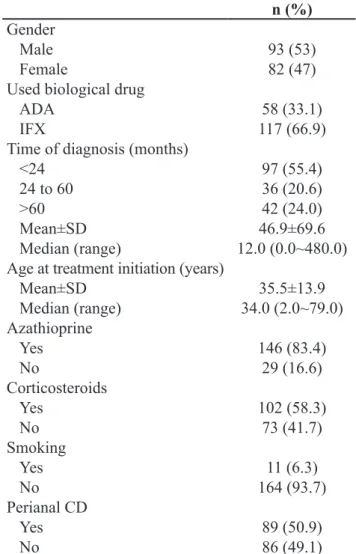
The study included 175 patients, 93 (53%) were male and 82 (47%) female. In relation to age at the be-ginning of biological treatment, a mean of 35.5 years old (2–79; SD=13.9) was found. The mean time of duration of CD at the beginning of treatment was 46.9 months (0–480; SD=69.6). However, it was ob-served that most cases (55.4%) started biological treat-ment less than 24 months after the onset of the disease. One hundred and forty-six patients (83.4%) were on concomitant use of azathioprine (AZA), using the strategy of combo therapy, more recently described1.
Corticosteroids were used at the beginning of biologi-cal treatment in 102 patients (58.3%). No patient used methotrexate. There were only 11 smoking patients, which corresponded to 6.3% of the total sample. Peri-anal disease was found in 89 patients (50.9%). The biological therapies used were IFX in 117 (66.9%) patients and ADA in 58 (33.1%). No patient was on CER. Table 2 summarizes the baseline characteristics of the analyzed patients.
Universidade Católica do Paraná (PUC-PR),
pro-tocol number 0005580/11.
This was a retrospective, transversal multicenter study with patients with CD who were on biological ther-apy from May 2000 to May 2012, coming from ive dif-ferent reference centers of inlammatory bowel disease (IBD) from the South and Southeast of Brazil.
The study included: patients with CD, users of IFX, ADA or CER as the irst anti-TNF agent, who had not previously been on biological therapy, at any age. The study excluded: patients with ulcerative coli-tis or indeterminate IBD, and those who were using a second biological drug in the treatment (patients with previous exposure to a irst biological agent).
The study sample was not calculated, but per-formed by means of a convenience sample, including the actual number of patients coming from the men-tioned reference centers. A data review was conduct-ed with information from mconduct-edical iles and posterior completion of a speciic protocol, with previously chosen variables to be analyzed. When necessary, the patient received a phone call in case there was con-licted or missing information, to clear any doubts or to request any additional information. After the revi-sion of medical iles and data collection, 175 patients met the criteria and were included in this study.
All reference centers of IBD that offered their pa-tients data manage CD according to the guidelines by the European Crohn’s and Colitis Organization (ECCO), which standardizes specially the indication to biological treatment in the included subjects9.
The analyzed variables were gender, age at biologi-cal therapy initiation, time of diagnosis, associated perianal disease, concomitant medications, smoking, type of anti-TNF agent anti-anti-TNF (IFX, ADA or CER) and Montreal classiication (age at diagnosis of CD, location of disease and phenotype). The Montreal classiication is detailed in Table 1. Protocols were fulilled based on the compiled data concerning the beginning of biological treatment, and not the time of diagnosis of CD.
Literature review was based on searches in the fol-lowing databases: PubMed, MEDLINE and SciELO. The searched terms were: “inliximab”, “adalimumab”, “certolizumab pegol”, “anti-TNF”, “biologics” and “epidemiology”, always combined with “Crohn’s dis-ease”. All relevant articles published until July 2012 were reviewed, and those with similar
epidemiologi-Table 1. Detailed Montreal Classiication, adapted
from Silverberg et al.0.
Montreal Classiication
Age at diagnosis (A)
A1 ≤16 years old A2 17–40 years old A3 ≥40 years old
Disease location (L)
L1 Terminal ileum
L2 Colon
L3 Ileum-colon L4 Upper gastrointestinal tract
According to the Montreal classii cation, the fol-lowing results were obtained for each of the variables: age at diagnosis A1 (n=21; 12%), A2 (n=102; 58.3%) and A3 (n=52, 29.7%). CD location: L1 (n=42; 24%), L2 (n=51, 29.1%), L3 (n=81, 46.3%), and L4 (n=1, 0.6%). So, there was a higher prevalence of pa-tients diagnosed with CD between 17 and 40 years old (A2), patients with ileocolic location (L3) and with i stulizing disease (B3). Figure 1 illustrates these data.
DISCUSSION
The determination of epidemiological characteris-tics in patients with CD is very difi cult, in Brazil and in other developing countries, due to the dei cient registra-tion systems. It is more difi cult to characterize patients with CD on biological therapy, because even in devel-oped countries these data are controversial, and ana-lyzed in different manners by the studies that are avail-able in literature2. Some assess only isolated users of
biological therapy, most of the time analyzing its efi ca-cy, safety or loss of response11-16,18. Therefore, this study
aimed to assess data from subjects coming from i ve reference centers of IBD from the South and Southeast of Brazil in order to present a general epidemiological proi le of these patients, which is more adequate to our reality, and compare them with other studies conducted in Brazil and in other parts of the world.
The i ndings in this study demonstrated the greater prevalence of CD in young patients – A2 in the Montreal classii cation, and mean age of 35.5 years old – in accordance with national and international lit-erature2,11-18. This fact reveals the great importance of diagnosis and adequate management of these patients, since it’s a period of major activity and productivity of subjects. Since the disease is considerably debilitat-ing, both physically and emotionally, and because the treatment is long, these years in the patient’s life end up being compromised11,13.
The higher prevalence of male (53 versus 47%)
was a bit different than i ndings from literature, which presents 45 to 61.8% of female patients and 32.8 to 55% of male patients2,11-18. According to
Cosnes et al.17, in countries with low incidence of CD, in Europe and North America, the prevalence of the disease has increased among men, being
simi-lar or even superior to women. Figure 1.biological therapy. Mo ntreal Classii cation of the 175 patients submitted to
70
60
50
40
30
20
10
0 A1 12%
58.3%
29.7% 24%
29.1% 46.3%
33.7% 26.3%
40%
A2 A3 L1 L2 L3 L4 B1 B2 B3
% of pa
ti
ent
s
Montreal Classification
Table 2. Baseline characteristics of the 175 analyzed
patients.
n (%)
Gender
Male 93 (53)
Female 82 (47)
Used biological drug
ADA 58 (33.1)
IFX 117 (66.9)
Time of diagnosis (months)
<24 97 (55.4)
24 to 60 36 (20.6)
>60 42 (24.0)
Mean±SD 46.9±69.6
Median (range) 12.0 (0.0~480.0) Age at treatment initiation (years)
Mean±SD 35.5±13.9
Median (range) 34.0 (2.0~79.0) Azathioprine
Yes 146 (83.4)
No 29 (16.6)
Corticosteroids
Yes 102 (58.3)
No 73 (41.7)
Smoking
Yes 11 (6.3)
No 164 (93.7)
Perianal CD
Yes 89 (50.9)
No 86 (49.1)
Epidemiological proile of 175 patients with Crohn’s disease submitted to biological therapy Marcelo Rassweiler Hardt et al.
J Coloproctol
October/December, 2012
Vol. 32 Nº 4
The other two analyzed variables that presented different numbers than those found in literature were the presence of perianal disease and smoking. Since the study was performed in specialized IBD centers, especially coloproctology units, more than half of the patients (50.9%) had associated perianal disease. This percentage was signiicantly different when compared to other papers in literature, which showed 13.1–42% patients affected by perianal disease2,11-13,16,17.
Howev-er, it is important to notice the increase of severe and complicated forms of CD, such as perianal compro-mise or other conditions2. The presence of istulae is
especially emphasized, since they have a signiicant impact on the quality of life of patients and make the treatment for CD even more challenging13,15.
Regarding smoking, the difference was even greater. In this study, only 6.3% of patients smoked, while in literature this habit was present in 19 to 47.8% of the cases2,12,13,15-17. Maybe this fact is justiied by the
greater announcement of the relation between smok-ing and the worse evolution of the disease, especially in patients’ associations and reference services.
In relation to immunosuppressive drugs, distinct values were found in comparison to the literature when analyzing only the use of AZA: 83.4% in this study and percentages between 25 and 49.7% in the international literature. However, in relation to the use of concomitant drugs, such as methotrexate, 6-mercaptopurine and ami-nosalicylates, which are common in Europe and in the United States, if added to the use of AZA, the per-centage is close to 70%2,11-16. These values suggest
that even with adverse effects and slow action onset, there are beneits to the combined treatment with anti-TNF that overcome its disadvantages1,14. The results
presented by Colombel et al.1, in the SONIC study, demonstrated that the combined therapy of IFX and AZA presented better clinical remission rates for CD as well as mucosal healing, in comparison to mono-therapy with IFX or AZA.
By analyzing the use of corticosteroids at the begin-ning of biological treatment, 58.3% of the patients in this study used them. In the national and international litera-ture, these values ranged from 26 to 77% of the cases, which demonstrates one of the great indications to use biological drugs for the treatment of CD, the corticoste-roid dependency2,11-18. Brazilian studies that also reported the analysis of this variable, demonstrated that 67 to 77%
of the patients were on the medication. These data may seem to relect the tendency of the great use of cortico-steroids in Brazil in relation to the other countries2,19,20.
It is very dificult to deine which biological agent is more used nowadays. The most relevant in-ternational studies on the subject aim to assess the safety and eficacy of each isolated drug2,11-16. National
studies and other case series do not present these data comparatively2,19,20. Even though, a signiicantly high-er prevalence of IFX is still obshigh-erved, maybe for its longer presence in the market or because of its avail-ability in some centers. It could also be due to the ex-perience of professionals who prescribe it and handle it. However, ADA is being more and more used, so this difference is being reduced as observed in publica-tions throughout the years1,2,15. It is certain that within
a few years there will be a greater number of patients on CER, which was recently approved in Brazil to treat CD patients. The results in this study demonstrated 66.85% of patients on IFX and 43.15% on ADA, with a clear progression on the use of ADA each year during the analyzed period. No patient was on CER. The main epidemiological data found in this study in comparison to data from literature are described on Table 3.
Concerning the Montreal classiication, many studies were analyzed; however, those that described the samples with this system were not only studies with patients on biological treatment, but with CD in gener-al. Some analyses that assessed only patients on ADA or IFX did not use this classiication, since their objec-tives were not related to epidemiological variables. So, the values found in this study were comparable to those of Brazilian analyses relecting a reality closer to ours, besides an international study that aimed to expose the evolution of the incidence and prevalence of IBD, CD and ulcerative colitis, separately, throughout the years, which consistently demonstrated the prevalence of each one of the classiications2,17,19-21.
Group A2 in the Montreal classiication (age at diagnosis between 17 and 40 years) was the most prevalent in this study, accounting for 58.3% of the patients. This number was similar to that of papers in literature analyzed in this comparison (between 59 and 73%), which shows the great prevalence of CD and the biological treatment in this age group17,19-21.
The most prevalent type was L3 (ileocolic CD), in 46.3% of the cases. In the literature, this was also the most com-mon form observed in most of the reviewed studies, with percentages ranging from 34.5 and 47%2,17,19-21.
Regarding the behavior of CD, differences be-tween the indings in this sample were found in com-parison to literature. The B3 type (penetrating CD) was described as being the most frequent one, representing 40% of the cases. In most studies, the B1 type was more prevalent (luminal CD), ranging between 29.2 and 71%. This fact can be explained by the conduction of studies in colorectal surgery units, instead of gastroenterology clinics, where the reference and indications for patients with istulizing perianal CD is more prevalent2,17,19,20.
The comparative data in the present sample in relation to the Montreal classiication and other studies in litera-ture are detailed in Table 4.
CONCLUSIONS
Patients with CD on biological treatment, who had not been previously on anti-TNF therapy, had mean age of 35.5 years old, and most of them were male (53%). The subtype A2, from the Montreal clas-siication, was the most found one (68.3%), and ileo-colic segment (L3) as the most frequent compromised location in 46.3% of the cases. Most patients were on treatment with AZA or corticosteroids together with the biological treatment. These data characterize an epidemiological proile compatible with that found in international literature.
The presence of perianal disease was shown in 50.9% of the cases, and the subtype B3 from the Mon-treal classiication was present in 40% of the cases, with higher prevalence comparing to the literature.
Table 3. Clinical and epidemiological basal characteristics of patients in comparison to papers from the national
and international literature.
Author
Gender (%)
Mean age
Perianal Disease
(%)
Smoking (%)
Concomitant AZA
(%)
Concomitant corticosteroid
(%) Male Female
Panaccione et al.11 43.1 56.9 37 22.4 – 46.4 47.4 Colombel et al.12 38.2 61.8 37.1 15.2 35.5 32.2 44.0 Lichtiger et al.13 40.9 59.1 40.8 13.1 23.5 41.2 42.3
Hanauer et al.14 42.0 58.0 35 – – 25.0 51.0 Sands et al.15 55.0 45.0 37 – 45.0 30.0 26.0 Schnitzler et al.16 39.0 61.0 33.9 28.0 47.8 49.7 32.2
Cosnes et al.17 54.0 46.0 33 31.0 19.0 – – Souza et al.2 44.0 56.0 32 42.0 – 48.8 77.0
Kotze et al.8 46.3 53.7 36.7 50.0 – – 55.5 This study 53.0 47.0 35.5 50.9 6.3 83.4 58.3
AZA: azathioprine.
Author Montreal
A1 A2 A3 L1 L2 L3 L4 B1 B2 B3
Teixeira et al.21 10.0% 72.0% 18.0% 34.5% 31.0% 34.5% 0.0% - - -Souza et al.20 - - - 22.0% 29.0% 47.0% 2.0% 58.0% 19.0% 23.0%
Poli et al.19 8.0% 73.0% 19.0% 34.0% 15.0% 45.0% 1.0% 38.0% 26.0% 36.0% Souza et al.2 8.0% 59.0% 33.0% 46.0% 10.0% 43.0% 1.0% 71.0% 8.0% 21.0%
Cosnes et al.17 11.0% 72.0% 17.0% 25.3% 27.2% 34.6% 13.1% 29.2% 33.6% 37.2% This study 12.0% 58.3% 29.7% 24.0% 29.1% 46.3% 0.6% 33.7% 26.3% 40.0%
Epidemiological proile of 175 patients with Crohn’s disease submitted to biological therapy Marcelo Rassweiler Hardt et al.
J Coloproctol
October/December, 2012
Vol. 32 Nº 4
REFERENCES
1. Colombel JF, Sandborn WJ, Reinisch W, Mantzaris GJ, Kornbluth A, Rachmilewitz D, et al. Inliximab, azathioprine, or combination therapy for Crohn’s disease. N Engl J Med 2010;362(15):1383-95.
2. Souza MHLP, Troncon LEA, Rodrigues CM, Viana CFG, Onofre PHC, Monteiro RA, et al. Evolução da ocorrência (1980-1999) da doença de Crohn e da retocolite ulcerativa idiopática e análise das suas características clínicas em um hospital universitário do sudeste do Brasil. Arq Gastroenterol 2002;39(2):98-105.
3. Sedlack RE, Whisnant J, Elveback LR, Kurland LT. Incidence of Crohn’s disease in Olmsted County, Minnesota, 1935-1975. Am J Epidemiol 1980;112(6):759-63.
4. Sonnenberg A. Geographic variation in the incidence of and mortality from inlammatory bowel disease. Dis Colon Rectum 1986;29(12):854-61.
5. Yanai H, Hanauer SB. Assessing response and loss of response to biological therapies in IBD. Am J Gastroenterol 2011;106(4):685-98.
6. Chaparro M, Panés J, García V, Merino O, Nos P, Domènech E, et al. Long-term durability of response to adalimumab in Crohn’s disease. Inlamm Bowel Dis 2012;18(4):685-90. 7. Rutgeerts P, Van Assche G, Vermeire S. Optimizing anti-TNF
treatment in inlammatory bowel disease. Gastroenterology 2004;126(6):1593-610.
8. Wu EG, Mulani PM, Yu AP, Tang J, Pollack PF. Loss of treatment response to inliximab maintenance therapy in Crohn’s disease: a payor perspective. Value Health 2008;11(5):820-9.
9. Dignass A, Van Assche G, Lindsay JO, Lémann M, Söderholm J, Colombel JF, et al. The second European evidence-based Consensus on the diagnosis and management of Crohn’s disease: Current management. J Crohns Colitis 2010;4(1):28-62 10. Silverberg MS, Satsangi J, Ahmad T, Arnott ID, Bernstein
CN, Brant SR, et al. Toward an integrated clinical, molecular and serological classiication of inlammatory bowel disease: Report of a Working Party of the 2005 Montreal World Congress of Gastroenterology. Can J Gastroenterol 2005;19 (Suppl A):5-36.
11. Panaccione R, Loftus Jr EV, Binion D, McHugh K, Alam S, Chen N, et al. Eficacy and safety of adalimumab in Canadian patients with moderate to severe Crohn’s disease: results of the Adalimumab in Canadian SubjeCts with ModErate to Severe Crohn’s DiseaSe (ACCESS) trial. Can J Gastroenterol 2011;25(8):419-25.
12. Colombel JF, Sandborn WJ, Rutgeerts P, Enns R, Hanauer SB, Panaccione R, et al. Adalimumab for maintenance of clinical response and remission in patients with Crohn’s disease: the CHARM trial. Gastroenterology 2007;132(1):52–65. 13. Lichtiger S, Binion DG, Wolf DC, Present DH, Bensimon AG,
Wu E, et al. The CHOICE trial: adalimumab demonstrates safety, istula healing, improved quality of life and increased work productivity in patients with Crohn’s disease who failed prior inliximab therapy. Aliment Pharmacol Ther 2010;32(10):1228-39.
14. Hanauer SB, Feagan BG, Lichtenstein GR, Mayer LF, Schreiber S, Colombel JF, et al. Maintenance inliximab for Crohn’s disease: the ACCENT I randomised trial. Lancet 2002;359(9317):1541-9.
15. Sands BE, Anderson FH, Bernstein CN, Chey WY, Feagan BG, Fedorak RN, et al. Inliximab maintenance therapy for istulizing Crohn’s disease. N Engl J Med 2004;350(9):876-85.
16. Schnitzler F, Fidder H, Ferrante M, Noman M, Arijs I, Van Assche G, et al. Long-term outcome of treatment with inliximab in 614 patients with Crohn’s disease: results from a single-centre cohort. Gut 2009;58(4):492-500.
17. Cosnes J, Gower-Rousseau C, Seksik P, Cortot A. Epidemiology and natural history of inlammatory bowel diseases. Gastroenterology 2011;140(6):1785-94.
18. Kotze PG, Vieira A, Sobrado Jr CW, Salem JB, Kotze LMS. Adalimumab in the induction of Crohn’s disease remission: results of a Brazilian multicenter case series. J Coloproctol 2011;31(3):233-40.
19. Poli DD. Aspectos da raça e da ancestralidade na apresentação e evolução da DC no Brasil [Dissertação de Mestrado]. São Paulo: Faculdade de Medicina da Universidade de São Paulo; 2007. 51 p.
20. Souza MM; Belasco AGS; Aguilar-Nascimento JE. Peril epidemiológico dos pacientes portadores de doença inlamatória intestinal do estado de Mato Grosso. Rev Bras Colo-proctol 2008;28(3):324-8.
21. Teixeira MG, Habr-Gama A, Takiguti CK, Brunetti Netto C, Pinotti HW. Aspectos epidemiológicos da doença de Cröhn em 140 pacientes do serviço de Colo-Proctologia do HCFMUSP. Rev Bras Colo-Proctol 1993;13(4):128-32.
Correspondence to: Paulo Gustavo Kotze
Rua Mauá, 682