*Correspondence: A. M. Pugens Pinto. Biocinese – Centro de Estudos Bio-farmacêuticos, Av, Ministro Cirne Lima, 1541, Vila Becker, 85903-590 –Toledo – Paraná – PR, Brasil. E-mail: [email protected]
A
rti
Pharmaceutical Sciences vol. 45, n. 4, oct./dec., 2009
Bioavailability of two oral formulas of
secnidazole in healthy volunteers
Patrícia Andréa Bertuol Montovani*,
Ana Maria Pugens Pinto, Mauricio Bedim dos Santos,
Daiane Loss Vieira, Anelise Weich do Prado, Josélia Larger Manio
Biocinese, Centro de Estudos Biofarmacêuticos Ltda.
Secnidazole is an antimicrobial agent used primarily in the treatment of amoebiasis. For this bioequivalence study of secnidazole, twenty-eight healthy female volunteers were enrolled in a randomized crossover study. Each volunteer was given a single oral dose of secnidazole test preparation and then the reference preparation, or vice versa, with a wash out interval of two weeks. The plasma concentrations of secnidazole were determined by HPLC, and the samples were extracted with tert-butyl-methyl-ether: dicloromethane (60:40, v/v). Secnidazole and its parent compound metronidazole were separated on a C18 column with water:acetonitrile (85:15, v/v) as the mobile phase, and monitored at 310 nm. The ratio of mean Cmax,
AUC0−t and AUC0−∞ values for the test and reference products were within the predetermined range
established by ANVISA, demonstrating that the two formulations are bioequivalent in rate and extent of absorption.
Uniterms: Oral formulas/bioequivalence study. Secnidazole/bioavailability. Antimicrobials/ bioavailability.
Secnidazol é um agente antimicrobiano utilizado principalmente no tratamento da amebíase. Para este estudo de bioequivalência de secnidazol em voluntários saudáveis, foram incluídos vinte e oito voluntárias mulheres no estudo randomizado cruzado. Cada voluntária recebeu uma única dose oral de secnidazol do produto teste e referência para comparação, com um intervalo de wash-out de duas semanas. As concentrações plasmáticas de secnidazol foram determinados por CLAE, as amostras foram extraídas com terc-butil-metil-éter: dicloromethano (60:40, v/v). O secnidazol e seu padrão interno metronidazol foram separados em uma coluna (C18 ) com fase móvel água ultra-pura:acetonitrila (85:15, v/v) e monitorado em 310 nm. As razões entre as médias geométricas de Cmáx, ASC0-t e ASC0-∞,
encontraram-se dentro do estabelecido pela ANVISA, demonstrando que as formulações são bioequivalentes quanto à taxa e extensão de absorção
Unitermos: Formulações orais/estudo de bioequivalência. Secnidazol/biodisponibilidade. Antimicrobianos/biodisponibilidade.
INTRODUCTION
Nitroimidazoles have recently been indicated as the category of drugs offering the closest to ideal treatment for amoebiasis, due to their low toxicity (Silva, 2006). The principal derivatives of nitroimidazoles are: metronidazo-le, tinidazometronidazo-le, ornidazometronidazo-le, and secnidazometronidazo-le, (Silva, 2006; Goodman et al., 2007).
These drugs share the same common spectrum of
action against anaerobic microorganisms and are also effective in treatment of amoebiasis, giardiasis and tricho-monas (Gillis et al., 1996).
Metronidazole was the irst nitroimidazole for the treatment of trichomonas, a disease caused by
Trycho-monas vaginalis, although there are now reports that
secnidazole is more effective for curing disorders caused by this pathogen (Saracoglu et al., 1998).
liver, principally by oxidation, as it does not induce nor inhibit iso enzymes of CP450, and its principal metabolite while inactive is RP-35843. It has a plasma half life of 17 to 29 hours in men and 14 hours in women (Klasco et al., 2006).
Studies of bioavailability and equivalence are used to determine the blood pharmaceutical concentration of the test pharmaceutical compared to the reference medi-cation. Based on these studies, therapeutic equivalence is conirmed for the generic product, which represents a less costly alternative for the general population.
This study was designed to evaluate the bioavailabi-lity of two medications containing secnidazole 1000 mg, to determine their bioequivalence. The test product, secnida-zole 1000 mg, was obtained from Prati, Donaduzzi Labo-ratories, while the reference was secnidazole (Secnidal®)
1000 mg from Adventis Pharma Laboratory.
MATERIAL AND METHODS
Material
Secnidazole 1000 mg, tablet form (test medication) Secnidal® 1000 mg tablet form (reference medication)
Secnidazole (Study standard - Siddharth International) Metronidazole (Internal standard-secondary standard- Aarti Drugs)
Reagents
Distilled water
Acetonitrile HPLC Grade (TEDIA) Methyl-tert-butyl-ether (TEDIA) Dichloromethane (TEDIA)
Equipments
High Performance Liquid Chromatography (HPLC) Soft-ware LC Solution- Shimadzu®
Automatic pipettes EP 20, 200, 1000, and 5000 µL Ultra Freezer, ILSHIN
Freezer, Electrolux FE26
Refrigerated Centrifuge, CIENTEC 5000R Vortex Tube Agitator, AP 56 PHOENIX Bain Marie- TECNAL
WinNolin Pharsight®
Volunteer Selection
Twenty-eight healthy female volunteers between the ages of 18 and 50 years, with a body mass index of ≥ than
19 and ≤ 27 and no serious diseases were selected after a medical exam. Before the study, the volunteers underwent a clinical history, clinical exam, laboratory tests and elec-trocardiogram.
All patients read and signed an informed consent statement before entering the study, which was approved by the Research Ethics Committee of the Hospital de Clí-nicas in Curitiba, Paraná.
The study involved two hospitalizations of 23 hours with a two-week interval. Volunteers were admitted to a private clinic, and were fasting for 8 hours before the study which began at 7 a.m. During the study, the volunteers re-ceived a standard diet and had vital signs (blood pressure, pulse) and temperature monitored constantly.
The pre-dose blood sample was collected in a hepa-rinized vacutainer about 60 minutes before the medication was given. Further blood samples were collected at the following times after administration: at one hour, then every 20 minutes for the next 6 samples, then half hourly for two samples, then at 4,6,10 48 and 96 hours after ad-ministration (corresponding to the following times:1:00; 1:20;1:40;2:00; 2:40; 3:00; 3:30; 4:00; 6:00; 10:00; 48:00 and 96:00 hours).
Samples were centrifuged at 3000 rpm for 10 mi-nutes at 4 ºC, and the plasma was then transferred into cryogenic tubes and stored in a freezer at -20 ºC. After freezing, the samples were transported to the analytic laboratory.
Study Design
The study was a randomized open “crossover” consisting of two time periods, using a single oral dose for each administration and a washout period between ad-ministrations. Patients were randomized to receive either the test drug followed by the reference drug or vice versa. Blood samples were collected to allow for at least three half-lives of the agent to elapse. A wash out period of two weeks was allowed to be certain of elimination of secni-dazole 1000 mg, which has a half-life of about 21 hours.
Bioanalytical Methods
The bioanalytical method devised to quantify secni-dazol levels in human plasma was validated by examining the following parameters, as set forth in Resolution N.899 of May 29, 2003 (Brasil, 2003): speciicity, linearity, recu-peration, quantiication limits, detection limit, precision and accuracy, robustness, and stability.
(HPLC), with metronidazole as the internal standard. A total of 300 µL of plasma was transferred to an Eppendorf tube and 40 µL of standard solution (1000 ug/mL dissolved in acetonitrile 20%), was added, and the tubes then agitated in a vortex for 30 seconds.
Extraction was done using 4 mL of methyl-tert -butyl-ether (60:40, v/v) and the tubes were spun for a further 90 seconds and then centrifuged at 2,700 rpm for 20 minutes at 4 0C. After centrifugation, the organic phase
was separated and evaporated under nitrogen at 45 °C until dry. The residue was reconstituted with 200 µL of acetonitrile 15%. The mobile phase was reconstituted with distilled water: acetonitrile (85:15). Analysis was done un-der lux of 1.0 mL/min and volume of injection was 50 µL. The HPLC system used was Shimadzu (Kyoto, Japan) model LC-20AT with a quaternary system of bom-bardment and an automatic degasiication module for the mobile phase. Detection was done using UV at 310 nm. Chromatographic separation was done on a Kromasil C 18 (150x4.6 mm, 5 µm).
Concentration calculations of the samples were done using the software LC Solution®, provided with the HPLC system. The ratio of the area of the peak of secnidazole and the internal standard metronidazole were used as the calibration curve, using a linear regression model with a weight of 1/x, for the straight line equation: y=ax + b, whe-re y corwhe-responds to the awhe-reas of secnidazole/metronidazole and x refers to the concentration of Secnidazole; b is the intersection of the line with the y axis and a corresponds to the slope of the line.
Pharmacokinetic Analysis
The maximum peak concentration (Cmax) and the time to attain this concentration (Tmax) were obtained directly from the details of plasma concentration versus time. The plasma half-life was found using the following equation: T1/2
= 0.693/K
le , where the elimination constant (Kel) was
calcu-lated from the inclination coeficient of the regression line adjusted for at least the last three concentration values in log n format. The area under the curve of concentration versus time, from time zero until the inal collection (AUC0-t) was obtained using the method of trapezoids. The area under the curve from zero until ininity (AUC0-∞)was calculated as fol-lows: AUC0-∞= AUC0-t + Ct/Kle,where C
t is the last measured
concentration (Chow et al., 2000).
Statistical Analysis
The pharmacokinetic parameters Cmax, AUC0-t and AUC0-∞, were analyzed after logarythmic transformation
(In). ANOVA analysis of variance for crossover studies was used, as well as the details of Cmax, AUC0-t and AUC0-∞, to determine the effects of the sequence and vo-lunteer within the sequence, formulation, and time period.
A 90% Conidence Interval (CI) was used for the ra-tio of the geomentric means of the transformed data for the test medication and the reference standard (test/reference). The two medications were considered bioequivalent when the 90% CI of the ratio of the means was between 80 and 125% (Brasil, 2006).
RESULTS AND DISCUSSION
Twenty eight female volunteers with a mean age of 28 years, mean weight of 59.05 kg, mean height of 1.61 m and mean BMI of 22.81, participated in the study. The following inclusion criteria were observed: healthy female volunteers, not pregnant and not nursing, with a Body Mass Index ≥ 19 and ≤27, willing to sign an informed consent form, and comply with the study protocol. The laboratory exams applied were: clinical history, physical and psychological examination, blood pressure and pulse, EEG and complementary laboratory exams. Subjects also had to be able to understand the nature and objective of the study and be willing to cooperate with the Investigator and adhere to all the study requirements.
The method used in the study has some advantages compared to other methods using HPLC, as described in the literature. Ravi and coauthors (1997) used dichloro-methane as an extraction solvent, which led to some di-ficulties in processing of the samples and in recuperation and accuracy of the results. In the present study, a strongly non-polar solvent, methyl-tert-butyl-ether (60:40, v/v) was used for extraction, improving processing conditions and results, while providing greater ease, speed and recupera-tion during extracrecupera-tion of the samples.
the column length of 150 mm, which allowed analysis of a larger number of samples in a shorter time period, with greater economy of reagents, since bioequivalence studies usually involve an average of 1300 samples.
According to Ravi et al. (1997), in order to ob-tain a quantification limit in a concentration less than 1000 ng/mL, an electron capture detector should be used. However, in the current study a quantification limit of 300 ng/mL was observed without the need for this detector.
The method employed in this study followed the legislation in force (Brasil, 2003) and the stability of the pharmacologic agent in plasma was also proven. The para-meters of precision and accuracy yielded values of 6.37% and 100.21% for CBQ; 4.62% and 106.88% for CMQ and 4.90% and 108.95% for CQA, respectively. For linearity, the value found was 0.9980, the angular coeficient was 41697.07 and the line intercept was -16.3680. Recupera-tion values were 99.22% for secnidazole and 85.58% for the internal standard metronidazole. The samples remained stable during the three cycles of freezing and thawing in the short-term of 4 hours, post-processing of 48 hours, and long-term of 56 days afterward, indicating adequate stability of the plasma samples of volunteers from the time of collection to the last analysis.
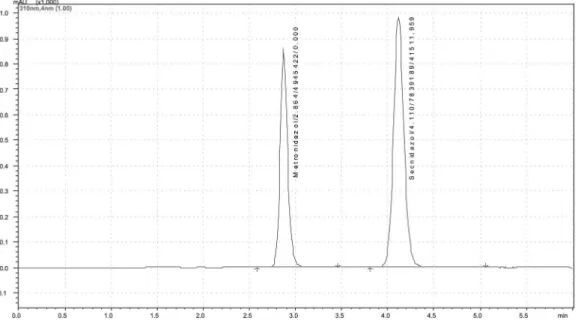
Figure 1 shows the chromatographic profile of secnidazole.
The analytic method used in this study for the quan-tiication of secnidazole in plasma samples can also be applied in bioequivalence studies.
The curve of mean plasma concentration versus time for the test medication and the reference is shown in Figure 2, demonstrating similar absorption, distribution and elimination for both drugs.
The pharmacologic parameters of the reference and test medications are shown in Table 1.
The plasma half-life (T1/2) of both products was simi-lar, with a mean of 19.60 hours. In a similar study, Bibi et al. (2002) found a plasma half life of 13.86 hours; although Tenenbaum et al. (1993), in a study which used 2 g of secnidazole, found a greater half-life of 28.80 hours. The time taken to reach maximum concentration (Tmax) in our study was. on average, 1.64 hours. Bibi et al (2002) found a mean Tmsx of 1.77 whereas Shahid (2001) found a Tmax of 5.03 hours in male volunteers. The maximum mean con-centration found in the present study was 24,899.32 ng/mL, above the value of 16,240.00 ng/mL found by Bibi et al. (2002). Ravi et al. (1997) however, found a Cmax of 25,680.00 ng/mL in six male volunteers.
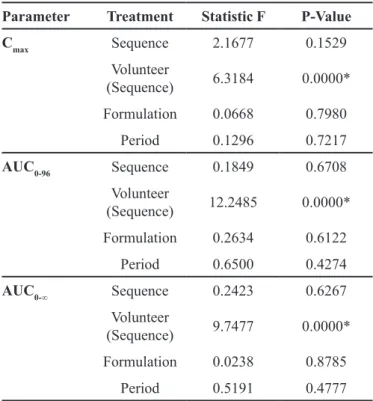
The ANOVA results for the parameters Cmax, AUC0-96 and AUC0-∞ shown in Table II demonstrate no significant difference in the formulations, period and sequence at a level of signiicance of α = 0.05, indicating
equivalence of the bioavailability means of secnidal® and
Secnidazole.
The difference found in effect of volunteer (se-quence) for the parameters Cmax, AUC0-96 and AUC0-∞, relects individual variability. The ratio of the geometric means for Cmax, was 99.46%, with a 90 %CI (Conidence
FIGURE 1 - Chromatograph obtained from volunteers after administration of 1000 mg of secnidazole added to the internal standard,
Interval) of 95.97% - 103.07%. For AUC0-96, the ratio of geometric means was100.88% with a 90% CI of 97.98% -103.86%; and for AUC0-∞, the ratio was 99.71% with a 90% CI of 96.59%-103.60%.
FIGURE 2 - Proile of mean plasma concentrations (± 2 standard errors) of secnidazole versus time, for one dose of the test and
reference formulations of an oral dose of secnidazole 1000 mg.
TABLE 1 -Pharmacologic parameters of the reference standard
and test medications
Pharmacokinetic Parameter Secnidal® Secnidazole
Tmax (h) 1.83
(2.00) (1.08)1.45 Mean (Standard Deviation)
Cmax (ng/mL) 25,020.35
(4101.64) 24,778.29 (3329.89) Mean (Standard Deviation)
Kel (1/h) 0.04
(0.01) (0.01)0.04 Mean (Standard Deviation)
T1/2 (h) 19.97
(4.29) (3.35)19.23 Mean (Standard Deviation)
AUC0-96 (ng/mL.h) 676,436.39
(103,797.75) (11,866.61)684,080.84 Mean (Standard Deviation)
AUC0-∞(ng/mL.h) 707,181.13
(105,924.32) (124,391.66)707,925.29 Mean (Standard Deviation)
Tmax =Time to reach maximum concentration; Cmáx = Maximum
concentration obtained; Kel =Elimination constant; T1/2 = Plasma
elimination half-life; AUC0-96 =Area under the concentration
curve versus time from 0 -96 hours; AUC0-∞ = Area under the
concentration curve versus time extrapolated to ininity
TABLE II - Analysis of Variance (ANOVA) of the Pharmacokinetic
Parameters
Parameter Treatment Statistic F P-Value
Cmax Sequence 2.1677 0.1529 Volunteer
(Sequence) 6.3184 0.0000* Formulation 0.0668 0.7980
Period 0.1296 0.7217
AUC0-96 Sequence 0.1849 0.6708 Volunteer
(Sequence) 12.2485 0.0000* Formulation 0.2634 0.6122
Period 0.6500 0.4274
AUC0-∞ Sequence 0.2423 0.6267 Volunteer
(Sequence) 9.7477 0.0000* Formulation 0.0238 0.8785
Period 0.5191 0.4777 Cmax =Maximum Concentration; ASC0-96 = Area under the
concentration curve versus time 0 to 96 hours; ASC0-∞ = Area
The results of the analysis of variance with the Conidence Intervals for the above parameters prove the bioequivalence of the formulations, as the 90% CI of the ratio of means was between 80-125% (Brasil, 2006).
The power of the test used in this study was above 99.99%, indicating that the number of volunteers in the study was suficient to ensure reliability of the results.
CONCLUSION
The results of this study show that the two formula-tions of Senidazole (test/reference) are interchangeable, as the 90% CI of the pharmacokinetic parameters evalu-ated were within the range established by the regulatory agency-ANVISA.
ACKNOWLEDGEMENTS
Study funding was provided by Indústria Farmacêu-tica Prati, Donaduzzi & Cia LTDA –Toledo-PR.
REFERENCES
BIBI, R. N. S.; SHAHID, M.; KIANI, S. Q. Analysis of blood for Secnidazole in female volunteers by HPLC method.
J. Biol. Sci., v.2, n.11, p.769-770, 2002.
BRASIL. Leis, decretos, etc. Resolução n.899, de 29 de maio de 2003. A Agência Nacional de Vigilância Sanitária aprova o Guia para validação de métodos analíticos e bioanalíticos.
Diário Oicial da União, Brasília, 2 jun. 2003. Seção 1, p. 56-59.
BRASIL. Leis, decretos, etc. Resolução n.1170, de 19 de abril de 2006. A Agência Nacional de Vigilância Sanitária Guia para provas de biodisponibilidade relativa/bioequivalência de medicamentos. Diário Oicial da União, Brasília, 24 abr. 2006. Seção 1, p. 35-55.
CHOW, S.; PEI LIU, J. Design and analysys of bioavailability and bioequivalence studies. New York: Marcel Dekker, 2002. p.8-10.
GILLIS, J. C.; WISEMAN, L. R. Secnidazole: a review of its antimicrobial activity, pharmacokinetic properties and therapeutic use in the management of protozoal infections and bacterial vaginosis. Drugs, v.51, n.4, p.621-638, 1996.
GOODMAN, A. G.; GILMAN, A. As bases farmacológicas da terapêutica. 11.ed. Rio de Janeiro: MacGraw-Hill, 2007. p.983-997.
KLASCO, R. K. (Ed.). DRUGDEX® System. Thomson MICROMEDEX, Greenwood Village, Colorado, USA. 2007. Avaiable at: <http://www.periodicos.capes.gov.br>. Accessed on: 04 jul. 2007.
SARACOGLU, F.; GOL, K.; SAHIN, I.; TURKKANI, B.; ATALAY, C.; OZTOPÇU, C. Treatment of bacterial vaginosis with oral or vaginal ornidazole, secnidazole and metronidazole.Int. J. Gynecol. Obst., v.62, p.59-61, 1998.
SHAHID, M. Biokinetics of secnidazole in male volunteers determined by HPLC method. M. Phil Pakistan. Faisalabad, 2001. [Thesis. Department of Chemistry. University of Agriculture.].
SILVA, P. Farmacologia. 7.ed. Rio de Janeiro: Guanabara Koogan, 2006. p.1094-1095.
RAVI, S. K.; RAVI, M. U. R.; SEKHAR, E. C.; RAO, T. R. K.; SHOBHA, J. C.; RANI, P. U.; SURYA, K. J. Rapid and selective analysis of secnidazole in human plasma using high-performance liquid chromatography with ultraviolet detection. J. Chromatogr. B., v.691, p.208-211, 1997.
TENENBAUM, H.; CUISINIER, F. J.; LE LIBOUX, A.; PICHARD, E.; MONTAY, G.; FRYDMAN, A. Secnidazole concentration in plasma and crevicular luid after a single oral dose. J. Clin. Period., v.20, n. 7, p.505-508, 1993.
Received for publication on 22th August 2007.