www.bjorl.org
Brazilian
Journal
of
OTORHINOLARYNGOLOGY
ORIGINAL
ARTICLE
Comparison
of
drug-induced
sleep
endoscopy
and
Müller’s
maneuver
in
diagnosing
obstructive
sleep
apnea
using
the
VOTE
classification
system
夽
Yakup
Yegïn,
Mustafa
C
¸elik
∗,
Kamïl
Hakan
Kaya,
Arzu
Karaman
Koc
¸,
Fatma
Tülin
Kayhan
BakırköyDr.SadiKonukTrainingandResearchHospital,DepartmentofOtorhinolaryngology---HeadandNeckSurgery,Istanbul, Turkey
Received3November2015;accepted24May2016 Availableonline20June2016
KEYWORDS Obstructivesleep apnea;
Müller’smaneuver; Drug-inducedsleep endoscopy; VOTEclassification
Abstract
Introduction:Knowledgeofthesiteofobstructionandthepatternofairwaycollapseis essen-tial for determiningcorrect surgicaland medicalmanagementofpatients with Obstructive SleepApneaSyndrome(OSAS).Tothisend,severaldiagnostictestsandprocedureshavebeen developed.
Objective: Todeterminewhetherdrug-inducedsleependoscopy(DISE)orMüller’smaneuver (MM)wouldbemoresuccessfulatidentifyingthesiteofobstructionandthepatternofupper airwaycollapseinpatientswithOSAS.
Methods:Thestudy included63patients (52maleand11female)whowerediagnosedwith OSASatourclinic.Agesrangedfrom30to66yearsoldandtheaverageagewas48.5years. AllpatientsunderwentDISEandMMandtheresultsoftheseexaminationswerecharacterized accordingtotheregion/degreeofobstructionaswellastheVOTEclassification.Theresultsof eachtestwereanalyzedperupperairwaylevelandcomparedusingstatisticalanalysis(Cohen’s kappastatistictest).
Results:TherewasstatisticallysignificantconcordancebetweentheresultsfromDISEandMM forproceduresinvolvingtheanteroposterior(73%),lateral(92.1%),andconcentric(74.6%) con-figurationofthevelum.Resultsfromthelateralpartoftheoropharynxwerealsoinconcordance betweenthetests(58.7%).Resultsfromthelateralconfigurationoftheepiglottiswerein con-cordancebetweenthetests(87.3%).Therewasnostatisticallysignificantconcordancebetween thetwoexaminationsforproceduresinvolvingtheanteroposteriorofthetongue(23.8%)and epiglottis(42.9%).
夽 Pleasecitethisarticleas:YegïnY,C¸elikM,KayaKH,Koc¸AK,Kayhan FT.Comparisonofdrug-inducedsleependoscopyand Müller’s maneuverindiagnosingobstructivesleepapneausingaVOTEclassificationsystem.BrazJOtorhinolaryngol.2017;83:445---50.
∗Correspondingauthor.
E-mail:[email protected](M.C¸elik).
PeerReviewundertheresponsibilityofAssociac¸ãoBrasileiradeOtorrinolaringologiaeCirurgiaCervico-Facial.
http://dx.doi.org/10.1016/j.bjorl.2016.05.009
Conclusion:We suggestthatDISE hasseveraladvantages includingsafety,easeofuse,and reliability,whichoutweighMMintermsoftheabilitytodiagnosesitesofobstructionandthe patternofupperairwaycollapse.Also,MMcanprovidesomeknowledgeofthepatternof pha-ryngealcollapse.Furthermore,wealsorecommendusingtheVOTEclassificationincombination withDISE.
© 2016 Associac¸˜ao Brasileira de Otorrinolaringologia e Cirurgia C´ervico-Facial. Published by Elsevier Editora Ltda. This is an open access article under the CC BY license (http:// creativecommons.org/licenses/by/4.0/).
PALAVRAS-CHAVE Apneiaobstrutivado sono;
ManobradeMüller; Endoscopiacomsono induzidopor
fármacos;
Classificac¸ãoVOTE
Comparac¸ãoentreendoscopiacomsonoinduzidoporfármacosemanobradeMüller nodiagnósticodeapneiaobstrutivadosonousandoosistemadeclassificac¸ãoVOTE
Resumo
Introduc¸ão:Oconhecimentodolocaldaobstruc¸ãoedopadrãodecolapsodasviasrespiratórias éessencialparadeterminarotratamentocirúrgicoeclínicocorretosdepacientescomSíndrome deApneiaObstrutivadoSono(SAOS).Paraestefim,váriostesteseprocedimentosdediagnóstico foramdesenvolvidos.
Objetivo:Determinar seaEndoscopiadeSonoInduzidoporFármacos(DISE)ouManobrade Müller(MM) seriamaisbem-sucedidanaidentificac¸ãodolocal deobstruc¸ãoedopadrãode colapsodasviasrespiratóriassuperioresempacientescomSAOS.
Método: Oestudoincluiu63pacientes(52dosexomasculinoe11dosexofeminino)queforam diagnosticadoscomSAOSemnossaclínica.Asidadesvariaramde30a66anoseaidademédiafoi de48,5anos.TodosospacientesforamsubmetidosaDISEeMMeosresultadosdestesexames foramcaracterizados deacordocomaregião/graude obstruc¸ão,bemcomo aclassificac¸ão VOTE.Osresultadosdecadatesteforamanalisadosporníveldasviasrespiratóriassuperiores ecomparadosusandoanáliseestatística(testeestatísticokappadeCohen).
Resultados: HouveconcordânciaestatisticamentesignificativaentreosresultadosdaDISEeMM paraosprocedimentosqueenvolvemconfigurac¸ãoanteroposterior(73%),lateral(92,1%)e con-cêntrica(74,6%)dovéupalatino.Osresultadosdapartelateraldaorofaringetambémestavam em concordância entreos testes(58,7%). Osresultados daconfigurac¸ãolateraldaepiglote estavamemconcordância entreostestes(87,3%).Nãohouveconcordânciaestatisticamente significativaentreosdoisexamesparaosprocedimentosqueenvolvemaparteanteroposterior dalíngua(23,8%)eepiglote(42,9%).
Conclusão:Sugere-sequeaDISEapresentavárias vantagens,como seguranc¸a,facilidadede usoeconfiabilidade,quesuperamaMMemtermos dacapacidade dediagnosticarlocaisde obstruc¸ãoe opadrão decolapsoda viarespiratóriasuperior. OMM podetambém fornecer algumconhecimentosobreopadrãodecolapsodafaringe.Alémdisso,recomendamosouso daclassificac¸ãoVOTEemcombinac¸ãocomDISE.
© 2016 Associac¸˜ao Brasileira de Otorrinolaringologia e Cirurgia C´ervico-Facial. Publicado por Elsevier Editora Ltda. Este ´e um artigo Open Access sob uma licenc¸a CC BY (http:// creativecommons.org/licenses/by/4.0/).
Introduction
In 1973, Guilleminault first described obstructive sleep apnea (OSA) as a syndrome characterized by recurrent episodesofsleepapneaandhypopneacausedbyrepetitive upperairway(UA)collapse.OSAoftenresultsindecreased oxygenlevelsinbloodandarousalfromsleep.1Obstructive
SleepApnea Syndrome (OSAS) may induce excessive day-timesomnolence,morningheadaches,poorconcentration, cardiopulmonaryandcardiovasculardiseases, andalower qualityoflife.2,3
Polysomnography,firstdescribed in1965 byGastaut,is utilizedtodiagnoseandassesstheseverityofOSAS.4
How-ever,knowledgeofthesiteofobstruction andthepattern
ofairwaycollapseisessentialfor determiningcorrect sur-gical and medicalmanagement of patients with OSAS.To thisend,severaldiagnostictestsandprocedureshavebeen developed.Fiber-opticnasalendoscopywasfirstutilizedby WeitzmanandHilltodiagnosepatientswithOSAS.5,6In1978,
Müller’smaneuver(MM)wasintroducedbyBorowieckietal.7
todeterminesitesofairwaycollapseinpatientswithOSAS. Sheretal.8suggested thatMMisbeneficialforidentifying
Inthisstudy,wecomparedtwomethods,DISEandMM, regarding their ability to identify the site and degree of upper airway collapse, and characterized according the VOTEclassification.
Methods
We conducted a retrospective review of data collected from November 2013 to August 2014 at the our hospital within the Department of Otolaryngology Head and Neck Surgery. Therewere 63patients included in thestudy, 52 males and 11 females, with an average age of 48.5±8.9 years old (range, 30---66). We included patients with an apnea---hypopnea index greater than 5, asdetermined by on overnight sleep study. Patients were excluded if they hadanyofthefollowingcharacteristics:anapnea---hypopnea indexlowerthan5,lessthan18yearsold,bodymassindex (BMI) greater than 40, history of previous sleep surgery, AmericanSocietyofAnesthesiologists(ASA)grade3---4,and patients who refused surgical therapy. Each patient was evaluated based on the Epworth Sleepiness Scale (ESS), apnea---hypopneaindex(AHI),BMI,andneckcircumference. For all OSAS patients in this study, MM and DISE were performed by the same surgeon. Topical nasal deconges-tantandtopicalanesthetic(10%lidocaine)wereappliedto bothnasalcavities.Patientswereplacedinasupine posi-tionontheoperatingroomtable withthelightsdimmed. Aflexiblefiber-opticlaryngoscopewaspassedthroughthe anesthetizednasalcavityintothelarynxandobservations were digitally recorded. The pattern, site, and degree of upperairway collapsewere characterizedaccording to the VOTE classification.The following upper airway sites were evaluated: velum, oropharynx lateral wall, tongue, and the epiglottis. All patients were providedthe neces-sary information to perform the MM, which the patients then performed by maintaining maximal inspiration with an openglottisagainstclosed oraland nasalairways.The samemaneuverwasperformedforeachupperairwaylevel. Thedegreeofupperairwaycollapsewasdividedintothree categories: total,partial obstruction, and noobstruction, allaccordingtotheVOTEclassification.DISEwasalso per-formedonallpatientsinasilentoperatingroomwitheach patientinasupineposition.First,atropine(0.5mg/kg)was appliedtoreduceupperairwaysecretion,andthentopical nasaldecongestant andtopical anesthetic(10% lidocaine) were appliedtoboth nasalcavities. Throughout this pro-cedure, oximetry andcardiac rhythmswere monitoredby ananestheticteamandsupplementaloxygenwas adminis-teredby a blow-byfacemask (or whennecessary, a nasal cannula). Sedation was achieved using an infusion of a standardpropofoltitrationprotocolbeginningatarateof 50---75mcg/kg/min.Forpatientswhohadsnoringor obstruc-tiveapneas,we passed aflexible fiber-opticlaryngoscope throughthe anesthetizednasalcavity. Following DISE,we utilizedtheVOTEclassificationsystemtoevaluatetheupper airway collapse. For all patients, both endoscopic proce-dures were performed by the same surgeon. All patients werewellinformedandprovidedwritteninformedconsent. Theprotocolforthisstudywasapprovedbythesame hos-pital’slocal ethicscommittee (Ethical Committeenumber 2014/164).
Statisticalanalysis
TheNumberCruncherStatisticalSystem(NCSS)2007 Statis-ticalSoftware(UT, USA)wasusedfor statistical analyses. Data were evaluated using descriptive statistical meth-ods(e.g.,mean,standarddeviation,median,interquartile range). The results of both procedures were statistically analyzedusingCohen’skappastatisticaltest.Resultswitha p-value<0.05wereconsideredstatisticallysignificant.
Results
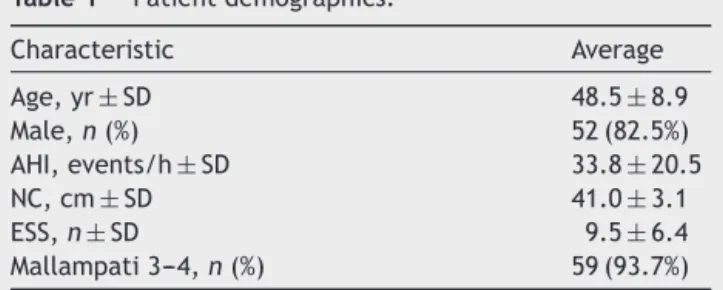
ThemeanAHIforallofthepatientswas33.8±20.5events/h and ranged from 5 to 94.6events/h. The mean BMI was 29.2±4.3kg/m2andranged from19.6to38.3kg/m2.The meanneckcircumferencewas41±3.1cmwithvalues ran-gingfrom 33 to 46cm. The mean ESS was9.5±6.4 with valuesrangingfrom0to24.Theresultsofallofthesetests arelistedinTable1.
Amongthe63patients,30patientslyinginan anteropos-terior configuration, 5 patients in a lateral configuration, and 27 patients in a concentricconfiguration had velum-relatedobstruction asobservedby bothMM andDISE.For eachoftheseconfigurations,therewassignificant concord-anceinthediagnosisofvelum-relatedobstructionbetween thetwomethods (anteroposterior,73%;=0.55,p<0.05),
lateral,92.1%;=0.348,p<0.05), andconcentric,74.6%; =0.555,p<0.05)(Fig.1).
Both endoscopic techniques identified 50 patients as having oropharynx-related obstruction in the lateral con-figuration (58.7%; =0.414, p<0.05); none had it in the
anteroposterior or concentric configurations according to eitherprocedure(Fig.2).
At the tongue level, 20 patients in the anteroposte-riorconfigurationwerediagnosedwithsevereupperairway collapse whenexamined via MM compared to51 patients diagnosedvia DISE.This reveals a lack of concordance in thediagnosisofseveretongue-relatedcollapsebetweenthe twomethods(76.2%;=0.026,p>0.05)(Fig.3).
Attheleveloftheepiglottis(anteroposterior configura-tion),weobservedseverecollapsein11patientsexamined via MM comparedto39 patients when examined by DISE, demonstratingalackofconcordancebetweenthetwo meth-ods(57.1%;=0.107,p>0.05).
Incontrast,inthelateralconfiguration,5patients exam-inedviaMMcomparedto9patientsexaminedviaDISEwere diagnosedwithsevereupperairwaycollapse,demonstrating significantconcordance(87.3%;=0.383,p<0.05)(Fig.4).
Table1 Patientdemographics.
Characteristic Average
Age,yr±SD 48.5±8.9
Male,n(%) 52(82.5%)
AHI,events/h±SD 33.8±20.5
NC,cm±SD 41.0±3.1
ESS,n±SD 9.5±6.4
Mallampati3---4,n(%) 59(93.7%)
C L
AP
Concordance 73 92.1 74.6
Discordance 27 7.9 25.4
0 10 20 30 40 50 60 70 80 90 100
Percentage, %
The velum-related collapse
46
17 5
5
4
1
Figure1 Concordanceofthediagnosisofvelum-related col-lapseinanteroposterior,lateral,andconcentricconfigurations (AP,anteroposterior;L,lateral;C,concentric).
Discordance Concordance
Percentage, % 58.7 41.3
0 10 20 30 40 50 60 70
Percentage, %
Concordance of the diagnosis of oropharyngeal collapse in lateral configuration.
39
24
Figure2 Concordanceofthediagnosisoforopharyngeal col-lapseinlateralconfiguration.
Discussion
Identification of the site and pattern of upper airway collapse is essential to accurately prescribe therapeutic approachesfor patients withOSAS.Furthermore,patients arelikelytohavedifferentsitesandpatternsofupper air-waycollapse,aswellasarangeofseveritiesofthedisease. Therefore, identifyingan accurate surgical treatment for OSASpatientswillreduceunnecessaryexpenses.10,11
Discordance Concordance
Percentage, % 23.8 76.2
0 10 20 30 40 50 60 70 80 90
Percentage, %
Concordance of the diagnosis of tongue collapse in anteroposterior configuration.
15
48
Figure3 Concordanceofthediagnosisoftonguecollapsein anteroposteriorconfiguration.
L AP
Concordance 42.9 87.3
Discordance 57.1 4.4
0 10 20 30 40 50 60 70 80 90 100
Percantage, %
Concordance of the diagnosis of epiglottis collapse in anteroposterior and lateral configurations.
2 36
55
8
Figure4 Concordanceofthediagnosisofepiglottiscollapse inanteroposteriorandlateralconfigurations(AP, anteroposte-rior;L,lateral).
Severalmethodshavebeenutilizedtodiagnosethe pres-enceofsevere level-specificupper airwaycollapse.12,13 In
1977,Weitzmanetal.5introducedendoscopicexamination
for identifying the site of upper airway collapse in OSAS patients. One technique that has readily been utilized in clinicalsettingsisMM.MMcanbeperformedinpatientswith OSAStodeterminethesiteofobstructionintheupper air-wayssinceitisacheapandeasilyperformedmethodthat canprovidevaluableinformation.Inthepresentstudy,MM was performed in a supine position different from previ-ousstudies.The mechanismresponsible fortheworsening of OSA in thesupineposition remains unclear.Mostlikely it relatesto theeffect ofgravity onthesize or shape of theupperairway.Asmallerpharyngealairwayinthesupine position,makingitmorevulnerabletocollapse,isan intu-itiveexplanation.However,studiesonthepharyngealsize betweenthetwoposturesareinconsistent.2,3Untilnow,the
effectofposture ontheupperairwayduringsleepinOSA patientsremainslargelyunclear.Toourknowledge,thereis noreportedstudythatfocusedontheinteractionbetween thesupineandseatedpositionsinMM.Therefore,MMwas animadverted for beingsubjectiveand foryielding differ-entresultswhenappliedbydifferentexaminers.10,12 Terris
etal.14reportedthatdespitedifferencesintheexperience
oftheexaminers,ithadahighinter-examinerconcordance, andwasavaluableexamination.However,onelimitationis thatitisperformed inanawakestate,andtheseverityof collapsediffersbetweenaconsciousandunconsciousstate, likelyduetodifferencesinthe toneofthe upper pharyn-geal muscle.Forthisreason,several studieshave instead focused onendoscopyduringsleep.Borowieckietal.7 did
not observe any obstruction at the level of the larynx when10 patientswithsleepapnea andhypersomniawere asleep. Croft and Pringle15 introduced DISE in 1991. This
typeofendoscopydirectlyvisualizesupperairwaycollapse inpatientslyinginasupineposition.
DISE has frequently been utilized in clinical settings. However, ourunderstanding of the advantages associated withDISEhavebeencloudedduetothemultitudeand com-plexity of classification systems used to compare results amongstudies.15---18
reportedthat theseendoscopicmethods produced similar diagnosesofretropalatalcollapsein53OSASpatients. How-ever, DISEindicated in amuchhigherincidence ofsevere retrolingualcollapsecomparedtoMM.Furthermore, Cava-liereetal.20 demonstratedthatusingMMismorelikelyto
hypothesizethediagnosisof laryngealobstructionin OSAS patients.Overall,dataonthecomparisonofDISEwithMMin termsoftheidentificationofthesiteandpatternofupper airwaycollapseremainssparse.
Inthisstudy,wecomparedthediagnosisofthesitesand degree of upper airway collapse, according to the VOTE classificationsystem,betweenthesetwoendoscopic meth-ods. Although MM is a dynamic test, whereas VOTE is a static classificationfor identification of the site and pat-tern of upper airway collapse, comparison of results this different methods seemsnot be ideal.Therefore, no any dynamic classification system was used for identification of the site and pattern of upper airway collapse in lit-erature.The VOTEclassification system providesvaluable knowledgeofupperairwayobstructionstatically,andonly theobstructioncanbedeterminedasanteroposterior, lat-eral or concentric configurations. Therefore, it may be inadequate for exact identification of upper airway col-lapse. The VOTE classification system contains the most commonly involved structures, containing thedegree and configurationoftheobstructionrelatedtothem.Although the VOTE classification system not reflects the degree of upper airwayobstructive events exactly,it provides valu-ableknowledge’sforidentificationof thesiteandpattern of upper airway collapse. No consensus has yet emerged regardingthegold standard classificationsystemfor iden-tification of upper airwaycollapse. Furthermore,the use of a universal scoring system can facilitate the scientific assessmentof studiesconductedinsinglecenters,aswell asmulticentricstudies,allowingcomparisonofresults.17,20
Lack of data hinders the resolution of several controver-sial issues.VOTE classification is aqualitative assessment methodmeasuredasthedegreeofupperairwayobstructive events,whichfocusesonprimarystructuresthatcontribute toupperairwaycollapseandtheirrelationshiptothe sever-ityofthecollapse.20,21 Theseverityassociatedofcollapse
anditsclassificationiscontingentonasurgeon’sexperiences and reliability.17 Upper airway obstruction is classified as
none,partial,andcomplete,whichisgeneralbutusefulto guidethetreatmentoptionsforOSASpatientsbecauseitis difficulttodetermineanexactpercentageofobstructionin patients.
Theuvulaandsoftpalatearethemainfactorsinvolved inthecollapseofthevelopharyngeallevelinpatientswith OSAS.16,22Theobstructionatthislevelcanoccurviacollapse
inananteroposterior,lateral,orconcentricconfiguration.21
Inourstudy,therewasstatisticallysignificantconcordance betweenthe twoendoscopicproceduresfor all configura-tionswithregardstovelopharyngeal-relatedobstruction.
Tonsils, lateral pharyngeal wall tissues that consist of musculature,andadjacentparapharyngealfatpadsall con-tributetothecollapseoftheoropharyngeallevelinpatients withOSAS.12,13 The obstruction atthis levelcan occurvia
collapse in the lateraland concentricconfiguration.23 We
observed statistically significant concordance in the diag-nosis of oropharyngeal-related obstructions in the lateral configurationbetweenthetwomethods.
Obstruction relatedtothe tongue is acommon finding inpatientswithOSASandismainlyidentifiedinan antero-posteriorconfiguration.23Dilationinthemuscletoneofthe
tongueismorepronouncedinpatientswithOSAS.22---24Inour
study,the presenceanddegree of tongueobstruction dif-feredbymethod,withMMindicatingseverecollapsein20 patientsandDISEindicating severecollapsein51patients in the anteroposterior configuration at the tongue level. In the present study, the presence of tongue obstruction washigherthanpreviousstudiesinliterature.Confounding variablesthat were addressed includethe deepsedation, higherMallampatiscores,oversensitiveobservationand pro-longedexamination. In the present study,we didnot use bispectralindexmonitoringtodeterminethelevelof seda-tionobjectively.Also,wedidnotassertthatthesimilarlevel of sedation wasprovided in all patients. Secondly, there isheterogeneitybetweenthe presentstudyandpublished studies withregard toMallampati scores. Thirdly, experi-enceofsurgeoncanaffecttheidentificationofthesiteand patternofupperairwaycollapse.Overall,severalvariables aredifferentbetweenOSA patientsincludingsuchasage, bodymassindex,priorsurgeries,cephalometricvariables, gender,racewhichcontributetoheterogeneitybetweenthe presentstudyandpublishedstudies.
We did not observe significant concordance in the incidenceofsevereepiglottis-relatedcollapseinthe antero-posterior configuration using MM compared to DISE, but did so in the lateral configuration. Further studies with largersample sizes arenecessary tosupportthe high cor-relations observed in this study between MM and DISE in diagnosing epiglottis-related obstruction in the lateral configuration.
InaprospectivestudyofGregorioetal.1 reportedthat
moreretroglossal obstructionsweredetected duringsleep endoscopycomparedtoMM.Ontheotherhand,DISEisnota naturalsleepingstate.Innaturalsleep,thereisareduction ingenioglossusmuscletoneduringNREMandREMsleepthat ismore pronouncedin OSA thannormals. Duringpropofol unconscioussedation,reductionsin genioglossustonealso occurandcancontributetotonguebasecollapse.
Limitationsof thisstudy thesamplesize, alack ofthe levelofsedationandalackofrandomization. Ifthestudy designwasrandomizedstudywithlargersamplesizes,the studymaybemorevaluable.
Conclusion
Conflicts
of
interest
Theauthorsdeclarenoconflictsofinterest.
References
1.GregórioMG,JacomelliM,FigueiredoAC,CahaliMB,Pedreira WL Jr, Lorenzi Filho G. Evaluation of airway obstruction by nasopharyngoscopy:comparisonoftheMüllermaneuverversus inducedsleep.BrazJOtorhinolaryngol.2007;73:618---22. 2.VianaAdaCJr,ThulerLC,Araújo-MeloMH.Drug-inducedsleep
endoscopyintheidentificationofobstructionsitesinpatients with obstructive sleep apnea: a systematic review. Braz J Otorhinolaryngol.2015;81:439---46.
3.BlumenMB,LatournerieV,Bequignon E,GuillereL, Chabolle F.Are theobstructionsites visualizedondrug-induced sleep endoscopyreliable?SleepBreath.2015;19:1021---6.
4.QureshiA, BallardDR,NelsonSH.Obstructivesleepapnea.J AllergyImmunol.2003;112:643---51.
5.WeitzmanED,PollakC,BorowieckiB,BurackB,ShprintzenR, Rakoff S. The hypersomnia sleep---apnea syndrome: site and mechanismofupperairwayobstruction.TransAmNeurolAssoc. 1977;102:150---3.
6.GuilleminaultC,HillMW,SimmonsFB,DementWC. Obstruc-tivesleepapnea:electromyographicandfiberopticstudies.Exp Neurol.1978;62:48---67.
7.Borowiecki B,PollakCP,WeitzmanED,RakoffS, ImperatoJ. Fibro-opticstudyofpharyngealairwayduringsleepinpatients withhypersomniaobstructivesleep-apneasyndrome. Laryngo-scope.1978;88:1310---3.
8.Sher AE, Thorpy MJ, Shprintzen RJ, SpielmanAJ, Burack B, McGregor PA. Predictive valueof Müller maneuver in selec-tionofpatientsfor uvulopalatopharyngoplasty.Laryngoscope. 1985;95:1483---7.
9.Pringle MB, Croft CB. A comparison of sleep nasendoscopy and the Muller manoeuver. Clin Otolaryngol Allied Sci. 1991;16:559---62.
10.SafiruddinF,KoutsourelakisI,deVriesN.Analysisofthe influ-enceofheadrotationduringdrug-inducedsleependoscopyin obstructivesleepapnea.Laryngoscope.2014;124:2195---9. 11.Fernández-JuliánE,García-PérezMÁ,García-CallejoJ,FerrerF,
MartíF,MarcoJ.Surgicalplanningaftersleepversusawake tech-niquesinpatientswithobstructivesleepapnea.Laryngoscope. 2014;124:1970---4.
12.LeeCH, Kim DK,Kim SY,RheeCS, Won TB.Changes insite of obstruction in obstructive sleep apnea patients accord-ingto sleep position:a DISE study.Laryngoscope.2015;125: 248---54.
13.Friedman M, Ibrahim H, Bass L. Clinical staging for sleep-disordered breathing. Otolaryngol Head Neck Surg. 2002;127:13---21.
14.Terris DJ, Hanasono MM, Liu YC. Reliability of the Muller maneuveranditsassociationwithsleep-disorderedbreathing. Laryngoscope.2000;110:1819---23.
15.CroftCB,PringleM.Sleepnasendoscopy:atechniqueof assess-mentinsnoringandobstructivesleepapnoea.ClinOtolaryngol AlliedSci.1991;16:504---9.
16.Kezirian E. Drug-induced sleep endoscopy. Oper Tech Otolaryngol.2006;17:230---2.
17.SafiruddinF,KoutsourelakisI,deVriesN.Upperairwaycollapse duringdruginducedsleependoscopy:headrotationinsupine position comparedwithlateralhead and trunk position.Eur ArchOtorhinolaryngol.2015;272:485---8.
18.De Vito A, Carrascollatas M, Vanni A, Bosi M, Braghiroli A, CampaniniA,etal.Europeanpositionpaperondrug-induced sedationendoscopy(DISE).SleepBreath.2014;18:453---65. 19.SoaresD,FolbeAJ,YooG,BadrMS,RowleyJA,LinHS.
Drug-inducedsleep endoscopyvs awakeMüller’s maneuver inthe diagnosisofsevereupperairwayobstruction.OtolaryngolHead NeckSurg.2013;148:151---6.
20.Cavaliere M, Russo F, Iemma M. Awake versus drug-inducedsleependoscopy:evaluationofairwayobstructionin obstructivesleepapnea/hypopnoeasyndrome.Laryngoscope. 2013;123:2315---8.
21.Kezirian EJ, Hohenhorst W, de Vries N. Drug-induced sleep endoscopy:theVOTEclassification.EurArchOtorhinolaryngol. 2011;268:1233---6.
22.SoaresD,SinaweH,FolbeAJ,YooG,BadrS,RowleyJA,etal. Lateral oropharyngeal wall and supraglottic airway collapse associatedwithfailureinsleepapneasurgery.Laryngoscope. 2012;122:473---9.
23.Koo SK, ChoiJW, Myung NS,Lee HJ, KimYJ, KimYJ. Anal-ysisof obstructionsite in obstructive sleepapnea syndrome patientsbydruginducedsleependoscopy.AmJOtolaryngol. 2013;34:626---30.