Interleukin-13 gene polymorphisms at -1055 C/T and +2044 G/A
positions in patients with squamous cell carcinoma of head and neck
Abstract
Bijan Khademi1, Seyed Basir Hashemi2, Abbass Ghaderi3, Ali Shahrestani4, Mohammad Mohammadianpanah5
1 Dr. (Professor of Otolaryngology, Department of Otolaryngology and Head and neck surgery, Khalili Hospital, Shiraz University of Medical Sciences, Shiraz, 71936-13511, Iran). 2 Dr. (Associate Professor of Otolaryngology, Department of Otolaryngology and Head and neck surgery, Khalili Hospital, Shiraz University of Medical Sciences, Shiraz, 71936-13511, Iran).
3 Dr. (Professor of Immunology, Cancer research center, Shiraz University of Medical Sciences, Shiraz, Iran).
4 Dr. (Student Research Commitee, Resident of Otolaryngology, Department of Otolaryngology and Head and neck surgery, Khalili Hospital, Shiraz University of Medical Sciences,
Shiraz 71936-13511, Iran).
5 Dr. (Shiraz Insitute for Cancer Research, Department of Radiaion Oncology, Namazi Hospital, Shiraz, Iran, Postcode: 71936-13511, Iran).
Cancer research center, Shiraz University of Medical Sciences, Shiraz, Iran.
Send correspondence to: Mohammad Mohammadianpanah. Cancer research center, Department of Radiaion Oncology, Namazi Hospital, Shiraz, Iran. Postcode: 71936-13511. Telefax: 0098 711 6474320. E-mail: [email protected]; [email protected]
This study was approved by the Ethics Commitee of Shiraz University of Medical Sciences as research number project 3487. Paper submited to the BJORL-SGP (Publishing Management System - Brazilian Journal of Otorhinolaryngology) on January 26, 2012;
S
quamous cell carcinoma (SCC) is the most common malignancy that involves the upper aerodi-gestive tract. Interleukin-13 (IL-13) is an immunoregulatory cytokine that has been reported to have some polymorphisms in it gene associated with same disease especially asthma and allergy. The present study aimed to investigate whether the polymorphisms of IL-13 gene (at positions of 1055C/T in the promoter of1L-13 gene and +2044G/T exon-4) differ in patients with head and neck SCC from healthy controls.Methods: This study was investigated in patient with head and neck SCC (n = 137) and age- and sex-matched healthy controls (n = 127). Genotyping of IL-13 gene polymorphism was performed using polymerase chain reaction-based restriction fragment length polymorphism method.
Results: No statistically significant differences were found in the frequencies of genotypes and al-leles between patients and control group at both sites (p = 0.16). In addition, no association was observed between investigated genotypes and other potential prognostic factors such as age, sex, primary tumor site, tumor size and smoking.
Conclusion: This study suggests that there is no association between IL-13 gene polymorphisms (at position -1055C/T and +2044GI A) and susceptibility of the patients to SCC of head and neck.
ORIGINAL ARTICLE Braz J Otorhinolaryngol.
2012;78(5):64-8.
BJORL
Keywords: carcinoma, genetic, head and neck neoplasms, il-13,
polymorphism, squamous cell.
INTRODUCTION
Cancer is a complex genetic disease derived from the accumulation of various genetic changes. Head and neck squamous cell carcinoma (HNSCC) is the most common malignancy of the aerodigestive tract and it accounts for more than 90% of malignancies in this area, with 500,000 new cases word wide1. It is the
fifth leading cause of cancer incidence and sixth lead-ing cause of cancer-related deaths despite significant improvement in conventional therapies. The overall survival for patients with HNSCC remained poor in past 30 years2. HNSCC affects more men than women
and the most important independently risk factors are tobacco and alcohol1, although susceptibility
(immuno-logic factors and age), environmental and occupational factors may also play a role. Genetic predisposition to SCC is well recognized. Deletion, allelic imbalances or loss of heterozygosity on the short arm of chromosome 3 has been associated with a more aggressive biologic behavior3. SCC of the head and neck is associated with
production of pro-inflammatory and proangiogenic cytokines. In vitro analysis of cell lines derived from HNSCC and in situ studies of the local head and neck tumor microenvironment have demonstrated that head and neck tumors express a number of autocrine and paracrine growth factors and cytokines4.
The human IL-13 gene is together with the IL-4 gene located within 15 kb on chromosome 5q315. IL-4
and IL-13 share many (but not all) functions. To date, variation screening has been extensively performed for these genes and several single-nucleotide polymor-phisms (SNPs) have been found to show functional significance and to be strongly associated with immune-related disease. Recently, six novel polymorphisms have been described for the IL-13 locus including a polymorphism in exon 4 (+2044G/A) leading to an amino acid substitution at position 130 (Arg130Gln), the Gln form is strongly associated with increased se-rum IgE levels in American and German populations6.
Another polymorphism is located in promoter region of IL-13 gene (-1055 C/T) which is altered regulation of IL-13 production and increased binding of nuclear proteins7. The present study aimed to investigate
as-sociation of polymorphisms of IL-13 gene (at positions of 1055C/T in the promoter of1L-13 gene and +2044G/T exon-4) in patients with HNSCC.
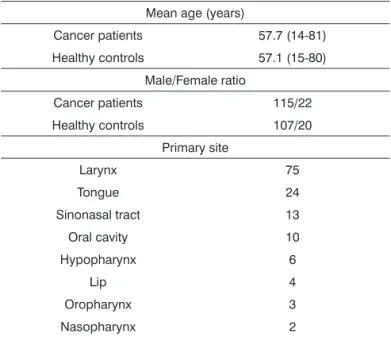
Table 1. Patients’ characteristics.
Mean age (years)
Cancer patients 57.7 (14-81)
Healthy controls 57.1 (15-80)
Male/Female ratio
Cancer patients 115/22
Healthy controls 107/20
Primary site
Larynx 75
Tongue 24
Sinonasal tract 13
Oral cavity 10
Hypopharynx 6
Lip 4
Oropharynx 3
Nasopharynx 2
METHOD
A group of 137 patients (mean age of 57.7 years) with head and neck SCC (115 male and 22 female) were recruited in this study and been compared with 127 age- and sex-matched healthy controls (mean age of 57.1 years) whom none had history of cancer and auto-immune disease in their first degree relatives. (Table 1).
DNA preparation
DNA was extracted from peripheral blood sam-ples using the traditional Proteinase-K method. Then DNA was prepared in 300 ng/µl concentration.
Genotyping assay
the extension cycle, all repeating for a total 30 cycles, followed by a final extension at 72°C for 10 min. 5 µl of PCR products were electrophoresed on 1.5% agarose gels and visualized with ethidiom bromide staining and Gene documentation. Enzyme digestion was carried out in a 15 µl final volume using 0.5 µl “Hpy199I” enzyme, 1.5 µl NTB4 buffer, 0.15 µl BSA buffer, 2.85 µl H20 and 10 µl of PCR product. The reactions were incubated at 37°C for 2 hours. The sizes of corres-ponding fragments were: CC = 339, 33 bp, CT = 372, 339, 33 bp and TT = 372 bp. Finally, the digested PCR products were electrophoresed on 2.7% agarose gels to separate the fragments The assay conditions for the polymorphism at +2044G/A was as following: forward primer: 5’-CTTCCGTGAGGACTGAATGAGACGGTC-3’ and reverse primer: 5’-GCAAATAATGATGCTTTCGA-AGTTTCAGTGGA-3’, each was used for a total of 6 pm per a tube. The “NlaIV” restriction enzyme was used to digest 236 bp fragment and produce GG = 178, 32, 26 bp, GA = 216, 178, 32, 26 bp and AA = 216, 26 bp fragments. The optimal annealing temperature for this test was 62.5°C.
Statistical analysis
Allele and genotype frequencies and quantitative traits were compared between control and patients’ subtypes by the use of Chi-square (χ2) and Fisher exact
tests. The results were then scheduled by SPSS 15 and EPI info (version 2002) soft wares and the associations were analyzed to adjust for different respective factors.
P-values more than 0.05 were considered insignificant.
Table 2. Allele and Genotype frequencies at -1055C/T and +2044 G/A positions in IL-13.
Subjects -1055C/T +2044G/A
Genotype CC CT TT C allele T allele GG GA AA G allele A allele
Patient (n = 137) 86 41 7 211 59 73 56 8 200 72
(62%) (30%) (8%) (78%) (22%) (53%) (41%) (6%) (74% (26%)
Control (n = 127) 61 48 8 171 67 53 51 13 157 79
(48%) (37%) (15%) (72%) (17%) (42%) (41%) (17%) (67%) (33%)
p-value 0.16 0.1 0.17 0.08
Table 3. Genotype distribution at -1055C/T and +2044 G/A positions in IL-13 among patients with HNSCC and healthy controls.
Subjects CC+GG CC=GA CC+AA CT+GG CT+GA CT+AA TT+GG TT+GA TT+AA
Patient (n = 137) 52 30 3 17 24 3 3 2 2
(38%) (22%) (2%) (13%) (18%) (2%) (2%) (1.5%) (1.5%)
Control (n = 127) 34 20 4 15 28 6 3 3 3
(27%) (16%) (3%) (12%) (22%) (5%) (2%) (2%) (2%)
This study was approved by the Ethics Commit-tee of the institution.
RESULTS
IL-13, -1055 and +2044 genotypes and alleles
As depicted in Table 2, screening of the patients for the IL-13 genotype and allele frequencies of the C-l055T and G+2044A polymorphisms revealed no significant differences in these two genotypes and their alleles in patients with HNSCC compared to healthy controls. Different genotypes of both sites were also collated two by two to evaluate any combination through them. According to the data depicted in Table 3, no linkage was identified within either of 137 patients and 127 control subjects.
IL-13 -1055 and +2044 genotypes and head and neck predisposing factors
Genotypes and alleles harvested from the two polymorphisms were investigated in order to achieve any association with patients’ baseline values like age and gender or prognostic/predictive factors such as primary tumor site, tumor size and smoking. Although, HNSCC is consistently attributed to each of them, no association was observed regarding these two poly-morphism substitutions.
DISCUSSION
dis-eases are complex genetic disorder that results from imbalance between activation of proto-oncogenes and inactivation of tumor suppressor genes. The human genome project currently offers a unique opportunity for identification of all the genetic changes associated with a human cancer8. Cytokines and related genes can
directly or indirectly act against defense mechanisms of tumor with changes in type of immune response and its quality2. T helper immune responses or cytotoxic
T cell activation are essential for antitumor actions. Several studies with animal model and human patients with cancer revealed that in these cases conventional responses of Th1 and activities of CD8+ cells were in-hibited. The tendency of antitumor immune responses to Th2 leads to suppression of Th1 responses9,l0. In a
study, the expression of Th1 and Th2 cytokines was evaluated in human tumoral cells that revealed domi-nancy of type II cytokines in 20 types of tumor cells. The escape of tumor cells from immune control may be related to this phenomenon10.
In other studies, the investigators observed that IL-4 and IL-13 can inhibit the tumor regression11. In
another study, The effects of human IL-4 and IL-13 on clonal growth of breast cancer cells were investigated that revealed IL-13 can reduced clonal growth of 3 cell type7. These studies concluded that IL-13 have
important role in regulation of antitumor activities. There were several polymorphisms in IL-13 gene. The 1055C/T was located in promoter region of IL-13 gene. The change of C to T nucleotide in this point may alter attachment and transcription factor type and then alter the expression of IL-13 gene. Several studies revealed that -1055C/T polymorphism was associated with al-lergic asthma, altered regulation of IL-13 production and increased binding of nuclear protein12.
Another important polymorphism in IL-13 gene is +2044 G/A that is located on Exon-4 that is important region for receptor-ligand interaction. Replacement of Arginin to Glutamine (Arg130G1n) leads to creation of an IL-13 protein with high affinity to its receptor. This can explain theoretically many aspects of allergic phe-notype (IgE production, mucus secretion, eosinophilic inflammation and hyper sensitivity reaction)9. This allele
was associated with increased susceptibility of diabetes type 1 and COPD and its frequency was low in patients with Juvenile idiopathic arthritis and graves disease3. In
our study the 1055C/T and +2044G/A polymorphisms was analyzed in patients with head and neck SCC.
Previous study has been carried out on patients with head and neck SCC.
In the literature, there are few studies investigat-ing the association of IL-13 haplotypes and susceptibil-ity to cancers. Faghih et al.13 investigated the
associa-tion of IL-13 haplotypes and susceptibility of Iranian women to breast cancer. They found no significant differences in the distribution of -1512A/C, -1055C/T and +2044G/A genotypes or alleles between patients and the control group; however, they suggested a potential association of CCA haplotype of IL13 gene with susceptibility of Iranian women to breast cancer. In another study, Sameni et al.14 found no association
between interleukin-13 gene polymorphisms (-1055 C/T and +2044 G/A) in Iranian patients with lung cancer. To the best of our knowledge, this is the first study investigating IL-13 gene polymorphisms at -1055 C/T and +2044 G/A positions in patients with squamous cell carcinoma of head and neck.
CONCLUSION
Results of this study indicate no association be-tween IL-13 gene polymorphisms (at position -1055C/T and +2044G/A) and susceptibility of the patients to HNSCC.
REFERENCES
1. Sidransky D. Molecular Biology of Head and Neck Tumors. In: DeVita VT, Hellman S, Rosenberg SA, editors. Cancer: Princi-ples & Practice of Oncology, 8th ed. Philadelphia: Lippincott, Williams, & Wilkins; 2008. p.799-809.
2. Terabe M, Park JM, Berzofsky JA. Role of IL-13 in regulation of anti-tumor immunity and tumor growth. Cancer Immunol Immunother. 2004;53(2):79-85.
3. Heinzmann A, Jerkic SP, Ganter K, Kurz T, Blattmann S, Schu-chmann L, et al. Association study of the IL13 variant Arg110Gln in atopic diseases and juvenile idiopathic arthritis. J Allergy Clin Immunol. 2003;112(4):735-9.
4. Chaouchi N, Wallon C, Goujard C, Tertian G, Rudent A, Caput D, et al. Interleukin-13 inhibits interleukin-2-induced proliferation and protects chronic lymphocytic leukemia B cells from in vitro apoptosis. Blood. 1996;87(3):1022-9.
5. Bugawan TL, Mirel DB, Valdes AM, Panelo A, Pozzilli P, Erli-ch HA. Association and interaction of the IL4R, IL4, and IL13 loci with type 1 diabetes among Filipinos. Am J Hum Genet. 2003;72(6):1505-14.
8. Taramelli R, Acquati F. The human genome project and the discovery of genetic determinants of cancer susceptibility. Eur J Cancer. 2004;40(17):2537-43.
9. Bacharier LB, Geha RS. Molecular mechanisms of IgE regulation. J Allergy Clin Immunol. 2000;105(2 Pt 2):S547-58.
10. McKenzie GJ, Bancroft A, Grencis RK, McKenzie AN. A distinct role for interleukin-13 in Th2-cell-mediated immune responses. Curr Biol. 1998;8(6):339-42.
11. Becker Y. Molecular immunological approaches to biotherapy of human cancers--a review, hypothesis and implications. Anti-cancer Res. 2006;26(2A):1113-34.
12. Izuhara K, Arima K. Signal transduction of IL-13 and its role in the pathogenesis of bronchial asthma. Drug News Perspect. 2004;17(2):91-8.
13. Faghih Z, Erfani N, Razmkhah M, Sameni S, Talei A, Ghaderi A. Interleukin13 haplotypes and susceptibility of Iranian women to breast cancer. Mol Biol Rep. 2009;36(7):1923-8.