Research Article
Port J Public Health
Evaluation of Some Physical and Health
Parameters in a Local Physical Activity
Program for Seniors
Paulo Infante
aGonçalo Jacinto
aAnabela Afonso
aJosé Conde
bTeresa Engana
bJorge Vicente
bPedro Silva
bAna Carla Coelho
cPaula Costa
caDepartamento de Matemática/ECT e Centro de Investigação em Matemática e Aplicações /IIFA, Universidade de Évora, Évora, Portugal; bDivisão da Juventude e Desporto, Câmara Municipal de Évora, Évora, Portugal; cAdministração Regional de Saúde do Alentejo, Évora, Portugal
Received: May 14, 2018 Accepted: February 7, 2019 Published online: April 25, 2019
Paulo Infante © 2019 The Author(s). Published by S. Karger AG, Basel
DOI: 10.1159/000497788
Keywords
Active ageing · Physical activity · Physical exercise · Physical fitness
Abstract
Background: About 1/5 of the population of Évora
Munici-pality in Portugal is aged 65 and over, and there has been a continued deterioration in the ageing index (159 in 2016). Évora City Hall offers the Active Seniors program which aims to promote physical activity and healthy lifestyles among older adults (at least 55 years). This study aims to evaluate the effect on some physical and medical parameters of the participants in this program within a period of 6–12 months, showing why it is worthwhile for the municipalities to elect this type of programs. Methods: A 1-year follow-up of three groups of seniors was conducted that covered participants enrolled for the first time in the Active Seniors program and individuals who had participated in the Active Seniors pro-gram in previous years and who would maintain or increase
the number of sessions per week. Participants self-reported sociodemographic and past health information and were submitted to medical tests, and anthropometric and physi-cal evaluations. Differences in mediphysi-cal and physiphysi-cal param-eters were evaluated using analysis of covariance and mixed models. Results: In just 6 months, seniors who participated in the Active Seniors program for the first time improved sev-eral medical tests results and improved their performance in physical fitness tests (all p < 0.05). The increase in the number of sessions per week decreased the systolic blood pressure values after only 6 months (p < 0.001) and improved the physical fitness tests over 12 months (p < 0.05). Conclusions: The Active Seniors program is an effective way to improve the health and physical fitness of older adults. The continu-ation of the program, with or without the increase in the number of weekly sessions, allows controlling the medical parameters and increasing the functional fitness of the par-ticipants. © 2019 The Author(s). Published by S. Karger AG, Basel
Avaliação de alguns parâmetros físicos e de saúde num programa autárquico de atividade física para seniores
Palavras chave
Aptidão física · Atividade física · Envelhecimento ativo · Exercício físico
Resumo
Contexto: No concelho de Évora cerca de 1/5 da
popula-ção tem 65 ou mais anos e tem-se assistido a um agrava-mento continuado no índice de envelheciagrava-mento (159 em 2016). A Câmara Municipal de Évora oferece o programa Seniores Ativos que visa promover a atividade física e es-tilos de vida saudáveis junto dos adultos com pelo menos 55 anos. Este estudo visa avaliar o efeito em alguns parâ-metros físicos e médicos com a participação neste pro-grama ao longo de 6 e 12 meses, procurando também mostrar que vale a pena que os municípios apostem nesse tipo de programas. Métodos: Durante 12 meses foram se-guidos três grupos de adultos, com 55 ou mais anos, que abrangiam indivíduos que participavam pela primeira vez neste programa e indivíduos que já participavam no pro-grama Seniores Ativos em anos anteriores e que iriam manter ou aumentar o número de sessões por semana. Os participantes forneceram informações sociodemográfi-cas e do seu estado de saúde, e foram submetidos a exa-mes médicos e a avaliações antropométricas e físicas. As diferenças nos parâmetros médicos e físicos foram avali-adas usando testes paramétricos e não paramétricos, análise de covariância e modelos mistos. Resultados: Em apenas 6 meses, os seniores que participaram pela pri-meira vez no programa Seniores Ativos melhoraram os resultados dos seus testes médicos e melhoraram o seu desempenho em todos os testes de aptidão física (todos
p < 0.05). O aumento do número de sessões por semana
originou uma diminuição do valor da pressão sanguínea sistólica em apenas 6 meses (p < 0.001) e uma melhoria nos resultados dos testes de aptidão física ao longo dos 12 meses (p < 0.05). Conclusões: O programa Seniores Ati-vos é um meio eficaz para melhorar a saúde e a aptidão física dos idosos. A permanência no programa, com ou sem aumento no número de sessões semanais, permite controlar os parâmetros médicos e melhorar a aptidão funcional dos participantes.
© 2019 The Author(s). Published by S. Karger AG, Basel on behalf of NOVA National School of Public Health
Introduction
The World Health Organization (WHO) recognizes the importance of physical activity (PA) in physical, men-tal, and social health and states that intervention policies are necessary to promote the practice of PA in all age and social groups [1]. The regular practice of PA is effective in preventing various coronary diseases, like type 2 dia-betes, cancer, hypertension, obesity, depression, osteopo-rosis, and premature death [2]. Recent evidence suggests that physically active people have a reduced risk of de-mentia [3] and cognitive decline [4]. PA promotes well-being, increases social interaction and quality of life for individuals who practice it, contributes to environmental sustainability and provides benefits to society [5, 6]. The promotion of PA programs would not only contribute to reduce population morbidity and the costs associated with chronic diseases health care. It is therefore not sur-prising that the WHO states that PA is one of the main factors to consider for an active and life quality ageing.
In today’s society, the increase in the number of el-derly people is a positive sign of development. However, it entails a significant increase in the costs for health and social services [7]. PA is important for the elderly increas-ing and maintainincreas-ing the quality of life and independence, improving strength, balance, coordination, flexibility, en-durance, mental health, motor control and cognitive function. It also helps to prevent falls [8] (the greatest cause of disability among the elderly population). In the social context, walking and organized physical exercise sessions allow social interaction and reduce loneliness and social exclusion [9].
In Portugal, there are several PA programs developed by the local government for elderly people; however, none measures the efficiency of those programs in the health and life quality of the participants [10]. We must point out that it is not our intention to measure the dose-response obtained with a certain physical load. It is a case study of a municipal initiative, not individualized train-ing and/or laboratory testtrain-ing, where the results could be different given greater control over experimental units and conditions. The Active Seniors (AS) program is de-veloped by Évora City Hall, being a free program, whose main objectives are to improve, develop, meliorate, ac-quire and maintain active lifestyles in the elderly. Accord-ing to 2011 Portugal Census, about 1/5 of the population of the municipality of Évora is aged 65 and over; for every 100 young people under the age of 15 there are 138 el-derly people aged 65 and over (ageing index). For every 100 elderly people aged 75 and over there are 108 elderly
people aged 65 to 74 (longevity index). In 2016, a deterio-ration was observed in all these indicators. The total pop-ulation decreased 5%, the poppop-ulation of elderly aged 65 and over increased to 22%, the ageing index increased to 159, and the longevity index decreased to 103.
During the European Year of Active Ageing and Soli-darity between Generations, in 2012, the Évora City Hall, in partnership with the Évora University (through the Re-search Centre for Mathematics and Applications – CIMA), carried out a study about the physical, psycho-logical and social aspects of the AS program. In this paper, we present the results of this study regarding some medi-cal and physimedi-cal parameters, at the beginning of the study and after 6 and 12 months of follow-up, in adults with 55 or more years. The study was carried out between Decem-ber of 2012 and February 2014.
We analyze some health and physical parameters of the participants in AS program over a 1-year follow-up. The specific goals are to analyze which changes on sev-eral medical (weight, body mass index [BMI], abdominal perimeter, HDL, LDL, non-HDL, diastolic BP, systolic BP, triglycerides) and physical (strength of the upper and lower body, aerobic fitness, agility/dynamic balance, and flexibility of the upper and lower body) parameters are obtained: (1) just after 6 months of participation; (2) after 12 months of participation; (3) with the increase in the frequency of participation per week. This study aimed to understand the impact of the AS program on some as-pects of the quality of life of the participants and to serve as a tool to draw some conclusions for the future of these programs.
Methods
The AS Program
The AS program was created in 2005 by Évora City Hall with the partnership of some local Social Institutions. The main objec-tives of the AS program are to promote PA and healthy lifestyles, mobilize the sedentary population by integrating the PA into daily routines and increase awareness about health, social and econom-ic benefits of PA practeconom-ice.
It is a 1-year program of one weekly PA session of 1 h for the population over 55 years old. The AS sessions are of low to moder-ate intensity and in some cases very low. The activities are devel-oped by physical education teachers and take place in the green spaces of the city (maintenance circuits, nature trail, public gar-den), in the facilities of the partners and in the municipal pool. Some sessions are held at home, with elderly people institutional-ized in both urban and rural areas.
The classes are varied and suitable both to the mobility of each one, and to particular conditions of diseases and limitations. The resources available to SA are limited and consider their limitations
on sessions. The exercises aim to improve/maintain the physical condition, slow down typical losses of aging, maintaining the safe-ty of the elderly.
During 2013 and 2014, 21 institutions and a total of 442 par-ticipants were enrolled in the program.
Participants
For this study, the target population aged 55 years or over lived in the municipality of Évora at the time of the study. Two types of requests for participation were disclosed:
1 One application was addressed to individuals, not participating in the AS program, and who wanted to join the AS program. 2 The second request was addressed to the group of current AS
program participants who desired to maintain or increase the current weekly frequency of PA. Since there was some prior knowledge about the health status of this group of participants and their availability, the request to increase the frequency of the practice was directed at individuals who were known to be able to do so.
To integrate this study, all volunteers agreed to test their phys-ical and medphys-ical parameters at the beginning of the study and 6 and 12 months later. Due to budget restrictions, 12 months after the beginning of the study only physical parameters were evalu-ated. All of them signed a free consent term and were required to attend at least 75% of classes. It was an observational study.
The final sample of 80 participants compromises a non-prob-abilistic convenience sample and was divided into 3 groups: 1 Beginners: 15 adults who will participate in the AS program for
the first time at the beginning of the study, with a weekly fre-quency equal to that of the default group;
2 1× Active: 37 members of the AS program who maintained the current frequency of once a week;
3 3× Active: 28 members of the AS program who volunteered to increase the frequency of PA to three times a week.
Measures
At the beginning of the study (December 2012), the partici-pants answered a questionnaire about several demographic, social, and health status characteristics, such as sex, age, occupation, pres-ence of some diseases, and consumption of medicines. Participants were submitted to anthropometric evaluation, and blood tests to measure systolic and diastolic blood pressure, cholesterol (HDL, LHL, non-HDL), and triglycerides. For all participants, the blood samples were obtained before the physical tests. The blood tests and the anthropometric evaluation were carried out by the nursing team from Regional Health Administration of Alentejo. To assess the functional fitness performance, the participants underwent the battery Senior Fitness Tests (SFT) [11] at the beginning of the study and 6 months later (June 2013).
The SFT includes measures of strength (upper and lower body), aerobic fitness, agility/dynamic balance, and flexibility (upper and lower body). Four of the six tests in the SFT involve body move-ment measuremove-ments, which include arm-curl test (to do as many arm curls as possible in 30 s) and 30-s chair-stand test (stand up and sit on a chair for 30 s) to measure strength, 6-min walk test (distance walked for 6 min) for aerobic fitness, and 8-ft up-and-go test (time necessary to get up from a chair, walk 2.44 meters and return to the initial position) to measure agility/dynamic balance. The other two tests are the back scratch test (minimum distance reached with hands behind back) and the chair sit-and-reach test
(distance from the hands to the tips of the feet) to measure flexibil-ity. The normative standards of the SFT for senior age groups of American men and women ranging from 60 to 94 years of age are described in Rikli and Jones [11]. Similar normative values have been reported for a Portuguese sample of healthy elderly people ranging from 65 to 103 years age [12].
The AS sessions are of low to moderate intensity. The classes are varied and suitable both to the mobility of each participant, and to particular conditions of diseases and limitations. They are com-posed of dances and games, with balance, strength, flexibility, aer-obic work, coordination, skills, and concentration exercises. The sessions have an initial warming-up, followed by the main exer-cises, and ending in relaxing and stretching exercises.
About 1 year after the beginning of this study (February 2014) only some participants repeated the SFT, since some participants were unable to be present on the day the physical evaluation tests were performed. Therefore, the sample size was 80 participants at the beginning of the study and 6 months later, but only 23 a year later (6 from the Beginners group, 11 from 1× Active group and 6 from 3× Active group).
Statistical Analysis
Analysis of variance (ANOVA), followed by Tukey-Kramer multiple comparisons test, was used to test for differences in age and BMI% between groups. The χ2 test was used to evaluate
differ-ences between groups for the number of reported diseases. A longitudinal study was carried out to understand the ben-efits for participating in the AS program for 6 months. For each group, paired Student t tests were used to examine differences of means in medical and physical fitness results between the begin-ning of the study (baseline) and 6 months after. Under the viola-tion of the assumpviola-tion of normal distribuviola-tion in the sample dif-ferences, instead of the Student t tests Wilcoxon’s paired tests were used, if it was possible to assume the symmetry of the dis-tribution, or the signal tests otherwise. An analysis of covariance (ANCOVA) was applied to all medical and physical fitness vari-ables to compare those groups that actually performed PA in the study period (Beginners, 1× Active and 3× Active), adjusting for the values obtained at baseline (first measurement). With this ap-proach, it is possible to compare differences between groups after 6 months in the medical parameters and in the level of perfor-mance of the SFT. ANCOVA is the best statistical model to ana-lyze the data and compare the groups with each other, when we have two measurement points with groups that cannot be
con-sidered completely randomized [13]. The assumptions of AN-COVA were verified, i.e. the homogeneity of regression slopes, the non-dependence between the group and the result of the first measurement, the normality of the errors, the homogeneity of the variances in the different groups and the linearity between the response and covariate variables. When the assumption of nor-mality was not validated and a suitable transformation could not be found, a non-parametric ANCOVA was performed [14]. For tests where the group factor was found to be significant, multiple comparisons were performed to compare each level with the pre-vious one, that is, the Beginners group was compared with the 1× Active group, and this last group was also compared with the 3× Active group.
For the analysis of the physical fitness after 12 months of par-ticipation in this study, that is including the third measurement, we used the linear mixed-effect models (LMM) [15, 16]. At this last moment of measurement, the follow-up group of 80 partici-pants were reduced to 23. The reduction of the number of obser-vations was due to the fact that after 12 months some participants did not fulfil the requirements imposed to participate in the study, and others were unable to be present on the day the phys-ical evaluation tests were performed. Therefore, for the 12-month analysis we have a much smaller sample than the one that was used in the 6-month analysis. This was one of the main reasons for using LMM, since they prevent listwise deletion due to miss-ing data. In addition, the design is unbalanced, and the measure-ments were not equally spaced (although for the sake of simplify-ing in the description of the results, it was considered that the measurements were equally spaced). Finally, in this case study we have repeated measures and LMM allow to consider the depen-dence and correlation structure of the errors. The model used to estimate the effects of each physical variable had one fixed effect (group variable) with tree levels, individuals were used as random effects, and the first measurement was used as a covariate. Only the ordinate was considered for each individual (allowing to con-trol for the performance difference of each individual), since only 3 observations were available at the time [17]. The assumptions underlying each model, namely the normality and homoscedas-ticity of the errors, the normality of the random effects and MCAR assumptions were validated for all parameters analyzed. It should be noted that the LMMs were not used with the 80 in-dividuals of the initial sample because the underlying assump-tions could not be verified. The estimation of fixed effects and components of variance was done by the maximum penalized
Table 1. Summary statistics for age (mean ± standard deviation) and number of reported diseases (prevalence by category), per group, measured at baseline
Variable Category Beginners
(n = 15) 1× Active (n = 37) 3× Active (n = 28) p
Age 69.7±5.8 70.8±7.2 68.8±6.1 0.480a
Number of reported diseases 0–1 20.0% 21.6% 25.0% 0.696b
2–3 26.7% 32.4% 42.9%
4 and more 53.3% 45.9% 32.1%
likelihood method. When the fixed-effect factors were signifi-cant, Tukey’s multiple comparison test was applied to find out the significant differences.
All statistical analyses were carried out using R software, and a statistical significance level was assumed at 5%.
Results
Group Characterization
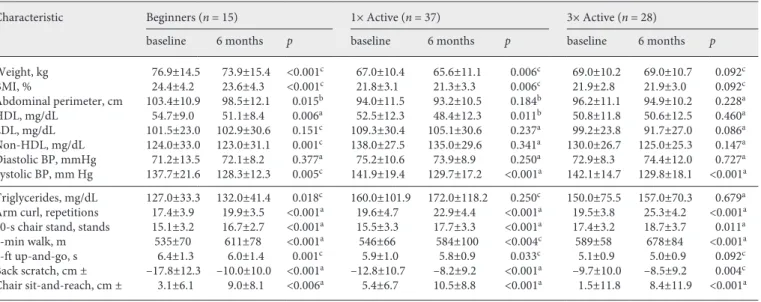
The percentage of females was higher than that of males in all groups: Beginners (67%), 1× Active (86%), and 3× Active (68%) groups. The age of the participants varied between 55 and 90 years of age (Table 1). The Be-ginners group was the one with less variability in ages, while the 1× Active group has the highest variability. In the 1× Active group, 1 in 4 participants was over 75 years old. There was no significant difference between groups regarding mean age of the participants (p = 0.48). One in 3 participants in the Beginners and 3× Active groups in-dicated that they had practiced PA in the last 6 months outside the AS program. In the other group, the percent-age was lower. More than 90% of the participants report-ed taking mreport-edications. More than half (53%) of the Be-ginners group were medicated for at least 4 different diseases (Table 1). There was no significant difference be-tween groups regarding the number of reported diseases (p = 0.70).
From results presented in Table 2, we can observe that at baseline, participants from all groups had normal HDL values (40–59 mg/dL). Members of the 3× Active group had optimal mean levels of blood concentration of bad cholesterol (LDL <100 mg/dL), and the remaining groups had near optimal mean levels (101–130 mg/dL). All groups presented normal mean results of diastolic blood pressure (<85 mm Hg). Groups 1× Active and 3× Active started with a mean value of systolic blood pressure at the first stage of hypertension (140–159 mm Hg). Only the Beginners group had desirable mean results of triglycer-ides (<150 mg/dL), while the other groups had high mean values (>150 mg/dL).
Participants had a normal BMI (values in the range 18.5≤ BMI% <24.9); however, participants in the Begin-ners group presented values that were less similar to each other (Table 2). There was a significant difference in BMI% between groups (p = 0.03). The average BMI in the Beginners group was significantly higher than in the 1× Active group (p = 0.03). In the Beginners and 1× Active groups, there were participants with moderate obesity (30≤ BMI% <35), but in all groups around 90% of the participants presented an increased metabolic risk (ab-dominal perimeter >94 for men and >80 for women). About 5% of participants in the 1× Active and 11% in the 3× Active groups were underweight (BMI% <18.5). The reference values for BMI and abdominal perimeter can be found in WHO [18].
Table 2. Number of observations (n) and mean ± standard deviation of some medical and physical parameters, per group, measured at baseline and after 6 months
Characteristic Beginners (n = 15) 1× Active (n = 37) 3× Active (n = 28)
baseline 6 months p baseline 6 months p baseline 6 months p
Weight, kg 76.9±14.5 73.9±15.4 <0.001c 67.0±10.4 65.6±11.1 0.006c 69.0±10.2 69.0±10.7 0.092c BMI, % 24.4±4.2 23.6±4.3 <0.001c 21.8±3.1 21.3±3.3 0.006c 21.9±2.8 21.9±3.0 0.092c Abdominal perimeter, cm 103.4±10.9 98.5±12.1 0.015b 94.0±11.5 93.2±10.5 0.184b 96.2±11.1 94.9±10.2 0.228a HDL, mg/dL 54.7±9.0 51.1±8.4 0.006a 52.5±12.3 48.4±12.3 0.011b 50.8±11.8 50.6±12.5 0.460a LDL, mg/dL 101.5±23.0 102.9±30.6 0.151c 109.3±30.4 105.1±30.6 0.237a 99.2±23.8 91.7±27.0 0.086a Non-HDL, mg/dL 124.0±33.0 123.0±31.1 0.001c 138.0±27.5 135.0±29.6 0.341a 130.0±26.7 125.0±25.3 0.147a Diastolic BP, mmHg 71.2±13.5 72.1±8.2 0.377a 75.2±10.6 73.9±8.9 0.250a 72.9±8.3 74.4±12.0 0.727a Systolic BP, mm Hg 137.7±21.6 128.3±12.3 0.005c 141.9±19.4 129.7±17.2 <0.001a 142.1±14.7 129.8±18.1 <0.001a Triglycerides, mg/dL 127.0±33.3 132.0±41.4 0.018c 160.0±101.9 172.0±118.2 0.250c 150.0±75.5 157.0±70.3 0.679a
Arm curl, repetitions 17.4±3.9 19.9±3.5 <0.001a 19.6±4.7 22.9±4.4 <0.001a 19.5±3.8 25.3±4.2 <0.001a
30-s chair stand, stands 15.1±3.2 16.7±2.7 <0.001a 15.5±3.3 17.7±3.3 <0.001a 17.4±3.2 18.7±3.7 0.011a
6-min walk, m 535±70 611±78 <0.001a 546±66 584±100 <0.004c 589±58 678±84 <0.001a
8-ft up-and-go, s 6.4±1.3 6.0±1.4 0.001c 5.9±1.0 5.8±0.9 0.033c 5.1±0.9 5.0±0.9 0.092c
Back scratch, cm ± –17.8±12.3 –10.0±10.0 <0.001a –12.8±10.7 –8.2±9.2 <0.001a –9.7±10.0 –8.5±9.2 0.004c
Chair sit-and-reach, cm ± 3.1±6.1 9.0±8.1 <0.006a 5.4±6.7 10.5±8.8 <0.001a 1.5±11.8 8.4±11.9 <0.001a a Student t test. b Wilcoxon test. c Signs test.
The most regular scores in all SFT tests were achieved by the participants already engaged in the AS program, i.e. 1× Active and 3× Active groups (Table 2). The Begin-ners group presented a lower performance in the 6-min walk and back scratch tests.
Health and Physical Fitness Benefits after 6 Months of Participation in the AS Program
Differences within Groups
In the longitudinal analysis, we observed that some significant changes occurred in medical and physical fit-ness tests within the groups after 6 months of participa-tion in the AS program (Table 2).
None of the groups significantly reduced the diastolic blood pressure, but all decreased their systolic blood pres-sure. The participants in the Beginners group significant-ly reduced the other medical parameters except the LDL and reduced significantly the weight, BMI and the ab-dominal perimeter. The 1× Active group decreased sig-nificantly their weight, BMI, HDL, and systolic BP. The 3× Active group had a marginal significant reduction in weight, BMI, and LDL values and a significant reduction in systolic BP.
The Beginners, 1× Active, and 3× Active groups got better scores in all SFT tests; however, the results in 8-ft up-and-go test for the 3× Active group were marginally significant.
Differences between Groups
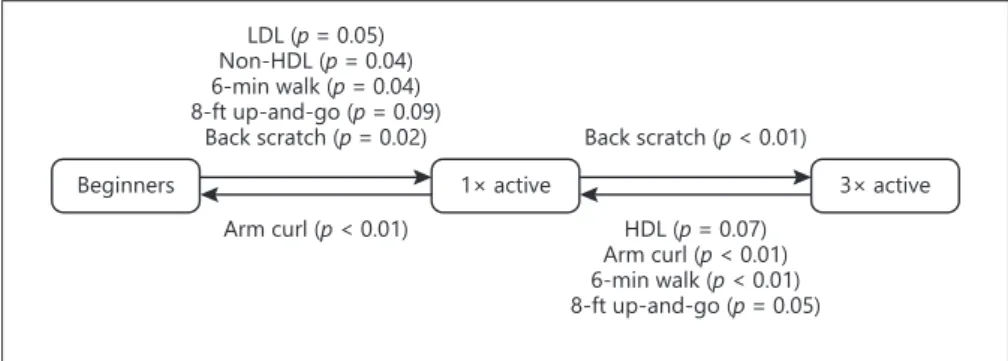
With ANCOVA, significant differences were found between groups in some medical and physical fitness pa-rameters after 6 months, adjusting to baseline values as covariates. Comparing participants with equal values at baseline, the mean values of non-HDL and LDL after 6 months were significantly lower in the Beginners group than in the 1× Active group. After 6 months, the values of LDL were (marginally significative) lower, in mean, in the 3× Active group in comparison to the 1× Active group,
when comparing participants with the same LDL values at baseline (Fig. 1).
Regarding the physical variables, when comparing participants in equal circumstances at baseline, the group that increased the frequency of PA (3× Active) achieved better mean performance than the group that maintained the frequency of the PA (1× Active) in the aerobic fitness, upper body strength and agility/dynamic balance (Fig. 1). The Beginners group presented significantly better per-formances in the aerobic fitness and upper body (shoul-der) flexibility than the 1× Active group, and also a mar-ginal significant better performance in the agility/dynam-ic balance. It is interesting to note the strong effect of PA in only 6 months in the Beginners group. The 1× Active group had a better upper body flexibility after 6 months than the 3× Active group and a higher upper body strength than the Beginners group. In the lower body strength and flexibility tests, no differences were detected between any of the groups, while there were differences in the three groups regarding upper body flexibility.
Physical Fitness after 12 Months of Participation in the AS Program
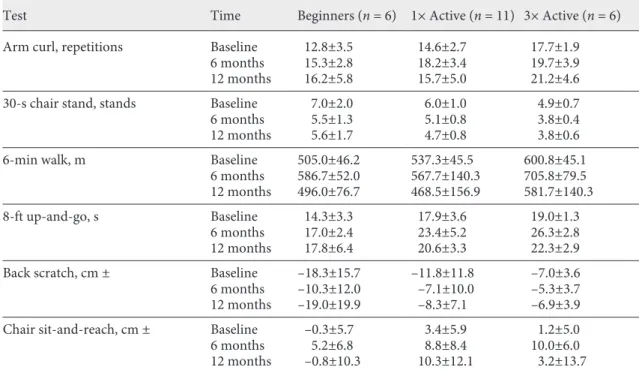
Table 3 presents the summary statistics of the physical tests at baseline and after 6 and 12 months of participa-tion in the AS program.
All sociodemographic characteristics of participants were not significant in all adjusted LMM models (all p > 0.05), and therefore none of these variables were included in the final model. The interaction between group and the measurements of the variables was not statistically sig-nificant (all p > 0.05, i.e. the effect of the measurement does not depend on the group; neither does the effect of the group depend on the moment when the measurement was obtained. Only for the arm curl test were the results adjusted for the individual’s age, since it was the only model where age was significant (p = 0.04). The variation associated with the random effects (individuals) is
re-Beginners Arm curl (p < 0.01) LDL (p = 0.05) Non-HDL (p = 0.04) 6-min walk (p = 0.04) 8-ft up-and-go (p = 0.09) Back scratch (p = 0.02) 1× active HDL (p = 0.07) Arm curl (p < 0.01) 6-min walk (p < 0.01) 8-ft up-and-go (p = 0.05) Back scratch (p < 0.01) 3× active
Fig. 1. Results of the multiple comparisons that were significant in medical and physi-cal tests based on ANCOVA models (the group with the best result is associated with the origin of the arrow). Marginal sig-nificance differences (p < 0.1) were also re-ported.
sponsible for 15% (arm-curl test), 13% (30-s chair stand test), 53% (6-min walk test), 81% (8-ft up-and-go test), 82% (back scratch test), and 66% (chair sit-and-reach test) of the total variation.
No significant differences were found between groups in the performance of the tests that measure flexibility (back scratch and chair sit-and-reach). The 3× Active group had better scores than the Beginners and 1× Active groups in the tests 30-s chair stand (p = 0.03 and p < 0.01, respectively), 6-min walk (p = 0.05 and p = 0.02, tively), and 8-ft up-and-go (p < 0.01 and p = 0.04, respec-tively). No differences were found between the groups 3× Active and 1× Active in the arm-curl test, but both per-formed better in this test than the Beginners group (p < 0.01 and p < 0.01, respectively).
The performance of the groups at 6 months was better in all tests than at baseline, but the same was not observed at the end of 12 months. After 12 months, the perfor-mance was no better than at 6 months but was better than at baseline in the tests: arm curl (p < 0.01), 30-s chair stand (p = 0.05), 8-ft up-and-go test (p < 0.01), and chair sit-and-reach (p < 0.01). After 12 months, the performance decreased when compared with 6 months in the tests: 6-min walk (p < 0.01) and back scratch (p = 0.02). In this last test, no differences were found in the scores of the groups at baseline and after 12 months.
Discussion
This study aimed to examine for the first time the ef-fects of the AS program on the health and physical fitness of its participants. This is a PA program for elderly people offered in Évora, Portugal, whose main objectives are to promote health and improve physical function. PA pro-motion is one of the most difficult and important tasks in lifestyle change, as society is becoming increasingly suc-cessful in reducing our need to move [19].
In an 8-year follow-up, it was demonstrated that par-ticipants who became active during the follow-up period had significant health benefits even if they started rela-tively late in life [20]. For older people, adequate aerobic exercise is associated with a 1- to 2-year increase in life expectancy, as well as improved functional independence, even in people who became physically active as late as age 60 years [21]. We have observed the same as reported by these authors, since only 6 months after initiating regular PA in the AS program several improvements were ob-served, both in medical parameters and in the fitness tests.
Participants who started their regular participation in the AS program improved all scores on physical fitness tests only 6 months after PA introduction. In the medical tests, there were no significant improvements in HDL
Table 3. Number of observations (n) and mean ± standard deviation of physical tests, per group, at baseline and after 6 and 12 months
Test Time Beginners (n = 6) 1× Active (n = 11) 3× Active (n = 6) Arm curl, repetitions Baseline 12.8±3.5 14.6±2.7 17.7±1.9
6 months 15.3±2.8 18.2±3.4 19.7±3.9
12 months 16.2±5.8 15.7±5.0 21.2±4.6 30-s chair stand, stands Baseline 7.0±2.0 6.0±1.0 4.9±0.7
6 months 5.5±1.3 5.1±0.8 3.8±0.4
12 months 5.6±1.7 4.7±0.8 3.8±0.6
6-min walk, m Baseline 505.0±46.2 537.3±45.5 600.8±45.1
6 months 586.7±52.0 567.7±140.3 705.8±79.5 12 months 496.0±76.7 468.5±156.9 581.7±140.3
8-ft up-and-go, s Baseline 14.3±3.3 17.9±3.6 19.0±1.3
6 months 17.0±2.4 23.4±5.2 26.3±2.8
12 months 17.8±6.4 20.6±3.3 22.3±2.9 Back scratch, cm ± Baseline –18.3±15.7 –11.8±11.8 –7.0±3.6 6 months –10.3±12.0 –7.1±10.0 –5.3±3.7 12 months –19.0±19.9 –8.3±7.1 –6.9±3.9 Chair sit-and-reach, cm ± Baseline –0.3±5.7 3.4±5.9 1.2±5.0
6 months 5.2±6.8 8.8±8.4 10.0±6.0
and diastolic blood pressure, two values that showed no improvement in either group. When we compare the per-formance of this group with the participants that had al-ready been practicing regular PA, considering equal val-ues at baseline, it was concluded that there was a signifi-cant reduction of bad cholesterol and an increase in the flexibility of the upper body. The participants already en-gaged in the AS program did not change most of the med-ical parameters, which contributed to the fact that their health status did not continue to deteriorate (active age-ing). Increasing the frequency per week of PA (i.e., num-ber of sessions per week) leads to the control of good cho-lesterol and improves the flexibility and strength of the upper body as well aerobic fitness and agility. PA can be seen as a therapeutic complement, for hypertension, for glycaemia and for psychological diseases (depression, anxiety).
In previous studies, it was shown that participants who became physically active were more likely to be healthy than those who remain inactive [20]. It was also seen in other studies that the effect of PA on HDL levels varies among exercise intervention studies [22]. It seems that there exists a minimum exercise volume to obtain a sig-nificant increase in HDL level. Considering the short re-duction in blood pressure with endurance and strength training, it is noteworthy that exercise is a great therapeu-tic complement, even having an impact on the natural history of hypertension [22]. Our results go exactly in this direction. Just after 6 months of PA in the AS program, we observed that the group that regularly initiated PA (Beginners group) improved the medical results in terms of LDL and non-HDL values when compared to their baseline values, but also when compared to the group that maintained their regular participation in the AS program (1× Active group).
Regarding the physical parameters, existing studies observed a reduction in performance with increasing age [12]. Lower levels of aerobic resistance, flexibility, and strength increase the risk of fall, increase the sever-ity of injury, and limit the functional abilsever-ity of this age group [23]. In our study, we observed a marked im-provement in endurance and agility in those who started or increased the frequency of participation in the AS program for 6 months. The results indicate that the in-troduction of regular PA in the participants’ lives allows them to have the values of the physical tests identical or superior to those relatively younger (active ageing), which allows them to achieve the same or greater func-tionality and autonomy. The participants that have initi-ated regular PA in the AS program, saw their
perfor-mance after 12 months become significantly better than at baseline in the arm curl, 30-s chair stand, 8-ft up-and-go, and chair sit-and-reach physical tests. However, this group had no difference in performance when compar-ing the results at 12 and 6 months. This result may be related to one of the following situations: (1) after 6 months, they reach their best performance; if they stopped PA after 6 months, maybe they would not be able to maintain their performance after 12 months; or (2) the AS program is interrupted in July and August; however, despite this 2-month interruption, the partici-pants were able to maintain their performance if they remained engaged in the AS program, i.e. with the prac-tice of PA. Their state of health stabilized avoiding the deterioration of their quality of life.
These results should not be seen only in a perspective of differences, or not, in performances between groups or longitudinally. Due to the advanced age of individuals, often the nonexistence of differences translates into a slowing down of the loss of functions (active ageing).
This study has some limitations that should be consid-ered. It is a case study of a municipal initiative, not indi-vidualized training and/or laboratory testing, where the results could be different given greater control over ex-perimental units and conditions. The results cannot be generalized to all population. Some systematic errors may be present due to observers, individuals and instruments. Lastly, the design was unbalanced, sample units selected for convenience, and the first and second measurements were done by different evaluators.
Conclusion
There were improvements in the strength and flexibil-ity of the upper body and aerobic fitness associated with the increasing frequency of PA in a 6-month period of participation in the AS program. After just 6 months of participation, the seniors who started regular participa-tion improved most of the medical parameters, except HDL and diastolic blood pressure; the seniors who main-tained the participation with the same frequency of par-ticipation reduced their body fat, HDL and systolic blood pressure and stabilized the other medical parameters, while the seniors who increased the frequency of PA con-trolled their good cholesterol.
These findings should carefully consider a scenario of active ageing. With the practice of PA, health and physical fitness of the participants improved or stabilized, which avoids the deterioration of their quality of life.
The inclusion in this program has increased with the years, and further studies are needed to better understand its effects on health and physical fitness. Albeit the limita-tions, this study found that the participation in the AS program allows to improve or control the medical param-eters and increase the functional fitness of the partici-pants.
On the other hand, we believe that this study stimu-lates local debate, which is otherwise nonexistent or scarce, and increases the knowledge of the local reality. The efficiency of this program was evaluated by the re-sults obtained. Without this program, everything would be different for these people. This program helps to keep these people active, non-dependent, non-lonely, and mo-tivated for something that gives them a better quality of life (both physically and psychically). Therefore, even with so many limitations, it is worthwhile the munici-palities elect this type of programs.
Further studies should assess the effectiveness of these programs in reducing health costs.
Statement of Ethics
This research had the concordance of CME (Câmara Munici-pal de Évora) and ACES (Agrupameto de Centros de Saúde do Alentejo Central). Informed consent of each participant was ob-tained. All the participants participated in our study voluntarily and after their consent. We respected the confidentiality and ano-nymity of our participants. All clinical investigations were con-ducted according to the principles expressed in the Declaration of Helsinki.
Disclosure Statement
The authors declare that they have no competing interests.
Funding Sources
Paulo Infante, Gonçalo Jacinto and Anabela Afonso are mem-bers of CIMA, Research Center funded by Fundação Nacional para a Ciência e Tecnologia (FCT), Portugal, by project “UID/ MAT/04674/2019(CIMA).” The funding of this project was par-tially supported by Évora City Hall. Pharmaceutical company As-trazeneca, provided the equipment and the lab tests to measure the medical parameters.
References
1 World Health Organization. Global recom-mendations on physical activity for health. Ge-neva: World Health Organization; 2010 [cited 2017 Nov 30]. Available from: http://www. who.int/dietphysicalactivity/publications/ 9789241599979/en/
2 Warburton DE, Nicol CW, Bredin SS. Health benefits of physical activity: the evidence.
CMAJ. 2006 Mar;174(6):801–9.
3 Hamer M, Chida Y. Physical activity and risk of neurodegenerative disease: a systematic re-view of prospective evidence. Psychol Med. 2009 Jan;39(1):3–11.
4 Sofi F, Valecchi D, Bacci D, Abbate R, Gensini GF, Casini A, et al. Physical activity and risk of cognitive decline: a meta-analysis of prospective studies. J Intern Med. 2011 Jan;269(1):107–17. 5 Brown DW, Balluz LS, Heath GW, Moriarty
DG, Ford ES, Giles WH, et al. Associations be-tween recommended levels of physical activity and health-related quality of life. Findings from the 2001 Behavioral Risk Factor Surveil-lance System (BRFSS) survey. Prev Med. 2003 Nov;37(5):520–8.
6 Bull FC, Gauvin L, Bauman A, Shilton T, Kohl HW 3rd, Salmon A. The Toronto Charter for Physical Activity: a global call for action. J Phys Act Health. 2010 Jul;7(4):421–2.
7 Siddall C, Kjaeserud G. Healthy ageing: key-stone for a sustainable Europe-EU health pol-icy in the context of demographic change [Internet]Brussels: European Commissions; 2007.[cited 2016 Nov 30], Available from http://ec.europa.eu/health/archive/
ph%5Cchar%60_information/indicators/ docs/healthy%5Cchar%60_ageing%5Cchar %60_en.pdf
8 Gillespie LD, Gillespie WJ, Robertson MC, Lamb SE, Cumming RG, Rowe BH. Interven-tions for preventing falls in elderly people. Co-chrane Database Syst Rev. 2003;(4):CD000340. 9 Thurston M, Green K. Adherence to exercise
in later life: how can exercise on prescription programmes be made more effective? Health Promot Int. 2004 Sep;19(3):379–87.
10 Marques AI, Soares P, Soares-Miranda L, Moreira C, Oliveira-Tavares A, Clara-Santos P, et al. Evaluation of physical activity pro-grammes for the elderly - exploring the lessons from other sectors and examining the general characteristics of the programmes. BMC Res Notes. 2011 Sep;4(1):368.
11 Rikli RE, Jones CJ. Senior fitness test manual. Leeds: Human Kinetics; 2013.
12 Marques EA, Baptista F, Santos R, Vale S, San-tos DA, Silva AM, et al. Normative functional fitness standards and trends of Portuguese old-er adults: cross-cultural comparisons. J Aging Phys Act. 2014 Jan;22(1):126–37.
13 Dimitrov DM, Rumrill PD Jr. Pretest-posttest designs and measurement of change. Work. 2003;20(2):159–65.
14 Logan M. Biostatistical design and analysis using R: a practical guide. London: Wiley-Blackwell; 2010. https://doi.org/10.1002/ 9781444319620.
15 Gałecki A, Burzykowski T. Linear mixed-ef-fects models using R: a step-by-step approach.
New York (NY): Springer; 2013. https://doi. org/10.1007/978-1-4614-3900-4.
16 West BT, Welch KB, Galecki AT. Linear mixed models: a practical guide using statistical soft-ware. 2nd ed. Boca Raton (FL): CRC Press; 2014. https://doi.org/10.1201/b17198. 17 Maas CJ, Hox JJ. Sufficient sample sizes for
multilevel modeling. Methodology. 2005;1(3): 86–92.
18 World Health Organization. Waist circum-ference and waist–hip ratio: report of a WHO expert consultation. Copenhagen: World Health Organization; 2011 [cited 2016 Nov 30]. Available from: http://apps.who.int/iris/ bitstream/10665/44583/1/9789241501491_ eng.pdf
19 Erikssen G. Physical fitness and changes in mortality: the survival of the fittest. Sports Med. 2001;31(8):571–6.
20 Hamer M, Lavoie KL, Bacon SL. Taking up physical activity in later life and healthy ageing: the English longitudinal study of ageing. Br J Sports Med. 2014 Feb;48(3):239–43.
21 Rooney EM. Exercise for older patients: why it’s worth your effort. Geriatrics. 1993 Nov; 48(11):68–71.
22 Kodama S, Tanaka S, Saito K, Shu M, Sone Y, Onitake F, et al. Effect of aerobic exercise train-ing on serum levels of high-density lipoprotein cholesterol: a meta-analysis. Arch Intern Med. 2007 May;167(10):999–1008.
23 Toraman A, Yildirim NÜ. The falling risk and physical fitness in older people. Arch Gerontol Geriatr. 2010 Sep-Oct;51(2):222–6.