Prevalence of weight-loss strategies and use of
substances for weight-loss among adults:
a population study
Prevalência de estratégias de emagrecimento e
uso de substâncias para perder peso entre
adultos: um estudo populacional
1 Universidade Federal de Pelotas, Pelotas, Brasil.
Correspondence E. C. Machado Universidade Federal de Pelotas.
Praça José Bonifácio 105, apto. 301, Pelotas, RS 96015-170, Brasil. eduardo.coelho.machado@ gmail.com
Eduardo Coelho Machado 1 Mariângela Freitas da Silveira 1 Vera Maria Freitas da Silveira 1
Abstract
This paper concerns a cross-sectional popula-tion-based study conducted with adults living in the city of Pelotas, Rio Grande do Sul State, Brazil. It aims to determine the prevalence of weight-loss practices and use of substances for weight-loss during the 12 months preceding the interview. The prevalence of weight-loss attempts was 26.6%. Although dietary control and regu-lar physical exercise were the most commonly used strategies, the prevalence of the combined use of these methods was only 36% for individu-als trying to lose weight. The prevalence of use of substances for weight-loss was 12.8% (48.4% of those who tried to lose weight). The use of di-etary control and substances was more common among women, while men practiced physical ex-ercise with greater frequency. Teas were the most frequently used substances for weight-loss. Mul-tivariate analysis identified being female, excess weight and self-perception of excess weight as major associated factors for the use of substances for weight-loss. Finally, we found that, although weight-loss attempts are common, the majority of obese individuals do not make attempts to lose weight and only a minority follows the recom-mended practices.
Weight Loss; Anti-obesity Agents; Phytotherapy; Cross-Sectional Studies
Introduction
High prevalence of excess weight has been re-peatedly documented in the literature 1,2, mainly
because of its strict relationship with several chronic diseases and risk of death 3,4. In
addi-tion, overweight individuals suffer discrimina-tion and stigma because of their appearance in a culture that excessively values a prototype of beauty associated with thinness, limiting the so-cial and professional opportunities of those with this profile 5.
Despite scientific interest and a proposal of the World Health Organization (WHO) in 2004 to create a set of strategies and goals to prevent obe-sity and chronic diseases 6, the prevalence of
obe-sity is increasing around the world. Recent data shows that 50% of the Brazilian adult population is overweight and 15% is obese 7. International
projections indicate that by 2015, approximately 700 million people aged 15 years and over will be obese 8. There is no sign that the pandemic is
being controlled, indicating failures in the imple-mentation of effective treatment and prevention strategies.
There is a consensus that lifestyle modifica-tion, such as healthy dietary habits and regular practice of physical activity 9,10, is necessary for
long-term weight control. There are no highly ef-ficacious and safe medicines for weight-loss 11
in the public health sector is limited due to con-traindications and cost issues and should there-fore be restricted to a limited sub-population 12.
Therefore, strategies besides lifestyle modifica-tion should be seen as complimentary.
Nonetheless, adherence to lifestyle modifica-tions is low, as demonstrated by data from the Be-havioral Risk Factor Surveillance System (BRFSS) from 1996 13 and the National Health Interview
Survey (NHIS) from 1998 14. Both studies
indi-cate that while more than 30% of United States residents were attempting to lose weight, only 20 to 30% combined physical activity and dietary change in their strategy.
Despite clear evidence that modern lifestyles, increasing professional demands, the focus on technology and the influence of the media facili-tate sedentary behavior and unhealthy dietary practices, it is possible that noncompliance with lifestyle modifications occurs partly because the effectiveness of this strategy does not match up to the individual’s expectations 15. Social
pres-sure often demands improbable weight loss, thereby creating a highly favorable environment for unproven practices. The use of “alternative” treatments with no scientific foundation, that focuses on losing weight for aesthetic reasons and includes promises of rapid weight-loss with-out any effort, exposes individuals to dangerous substances that are ineffective (e.g.: teas, dietary supplements) 16,17 and hold possible health risks
which are greater than their potential benefits (e.g.: weight-loss formulas, amphetamines) 18,19.
Although a widespread practice, the total ex-tent of the use of substances for weight-loss in Brazilian society is unknown. The last 10 years has seen an absence of published population studies regarding the use of these substances, however, recent reports indicate that Brazil is a major consumer of weight-loss drugs 20,21. In
an article published in 1998, Lima et al. 22 found
a 1.3% prevalence of amphetamine use among adults. International data, although scarce, sug-gests high consumption of substances for weight-loss, which appears unaccompanied by adequate counseling and emphasis on lifestyle modifica-tion 23,24,25,26.
The lack of Brazilian publications on this sub-ject reinforces the need for contemporary stud-ies regarding weight-loss practices among the population and associated characteristics. This knowledge is fundamental to better understand our reality, as well as to develop strategies to raise awareness regarding truly efficacious practices and the risks associated with unproven practices.
The goal of this work was to evaluate the prevalence of weight-loss strategies among the population during the 12 months that preceded
the study, and identify the factors associated with the use of substances for weight-loss.
Methods
Between January and June of 2010, a cross-sec-tional population based study was conducted with adults aged 20 years and over residing in the urban zone of Pelotas, a municipality with ap-proximately 350,000 inhabitants 27, in Southern
Brazil. The study united data collected through a series of projects undertaken by a consortium of different researchers using a common tool 28.
The multistage sampling process focused on sectors of the municipality taken from the 2000 demographic census, stratified by income. The necessary sample size was calculated for an es-timated 11% prevalence of the use of substances for weight loss, with an acceptable error of 1.5 percentage points based on an unpublished study of weight-loss practices conducted in same city in 1999. The lowest prevalence ratio estimate for associations was 2.0 with a power of 80% and 95% confidence level. The study design effect was estimated at 50%. The needed sample size was calculated as 2,656 individuals.
Sectors and households were randomly se-lected and all resident adults that did not meet exclusion criteria (non-Portuguese speaker, institutionalized person, physical or mental in-capacity to answer questions) were invited to participate.
Questionnaires were administered using per-sonal digital assistants (PDAs). Anthropometric measurements (weight and height) were taken of all eligible individuals that were able to stand. Data was collected by interviewers and anthro-pometrists trained on standard practices pro-posed by Lohman et al. 29 and Habitch 30.
Use of substances for weight-loss was defined as the use of any medication (tea, herbs, natural remedy, nutritional supplements or other sub-stance) with the aim of weight loss over the pre-ceding 12 months reported by answering yes to the question: “have you done or used something to lose weight in the last year?”. Those individuals that answered yes were asked specific questions about the use of each particular method (diet, exercise, medicines, teas, shakes, etc.).
The following independent variables were analyzed:
• Demographic: sex, age, observed skin color and marital status;
• Socioeconomic: education level (number of years of schooling) and family income;
and categorized according to the WHO definition of overweight and obesity (normal weight up to 24.9kg/m2, overweight 25.0 to 29.9kg/m2 and
obese > 30.0kg/m2);
• Behavioral: leisure time physical activity eval-uated by the short version of the International Physical Activity Questionnaire (IPAQ) and tobac-co use defined as at least one cigarette per day for at least a month;
• Self-perception variable: where the participant chose one of six alternatives for how they viewed their body weight (too skinny, skinny, normal, fat, very fat).
Data from the PDAs was transferred frequent-ly to a central computer using the PENDRAGON forms manager program version 5.1 (Pendragon Software Corp., Buffalo Grove, USA), allowing for review and timely correction of inconsistencies and missing data. Anthropometric data were col-lected using printed questionnaires and entered in the program Epi Info 6.04 (Centers for Disease Control and Prevention, Atlanta, USA), with dou-ble entry and validation.
Data quality was evaluated for 11% of the participants using a simplified questionnaire ad-ministered by field coordinators.
Statistical analysis was performed using Stata 11.0 (Stata Corp., College Station, USA). A de-scriptive analysis of sample characteristics and weight-loss strategies, stratified by sex, was also carried out. The prevalence of use of substances for weight-loss and type of substance utilized were also evaluated in relation to gender. Factors associated with use of substances for weight-loss were analyzed using Poisson regression to esti-mate the prevalence ratio (PR) and confidence intervals 31. Statistical significance of
associa-tions was evaluated using the Wald test of het-erogeneity of trends, using a p-value < 0.05 for statistically significant associations. All variables were analyzed using this model regardless of the results of crude analysis. To control for con-founding factors, a p-value ≤ 0.2 was selected to keep variables in the model. We used a three-lev-el hierarchical modthree-lev-el to perform the multivari-ate analysis, where each variable was adjusted to variables at the same and higher levels with each level consisting of the following variables: level one – demographic and socioeconomic variables (more distal); level two – BMI, level of leisure time physical activity, tobacco use; level three – self-perception of body weight. All participants signed a voluntary informed consent form that informed them about the study and their rights. The project was approved by the Research Ethics Committee of the Medical School of the Federal University of Pelotas.
Results
A total of 2,732 individuals were interviewed, of which 2,448 were measured and weighed. Losses or refusals amounted to 10.7% for interviews and 19.1% for anthropometric measurements. Re-garding the use of substances for weight-loss, the sample design effect was 1.2 and the intraclass correlation coefficient was 0.01. For the use of a weight-loss strategy in the preceding 12 months, the Kappa coefficient was 0.56.
The characteristics of the sample are pre-sented in Table 1. The average age of partici-pants was 46.1 years with a standard deviation (SD) of 17.0 years. The majority of the sample was female, white and had eight or less years of schooling. Overall, 39% of the sample had house-hold incomes of was over 3.6 minimum wages. Although excess weight was identified in 62% (BMI ≥ 25.0kg/m2) of the sample, almost half
of the individuals (49.3%) perceived themselves to be normal weight. Insufficient leisure time physical activity was observed in 75.6% of the sample.
Table 1 also shows the prevalence of weight-loss attempts according to sample characteristics. Some kind of weight-loss attempt in the last year was reported by 26.6% (95%CI: 24.6-28.6) of the sample. Higher prevalence of weight-loss strate-gies was observed among females (30.8%; 95%CI: 28.5-33.2), individuals aged between 30 and 39 years (31.9%; 95%CI: 27.0-36.7) and single people (29.8; 95%CI: 26.0-33.6).There was a positive as-sociation between prevalence rates and education level, household income, BMI and self-perception of being overweight. A total of 41.5% of obese in-dividuals and 60.6% of inin-dividuals that perceived themselves as very fat reported having attempted to lose weight over the last 12 months.
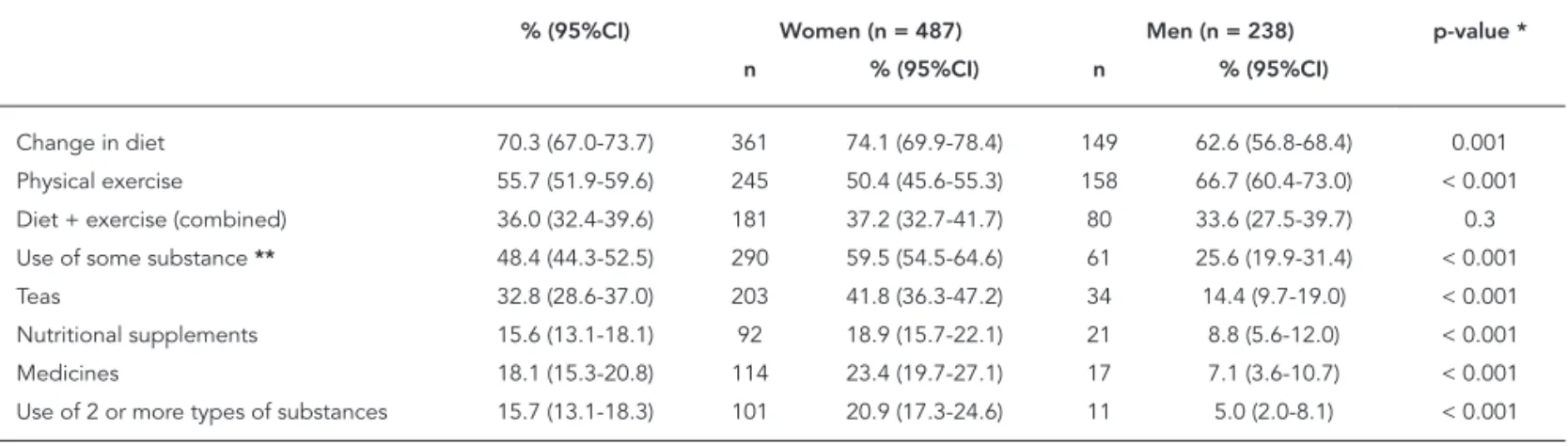
The strategies used by those who attempted weight-loss are demonstrated in Table 2. The most frequent practices were dietary control (70.3%; 95%CI: 67.0-73.7) and physical exercise (55.7%; 95%CI: 51.9-59.6). The combination of both these methods occurred in 36% (95%CI: 32.4-39.6) of cases. Among individuals that tried to lose weight, 48.4% (95%CI: 44.3-52.5) used a substance, which is equivalent to 12.8% (95%CI: 11.5-14.2) of the total sample. The most common-ly used substances for weight-loss among men and women were teas, followed by drugs among women and nutritional supplements among men.
Table 1
Sample characteristics and prevalence of weight-loss attempts. Pelotas, Rio Grande do Sul State, Brazil, 2010 (N = 2,732).
Variables n (%) Weight-loss attempts (95%CI) p-value
Sex < 0.001 *
Male 1,151 (42.1) 20.7 (17.8-23.6)
Female 1,581 (57.9) 30.8 (28.5-33.2)
Age (years) < 0.001 *
20-29 595 (21.8) 30.5 (26.7-34.3)
30-39 462 (16.9) 31.9 (27.0-36.7)
40-49 545 (20.0) 27.3 (23.4-31.3)
50-59 495 (18.1) 28.7 (24.8-32.6)
60 or + 635 (23.2) 16.7 (13.7-19.7)
Skin color 0.04 *
White 2,218 (81.2) 27.3 (25.1-29.6)
Non-white 513 (18.8) 23.0 (19.6-26.4)
Marital status < 0.001 *
With a partner 1,606 (58.8) 27.0 (24.4-29.5)
Single 644 (23.6) 29.8 (26.0-33.6)
Divorced 234 (8.5) 26.9 (20.6-33.2)
Widowed 248 (9.1) 14.9 (10.4-19.4)
Schooling (years) < 0.001 **
0-4 678 (24.9) 15.3 (12.4-18.3)
5-8 773 (28.3) 24.0 (20.5-27.5)
9-11 732 (26.8) 30.6 (27.3-33.9)
12 or + 547 (20.0) 38.6 (34.7-42.5)
Family income (terciles) < 0.001 **
Lower 742 (27.4) 20.7 (17.5-23.9)
Medium 907 (33.6) 23.4 (20.5-26.2)
Higher 1,054 (39.0) 33.4 (30.4-36.4)
Current tobacco use < 0.001 *
No 2,149 (78.7) 29.5 (27.2-31.8)
Yes 583 (21.3) 15.6 (12.5-18.8)
Self-perception of weight < 0.001 **
Very skinny/Skinny 286 (10.5) 4.9 (2.4-7.4) Normal 1,338 (49.3) 17.9 (15.4-20.5)
Fat 958 (35.3) 40.6 (37.1-44.1)
Very fat 133 (4.9) 60.6 (51.8-69.4)
BMI *** < 0.001 **
Normal 922 (37.7) 14.3 (11.7-16.8)
Overweight 888 (36.3) 29.9 (26.3-33.6)
Obese 638 (26.0) 41.5 (37.7-45.3)
Leisure physical activity (IPAQ) < 0.001 *
Insufficiently active 2,007 (75.6) 24.7 (22.5-26.9)
Active 649 (24.4) 34.0 (30.2-37.7)
BMI: body mass index; IPAQ: International Physical Activity Questionnaire; 95%CI: 95% confi dence interval. * Chi-square test of heterogeneity;
** Chi-square test for trends;
Regarding BMI, weight-loss attempts in the last 12 months was more common among obese people (41.5%; 95%CI: 37.7-45.3), as were dietary modifications (29.6%; 95%CI: 26.5-32.8) and physical exercise (20.9%; 95%CI: 17.8-24.0). The combination of both practices was reported by 14.2% (95%CI: 11.5-16.8) of obese individuals and 11% (95%CI: 8.9-13.2) of overweight people. The prevalence of weight-loss attempts and the strategies utilized by the study population ac-cording to BMI are presented in Figure 1.
Usage of all weight-loss substances was greater among women (Figure 2). Use of teas was reported by 8.7% (95%CI: 7.5-9.9) of the popula-tion and was the most commonly used substance by women and men. Weight-loss drugs were uti-lized by 7.3% (95%CI: 6.0-8.6) of women and 1.5% (95%CI: 0.7-2.2) of men.
Table 3 shows crude and adjusted analysis of factors associated with use of substances for weight loss, according to the hierarchical model. In the crude analysis, women younger than 40 years of age, with more than 11 years of schooling and increased family income, were more likely to use substances. Regarding self-perceived weight, 42.9% of those who perceived themselves as very fat and 24.3% of obese people used some kind of weight-loss substance.
In the adjusted analysis, being female and obese were the strongest predictors of the use of a substance for weight loss. Women were 3.48 (95%CI: 2.59-4.68) times more likely than men to use some kind of substance. Among obese in-dividuals PR was 5.31 (95%CI: 3.93-7.18) times greater than in normal weight individuals.
High-er prevalence of the use of substances for weight-loss was also found among individuals younger than 60 years of age, with more than 4 years of schooling, increased family income and that per-ceived themselves as fat or very fat. In contrast, even after adjustment, smoking was associated with decreased use of substances for weight-loss (PR = 0.68; 95%CI: 0.50-0.93).
Discussion
Despite their importance, weight-loss strategies have not been studied at a population level in Brazil. For the first time, this study shows high prevalence of weight-loss practices and use of substances for weight-loss among a sample of the Brazilian adult population.
The observed frequency of weight-loss prac-tices was similar to that reported more than 10 years ago in the US by Serdula et al. 13.
Preva-lence was less than that identified by Weiss et al. 32, using National Health and Nutrition
Ex-amination Survey (NHANES) data in 2002, than that observed in a Malaysian study carried out by Kong et al. 24 and that found by Kruger et al. 14 in
a study involving the NHIS in 1998.
Our data indicates that the pursuit of weight-loss is frequently not combined with healthy practices. This observation is similar findings of Kruger et al. 14 in the US, where slightly more
than 1/3 of individuals who tried to lose weight in the previous year reported a combination of diet modification and physical activity. Howev-er, the fact that it is widely known that physical
Table 2
Weight-loss strategies adopted by those who attempted weight-loss in the last year according to gender. Pelotas, Rio Grande do Sul State, Brazil, 2010.
% (95%CI) Women (n = 487) Men (n = 238) p-value *
n % (95%CI) n % (95%CI)
Change in diet 70.3 (67.0-73.7) 361 74.1 (69.9-78.4) 149 62.6 (56.8-68.4) 0.001 Physical exercise 55.7 (51.9-59.6) 245 50.4 (45.6-55.3) 158 66.7 (60.4-73.0) < 0.001 Diet + exercise (combined) 36.0 (32.4-39.6) 181 37.2 (32.7-41.7) 80 33.6 (27.5-39.7) 0.3 Use of some substance ** 48.4 (44.3-52.5) 290 59.5 (54.5-64.6) 61 25.6 (19.9-31.4) < 0.001 Teas 32.8 (28.6-37.0) 203 41.8 (36.3-47.2) 34 14.4 (9.7-19.0) < 0.001
Nutritional supplements 15.6 (13.1-18.1) 92 18.9 (15.7-22.1) 21 8.8 (5.6-12.0) < 0.001 Medicines 18.1 (15.3-20.8) 114 23.4 (19.7-27.1) 17 7.1 (3.6-10.7) < 0.001 Use of 2 or more types of substances 15.7 (13.1-18.3) 101 20.9 (17.3-24.6) 11 5.0 (2.0-8.1) < 0.001
95%CI: 95% confi dence interval. * Chi-square test of heterogeneity;
Figure 1
Prevalence of weight-loss attempts and strategies used for reducing weight during the last year, according to current body mass index (BMI). Pelotas, Rio Grande do Sul State, Brazil, 2010.
Figure 2
Prevalence of substances used for weight loss in the population, according to gender. Pelotas, Rio Grande do Sul State, Brazil, 2010.
0 %
5 10 15 20 25 30 35 40 45
Normal weight Overweight Obese
Weight-loss attempt in last year
Dietary modification
Physical exercice
Substance use
Combined exercise and diet
0 2 4 6 8 10 12 14
%
Total
Males
Females
Teas * Dietary supplements ** Medicines ***
Table 3
Factors associated with the use of substances for weight-loss -crude and adjusted analysis. Pelotas, Rio Grande do Sul State, Brazil, 2010 (N = 2,732).
Level * Variables Prevalence (95%CI) Crude analysis Adjusted analysis PR (95%CI) p-value PR (95%CI) p-value
1 Sex < 0.001 ** < 0.001 **
Male 5.3 (3.9-6.7) 1.00 1.00
Female 18.3 (16.2-20.5) 3.46 (2.59-4.63) 3.48 (2.59-4.68)
Age (years) < 0.001 ** < 0.001 **
20-29 16.1 (13.0-19.3) 2.77 (1.90-4.03) 2.34 (1.59-3.45)
30-39 17.1 (13.6-20.6) 2.93 (1.93-4.46) 2.72 (1.79-4.14) 40-49 13.4 (10.5-16.3) 2.30 (1.53-3.46) 2.23 (1.47-3.38) 50-59 13.3 (10.3-16.4) 2.29 (1.57-3.34) 2.20 (1.51-3.21)
60 or + 5.8 (3.9-7.8) 1.00 1.00
Skin color 0.5 ** 0.5 **
Non-white 12.1 (11.5-14.5) 1.00 1.00
White 13.0 (9.2-14.9) 1.08 (0.84-1.38) 0.93 (0.74-1.18)
Marital status 0.02 ** 0.7 **
With a partner 12.5 (10.8-14.1) 1.72 (1.16-3.44) 1.26 (0.80-2.00) Single 15.4 (12.7-18.1) 2.12 (1.31-3.42) 1.27 (0.77-2.09)
Divorced 14.5 (9.8-19.3) 2.00 (1.16-3.44) 1.39 (0.80-2.42)
Widowed 7.3 (4.1-10.5) 1.00 1.00
Schooling (years) < 0.001 *** 0.02 ***
0-4 6.5 (4.5-8.5) 1.00 1.00
5-8 12.7 (10.1-15.2) 1.95 (1.34-2.85) 1.60 (1.09-2.34)
9-11 14.5 (11.9-17.1) 2.23 (1.57-3.17) 1.56 (1.09-2.24) 12 or + 18.7 (15.9-17.1) 2.87 (2.00-4.14) 1.74 (1.15-2.65)
Family income (terciles) < 0.001 *** 0.007 ***
Lower 9.8 (7.7-12.0) 1.00 1.00
Medium 11.5 (9.3-13.6) 1.17 (0.88-1.55) 1.16 (0.88-1.53)
Higher 16.3 (14.0-18.6) 1.66 (1.29-2.14) 1.50 (1.12-2.02)
2 Current tobacco use < 0.001 ** 0.02 **
No 14.2 (12.6-15.9) 1.00 1.00
Yes 7.7 (5.7-9.8) 0.54 (0.41-0.72) 0.68 (0.50-0.93)
BMI (kg/m2) < 0.001 *** < 0.001 ***
< 25.0 (normal weight) 5.7 (4.1-7.4) 1.00 1.00 25.0-29.9 (overweight) 12.7 (10.5-15.0) 2.21 (1.59-3.08) 3.08 (2.26-4.18)
≥ 30.0 (obese) 24.3 (20.9-27.7) 4.23 (3.03-5.90) 5.31 (3.93-7.18) Leisure time physical
activity (IPAQ)
1.0 ** 0.8 **
Insufficiently active 13.2 (11.4-14.9) 1.00 1.00 Active 13.3 (10.8-15.7) 1.01 (0.80-1.27) 1.03 (0.80-1.32) 3 Self-perceived body
weight
< 0.001 *** < 0.001 ***
Very skinny/Skinny 0.7 (0.03-1.7) 0.11 (0.03-0.43) 0.15 (0.04-0.60)
Normal 6.5 (5.1-7.9) 1.00 1.00
Fat 21.4 (18.5-24.3) 3.29 (2.55-4.24) 2.11 (1.52-2.91) Very fat 42.9 (34.4-51.4) 6.59 (4.89-8.88) 3.30 (2.26-4.81)
BMI: body mass index; IPAQ: International Physical Activity Questionnaire; PR: prevalence ratio; 95%CI: 95% confi dence interval.
* Level of the variable according to the hierarchical analysis model. The measure of effect is controlled for all the variables of the same level or higher levels that present a p-value < 0.2;
activity is a healthy practice may have induced some individuals to choose this answer. We can therefore assume that physical activity is less common than reported and that the data overes-timates prevalence 33.
Lifestyle modifications are essential and are universally recommended in the treatment of overweight individuals 34,35. The study found that
less than 30% of overweight individuals and more than 40% of obese people reported a weight-loss attempt in the last year. Although weight-loss strategies are more prevalent in these subgroups than among groups with appropriate weight, the combination of healthy practices was the excep-tion and was reported by less than 15% of these individuals. Although obesity may limit physical activity and the frequency of combined health practices, it seems that even those individuals who most need to lose weight tend to opt for inad-equate strategies whose use is based on low levels of scientific evidence.
Gender differences were found with respect to weight-loss strategy. As reported by other stud-ies 13,14,36, weight-loss attempts and
consump-tion of substances for diet and weight-loss were greater in women. In contrast to Serdula et al. 13,
that reported equal use of physical activity by men and women as a weight-loss strategy, in our study men used physical activity more often to lose weight.
Regarding the consumption of substances for weight-loss, the observed prevalence dif-fered from findings of other population studies. It should be noted that the prevalence of obe-sity and the variety of cultural characteristics between different populations may significantly influence this practice and no comparable Brazil-ian studies were identified on this subject. How-ever, international publications show that use of substances for weight-loss varies between 4%, in the NHIS study of 1998 14, and 33.9%, reported in
a study undertaken by Pilliteri et al. 26 which had
a 19% response rate. Another study in the US with high refusal rates 25 found a prevalence of 8.7%
for the use of non-prescribed substances during the preceding year.
Teas were the most common weight-loss sub-stances consumed in our sample, among both men and women. Nonetheless, few publications evaluate the use of these substances at the popu-lation level. Blank et al. 23 and a Malaysian study
carried out by Konget al. 24, showed that
approxi-mately 10% of adults used some herbal product for weight loss. Also, the National Physical Ac-tivity and Weight-loss Survey in 2002 25, found a
higher than 15% prevalence rate.
It is interesting to note that when we evalu-ated herbal supplements, there were no usage
indications for the treatment of excess weight and no scientific evidence that these methods are effective 17,37,38. Indeed, several publications
suggest potentially harmful effects of these sub-stances, especially gastrointestinal and psycho-logical disorders and hepatic lesions 39,40.
In accordance with other studies 23,35,41, we
found an association between use of substances for weight-loss and being female and overweight. The consistency of these findings reinforces the idea that both characteristics are undeniably as-sociated with use of weight-loss substances and are the strongest predictors of this behavior.
In relation to age, there was an increased likelihood of use of substances for weight-loss in people younger than 60 years of age, regardless of sex. This finding is similar to that observed by Kruger et al. 14. However, other
publica-tions found an association only in younger age groups 36,42.
Skin color and marital status were not associ-ated with use of substances or weight-loss prac-tices. Although some US publications 26,41 report
non-white skin color as a risk factor, it is likely that this finding is associated with the specific cultural characteristics of the population. In Bra-zil, skin color is not associated with weight-loss practices due to higher levels of cultural misce-genation and an increased diffusion of concern over body shape.
An inverse association with tobacco use was also identified in other studies 13, with evidence
of increased risk of weight gain associated with tobacco cessation 43. This finding may reflect the
belief that smoking could work as a weight con-trol strategy 44 and demonstrates the emphasis
on the aesthetic aspects of weight loss, irrespec-tive of the health implications. Furthermore, the lower prevalence of weight-loss attempts in obese smokers than in obese nonsmokers (44.1% vs. 27.7%) could be an indication of worse gen-eral health-care associated with smoking, as has been demonstrated in other studies 45.
Self-perceived excess weight was a factor in-dependently associated with use of substances for weight loss. No publication regarding this specific association was identified, but studies with adolescents have found increased risk of weight-loss practices 46,47 and unhealthy
weight-loss strategies 48,49 associated with
self-percep-tion of excess weight.
the reported substance. This possibility is unlike-ly however, since the vast majority of substances for weight-loss do not show substantial ability to reduce body weight and therefore normalize the BMI of an obese person.
The causal association with physical activ-ity may also be biased due to reverse causalactiv-ity. However, no evidence was found for this, since the prevalence of physical activity and reports of physical activity were similar between users and non-users of substances for weight-loss. The most relevant finding was the high prevalence (> 75%) of sedentary behavior among users of weight-loss supplements.
One of the strong points of this study is that the response rate is the highest among the identified publications with similar objectives 13,14,23,25,26.
The greater frequency of men among losses may lead to an overestimate of the frequency of weight-loss strategies and use of substances. However, this does not appear to have influenced the estimates of association, and effect modifica-tion associated with gender was not found.
Our findings reinforce the idea that, although weight-loss attempts and use of substances for weight-loss are common practices, these strate-gies are not used by the majority of individuals that need to lose weight. The fact that most in-dividuals who attempt to lose weight do not ad-here to recommended practices, may reflect the aesthetic emphasis of weight-loss strategies. In addition, the high usage of unproven substances with potentially adverse effects reveals the need for greater control of teas, phytotherapies and dietary supplement sales, and highlights the im-portance of awareness raising actions concerning the lack of efficacy and risk of these methods.
Finally, the findings show that the issue of “weight loss” is extremely prominent and impor-tant in our society, and there is a public health need to spread clear information about the risks associated with certain weight-loss practices and emphasize the necessity to create public policies to promote lifestyle modification and the regula-tion of substances with unproven efficacy and safety.
Resumo
Estudo transversal de base populacional conduzido com adultos residentes na cidade de Pelotas, Rio Gran-de do Sul, Brasil, que objetivou Gran-determinar a prevalên-cia de práticas de emagrecimento e uso de substânprevalên-cias para emagrecer, nos últimos 12 meses antes da entre-vista. A prevalência de tentativas de emagrecimento foi de 26,6%. Controle dietético e prática regular de exercícios físicos foram as estratégias mais frequentes, mas apenas 36% daqueles que tentaram emagrecer combinaram-nas. A prevalência do uso de substân-cias para emagrecer foi de 12,8% (48,4% daqueles que tentaram emagrecer). Mulheres utilizaram controle dietético e substâncias mais frequentemente do que homens, enquanto estes utilizaram mais exercícios físicos. As substâncias de uso mais frequente foram os chás. A análise ajustada identificou sexo feminino, excesso de peso e percepção do excesso de peso como os maiores fatores associados ao uso de substâncias. Assim, identificamos que tentativas de emagrecimento são frequentes, porém, não são referidas pela maioria dos obesos e apenas uma minoria daqueles que tentam emagrecer segue as práticas recomendadas.
Perda de Peso; Fármacos Antiobesidade; Fitoterapia; Estudos Transversais
Contributors
E. C. Machado participated in all stages of the study, including conception and design, acquisition, analysis and interpretation of data and drafting this article. M. F. Silveira and V. M. F. Silveira participated in the con-ception and design of the study, data interpretation and critical revision of this article.
Acknowledgments
References
1. Caballero B. The global epidemic of obesity: an overview. Epidemiol Rev 2007; 29:1-5.
2. Prentice AM. The emerging epidemic of obesity in developing countries. Int J Epidemiol 2006; 35:93-9.
3. Overweight, obesity, and health risk. National Task Force on the Prevention and Treatment of Obesity. Arch Intern Med 2000; 160:898-904.
4. Nguyen NT, Magno CP, Lane KT, Hinojosa MW, Lane JS. Association of hypertension, diabetes, dyslipidemia, and metabolic syndrome with obe-sity: findings from the National Health and Nutri-tion ExaminaNutri-tion Survey, 1999 to 2004. J Am Coll Surg 2008; 207:928-34.
5. Carr D, Friedman MA. Is obesity stigmatizing? Body weight, perceived discrimination, and psy-chological well-being in the United States. J Health Soc Behav 2005; 46:244-59.
6. Waxman A. WHO global strategy on diet, physi-cal activity and health. Food Nutr Bull 2004; 25: 292-302.
7. Instituto Brasileiro de Geografia e Estatística. Pes-quisa de Orçamentos Familiares – POF 2008-2009. Antropometria e estado nutricional de crianças, adolescentes e adultos no Brasil. Brasília: Instituto Brasileiro de Geografia e Estatística; 2010.
8. World Health Organization. Fact sheet no. 311: obesity and overweight. Geneva: World Health Or-ganization; 2006.
9. Wilding JP. Treatment strategies for obesity. Obes Rev 2007; 8 Suppl 1:137-44.
10. Rao G. Office-based strategies for the management of obesity. Am Fam Physician 2010; 81:1449-56. 11. Padwal R, Li SK, Lau DC. Long-term
pharmaco-therapy for obesity and overweight. Cochrane Da-tabase Syst Rev 2004; CD004094.
12. Colquitt JL, Picot J, Loveman E, Clegg AJ. Surgery for obesity. Cochrane Database Syst Rev 2009; CD003641.
13. Serdula MK, Mokdad AH, Williamson DF, Galuska DA, Mendlein JM, Heath GW. Prevalence of at-tempting weight-loss and strategies for controlling weight. JAMA 1999; 282:1353-8.
14. Kruger J, Galuska DA, Serdula MK, Jones DA. At-tempting to lose weight: specific practices among U.S. adults. Am J Prev Med 2004; 26:402-6. 15. Polivy J. The false hope syndrome: unrealistic
ex-pectations of self-change. Int J Obes Relat Metab Disord 2001; 25 Suppl 1:S80-4.
16. Lenz TL, Hamilton WR. Supplemental products used for weight loss. J Am Pharm Assoc (2003) 2004; 44:59-67.
17. Pittler MH, Ernst E. Complementary therapies for reducing body weight: a systematic review. Int J Obes (Lond) 2005; 29:1030-8.
18. Kaptein EM, Beale E, Chan LS. Thyroid hormone therapy for obesity and nonthyroidal illnesses: a systematic review. J Clin Endocrinol Metab 2009; 94:3663-75.
19. Singleton J, Degenhardt L, Hall W, Zabransky T. Mortality among amphetamine users: a systematic review of cohort studies. Drug Alcohol Depend 2009; 105:1-8.
20. Informe de la Junta Internacional de Fiscalización de Estupefacientes. New York: Naciones Unidas; 2010.
21. United Nations Office on Drugs and Crime. 2008 World Drug Report. Vienna: United Nations; 2008. 22. de Lima MS, Beria JU, Tomasi E, Mari JJ. Use of
amphetamine-like appetite suppressants: a cross-sectional survey in Southern Brazil. Subst Use Mis-use 1998; 33:1711-9.
23. Blanck HM, Khan LK, Serdula MK. Use of nonpre-scription weight-loss products: results from a mul-tistate survey. JAMA 2001; 286:930-5.
24. Kong WT, Chua SS, Alwi S. Weight-loss practices among Malaysian adults. Asia Pac J Public Health 2002; 14:99-104.
25. Blanck HM, Serdula MK, Gillespie C, Galuska DA, Sharpe PA, Conway JM, et al. Use of nonprescrip-tion dietary supplements for weight-loss is com-mon acom-mong Americans. J Am Diet Assoc 2007; 107:441-7.
26. Pillitteri JL, Shiffman S, Rohay JM, Harkins AM, Burton SL, Wadden TA. Use of dietary supple-ments for weight-loss in the United States: results of a national survey. Obesity (Silver Spring) 2008; 16:790-6.
27. Instituto Brasileiro de Geografia e Estatística. Es-timativa populacional para 2009 – Pelotas, RS. http://www.ibge.gov.br/cidadesat/topwindow. htm?1.
28. Barros AJ, Menezes AMB, Santos IS, Assunção MCF, Gigante D, Fassa AG, et al. UFPel’s epidemiology MSc program based on research consortium: an innovative experience. Rev Bras Epidemiol 2008; 11 Suppl 1:133-44.
29. Lohman TG, Roche AF, Martorell R. Anthropomet-ric standardization reference manual. Champaign: Human Kinetics Books; 1988.
30. Habicht JP. Standardization of quantitative epide-miological methods in the field. Bol Oficina Sanit Panam 1974; 76:375-84.
31. Barros AJ, Hirakata VN. Alternatives for logistic re-gression in cross-sectional studies: an empirical comparison of models that directly estimate the prevalence ratio. BMC Med Res Methodol 2003; 3:21.
32. Weiss EC, Galuska DA, Khan LK, Serdula MK. Weight-control practices among U.S. adults, 2001-2002. Am J Prev Med 2006; 31:18-24.
33. Knuth AG, Bielemann RM, Silva SG, Borges TT, Del Duca GF, Kremer MM, et al. Conhecimento de adultos sobre o papel da atividade física na pre-venção e tratamento de diabetes e hipertensão: estudo de base populacional no Sul do Brasil. Cad Saúde Pública 2009; 25:513-20.
34. Tsigos C, Hainer V, Basdevant A, Finer N, Fried M, Mathus-Vliegen E, et al. Management of obesity in adults: European clinical practice guidelines. Obes Facts 2008; 1:106-16.
36. Bendixen H, Madsen J, Bay-Hansen D, Boesen U, Ovesen LF, Bartels EM, et al. An observational study of slimming behavior in Denmark in 1992 and 1998. Obes Res 2002; 10:911-22.
37. Pittler MH, Ernst E. Dietary supplements for body-weight reduction: a systematic review. Am J Clin Nutr 2004; 79:529-36.
38. Egras AM, Hamilton WR, Lenz TL, Monaghan MS. An evidence-based review of fat modifying supple-mental weight loss products. J Obes 2011; [Epub 2010 Aug 10].
39. Pittler MH, Schmidt K, Ernst E. Adverse events of herbal food supplements for body weight reduc-tion: systematic review. Obes Rev 2005; 6:93-111. 40. Hasani-Ranjbar S, Nayebi N, Larijani B, Abdollahi
M. A systematic review of the efficacy and safety of herbal medicines used in the treatment of obesity. World J Gastroenterol 2009; 15:3073-85.
41. Khan LK, Serdula MK, Bowman BA, Williamson DF. Use of prescription weight-loss pills among U.S. adults in 1996-1998. Ann Intern Med 2001; 134:282-6.
42. Levy AS, Heaton AW. Weight control practices of U.S. adults trying to lose weight. Ann Intern Med 1993; 119:661-6.
43. Chiolero A, Faeh D, Paccaud F, Cornuz J. Conse-quences of smoking for body weight, body fat dis-tribution, and insulin resistance. Am J Clin Nutr 2008; 87:801-9.
44. Li MD, Kane JK, Konu O. Nicotine, body weight and potential implications in the treatment of obesity. Curr Top Med Chem 2003; 3:899-919.
45. Wolf R, Freedman D. Cigarette smoking, sexually transmitted diseases, and HIV/AIDS. Int J Derma-tol 2000; 39:1-9.
46. Strauss RS. Self-reported weight status and dieting in a cross-sectional sample of young adolescents: National Health and Nutrition Examination Sur-vey III. Arch Pediatr Adolesc Med 1999; 153:741-7. 47. Cheung PC, Ip PL, Lam ST, Bibby H. A study on
body weight perception and weight control be-haviours among adolescents in Hong Kong. Hong Kong Med J 2007; 13:16-21.
48. Wharton CM, Adams T, Hampl JS. Weight-loss practices and body weight perceptions among US college students. J Am Coll Health 2008; 56:579-84. 49. Harring HA, Montgomery K, Hardin J. Perceptions
of body weight, weight management strategies, and depressive symptoms among US college stu-dents. J Am Coll Health 2010; 59:43-50.
Submitted on 22/Sep/2011