CIÊNCIAS DA VIDA E DA SAÚDE LIFE AND HEALTH SCIENCES
CIENCIAS DE LA VIDA Y LA SALUD
mill
e
nium
79
Millenium, 2(4), 79-88.
SATISFAÇÃO DA PESSOA SURDA COM A QUALIDADE DA ASSISTÊNCIA EM SAÚDE
SATISFACTION OF DEAF PEOPLE WITH THE HEALTH CARE SYSTEM QUALITY
SATISFACCIÓN DE LA PERSONA SORDA CON LA CALIDAD DE LA ASISTENCIA SANITÁRIA
Betânia Farias
1Madalena Cunha
21Nurse, Alagoas, Brasil
2Professor, Polytechnic Institute of Viseu (IPV), School of Health, Studies Centre in Education, Technology and Health (CI&DETS),
Research and Development Unit of the IPV, Viseu, Portugal.
Betânia Farias – [email protected] | Madalena Cunha – [email protected]
Corresponding Author
Madalena Cunha
Escola Superior de Saúde
Rua D. João Gomes Crisóstomo de Almeida, nº102 3500-843 Viseu, Portugal
RECEIVED: 22th of August, 2017 ACCEPTED: 28th of September, 2017
Farias, B. & Cunha, M. (2017). Satisfaction of deaf people with the health care system quality. Millenium, 2(4), 79-88.
m
4
80
RESUMO
Introdução: A barreira de comunicação existente entre as pessoas surdas e ouvintes prejudica a participação ativa da pessoa
surda na sociedade.
Objetivo: Avaliar a satisfação da pessoa surda com a qualidade das ações e serviços oferecidos nas unidades de saúde públicas. Métodos: Estudo de natureza exploratório-descritiva e enfoque transversal, realizado com uma amostra de 15 pessoas surdas
com perda auditiva severa ou profunda, de ambos os sexos (10 homens e 5 mulheres), que se comunicam através da Língua de Sinais (Libras), com idade compreendida entre 20 e 38 anos, usuárias dos serviços públicos de saúde. Foi utilizado um Questionário de Satisfação.
Resultados: A maioria dos participantes (86,7%) declararam-se muito insatisfeitos com a comunicação dos funcionários, 80%
referiram ausência de materiais informativos e educativos e 53,3% demonstram nível de satisfação negativo, quanto à pontualidade no agendamento das consultas, marcação e entrega de exames.
Conclusões: Os resultados mostram a necessidade de contratação de intérpretes para melhorar a assistência das pessoas surdas. Palavras-chave: Surdez; Satisfação; Assistência; Saúde
ABSTRACT
Introduction: The communication barrier between deaf and hearing people harms the active participation of the deaf person in
society.
Objective: To evaluate the satisfaction of the deaf person with the quality of the actions and services offered in public health
units.
Methods: An exploratory, descriptive, cross-sectional study was carried out on a sample of 15 deaf people with severe or
profound hearing loss, of both genders (10 men and 5 women), who communicate through Sign Language (Libras), aged between 20 and 38 years, who use public health services. A Satisfaction Questionnaire was used.
Results: Most participants (86.7%) were very dissatisfied with the level of communication of the employees, 80% reported lack
of informative and educational materials and 53.3% showed a negative level of satisfaction regarding the timeliness of scheduling appointments and delivery of test results.
Conclusions: Results show the need to hire interpreters to improve care for deaf people. Keywords: Deafness; Satisfaction; Assistance; Health
RESUMEN
Introducción: La barrera de comunicación existente entre las personas sordas y oyentes perjudica la participación activa de la
persona sorda en la sociedad.
Objetivo: Evaluar la satisfacción de la persona sorda con la calidad de las acciones y servicios ofrecidos en las unidades de salud
públicas.
Métodos: Estudio de carácter exploratorio-descriptivo y enfoque transversal, realizado con una muestra de 15 personas sordas
con pérdida auditiva severa o profunda, de ambos sexos (10 hombres y 5 mujeres), que se comunican a través de la Lengua de Signos (Libras), Con edad compendida entre 20 y 38 años, usuarias de los servicios públicos de salud. Se utilizó un Cuestionario de Satisfacción.
Resultados: La mayoría de los participantes (86,7%) se declararon muy insatisfechos con la comunicación de los funcionarios, el
80% señaló ausencia de materiales informativos y educativos y el 53,3% demuestra un nivel de satisfacción negativa, en cuanto a la puntualidad en la programación de las directrices Consultas, marcado y entrega de exámenes.
Conclusións: Los resultados muestran la necesidad de contratación de intérpretes para mejorar la asistencia de las personas
sordas.
Farias, B. & Cunha, M. (2017).
Satisfaction of deaf people with the health care system quality. Millenium, 2(4), 79-88.
m
4
81
INTRODUCTION
The understanding of deafness depends on the ideological conceptions acquired throughout History, and is directly related to the inclusion or non-inclusion of the subjects involved within the social environment of predominantly listeners. In the present research, two ideologies based on the work of McDonnell (2016) were acknowledged: the norm that consists in turning the Deaf individual into a listener or as oralized as possible in the listening society; and that of the Deaf and disability rights, that is, to make them socially inclusive through respect for social and cultural rights.
In this article, we chose to use the word "Deaf" with a capital letter, following the bibliographical line of the specialty that defends the definition of the word in the sociological and cultural sense of the term, as it used 1st time in the University of Gallaudet, in Washington DC, in 1972, as reported by Moura (2000) and Mottez (2006).
Mottez (2006) describes a multiplicity of names for the deaf ("deaf-mute", "hearing impaired", etc.) and argues that such names are often characteristic of society's denial of deafness. The contributions of Bernard Mottez were particularly relevant in the sociological approach that emerges in the conceptualization of Deafness, the Deaf Culture and the use of Sign Language.
The concept of deafness as a sensorial deficit is aimed only at organic-biological aspects derived from oral philosophy, which conceives the socially included deaf individuals through intense training, both in terms of speech and lip reading as well as auditory training, in the attempt to make the deaf oralized (Nóbrega, Andrade, Pontes, Bosi & Machado, 2012). This is usually diffused through the availability of hearing aids and clotting implants in auditory correction, used by health services in response to public policies towards the hearing impaired (Souza, Brito, Bento, Gomez, Tsuji, & Hausen-Pinna, 2011; Ramos, Jorge, Teixeira, Ribeiro & Paiva, 2015). However, despite the technological advances in hearing recovery, there are reports of resistance to the use of these devices due to the discomfort caused by the interference of audible noise, and the psychological sufferings as a consequence of the family's imposition to make them listeners (Nóbrega et al, 2012; Silva & Abreu, 2014). In accordance with the special needs of the deaf, Art. 2 of Decree No. 5.626 (Brazil, 2005) takes into account the biological factor of deafness, but considers the deaf person to be able to interact socially through sign language and through it be able to spread his/her own culture and identity. The construction of social identity occurs within and by sharing a culture, in the production of speeches and meanings that are attributed during interpersonal coexistence. This implies that, from a cultural point of view, the individual does not consider himself/herself deaf because of a sensory limitation, but rather because they share common experiences with each other as an integral part of a social group (Nóbrega et al, 2012).
Integral attention in health care for the Deaf person is essential, and in Brazil, Art. 2 of Law No. 7.853 (Brazil, 1989) places on the Public Power and its organs the responsibility to assure to this population the full exercise of their rights, among them that of health. It is worth mentioning that since the creation of the current health system - Single Health System (SUS), access to health care has become a right of all citizens regardless of their social, economic and cultural status, among others. This is guaranteed by the Norms and Guidelines that guide the legal framework of the SUS expressed in Law No. 8.080 (Brazil, 1990), which provides for the conditions, organization and functioning of health services at different levels of care. It also entitles the government the responsibility to ensure universal and equal access to all Brazilian citizens.
The provision of services, the atmosphere of physical premises, professional training and access to information should be of good quality. Nonetheless, studies have revealed non-compliance and weaknesses in the provision of health care for the hearing disabled (Andrade, Fernandes, Ramos, Mendes, & Alves, 2013; Castro, Lefèvre, Lefèvre & Cesar, 2011; França, 2011; Ribeiro et al, 2010; Vianna, Cavalcante & Acioli, 2014).
In this context, and based on the hypothesis that the hearing loss does not cognitively incapacitate the subjects, nor does it prevent them from recognizing the quality of the services provided in consonance with their rights as citizens, the following question was made: What is the deaf person's level of satisfaction with the quality of actions and services offered in public health
services?
In agreement, the main objective of this study was to evaluate the level of satisfaction of the deaf person with the quality of the
actions and services offered in the public health units.
1. CONCEPTION OF DEAFNESS
The legal framework of Brazil, Art. 2 of Decree 5.626 of 2005 (Brazil, 2005) defines the deaf person as "one who, through hearing
loss, understands and interacts with the world through visual experiences, manifesting their culture mainly through the use of the Brazilian Sign Language - Libras" (Brazil, 2005). Art. 2 of Decree 5.626 of 2005 considers the sensory loss measured by an
audiogram, but does not conceive the deaf person as a disabled person. Instead, he/she is seen as an individual cognitively active with the surroundings in which he/she lives in. Hearing impairment is defined as the "partial or total bilateral loss of
forty-one decibels (dB) or more, measured by an audiogram at the frequencies of 500Hz, 1,000Hz, 2,000Hz and 3,000Hz." (Brazil,
Decree No. 5296, 2004).
Giuseppe Rinaldi et al. (1997) quoted by Wilhelms (2013), advocates that deafness, apart from level classification, may be presented as: unilateral (when only one ear is affected); bilateral (when there is an impairment of both ears); congenital (caused
Farias, B. & Cunha, M. (2017). Satisfaction of deaf people with the health care system quality. Millenium, 2(4), 79-88.
m
4
82
during pregnancy); acquired (occurring during or after childbirth), in which the latter can be subdivided into pre-lingual - before the acquisition of language - or post-lingual manifested during the course of life after language use.
The conception of deafness integrates a historical context that, depending on the individual or collective understanding as well as the social circumstances of the ideological foundation, are practically antagonistic. McDonnell (2016) argues that there are two dominant ideologies that have significantly influenced the interpersonal relationship between listeners and deaf people: the ideology of "normalization" and the ideology "disability rights and deaf rights." In accordance with the aforementioned normalization ideology, Nóbrega et al (2012) refer to this practice as an "oralist philosophy" for trying to oralize deaf people through intense oral and auditory training, even through "body punishment practices" without considering their linguistic specificities and cultures, as a consequence of a belief which is directly related to linguistic and intellectual development through oralism.
1.1 The hearing society´s concept of deafness
The perception of the subject with an auditory sensorial deficit can be directly related to the concept of deafness and hearing impairment that each social segment possesses, either by normative and majority determination on behalf of the listeners, or by the empowerment of the deaf population.
There are two understandings of deafness: the pathological and the cultural one, and these concepts have repercussions on the lives of the deaf and on how these subjects are perceived by the listening communities.
The repercussion of the idea that deafness was a disability made the deaf have to attend schools for their listeners and undergo extensive oralization and lip-reading exercises without the right to use sign language. Attempts to turn deaf people into listeners have led to a number of adaptation problems for the deaf and an issue of accepting their limitations on behalf of family members and society in general (Pereira, 2013).
Mottez (2006) found that the Deaf were "massively under-educated. The fact that they are, on average, neither more nor less intelligent than the audience is enough to show that this deficiency cannot be attributed to them. It has its origin in the inadequacy of the education given to them: a system based on the fetishism of speech." (Mottez, 2006, p.247) Gestures were banned for a long timein deaf institutes, in order to force them to speak. The sociologist recalls that it was in the United States and Scandinavian countries, in the 1960s, that sign language began to be regarded as a "real" language (Mottez, 2006).
In general, the limited vision of deafness as a disability gives rise to challenges in families regarding the acceptance of deafness, difficulty in communicating with children, the fight against existing social prejudice, and resistance to the use of sign language by family members as well as society (Pereira, 2013, Santos & Molon, 2014).
A widely adopted short-term understanding for the correction of hearing impairment concerns the use of increasingly sophisticated technology, such as the provision of hearing aids and cochlear implants. Moreover, there is already evidence of an improvement in the quality of life of those who have implants (Souza, Brito, Bento, Gomez, Tsuji, & Hausen-Pinna, 2011; Ramos, et al, 2015).
The use of technological devices for the normalization of the deaf population generates an expectation of inclusion within the family, health professionals and the population in general. Nevertheless, there are coexisting reports of deaf people who have been forced to use these means, which has caused negative feelings such as discomfort, pain, irritability, sadness, non-adherence to the use and treatment, as a result of increased noise and perceived noise as well as the impossibility of listening to one's voice, especially in high levels of deafness (Nóbrega et al, 2012).
On the other hand, many deaf people do not adhere to treatment because they are denied the right to information, the choice of treatment and their opinion about whether or not to accept the procedures that need to be performed. Thus, the necessity to improve healthcare services in this niche of the population is major (Nóbrega et al, 2012).
1.2 The deaf community´s concept of deafness
The perception of deafness among the deaf is not homogeneous. There are deaf people who, living in the community, acquire a deaf identity and do not see themselves as having a hearing impairment. Likewise, there are deaf people who, living in the midst of listeners or even deaf people, consider themselves to be inferior and therefore disabled and, as a result, seek other forms of becoming closer to the listeners (Wilhelms, 2013).
The non-identification as deaf, and/or non-acceptance of the deaf culture, implies a risk of social exclusion, since subjects have a limitation in the field of oral language that makes it impossible to acquire new knowledge and prevent them from actively participating in society.
Among subjects with a deaf identity, the use of Libras in communication has been increasingly implemented. The syntactic order of this language follows a very unique formation that follows a logical visual sequence that differs from the Portuguese grammatical order. It requires a certain type of body language that helps with the meaning of the words to better understand their meaning in context (Pereira, 2013).
Farias, B. & Cunha, M. (2017).
Satisfaction of deaf people with the health care system quality. Millenium, 2(4), 79-88.
m
4
83
Since Brazilian Sign Language (Libras) is a visual, spatial and natural language, it has its own grammar, which is easy to acquire unlike the Portuguese language. It reinforces the idea that the deaf pay more attention when it comes to understanding the cognitive forms presented to them, which are not always understandable (Pereira, 2013).
In order to understand the grammatical organization of Libras, this research is guided through the definitions of Capovilla & Rafael (2001) that present a clear and concise composition of this language. Thus, the gestural and visual communication used in this study is based grammatically on five parameters: hand configuration (HC); point of articulation (PA); movement (M), direction (D) and unnatural markers that are the facial expressions. It is the articulation of these elements that generates signals containing the information that comes closest to what the interlocutors wish to express.
2. METHODS
A descriptive-exploratory study with a cross-sectional approach developed in Alagoas, a Brazilian north-eastern state, with 15 deaf people with severe or profound hearing loss of both genders, who communicate through the Brazilian Sign Language (Libras), over 18 years of age and who were treated in public health services.
Accepting the postulate that deaf people do not have a disabling cognitive limitation, but instead a sensory dysfunction and that is why they are able to evaluate the quality of the actions and services provided to the population, the objective of this study was to evaluate the deaf person's perception of the quality of actions and services offered in Brazilian public health institutions of the region under study.
This nature of study was chosen because it allows us to describe how Deaf people perceive the world of listeners, especially on the topic of the health care provided to them.
The developmental stages of the study were based on the theoretical reference of Minayo et al. (2011): 1) exploratory phase; 2) field work; 3) analysis and treatment of empirical and documentary material through ordering, classification and analysis of the data. The first phase also included a bibliographic search to guide the theoretical reference, in the second approach with the subjects of the study by means of snowball sampling for data collection through a structured questionnaire (with the help of an interpreter), and in the third the organization of data into categories, followed by content analysis.
2.1 Participants
The selection of participants was based on the technique of non-probabilistic snowball sampling (Dewes, 2013). Of the five initial contacts (seeds), contact waves were generated, which resulted in five groups of seeds with around five participants each, making a total of twenty-five participants, of whom fifteen accepted to participate in the study and ten were excluded by refusal or non-attendance in the meetings scheduled.
Fifteen deaf people with profound hearing impairment, who were users of Libras, participated. There were 10 male individuals and 5 female individuals, aged between 20 and 38 years old, 6 married and 9 single, all Christians (6 Catholics and 9 Evangelicals); 11 attended 8 or more years of schooling, 4 were attending higher education and 3 referred to having a school level of less than three years.
With regard to family income, the majority (06) state their income is less than minimum wage. Of the 10 who work, the professions/jobs are: a busboy, a trader, teacher, administrative assistant, salesman and freelancer. Those who are not professionally active are: a student, a retiree, a housewife and two people who are unemployed.
2.2 Data collection instrument
The data collection was supported using the Satisfaction Questionnaire and with the help of a certified Libras interpreter for placing the question and translating the answers. Given that Libras is a sign language and considering that there is no specific sign for the Portuguese term that indicates the expressions concerning the level of satisfaction, we used adapted phrases and engravings that enabled the communication with the participants.
The data collection took place during the scheduled meetings, after previously having been in contact with the participants. The ad hoc satisfaction questionnaire consisted of 10 multiple choice questions, organized into categories that were grouped according to thematic order, structured in the light of the theoretical references: category (A) quality of communication in health services to evaluate the principle of universality; category (B) quality of care to assess the principle of completeness; category (C) quality of the consultation to evaluate the principle of fairness.
In categories A, B and C the participants answered the evaluation items using the criteria scored according to the level of satisfaction accompanied by a figure that best expressed their perception, with the following match: 1- Satisfied 2- Very satisfied 3 - Unsatisfied 4 - Very unsatisfied. The sum of the first two (1 and 2) reflects a level of positive satisfaction and of the last two (3 and 4) a level of negative satisfaction.
Questions related to socio-demographic data were also included: age, gender, schooling, marital status, occupation and family income.
Farias, B. & Cunha, M. (2017). Satisfaction of deaf people with the health care system quality. Millenium, 2(4), 79-88.
m
4
84
It was decided to ask questions focusing on the factors that determine the quality of services referred to in Assada (2001) cited by Fadel (2006). The choice of using these factors to evaluate the quality of health services in general was due to their relevance so as to analyse the correlation with the principles of completeness, universality and fairness of the SUS.
2.3 Procedures
Initially, it was sought to identify deaf people among listeners, who were in contact with them and who would enable them to get closer to the research team. Five people were contacted and a day and place was arranged according to the interviewee's choice. The information contained in the ad hoc questionnaire was read and explained through the Brazilian Sign Language (Libras) with the support of a certified interpreter. With the help of this professional, there was a brief presentation on the objectives of the research and a clarification as to the identity of the participants who freely acceded to participate in this research, exposing their perceptions about the quality of care provided by the health services, according to the Consent Form that was signed.
Guidance for completing the questions was followed.
The process of data collection was filmed for storage as well as the analysis of information expressed during the research communication - interpreter of Libras - deaf people. This procedure was aimed at ensuring the rigorous analysis and interpretation of the information contained in the data acquired when completing the answers to the questions. The expressions of the participants were also observed and recorded through filming. Each questioning lasted approximately 30 minutes. After the application of the data collection instrument, they were asked to refer between three and six new contacts. Explicit permission was obtained in order to film the participants, and it was guaranteed that the collected material would be used only for research purposes. Anonymity and confidentiality in the treatment of information and dissemination of results were ensured by assigning a code to each interviewee and respective information material collected that ranged from S1 to S15.
2.4 Analysis of the data
The collected data were grouped through the Microsoft Office Excel version 2007 tool, organized into Categories A, B and C, previously described and evaluated according to the trajectory of thematic content analysis using interpretive analysis.
The control of potential biases associated with the results was performed, obtaining its validation by the participants (deaf people), thus giving them the opportunity to compare the data previously provided with the researcher's interpretation.
3. RESULTS
Satisfaction with healthcare
Most of the participants (86.7%) were very unsatisfied with the communication of the employees and 80% reported lack of informative and educational materials. There was variation in the perception of punctuality to what concerns scheduling appointments and delivery of test results, in which 46.7% were positive (sum of scores 1 and 2) and 53.3% showed a negative satisfaction level (sum of scores 3 and 4). This result reflects a possible inequality gap in health care among services. (Table 1).
Farias, B. & Cunha, M. (2017).
Satisfaction of deaf people with the health care system quality. Millenium, 2(4), 79-88.
m
4
85
Table 1 - Satisfaction with healthcare
Level of Satisfaction
The service of the employees The timeliness in scheduling appointments
and delivering test results
The availability of informative notices and educational material in Libras Male n=10 100 % Female n=5 100% Total n =15 100% Male n=10 100% Female n=5 100% Total n=15 100% Male n=10 100 % Female n =5 100% Total n =15 100% Very Satisfied Satisfied Unsatisfied Very Unsatisfied - 0,0 - 0,0 2 20 8 80 - 0,0 - 0,0 - 0,0 5 100 - 0,0 - 0,0 2 13,3 13 86,7 1 10 4 40 1 10 4 40 - 0,0 2 40 2 40 1 20 1 6,7 6 40 3 20 5 33,3 - 0,0 - 0,0 2 20 8 80 - 0,0 - 0,0 1 20 4 80 - 0,0 - 0,0 3 20 12 80
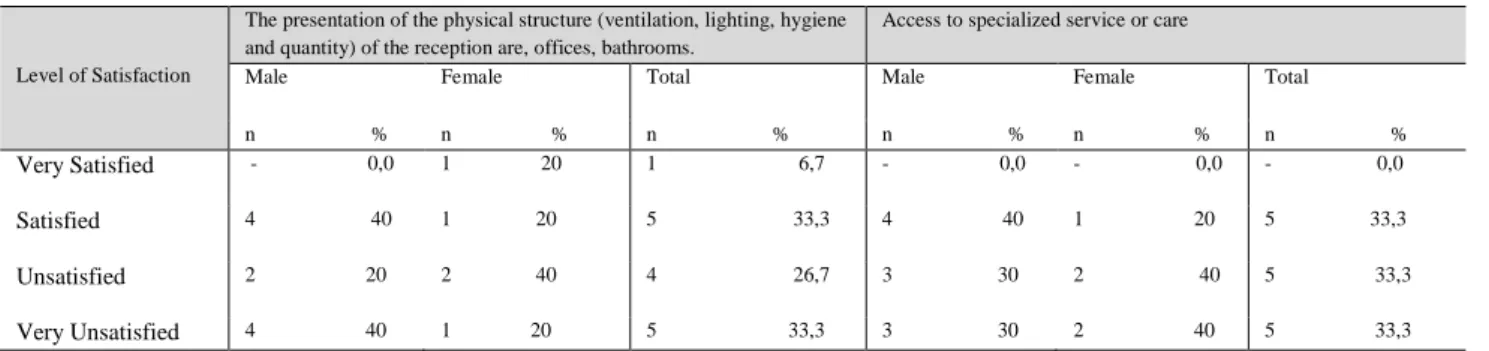
When questioned about the quality of care regarding the structure, responses remained at the level of high dissatisfaction: 60% are unsatisfied with the physical structures, as opposed to 33.3% who consider them satisfactory.
The following aspects were mostly evaluated as "very unsatisfied": the access to specialized services (66.6%) and the availability of drugs or materials and the presence of the interpreter, both with 33.3%.
The variation of the satisfaction level in relation to the physical structure may be due to the architectural changes that have occurred in recent years as well as the construction of the new basic health units within the parameters established in comparison with others in which compliance with the legal requirements has not yet occurred.
Table 2 - Satisfaction related to the quality of the assistance regarding the structure and specialized services
Level of Satisfaction
The presentation of the physical structure (ventilation, lighting, hygiene and quantity) of the reception are, offices, bathrooms.
Access to specialized service or care
Male Female Total Male Female Total
n % n % n % n % n % n %
Very Satisfied - 0,0 1 20 1 6,7 - 0,0 - 0,0 - 0,0
Satisfied 4 40 1 20 5 33,3 4 40 1 20 5 33,3
Unsatisfied 2 20 2 40 4 26,7 3 30 2 40 5 33,3
Very Unsatisfied 4 40 1 20 5 33,3 3 30 2 40 5 33,3
Satisfaction regarding quality of care in private institutions
There were reports of somewhat more qualified services among professionals in private services.
According to S3, the payment for the services assures better service. Both S1 and S14, when evaluating customer care of the public service, commented that the disrespect is evident. That is, even after they had explained that they were deaf, they were approached with apathy.
"I do not go to the health centre, I pay for an appointment and I get better customer service (S3)". "There are doctors who perform services well, and other who don't ... it depends (S14)". "You show that you are deaf and they laugh, they don't care, and signal you to wait. They don't respect the rights of the deaf. They call you as if you were a listener. And you wait without knowing if they've called you already (S1)".
4. DISCUSSION
The discussion begins by analysing the methodological options of the research. It is emphasized that sharing the results on a topic in which there is a knowledge gap based on the perception of deaf people, is a positive implication of qualitative research. Nonetheless, the implications and impact of the study matter to the social sphere of the particularity of the context studied because, despite the theoretical arguments that support the main results presented, the limitations underlying the methodological and research options of a qualitative nature should also be taken into account, namely n of the sample selection. As a positive element, resorting to the use of certified interpreters (selection criterion) so as to control any biases associated with the communication process and to validate the data interpreted from the participants (deaf people). The control status assigned to the filming that occurred during the data collection process is also highlighted, aiming to provide thoroughness to the data obtained and subsequent investigative inferences.
Farias, B. & Cunha, M. (2017). Satisfaction of deaf people with the health care system quality. Millenium, 2(4), 79-88.
m
4
86
Concerning the topic at hand, deaf people need more attention given the barrier in communication with the hearing society, which is becoming a health risk in this population (France, 2011).
Although they have their rights guaranteed by law, this does not appear to be the case in our sample as most respondents were very dissatisfied with the service of employees, reported lack of informative and educational materials, and were dissatisfied with the scheduling of appointments and delivery of test results.
In addition, the use of other resources for communicating with the hearing impaired was considered inadequate, exposing them to imminent risks in the diagnosis and consequent misconduct in the treatment (Araújo et al., 2015).
In the service-patient relationship, the intolerance of the professionals in dealing with the deaf population is worrisome and evidenced in the lack of patience and in directing the person accompanying the patient to collect information about his/her health status, as evidenced in the statement of S9.
This fact corroborates the influence of the normative ideology on interpersonal relations between professionals and the deaf person, described by McDonnell (2016), observed in the hostile behaviour in response to the deafness of the hearing society and the lack of consideration of intellectual abilities and promotion of autonomy/independence. "Everything takes
place very quickly, they talk to the person accompanying you, hand out the prescription and call another patient" (S9).
The lack of knowledge in sign language among health professionals generates, in most cases, a discomfort in communication between both parties and the dependence on family members and interpreters, thereby compromising respect for equity during customer care (Vianna et al., 2014).
In the absence of family members during an appointment, deaf people who do not have access to quality communication are often forced to hire interpreters as a result of professionals who are unprepared for this situation or health services that do not have one available. Thus, it is observed the non-compliance with the principles of universality evidenced by the lack of informative resources, as well as of the fairness evidenced in precarious communication (Costa et al, 2009), as stated by S5. "There is no interpreter, we pay every time. He does not know how to speak to the deaf (S5)."
If on the one hand communication is crucial for a better fulfilment of the health needs, the physical premises should be too, since both communication and the physical environment must provide therapeutic conditions that are favourable to the clients. The provision of health services within a suitable physical structure favours both the reception of the clientele as well as the better performance of the professionals who work there (Medeiros, Souza, Barbosa & Costa, 2010).
Still, in this study, there was a dissatisfaction among participants regarding this dimension, reflecting fragility in the principle of equality as a result of precariousness in the environment, as reported by S2, S8 and S4. Similar results were also observed by Castro et al. (2011), concluding that the weaknesses reported by people with disabilities violated the principle of fairness: "A hot place (S2)". "Small, crowded ... hot, hot (S8)". "Dirty, very dirty (S14)". Similar results were also observed by Castro et al. (2011), concluding that the impairments reported by people with disabilities violated the principle of equity. Regarding the principle of completeness, the satisfaction levels among participants was close regarding the quantity of medicine available in the services, access to specialized care and presentation of the physical structure. This may be associated with the existing variations in the supply of the assistance rendered, as well as with the possible construction of physical spaces adapted to the standards established by the existing technical norms.
Finally, results show a lack of compliance with the principles of the SUS, presenting as crucial weaknesses the lack of adequate communication and the precariousness of the clinical environment, which is of the utmost importance for the performance of a support focused on the promotion of the health and quality of life of the population in general and of the Deaf in relation to the particular assistance specificities that are intended to be inclusive.
CONCLUSIONS
The linguistic barrier observed among deaf and hearing people is characterized as one of the main difficulties faced by the deaf in the daily life of today's societies.
As an evaluation parameter of the perspective of this group of people, the following was used: the understanding of access to information, the quality of customer care and appointments, correlated with the principles of universality, completeness and equity of the Single Health System (SUS) in force in Brazil.
The collaboration of a certified interpreter in the communication process, validation of the data interpreted from the participants (deaf people) was assumed as a methodological strategy to impose rigor in the collection and treatment of data. However, in doing so, there is also a hypothetical source limitation associated with the risk of bias in the control of the results.
It should be noted that the deaf person's perception of the quality of the actions and health services provided justifies the study, whose qualitative approach made it possible to take a deeper look at the participants of this research concerning an important indicator for assessing health care fragility.
Farias, B. & Cunha, M. (2017).
Satisfaction of deaf people with the health care system quality. Millenium, 2(4), 79-88.
m
4
87
The present study allowed for the research questions to be answered, and it was verified that the participants are aware of the non-fulfilment of the right to access health in an egalitarian, impartial and integral way, since they manifest a high level of dissatisfaction with the quality of actions and services provided in the health facilities.
It was also found that little preparation to communicate with Deaf users manifests itself in the communication gap between service providers and Deaf users, as well as the unavailability of informative or educational resources combined with the hiring of interpreters directly by deaf patients to meet their needs, reflect an inoperativeness of the existing health policies and a deviation from the responsibility of the State regarding the security of full access to health services without loss or damages for this specific population.
It became clear that auditory limitation did not detract from the users' understanding of the quality of health actions and services that should be provided; on the contrary, the level of reported unsatisfaction expresses the existing challenge to achieve the complete care of people with special needs motivated by deafness in the public health system in Brazil. Only then will it be possible to promote the universality, completeness and equity of health services to people with special needs, such as the deaf person.
As final reflections on the research carried out, it is reiterated that from the beginning of the conceptualization of the study, there was the concern in developing a rigorous methodological work with clarification of the steps taken. Despite this carefulness, it is assumed that the low n of the sample constitutes a limitation in the present study. According to Cunha-Nunes (2006), these fragilities inherent to empirical studies with a cross-sectional matrix would be avoided had the sample been larger and if a study of a longitudinal nature were chosen. However, this was not possible due to time limitations in order for it to be carried out.
To conclude, it is emphasized that, although a comprehensive study was carried out, there is still a need for replication of the research in broader samples in order to understand whether the trend of the results encountered remains the same. This tells us that a uni-factorial study is too simplistic in understanding this problem, and that there is a need to research using multidimensional and multifactorial approaches. Considering the deaf person as a whole biopsychosocial, endowed with cultural and spiritual identity, an integrative design was tested that allowed to analyse the health care tendencies in Brazil according to the perspective of the users with special aid needs, deaf people. Hence, the positive aspects of the study should be emphasized, providing useful information to understand the multiple factors that influence the health care process and, consequently, satisfaction with health care, and thereby raise awareness and reflection on the quality of health services.
ACKNOWLEDGEMENTS
FCT, Portugal, CI&DETS, Superior School of Health, Polytechnic Institute of Viseu, Portugal; CIEC, Minho University, Portugal. This work is funded by national funds on behalf of FCT – Fundação para a Ciência e a Tecnologia, I.P., within the scope of project UID/Multi/04016/2016.
REFERENCES
Andrade, C. L., Fernandes, L., Ramos, H. E., Mendes, C. M. C., & Alves. C. A. D. (2013). Programa nacional de atenção à saúde auditiva: Avanços e entraves da saúde auditiva no Brasil. Revista Ciência Médica Biológica, 12(especial), 404-410. Retrieved from http://www.portalseer.ufba.br/index.php/cmbio/article/viewFile/9181/6749ADDIN
Araújo, C. C. J., Coura, A. S., França, I. S. X., Araújo, A. K. F. & Medeiros, K. K. A. S. (2015). Consulta de enfermagem às pessoas surdas: Uma análise contextual. ABCS Health Science, 40(1), 38-44. Retrieved from
https://www.portalnepas.org.br/abcshs/article/download/702/667
Capovilla, F. C., & Raphael, W. D. (2001) Dicionário enciclopédico ilustrado trilíngue: Língua de sinais Brasileira (2ª ed.). São Paulo: Edusp.
Castro, S. S., Lefèvre, F., Lefèvre, A. M. C., & Cesar, C. L. G. (2011). Acessibilidade aos serviços de saúde por pessoas com deficiência. Revista de Saúde Pública, 45(1), 99-105. Retrieved from http://www.scielo.br/pdf/rsp/v45n1/2073.pdf Costa, L. S. M., Almeida, R. C. N., Mayworn, M. C., Alves, P. T. F., Bulhões. P. A. M., & Pinheiro. V. M. (2009). O atendimento em
saúde através do olhar da pessoa surda: Avaliação e propostas. Revista Brasileira de Clínica Médica, 7, 166-170. Retrieved from http://files.bvs.br/upload/S/1679-1010/2009/v7n3/a166-170.pdf
Farias, B. & Cunha, M. (2017). Satisfaction of deaf people with the health care system quality. Millenium, 2(4), 79-88.
m
4
88
Dewes, J. O. (2013). Amostragem em bola de neve e respondet drivensampling: Uma descrição do método (Monografia de conclusão de curso, Universidade Federal do Rio Grande do Sul). Retrieved from
http://www.lume.ufrgs.br/bitstream/handle/10183/93246/000915046.pdf?sequence=1
Fadel, M. A. V. (2006). Percepção da qualidade em serviços públicos de odontologia: Um estudo de caso (Dissertação de Mestrado, Universidade Federal de Santa Catarina). Retrieved from
https://repositorio.ufsc.br/bitstream/handle/123456789/89078/228769.pdf?sequence=1
França, E. G. (2011). Atenção à saúde do surdo na perspectiva do profissional de saúde (Dissertação de mestrado, Universidade Federal da Paraíba). Retrieved from
http://bdtd.uepb.edu.br/tde_arquivos/14/TDE-2012-08-23T152220Z-139/Publico/Euripedes%20Gil%20de%20Franca.pdf
Lei nº 7.853/1989. (1989, Outubro 24). Dispõe sobre o apoio às pessoas portadoras de deficiência, sua integração social, sobre a Coordenadoria Nacional para Integração da Pessoa Portadora de Deficiência, Corde, institui a tutela jurisdicional de interesses coletivos ou difusos dessas pessoas, disciplina a atuação do Ministério Público, define crimes, e dá outras providências [Brasil]. Presidência da República, Casa Civil, Subchefia para Assuntos Jurídicos. Retrieved from http://www.planalto.gov.br/ccivil_03/leis/L7853.htm
Lei n.º 8.080/1990. (1990, Setembro 19). Dispõe sobre as condições para a promoção, proteção e recuperação da saúde, a organização e o funcionamento dos serviços correspondentes e dá outras providências [Brasil]. Presidência da República, Casa Civil, Subchefia para Assuntos Jurídicos. Retrieved from http://www.planalto.gov.br/ccivil_03/leis/l8080.htm.
McDonnell, P. (2016). Deficiência, surdez e ideologia no final do século XX e início do século XXI. Educação & Realidade, 41(3), 777-788. Retrieved from
http://www.scielo.br/scielo.php?script=sci_arttext&pid=S2175-62362016000300777&lng=pt&nrm=iso&tlng=pt
Medeiros, F. A., Souza, G. C. A., Barbosa, A. A. A., & Costa, I. C. C. (2010). Acolhimento em uma unidade básica de saúde: A satisfação do usuário em foco. Revista de Saúde Pública, 12(3), 402-413. Retrieved from http://www.scielo.org.co/pdf/rsap/v12n3/v12n3a06.pdf
Minayo, M. C. S., Deslandes, S. F., & Gomes, R. (Orgs.). (2011). Pesquisa social: Teoria, método e criatividade (30ª ed.). Petrópolis, RJ: Vozes.
Mottez, B. (2006 ). Les sourds existent-ils: Textes réunis et présentés par Andrea Benvenuto. Paris: L'Harmattan. Moura, M. C. (2000). O surdo: Caminhos para uma nova identidade. Rio de Janeiro: Revinter.
Nóbrega, J. D., Andrade, A. B., Pontes, R. J. S., Bosi, M. L. M., & Machado, M. M. T. (2012). Identidade surda e intervenções em saúde na perspectiva de uma comunidade usuária de língua de sinais. Ciência Saúde Coletiva, 17(3), 671-679. Retrieved from http://www.scielo.br/pdf/csc/v17n3/v17n3a13.pdf.
Pereira, O. R. (2013). Alunos surdos, Intérpretes de libras e professores: Atores em contato na universidade. Cadernos de Educação, 12(24), Retrieved from https://www.metodista.br/revistas/revistas-metodista/index.php/cadernosde educacao/article/viewFile/4914/4119
Ramos, D., Jorge, J. X., Teixeira, A., Ribeiro, C., & Paiva, A. (2015). Desenvolvimento da linguagem em crianças com implante coclear: Terá o gênero alguma influência? Revista CEFAC, 17(2), 535-541. Retrieved from
http://www.scielo.br/pdf/rcefac/v17n2/1982-0216-rcefac-17-02-00535.pdf
Santos, S. F., & Molon, S. I. (2014). Comunidade surda e língua Brasileira de sinais nos relatos de uma professora surda. Revista
Eletrônica de Educação, 8(2), 304-320. Retrieved from
http://www.reveduc.ufscar.br/index.php/reveduc/article/viewFile/800/340
Souza, I. P. S., Brito, R., Bento, R. F., Gomez, M. V. S. G., Tsuji, R. K., & Hausen-Pinna, M. (2011). Speech perception in adolescents with pre-lingual hearing impairment with cochlear implants. Brazilian Journal of Otorhinolaryngology, 7(2), 153-157. Retrieved from http://www.scielo.br/pdf/bjorl/v77n2/pt_v77n2a03.pdf
Vianna, N. G., Cavalcanti, M. L. T., & Acioli, M. D. (2014). Princípios de universalidade, integralidade e equidade em um serviço de atenção à saúde auditiva. Ciência e Saúde Coletiva, 19(7), 2179-2188. Retrieved from http://www.scielosp.org/pdf/csc/v19n7/1413-8123-csc-19-07-02179.pdf
Wilhelms, N. S. (2013). O Surdo além da deficiência (Monografia de conclusão de curso, Universidade de Brasília). Retrieved from http://bdm.unb.br/bitstream/10483/7163/1/2013_NayaradeSouzaWilhelms