Volume 40, Issue 4
Drivers of and Barriers to the SME Internationalisation Process in a Small
Open Economy
Ana Brochado
Instituto Universitário de Lisboa (ISCTE-IUL), DINÂMIA´CET – IUL
Carla Azevedo lobo
Universidade Portucalense, Research on Economics, Management and Information Technologies (REMIT) Luís Pacheco
Universidade Portucalense, Research on Economics, Management and Information Technologies (REMIT)
Isabel Maldonado
Universidade Portucalense, Research on Economics, Management and Information Technologies (REMIT)
Abstract
Small and medium-sized enterprises (SMEs) have actively increased their participation in international markets. This research's primary objective was to identify, based on 11 case studies, the main barriers to and drivers of the SME internationalisation process in a small open economy. Content analysis of in-depth interviews used Leximancer software to identify 7 themes that describe both internal and external barriers and 12 themes that characterise drivers, which were classified into five groups: SME human capital, technology, institutional support, networks and other drivers.
This work is supported by FEDER funds from COMPETE 2020 and Portuguese funds - PORTUGAL 2020. Project IEcPBI - Interactive Ecosystem for Portuguese Business Internationalization - POCI-01-0145-FEDER-032139
Citation: Ana Brochado and Carla Azevedo lobo and Luís Pacheco and Isabel Maldonado, (2020) ''Drivers of and Barriers to the SME Internationalisation Process in a Small Open Economy'', Economics Bulletin, Volume 40, Issue 4, pages 2932-2942
Contact: Ana Brochado - [email protected], Carla Azevedo lobo - [email protected], Luís Pacheco - [email protected], Isabel Maldonado - [email protected].
Submitted: August 22, 2020. Published: November 14, 2020.
1. Introduction
Small and medium-sized enterprises (SMEs) have actively increased their participation in international markets (Dominguez and Mayrhofer 2017). However, SMEs normally face more challenges during internationalisation than large companies do. SMEs have smaller market shares, weaker reputations, smaller economies of scale, fewer resources, less knowledge about international markets and less extensive integration into international networks compared with bigger firms. Nonetheless, both large companies and SMEs are active in international markets (Morais and Ferreira 2020).
SMEs’ internationalisation process has been examined in the literature from three main theoretical perspectives: the incremental, international entrepreneurship and network theories. The incremental perspective incorporates the Uppsala (Johanson and Vahlne 1977, Johanson and Wiedersheim 1975) and innovation models (Bilkey and Tesar 1977, Cavusgil 1980). According to this theoretical framework, the SME internationalisation process can be structured into steps. Companies take the next step when they perceive the risk as low level. Firms usually select entry markets characterised by geographic and/or cultural proximity with the home country.
The international entrepreneurship perspective explains the SME internationalisation process by relying on the born global (Knight and Cavusgil 1996) and international new ventures models (Oviatt and McDougall 1994). This conceptual framework seeks to understand the early internationalisation phases of SMEs that target various international markets. According to this theory, companies internationalise either in the early stages of their life cycle or after a sudden decision. Compared with more traditional perspectives, the international entrepreneurship approach assumes younger firms tend to be more committed to entering international markets and selecting more geographically dispersed entry markets. The last perspective relies on network theory (Coviello and Munro 1997), positing that SMEs seek to internationalise based on previously established business and social networks and formal and informal partnerships (Ibeh and Kasem 2011).
Because previous empirical research has provided support for all three theoretical perspectives, no single model yet exists that can explain the entire SME internationalisation process (Spence and Crick 2006). Researchers have thus called for a more holistic perspective that combines previous theories (Dominguez and Mayrhofer 2017). To fill this gap (Morais and Ferreira 2020) and contribute to the existing understanding of SMEs’ internationalisation, the present study sought to analyse this process based on various available approaches.
Previous research has confirmed that the SME internationalisation process is restricted by barriers (Korsakienė and Tvaronavičienė 2012) and encouraged by drivers (Morais and Ferreira 2020). Paul et al. (2017) classified SME internationalisation barriers as either internal (i.e. endogenous to SMEs) and external (i.e. beyond SMEs’ control) obstacles. The literature identifies different types of internal or endogenous barriers including the cost of starting the process (Korsakienė and Tvaronavicienė 2012), a lack of financial support (Vide et al. 2010), shortcomings in international experience (Sass 2012), limited knowledge about global markets (Cardoza et al. 2015), restricted skilled human resources (Sass 2012), small company size (Colapinto et al. 2015) and firm ownership structure (Pacheco 2017). The main external obstacles in the way of SME internationalisation are limited access to financial resources (Bellone et al. 2010), bureaucracy (Korsakienė and Tvaronavicienė 2012), regulations (Cardoza et al. 2015), tax burdens (Colapinto et al. 2015), inadequate institutional support (Narooz and Child 2017), high levels of competition in global markets (Korsakienė and Tvaronaviciene 2012) and different cultures and players in international markets (Hashim 2015).
Despite these barriers, multiple SMEs have internationalised their operations. After a systematic literature review, Morais and Ferreira (2020) concluded that human capital,
ownership structure and technology facilitate the internationalisation process. Svetlicic et al. (2007) maintain that SMEs’ competitive advantages, such as organisational structure and flexibility, close client relationships and technological know-how, are important drivers of these firms’ internationalisation. Although inadequate government support is considered a significant obstacle, Korsakienė and Tvaronavičienė (2012) also found that government support promotes SME internationalisation.
Following Paul et al.’s (2017) suggestions, the current research used qualitative methods centred around case studies and interviews of major actors engaged in SME internationalisation in order to explore this phenomena more fully. Korsakienė and Tvaronavičienė (2012) observe that SMEs’ challenges vary according to which countries are involved. The present study selected a small open economy as the research context. This kind of economy is characterised by an absence of large companies, so SMEs have limited opportunities to learn from benchmark companies. SMEs must deal with a small domestic market, which means the internationalisation process offers opportunities for growth despite fierce global competition (Kahiya 2020). More specifically, the current study addressed the following research questions:
− What are the main perceived drivers of SME internationalisation? − What are the main perceived barriers to SME internationalisation?
2. Methodology 2.1 Case studies
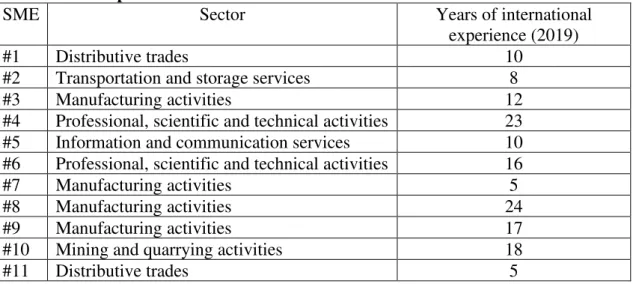
This study focused on Portugal, which is a small open economy in the eurozone located on Europe’s periphery (Kahiya 2020). Eurostat data reveal that the export and import of goods and services accounted for 43.5% and 43.3%, respectively, of Portugal’s gross domestic product in 2019. The SMEs that participated in the current research had their headquarters in Portugal’s North region, and these firms had sustained international activities for at least five years. The North region accounts for 38.4% of Portugal’s total exportation of goods. Most companies (99.8%) are SMEs (Banco de Portugal 2019). As in previous SME internationalisation studies conducted in Europe, SMEs were defined as companies with less than 250 employees. The SMEs that agreed to participate operate in varied industries with different technological intensities. Various members of the management teams responsible for internationalisation decisions provided the information analysed in this research (see Table 1).
Table 1. SMEs’ profile
SME Sector Years of international
experience (2019)
#1 Distributive trades 10
#2 Transportation and storage services 8
#3 Manufacturing activities 12
#4 Professional, scientific and technical activities 23 #5 Information and communication services 10 #6 Professional, scientific and technical activities 16
#7 Manufacturing activities 5
#8 Manufacturing activities 24
#9 Manufacturing activities 17
#10 Mining and quarrying activities 18
2.2 Research design
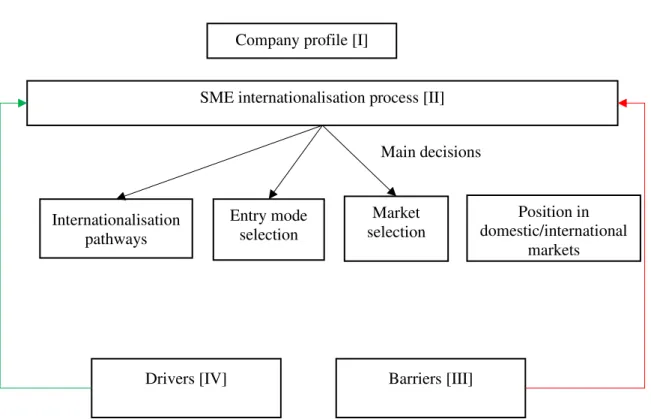
The data were collected through in-depth executive interviews conducted in each company’s management team office by a member of the research team. The interviews lasted on average for 60 minutes. All the participants agreed to an audio recording of the interviews, which were subsequently written out as full transcripts. The interview guide was structured into four parts or discussion topics (see Figure 1):
− Part I: Company profile in terms of sector and number of years of internationalisation − Part II: Internationalisation process, including internationalisation pathways, entry
mode, market selection and position in domestic and/or international markets − Part III: Barriers encountered during the internationalisation process
− Part IV: Drivers of the internationalisation process
Figure 1. Interview guide’s structure 2.3 Data treatment
Content analysis is a method used to process qualitative data. To identify the main barriers to and drivers of SME internationalisation, a mixed content analysis approach was employed to process the in-depth interviews’ transcripts in two steps. First, Leximancer software facilitated the identification of the main themes and concepts. This programme identified the presence of predefined concepts in texts (i.e. conceptual analysis) and the interrelationships between the concepts (i.e. relational analysis). The first step’s output was a concept map. Concepts that settled near one another on the map appeared together in the interviewees’ narratives.
As in previous studies using these methods (cf. Brochado et al. 2019), each theme was matched in the second step with a set of narratives extracted from the interview transcripts, which encompass the themes’ main concepts. Leximancer’s main advantage is thus that it offers an inductive identification of themes in natural language texts with minimal manual intervention by researchers (Brochado et al. 2019).
Company profile [I]
Market selection Entry mode selection Internationalisation pathways Drivers [IV]
SME internationalisation process [II]
Barriers [III] Main decisions
Position in domestic/international
3. Results
3.1 SME internationalisation process
This subsection describes the main results regarding the SME internationalisation process. The topics covered are internationalisation pathways, entry mode selection, market selection and position in domestic and international markets.
3.1.1 Internationalisation pathways
The great majority of the SMEs (number [n] = 10 out of 11) adopted a traditional pathway, structured into different steps. One SME manager explained that ‘[t]he company adopted an entry strategy applied in stages. In the initial phase, we selected a neighbouring market (i.e. Spain). Then, to cope with the subprime [mortgage] crisis, we started to export to France and Angola and more recently to Switzerland’ (SME #10). Another company’s representative reported that ‘[t]he company implemented an entry strategy in a series of steps in which market research was fundamental’ (SME #12). Only one of the companies adopted an early internationalisation pattern as ‘the company was created to target only the international market’ (SME #5).
3.1.2 Entry mode selection
Most of the firms (n = 8) entered external markets with direct and indirect export activities. Three companies exported their offers using a lower risk and cost entry mode, with 1 SME applying a contractual and/or franchising mode and 2 firms selecting an investment mode. An increased control of and proximity with clients were the main reasons for selecting entry modes that implied higher levels of commitment.
3.1.3 Market selection
Regarding their main external markets, the SMEs managers listed 28 countries located in Europe, Latin America, North America, Africa and Central Asia. The analysis of the interview data on the external markets’ selection revealed that multiple motives contributed to decisions, which can be grouped into nine factors:
1. Existing business relationships with partners in external markets (n = 6 companies) 2. External markets’ potential (n = 6) measured by market size and purchasing power 3. External markets’ attractiveness (n = 5), which includes low bureaucracy levels,
attractive fiscal conditions, countries’ political stability, low risk of terrorism and favourable commercial conditions
4. Experience and knowledge of the foreign markets’ board of trade (n = 2) 5. Competitive advantages of the company’s products (n = 2)
6. Geographical proximity (n = 1) 7. Cultural proximity (n = 1)
8. Technological proximity (n = 1) (i.e. the same technical specifications and standards) 9. Social relationships (n = 1) (i.e. word-of-mouth recommendations)
3.1.4 Positioning in domestic and international markets
External markets represent between 30% and 100% of the total turnover of the SMEs under study. Except for one company that only targets foreign markets, these firms adopted different positioning strategies in their domestic and external markets. One manager maintained that ‘[o]ur strategy is always to take a different approach in the domestic market and international market and even in each international market’ (SME #3). The main differences are related to the products, prices, distribution, sales approaches and sales teams.
3.2 Barriers to internationalisation process
Leximancer’s analysis of the respondents’ narratives focused on barriers to internationalisation identified 7 themes that can be put into 2 clusters: external and internal barriers. The evidence gathered though the interviews revealed that the main barriers to internationalisation faced by these SMEs are both exogenous (i.e. external) and endogenous (i.e. internal) to the company.
The external barriers cluster comprises the themes of bureaucracy, customs and clients (see Figure 2). The bureaucracy theme connects the concepts of bureaucracy, regulations, laws and tax burden. This theme highlights that the internationalisation process is limited by high levels of bureaucracy and taxes. As one SME manager reported, the main barriers to internationalisation are ‘legal issues, bureaucracy and high levels of uncertainty’ (SME # 9). The customs theme includes the concepts of customs, barriers and tariffs, which are linked to protectionism measures.
Figure 2. Main barriers to internationalisation process
Internal barriers
The clients theme encompasses the concepts of clients, quality and delivery and underlines the challenges presented by more demanding international clients. One interviewee’s company must deal with ‘the need to meet short delivery deadlines and high product quality requirements’ (SME #8), while another manager mentioned foreign exchange risks, mainly with African clients (SME #11). Another firm representative asserted that ‘[t]he international markets are more competitive. Clients demand higher quality and thus companies face higher risks in external markets than in domestic ones’ (SME #5).
The internal barriers cluster includes the themes of price, cost, process and knowledge (see Figure 2 above). The price theme comprises the concepts of price, competition, reputation and awareness. This theme describes SMEs’ challenges in international markets due to greater competition and smaller economies of scale. One company’s manager reported, the ‘low demand does not allow us to offer lower prices, and the lack of brand awareness and brand reputation [prevents us] from selling at higher prices’ (SME #7).
The cost theme brings together the concepts of cost, certification, transportation, innovation and investment. Thus, this theme appears to summarise the main costs of operating in international markets. As one SME’s representative shared, ‘the company has higher costs in international markets that decrease margins and profits’ (SME #9).
The process theme comprises the concepts of process, internationalisation, time, finance and case. This theme describes broader characteristics of the internationalisation process. A company manager reported that the main barrier early on was the difficulty of ‘obtaining financing’ (SME #2), and another interviewee mentioned ‘the time it takes to internationalise’ (SME #5).
The internationalisation process is also limited by cases of failure linked to the bankruptcy of both partners (SME #5) and clients (SME #8), which can put a strain on the companies’ financial resources. One company’s representative said, ‘a client went bankrupt and didn’t pay us’ (SME #8). Finally, the knowledge theme covers the concepts of knowledge and market. An SME manager identified a ‘lack of knowledge of the market and its players’ as a barrier (SME #9).
3.3 Drivers of internationalisation process
Leximancer’s analysis of the interviewees’ responses regarding drivers of the internationalisation process revealed 12 themes that can be grouped into five clusters: SME human capital, networks, technology, institutional support and other (drivers) (see Figure 3). The cluster SME human capital includes the themes of experience, global (mindset) and best (professionals). This group of themes describes how human capital (i.e. managers and staff) influences SMEs’ internationalisation.
The experience theme encompasses the concepts of experience, knowledge, manager, team, fluency and languages. The global theme includes the concepts of global (mindset), flexibility and social (capital). Both themes reflect the typical profiles of management teams and staff members engaged in internationalisation activities: international experience, specialist knowledge, involvement in international networks, accumulated social capital, fluency in different languages, global mentality and flexibility in terms of staying for long periods abroad. A company manager reported, ‘[t]he main characteristics the staff should exhibit are risk taking, language fluency (i.e. English) and international professional experience’ (SME #5). Another interviewee stated, ‘[t]he staff should be fluent in English, have the flexibility to travel and to stay for long periods abroad and have a global mindset’ (SME #4). A good illustration of the best (professionals) theme and concept was provided by one company’s representative, who asserted that ‘[t]he professionals involved in the
internationalisation … must be the best professionals that the company has, both at the professional level and in terms of personal characteristics’ (SME #11).
The networks cluster comprises the themes of partnership, network and information. The partnership theme includes the concepts of partnership, formal (partnership), informal (partnership), client, agent, distribution, logistics and recommendations. This theme identifies the main kinds of partnerships – formal and informal – that influence the internationalisation process, as well as the primary types of partners, and highlights recommendations as one of the ways to select and develop partnerships.
Figure 3. Main drivers of internationalisation process
The networks theme contains the concepts of network, business, connection and international. This theme identifies the main categories of networks established by SMEs:
business and social. A company manager shared, ‘I seek to have a close relationship with our business partners. … I try to get in contact once a month, and, each year, I visit our main business partners 1 or 2 times’ (SME #11).
The information theme combines the concepts of information, target, market, resources and access. This theme can be understood as comprising the networks’ results, namely, ‘obtaining specific market knowledge about the target markets’ (SME #9) and ‘gaining access to resources such as technology’ (SME #5).
The technology cluster covers the themes of information and communications technology (ICT) and digital(isation). The ICT theme includes the concepts of ICT, promotion, platform, relationship and/or proximity and software. The digital(isation) theme includes the concepts of digital(isation) and economy. Ten out the 11 company representatives felt ICT and digital business are crucial to the internationalisation process. Thus, one interviewee said, ‘ICT is of utmost importance for the digitalisation of the business process, including e-invoices’ (SME #3), and another mentioned ‘software for product management’ (SME #4). In addition, one manager stated, ‘ICTs have had an important role as they make reaching new markets a low cost venture’ (SME #10).
The institutional support cluster comprises the themes of institutional support, trade, embassy and projects. The institutional support theme includes the concepts of institutional (support), support, government and incentive. The trade theme contains the concept of trade fairs. A company manager reported, ‘[t]he [only] institutional support in the past was through participation in trade fairs’ (SME #1). Involvement in international trade fairs is seen as ‘an important activity [that allows firms] to express interest in developing contacts and identify potential commercial partners’ (SME #6) and to ‘join networks’ (SME #5).
The embassy theme includes the concepts of local (embassy) and embassy. A company representative shared that one of ‘the most important forms of institutional support is provided by local embassies’ (SME #3). The projects theme covers the concepts of projects, Agencia para o Investimento e Comercio Externo de Portugal (Portugal’s Agency for Investment and External Commerce) and Portugal2020. An SME representative said, ‘[t]he company has recently received support through Portugal2020 incentives, S[istema de] I[ncentivos] Inovação [(Incentives to Innovate)] and S[istema de] Incentivos Internacionalização [(Incentives to Internationalise)], which has helped us to develop new innovative production processes to reach new markets and to carry out prospecting in these markets’ (SME #9).
The other drivers cluster contains the theme of other drivers with the concepts of motivation, need and opportunity. For one of the interviewees, ‘[t]he main motivation to start the internationalisation process was the collapse of the national market due to the 2008 crisis, which forced the company to redefine its strategies to survive’ (SME #9).
4. Discussion
The results provide further support for the conclusion that SME internationalisation is a complex phenomenon, so multiple theories could be applicable. Most companies’ internationalisation process fits traditional theories (i.e. the incremental perspective), which assume that firms internationalise through a sequence of steps. However, for around 1 in 2 of the SMEs under study, existing networks and partnerships are of utmost importance in their internationalisation strategy, as predicted by the network perspective. The international entrepreneurship perspective applies to one company that adopted an early internationalisation approach, targeting only international markets.
With regard to the first research question (i.e. What are the main perceived barriers to SME internationalisation?), content analysis of the SME managers’ responses revealed seven
main themes. These barriers were further classified as either internal (i.e. endogenous) or external (i.e. exogeneous), which are the main categories of SME export activities identified by Paul et al. (2017). The internal barriers identified in the present research are in accordance with previous studies, including the cost of starting the internationalisation process (Korsakienė and Tvaronavicienė 2012), insufficient knowledge about international markets and their players (Cardoza et al. 2015), limited financial resources and the time needed to complete the internationalisation process (Vide et al. 2010).
Another challenge is offering competitive prices due to smaller economies of scale (Colapinto et al. 2015) and weaker reputations in international markets. The present study identified external obstacles that are also in accordance with previous research’s results including bureaucracy (Korsakienė and Tvaronavicienė 2012), customs barriers (Colapinto et al. 2015) and more demanding clients in international markets (Korsakienė and Tvaronaviciene 2012).
Regarding the second research question (i.e. What are the main perceived drivers of SME internationalisation?), content analysis highlighted 12 themes classified into 5 clusters, as follows: SME human capital, networks, technology, institutional support and other drivers. Two of these drivers match the results on SME internationalisation drivers found in the systematic literature review conducted by Morais and Ferreira (2020), who concluded that human capital and technologies facilitate the internationalisation process. Networks’ role is highlighted by network theory (Ibeh and Kasem 2011, Coviello and Munro 1997). Korsakienė and Tvaronavičienė (2012) concluded that the barriers faced by SMEs vary in accordance with their country of origin. The present results in this area differ from previous research (e.g. Paul et al. 2017) since institutional support is identified as a facilitator of the SME internationalisation process rather than as a barrier.
5. Conclusion
SMEs play a significant role in the economic development of nations, industries and productivity. Falk and Hagsten (2015) found that European SMEs that engage in internationalisation report a higher growth rate than those that only operate in their domestic market. Despite having fewer resources and smaller economies of scale than larger companies, SMEs offer their products in international markets and thus enter competitive marketplaces. The present study’s findings contribute to the literature on SME internationalisation by identifying the main barriers that restrict – and significant drivers that facilitate – internationalisation. This research comprised content analysis of 11 in-depth interviews with key SME actors from a small open economy.
The findings also have managerial implications. For SMEs that seek to internationalise, the empirical analysis’s results offer a guide to the most important components of the internationalisation process. The findings also benefit policymakers. As institutional support was identified by the SME managers interviewed as a facilitator of internationalisation, governmental programmes need to promote other drivers. These can include support for innovation (i.e. process, product and marketing) that allows SMEs to operate in competitive global markets, develop their firm’s human capital, promote digitalisation of business activities and strengthen participation in business networks (e.g. participation in trade fairs).
Future studies may want to analyse whether the drivers of and barriers to SME internationalisation vary according to the specific internationalisation pathway (i.e. early internationalisation or internationalisation in discrete steps). In addition, researchers could investigate whether these drivers and barriers vary according to SMEs’ sector. Another area that merits further research is to determine whether barriers and drivers vary according to the companies’ size (i.e. SMEs vs larger companies) and how synergies and knowledge sharing can be promoted.
References
Banco de Portugal (2019) “Análise das Empresas da Região Norte” Estudos da Central de Balanços 38. Retrieved from https://www.bportugal.pt/sites/default/files/anexos/pdf-boletim/estudos_da_cb_38_2019.pdf
Bellone, F., P. Musso, L. Nesta, and S. Schiavo (2010) “Financial Constraints and Firm Export Behaviour” World Economy 33(3), 347-73.
Bilkey, W.J. and G. Tesar (1977) “The Export Behavior of Smaller-sized Wisconsin Manufacturing Firms” Journal of International Business Studies 8(1), 93-8.
Brochado, A., P. Rita, C. Oliveira, and F. Oliveira (2019) “Airline Passengers’ Perceptions of Service Quality: Themes in Online Reviews” International Journal of Contemporary Hospitality Management 31(2), 855-73.
Cardoza, G., G. Fornes, V. Farber, R.G. Duarte, and J.R. Gutierrez (2015) “Barriers and Public Policies Affecting the International Expansion of Latin American SMEs: Evidence from Brazil, Colombia, and Peru” Journal of Business Research 69(6), 2030-9.
Cavusgil, S.T. (1980) “On the Internationalization Process of Firms” Journal of International Business Studies 8(6), 273-81.
Colapinto, C., L. Gavinelli, M. Zenga, and A. Di Gregorio (2015) “Different Approaches to the Pursuit of Internationalization by Italian SMEs” Journal of Research in Marketing and Entrepreneurship 17(2), 229-48.
Coviello, N. and H. Munro (1997) “Network Relationships and the Internationalisation Process of Small Software Firms” International Business Review 6(4), 361-86.
Dominguez, N. and U. Mayrhofer (2017) “Internationalization Stages of Traditional SMEs: Increasing, Decreasing and Re-increasing Commitment to Foreign Markets” International Business Review 26(6), 1051-63.
Falk, M. and E. Hagsten (2015) “Export Status and Firm Growth of European SMEs” Economics Bulletin 35(2), 1330-8.
Hashim, F. (2015) “SMEs’ Impediments and Developments in the Internationalization Process: Malaysian Experiences” World Journal of Entrepreneurship, Management and Sustainable Development 11(2), 100-19.
Ibeh, K. and L. Kasem (2011) “The Network Perspective and the Internationalization of Small and Medium Sized Software Firms from Syria” Industrial Marketing Management, 40(3), 358-67.
Johanson, J. and J.E. Vahlne (1977) “The Internationalization Process of the Firm – a Model of Knowledge Development and Increasing Foreign Market Commitments” Journal of International Business Studies 8(1), 23-32.
Johanson, J. and P. Wiedersheim (1975) “The Internationalization Process of the Firm – Four Swedish Case Studies” Journal of Management Studies 12(3), 305-23.
Kahiya, E.T. (2020) “Context in International Business: Entrepreneurial Internationalization from a Distant Small Open Economy” International Business Review 29(1), 101621.
Knight, G.A. and S.T. Cavusgil (1996) “The Born Global Firm: A Challenge to Traditional Internationalization Theory” Advances in International Marketing 8, 11-26.
Korsakienė, R. and M. Tvaronavičienė (2012) “The Internationalization of SMEs: An Integrative Approach” Journal of Business Economics and Management 13(2), 294-307. Morais, F. and J. Ferreira (2020) “SME Internationalisation Process: Key Issues and Contributions, Existing Gaps and the Future Research Agenda” European Management Journal 38, 62-77.
Narooz, R. and J. Child (2017) “Networking Responses to Different Levels of Institutional Void: A Comparison of Internationalizing SMEs in Egypt and the UK” International Business Review 26(4), 683-96.
Oviatt, B.M. and P.P. McDougall (1994) “Toward a Theory of International New Ventures” Journal of International Business Studies 25(1), 45-64.
Pacheco, L. (2017) “Internationalization vs. Family Ownership and Management: The Case of Portuguese Wine Firms” International Journal of Wine Business Research 29(2), 195-209. Paul, J., S. Parthasarathy and P. Gupta (2017) “Exporting Challenges of SMEs: A Review and Future Research Agenda” Journal of World Business 52(3), 327-42.
Sass, M. (2012) “Internationalisation of Innovative SMEs in the Hungarian Medical Precision Instruments Industry” Post-communist Economies 24(3), 365-82.
Spence, M. and D. Crick (2006) “A Comparative Investigation into the Internationalisation of Canadian and UK High-tech SMEs” International Marketing Review 23(5), 524-48.
Svetlicic, M., A. Jaklic, and A. Burger (2007) “Internationalization of Small and Medium-size Enterprises from Selected Central European Economies” Eastern European Economics 45(4), 36-65.
Vide, R.K., V. Bobek, V. Cancer, I. Perko, and L. Hauptman (2010) “The Efficiency of Entrepreneurship Policy Support for the Internationalisation of SMEs: The Case of Slovenia European Journal of International Management 4(6), 644-64.