FEDERAL UNIVERSITY OF UBERLÂNDIA
INSTITUTE OF LANGUAGE AND LINGUISTICS
UNDERGRADUATE PROGRAM IN TRANSLATION
CECÍLIA FRANCO MORAIS
THE INFLUENCE OF DOMAIN KNOWLEDGE ON SIMULTANEOUS
INTERPRETING TASKS PERFORMED BY STUDENTS:
An exploratory study of the interpreting process
Uberlândia/MG
CECÍLIA FRANCO MORAIS
THE INFLUENCE OF DOMAIN KNOWLEDGE ON SIMULTANEOUS
INTERPRETING TASKS PERFORMED BY STUDENTS:
An exploratory study of the interpreting process
Senior thesis submitted in partial fulfillment of the requirements for Bachelor of Translation at the Federal University of Uberlândia.
Advisor: Prof. Dr. Igor A. Lourenço da Silva
Uberlândia/MG
CECÍLIA FRANCO MORAIS
THE INFLUENCE OF DOMAIN KNOWLEDGE ON SIMULTANEOUS
INTERPRETING TASKS PERFORMED BY STUDENTS:
An exploratory study of the interpreting process
Senior thesis submitted in partial fulfillment of the requirements for Bachelor of Translation at the Federal University of Uberlândia.
Evaluation Committee:
Prof. Dr. Igor Antônio Lourenço da Silva – UFU Advisor
Profa. Dra. Marileide Dias Esqueda – UFU Member
Profa. Dra. Camila Tavares Leite – UFU Member
ACKNOWLEDGMENTS
A big thanks:
To my family (my mother, Arcila; my father, Gilson; my sister, Camila; and my
brother, Fernando), for always helping me overcome the difficulties these last years
brought me. We have entered this journey together. And we are together now, more
than ever. You all will always be in my heart.
To my companion, Claiton, who has appeared along the way and made me see the
world with different eyes. Thanks for all the happiness you have made me feel.
To my friends, the ones I had before entering the program, and the ones I have made
as the years passed by. You have made me feel like I can do anything I want.
To all the professors of the undergraduate program in Translation of the Federal
University of Uberlândia. You have helped me remove rust from my brain and
opened this beautiful Translation world to me.
To my advisor, Igor Antônio Lourenço da Silva, for stretching my brain even more at
the end of this crazy road.
To professor Marileide, who has presented me interpreting, a dream that will
someday come true.
The greater our knowledge increases the more our ignorance unfolds.
ABSTRACT
This senior thesis aims to analyze the role that domain knowledge—as both declarative knowledge and procedural knowledge—plays on the performance and understanding of simultaneous interpreting tasks performed by translation students.
The participants of this study were students from two classes of the undergraduate
program in Translation of the Federal University of Uberlândia. A questionnaire was
applied to assess whether the students’ beliefs about simultaneous interpreting changed after they had acquired theoretical and practical training to perform
simultaneous interpreting tasks. Recordings of a simultaneous interpreting session
were analyzed to assess whether domain knowledge had an impact on the cognitive
effort of the students as measured through six cognitive effort markers, namely:
(a) omissions, (b) additions, (c) head starts, (d) pauses, (e) meaning errors, (f) and
logical-time sequence errors. The software Sanako 9.3 was used to record the interpreting sessions, and the software ELAN 5.2 was used to analyze these data from the recordings. The results point out that some of the beliefs changed
(i.e., regarding the role of interpreter’s training, the importance of domain knowledge
to the interpreter’s performances), while others did not (e.g., regarding the need for a
special gift to perform an interpreting task). The results also indicate that the
students’ declarative knowledge and procedural knowledge changed after they had
received theoretical and practical training in simultaneous interpreting. However, it
was not sufficient to help them find interpreting strategies to avoid a high level of
cognitive effort, which eventually ended up with several errors and problematic
renditions in the target language. This research contributes to both translation
process research and simultaneous interpreter training.
RESUMO
Esta monografia tem como objetivo analisar o papel que o conhecimento de
domínio, em termos tanto de conhecimento declarativo quanto de conhecimento
procedimental, exerce na compreensão e no desempenho de estudantes de
tradução ao realizarem tarefas de interpretação simultânea. Os participantes desta
pesquisa são estudantes de duas turmas do Curso de Graduação em Tradução da
Universidade Federal de Uberlândia. Aplicou-se um questionário para avaliar se as
crenças dos alunos sobre interpretação simultânea mudaram após formação teórica
e prática em interpretação simultânea. Também foram realizadas gravações de
sessões de interpretação simultânea para avaliar se o conhecimento de domínio
exerceu alguma influência no esforço cognitivo dispendido pelos estudantes durante
a sessão de interpretação simultânea. O esforço cognitivo foi medido considerando
as variáveis: (a) omissão, (b) adição, (c) décalage, (d) pausa, (e) erros de significado e (f) erros de sequência lógico-temporal. O software Sanako 9.3 foi usado para gravar as sessões de interpretação, e o software ELAN 5.2 foi usado para analisar os dados das gravações. Os resultados apontam que algumas crenças mudaram
(i.e., aquelas relacionadas ao papel da formação de intérpretes e à importância do conhecimento de domínio para o desempenho de intérpretes), enquanto outras
permaneceram (e.g., a necessidade de se possuir um dom especial para a realização de uma tarefa de interpretação). Os resultados também indicam
mudanças nos conhecimentos declarativo e procedimental dos alunos após o
recebimento de formação teórica e prática sobre interpretação simultânea. Porém, o
conhecimento adquirido não foi suficiente para ajudá-los a encontrar estratégias de
interpretação que evitassem um alto nível de esforço cognitivo, o que acabou se
revelando diversos erros e em um discurso com segmentos problemáticos na
língua-alvo. Esta pesquisa contribui tanto para a área dos estudos processuais da tradução
quanto para a formação de futuros intérpretes simultâneos.
LIST OF GRAPHS
Graph 1 – The role students think courses and events about simultaneous
interpreting play on simultaneous interpreters’ training. ... 35
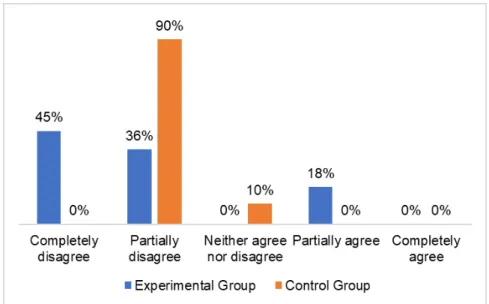
Graph 2 – Statement 17a: A good simultaneous interpreter is someone who has a special gift to perform this task. ... 37
Graph 3 – Statement 17i: A good simultaneous interpreter must have good knowledge of the speech’s theme to perform adequately. ... 39 Graph 4 – Statement 17j: The simultaneous interpreter who has good knowledge of the of theme resorts to fewer interpreting strategies. ... 40
Graph 5 – Statement 17k: The simultaneous interpreter who has good knowledge of the speech theme solves interpreting problems more easily than the one who does not know anything about the theme. ... 40
Graph 6 – Statement 17l: A cardiologist who masters a foreign language will perform a better simultaneous interpreting of a Cardiology conference... 41
Graph 7 – Statement 17m: The quality of the simultaneous interpreting of a Cardiology conference performed by a cardiologist who masters the foreign language will be superior to that performed by an interpreter. ... 42
Graph 8 - The role students think courses and events about simultaneous
interpreting pay on simultaneous interpreters’ training. ... 43
Graph 9 – Statement 17a: A good simultaneous interpreter is someone who has a special gift to perform this task. ... 44
Graph 10 – Statement 17c: A good simultaneous interpreter is someone who has lived in some country that speaks the foreign language involved in the interpreting task. ... 45
Graph 11 – Statement 17d: A good simultaneous interpreter is someone who has linguistic knowledge of both the mother tongue and the foreign language ... 45
Graph 12 – Statement 17i: A good simultaneous interpreter must have good
knowledge of the speech’s theme to perform adequately. ... 46
Graph 13 – Statement 17j: The simultaneous interpreter who has good knowledge of the speech theme s/he resorts to fewer interpreting strategies. ... 47
Graph 14 – Statement 17k: The simultaneous interpreter who has good knowledge of the speech theme solves interpreting problems more easily than the one who does not know anything about the topic. ... 48
Graph 15 – Statement 17l: A cardiologist who masters a foreign language will interpret simultaneously a Cardiology conference more easily than an interpreter. .. 49
Graph 16 – Statement 17m: The quality of the simultaneous interpreting of a Cardiology conference performed by a cardiologist who masters the foreign language will be superior to that performed by an interpreter. ... 50
LIST OF TABLES
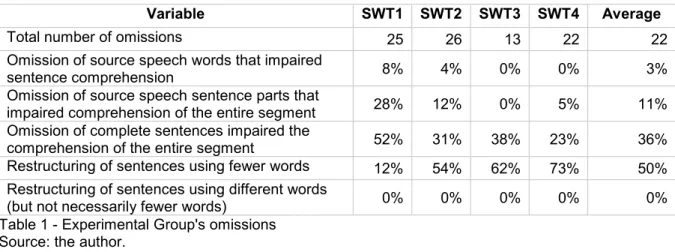
Table 1 - Experimental Group's omissions ... 51
Table 2 - Experimental Group's additions ... 52
Table 3 - Experimental Group's head start ... 52
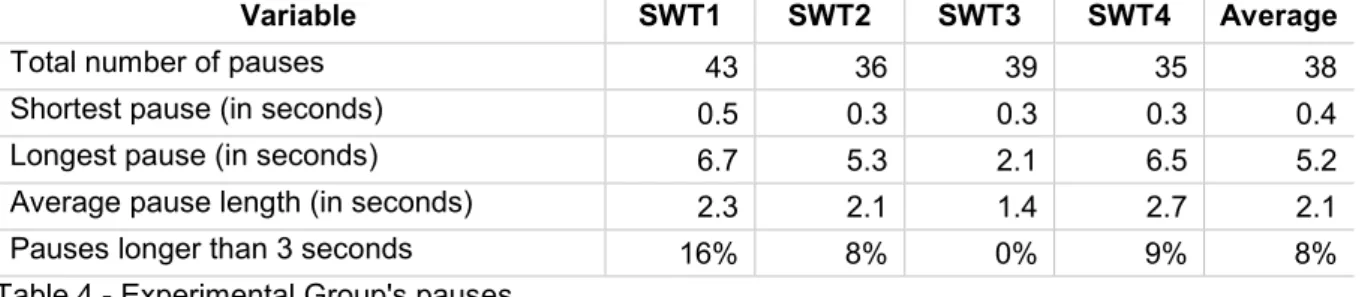
Table 4 - Experimental Group's pauses ... 53
Table 5 - Experimental Group's meaning errors ... 54
Table 6 - Experimental Group's logical-time sequence errors ... 54
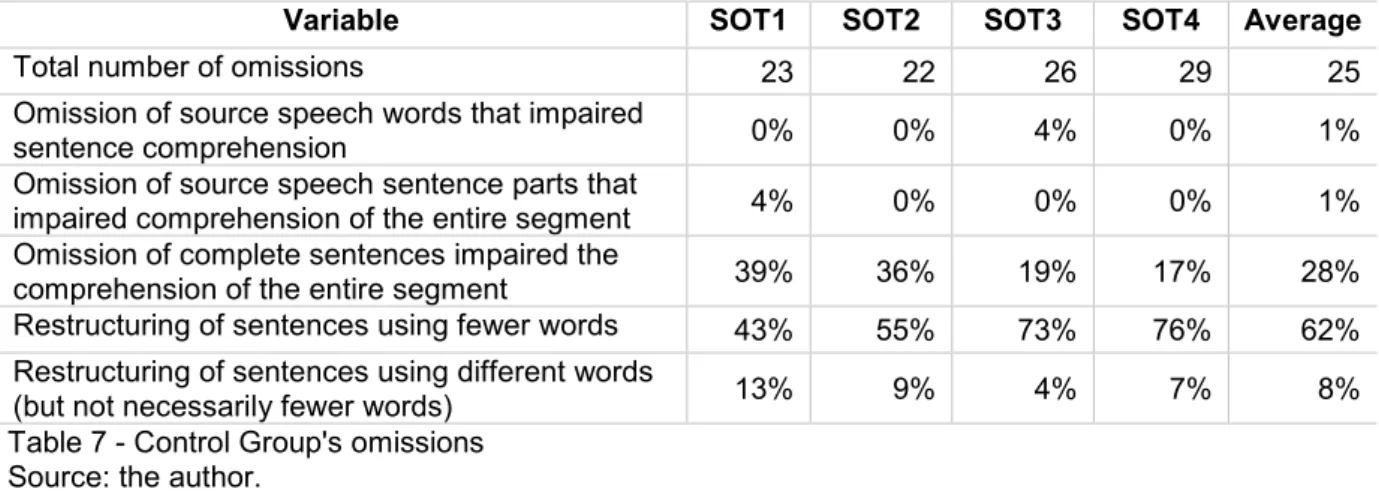
Table 7 - Control Group's omissions ... 56
Table 8 - Control Group's additions ... 57
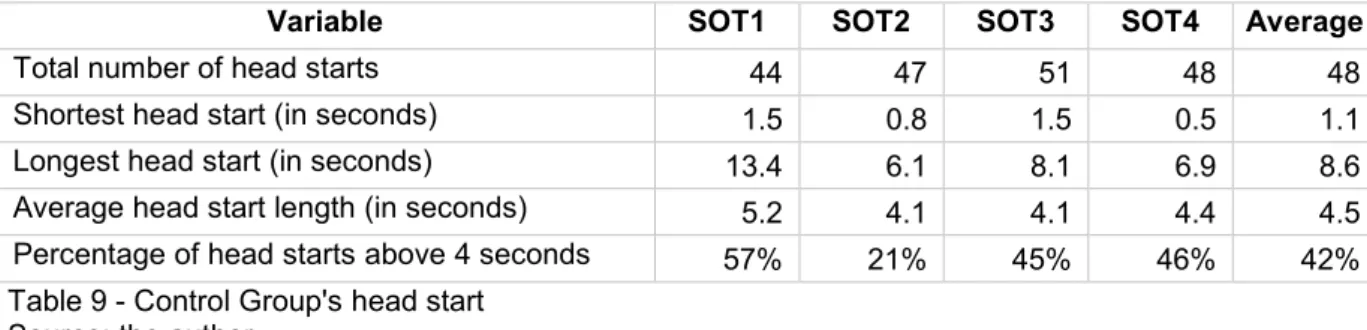
Table 9 - Control Group's head start ... 57
Table 10 - Control Group's pauses ... 58
Table 11 - Control Group's meaning errors ... 59
Table 12 - Control Group's logical-time sequence errors ... 59
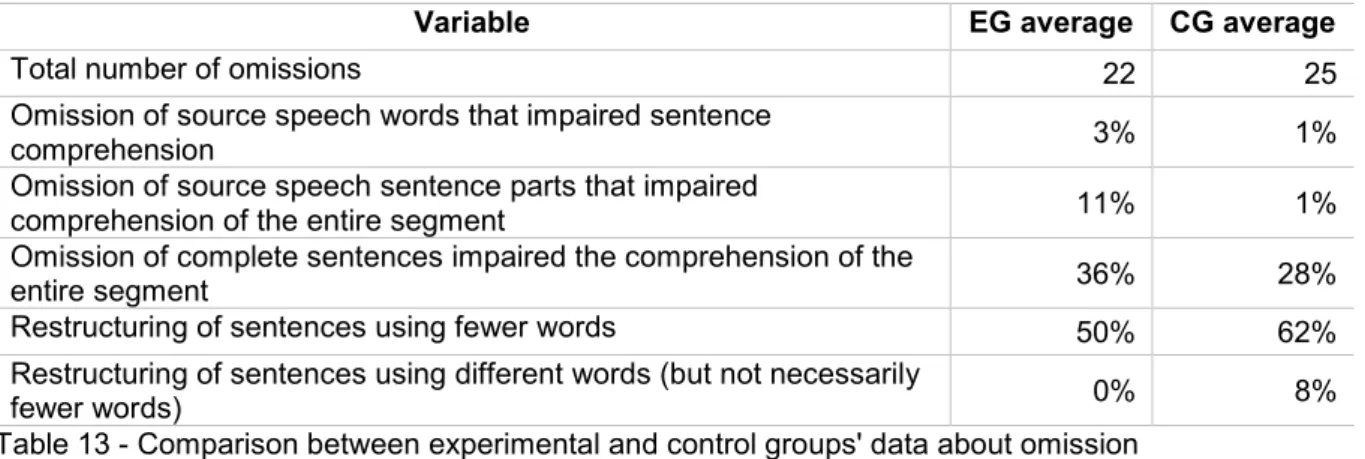
Table 13 - Comparison between experimental and control groups' data about omission ... 60
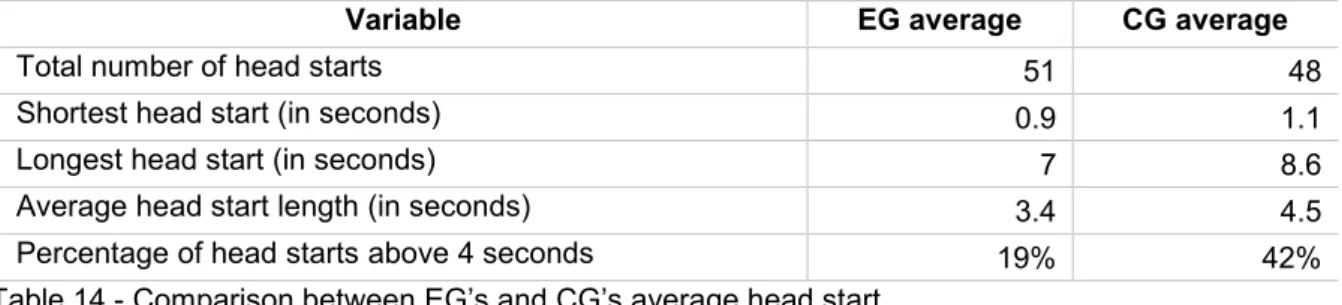
Table 14 - Comparison between EG’s and CG’s average head start ... 63
Table 15 - Comparison between EG’s and CG’s average pauses ... 63
TABLE OF CONTENTS
1 INTRODUCTION ... 10
2 REVIEW OF THE LITERATURE ... 13
2.1 Translation and Interpreting ... 13
2.2 Interpreting Modes and Types ... 14
2.3 Translation Process Research and Domain Knowledge ... 16
2.4 Students’ Beliefs ... 18
2.5 Problem Triggers and Markers of Cognitive Effort ... 19
2.5.1 Omission ... 21
2.5.2 Addition ... 21
2.5.3 Head Start ... 22
2.5.4 Pause ... 23
2.5.5 Meaning error ... 23
2.5.6 Logical-time sequence error ... 23
3 METHODOLOGY ... 25
3.1 Data Collection ... 25
3.2 Data Analysis ... 28
4 DATA ANALYSIS ... 33
4.1 Analysis of Questionnaires ... 33
4.1.1 Experimental Group’s profile ... 33
4.1.2 Control Group’s profile ... 34
4.1.3 Comparison of beliefs and domain knowledge before and after formal training ... 34
4.1.4 Comparison between EG’s and CG’s profile, beliefs and domain knowledge .. 42
4.2 Analysis of the Interpreting Task ... 50
4.2.1 Experimental Group’s data ... 50
4.2.2 Control Group’s data ... 56
4.2.3 Comparison between Experimental Group and Control Group ... 60
5 FINAL REMARKS ... 68
REFERENCES ... 74
1 INTRODUCTION
The simultaneous interpreters’ ability to listen to a speech in one language and, nearly at the same time, re-express it in another language is something that
intrigues not only laymen, but also practitioners and researchers from different
disciplines, including the Translation Studies, the Language Studies, Cognitive
Psychology, and Neuroscience. Such researchers have been trying to account for
this phenomenon by building on assumptions and methods from their own domain
areas.
A research field interested in this phenomenon of listening to a speech in one
language, mentally translating it and retelling it in another language at nearly the
same time is Translation Process Research (TPR). One of the aspects analyzed in
this field is the impact domain knowledge has on simultaneous interpreters’ performance, especially when it comes to cognitive effort (TISELIUS; JENSET, 2011;
TIMAROVÁ, 2010; TISELIUS, 2013).
Translation process research is a growing field within the Translation Studies
(e.g., MEES; ALVES; GÖPFERICH, 2009; GÖPFERICH; ALVES; MEES, 2010;
TIMAROVÁ, 2010; SHREVE; ANGELONE, 2010; ALVSTAD; HILD; TISELIUS, 2011;
TISELIUS, 2013; ALVES, 2015). According to Alves (2003, p. 72), this field has
shown significative advances in the last years, but it still has several gaps to address.
By drawing on TPR and carrying out applied, exploratory, empirical research
(HALE; NAPIER, 2013), this senior thesis investigates the performance of four
translation students who assumedly acquired domain knowledge in simultaneous
interpreting1 as compared to four students who do not have such knowledge. As
such, this study is not focused on the interpreting product itself, but rather on the
processes underlying an interpreter’s delivery (ALVES, 2003).
Such study builds on the assumption that interpreters should have broad
knowledge of the topic of the session they are about to interpret, that is, interpreters
should have not only linguistic knowledge, but also, and most importantly, domain
knowledge (LIU; SCHARLLERT; CARROLL, 2004). According to Hambrick and
Engle (2002), “domain knowledge is the primary determinant of success in cognitive
1 These students have had only one course on this topic during the whole undergraduate program.
endeavors”, such as interpreting. Therefore, the findings of this study may provide professional interpreters with empirical data to support their requests for preparation
time and consulting material from their clients.
Incidentally, this study can also contribute to interpreter training. Learning
provides new knowledge, which in turn can change the interpreters’ beliefs about their work and, consequently, can help them find better interpreting strategies, make
better deliveries and expend less cognitive effort during a work session. According to
Farrington-Darby and Wilson (2006, p. 28), “the more we understand how people perform (their limitations and capabilities) and what factors affect performance (either
positively or negatively), the more we can shape performance through good design of
systems, jobs, training etc [sic].”
The general objective of this senior thesis is to analyze the role that domain
knowledge—including both declarative knowledge (assessed through questionnaires) and procedural knowledge (assessed through recordings of a simultaneous
interpreting session)—plays on the performance and understanding of simultaneous interpreting tasks. Two specific objectives were established, namely:
1. To assess whether students’ beliefs about simultaneous interpreting change after they acquire theoretical and practical training to perform
simultaneous interpreting tasks; and
2. To assess whether domain knowledge has an impact on the cognitive
effort of translation students during a simultaneous interpreting session, by
analyzing their (a) omissions, (b) additions, (c) head starts, (d) pauses,
and (e) meaning errors and (f) logical-time sequence errors.
Such objectives ended up with the following research questions:
1. Are the beliefs about simultaneous interpreting different between students
who acquired domain knowledge of simultaneous interpreting and
students who did not?
2. Is the cognitive effort of translation students who acquired domain
knowledge of simultaneous interpreting different from that of students
without such knowledge while performing a simultaneous interpreting
session?
1) There are differences between the beliefs about simultaneous
interpreting held by students before and after receiving theoretical and
practical training in simultaneous interpreting; and
2) Domain knowledge acquired through formal training has a positive
impact in decreasing the cognitive effort of translation students during a
simultaneous interpreting session.
This thesis is divided into five chapters, including this Introduction. Chapter 2
presents a review of the literature relevant to the topics under scrutiny. Chapter 3
describes the methodology used to collect and analyze the data. Chapter 4 provides
an analysis of the data collected through questionnaires and recordings, as well as
briefly discusses the findings based on the literature. Chapter 5 provides some final
2 REVIEW OF THE LITERATURE
2.1 Translation and Interpreting
Translation and Interpreting are different areas within Translation Studies.
Translation refers to written texts, while interpreting refers to oral texts (LEDERER,
2003). However, they share the same purpose:
The main purpose of both translation and interpreting is to transfer [sic] a message expressed in a certain language to another language, so it can be understood by a community that does not speak the language in which this message was originally produced. (PAGURA, 2003, p. 223)2
Both translators and interpreters are supposed to fully master both languages
involved in the process and the topic of the text to be translated or interpreted
(PAGURA, 2003). In addition, both activities are supposed to be performed by
“professionals capable of understanding and articulating ideas related to several
different areas of human knowledge”3 (PAGURA, 2003, p. 224). Therefore,
translators and interpreters are supposed to be constantly updated about the domain
areas with which they work and be in touch with experts in these areas.
Despite such similarities, interpreting and translation are indeed different
from each other in several aspects. During the translation task, translators have time
to search dictionaries, glossaries and other external support, while interpreters have
time only to search their memories (VIANNA, 2006). To compensate the lack of time
to search in external resources during the interpreting task, interpreters are supposed
to master both source and target languages and cultures, as well as the topic of the
speech, even more than translators do (PAGURA, 2003). This is why interpreters
should study the topic of the speech to prepare themselves before an interpreting
session.
Unlike translators, interpreters have no time to review the target speech.
Interpreters need to analyze the content of the source message and re-express it in
the target language, with all its sentences connected and within the conventions of
the target culture, a few minutes (or seconds) apart from the utterance of the source
2 My translation to: “O propósito principal tanto da tradução quanto da interpretação é fazer com
que uma mensagem expressa em determinado idioma seja transposta [sic] para outro, a fim de ser compreendida por uma comunidade que não fale o idioma em que essa mensagem foi originalmente concebida” (PAGURA, 2003, p. 223).
3 My translation to: “ser realizadas por profissionais capazes de compreender e expressar idéias
speech (PAGURA, 2003). Therefore, interpreters should have the ability to
concentrate and tie together all the pieces of the source speech.
Another difference, according to Vianna (2006), is that translators have
access to the entire source text at once, which does not happen in interpreting.
Interpreters only have access to new text material while the speaker is uttering
his/her speech. As a result, especially in simultaneous interpreting, it is the speaker,
rather than the interpreter, who sets the target speech production rhythm. Besides,
while performing his/her delivery, an interpreter can only have access to what s/he
has retained in the memory while listening to the speaker. This explains why
interpreters do not say every word the speaker says and end up omitting much more
and more frequently than translators do.
An advantage interpreters have in relation to translators is their immediate
access both to the author of the source speech and to the target audience.
Translators, most of the time, do not know to whom they are translating to, and
therefore they are not as capable of inferring the relevance of their translation as
interpreters are.
2.2 Interpreting Modes and Types
There are different interpreting modes and types. According to Pagura
(2003), the interpreting modes are: consecutive, simultaneous, and liaison
interpreting.
In the consecutive mode, interpreters listen to and takes notes of a relatively long speech before taking the turn to re-express the speech in the target language. It
generally happens in events that convene a small group of people and involve only
two languages. This is the mode interpreter trainers use to develop “the techniques that are going to be fundamental to the performance of simultaneous [interpreting],
such as the ability to understand and analyze the source speech” (PAGURA, 2003, p. 211)4
In the liaison mode, interpreters sit next to the listener and interpret short sentences, to both native and foreign languages, alternating their delivery with the
4 My translation to: “as técnicas que serão fundamentais para o desempenho da [interpretação]
speaker’s speech. It is usually performed during small meetings and by untrained people (PAGURA, 2003).
In the simultaneous mode,
Interpreters—always in pairs—work isolated within a glass booth, so that they can see the speaker and listen to his/her speech through headphones. They process the message and re-express it in the target language through a microphone connected to a sound system that takes their speech to the listeners, who listen to it through headphones or receptors similar to portable radios. This mode allows for translating [sic] the message to an infinite number of languages at the same time, as long as the equipment is capable of doing so. (PAGURA, 2003, p. 211)5
In performing simultaneous interpreting, while interpreters are making their
delivery in the target language, they need to pay attention to the next unit of sense6
that will be uttered by the speaker or they will incur the risk of not being able to
express it right after. This is a triple process, as described by Lederer (2003), in
which the three steps (i.e., listening to a unit of sense, deverbalizing7 its linguistic
form, and re-expressing it in the target language) happen simultaneously. Liu,
Scharllert and Carroll (2004, p. 37) state “it is the act of temporarily switching attention from an unfinished utterance to an incoming message that makes the task
of simultaneous interpreting so different from what we are used to in our usual mode
of verbal communication”.
Simultaneous interpreting has become an object of research exactly because
it is an unusual act. Ericsson (2000) reports several studies on expertise in
simultaneous interpreting (e.g., CHERNOV, 1979; DILLINGER, 1989, 1994; GERVER, 1974; GERVER et al., 1984). He points out that most of them aim to
analyze only the characteristics of the target speech produced, that is, the
interpreting product, usually by comparing the professional interpreters’ performance to that of bilinguals and/or novice interpreters.
Interpreting can also be classified according to where it is performed and to
its objective (PAGURA, 2003). This results in the so-called interpreting types, such as
5 My translation to: “os intérpretes – sempre em duplas – trabalham isolados numa cabine com
vidro, de forma a permitir a visão do orador e recebem o discurso por meio de fones de ouvido. Ao processar a mensagem, re-expressam-na na língua de chegada por meio de um microfone ligado a um sistema de som que leva sua fala até os ouvintes, por meio de fones de ouvido ou receptores semelhantes a rádios portáteis. Essa modalidade permite a tradução [sic] de uma mensagem em um número infinito de idiomas ao mesmo tempo, desde que o equipamento assim o permita” (PAGURA, 2003, p. 211).
6 Defined as “what results from this fusion of the semanticisms of words and cognitive inputs”
(LEDERER, 2003, p. 18).
7 Defined as “immediate and deliberate abandonment of words and retention of the mental
community interpreting, court interpreting, conference interpreting, medical
interpreting, and escort interpreting. Interpreting types may be performed in any
mode (e.g., liaison community interpreting). In the present study, the aim is to investigate simultaneous interpreting performed in the academic context.
2.3 Translation Process Research and Domain Knowledge
This study aims to analyze not only the simultaneous interpreting product, but
also the cognitive process involved in the interpreting act. In other words, the aim is
to look into both the target speech and what happens during its production by
simultaneous interpreters.
The examination of both process and product may provide a richer picture of
the task performed by the subject (KOBUS; PROCTOR; HOLSTE, 2001). Tiselius
and Jenset (2011, p. 270) say
… it is necessary to consider both process and product: process, because these may alter with experience without necessarily showing in the product; and product, because the products of experienced practitioners most likely differ from those of less experienced practitioners.
This point of view is shared by Alves (2003), who states that process and
product data complement each other and can strengthen the analysis of cognitive
processes that underlie the translation task. According to Farrington-Darby and
Wilson (2006), to study different phenomena through the process perspective allows
us to scrutinize the decision making and the problem solving involved in the
production of the outcome. Alves (2003) includes other cognitive factors that may be
studied through a process analysis, such as memory, attention, and categorizations.
Domain knowledge is one of the factors that can be studied through process
analysis. Domain is “the subject area within which the task is being performed” (BUCHANAN; DAVIS; FEIGENBAUM, 2006, p. 88). It may “refer to both informal domains, such as sewing and cooking, and formal domains, such as biology and
chess” (CHI, 2006, p. 21). Domain knowledge is the knowledge about a specific
content, field of interest or practice that someone has (SCARDAMALIA; BEREITER,
1991).
Domain knowledge includes declarative knowledge and procedural knowledge, among others. According to Gonçalves (2006, p. 81),
nature, it entails conscious access and processing at the “highest” levels of the cognitive system. In contrast, procedural/operative knowledge indicates a “know-how” that is not necessarily of a propositional nature, but rather much more of an algorithmic nature.8
Declarative knowledge is knowing that, while procedural knowledge is knowing how: “to know what ‘+’ means is declarative knowledge; being able to add is procedural knowledge” (BERGE; VAN HEZEWIJK, 1999, p. 615).
Domain knowledge and exposure to a specific domain provide familiarity with
and meaningfulness to a task (FARRINGTON-DARBY; WILSON, 2006). In
translation, “domain knowledge raises the number of words that can be processed by the working memory during the translation task”9 and has a positive impact on the
accomplishment of a translation task (DA SILVA, 2007, p. 90).
Translators tend to understand the source text better when it features
contents within a domain that is relevant to them (HAMBRICK; ENGLE, 2002). A
highly specialized domain knowledge of the source text is very important to superior
performance in several domains of expertise (ERICSSON, 2000).
Domain knowledge is the most important difference between expert and
novice interpreters (LIU; SCHALLERT; CARROLL, 2004). In fact, experts can
produce a better target speech than novices when they are working within their
domain of expertise. For instance, Soares (2015) observed that, in her sample, the
interpreter who had the largest domain knowledge of the source speech was the one
more capable of making adequate decisions and solving problems during an
interpreting task.
Domain knowledge allows interpreters to judge what is going to be relevant
to their target audience and to undo misunderstandings caused by cultural
differences (VIANNA, 2006). Therefore, the target audience who is listening to the
speech through interpreters may sometimes understand the speech better than the
audience that is listening directly to the speaker.
8 My translation to: “o conhecimento declarativo indica um saber que poderíamos identificar como
proposicional, isto é, significa saber alguma coisa, ou implementar representações de eventos ou estados de coisas. Pelo seu caráter proposicional, implica acesso consciente e processamento nos níveis mais ‘altos’ do sistema cognitivo. Por outro lado, o conhecimento procedimental/operativo indica um ‘saber fazer,’ que não tem necessariamente uma natureza proposicional, mas, muito mais, algorítmica” (GONÇALVES, 2006, p. 81).
9 My translation to: “As evidências parecem apontar para o fato de que o conhecimento de domínio
2.4 Students’ Beliefs
One of the goals of using a questionnaire in this thesis was to investigate the
participants’ beliefs about simultaneous interpreting. Pagano (2000, p. 9) defines
beliefs as everything a student presumes about learning and about acquiring knowledge. Beliefs about translation and the translator comprise what the students
believe that the act of translating is, or what a good translation is, or what role a
translator plays, among others (PAGANO, 2000, p. 11).
Students’ beliefs about the act of simultaneously interpreting a speech can
affect their productions:
Thus, solutions for the translations begin to be motivated by the translator-subject, by her/his assumptions about the text to be translated and even by the image s/he has about the clients' or readers' expectations. Such conception, in some way, gives self-confidence to the translation student and will be essential to her/his journey towards her/his training as a professional who will be aware of her/his role and not afraid of assuming, responsibly, her/his function as a re-creator of the translated text.10
(STUPIELLO, 2006, p. 138)
Negative or inadequate beliefs may lead to inadequate and insufficient
performances (PAGANO, 2000). In the translation domain, beliefs play a wider social
role because they can influence not only the translator’s performance, but also the way the society evaluates translation as a profession and the translator as a
professional (PAGANO, 2000). By the same token, adequate beliefs take translators
to success through the selection of the appropriate resources. They “filter the ways of thinking of and approaching the translation and have a considerable effect both on
the translation student’s performance and on the work to be done” (PAGANO, 2000, p. 11).11
Esqueda and Oliveira (2013) review the work of Rodrigues (2004), who
corroborates Pagano (2000) and states that one of the major beliefs about translation
is that a person should have a “gift” if s/he is to be(come) a good translator, that is, there is no need for specific training. Ericsson (2000) contends such a statement is
10 My translation to: “As soluções para as traduções passam, então, a serem motivadas pelo
sujeito-tradutor, por suas pressuposições a respeito do texto que traduz e, até mesmo, pela imagem que tem das expectativas de seus clientes ou de seus leitores, uma concepção que, de certa maneira, confere autoconfiança ao aprendiz de tradução, o que lhe será essencial em seu percurso em direção à capacitação de um profissional consciente de seu papel e sem receio de assumir, com responsabilidade, sua função de recriador do texto traduzido” (STUPIELLO, 2006, p. 138).
11 My translation to: “[As crenças] filtram as formas de pensar e abordar a tradução e têm um efeito
common sense and also provides a study which refuses this idea (MOSER-MERCER
et al., 2000). According to Pagano (2000), beliefs can be changed through some
agent: experience or deliberate intervention of someone in the learning process.
2.5 Problem Triggers and Markers of Cognitive Effort
Seleskovitch (1978 apud PAGURA, 2003, p. 221) says the target speech in
an interpreting session should always feature the “complete original message, with all its details, and reflect the characteristics of the target language.”12 Pio (2003,
p. 69) argues that a good interpreting performance presents grammatically accurate
target language and adequately reproduces “in the target language the contextually determined pragmatic sense.” According to Pagura (2003), interpreters should be able to analyze the content of a message and use the cohesion elements to connect
the speaker’ sequence of thought.
Some markers of cognitive effort are identifiable when interpreters fail to
achieve the aforementioned elements. They are referred to as problem triggers by Gile (1999) and may arise for several reasons, including: insufficient linguistic and/or
extra linguistic knowledge of one or both languages in use (e.g., the relevant
segments might be too specialized or even too difficult to render in the target
language), cognitive saturation, trouble in dealing with the task processing itself
(processing capacity deficit), or poor conditions in the delivery of the source speech
(the relevant segments might have been poorly pronounced or delivered too quickly).
In Gile (1999, p. 157),
… the existence of ‘problem triggers’ was hypothesized, in particular speech segments or tasks requiring heightened attentional resources. The assumption was that if indeed interpreters work near saturation level, even limited additional attentional requirements could lead to failure. Another hypothesis was that speech segments with low redundancy were also problem triggers, since they had low tolerance of attentional lapses such as might occur because of attentional mismanagement.
Such problem triggers may generate failures next to the relevant segment
itself and at a distance, thereby causing a failure sequence (GILE, 1999). This may
happen due to a local attentional management deficit: the interpreter is paying
attention to a difficult segment and forgets to pay attention to the next one, which
may be just as difficult, and, eventually, it will lead to a failure. Difficulties in
12 My translation to: “a mensagem original deve ser completa, provida de todos os detalhes e deve
processing capacity management and/or cognitive saturation may cause
deterioration in the interpreters’ output (GILE, 2011).
According to Ericsson (2000), the reader begins to engage in
problem-solving activities when the text is difficult to understand, either because of unfamiliar
vocabulary or lack of necessary background knowledge. Some of such
problem-solving activities are called strategies. From Pagano’s (2000) standpoint, strategies are all forms of problem-solving actions in which an individual engages, either
consciously or unconsciously. The strategies used by translation students may also
be closely related to their beliefs about translation (PAGANO, 2000).
Li (2013, p. 105), however, argues that strategies “are intentional and goal -oriented procedures to solve problems resulting from the interpreters’ processing capacity limitations or knowledge gap, or to facilitate the interpreter’s task and
prevent potential problems”. The author says there are several strategies which may
reduce the interpreters’ cognitive load and help interpreters solve or avoid cognitive or language problems. Such strategies tend to become automatic solutions as the
interpreter uses them more frequently. Such automaticity reduces the cognitive load
and, consequently, the cognitive effort, while also helping the translators and
interpreters deliver more adequate, reliable and satisfactory products (LI, 2013).
Identifying the strategies used by the interpreters can
… contribute to the description of the interpreting process. […] An understanding of interpreters’ use of certain strategies to solve problems reveals about the relations between the original discourse, the interpreted discourse, the possible problems in interpreting, the strategies applied, the interpreter, and the communicative setting. (LI, 2013, p. 108)
Since the focus of this work is on identifying the influence of domain
knowledge on the translation students’ process and product, it targets markers of cognitive effort related to meaning (PIO, 2003) (i.e., omissions and additions), markers of cognitive effort related to fluency (i.e., head starts and pauses) (PIO, 2003), and errors committed by the students, that is, meaning errors (GILE, 2011)
and logical-time sequence errors (PIO, 2003). The two last categories of markers
were also investigated because they affect, to some extent, the meaning of the
2.5.1 Omission
The simultaneous interpreting task forces interpreters to extract the speech’s main ideas. Due to the speed in which the task is performed, it is difficult to say every
word the speaker is saying.
To omit is to render the original message in a more general and concise way
(LI, 2013), and knowing what to omit is an important ability for interpreters
(SHLESINGER, 2000), who usually do this deliberately aiming at reducing effort and
ensuring greater target-speech clarity (PIO, 2003). Therefore, omissions are often
(but not necessarily) a strategy to avoid cognitive overload and producing
ungrammatical or unfinished sentences (GILE, 2011).
Interpreters usually omit repetitive, redundant and less important information
from the source speech. Long omissions are usually considered a strategy (GILE,
2011). Interpreters decide to omit long clauses, full sentences and even longer
utterances to avoid lagging behind the speaker, missing important information, or
losing control of the task.
There is an interpreting problem, however, when interpreters do not select
the correct information to omit and, as a result, the listener does not understand the
message. Li (2013, p. 110) contends that interpreters may use “periods of silence and pauses in which certain messages are not interpreted at all due to
comprehension, note reading, or memory failure.” Pio (2013, p. 70) highlights
Gever’s (1971) proposition that sometimes “omissions of words, omissions of
phrases, omissions of longer stretches of input of eight words or more” that causes discontinuities in the output compared to the input are errors, rather than strategies.
Omissions of basic source-speech information units (words with high information
relevance, phrases, clauses, or even whole sentences which are either highly
informative or rhetoric) cause changes to the source speech meaning and are
detrimental to the speaker’s communicative intent (PIO, 2003).
2.5.2 Addition
Additions are new materials added or expansion of the source speech that
the interpreters perform to express a clearer message or to avoid the delivery of
unclear information in the target speech (LI, 2013). They are a survival strategy that
may change the meaning of the source speech, and sometimes lead to discontinuity
errors (PIO, 2003).
Pio (2003, p. 83) reinforces Barik’s (1994) argument that interpreters add
neutral information as “a remedy for previous omission.” When they do so, additions
can co-occur with different errors, which may create “contradictions, ambiguous statements or misinterpretations, and logical-sequence errors” (PIO, 2003, p. 93).
2.5.3 Head Start
Head start, also called ear-voice span (EVS), décalage, or time lag, is the
“time spent to process the information received and then reorganize its form of
uttering”13 (PAGURA, 2003, p. 211). Interpreters decide how much time they will lag
behind the speaker based on their memory capacity limitations (GILE, 1999).
Timarová, Dragsted and Hansen (2011), while reviewing the works of
Pöchhacker (2004), Treisman (1965) and Shlesinger (1998), argue that this is a
variable that reflects temporal characteristics of processing. It “provides insight into the temporal characteristics of simultaneity in interpreting, speed of translation and
also into the cognitive load and cognitive processing involved in the
translation/interpreting process” (TIMAROVÁ; DRAGSTED; HANSEN, 2011, p. 121). Head start is influenced by both external factors (e.g., the speaker’s delivery rate, text type, language difficulty, and accent) and internal factors (e.g., subjective
perception of speech difficulty, strategies, familiarity with the topic, and segmentation
of the input) (TIMAROVÁ; DRAGSTED; HANSEN, 2011). Pio (2003), while reviewing
Gerver (1971), argues that interpreters tend to increase their distance from the
speaker’s utterance when they need to interpret a source speech delivered at increased rate.
There is no consensus about the exact amount of head start interpreters
should spend. Anderson (1994) says it is three seconds on average, while Lee
(2002) states it is somewhere between two and five seconds, with four seconds
being the limit for target speech’s accuracy.
Despite the differences, there is a consensus that a “longer time lag in interpreting reflects more elaborate processing” (TIMAROVÁ; DRAGSTED; HANSEN, 2011, p. 139). Therefore, interpreters that spend more than four seconds,
13 My translation to: “espaço de tempo para processar a informação recebida e reorganizar sua
according to Lee (2002), could have found a problem that they do not know how to
solve. This may lead to incorrect interpreting which cannot be considered a strategic
action deliberately taken by the interpreter.
2.5.4 Pause
Pauses indicate that a cognitive process is taking place, and that the
translator is searching for planning strategies to solve a problem (SCHILPEROORD,
1996). This can also be applied to interpreting problems. There are four main
possible causes for a pause: cognitive, physical (breathing or articulatory pauses,
which normally last less than .25 seconds), social-psychological (stress or speaking
anxiety), and communicative causes (time for the speaker to prepare the subsequent
speech and for the interlocutors to understand the message) (SCHILPEROORD,
1996).
This study focuses on the cognitive pauses, which indicate changes in the
attentional state and require more cognitive effort when they are long (ALVES, 2003;
SCHILPEROORD, 1996). Pio (2003) defines an unfilled pause “as a silence between two speech sequences lasting more than three seconds” (PIO, 2003, p. 75) When the pause exceeds this time, it may be a sign that the interpreter is at odds with the
task.
2.5.5 Meaning error
Meaning errors are incorrect interpreting of words. This happens more
frequently with false cognates. They occur when the interpreter does not understand
a word, or a group of words uttered by the speaker (GILE, 2011). They
… can result from insufficient background knowledge or linguistic knowledge, or from signal distortions (the speaker’s strong unfamiliar accent, background noise), from cognitive saturation affecting the Listening Effort, or, more interestingly, from a processing capacity deficit in the Production Effort. In non-technical everyday language (as opposed to rare words or specialized terms), false cognates in a skilled interpreter’s output into an A language (native language) are likely to result from such cognitive failures. (GILE, 2011, p. 206)
2.5.6 Logical-time sequence error
According to Pio (2003, p. 75), logical-time sequence errors are found in
the interpreter's ability to properly reproduce in the TT [target text] the logical relation among clauses, phrases or sentences of the ST [source text]. Moreover, this criterion also concerns the interpreter's ability to respect the time sequence of information material presented in the ST [source text].
Logical-time sequence errors are discontinuities that change the logical
relation between source-speech information units in the target speech (logical
sequence) or time references (time sequence) in the target speech. They represent a
change in the speaker’s communicative intentions and, consequently, in the source-speech meaning (PIO, 2003). These are the type of discontinuity errors that “reflect insufficient knowledge of the relevant languages and/or insufficient extralinguistic
knowledge, but also saturation14 due to high processing capacity requirements as
well as processing capacity management errors” (GILE, 2011, p. 205). High delivery rate of the source speech is another possible cause of this type of error (PIO, 2013).
Logical sequence errors create new relations among clauses or sentences in
the target speech which did not exist in the source speech (PIO, 2003). Fragmented
utterances, unfinished sentences and omission of large units of the source discourse
represent this kind of error (PIO, 2013).
Errors in verb tense and mode, as well as changes to time references, days
and years, represent time sequence errors (PIO, 2003). Less time for interpreters to
segment information units and connect them according to the time sequence in the
source speech may lead to such errors (PIO, 2003).
14
Cognitive saturation occurs when the interpreter consumes almost all his/her total available
3 METHODOLOGY
3.1 Data Collection
This is an applied, exploratory, empirical research (HALE; NAPIER, 2013)15.
Domain knowledge of Translation Studies, especially about interpreting, was defined
as the independent variable, and cognitive effort, which may be related to the
participants’ beliefs about interpreting, is the dependent variable.
Each year, 20 new students enter the 3.5 year-long undergraduate program
in Translation at the Federal University of Uberlândia. The participants of this study
were students from two classes of this program. The Experimental Group (EG)
comprised 13 students who were attending the 60-hour-long (fulfilled in 4 months)
course “Interpreting Foundations” (Fundamentos da Interpretação), in their sixth semester, and the Control Group (CG) comprised 10 students, in their fourth
semester, who had not taken this course yet. The data were collected during the
second semester of 2017. All students were chosen by convenience and provided
informed consent as approved by the university’s ethics committee (Approval No. 1,314,979).
Students were asked to answer a questionnaire and to perform a
simultaneous interpreting session. The participants from the EG were also asked to
answer the same questionnaire once again at the end of the semester, approximately
1.5 month after the first application. The interpreting task was designed to assess
whether the cognitive effort made by translation students who had acquired domain
knowledge of interpreting is different from that made by students who did not. The
questionnaire was designed to assess the participants’ declarative knowledge and differences in beliefs between students who had domain knowledge of interpreting
and students who had no such knowledge.
The questionnaire was based on Esqueda and Oliveira (2013) and Soares
(2015). However, some questions were adapted (questions about translation were
15 An “applied research aims to investigate real-world problems with the aim to solve them” (HALE;
changed into questions about interpreting), and some questions related to the focus
of this research were added (the ones about domain knowledge).
The questionnaire encompassed 14 open-ended questions to collect the
participant’s: age, gender, mother tongue, number of foreign languages spoken, level
of proficiency in each foreign language (considering CNPq’s scale for Lattes curriculum), years of study of the English language, institution of English studies,
experience abroad, experience in interpreting, difficulties in interpreting, training in
interpreting, and attendance to interpreting conferences. It also included two
open-ended questions to identify the participants’ opinions and beliefs about simultaneous interpreting: 1) one about the influence students thought that experience, or the lack
thereof, have on their performance as simultaneous interpreters-to-be; and 2) one
about the influence they thought interpreting events and/or courses have on their
training process as simultaneous interpreters. In addition, it encompassed one
closed-ended question about their level of agreement (completely disagree, partially
disagree, neither agree nor disagree, partially agree, completely agree) with 13
statements—nine on the students’ beliefs about the characteristics of a good simultaneous interpreter, and six on the students’ domain knowledge of simultaneous interpreting. Two of these statements referred to both beliefs and domain knowledge.
Finally, an open-ended question asked for further comments, if any (cf. Appendices 1
and 2).
The questionnaire was piloted with five students from the second semester of
the same undergraduate program in Translation to ensure that the questionnaire was
a valid instrument (HALE; NAPIER, 2013). They were asked to answer the
questionnaire and to give an account of the difficulties they had in answering it. They
pointed out three questions that needed to be reformulated to become clearer to the
reader (questions 5, 6 and question 17—sentences b and g).
Students from the EG were in the sixth semester and had already received a
little theoretical and practical training in consecutive interpreting during previous
classes of “Interpreting Foundations” by the time they answered the questionnaire for the first time (Questionnaire 1—Q1), but they had not received any training in simultaneous interpreting yet. Students from the CG were in the fourth semester and
had not received any specific, formal training in interpreting, but had already had a
Each group answered the questionnaire during class time, in their
classrooms, at a moment provided by their teachers. Students from the EG answered
the same questionnaire again (Questionnaire 2—Q2) one month and a half after answering it for the first time, after attended classes about simultaneous interpreting.
The questionnaire was answered again to check if there were changes in the
students’ beliefs throughout time, i.e., after they acquired a little theoretical and
practical training in simultaneous interpreting.
According to Ericsson (2000, p. 205) “verbal descriptions and explanations given by experts and other subjects are often inconsistent with careful observations
of their actual behavior.” In general, there are several inconsistencies between actual behavior and answers from questionnaires. This is the reason why the participants
were asked to also perform a simultaneous interpreting session.
Four students in the EG and four students in the CG were recruited to
perform a simultaneous interpreting session of a five-minute video three weeks after
they had answered the questionnaire (Questionnaire 1, in the EG’s case). The interpreting sessions were conducted individually at the Laboratory of Languages
(Labling) in the Institute of Language and Linguistics, Federal University of
Uberlândia. Each student was on a separate booth, with adequate equipment (an
individual screen showing the video to be interpreted, headphones, microphone and
suite to regulate the microphones’ and the headphones’ volume).
The interpreted video (in .mp4 format) featured a speaker talking about
interpreting as a career, similarities and differences between interpreting and
translation, and similarities and differences between consecutive and simultaneous
interpreting. The interpreting sessions were recorded using the software Sanako 9.3 and were saved as audio files (.mp3 format). The recorded audio files contained both
source and target speeches, but the target speech’s volume was higher than the source speech’s volume. The lecturer responsible for the course “Interpreting Foundations” operated the software Sanako 9.3 during the sessions of both groups.
Students from the EG had their performances recorded during a regular
“Interpreting Foundations” class, as part of the practical activities proposed by the course’s teacher. The simultaneous interpreting performances were recorded during the first video exhibition. Students from the CG had their sessions scheduled in a
timeslot different from their class time, but also with the assistance of the lecturer
the equipment, since they were unfamiliar with it, and about the task to be performed.
The video was shown twice. The first exhibition was used for the students to
familiarize with the process of performing the task and with the equipment. The
second exhibition was used for the students to perform the interpreting task. The
students’ productions were recorded during the second exhibition of the video only.
3.2 Data Analysis
The data collected through the questionnaires were processed using the
Google Forms and Microsoft Excel. All the data from the questionnaires presented a percentage in relation to the total number of participants: 13 students answered
Questionnaire 1 (Q1) in the EG, 11 students answered Questionnaire 2 (Q2) in the
EG16, and 10 students answered the Questionnaire in the CG.
The comparisons between the answers to the EG’s Q1 and Q2, and between the answers to EG’s Q2 and CG’s Questionnaire were based on the graphs that represented each questionnaire’s percentages. These comparisons aimed: 1) to identify potential differences in the perception of the EG’ students about the influence of domain knowledge on simultaneous interpreting before and after receiving
theoretical and practical training, and 2) to assess whether there were differences in
the perception students from each group had about the influence of domain
knowledge on simultaneous interpreting.
Students were given codes to maintain confidentiality. All students from the
EG received the code SWT (student with training) plus a sequential number (1 to 13)
and a number that indicates if the answer corresponds to Q1 or Q2. For instance,
SWT101 indicates that this is the 10th student who answered Q1 in the EG. All
students from the CG received the code SOT (student without training) plus a
sequential number (1 to 10). For instance, SOT8 indicates that this is the 8th student
who answered the questionnaire in the CG.
Google Forms was used to generate the percentages for questions 1 to 14, that is, the questions which describe the groups’ profiles. After creating an online form and transcribing each participant’s answer to the entire questionnaire, the online software automatically generated the percentage graphs.
16 Two of the students who answered Questionnaire 1 were absent the day Questionnaire 2 was
Microsoft Excel was used to generate descriptive data for questions 15 to 17, that is, the questions which identify the participants’ beliefs and domain knowledge. Questions 15 and 16 were converted into nominal data (names and categories), and
question 17 was converted into ordinal data (ranking scale) (HALE; NAPIER, 2013,
p. 58) to generate the percentages:
− In question 15 (Do you think your experience, or lack of experience, in such courses or events may influence your performance as a simultaneous interpreter?), value 1 corresponded to “yes” and value 2 corresponded to “no”;
− In question 16 (Which role do you think such courses or events represent
to a simultaneous interpreter training?), the open-ended answers were grouped into four categories (practical experience, theoretical knowledge,
improvement, professional training), which summarized the participants’ answers with some of the participants’ answers being included in more than one category;
− In question 17 (Check an X in the column that indicates your level of agreement with the following sentences), each sentence received a value from 1 to 5 (1—Completely disagree, 2—Partially disagree, 3—Neither agree nor disagree, 4—Partially agree, 5—Completely agree), and separated graphs were created to each of the 13 sentences.
The recordings of the simultaneous interpreting sessions performed by 4
students from the CG and 4 students from the EG were analyzed using the software
ELAN 5.2. The video file (.mp4 format) containing the source speech was converted into audio file (.wav format) using the software Audacity 2.0.6. All the interpreting sessions recorded were converted into ELAN-supported audio format .wav using the same software. Both source and the target speeches were transcribed.
Before the analysis of the recordings, the source and the target speeches’ audios were synchronized. All the source speech’s unfilled pauses and beginnings of sentences with complete ideas were marked to measure the head start. The source
speech’s transcription, unfilled pauses and beginnings of sentences with complete ideas were saved as a template. This template was used with all target speeches to
maintain a pattern in the recordings’ analysis.
In all recordings, the analysis targeted each occurrence of the strategies and
omission, 2) addition, 3) head start, 4) pause, 5) meaning errors and 6) logical-time
sequence errors. These markers were separated for analysis purposes, but are
related, closely interdependent, and influence each other, especially regarding
meaning (PIO, 2003).
Omissions were identified and classified according to their type: omission of
source speech’s words that impaired sentence comprehension, omission of the source speech’s parts of sentences that impaired comprehension of the entire segment, omission of complete sentences that impaired comprehension of the entire
segment, sentence restructuring using fewer words, sentence restructuring using
different words (but not necessarily fewer words). In contrast, additions were
considered new material added or expanded source speech. Words and sentences
whose meaning had not been explicitly uttered by the speaker constituted examples
of new material.
Head start (i.e., the distance, or lag, between the speakers’ input and the
interpreters’ output) was measured following the method described by Timarová,
Dragsted and Hansen (2011). It is difficult to match source and target speech
segments because they do not have exact correspondence all the time, as a result of
the interpreters’ linguistic restructuring. Thus, sentences were considered units, and
[s]entence beginnings are convenient as they are relatively easy to locate in the recordings, and sentences as units are rarely missing values. Verbs are fairly numerous, and given their prominent syntactical role it is assumed they will be usually interpreted. (TIMAROVÁ; DRAGSTED; HANSEN, 2011, p. 137)
The sentences’ beginnings in the source speech were marked as the initial
cue of head start and the beginnings of the correspondent sentences in the target
speech were marked as its final cue. Sentences completely omitted were registered
as missing values (omissions), rather than as head starts. This process was carried
out for the entire interpreting task to identify which parts demanded more processing
effort. A threshold of four seconds was set as a head start reference value, as
adopted by Lee (2002). Values above it, according to this author, might cause lack of
accuracy on the target speech.
Pauses were identified following Pio (2003), with three seconds as the
threshold. All the filled pauses (i.e., containing hesitations, false starts, repetitions
and corrections) were excluded since they have more influence on fluency than on
meaning (PIO, 2003). When the hesitations, false starts, repetitions and corrections
they appeared connected to a speech segment, they were included in the speech.
Although they do have an impact on the interpreters’ performance and should be identified separately, it was assumed that such a procedure would not have a major
impact on the present results because such items are more related to fluency than to
meaning. When the pause began before the initial point of the head start, it was
counted as pause and head start (pause until the initial point of the head start, and
head start from this point on). Physical pauses, such as breathing or articulatory
pauses, which normally last less than .25 seconds, were not counted nor analyzed.
Meaning errors included all incorrect interpreting of false cognates and words
with different meaning in the source and target languages. The most important errors
of this type in this study were the ones related specifically to the interpreting domain.
Logical-time sequence error was subdivided according to the effect it
produced on the target speech, as proposed by Pio (2003). They were changes to
the time sequence in the source speech, changes to the source speech’s message, break of the logical relation across sentences (with the one before, the one after, or
both), break of the logical relation within a sentence, and incompliance with the
speaker's communicative intentions.
All data obtained through ELAN 5.2 were exported as .txt files, which were opened and manipulated as Microsoft Excel spreadsheets. The filter function of the software was used to obtain the number of each marker of cognitive effort (and their
subcategories). Subsequently, average values and percentages were obtained for
each marker (and their subcategories). In addition, graphs were generated to
facilitate the comparison between the EG and the CG’s data. Doubts related to the
data’s compilation and manipulation were discussed with the advisor.
This thesis triangulated process and product data concerning students’ domain knowledge. As stated by Alves (2003), the product delivered in the target
speech allows for establishing correlations between cognitive processes observed
during the participants’ tasks. Besides, inconsistencies between actual behavior and answers to the questionnaires are common (ERICSSON, 2000). Such
inconsistencies are used in this thesis to contrast the participants’ declarative
knowledge and procedural knowledge.
validation”17 (DA SILVA, 2007, p. 35). Data about the same object collected and
interpreted through different methods expand the researchers’ ability to observe, comprehend and explain the phenomenon they are investigating (ALVES, 2003).
The analysis of the data is reported in Chapter 4 as follows.
17 My translation to: “Essa metodologia consiste em integrar dados qualitativos e dados
4 DATA ANALYSIS
This chapter is divided into two sections: analysis of questionnaires (Section
4.1), and analysis of the interpreting task (Section 4.2).
4.1 Analysis of Questionnaires
The analysis of the data collected through questionnaires is subdivided into four
sections: Experimental Group’s profile (Section 4.1.1), Control Group’s profile (Section 4.1.2), Comparison of beliefs and domain knowledge before and after formal
training (Section 4.1.3), and Comparison between EG’s and CG’s profiles, beliefs and domain knowledge (Section 4.1.4).
4.1.1 Experimental Group’s profile
Thirteen students who were attending the course “Interpreting Foundations” answered Questionnaire 1 (Q1), and eleven of them also answered Questionnaire 2
(Q2). The group’s average age was 29 years old (range 20-59), and 85% of them were female. Age may be indicative of more life experience, which may have a
positive influence on the interpreting performance. According to Vianna (2006),
cultural knowledge only enlarges over time and may help interpreters undo
misunderstandings.
All participants in this group had Portuguese as their mother tongue, English
as their second language, and 50% of them also had Spanish as their third language.
All of them stated they could read, speak, write and understand English well, and
they had been studying English for 13 years on average. The majority, 92%, studied
English at a language school. When asked about their experience abroad, 62%
stated they had lived abroad, and 60% of them had lived in an English-speaking
country (40% of them with the purpose of studying English). Their relatively long time
of experience with English may affect their beliefs about the relationship between
language skills and interpreting skills (cf. Section 4.1.4).
None of the participants in this group had experience in working as an