Low-rise structures in reinforced concrete:
approximation of material nonlinearity for global
stability analysis
Estruturas de pequeno porte em concreto armado:
consideração aproximada da não-linearidade física para
análise da estabilidade global
a Federal Institute of Education, Science and Technology of Mato Grosso do Sul, Department of Infrastructure, Aquidauana, MS, Brazil; b State University of Maringá, Department of Civil Engineering, Maringá, PR, Brazil.
Received: 08 Dec 2016 • Accepted: 06 Feb 2017 • Available Online: 15 Feb 2018
L. M. MOREIRA a
[email protected] C. H. MARTINS b
Abstract
Resumo
In the analysis of the second-order global effects, the material nonlinearity (NLF) can be considered in an approximate way, defining for the set of each structural element a mean flexural stiffness. However, there is less research concerning low-rise buildings in the analysis of global stabil -ity in contrast to high buildings, because these have a greater sensitiv-ity to this phenomenon and they are more studied. In this way, the paper objective is to determine the flexural stiffness values, of beams and columns, for buildings with less than four floors, to approximate consideration of the NLF in the global analysis. The idealized examples to buildings with 1, 2 and 3 floors, being simulated through the software CAD/TQS and an analysis model based in an iterative process. The simulations results defined the stiffness values of the set of beams and columns in each example, followed by a statistical analysis to define general values of application in the buildings. Finally, a proposal is suggested of stiffness reduction coefficients for beams and columns to be adopted in the approximation the NLF (EIsec = αv/p ∙ Eci Ic), as follows: buildings with 1 floor (αv = 0,17 and αp = 0,66), buildings with 2 floors (αv = 0,15 and αv = 0,71) and buildings with 3 floors (αv = 0,14 and αv = 0,72). The results obtained can be used for the analysis of low-rise structures to consider the second order global effects with more safely.
Keywords: second order effects, global analysis, stiffness of structural elements.
Na análise dos efeitos globais de segunda ordem, a não-linearidade física (NLF) pode ser considerada de forma aproximada, definindo-se para o conjunto de cada elemento estrutural, uma rigidez secante à flexão. No entanto, encontram-se menos pesquisas referentes a edifícios baixos na análise da estabilidade global em contraste com os edifícios altos, pois estes possuem uma maior sensibilidade a esse fenômeno e, consequen-temente, são objeto de maior estudo. Desta forma, o objetivo deste trabalho é determinar os valores de rigidez à flexão, de vigas e pilares, para edificações com menos de quatro pavimentos, de modo a considerar a NLF de forma aproximada na análise global. Os exemplos idealizados são referentes a edificações com 1, 2 e 3 pavimentos, sendo simulados através do software CAD/TQS e por meio de um modelo de análise baseado em um processo iterativo. Os resultados das simulações definiram os valores da rigidez do conjunto de vigas e de pilares em cada exemplo, prosseguindo-se a uma análise estatística com o intuito de se definir valores gerais de aplicação nas edificações. Por fim, apresenta --se uma proposta de coeficientes redutores de rigidez para vigas e pilares a serem adotados na consideração da NLF de forma aproximada (EIsec = αv/p ∙ Eci Ic), conforme a seguir: edifícios com 1 pavimento (αv = 0,17 e αp = 0,66), edifícios com 2 pavimentos (αv = 0,15 e αv = 0,71) e edifícios com 3 pavimentos (αv = 0,14 e αv = 0,72). Os resultados obtidos podem ser utilizados para a análise de estruturas de pequeno porte de modo a se considerar os efeitos globais de segunda ordem de forma mais segura.
1. Introduction
Basically, a global stability analysis evaluates the global second-order effects on buildings, considering the material nonlinearity of the included materials and the geometric nonlinearity that result from the structure in its deformed state. However, at that stage, the struc-tural elements are not yet scaled out, and consequently, there are no details on the armor. As a result, the global stability analysis is char-acterized as a preliminary step before scaling structures, and thus, an approximate evaluation of the material nonlinearity is conducted. The material nonlinearity can be approximately considered, by es-tablishing the secant stiffness of bending for each structural ele-ment. However, there have been very few studies on low rise build-ings in the analysis of global stability compared to tall buildbuild-ings because these have a higher sensitivity to this phenomenon, and consequently, are subject to more studies.
This idea is corroborated by the fact that the ABNT NBR 6118:2014 in its item 15.7.3 proposes approximate stiffness values for beams, columns and slabs in buildings with at least four floors.
According to IBRACON (2015), the use of these stiffness values proposed by the standards organization for smaller buildings may lead to results detrimental to the safety of the structures as these values are usually smaller.
However, setting the stiffness for the entire set of beams and col-umns in low rise buildings is essential but highly complex at the same time. In fact, each building has unique features that, in turn, affect the setting of the secant stiffness of the entire set of its struc -tural elements. Thus, statistical analysis becomes an important tool for the integration of the specificities of each building.
Khuntia and Ghosh (2004a) obtained values of effective bending stiff-ness (
EI
ef) for beams and columns through an analytical approach. They conducted a parametric study where the analysis of beams and columns was conducted separately to investigate the dependency that exists between bending stiffness and other relevant parameters. According to the results obtained, they proposed an equation for the calculation ofEI
ef for columns, by equation 1.(1)
where:
EIef : effective bending stiffness;
EcIg : bending stiffness of the gross section;
ρg : longitudinal armor rate;
e ⁄ h : relative eccentricity;
ρu : requested normal force of calculation; ρ0 : resistant normal force of calculation.
For beams, they proposed expressions for the following situations:
I. For rectangular beams with
f
ck≤
41, 4 MPa
, theEI
ef can becalculated by equation 2 or equation 3 that consider the inertia moment of the cracked section.
(2)
(3)
where
EIef : effective bending stiffness;
EcIg : bending stiffness of the gross section;
ρg : longitudinal armor rate;
b : width of the beam; d : clear height of the section; c : depth of the neutral line;
n : relationship between the elasticity modules of steel and concrete; As : positive armature steel area.
II. For rectangular beams with
f
ck>
41, 4
MPa
, theEI
ef can becalculated by equation 4.
(4)
where:
EIef : effective bending stiffness;
EcIg : bending stiffness of the gross section;
ρg : longitudinal armor rate; b : width of the beam; d : clear height of the section; fc' : concrete’s compressive strength.
III. For beams with section T and compressed table, the
EI
ef canbe calculated by equation 5.
(5)
where
EIefT : effective bending stiffness for beams with T-section; EIef : effective bending stiffness for rectangular beams; tf : width of the table;
h: height of the section.
Based on the equations, Khuntia and Ghosh (2004a) suggested a methodology for considering the values of
EI
ef for portico beams and columns, with emphasis on slender columns:1. In the analysis of porticos, for the consideration of the global effects of first and second-order, values of EIef = 0,35 ∙ EcIg for
beams and EIef = 0,7 ∙ EcIg for columns can be assumed. 2. At the end of this first analysis, the values of EI_ef for the beams
and columns were recalculated following equations 1 and 2. If the values obtained are greater than 15% of the initial values considered, it is recommended to perform a new analysis using the values obtained by the equations. Otherwise, performing a new analysis is not required.
Khuntia and Ghosh (2004b) validated the analytic approach designed in Khuntia and Ghosh (2004a) through experimental analysis. Martins (2008) analyzed reinforced concrete beams, bi-supported and bi-embedded, with different rates of longitudinal armor and distributed loads, using a finite element formulation, considering integrated concrete between cracks as a contributing factor
(ten-sion stiffening) and M-1/r diagrams to evaluate the
EI
ef of thebeams in the two above-mentioned binding situations. For the bi-supported beams, the values obtained were 0,41 ∙ EciIc ≤ EIef ≤
0,54 ∙ Eci Ic. For the bi-embedded beams, the values obtained were
0,57 ∙ EciIc ≤ EIef ≤ 0,64 ∙ EciIc, where
E
ci is the concrete’s initialreinforced concrete buildings should be an intermediate situation in relation to those analyzed, the approximate
EI
ef for the beams should be considered as 0,54 ∙ EciIc in verifications of the ultimatestate limit design. However, according to the results obtained, Martins emphasized that the
EI
ef should be differentiated for thebeams with equal and different lower and upper armor.
The ACI 318:2014 suggests the use of equations 1 and 2 pro-posed by Khuntia and Ghosh (2004a) for the calculation of
EI
effor columns and beams, respectively. However, for the columns, the limits of 0,35 ∙ EcIg ≤ EIef ≤ 0,875 ∙ EcIg are set. Moreover, for the
beams, the limits are 0,25 ∙ EcIg ≤ EIef ≤ 0,50 ∙ EcIg. The final values
of
EI
ef should also be multiplied by the reduction factor ∅k = 0,875. According to Franco (1995), this reduction only makes sense for the general formulation of the American standard.Bueno (2014) determined stiffness values to be used for beams (EIsec = αv ∙ EciIc) and columns (EIsec = αp ∙ EciIc) in buildings with less than four floors, to consider the material nonlinearity, in an approximate manner, in the evaluation of global stability. To obtain these values, a number of examples were designed and their re-spective analyses were conducted using the CAD/TQS software, version 16.9.79, considering the specifications of the ABNT NBR 6118:2007. Finally, the following values for the stiffness coefficients were suggested: buildings with 1 floor (αv = 0,20 and αp = 0,60),
buildings with 2 floors (αv = 0,30 and αp = 0,60), buildings with
3 floors (αv = 0,30 and αp = 0,70) and buildings with 4 to 10 floors (αv = 0,40 and αp = 0,80).
As defined earlier, in the global analysis, the geometric nonlinearity is associated with the changes that occur in the geometry of the structure as a whole and there are established methods to evalu-ate it (e. g., coefficient γz, P-Δ analysis, the method of the geometric stiffness matrix). However, the consideration of the geometric non-linearity essentially depends on a good evaluation of the deformed structure, i.e., the correct consideration of the material nonlinearity.
1.1 Objective
To determine the values of bending stiffness of beams and col-umns, for buildings with less than four floors; to enable the evalu-ation of material nonlinearity, in an approximate manner, for the global stability analysis of low rise buildings.
1.2 Justification
The ABNT NBR 6118:2014 suggests the use of the instability parameter α and/or the coefficient γz for the evaluation of global second-order effects.
Unlike the instability parameter α that incorporates the values of bending stiffness of the cross-linked structure in its formulation, it becomes necessary to consider the material nonlinearity with stiff-ness reducing values of the structural elements suggested by the standard in item 15.7.3 in the calculation of the coefficient γz.
How-ever, these values are for buildings with at least four floors, thus preventing the use of the coefficient γz in smaller buildings.
Because the instability parameter α does not have this limitation, it can be used to assess the overall stability instead of the coefficient
γz. However, the instability parameter α does not allow the calcula-tion of the second-order global effects, unlike the coefficient γz.
Therefore, the determination of the stiffness values of structural elements for buildings with less than four floors makes it possible to use the coefficient γz for the evaluation of global stability and
calculation of the second-order global effects (when needed) for buildings of this size.
In relation to the calculation of the second-order global effects, the values of bending stiffness can also be used in considerably com-plex methods for the evaluation of geometric nonlinearity, such as the P-Δ analysis and the geometric stiffness matrix method.
2. Materials and numerical simulations
In this study, we attempted to define an analysis method different from that employed by Bueno (2014), to expand the investigation of the approximate material nonlinearity into the evaluation of glob-al stability. According the objective, it is required to set the stiffness values of beams (EIsec = αv ∙ EciIc) and columns (EIsec = αp ∙ EciIc) for buildings with less than four floors.
As such, we used the CAD/TQS software, version 18.11.53, made available by the Department of Civil Engineering of the State Univer-sity of Maringa, because it fulfills the requirements of the ABNT NBR 6118:2014 and includes advanced and automated analysis methods.
2.1 Characterization of the studied examples
The examples studied are relative to buildings with one, two, and three floors. The following are some fixed characteristics adopted in all examples:
n For the classification of environmental aggressiveness, we se-lected class II;
n The presence of masonry walls was considered over all the beams on all floors (on the coverage floors, the height of the walls was of 1 m), composed of concrete blocks 14 and 19 cm wide for beams 15 and 20 cm wide, respectively;
n The slabs of the standard pavement are 12 cm thick with 2.0
and 3.0 kN/m² permanent and accidental load, respectively.
Figure 1
Plant of structural shapes T
1While the slabs of the coverage pavement are 12 cm thick with 3.0 ken/m² of permanent and incidental load;
n The action of the wind and geometric imperfections in four di-rections (0°, 90°, 180° and 270°) were also taken into consider-ation, resulting in 83 combinations of actions for analysis. For the analysis of the size of each building 16 examples were designed, based on different types of structural shapes, structural configurations, basic wind speeds and characteristic strength of concrete. These param-eters are presented in Figures 1 and 2 and Tables 1, 2 and 3.
It should be noted that, from the structural configurations listed in Table 1, only classifications E and F are used in the examples with three floors. Classifications G and H are only used in the examples with two floors. Classifications I and J are only used in the examples with one floor. This differentiation was used to
es-Figure 2
Plant of structural shapes T
2Source: Author
Table 1
Types of structural configurations
Nomenclature Beams
(cm x cm)
Columns (cm x cm)
Height of floor to floor (m)
Length of beams (m)
E 20 x 50 20 x 50 4 5
F 20 x 40 20 x 40 3 4
G 20 x 40 20 x 40 4 5
H 15 x 40 15 x 40 3 4
I 20 x 40 20 x 35 4 5
J 15 x 30 15 x 25 3 4
Source: Author
Table 2
Types of basic wind speed (V
0)
Nomenclature Basic wind speed (m/s)
v1 30
v2 50
Source: Author
Table 3
Types of characteristic strength of concrete (f
ck)
Nomenclature Characteristic strength of concrete (MPa)
f 25
g 40
Source: Author
Table 4
Examples for simulations
Combinations
3T1Ev1f 3T1Ev1g 3T1Ev2f 3T1Ev2g
3T1Fv1f 3T1Fv1g 3T1Fv2f 3T1Fv2g
3T2Ev1f 3T2Ev1g 3T2Ev2f 3T2Ev2g
3T2Fv1f 3T2Fv1g 3T2Fv2f 3T2Fv2g
2T1Gv1f 2T1Gv1g 2T1Gv2f 2T1Gv2g
2T1Hv1f 2T1Hv1g 2T1Hv2f 2T1Hv2g
2T2Gv1f 2T2Gv1g 2T2Gv2f 2T2Gv2g
2T2Hv1f 2T2Hv1g 2T2Hv2f 2T2Hv2g
1T1Iv1f 1T1Iv1g 1T1Iv2f 1T1Iv2g
1T1Jv1f 1T1Jv1g 1T1Jv2f 1T1Jv2g
1T2Iv1f 1T2Iv1g 1T2Iv2f 1T2Iv2g
1T2Jv1f 1T2Jv1g 1T2Jv2f 1T2Jv2g
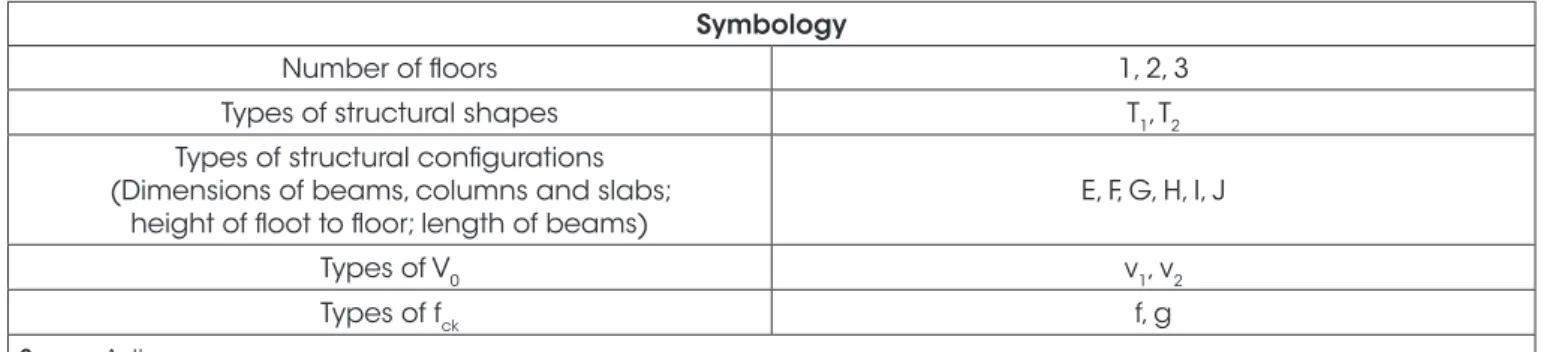
timate the features compatible with those used in real buildings. Thus, Table 4 shows the list of simulated examples. The symbols used are listed in Table 5.
The variability used in designing the examples was adopted to ob-tain different detailing of the armor in the structural elements, and consequently, different rates of longitudinal armor. It should also be considered that the stiffness of structural elements is sensitive to the variation of the steel rate set for each structural element.
2.2 Analysis of model examples
Having defined the examples, the next step is to demonstrate their
analysis. The analysis model is developed based on an iterative process to obtain the results, where, after the convergence, the av-erage stiffness values obtained for beams and columns accurately represent the material nonlinearity, in an approximate manner, for the simulated example.
Figure 3 shows the simulation process of all examples on a flowchart.
2.2.1 Processing 1
Initially, the material nonlinearity is evaluated, approximately, with the values of stiffness for the beams (EIsec = 0,4 ∙ EciIc) and the columns
(EIsec = 0,8 ∙ EciIc) — note that although these values are common for
Table 5
Description of symbology adopted in table 4
Symbology
Number of floors 1, 2, 3
Types of structural shapes T1, T2
Types of structural configurations (Dimensions of beams, columns and slabs;
height of floot to floor; length of beams)
E, F, G, H, I, J
Types of V0 v1, v2
Types of fck f, g
Source: Author
Figure 3
Analysis model of examples
buildings with four or more floors, they were used as an initial mea-sure. The geometric nonlinearity is analyzed by the P-Δ analysis. After the estimation of global effects (1st order + 2nd order), we continue
with the analysis of the local effects of second-order on the columns. As such, after setting the value of the total effects in each element, the dimensioning and detailing of structural elements is done, ac-cording to the parameters defined in the ABNT NBR 6118:2014.
2.2.2 Processing 2
On the basis of the material and geometric nonlinear portico the
material nonlinearity is evaluated by M-1/r and N-M-1/r diagrams,
for beams and columns, respectively. Analogous to processing 1, the geometric nonlinearity is evaluated by the P-Δ analysis. This processing consists of only one verification with respect to the ultimate state limit design and provides the stiffness values for each bar element discretized from the beams and columns. Such discretization is made for 50 cm long bar elements, as a simi-lar performance is evident in preliminary tests for the discretization of 10 cm long bar elements. With respect to the savings on compu-tational costs, the choice was justified.
For discretized bars that do not comply with the ultimate state limit
Table 6
Results of the simulations (part 1)
Example 1ª iteration 2ª iteration 3ª iteration 4ª iteration 5ª iteration Estimated Average rate of beams armor (%) Average rate of columns armor (%)
3T1Ev1f αv:0,16
αp:0,75
αv:0,15 αp:0,72
αv:0,15 αp:0,71
αv:0,15
αp:0,72
-αv:0,15
αp:0,72 0,92 0,73
3T1Ev1g αv:0,13
αp:0,79
αv:0,12 αp:0,74
αv:0,12
αp:0,74 -
-αv:0,12
αp:0,74 0,83 0,5
3T1Ev2f αv:0,16
αp:0,74
αv:0,15 αp:0,71
αv:0,15
αp:0,71 -
-αv:0,15
αp:0,71 0,92 0,76
3T1Ev2g αv:0,13
αp:0,79
αv:0,13 αp:0,74
αv:0,13
αp:0,74 -
-αv:0,13
αp:0,74 0,92 0,5
3T1Fv1f αv:0,14
αp:0,77
αv:0,15 αp:0,73
αv:0,15
αp:0,73 -
-αv:0,15
αp:0,73 0,75 0,59
3T1Fv1g αv:0,11
αp:0,82
αv:0,13 αp:0,77
αv:0,13
αp:0,77 -
-αv:0,13
αp:0,77 0,69 0,59
3T1Fv2f αv:0,14
αp:0,77
αv:0,16 αp:0,73
αv:0,15 αp:0,73
αv:0,15
αp:0,73
-αv:0,15
αp:0,73 0,8 0,6
3T1Fv2g αv:0,11
αp:0,82
αv:0,13 αp:0,77
αv:0,13
αp:0,77 -
-αv:0,13
αp:0,77 0,72 0,59
3T2Ev1f αv:0,18
αp:0,74
αv:0,15 αp:0,69
αv:0,15 αp:0,68
αv:0,15
αp:0,68
-αv:0,15
αp:0,68 0,85 0,62
3T2Ev1g αv:0,15
αp:0,78
αv:0,12 αp:0,72
αv:0,12 αp:0,71
αv:0,12
αp:0,71
-αv:0,12
αp:0,71 0,82 0,5
3T2Ev2f αv:0,20
αp:0,72
αv:0,16 αp:0,68
αv:0,16
αp:0,68 -
-αv:0,16
αp:0,68 1,03 0,83
3T2Ev2g αv:0,17
αp:0,76
αv:0,13 αp:0,70
αv:0,13
αp:0,70 -
-αv:0,13
αp:0,70 0,96 0,56
3T2Fv1f αv:0,14
αp:0,75
αv:0,15 αp:0,70
αv:0,15
αp:0,70 -
-αv:0,15
αp:0,70 0,72 0,6
3T2Fv1g αv:0,11
αp:0,80
αv:0,13 αp:0,73
αv:0,13 αp:0,74
αv:0,13
αp:0,74
-αv:0,13
αp:0,74 0,68 0,59
3T2Fv2f αv:0,14
αp:0,75
αv:0,16 αp:0,69
αv:0,16 αp:0,70
αv:0,16
αp:0,70
-αv:0,16
αp:0,70 0,76 0,6
3T2Fv2g αv:0,12
αp:0,79
αv:0,14 αp:0,72
αv:0,14 αp:0,73
αv:0,14
αp:0,73
-αv:0,14
αp:0,73 0,72 0,59
design, minimum increases are manually made in the respective areas of longitudinal armor and, then, the example undergoes an-other analysis with respect to material nonlinearity and geomet-ric nonlinearity by means of the material and geometgeomet-ric nonlinear portico, obtaining new values of stiffness for each discretized bar. This process is repeated until all the elements comply with ultimate state limit design.
Subsequently, a note is made on the average values of stiffness provided by the software, for the whole set of beams and columns of the structure.
2.2.3 Iterative process
We replace the initial values of material nonlinearity (beams: EIsec = 0,4 ∙ EciIc and columns: EIsec = 0,8 ∙ EciIc) with the obtained co-efficients (average values of stiffness) and repeat processing 1 and 2. As the values of the coefficients are presented with an accuracy of two decimal places, this iterative process is repeated until the values of an iteration are equal to those of a previous iteration. After convergence, the obtained values represent the evaluation of
the material nonlinearity, in an approximate manner, for that structure.
Table 6
Results of the simulations (part 2)
Example 1ª iteration 2ª iteration 3ª iteration 4ª iteration 5ª iteration Estimated Average rate of beams armor (%) Average rate of columns armor (%)
2T1Gv1f αv:0,18
αp:0,70
αv:0,18 αp:0,69
αv:0,18
αp:0,69 -
-αv:0,18
αp:0,69 1,34 0,85
2T1Gv1g αv:0,15
αp:0,74
αv:0,15 αp:0,71
αv:0,15
αp:0,71 -
-αv:0,15
αp:0,71 1,26 0,7
2T1Gv2f αv:0,18
αp:0,70
αv:0,18 αp:0,69
αv:0,18
αp:0,69 -
-αv:0,18
αp:0,69 1,28 0,87
2T1Gv2g αv:0,15
αp:0,75
αv:0,14 αp:0,72
αv:0,14
αp:0,72 -
-αv:0,14
αp:0,72 1,24 0,74
2T1Hv1f αv:0,15
αp:0,81
αv:0,16 αp:0,76
αv:0,15 αp:0,76
αv:0,15
αp:0,76
-αv:0,15
αp:0,76 0,81 1,03
2T1Hv1g αv:0,13
αp:0,84
αv:0,14 αp:0,78
αv:0,13 αp:0,78
αv:0,14
αp:0,78
-αv:0,14
αp:0,78 0,81 0,79
2T1Hv2f αv:0,15
αp:0,82
αv:0,15 αp:0,76
αv:0,15
αp:0,76 -
-αv:0,15
αp:0,76 0,79 1,01
2T1Hv2g αv:0,13
αp:0,85
αv:0,14 αp:0,78
αv:0,13 αp:0,79
αv:0,14
αp:0,78
-αv:0,14
αp:0,78 0,83 0,79
2T2Gv1f αv:0,18
αp:0,68
αv:0,18 αp:0,65
αv:0,18
αp:0,65 -
-αv:0,18
αp:0,65 1,27 0,76
2T2Gv1g αv:0,15
αp:0,72
αv:0,15 αp:0,67
αv:0,15
αp:0,67 -
-αv:0,15
αp:0,67 1,17 0,66
2T2Gv2f αv:0,19
αp:0,67
αv:0,18 αp:0,65
αv:0,19 αp:0,64
αv:0,18
αp:0,65
-αv:0,18
αp:0,65 1,31 0,88
2T2Gv2g αv:0,15
αp:0,70
αv:0,15 αp:0,66
αv:0,15
αp:0,66 -
-αv:0,15
αp:0,66 1,26 0,78
2T2Hv1f αv:0,16
αp:0,80
αv:0,16 αp:0,73
αv:0,16
αp:0,73 -
-αv:0,16
αp:0,73 0,8 0,93
2T2Hv1g αv:0,14
αp:0,82
αv:0,14 αp:0,75
αv:0,14
αp:0,75 -
-αv:0,14
αp:0,75 0,73 0,79
2T2Hv2g αv:0,14
αp:0,81
αv:0,14 αp:0,73
αv:0,14
αp:0,73 -
-αv:0,14
αp:0,73 0,76 0,79
1T1Iv1f αv:0,19
αp:0,68
αv:0,17 αp:0,64
αv:0,17 αp:0,65
αv:0,17
αp:0,65
-αv:0,17
αp:0,65 1,06 0,46
2.3 Statistical treatment
With the stiffness values estimated in each example owing to the iterative process, one should perform the statistical treatment to obtain the average values of the stiffness reducing coefficients for evaluation of the material nonlinearity, in an approximate manner, for buildings with one, two and three floors.
Thus, the measures used to describe the set of values obtained in each example are measures of central tendency (representa-tive average) and measures of dispersion (standard deviation, coefficient of variation, and maximum and minimum values). We also used Gaussian distribution graph x histogram, to compare the distribution mathematically established with the one that
represents the numerically obtained data.
The representative average is the value that the data of a distribu-tion concentrates the most and, for the purpose of this study, it can be defined by equation 6.
(6)
where
n: number of simulated examples;
α(v/p) :average stiffness reduction coefficient of beams or columns;
α(v/p)i : stiffness reducing coefficient of the beams or columns,
ob-tained in each example.
The standard deviation represents the variation or dispersion that
Table 6
Results of the simulations (part 2)
Example 1ª iteration 2ª iteration 3ª iteration 4ª iteration 5ª iteration Estimated Average rate of beams armor (%) Average rate of columns armor (%)
1T1Iv1g αv:0,16
αp:0,71
αv:0,14 αp:0,64
αv:0,14
αp:0,64 -
-αv:0,14
αp:0,64 1,12 0,73
1T1Iv2f αv:0,19
αp:0,67
αv:0,17 αp:0,65
αv:0,17 αp:0,64
αv:0,17
αp:0,64
-αv:0,17
αp:0,64 1,09 0,8
1T1Iv2g αv:0,16
αp:0,71
αv:0,14 αp:0,65
αv:0,14 αp:0,64
αv:0,14
αp:0,64
-αv:0,14
αp:0,64 1,07 0,73
1T1Jv1f αv:0,17
αp:0,76
αv:0,19 αp:0,73
αv:0,19
αp:0,73 -
-αv:0,19
αp:0,73 1,27 1,42
1T1Jv1g αv:0,14
αp:0,78
αv:0,15 αp:0,73
αv:0,15
αp:0,73 -
-αv:0,15
αp:0,73 1,12 1,25
1T1Jv2f αv:0,17
αp:0,75
αv:0,19 αp:0,73
αv:0,19
αp:0,73 -
-αv:0,19
αp:0,73 1,25 1,55
1T1Jv2g αv:0,14
αp:0,78
αv:0,15 αp:0,73
αv:0,15
αp:0,73 -
-αv:0,15
αp:0,73 1,12 1,29
1T2Iv1f αv:0,21
αp:0,67
αv:0,19 αp:0,62
αv:0,19
αp:0,62 -
-αv:0,19
αp:0,62 1,11 0,56
1T2Iv1g αv:0,18
αp:0,71
αv:0,15 αp:0,63
αv:0,15 αp:0,62
αv:0,15
αp:0,62
-αv:0,15
αp:0,62 1,03 0,56
1T2Iv2f αv:0,21
αp:0,66
αv:0,19 αp:0,62
αv:0,19
αp:0,62 -
-αv:0,19
αp:0,62 1,05 0,59
1T2Iv2g αv:0,18
αp:0,70
αv:0,16 αp:0,62
αv:0,15 αp:0,62
αv:0,16 αp:0,62
αv:0,15 αp:0,62
αv:0,15
αp:0,62 1,06 0,56
1T2Jv1f αv:0,17
αp:0,73
αv:0,20 αp:0,69
αv:0,21 αp:0,69
αv:0,21
αp:0,69
-αv:0,21
αp:0,69 1,25 1,35
1T2Jv1g αv:0,14
αp:0,75
αv:0,16 αp:0,67
αv:0,17 αp:0,68
αv:0,17 αp:0,67
αv:0,17 αp:0,67
αv:0,17
αp:0,67 1,17 0,94
1T2Jv2f αv:0,16
αp:0,73
αv:0,20 αp:0,68
αv:0,20 αp:0,69
αv:0,20
αp:0,69
-αv:0,20
αp:0,69 1,24 1,4
1T2Jv2g αv:0,13
αp:0,76
αv:0,15 αp:0,68
αv:0,17 αp:0,67
αv:0,17
αp:0,67
-αv:0,17
αp:0,67 1,15 0,94
exists relative to the average for a given set of data and, for the purpose of this study it can be defined by equation 7.
(7)
where
s : standard deviation;
α(v/p) : average stiffness reduction coefficient of beams or columns;
α(v/p)i : stiffness reducing coefficient of the beams or columns, ob-tained in each example.
The standard deviation represents the variation or dispersion that exists relative to the average for a given set of data and, for the purpose of this study it can be defined by equation 7.
The coefficient of variation is a measure of relative dispersion, used for the accuracy of estimates and represents the standard deviation as a percentage of the average. For the purpose of this study, it can be defined by equation 8.
(8)
where
cv : coefficient of variation expressed in percentage (%) s : standard deviation;
α(v/p) : average stiffness reduction coefficient of beams or columns. Therefore, the lower the value of the variation coefficient, the more homogeneous will be the data, i.e., the smaller will be the disper-sion around the average. In general, the coefficient of variation can be evaluated as follows:
n cv ≤ 15% : low dispersion (homogeneous data); n 15% < cv ≤ 30% : average dispersion;
n cv > 30% : high dispersion (heterogeneous data).
3. Results and discussions
For each conceived example, their respective stiffness values for For each conceived example, their respective stiffness val-ues for the whole set of beams (EIsec = αv ∙ EciIc) and columns
(EIsec = αp ∙ EciIc) were obtained. Table 6 shows the values obtained for each iteration and the estimated value that represents the mate-rial nonlinearity, in an approximate manner, in each analyzed sample. After obtaining the estimated values of the stiffness reducing coeffi-cients in each example described in Table 6, the statistical treatment was commenced to obtain the average values of the stiffness reduc-tion coefficients for the evaluareduc-tion of the material nonlinearity, in an approximate manner, in buildings with one, two, and three floors The results of this statistical treatment are described below.
3.1 Buildings with three floors
3.1.1 Average stiffness reduction coefficient for beams
In Figure 4, we can see the Gauss distribution graph x histogram
Figure 4
Gauss distribution graph x histogram for the
beams stiffness in examples with 3 floors
Source: Author
Table 7
Result of statistical analysis for the beams stiffness
in examples with 3 floors
Descriptive statistics
Average representative 0,140625
Standard deviation 0,013400871
Variation coefficient 9,53%
Number of idealized examples 16
Minimum value 0,12
Maximum value 0,16
Source: Author
Figure 5
Gauss distribution graph x histogram for the
columns stiffness in examples with 3 floors
and, in Table 7, we present the values of the representative aver-age, standard deviation, coefficient of variation, and the maximum and minimum values.
3.1.2 Average stiffness reduction coefficient for columns
In Figure 5, we can see the Gauss distribution graph x histogram and, in Table 8, we present the values of the representative aver-age, standard deviation, coefficient of variation, and the maximum and minimum values.
3.2 Buildings with two floors
3.2.1 Average stiffness reduction coefficient
for beams
In Figure 6, we can see the Gauss distribution graph x histo-gram and, in Table 9, we present the values of the representative
average, standard deviation, coefficient of variation, and the max-imum and minmax-imum values.
3.2.2 Average stiffness reduction coefficient for columns
In Figure 7, we can see the Gauss distribution graph x histogram and, in Table 10, we present the values of the representative aver-age, standard deviation, coefficient of variation, and the maximum and minimum values.
3.3 Buildings with 1 floor
3.3.1 Average stiffness reduction coefficient for beams
In Figure 8, we can see the Gauss distribution graph x histogram and, in Table 11, we present the values of the representative aver-age, standard deviation, coefficient of variation, and the maximum and minimum values.
Table 8
Result of statistical analysis for the beams stiffness
in examples with 3 floors
Descriptive statistics
Average representative 0,721875
Standard deviation 0,027133927
Variation coefficient 3,76%
Number of idealized examples 16
Minimum value 0,68
Maximum value 0,77
Source: Author
Figure 6
Gauss distribution graph x histogram for the
beams stiffness in examples with 2 floors
Source: Author
Table 9
Result of statistical analysis for the beams stiffness
in examples with 2 floors
Descriptive statistics
Average representative 0,155625
Standard deviation 0,015903354
Variation coefficient 10,22%
Number of idealized examples 16
Minimum value 0,14
Maximum value 0,18
Source: Author
Figure 7
Gauss distribution graph x histogram for the
columns stiffness in examples with 2 floors
3.3.2 Average stiffness reduction coefficient for columns
In Figure 9, we can see the Gauss distribution graph x histogram and, in Table 12, we present the values of the representative aver -age, standard deviation, coefficient of variation, and the maximum and minimum values.
3.4 Proposal of stiffness values for beams
and columns
According to the obtained variation coefficients, the obtained rep-resentative averages show a low-dispersion around the average, owing to the homogeneity of the data, the averages represent sat-isfactorily the values of stiffness for the set of beams and columns obtained in each designed example.
Therefore, in Table 13 we present the stiffness values for beams (EIsec = αv ∙ EciIc) and columns (EIsec = αp ∙ EciIc) for the approximate
Table 10
Result of statistical analysis for the beams stiffness
in examples with 2 floors
Descriptive statistics
Average representative 0,715
Standard deviation 0,043969687
Variation coefficient 6,15%
Number of idealized examples 16
Minimum value 0,65
Maximum value 0,78
Source: Author
Figure 8
Gauss distribution graph x histogram for the
beams stiffness in examples with 1 floor
Source: Author
Table 11
Result of statistical analysis for the beams stiffness
in examples with 1 floor
Descriptive statistics
Average representative 0,170625
Standard deviation 0,022351361
Variation coefficient 13,10%
Number of idealized examples 16
Minimum value 0,14
Maximum value 0,21
Source: Author
Figure 9
Gauss distribution graph x histogram for the
columns stiffness in examples with 1 floor
Source: Author
Table 12
Result of statistical analysis for the beams stiffness
in examples with 1 floor
Descriptive statistics
Average representative 0,668125
Standard deviation 0,043392588
Variation coefficient 6,49%
Number of idealized examples 16
Minimum value 0,62
Maximum value 0,73
consideration of the material nonlinearity in the global stability analysis, in buildings with less than four floors.
3.4.1 Comparison with the work of Bueno (2014)
In the introduction section we mentioned the researches related to the topic of this study and only the work by Bueno (2014) could be directly compared, as its objective was also to suggest values of stiffness for beams and columns in buildings with less than four floors. Table 14 shows the values of his proposal, where γ(z,lim) = 1,3 is the maximum value of the coefficient γz in the calculation of the second-order global effects.
Initially, it can be indicated that processing 1 and processing 2 of the first iteration, relative to the analysis model of this work (Figure 3), correspond to processing 1 and processing 2 of the methodol-ogy used by Bueno (2014).
However, from that stage onwards, analysis methodologies differ, because in the model by Bueno (2014), processing 4 consisted of the comparison of values obtained in the geometric nonlinear-ity evaluation of processing 4 and processing 2, by means of the equation γz2 ≤ 1,10 ∙ γ
z
4. Moreover, only the analyzed examples
that would comply with this relationship were validated. Particu-larly, Bueno (2014) used the geometric nonlinearity evaluation to verify examples that obtained the best material nonlinearity evalu-ations so that we could, subsequently, calculate the representative average values of the stiffness reducing coefficients for beams and columns, obtained in each example.
However, in this study, there was no need for comparing the values regarding the geometric nonlinearity, as the “validation” of the coef-ficients occurs through an iterative process where processing 1 and processing 2 are repeated, adopting for every iteration the coefficients obtained in the previous one. Thus, the iterative process used in the model for this study performs the same function attributed to the con-ditional equation created by Bueno (2014) and described above.
Hence, the objective of the employed model is to turn the quan-tification of values into a considerably effective one, by isolating the analysis only in relation to the bending stiffness reducers for consideration of the material nonlinearity.
Another relevant factor is that Bueno (2014) designed exam-ples with 3, 4, 5 and 8 floors. As such, the stiffness values available on Table 14, for buildings with one and two floors are merely estimations, as no examples were analyzed. On the contrary, in this study, examples have been designed with one, two, and three floors, with the proposal described in Table 13 as the final result.
4. Conclusions
This study provides a proposal for the adoption of stiffness reduc -ing coefficients for beams and columns in the approximate consid-eration of the material nonlinearity (EIsec = αv/p ∙ EciIc) for the analy-sis of global stability, as follows: buildings with 1 floor (αv = 0,17 and αv = 0,66), buildings with 2 floors (αv = 0,15 and αv = 0,71) and buildings with 3 floors (αv = 0,14 and αv = 0,72).
It could be predicted that the values to be used for buildings with up to three floors were lower than the values suggested by the ABNT NBR 6118:2014, for buildings with, at least, four floors. In fact, in contrast to the results obtained, the values recommended by the standard deserve a re-evaluation, because of the discrepancy between the stiffness value of the beams for buildings with three floors (αv = 0,14) and that suggested by the standard for buildings with four floors or more (αv = 0,40).
Therefore, the suggested values provide a considerably precise evaluation of the approximate consideration of the material
nonlin-earity in low rise structures, contributing to the analysis of global
second-order effects in a safer manner.
5. Acknowledgments
The material conditions inherent to the preparation of the research were provided by the State University of Maringá.
The research was funded by the Araucária Foundation/CAPES.
6. References
[1] AMERICAN CONCRETE INSTITUTE COMMITTEE 318. Building code requirements for structural concrete and com-mentary. Farmington Hills, MI, 2014.
[2] BUENO, M. M. E. Study of approximate values of equivalent stiffness for beams and columns for global nonlinear analy-sis in low rise structures in reinforced concrete. 2014. 238f. Thesis (Doctorate in Structures and Civil Construction) –Bra-sília University, Bra–Bra-sília, 2014.
[3] BRAZILIAN NATIONAL STANDART ORGANIZATION. NBR
6118: Design of concrete structures - procedure. Rio de Ja-neiro, 2014.
[4] FRANCO, M. Global and local stability of concrete tall build-ings. In: Symposium on space structures, Milan, 1995. [5] IBRACON. ABNT NBR 6118:2014 Comments and
applica-tion examples. 1. ed. São Paulo: IBRACON, 2015.
[6] KHUNTIA, M.; GHOSH, S. K. Flexural stiffness of reinforced
Table 13
Proposal for reduction coefficients of stiffness
Floors αv αp
1 0,17 0,66
2 0,15 0,71
3 0,14 0,72
Source: Author
Table 14
Reduction coefficients of stiffness of the elements
Floors αv αp γ(z,lim)
1 0,2 0,6
1,3
2 0,3 0,6
3 0,3 0,7
4 a 10 0,4 0,8
concrete columns and beams: analytical approach. In: ACI Structural Journal. Vol 101, n. 3, p. 351-363, 2004a.
[7] KHUNTIA, M.; GHOSH, S. K. Flexural stiffness of reinforced concrete columns and beams: experimental verification. In: ACI Structural Journal. Vol 101, n. 3, p. 364-374, 2004b. [8] MARTINS, C. H. Consideration of the material nonlinearity