* Extracted from the course “Clinical Research”, Programa de Pós-Graduação Cuidados Clínicos em Enfermagem e Saúde, Universidade Estadual do Ceará, 2017. 1 Universidade Estadual do Ceará, Fortaleza, CE, Brazil.
ABSTRACT
Objective: Describing the current panorama on the production of experimental studies related to the gestational period. Method: A bibliometric descriptive study using a quantitative approach. The data collection was performed in the InternationalClinical Trials Registry Platform in the month of October 2016. A descriptive statistical analysis was conducted after reading the abstracts and summarizing the material. Results: The sample consisted of 33 studies registered in the period from 2007 to 2016. The Southeast Region concentrated 48.5% of the studies. Regarding the subjects covered, 33.1% of the total refer to physical activities during pregnancy and to perineal exercises to strengthen the pelvic floor musculature. Conclusion: The study showed us the panorama of the experimental studies focused on the gestational period, serving as support and incentive for performing further studies with a high level of evidence, which can impact the care provided to this population.
DESCRIPTORS
Obstetric Nursing; Pregnancy; Clinical Trial; Bibliometrics.
Experimental studies in the gestational period:
an overview of scientific production*
Estudos experimentais no período gestacional: panorama da produção científica
Estudios experimentales en el período gestacional: panorama de la producción científica
Sibele Lima da Costa Dantas1, Glória Yanne Martins de Oliveira1, Kalídia Felipe de Lima Costa1, Ariane Alves Barros1, Edna Maria Camelo Chaves1, Rhanna Emanuela Fontenele Lima de Carvalho1
How to cite this article:
Dantas SLC, Oliveira GYM, Costa KFL, Barros AA, Chaves EMC, Carvalho REFL. Experimental studies in the gestational period: an overview of scientific production. Rev Esc Enferm USP. 2018;52:e03325. DOI: http://dx.doi.org/10.1590/S1980-220X2017024403325
Received: 06/11/2017 Approved: 12/19/2017
Corresponding author:
Sibele Lima da Costa Dantas Av. Dr. Silas Munguba, 1700 – Campus do Itaperi
CEP 60741-000 – Fortaleza, CE, Brazil [email protected]
INTRODUCTION
Pregnancy is a period that produces several changes to the maternal organism resulting from the interaction between some hormones to prepare the woman’s body for pregnancy(1). Taking into account these significant physiological and emo-tional changes that affect the body and mind of pregnant women, and consequently their interaction with the world, it is important that women have adequate follow-up by family and health professionals, considering that in addition to dis-comfort there may be many risks associated with pregnancy, leading to possible complications for both the mother and the fetus, and subsequently for the newborn(1-2).
In this sense, it is necessary that women have access to quality and humanized prenatal care based on the best scientific evidence in order to provide timely interventions to ensure the health of the (mother-baby) binomial, thereby enabling early detection of health problems and conse-quently their timely treatment and avoiding complications during pregnancy and childbirth(3-4), thus contributing to reduced maternal mortality, which still has high occurrence. Data from the World Health Organization (WHO) show that maternal deaths are the second leading cause of death among women of childbearing age. Deaths of approx-imately 287,000 women are recorded annually worldwide due to complications related to pregnancy and childbirth, of which 99% are in developing countries(5).
Although Brazil has registered a significant reduction of the Maternal Mortality Ratio (MMR) in recent years, ranging from 104 maternal deaths per 100,000 live births in 1990 to 44 in 2015, the country still did not meet the 5th Millennium Development Goal (MDG 5) of reducing MMR by 75% between 1990 and 2015(6).
Health professionals must be capable of diagnosing early on when there are signs and symptoms resulting from physi-ological adaptations or from pathphysi-ological conditions in order to guide and provide effective care to the women, thus ensur-ing them a safe and calm pregnancy, free of complications. In this perspective, the WHO advocates a minimum set of evidence-based procedures and interventions directed to all preg-nant women and performed at critical moments of pregnancy, considering that clinical reasoning and decision-making must be based on relevant scientific evidence and not just on the basis of intuition or previous non-systematized clinical experience(3,7). Thus, the present study is justified by the need to become aware of the registered clinical studies developed with women in the gestational period, under the perspective that the best evidence that has been established is incorporated into professional healthcare practice, thus providing these women with humanized and quality care which guarantees them comfort, prevention and reduced complications.
Therefore, this study aims to describe the current pan-orama on the production of experimental studies related to the gestational period.
METHOD
This is a descriptive study conducted by way of a bibliometric review, which is a method of quantitative analysis commonly used to evaluate scientific production in several areas of knowledge. Bibliometry is essential so that researchers can follow what is being produced in their area of study, since it allows retrieval of infor-mation and contributes to the qualitative evaluation of scientific activity(8).
The collection of the studies was carried in the International Clinical Trials Registry Platform (ICTRP), which is the international network for clinical trial reg-istries (CT), and in an integrated research portal of the World Health Organization (www.who.int/ictrp/en/). The following guiding question was formulated to con-duct this study: What is the current panorama of the production of experimental studies related to the gesta-tional period?
The data were collected in October 2016 using the descriptor “pregnancy” available in the Medical Subject Headings (MeSH). Only Brazil was selected as the inves-tigated country in order to determine the outlook of the domestic production. No delimitation was made regarding the CT registration period.
Despite only selecting Brazilian experimental studies to compose the sample of this study and hav-ing the Brazilian Registry of Clinical Trials (Registro Brasileiro de Ensaios Clínicos –ReBEC) available, which is a free-to-access virtual platform to register the studies developed in the Brazilian territory, we chose to conduct the research in the ICTRP. The advanced research tool available on this international platform enables more refined results based on: insertion of specific descriptors, specifications for recruitment status and study phases, primary sponsor, secondary identifier, recruitment coun-tries and clinical trial registration period.
The criteria for study inclusion were: Brazilian experi-mental studies related to the gestational period, in all states of recruitment. The established exclusion criterion was that studies with temporarily interrupted or canceled recruitment would not be included.
The instrument Consolidated Standards of Reporting Trials − Consort 2010(7), was used to collect information from the CTs and to highlight the following informa-tion: eligibility criteria for participants; interventions from each group; sample size; types of randomization; type of blinding; primary and secondary outcomes; addi-tional information such as clinical trial location and related institution.
A descriptive statistical analysis was performed after reading the abstracts and summarizing the material. Fourteen (14) of the 47 analyzed studies were excluded because they did not meet the pre-established inclusion criteria; thus, the final sample consisted of 33 studies. One of the four excluded multicenter studies was based in Canada, and the other three were in the United States developed by large laboratories with a well-representative sample.
RESULTS
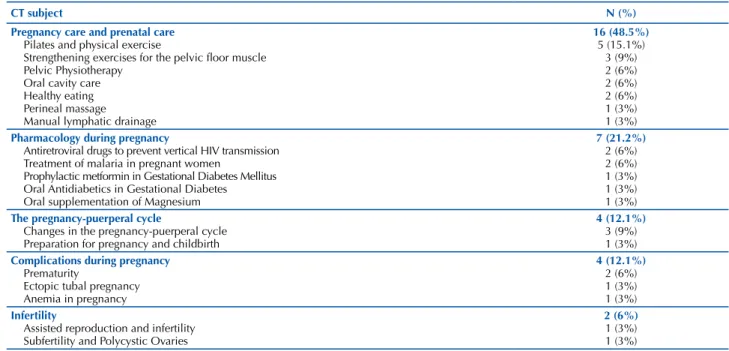
The studies analyzed in this research were charac-terized according to the subjects addressed, which were related to: pregnancy care and prenatal care; pharmacol-ogy during pregnancy; the pregnancy-puerperal cycle; complications during pregnancy; and infertility, as shown in Table 1.
Records Identified in the ICTRP: 59
12 Records not found
Analyzed records: 47
14 Excluded
Cross-sectional studies: 01 Observational studies: 09 Studies based in other countries: 04
33 Records of the selected CTs
Zero
Sample: 33 records of CTs
Identification
Screening
Eligibility
Inclusio
n
Figure 1 – Flowchart of the clinical trial screening process for final selection – Fortaleza, CE, Brazil, 2016.
Table 1 – Characterization of the analyzed clinical trials according to their subject – Fortaleza, CE, Brazil, 2016.
CT subject N (%)
Pregnancy care and prenatal care
Pilates and physical exercise
Strengthening exercises for the pelvic floor muscle Pelvic Physiotherapy
Oral cavity care Healthy eating Perineal massage Manual lymphatic drainage
16 (48.5%)
5 (15.1%) 3 (9%) 2 (6%) 2 (6%) 2 (6%) 1 (3%) 1 (3%)
Pharmacology during pregnancy
Antiretroviral drugs to prevent vertical HIV transmission Treatment of malaria in pregnant women
Prophylactic metformin in Gestational Diabetes Mellitus Oral Antidiabetics in Gestational Diabetes Oral supplementation of Magnesium
7 (21.2%)
2 (6%) 2 (6%) 1 (3%) 1 (3%) 1 (3%)
The pregnancy-puerperal cycle
Changes in the pregnancy-puerperal cycle Preparation for pregnancy and childbirth
4 (12.1%)
3 (9%) 1 (3%)
Complications during pregnancy
Prematurity
Ectopic tubal pregnancy Anemia in pregnancy
4 (12.1%)
2 (6%) 1 (3%) 1 (3%)
Infertility
Assisted reproduction and infertility Subfertility and Polycystic Ovaries
2 (6%)
1 (3%) 1 (3%)
In the studies on pregnancy care and prenatal care, the maternal and perinatal effects of physical exercise during pregnancy, the relationship of pelvic physiotherapy
drainage to treat leg edema at the end of pregnancy can be highlighted.
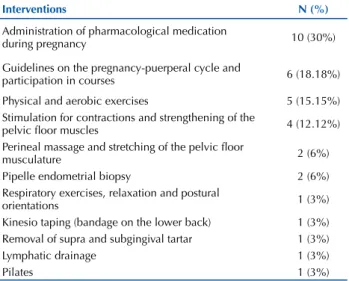
In addition, seven studies addressed the use of medi-cation during pregnancy, with different purposes. Among them, antiretroviral medication for treating pregnant women with HIV and for preventing vertical transmission, parasi-tological drugs for treating malaria during pregnancy, pro-phylactic metformin for gestationalDiabetes Mellitus(DM), metformin and glibenclamide for treatment of gestational DM, Magnesium supplementation to prevent prematurity and maternal death, and ferrous sulfate for treating anemia. Based on the diversity of subjects addressed in the CTs analyzed in this study, we were able to verify a variety of clin-ical interventions which ranged from providing guidelines and follow-up of pregnant women to invasive procedures, as shown in Table 2. Given these results, it is important to highlight that some studies used more than one interven-tion modality, and for this reason the number of activities/ interventions does not correspond to the number of ana-lyzed trials.
Table 2 – Characterization of the clinical trials analyzed according to the interventions performed with the experimental groups – Fortaleza, CE, Brazil, 2016.
Interventions N (%)
Administration of pharmacological medication
during pregnancy 10 (30%) Guidelines on the pregnancy-puerperal cycle and
participation in courses 6 (18.18%) Physical and aerobic exercises 5 (15.15%) Stimulation for contractions and strengthening of the
pelvic floor muscles 4 (12.12%) Perineal massage and stretching of the pelvic floor
musculature 2 (6%) Pipelle endometrial biopsy 2 (6%) Respiratory exercises, relaxation and postural
orientations 1 (3%) Kinesio taping (bandage on the lower back) 1 (3%) Removal of supra and subgingival tartar 1 (3%) Lymphatic drainage 1 (3%)
Pilates 1 (3%)
Among the non-invasive interventions are perineal massage, physical and aerobic exercises, pilates, guidelines, bandage, and lymphatic drainage; and among the invasive interventions are the use of medication, biopsy and den-tal techniques.
Regarding the sample of the clinical trials, a discrep-ant variation in the number of subjects involved was found with a minimum of one and a maximum of 3,000 subjects enrolled, according to Table 3.
Table 3 – Characterization of the clinical trials analyzed accor-ding to their sample – Fortaleza, CE, Brazil, 2016.
Sample of the CTs N
1 to 100 subjects 17 101 to 500 subjects 12 501 to 1,000 subjects 2 Above 1,000 subjects 1 Mean ± standard deviation 254.62 ± 527.40 Minimum – maximum 01 – 3000 Total number of subjects enrolled 8,148
It was observed that most of the clinical studies enrolled a total of 1 to 500 subjects, and only a minority exceeded that amount. It is important to emphasize that one trial was not included in this analysis, since it did not define the sample of included individuals.
The study sites were also analyzed, and the data are shown in Table 4 (names of the institutions are presented in Portuguese). The studies were carried out in three regions of Brazil (Southeast, South, and Northeast), with an empha-sis in the Southeast Region. The other two regions of the country (Midwest and North region) did not have any CTs registered on the analyzed subject. Still in this context, four studies were developed in Brazil with the support of pri-vate institutions from other countries; however, they did not include data indicating in which region they were performed or which institution was linked to data collection in the course of their information.
Table 4 – Distribution of the clinical trials analyzed according to the region of the country – Fortaleza, CE, Brazil, 2016.
Region Study site N (%)
Southeast
1. Faculdade de Medicina de Ribeirão Preto – USP 2. Universidade Paulista
3. Fundação Oswaldo Cruz
4. Faculdade Anhanguera de Campinas − Campinas, SP, Brazil 5. Escola de Enfermagem da Universidade de São Paulo
6. Faculdade de Ciências Médicas da Universidade Estadual de Campinas − Campinas, SP 7. Universidade Federal de São Paulo
8. Instituto Nacional de Alergia e Doenças Infecciosas (NIAID) – Carried out in Rio de Janeiro
9. Hospital do Servidor Público Estadual – São Paulo 10. UPECLIN HC FM Botucatu Unesp
11. Setor comercial/indústria FAPESP
12. Centro de pesquisa em saúde reprodutiva de Campinas 13. Hospital das Clínicas em São Paulo
14. Centro de Saúde Pública de Bauru
15. Hospital Geral de Nova Iguaçu (HGNI) / Instituto de Pesquisa Clínica Evandro Chagas / Hospital dos Servidores do Estado 16. Clínica e Centro de Pesquisa em Reprodução Humana Roger Abdelmassih − São Paulo
16 (48.5%)
Regarding the CT years, it was found that although no cut-off period was established, the studies were recorded in the period between 2007 and 2016, with a higher incidence in the last 3 years: 2014 (six studies), 2015 (five studies) and 2016 (five studies). Overall, these trials are recent consid-ering that the earliest one was recorded nine years ago. The majority of the analyzed studies (87.87%) were Randomized Clinical Trials (RCTs), 9% were non-randomized trials, and 3% were phase III validation studies.
DISCUSSION
The analysis of the results indicated that 48.5% of the experimental studies related to the gestational period have the prevention of complications and aggravations in the gestation, delivery and postpartum periods as their main objective, with 33.1% of the total focusing on physical activ-ities during pregnancy and perineal exercises to strengthen the pelvic floor musculature. Consequently, the interven-tions – physical and aerobic exercises, pilates, strengthening and stretching of the pelvic floor musculature and perineal massage – directed to this objective corresponded to 36.27% of the total CTs analyzed.
In recent years, much evidence has been recorded on the benefits of practicing physical activity in healthy pregnant women, including improvement in physical capacity, con-trol of the monthly weight gain, return in the postpartum to prepartum weight conditions, prevention of thrombosis, improvement of venous return, reduction in gestational diabetes index, which effectively contributes to the mech-anism of vaginal delivery(10-11).
It should be emphasized that pregnant women should only start or resume their exercise routine after the first pre-natal appointment. On this occasion and upon the absence of gestational risk, adequate and individualized guidance will be given on the type, frequency, intensity and optimal timing for physical exercise, taking into account that each gestational trimester has its specific characteristics(10-11).
In addition to practicing physical and aerobic exer-cises, it is recommended that women perform pelvic floor
strengthening exercises during the gestational period, reducing the chances of pelvic organ prolapse (POP). The morphological changes evidenced in several randomized controlled clinical trials after pelvic floor muscle training allowed to conclude that these exercises are effective in reducing symptoms and/or the stage of POP in middle-aged women, as well as having a potential preventive effect in postpartum prolapse(12).
Recent studies have confirmed that pelvic floor mus-cle training exercises are effective for treating stress urinary incontinence (SUI) and improving the quality of life of incontinent women(13-14). The evidence also indicates that the results are better when pelvic floor exercises are performed weekly under professional supervision(15).
Preventive and rehabilitative activities for the pelvic floor muscle constitute areas of important nursing perfor-mance, since despite the etiology of urinary incontinence (UI) being multifactorial, pregnancy, and in particular vaginal delivery, are implicated in its etiology. This fact associated with an increasing number of women who opt for a cesarean section without clinical indication seems to be motivated by the desire to avoid pelvic floor damage, including UI(16).
Thus, the health team should stimulate perineal mus-cle exercises focused on promoting the quality of life of women in the gestational period, in addition to contributing to reduced cesarean rates which are still very high in some Latin American countries, and which is the region with the highest rate of cesarean deliveries in the world. In Brazil, the number of surgical deliveries exceeds 50%(17).
Other non-invasive interventions such as lymphatic drainage and kinesio taping have also been performed to a lesser extent with the experimental groups, however it is important to note that 18.18% of the experiments set out to evaluate the impact of implementing guidelines during the pregnancy-puerperal cycle. The implementa-tion of courses and training groups, as well as the use of educational booklets were strategies used for developing educational practices in health.
Region Study site N (%)
South
1. Centro de Saúde em Viamão / Rio Grande do Sul
2. Programa de Pós-Graduação em Enfermagem da Universidade Federal de Santa Catarina − PEn/UFSC 3. Pontifícia Universidade Católica do Rio Grande do Sul (PUC − RS)
4. Universidade da Região de Joinville – Univille 5. Universidade Federal do Paraná
6. Universidade Federal de Pelotas 7. Hospital de Clínicas de Porto Alegre
07 (21.2%)
Northeast
1. Universidade Federal do Rio Grande do Norte
2. Centro de Ciências da Saúde da Universidade Federal de Pernambuco − CCS / UFPE − Recife, PE 3. Instituto de Medicina Integral Prof. Fernando Figueira
4. Instituto de Medicina Integral Prof. Fernando Figueira 5. Instituto Materno Infantil Prof. Fernando Figueira 6. Instituto Materno Infantil Prof. Fernando Figueira
06 (18.2%)
North ---
---Midwest ---
---Not
Specified Not Specified
In this context, health education is an important tool for emancipating the subject and strengthening their autonomy, producing knowledge and generating attitudes that improve individual and collective health(18-19). These educational prac-tices permeate all levels of care; however, it is in the context of primary care that permanence of the groups as officially recognized spaces to carry out educational activities in health seems to be recognized(20).
A comparative study between the maternal health sce-narios in Brazil and in Portugal identified that the formation of these groups seems to be of great interest to professionals involved in the care of pregnant women; however, the passive methodology was evidenced in both contexts. Despite the informative or educational nature, it is important that these spaces allow women to be agents of change in their own processes. Thus, the methodology used in the management of booklets and albums, as well as in conducting groups and courses needs to be more focused on building higher coefficients of autonomy and participation, and ensuring the possibility of female reflection and empowerment in the context of pregnancy(20).
Also regarding the proposed interventions, it was observed that 30% were related to administration of phar-macological medication during pregnancy, indicating a high incidence of care medicalization. It can be emphasized that drug therapies expose both mother and the fetus, and the effects on the concept will depend on some factors such as: drug class, patient profile, time of exposure during pregnancy, frequency and total dose, and which may result in fetal abor-tion, death or malformation. Thus, the use of medications during pregnancy should be first and foremost avoided(21).
It is known that the use of medication in certain clinical situations is necessary, and it is up to the professionals to provide the guidelines for the correct use. This activity is a relevant clinical practice in health services in which prenatal care is performed, and this care performed by the profes-sionals will favor the reestablishment of the health of the pregnant woman who is under drug therapy.
Analysis of the CTs revealed a large oscillation in the sample ranging from one to more than 1,000 subjects. Among other reasons, these variations may occur due to the fact that CTs are extremely expensive and time-consum-ing(22), requiring investments that Brazilian funding agen-cies or even national research sources are not always able to provide. For researchers, this often represents an obstacle as, depending on the stage of the study, the costs might make it unfeasible. An option to encourage the performance of this type of study would be greater subsidy by development agencies, since it is not possible to offer new therapeutic options to the community without research.
CTs are the gold standard to evaluate the effectiveness of interventions and are the basis for clinical practice; therefore, they need to have a representative sample so that an important clinical effect may be significant in the statistical analysis for the studied outcomes. Moreover, a large sample may favor other outcomes which are often considered unimportant in certain studies. In contrast, studies with a small sample, as evidenced in the study in which one of the CTs reported only
having one subject enrolled, may lead to bias in the representa-tiveness of the analysis. Randomization of eligible participants in intervention or control groups is another important point in this type of study, since it is a way of guaranteeing the same chance of allocation for both groups(23-24).
Regarding the regions where the CTs were conducted, it can be seen that the Southeast region concentrated most of the studies, whereas the North and Midwest regions did not record any studies. The Southeast region has been highlighted in CT development due to having a greater tradition in devel-oping studies and a greater number of researchers(25), not to mention that the largest Brazilian research institutes are in this region. The Southeast region of Brazil is also the most developed region in the country, responsible for approximately 55% of the Brazilian GDP (Gross domestic product)(26).
However, it is still necessary to develop further studies in other regions of Brazil such as the Midwest, the North and the Northeast, considering that there is population and qualified personnel for such, and it is indispensable that the financial support agencies offer the opportunity for develop-ing more research in these regions. Research funddevelop-ing favors the structuring of researchers’ fields of action.
The last 3 years have shown an increase in the num-ber of CTs. The accomplishment of this type of study in Brazil is becoming a growing practice, since there is a great demand of patients and legislation favors conducting clinical studies(27-28). Multicenter phase III studies should have a minimum sample of 800 to 1,000 patients. These protocols are designed so that all participating centers can follow the recommendations proposed in the study(29).
To follow the development of clinical trials in Brazil, the Brazilian Registry of Clinical Trials (ReBEC) was created in December 2010. It is a platform that gives researchers access to what is being produced and leads to reducing the levels of duplication of clinical studies(25). However, it is necessary that these studies are registered on the platform in full, as it was not possible to determine in which region a multicenter study funded by another country was carried out according to the ReBEC stages.
The ReBEC was launched as a partnership of the Ministry of Health, the Institute of Communication and Scientific and Technological Information in Health (Icict/Fiocruz), of the Pan American Health Organization (PAHO) and the Latin American and Caribbean Center on Health Sciences Information (Bireme), aggregating values to the studies by collecting reliable information and improving the available evidence(25).
RCTs stand out and are characterized as being experi-mental studies developed in humans so that the effects of certain interventions can be observed, being able to generate evidence for professional practice(22).
RESUMO
Objetivo: Descrever o panorama atual da produção de estudos experimentais relacionados ao período gestacional. Método: Estudo bibliométrico, descritivo, de abordagem quantitativa. A coleta dos dados foi realizada no InternationalClinical Trials Registry Platform, durante o mês de outubro de 2016. Após leitura dos resumos e sistematização do material, realizou-se análise estatística descritiva. Resultados: A amostra foi composta por 33 estudos registrados no período de 2007 a 2016. A Região Sudeste concentra 48,5% dos experimentos. Dos assuntos abordados, 33,1% do total referem-se a atividades físicas durante a gravidez e a exercícios perineais para o fortalecimento da musculatura do assoalho pélvico. Conclusão: A pesquisa possibilitou conhecer o panorama dos estudos experimentais com foco no período gestacional, servindo de suporte e incentivo para realização de mais estudos com alto nível de evidência, que tragam impacto à assistência prestada a esse público.
DESCRITORES
Enfermagem Obstétrica; Gravidez; Ensaio Clínico; Bibliometria.
RESUMEN
Objetivo: Describir el panorama actual de la producción de estudios experimentales relacionados con el período gestacional. Método: Estudio bibliométrico, descriptivo, de abordaje cuantitativo. La recolección de los datos fue realizada en la InternationalClinical Trials Registry Platform, durante el mes de octubre de 2016. Previa lectura de los resúmenes y sistematización del material, se llevó a cabo el análisis estadístico descriptivo. Resultados: La muestra estuvo compuesta de 33 estudios registrados en el período de 2007 a 2016. La Región Sureste concentra el 48,5% de los experimentos. De los temas abordados, el 33,1% del total se refieren a actividades físicas durante el embarazo y a ejercicios perineales para el fortalecimiento de la musculatura del suelo pélvico. Conclusión: La investigación posibilitó conocer el panorama de los estudios experimentales con enfoque en el período gestacional, sirviendo de soporte e incentivo para la realización de más estudios con alto nivel de evidencia, que brinden impacto a la asistencia prestada a dicho público.
DESCRIPTORES
Enfermería Obstétrica; Embarazo; Ensayo Clínico; Bibliometría.
REFERENCES
1. Pinto AVA, Schleder JC, Penteado C, Gallo RBS. Evaluation of respiratory mechanics in pregnant women. Fisioter Pesq [Internet]. 2015 [cited 2017 Mar 10];22(4):348-54. Available from: http://www.scielo.br/pdf/fp/v22n4/en_2316-9117-fp-22-04-00348.pdf
2. Bezerra ACL, Mesquita JS, Brito MCC, Santos RB, Teixeira FV. Desafios enfrentados por mulheres primigestas em idade avançada. Rev Bras Ciênc Saúde [Internet]. 2015 [citado 2017 mar. 10];19(2):163-8. Disponível em: http://periodicos.ufpb.br/index.php/rbcs/article/ viewFile/24335/15065
3. Reis PAGD, Pereira CCA, Leite IC, Theme-Filha MM. Fatores associados à adequação do cuidado pré-natal e à assistência ao parto em São Tomé e Príncipe, 2008-2009. Cad Saúde Pública [Internet]. 2015 [citado 2016 nov. 10];31(9):1929-40. Disponível em: http://www. scielo.br/pdf/csp/v31n9/0102-311X-csp-31-9-1929.pdf
4. Ataide MM, Santos AAP, Silva JMO, Sanches METL. Exame obstétrico realizado pela enfermeira: da teoria à prática. Enferm Foco [Internet]. 2016 [citado 2017 mar. 10];7(2):67-71. Disponível em: http://revista.portalcofen.gov.br/index.php/enfermagem/article/view/798/323
5. World Health Organization. Health Statistics and Information Systems. Disease and injury regional estimates, 2000-2011. Cause specific mortality [Internet]. Geneva: WHO; 2013 [cited 2017 Mar 10]. Available from: http://www.who.int/healthinfo/global_burden_disease/ estimates_regional_2000_2011/en/
the gestational period, both the woman and the fetus can benefit from new evidence found. Although there have been less investments in research, researchers in recent years have developed partnerships that allow for applying new inter-ventions in different health scenarios.
CONCLUSION
We analyzed 33 records of experimental trials collected from the ICTRP search portal that met the eligibility crite-ria. Gaps regarding data completion were found, making it difficult to understand the reliability of a CT, as well as the representativeness and comprehensiveness of some studies, especially one study carried out with only one enrolled subject. We found that the production of experimental studies related to the gestational period presented greater emphasis on the topics related to pregnancy care and prenatal care, with objectives that were mainly related to preventing com-plications and aggravations during the gestation, delivery and postpartum periods. The other subjects were related to infertility, pharmacology during pregnancy, complications during pregnancy and to the pregnancy-puerperal cycle.
The profile of these records shows that the enrollment period in the ReBEC corresponds to the years 2007 to 2016, quantitatively highlighting the last 3 years (2014, 2015 and 2016), which shows a growth in the number of CTs performed in the country. Among the regions where the studies were carried out, records were found from three regions of Brazil (Southeast, South and Northeast), with an emphasis in the Southeast, while two other regions (Midwest and North) did not have any CTs reg-istered for the subject under analysis.
6. Organización Mundial de la Salud. Evolución de la mortalidad materna: 1990-2015. Estimaciones de la OMS, el UNICEF, el UNFPA, el Grupo del Banco Mundial y la División de Población de las Naciones Unidas [Internet]. Ginebra: OMS; 2015 [citado 2017 mar. 10]. Disponible en: http://apps.who.int/iris/bitstream/10665/204114/1/WHO_RHR_15.23_spa.pdf
7. Martins J, Sousa LM, Oliveira AS. Recomendações do enunciado CONSORT para o relato de estudos clínicos controlados e randomizados. Medicina (Ribeirão Preto) [Internet]. 2009 [citado 2016 nov 10];42(1):9-21. Disponível em: http://revista.fmrp.usp.br/2009/vol42n1/ Simp_Recomendacoes_Enunciado_CONSORT_1.pdf
8. Garcia LAA, Camargo FC, Gomes THM, Rezende MP, Pereira GA, Iwamoto HH, et al. Production of Nursing knowledge regarding potential life years lost: a bibliometric study. REFACS [Internet]. 2017 [cited 2017 Feb 1];5(1):34-46. Available from: http://seer.uftm.edu. br/revistaeletronica/index.php/refacs/article/viewFile/1911/1919
9. Galvão TF, Pansani TDSA, Harrad D. Principais itens para relatar revisões sistemáticas e Meta-análises: A recomendação PRISMA. Epidemiol Serv Saúde [Internet]. 2015 [citado 2016 nov. 10];24(2):335-42. Disponível em: http://www.scielo.br/pdf/ress/v24n2/2237-9622-ress-24-02-00335.pdf
10. Velloso EPP, Reis ZSN, Pereira MLK, Pereira AK. Maternal-fetal response resulting from the practice of physical exercise during pregnancy: a systematic review. Rev Med Minas Gerais [Internet]. 2015 [cited 2016 Nov 10];25(1):91-6 Available from: www.rmmg.org/exportar-pdf/1742/en_v25n1a15.pdf
11. Nascimento SL, Godoy AC, Surita FG, Pinto e Silva JL. Recomendações para a prática de exercício físico na gravidez: uma revisão crítica da literatura. Rev Bras Ginecol Obstet [Internet]. 2014 [citado 2016 dez. 26];36(9):423-31. Disponível em: http://www.scielo.br/pdf/rbgo/ v36n9/0100-7203-rbgo-0100-720320140005030.pdf
12. Bø K, Hilde G, Stær-Jensen J, Siafarikas F, Tennfjord MK, Engh ME. Postpartum pelvic floor muscle training and pelvic organ prolapse: a randomized trial of primiparous women. Am J Obstet Gynecol. 2015;212(1):38.e1-7. DOI: 10.1016/j.ajog.2014.06.049
13. Moroni RM, Magnani PS, Haddad JM, Castro RA, Brito LG. Conservative treatment of stress urinary incontinence: a systematic review with meta-analysis of randomized controlled trials. Rev Bras Ginecol Obstet. 2016;38(2):97-111. DOI: http://dx.doi.org/10.1055/s-0035-1571252
14. Dumoulin C, Hay-Smith EJC, Habée-Séguin GM. Pelvic floor muscle training versus no treatment, or inactive control treatments, for urinary incontinence in women (Cochrane Review). Cochrane Database Syst Rev. 2014;(5):CD005654. DOI: 10.1002/14651858.CD005654.pub3
15. Lopes MHBM, Costa JN, Lima JLDA, Oliveira LDR, Caetano AS. Programa de reabilitação do assoalho pélvico: relato de 10 anos de experiência. Rev Bras Enferm [Internet]. 2017 [citado 2017 mar. 09];70(1):231-5. Disponível em: http://www.scielo.br/pdf/reben/v70n1/ en_0034-7167-reben-70-01-0231.pdf
16. Gyhagen M, Bullarbo M, Nielsen TF, Milsom I. The prevalence of urinary incontinence 20 years after childbirth: A national cohort study in singleton primiparae after vaginal or caesarean delivery. BJOG. 2012;120(2):144-51. DOI: 10.1111/j.1471-0528.2012.03301.x
17. Anjos CDS, Westphal F, Goldman RE. Cesárea desnecessária no Brasil: revisão integrativa. Enferm Obstétr [Internet]. 2014 [citado 2017 ago. 24]; 1(3):86:94. Disponível em: http://www.enfo.com.br/ojs/index.php/EnfObst/article/view/21/19
18. Rodrigues DP, Guerreiro EM, Ferreira MA, Queiroz ABA, Barbosa DFC, Fialho AVM. Social representations of women in pregnancy, postpartum and educational actions. Online Braz J Nurs [Internet]. 2013 [cited 2017 Mar 09];12(4):911-22. Available from: http://www. objnursing.uff.br/index.php/nursing/article/view/4287/pdf_37
19. Santos ACC, Ferreira EJ, Santos L, Souza OSQ. Experience report in the context of health education of mother and child care. J Nurs UFPE On line [Internet]. 2015 [cited 2017 Mar 09];9 Suppl5):8474-8. Available from: http://www.revista.ufpe.br/revistaenfermagem/index.php/ revista/article/viewArticle/6469
20. Pio DAM, Oliveira MM. Educação em saúde para atenção à gestante: paralelos de experiências entre Brasil e Portugal. Saúde Soc. 2014;23(1):313-24. DOI: http://dx.doi.org/10.1590/S0104-12902014000100025
21. Rocha RS, Bezerra SC, Lima JWO, Costa FS. Consumption of medications, alcohol and smoking in pregnancy and assessment of teratogenic risks. Rev Gaúcha Enferm [Internet]. 2013 [cited 2017 Mar 09];34(2):37-45. Available from: http://www.scielo.br/pdf/rgenf/v34n2/en_ v34n2a05.pdf
22. Nedel WL, Silveira FD. Different research designs and their characteristics in intensive care. Rev Bras Ter Intensiva [Internet]. 2016 [cited 2016 Nov 12];28(3):256-60. Available from: http://www.scielo.br/pdf/rbti/v28n3/en_0103-507X-rbti-28-03-0256.pdf
23. Cameron S, Glasier A, Chen Z, Johnstone A, Dunlop C, Heller R. Effect of contraception provided at termination of pregnancy and incidence of subsequent termination of pregnancy. BJOG. 2012;119(9):1074-80. DOI: 10.1111/j.1471-0528.2012.03407.x
24. Ferreira JC, Patino CM. Choosing wisely between randomized controlled trials and observational designs in studies about interventions. J Bras Pneumol [Internet]. 2016 [cited 2016 Dec 26];42(3):165. Available from: http://www.scielo.br/pdf/jbpneu/v42n3/1806-3713-jbpneu-42-03-00165.pdf
25. Brasil. Ministério da Saúde. Fortalecendo a pesquisa clínica no Brasil: a importância de registrar os ensaios clínicos. Rev Saúde Pública [Internet]. 2011 [citado 2016 dez. 26];45(2):436-9. Disponível em: http://www.scielo.br/pdf/rsp/v45n2/itdecit.pdf
26. Instituto Brasileiro de Geografia e Estatística. Contas Regionais do Brasil 2012 [Internet]. Rio de Janeiro: IBGE; 2014 [citado 2017 mar. 10]. Disponível em: ftp://ftp.ibge.gov.br/Contas_Regionais/2012/pdf/contas_regionais_2012.pdf
27. Chiarini T, Vieira KP, Zorzin PLG. Universidades federais mineiras: análise da produção de pesquisa científica e conhecimento no contexto do sistema mineiro de inovação. Nova Econ [Internet]. 2012 [citado 2017 fev. 1];22(2):307-32. Disponível em: http://www.scielo.br/pdf/ neco/v22n2/v22n2a04.pdf
28. Silva RE, Amato AA, Novaes MRCG. Pharmaceutical innovation and technological dependence: a study of the Brazilian scenario. Int J Clin Trials [Internet]. 2016 [cited 2017 Aug 23];3(1):15-23. Available from: http://www.ijclinicaltrials.com/index.php/ijct/article/view/104
29. Lopes RL, Harrington RA. Compreendendo a pesquisa clínica. Porto Alegre: AMGH; 2015.