Nova School of Business and Economics
Three Essays in Risky Behaviors
Author:
Mafalda
Sampaio
Advisor:
Adeline
Delavande
CONTENTS
1. Strategic Behavior in Conversational Networks: Seeking HIV-Related Information
. . . 11
1.1 Introduction . . . 11
1.2 Model of Network Formation . . . 16
1.2.1 A Simple Theoretical Framework . . . 16
1.3 Data . . . 20
1.3.1 Malawi Longitudinal Study of Families and Health . . . 20
1.4 Descriptive Statistics . . . 22
1.4.1 Analytical Sample . . . 22
1.4.2 Descriptive Statistics of the Social Networks . . . 23
1.5 Empirical Analysis . . . 24
1.5.1 Network Selectivity . . . 24
1.5.2 Overlap Between Networks . . . 33
1.6 Conclusion . . . 34
1.A MLSFH Questionnaire . . . 46
2. HIV-related Social Stigma and Risky Sexual Behavior in a High HIV Prevalence Environment . . . 50
2.1 Introduction . . . 50
2.2 Data . . . 54
2.2.1 The Malawi Longitudinal Study of Families and Health . . . 54
2.2.2 Measures of Social Stigma against People Living with AIDS . . . 54
2.3 Empirical framework and Identification . . . 57
2.4 Results . . . 60
2.5 Conclusion . . . 62
2.A Appendix . . . 78
3. Childhood obesity dilemma: parents’ lack of knowledge or lack of power. . . . 80
3.1 Introduction . . . 80
3.2 The Childhood Obesity Epidemic . . . 83
3.2.1 Childhood Obesity Trends . . . 83
3.2.2 Determinants of childhood obesity . . . 84
3.3 Data Collection . . . 86
3.3.1 Sample . . . 86
3.3.2 Questionnaire Design . . . 87
3.4 Descriptive Statistics . . . 90
3.4.1 Nutritional Status of the Parent . . . 90
3.4.2 Perceived Nutritional Status of the Child . . . 91
3.4.3 Time and Income Allocation . . . 92
3.4.4 Health Habits . . . 93
3.4.5 Child Decision Power . . . 94
3.4.6 Subjective Expectations . . . 94
3.5 Do parents have accurate expectations? . . . 98
3.6 Empirical Approach . . . 102
3.6.1 Model Specification . . . 102
3.7 Conclusion . . . 104
3.A Appendix . . . 122
LIST OF FIGURES
3.1 Scale of the distribution of parent-child decision power . . . 88
3.2 Distribution of total beverages and of extra-curricular time . . . 90
3.3 Distribution of the Unconditional Probability of Child Obesity in 12 months119
3.4 Distribution of the Conditional Probability of Child Obesity in 12 months 119
3.5 Distribution of the Conditional Probability of Child Obesity in 12 months
by Gender of Parent . . . 120
3.6 Distribution of the Conditional Probability of Child Obesity in 12 months
by Age of Child . . . 120
3.7 Distribution of the Conditional Probability of Child Obesity in 12 months
by Nutritional Status of Parent . . . 121
3.8 Distribution of the Change Conditional Probability of Child Obesity in 12
months . . . 121
3.9 Visual Scale for Boys . . . 122
LIST OF TABLES
1.1 Descriptive Statistics . . . 40
1.2 Social Network Composition . . . 41
1.3 Differences between Networks . . . 42
1.4 Social Distance . . . 43
1.5 Network Selectivity . . . 44
1.6 Network Overlap . . . 45
2.1 Descriptive Statistics . . . 68
2.2 Association between Proportion of Population with Radio and Social Stigma in 2004 and 2006 at the Village Level. . . 70
2.3 Relationship between Stigma and Risky Sexual Behavior: OLS Regression Results . . . 71
2.4 Impact of Radio Ownership on Changes in Social Stigma: First-Stage Instrumental Variables Regression Results . . . 73
2.5 Relationship between Stigma and Risky Sexual Behavior: IV Regression Results . . . 75
2.6 Impact of Social Stigma on Sexual Behavior Instrumental Variable Spec-ifications for Men . . . 78
2.7 Impact of Social Stigma on Sexual Behavior Instrumental Variable Spec-ifications for Women . . . 78
3.1 Descriptive Statistics . . . 111
3.2 Nutritional Status . . . 112
3.3 Parent Perception of Nutritional Status . . . 113
3.5 Income Allocation . . . 115
3.6 Exercise and Nutrition Habits . . . 116
3.7 Child’s Decision Power . . . 117
3.8 Joint Conditional Probabilities of Child Obesity in 12 months . . . 117
ACKNOWLEDGEMENTS
First and foremost I offer my sincerest gratitude to my supervisor, Professor Adeline
Delavande, who has supported me throughout my doctoral research providing continued
encouragement and invaluable suggestions during this work. Either by enlightening
con-versations or the late-night e-mails, this research would not have been possible without
her help. I am also particularly grateful to Professor Neeraj Sood, who agreed to be my
co-author and who helped and guided me enumerable times with his knowledge.
I am also deeply indebted to Professor Ana Balc˜ao Reis and Susana Peralta, who believed
in me, supported me when I thought it would not be possible to complete this journey,
and were always the first to offer their help. I would also like to thank Professor Jose
Tavares for his out-of-the-box suggestions and Professor Pedro Portugal for his support
in econometric matters.
I express my gratitude to Nova School of Business and Economics: from the faculty to
all the participants in the Informal Research Workshop and PhD research group, who
have provided valuable input throughout my work. In particular, I would like to thank
my friends and colleagues Pedro Chaves, Sonia Felix, and Pedro Robalo, and more
re-cently Nuno Sobreira and Bernardo Pimentel, who were always available to give me their
suggestions and support. I also thank Professors Eliana la Ferrara, Martina Bjorkman,
Katja Kaufman, and all the participants of the Developing Research Group during my
visit to I.G.I.E.R - Universita Commercial Luigi Bocconi.
For the data collection part of my research I would like to express my gratitude to the
principals of the primary schools involved, who allowed me to conduct my research and
helped me collecting the data.
Financial support from Funda¸c˜ao para a Ciˆencia e Tecnologia (Doctoral Scolarship SFRH
Finally, and most importantly, I would like to thank my family and friends. Without
their unconditional support and encouragement the completion of this dissertation would
not have been possible. Probably unaware of their importance, my mother Ana and my
sister Catarina are the main people responsible for this achievement.
INTRODUCTION
This dissertation consists of three essays on the relationship between risky behaviors and
social environment, including the strategic construction of conversational networks to
discuss HIV related issues, the impact of social stigma on risky behaviors, and how
sub-jective expectations from parents can influence childhood obesity. Understanding where
people seek information and how they react according to the social environment is shown
to be important in designing effective prevention policies and programs.
In the first chapter we investigate the formation of informal HIV conversational
net-works in rural Malawi. Using data from the Malawi Longitudional Study of Familes
and Health (MLSFH), which contains detailed data on conversational networks, we
com-pare the overlap of conversational partners between the network formed to discuss family
planning and the one formed to discuss HIV-related issues. If networks were constructed
randomly, there should be a high overlap in the composition of different networks for
the same individual, as the establishment of a social link is costly. We find evidence
that points toward a strategic behavior of individuals by concluding that people (1) vary
the composition of their networks; (2) select partners to talk with about HIV who are
able to provide them with new information, and (3) both men and women who perceive
themselves to be less likely to be infected or to be less exposed to HIV risk consistently
look for partners who can provide them with better information.
The second paper is a joint work with Adeline Delavande and Neeraj Sood. We estimate
the causal effect of social stigma against HIV+ persons on risky sexual behavior in rural
Malawi by using plausibly exogenous variation in stigma arising from the introduction of
a radio campaign seeking to reduce social stigma. The effect of stigma on risky behavior is
a priori ambiguous. On the one hand, higher stigma can lead people to disassociate from
be viewed as a social tax on being HIV+ and higher stigma may reduce risky behavior
as a result. We find that an increase in social stigma is associated with an increase in
risky behavior, including more partners and a higher likelihood of having extra-marital
relations. This effect is mainly driven by the impact of stigma on men.
The third chapter of this dissertation tackles the childhood obesity epidemic, by
intro-ducing two new approaches: the subjective expectations that parents have about the
probability of future childhood obesity conditional on their choices of energy intake and
expenditure, and the distribution of decision-power within the household. To identify
these two new explanations for childhood obesity we designed and administered a
sur-vey in seven primary schools that resulted in an unique dataset covering three districts
from Portugal and 220 respondents. Evidence points to the conclusion that parents have
accurate expectations about the impact of consuming soft drinks and having an active
life. Nevertheless, parents tend to believe that limiting soft drink consumption plays a
more important role in fighting childhood obesity, and under-value the importance of
physical exercise. This leaves room for policy making in promoting the right balance in
the energy intake and expenditure. Moreover, we show that parents who have a higher
decision-power within the household and those who perceive a higher increase in the
probability of obesity when increasing soda consumption, are the ones whose children
drink less of such beverages.
All in all, this dissertation contributes to the literature of risky behaviors by shedding
some light about how the social environment shapes individuals’ attitudes and
percep-tions toward risky behaviors. Not only do people deliberately seek information, they also
tend to opt for less risky behaviors when they have a clear image of the risk they face and
they live in a tolerant society. This suggests that working on the quality of the society’s
values and information flow as a whole, could trigger a reduction in risk taking behaviors
1. STRATEGIC BEHAVIOR IN CONVERSATIONAL NETWORKS:
SEEKING HIV-RELATED INFORMATION
1.1 Introduction
Since the beginning of the pandemic, HIV is a major health problem responsible for over
25 million deaths (UNAIDS). It is estimated that 33.3 million people worldwide are
in-fected with HIV/AIDS. In 2009, 1.8 million people died due to HIV/AIDS and another
2.6 million were newly infected. Although it has spread worldwide, it affects developing
countries especially. Data from 2008 reported that over 68% (approximately 22.5 million
people) of all infected people live in Sub-Saharan Africa.
Malawi has been one of the most affected countries, occupying the 8th position in country
HIV prevalence rate (CIA (2011)). The first case of AIDS in Malawi was diagnosed in
1985, and the national prevalence peaked at 26 percent in 1998. Since then, national
prevalence has declined steadily. The most recent data (UNAIDS) estimated that the
national adult HIV prevalence rate was 11.9 percent in 2007 and approximately 930,000
Malawians were HIV positive. HIV-related complications cause 68,000 deaths each year.
The HIV epidemic in Malawi is characterized by significant geographic differences in HIV
prevalence, much higher in urban areas, at 17.1 percent compared with 10.8 percent in
ru-ral areas, though there has been a steep decline in recent years according to the UNGASS
(2010). Although there is a lower prevalence rate in the rural areas, the epidemic remains
a major concern in those areas, where 80 percent of Malawians live, and health services
are often limited. Moreover, Malawi’s epidemic is feminized and consequently children
are affected by the epidemic by contracting the disease from their mothers. At the end
of 2007, an estimated 91,000 children in Malawi were living with HIV, and more than
researchers have joined policy-makers in the urge to find a solution for the devastating
spread of HIV and have focused on understanding the determinants of risky behaviors,
emphasizing the influence that the social environment has on such behaviors.
This study investigates the formation of informal HIV conversational networks in
ru-ral Malawi, comparing individual choices of conversational partners between one network
created to discuss family planning methods and the one to discuss HIV related issues. It
examines whether people choose different network partners to discuss different subjects
and what the main drivers of their choices are. More specifically, we focus on the choice
of potentially more educated partners and study the impact of the individual’s perception
of risk in those choices, i.e., if people who feel they are less likely to be infected choose
different networks from those who believe they have a high probability of already having
contracted HIV.
The understanding of the construction and architecture of social networks is of
ex-treme importance for the implementation of HIV prevention campaigns. In developing
countries, social networks are one of the main vehicles of information transmission and
are likely to be one of the most important diffusion mechanisms of HIV prevention
mes-sages.1
Hence, in order to boost the reach of health-related campaigns and to maximize
their efficiency through an appropriate resource allocation, it is mandatory that policy
makers have a clear knowledge about how and where individuals seek information. In
fact, identifying the key players in each society, i.e., the ones that others seek information
and knowledge from, would allow targeting the prevention messages in such a way that
they would spread efficiently in the network. Moreover, targeting only a small group
of individuals in a society would enable a cost-efficiency gain in mass media campaigns,
which usually have limited funds.
1
Several studies have focused on investigating the formation and impact of social
net-works. Theoretical models of social network (e.g., Wasserman and Faust (1994), Brock
and Durlauf (2001)) have posited that social interaction is an important determinant of
behavior, and several papers have tested this influence empirically. For example, Behrman
et al.(2002) investigate the impact of social influence and social learning in contraceptive
methods use, while Gerland (2004) focuses on the impact of attendance to community
events and the structure of conversations in HIV prevention strategies. Most of these
studies assume that network formation is a random process according to which people
are associated with an ad-hoc social network composed of individuals from the same
vil-lage, kinship group, classroom, among others. This approach neglects the possibility of
strategic behavior by the decision-maker, which most likely contaminates the estimated
impact of the average network behavior on the individual’s decision.
In a seminal work Manski (1993) shed some light on the issue by addressing the
Re-flection Problem. According to this theory, when a researcher tries to infer whether the
average behavior in a certain group influences the action of the individuals that comprise
the group, he has to take into account and distinguish the endogenous, the contextual
and correlated effects: (1) the endogenous effects according to which the propensity of
an individual to behave in some way varies with the prevalence of the groups’ behavior,
(2) the contextual or exogenous effects where the propensity on an individual to behave
in some way varies with the exogenous characteristics of the group, and finally (3) the
correlated effects where individuals in the same group tend to behave similarly because
they face similar environments and have similar characteristics. While the first effect is
usually what researchers are aiming at, the correct estimation of its magnitude requires
the identification of all three. Having this identification in mind, Manski emphasized
the need to collect richer data so that the impact of each of the three factors could be
disentangled and correctly estimated.
Manski’s line of research was then followed by several authors. For example, Behrman
et al. (2002) concluded that the impacts of social networks on changes in contraception
practices in rural Kenya remained even after controlling for unobserved factors such as
homophily; Helleringer and Kohler (2005) used a fixed effects analysis to show that
so-cial interactions on the subject of HIV/AIDS have significant and substantial effects on
respondent’ perceptions of the risk of HIV/AIDS, even after controlling for unobserved
factors that affect the selection of social networks. Montgomeryet al.(2001) examined the
influence of informal social networks on the contraceptive behavior of reproductive-age
women, using longitudinal data collected in six communities in southern Ghana. These
authors acknowledge Manskis’ worries but argue that results driven on four rounds of
survey data, covering two years of reproductive experience, and employing stringent test
criteria (the fixed-effects model) are promissing. Also, Conley and Udry (2001) exploited
the learning process and consequent agricultural technology adoption in Ghana, by
col-lecting an extensive set of data that allowed the identification of the different effects
associated with social learning.
Although social networks appear to have a relevant role in all health-related issues,
their importance is likely to increase when (i) the uncertainty about a given subject is
greater leading people to seek information and (ii) the availability of other information
sources is limited. The spread of a fatal disease like AIDS in a developing country fits this
scenario perfectly. At the initial stage of the HIV epidemic, individuals were forced to
face a frightening new reality. As Kohleret al. (2007) argued, when confronted with this
new threat people are likely to seek information about transmission mechanisms of the
disease, which behaviors increase the risk of infection, and potential prevention strategies,
in their closer networks, especially through the interaction with friends and neighbors. In
this context of the AIDS pandemic Kohler et al. (2007) argued that social networks are
determined by: (i) the costs and benefits of learning about the existence of the disease,
its risks, and prevention strategies,(ii) the social constraints imposed by the availability
of suitable network partners and the social acceptability of communications about such
theoretical point in mind, any policy targeted at shaping individuals’ sexual behavior
should not only acknowledge the impact, but also the factors that determine the choice,
of social networks.
This study lays out a simple theoretical model where an individual’s network partner
choices are a function of the costs and benefits that each relationship yields. Defining
costs as the social distance that measures the geographical or cultural differences between
the two potential partners, in order to address the homophily concerns, and benefits as
to the amount and nature of the information that each potential partner can provide,
we argue that each individual will decide to establish a new relational link only if the
net benefit is positive. In fact, if networks were constructed randomly, there should be
a high overlap in the composition of networks formed to discuss different issues for the
same individual, as the establishment of a social link is costly2 .
In order to empirically test our predictions we use data from the Malawi Longitudional
Study of Families and Health (MLSFH), which contains detailed information on
conversa-tional networks. We compare the overlap of conversaconversa-tional partners between the network
formed to discuss family planning and the one formed to discuss HIV-related issues. A
unique feature of the MLSFH is that it collects data about social networks by asking each
sampled individual to name up to four persons with whom they chat about each issue,
separately, and collecting a set of characteristics about these network partners.
In our analysis we focus on the family planning network as the pool of potential partners
to discuss HIV related matters and analyze the main characteristics that increase the
probability of a person being chosen as partner in the HIV network. Using a linear
prob-ability model, including individual fixed effects to wipe out any unobserved heterogeneity,
we find evidence that points toward a strategic behavior of individuals by concluding that
(1) people vary the composition of their networks; (2) people select partners to talk about
HIV who are able to provide them with new information; and (3) both men and women
2
Although, theoretically, complete randomness in the allocation of network partners could imply complete overlap between different networks, we acknowledge that people may only have the opportunity to chat with someone once. This would mean that the overlap might not be perfect.
who perceive themselves to be less likely to be infected consistently look for partners who
can provide them with better information. Nevertheless, the characteristics that men
and women seek in their conversational network partners are different. While women
specifically seek those who have achieved a higher degree of education, men reach out for
those who are likely to listen to quality information on the radio, newspaper, etc.
The remainder of the chapter is organized as follow. Section 1.2 presents a simple
theoretical framework. Section 1.3 describes the data and Section 1.4 presents the
de-scriptive statistics of the analytical sample and their social networks. Finally, Section 1.5
shows the empirical analysis and results and 1.6 concludes.
1.2 Model of Network Formation
1.2.1 A Simple Theoretical Framework
We present a simple theoretical framework that delivers testable predictions of the
deter-minants of network formation. To formalize this approach we follow the non-cooperative
model of Bala and Goyal (1999), in which the authors build a model of network formation
with heterogeneous players. In their model each individual has a net benefit of creating
a link that is given by the difference between the value of the link (V) and the cost (C).
The most appealing feature of this model is that both the benefit and the cost allow for
heterogeneity in characteristics of both the individual and the partner, so that they can
depend simultaneously on the characteristics of both partners involved.
Introducing some notation, let i be the individual (ego) that is deciding on the size and
composition of his social network and j be a potential partner (alter), such that they
have the possibility of belonging to the same network g, centered on i. We refer to the
link between agents as ij, such that g−ij represents the network without such link and
g the network if agent i decides to establish the relationship. Hence, individual i will
For each individual i there is a pool of potential partners, from which he has to form
his network. In our context, including an individual in the social network means that the
potential partner is referred to as one of the persons i chats with about a given subject.
LetYij be a binary variable that equals one if the link is created, i.e., if agentj is included
in i′s network, g. Again, as we are discussing unilateral link nomination, Y
ij will equal
1 if i nominates j in his conversational network, and we can have Yij 6=Yji. The choice
of Yij referring to unilateral link relies on the nature of our networks. As we are dealing
with conversational networks, where people chat with each other, there is no enforcement
of sharing or perpetuating a relationship, so the decision of talking about a given subject
relies only on the individual who initiates the conversation.
Generally, when an individual decides to establish a relationship he incurs a cost Cij
specific to that link. This cost can represent social concerns such as the shame of talking
about HIV, in order to avoid association with the disease, mobility constraints that
makes it difficult for people to meet to discuss any aspect. The cost therefore depends
on the difference between own and alter’s characteristics, which hereinafter we refer to
as social distance. These homophyly concerns have been widely discussed as some of the
main drivers of social interactions (See McPherson et al. (2001), for example). Hence,
Cij is expected to be positively correlated with the social distance. Formally, we can
think of each individual as being fully described as a set of attributes Xk, k =i, j. The
distance between those individuals will be the difference between those attributes. Given
individualsi and j, the cost of forming Yij is given by Cij =C(|Xi−Xj|), where C(.) is
a weakly increasing function.
On the other hand, each conversational link yields a benefit Vij that depends on the
information obtained through the potential partner j. This information measure can
represent knowledge about the existence of the disease, prevention strategies, treatments
available, or other specific knowledge on the subject. This partner-specific knowledge is
represented by the vector Zj. Also, the ability of the potential partner to provide new
information will play a role in the decision to establish the link. This will be measured by
the relative number of connections of individualj with the rest of the network, φj = Lj
(N 2)
,
whereLj is the number of connections between individualj and the remaining members
of the network, and Ni is the size of the network. We call this measure the relative
con-nectedness of each network partner and it represents the contribution that each makes
to the network density.
If j is very connected with all other members, the network will become denser, and the
information he provides can soon become redundant, because it is likely that close
in-dividuals share information with each other, crowding out the flow of new knowledge.
Considering only this effect, we would anticipate that people would rather choose more
isolated partners to seek information from. However, they may be reluctant to discuss
certain things with complete strangers, as it is costly to engage in such conversations
due to the shame of talking about HIV-related issues, and require a certain level of
“fa-miliarity” that is not possible in a sparse network. Overall, the influence of relative
connectedness on link formation can be described by two channels: on the one hand,
people could need a certain degree of closeness, according to which potential partners
with more common connections will be preferred. This means that we might expect a
positive impact of the degree of connectedness of the potential partner on the likelihood
to establish a link. On the other hand, from a given point on, information will become
redundant, so individuals will choose partners further away. Behrman et al. (2002) have
used the concept of density of the social network to exploit the distinction between social
learning and social influence in fertility decisions on rural Kenya. Our analysis departs
from this in several original ways: (1) it uses the relative density of each partner, i.e., the
individual contribution of each potential partner to the overall density; (2) we focus on
the overlap between two networks and not on one particular network; (3) we exploit the
manner in which a particular individual chooses the composition of the network and not
framework is that it allows for heterogeneity from both individual characteristics
simul-taneously in costs and benefits of the relationship. This enables us to evaluate how one’s
characteristics shape their incentives to seek information, as it is likely that each
individ-ual has a different incentive, which is determined by one’s preferences or attributes. In
our setting we are interested in how the individual perception of the likelihood of being
infected with HIV influences the decision to seek information. Let Hi be this risk
percep-tion measure defined such that a higher level of risk perceppercep-tion will increase the value of
Hi. According to our setting the net benefit for individual i of having a conversational
link with j is given by:
u(ij) =V(Zj, Hi, φj)−C(|Xi−Xj|) +ǫij (1.1)
where all the variables are as explained above and ǫij represents a random component of
the individual utility. When the individual is choosing the network he will consider:
U(g) = f(u(i1), u(i2), ..., u(iN)). (1.2)
For both networks (with and without the link ij) to be in the individual’s choice set
they must grant at least a certain reservation utility, u which is the utility without any
network. If individual idecides to include j in the network it must be that:
U(g)≥U(g−ij). (1.3)
Considering one link at a time, the ego of the network is choosing individually whether
or not to include one potential partner in the network depending on the net benefit of
such link. The individual will choose to form the link if he or she obtains an expected
positive net benefit, meaning that the probability that the link is formed is given by:
P(Yij = 1) =P(V(Zj, Hi, φj)−C(|Xi−Xj|) +ǫij ≥0). (1.4)
We assume that ǫij are independent across pairs (i, j), are independent ofǫji 3
and that
ǫij have a normal distribution.
The number of individuals from the family planning network that the ego decides to
include in the AIDS network will then be given by a function g(.) of the costs and
benefits of each potential partner:
NXF P
j=1
Yij = NF P
X
j=1
g(Zj, Hi, φ, Xi, Xj, ǫij), (1.5)
where NF P is the number of network partners in the family planning network. With the
assumption that the overall number of partners chosen from the family planning network
to belong to the AIDS network is the sum of the individual decisions, the proportion of
common partners (defined as the number of common partners over the family planning
network size) will be a function of the average social distance, average relative density, and
average information value. This chosen set is a measure of selectivity as we would expect
that, given the inherent cost of establishing a link, the overlap would be maximum.
Overall we would expect that an information seeking individual would require sparser
networks in order to diversify knowledge, and would be linked to individuals that are
better informed.
1.3 Data
1.3.1 Malawi Longitudinal Study of Families and Health
The data for this paper come from the Malawi Longitudinal Study of Families and Health4 (MLSFH), whose goal is to study the role of informal conversations in changing behavior
and attitudes toward family planning and HIV/AIDS in rural Malawi. This project
be-gan in 1998 (MLSFH-1) and was conducted in three districts of rural Malawi: Rumphi,
Mchinji, and Balaka, representing the North, Center, and South of the country
respec-3
When links are bilateral it is likely thatǫij and ǫji are correlated, in which case our independence
tively. After this first set of semi-structured interviews, five more waves were carried out
in 2001, 2004, 2006, 2008, and in 2010. Although the sampling strategy was not designed
to be representative of the national population of rural Malawi it has been shown that
the sample characteristics closely match the characteristics of the rural population of the
1996 Malawi Demographic and Health Survey.5
In our paper we use the 2001 (MLSFH-2) wave for data availability reasons. The first
(MLSFH-1) wave was carried out in the summer of 1998 and the panel survey included
1,541 women of childbearing age who had married at least once and 1,198 men, from
which 1,065 were male spouses of the included women. The second round of the
sur-vey (MLSFH-2) followed-up the same respondents (excluding those who were reported
as deceased in the 1999 Family Transfers Project and women who had reached an age
over 49) and also interviewed the new spouses of respondents who had changed marital
status between the two survey rounds (the total number of interviewees in 2001 was 1,571
women and 1,097 men including 186 new wives and 28 new husbands).
The MLSFH goal is to study the role of informal conversations. It collects
infor-mation on two important egocentric informal conversational networks: family planning
and AIDS, which are big topics of conversation in the communities studied due to the
recent adoption of modern contraception methods and the magnitude of the HIV/AIDS
epidemic in the country (Schatz (2002); Zulu and Chepngeno (2003)). The survey
col-lects data on these two informal conversational networks in two different sections of the
questionnaire, where each begins by inquiring about the size of each network:
• F9b - How many people have you chatted with about modern methods of child
spac-5
There are numerous papers on the survey methodology of the MLSFH project, namely of the as-sessment of the quality of the data collected by the project’s surveys. Bignami Van-Asscheet al.(2003) takes advantage of the panel nature of the study, as well as of a set of re-interviews conducted in the MLSFH-2 to examine the consistency of responses for respondents interviewed by the two waves of the Malawian survey and finds that the re-interviewed respondents are overall consistent in their answers and that, when there are inconsistencies, they do not significantly affect the conclusions that can be drawn from multivariate analyses of the survey data. Also, Bignami Van-Asscheet al. (2003) examine several methodological issues: interviewer effects, question reliability, and sample attrition using the 1998 and 2001 Malawi surveys.
ing/family planning? I mean people other than your husband or partner.
• A24b - How many people have you chatted with about AIDS? I mean people other
than your husband or partner.
After asking freely about the network size, membership in a respondent’s network is
determined via one name generator, which is based on free recall of up to four alters.
For each of the four alters enumerated a set of characteristics was collected including
gender, residence, education, religion, strength of relationship (divided between confidant,
just a friend, acquaintance, and met just once or twice), nature of relationship (divided
between family, friends, or other), location, and a set of questions about knowledge and
use of family planning (for networks on family planning) and knowledge, attitudes, and
behaviors toward AIDS (for networks on AIDS). A detailed exposition of the questions
posed to individuals is presented in the Appendix. Finally, the respondents were asked
about the relationships between the two sets of network partners they identified.
1.4 Descriptive Statistics
1.4.1 Analytical Sample
The descriptive statistics of our analytical sample are presented in Table 1.1 and are
separated by gender. Due to the construction of the survey the majority of the sample
is married (97% of men and 91% of women). As for schooling, although most of the
population has primary schooling, there is a higher schooling level for men than for
women, with 17% of men (34% for women) without schooling. Furthermore, we see that
earnings (measured in hundreds of kwachas at current prices) are much higher and less
volatile for men than for women. An alternative measure of the economic status is the
roof material since, due to the replacement requirements of each material, a metal roof is
seen as a measure of wealth when compared to thatch. According to this measure, there
is an even distribution of wealth by gender, as it represents the wealth at the household
1.4.2 Descriptive Statistics of the Social Networks
Table 1.2 reports the composition of the informal conversational networks formed to chat
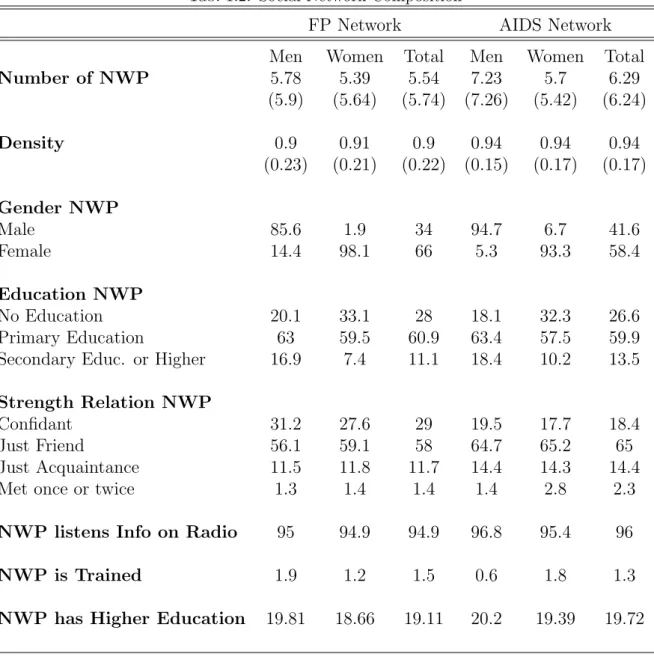
about family planning and HIV related issues. Starting with the overall composition we
see that family planning networks are smaller than the AIDS counterpart, and in both
situations men tend to choose more conversational partners. Moreover, both networks
are particularly dense6
, the latter being even denser (94% of the partners are connected,
while in the first network this share falls slightly to 90%).
In both networks there is a high gender clustering, where the majority of people choose
conversational partners of their own gender. However, one important remark should be
made: men seem to gender diversify more when talking about family planning, reporting
14.4% of women in their family planning network against 5.3% in the AIDS network.
This result suggests that men seek information on contraception methods from women,
who are more likely to be informed about such methods, while they talk more about
sex-ual transmitted diseases, that are linked with their own risky behaviors, with other men.
Depending on the network or gender, between 43% and 54% of the partners are friends.
Education of network partners follows the same pattern as education of respondents, with
about 60% of the partners having primary education.
An insightful analysis at this point is to check for significant differences in size and
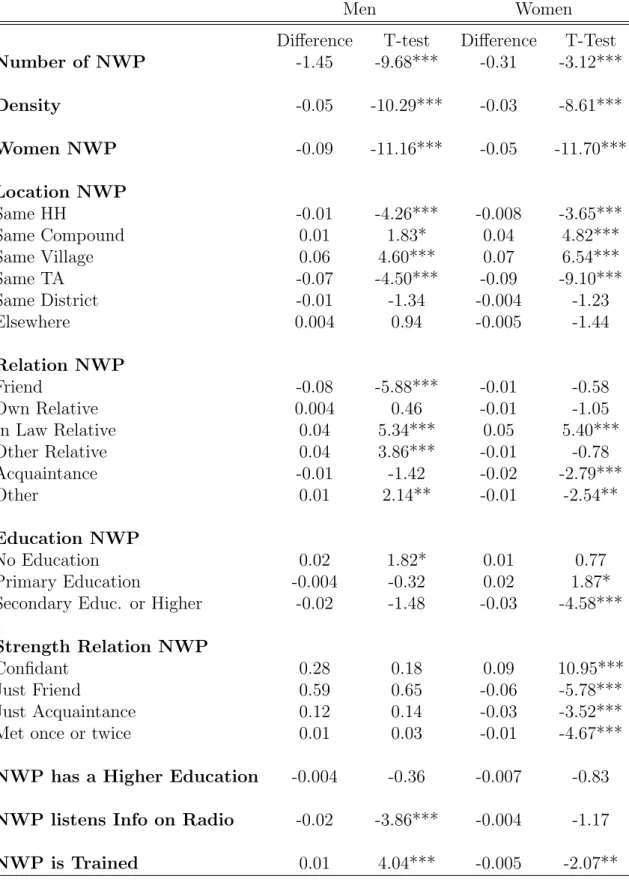
composition of both networks. T-statistics of such differences are reported in Table 1.3.
Men and women have similar behaviors when forming family planning and HIV
conver-sational networks: for both genders the AIDS network is higher as well as denser. This
suggests that although individuals are trying to reach more information, they are not
diversifying their connections to a greater extent, which might indicate the cost of
estab-lishing a link discussed in 1.2. Both men and women significantly decrease the proportion
of in-law relatives in their networks which, is consistent with the reluctance to discuss
sensitive issues. Concerning the potential information that each network partner may
6
The density was computed by dividing all relationships between network members by the total possible connections between the network member.
provide the individual, data show that women have a higher proportion of partners with
secondary schooling in the AIDS network as well as trained partners, while men prefer
those who listen to family-planning and AIDS information on the radio. Overall results
show for both men and women significant differences in the composition of the networks,
which strengthens our selectivity theory.
Finally, a useful measure is the proportion of individuals common people across both
networks. According to our reasoning, if people were not choosing strategically their
network partners, and were randomly allocated to a set of individuals, the relationships
built to discuss different subjects should not vary much, as establishing a link is costly.
This would mean that the overlap between both networks should be large. Data show
that the proportion of common partners across both networks is 27% and 24% for men
and women, respectively. This reinforces the idea that an individual, when deciding
whether or not to establish a conversational relationship measures the benefits that that
potential partner brings.
1.5 Empirical Analysis
1.5.1 Network Selectivity
Econometric Specification
Our main objective is to investigate the determinants of establishing a conversational link
between two potential partners. More specifically, we wish to understand if an
individ-ual chooses, from among the pool of partners with whom he discusses family planning
matters, the ones that he perceives to provide him the most valuable information to chat
with about AIDS.
As suggested in Section 1.2, one of the key issues in network formation modeling is the
definition of the pool of available partners. In the context of rural economies, researchers
example.) Not only do these proxies perhaps inaccurately represent one’s possibilities
of interaction, but they also are only possible to identify when the whole population is
surveyed. As a way to overcome these limitations of the standard definitions of possible
network links, we investigate whether people are strategically choosing those with whom
they chat by focusing on the family planning issues conversational network, as the pool
of available partners. From this set of possible links, we investigate how these network
partners are chosen to be part of the network built to discuss HIV-related matters.
This approach is key to our analysis: first, it is a natural candidate for the pool of
avail-able partners as it refers only to individuals with whom the respondent can relate with
relative ease, so that they are actually in the choice set. Second, and more importantly,
this approach allows us to assume that the establishment of this new conversational topic
is a one-way decision, as the decision to initiate a conversation about an alternative topic
is likely to be unilateral.
We posit that once a relationship is established, the decision to talk about a different
subject is driven by (i) the social distance between individuals, i.e., the difference in
their attributes, and (ii) the information that the potential conversational partner can
provide the individual with, on that particular subject. Assuming that an increase in
information is never costly, we have that only the person who initiates the conversation
bears the social distance cost. For this purpose we rely on the model presented in Section
2 and assume a linear function of the variables introduced. To estimate our parameters
we consider the following empirical specification:
Yij =αZj+βZjHi+γφ+δφ 2
+ζ|Xi−Xj|+fi +ǫij (1.6)
Where:
• Yi is a binary variable that assumes the value one when agent i chats about AIDS
with the family planning conversational partner j.
• Zj is the perceived level of information provided by the potential partner (whether
he has a higher education level than the respondent, whether he listens to
informa-tional programs on the radio about family planning, or whether he is considered a
trained network partner, e.g., nurse, doctor, VCT counselor).
• Hi stands for the incentive for information seeking that is measured by the risk
perception (see below for detail).
• φis the relative density of potential partnerj within the AIDS network of individual
i.
• |Xi −Xj| represents the distance between the two potential partners and includes
whether they are from the same gender, whether they live in the same household,
village, compound, traditional authority, district or elsewhere, whether they are
friends, relatives, acquaintances, or have a more distant relationships and whether
they share the same religious habits.
• ǫij is a random term.
To account for any individual unobserved tendency to have larger networks, and since
we have up to four observations per individual (one for each family planning network
partner), we include individual fixed effects. This inclusion limits us to the use of
lin-ear models due to the incidental parameter problem, according to which the maximum
likelihood estimator for a probit or logit model with fixed effects is both biased and
in-consistent (Neyman and Scott (1948) and Lancaster (2000)). Standard errors are robust
and clustered at the individual level.
Below we present a detailed description of the included variables, especially those that
are more important to our identification model.
Heterogeneity in benefits from adding a link depending on ego’s characteristics -Incentives for Information Seeking (Hi)
according to their perception of being infected with HIV. This perceived likelihood was
obtained directly from the questionnaire:
• A41a - In your opinion, what is the likelihood (chance) that you are infected with
HIV/AIDS now?
Possible answers are High Likelihood / Medium Likelihood / Low Likelihood / No
Like-lihood. For our purposes we construct a binary measure distinguishing between those
who report a high or medium perceived likelihood from those who report none or a low
likelihood.
At the bottom of Table 1.1 we describe individuals according to the perceived likelihood
of infection and we see that overall, people perceive themselves as having no or low
likeli-hood of being infected with HIV/AIDS. This result is even sharper for men, where 72.1%
report not being infected, compared to 61.2% for women.
Heterogeneity in benefits from adding a link depending on alter’s characteristics - The Information Value (Zj and φ)
We posit that people act strategically when building their social networks meaning that
the characteristics of the potential partners are likely to play a significant role. According
to this strategic behavior individuals are seeking reliable information, such that they
choose as network partners those who are perceived to provide them with the most
helpful information. We distinguish between the specific individual information that
each network member can deliver and the relative increase in information. We define
as individual-specific information the pieces of knowledge that can be assessed by the
decision-maker about the potential partner from their interaction in the family planning
network. We focus on:
• Higher Education - whether or not the potential partner has achieved a higher
education level than the respondent
• Trained Partner - whether or not the potential partner is a family planning
coun-selor, nurse, doctor, or health surveillance assistant
• Radio Information - whether or not the potential partner listens to news about
family planning on the radio.
At the bottom of Table 1.2 we report the proportion of network partners with,
respec-tively, a higher education than the network partner, is training in health-related issues,
and listens to information about family planning on the radio. Data show that, on
av-erage, 20% of the peers have a higher education than the ego of the network. The other
information measures have a lower variability, with 2% of trained network partners and
95% listening to information on the radio.
Concerning the relative information value, we focus on the relative number of
con-nections that each potential partner has, as it measures the degree of new information
inflow in the network. According to the theoretical model, the ideal measure would be
the connections that each potential partner had with the members that were included
in the network at that point in time. Our data have the limitation of not providing the
chronological order according to which links were made, which prevents us from
measur-ing the relative connectedness of each potential partner with the alters already present
in the network. As an alternative measure, we capture this effect using the relative
con-nectedness of each potential partner with all members of the network, regardless of the
timing on entrance. We rely on the following question:
• Finally, I would like briefly to ask you how well all the people you told me you chat
with about both AIDS and family planning know each other. For each pair that I
mention, please tell me whether they are confidants, just friends, acquaintances, or
they do not know each other.
We construct a measure φ that represents the relative density of each member of the
family planning network partner with the members of the AIDS network. This variable
is defined as the number of connections that each partner has with the all members of
the network (family, friendship, or other) over the total number of possible connections.
partners, the more likely it is that they have already shared information and hence, the
less useful it will be. In our analytical sample, the average relative density from each
network partner is 56%, with a standard deviation of 21%.
As stated in Section 1.2, the relative density is likely to have a non-linear effect. On
the one hand, individuals should require a given level of familiarity between individuals
in order to chat about sensitive issues, such as HIV, meaning that people would prefer
to establish relationships with those who are already connected with the rest of the
network. On the other hand, as the degree of connectedness increases, the novelty of the
information that potential partner provides decreases, meaning that from an information
seeking perspective, that partner is less useful, which should reduce the probability of
link between the two individuals. We exploit this non-linear relationship between the
relative density and the probability of a family planning network partner being chosen
to be part of the AIDS network partner by including in the regression both the relative
density and its square.
Heterogeneity in cost depending on social distance (|Xi−Xj|)
Our theoretical model suggests that one of the main determinants of the establishment
of a link between two potential partners is the cost of beginning and maintaining such
relationship. Sociologists and economists have long studied the homophyly phenomenon,
according to which people tend to relate with those potential partners that are more
alike.
In order to capture the homophily concept, we have focused on four different
dimen-sions of social distance: gender, location of network partner relative to the individual,
type of relationships and relative degree of religiosity. With this set of variables we seek
to measure the physical and social distance between the respondent and the potential
partner. For the gender effect we constructed a binary variable that represents whether
the two have the same gender. To measure the relative location of the network partner
we used a categorical variable that indicates whether they live in the same household,
same compound, same village, same traditional authority, or further apart. For the type
of relationship, we distinguish between friendship, own-relatives, in-law relatives, other
relatives, acquaintances, or further apart. Finally, as a way to measure the degree of
reli-giosity, we use the habit of becoming a New Born7
if one is Christian or making Tauba8 if
one is Muslim, by constructing a categorical variable that indicates if they had the same
behavior toward their own religion 9 .
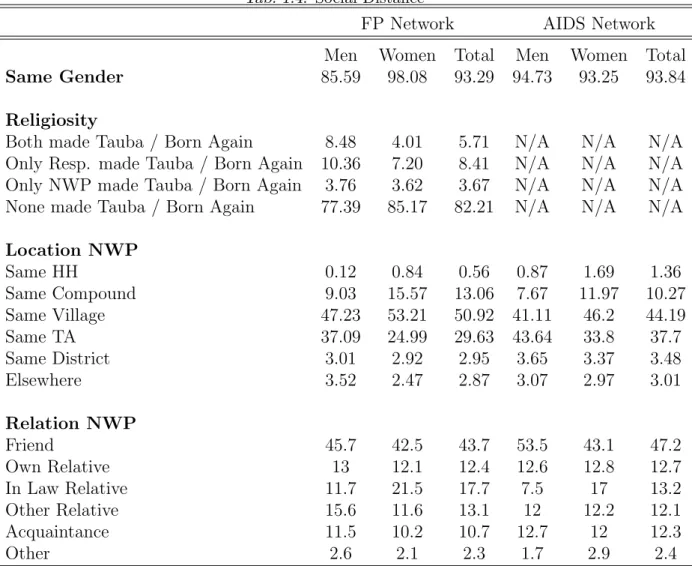
Table 1.4 reports the social distance descriptive statistics. As seen above, the majority
of individuals choose gender-according conversational partners although men report a
higher proportion of women in their AIDS network compared to the family planning
counterpart. Also, we see that, on average, 80% of the network partners are from the
same village or traditional authority. An important analysis should be made at this
point: there is an important difference between the location of the individuals chosen
to discuss family planning issues and the ones chosen to discuss HIV-related issues. In
fact, men (women) report less 6.6% (16.7%) and 13% (35%) of network partners living
in the same household or compound and in the same village, respectively, on the AIDS
network. Moreover, they report an increase of 17.7% (35%) of network partners from the
same traditional authority. This pattern of location suggests that when the relationship is
formed to discuss HIV-related matters, that are likely to be more sensitive and to involve
riskier behaviors, individuals choose partners that are further away. This pattern is also
present in the type of relationship, with the decrease of the share of the in-law relatives.
Concerning the degree of religiosity10
, measured by the decision to make a strong
religious commitment by becoming a Born Again (if the individual is Christian) or to
making Tauba (if the individual is Mulsim), we have that most links appear between
7
Born Agains created moral geographies from the ideological position of Christian Fundamentalim and thereby came to a number of different conceptualizations of what the good and evil spaces actually are and how they can be established. From the early 1970s, Malawi’s urban centers saw the rise of a number of Christian fundamentalist groups and organizations led by young itinerant preachers, that preached a doctrine of strict morality.
8
Tauba in Arabic literally means to return, i.e., acts of leaving what God has prohibited and returning to what he was commanded. It has been appointed as representing an equivalent religious commitment as the Born Again for Christians, if the individual is a Muslim.
9
individuals that have not engaged in such commitments. However, the data show (not
reported) that 40.46% of network partners of individuals that have made Tauba have
also made it, while the analagous proportion for respondents who have not made Tauba
is only 4.28%.
Results
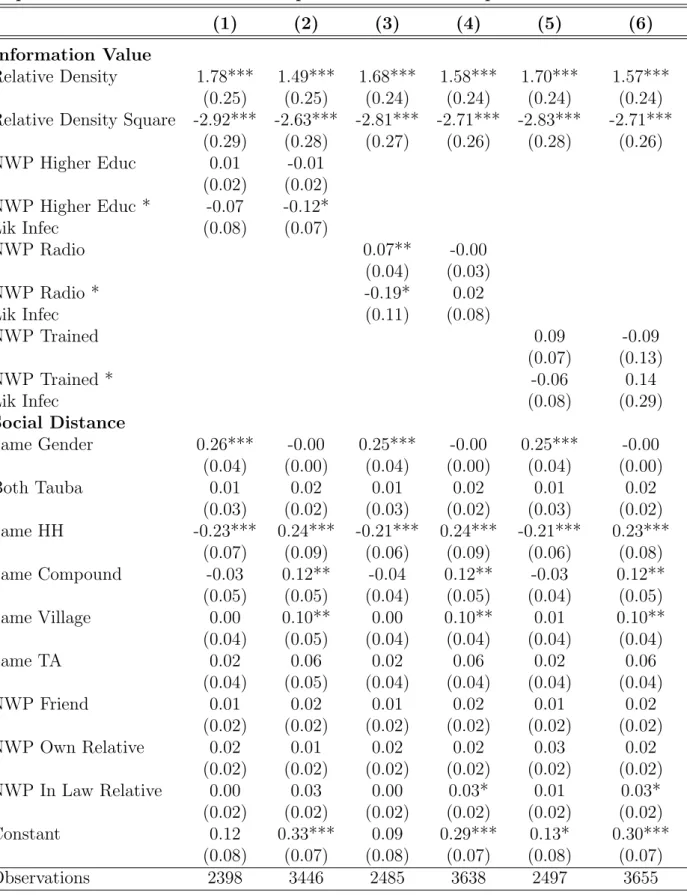
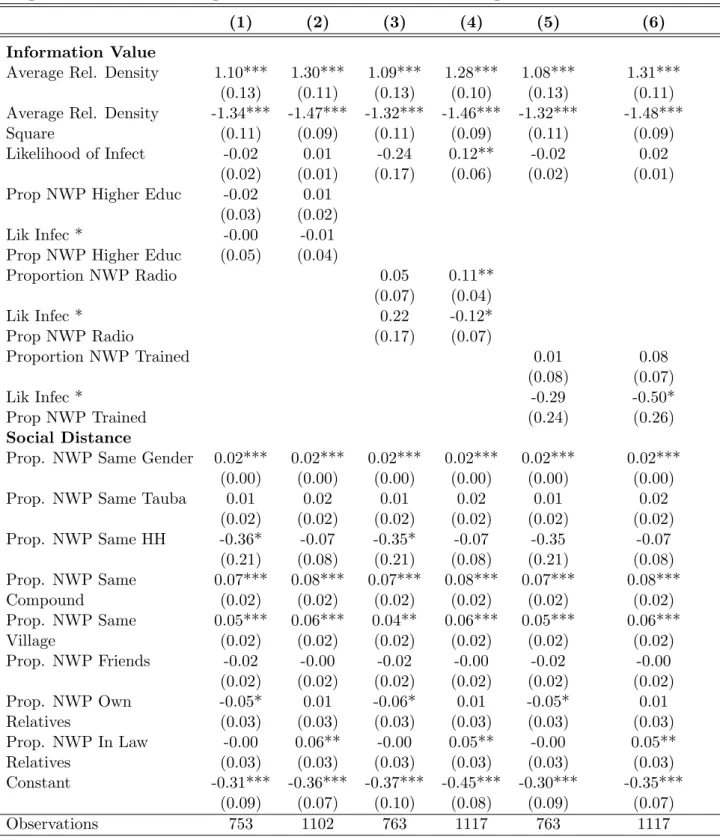
Results are presented in Table 1.5. The model is estimated by Ordinary Least Squares
(OLS) and results are split by gender. Odd columns present estimations for men, and
even for women. In columns 1 and 2 the information variable considered is whether or
not the potential partner has a higher education than the individual, columns 3 and 4
whether the potential partner listens to radio information about family planning, and in
columns 5 and 6 we consider whether he is a trained partner.
The main goal of this paper is to study if people are strategically seeking information.
The overall level of new knowledge of a potential partner is measured by his relative
connectedness with the remaining members of the network. The higher the degree of
connectedness, the lower the novelty of the information. Nevertheless, each ego may
require a certain level of familiarity to chat about HIV. This prediction is confirmed
em-pirically, through the coefficient estimated for both the relative connectedness of each
partner and its square. For men the probability of the link being established increases
until the relative connectedness reaches 61%. The maximum impact is achieved when
it reaches 30%, where a marginal increase in φ increases the probability of the potential
partner being included in the AIDS network by 27 p.p. For women, the maximum impact
is lower (21 p.p.) and is obtained when the relative density is 28%. While this could
suggest that women value more the diversification of information, in spite of the impact
on the probability of link establishment being lower, differences across genders are not
large.
People base their decisions not only on the overall novelty of information, but also on
the perceived specific knowledge of the potential partner. Results show that both men
and women are strategic in network formation, specifically targeting individuals who are
expected to provide them with better information. However, the characteristics that they
use to infer the access to information from their partners are different. Women who have
a low likelihood of being infected increase the probability of establishing a link with a
potential partner by 12.4 p.p. if he has a higher education level. Men who perceive
themselves not to be infected increase the probability of establishing a link by 18.6 p.p. if
the potential partner listens to news and information slots on the radio. Overall we have
that people believing themselves not to be infected value their HIV negative status, and
try to preserve it. As they believe they have something to protect, they seek information
from more qualified partners in order to maintain their HIV- status. This significant
dif-ference between behaviors according to the perceived likelihood of infection could reveal
a fatalistic behavior from those who believe themselves to be infected.
The social distance results reflect the pattern that was already anticipated by the
descrip-tive statistics. Men have an increased probability of talking with men about HIV/AIDS
and across all specifications women talk more with those potential partners that are
ge-ographically closer.
In conclusion, we find that people target specific individuals in order to access
informa-tion. This conclusion provides valuable guidelines to mass media campaigns. Information
campaigns do not substitute for social networks because people look to their peers for
information, especially for new and qualified one. Therefore, campaigns could focus on
identifying the key players in each network and target those individuals. As individuals
strategically seek information in their network, this will improve the efficiency of the
message in a two-fold way: on the one hand, it is a way of passing the information at
stake to the social network level. On the other hand, as it should target only a subset of
1.5.2 Overlap Between Networks
Econometric Specification
Choosing one by one whether or not to chat with a potential partner about HIV, each
respondent ends up creating a conversational network. Another measure that helps us
understand how the individual is creating and shaping the network, working as a
robust-ness check for the previous results, is the proportion of common partners between both
networks. We define this proportion as the total number of partners from the family
planning network that the individual chooses to be part of the AIDS network divided
by the family planning network size. To model this decision we rely on the following
econometric specification:
prop commoni = α∗average Zj +β∗average Hi∗Zj+γ∗average φ+ (1.7)
δ(average φ)2
+ζ∗average |Xi −Xj|+η∗Xi+ǫi
whereprop commoni stands for the proportion of common partners between the two
net-works and Xi is a set of controls for the respondent 11
(risk perception, age, age squared,
education, earnings, the number of children, and the roof material). All the other
vari-ables are the same as defined before. Also, standard errors are robust to
heteroskedas-ticity.
Results
Results are presented in Table 1.6. This robustness check confirms our findings on the
individual selection of each network partner. We find that the average relative density
has a non-linear effect on both men and women. It increases the proportion of family
planning network partners chosen to be part of the new network up until a relative
den-sity of 82% for men (88% for women). This reinforces our argument that people require
11
As we are looking at one decision per individual in a cross section (and not relying on the dyads) we cannot use fixed effects, and hence must control for individual characteristics.
a given level of familiarity between network members up until the point the information
that circulates within the network becomes redundant, when the individual starts seeking
partners elsewhere. Considering our individual information measures, the data show that,
on average, men do not vary the proportion of common partners according to the average
information level. However, women report a behavior that is consistent with what was
found previously at the individual level: women who are less likely to be infected with
HIV report a higher overlap the higher the proportion of network partners who listen to
news on the radio. In fact, if the proportion of people who listen to the radio increases
by 10 percentage points, the proportion of family planning network partners chosen
in-creases by 1.1 p.p. Moreover, we find that women who perceive themselves to be infected
significantly decrease this overlap the higher the proportion of trained partners. This
last finding might suggest an alternative mechanism behind the strategic formation of
social networks according to which people who believe themselves to be infected distance
themselves from qualified nurses and doctors who can identify them as HIV positive,
in order to keep their status in secrecy. Being so, health professionals should reinforce
the fight of social stigma when thinking about their line of action, as well as consider
explaining the benefits of anti-retroviral therapy in order to give the proper incentives
to infected individuals. More, since this effect is only significant in women, a campaign
that focuses on the possibility of preventing mother-to-child transmission (if the infected
mother-to-be is receiving the adequate treatment) might have a significant impact.
1.6 Conclusion
HIV has become a pandemic since its appearance in the 1980s, causing millions of deaths.
Due to the human and economic tragedy associated with the disease, it has become
ex-tremely important to design appropriate policies such as informational campaigns in order
to deter the spread of the epidemic. For that, an important issue is to identify where
Study of Families and Health, that contains detailed data on conversational networks,
we compare individual choices of conversational partners between the networks created
to discuss family planning and the one to discuss HIV-related issues. If networks were
constructed randomly, there should be limited differences in the composition of different
networks for the same individual, as establishing a link is costly.
Results show that both men and women are strategic in network formation,
specif-ically targeting individuals who are perceived to provide them with better information.
However, the characteristics that they use to infer the access to information from their
partners are different. Women who have a low likelihood of being infected increase the
probability of choosing a partner with a higher education by 12.4 p.p. Men who
per-ceive themselves not to be infected (or have a low likelihood of infection) increase the
probability of establishing a link by 18.6 p.p. if the potential partner listens to news and
information slots on the radio. Overall we have that people who believe themselves not
to be infected seek information from more qualified partners in order to maintain their
HIV- status. This difference between behaviors according to the perceived likelihood
of infection could also indicate a fatalistic behavior from those who believe themselves
to be infected. Policy makers should not only promote campaigns that provide people
incentives to protect themselves from the disease, but should also seek to instil infected
people with an altruistic behavior, providing them with information on how to protect
others which could potentially decrease the spread of the disease.
In conclusion, we find that people target specific individuals when forming
conversa-tional networks in order to access information. This finding provides valuable guidelines
to mass media campaigns. Information campaigns do not substitute for social networks,
as people look to their peers for information, especially for new and qualified
informa-tion. Taking this complementarity into account, campaigns should focus on identifying
the key players, i.e., those who are sought out by the ones seeking information, in each
network, and target those individuals. As individuals strategically seek information in
their network, this will improve the efficiency of the message in a two-fold way: on the
one hand, it is a way of passing the information at stake to the social network level. On
the other hand, as it targets only specific individuals it allows for a reduction in the costs
BIBLIOGRAPHY
Bala, B. and Goyal, S. (1999). A non-cooperative theory of network formation.
Tin-bergen Institute Discussion Papers,25 (1), Tinbergen Institute.
Behrman, J. R., Kohler, H.-P. and Watkins, S. C. (2002). Social networks and
changes in contraceptive use over time: Evidence from a longitudinal study in rural
Kenya. Demography, 39 (4), 713–738.
Bignami Van-Assche, S., Reniers, G. and Weinreb, A. (2003). An assessment
of the KDICP and MDICP data quality: Interviewer effects, question reliability and
sample attrition.Demographic Research, 1 (2), 31–76.
Brock, W. and Durlauf, S. N. (2001). Interactions-Based Models, Elvesier Science,
chap. 54, pp. 3297–3380.
CIA (2011).World Fact Book. Tech. rep., CIA.
Conley, T. and Udry, C. (2001). Social learning through networks: The adoption of
new agricultural technologies in Ghana. American Journal of Agricultural Economics,
83 (3), 668–73.
Cubitt, R. and Sugden, R. (1998). The selection of preferences through imitation.
Review of Economic Studies, 65, 761–771.
Fafchamps, M.and Gubert, F.(2007). Risk sharing and network formation. Journal
of Development Economics, 83 (2), 326–350.
Gerland, P. (2004). Paper presented at the Annual Meeting of the Population
Helleringer, S.and Kohler, H.-P. (2005). Social networks, perceptions of risk and
changing attitudes towards HIV/AIDS: New evidence from a longitudinal study using
fixed-effects estimation.Population Studies, 59 (3), 265–282.
Holden, R. (1987). Time series analysis of a contagious process. American Statistical
Association, 82 (400), 1019–1026.
Jackson, A.(1972). A model for determining information diffusion in a family planning
program. Journal of Marriage and the Family, 34 (3), 503–513.
Kohler, H.-P. (1997). Learning in social networks and contraceptive choice.
Demogra-phy, 34 (3), 369–381.
—,Behrman, J. R. and Watkins, S. C.(2007). Social networks and HIV/AIDS risk
perceptions. Demography, 44 (1), 1–33.
Lancaster, T.(2000). The incidental parameter problem since 1948.Journal of
Econo-metrics, 95, 391–413.
Manski, C. (1993). Identification of endogenous social effects: The reflection problem.
The Review of Economic Studies, 60 (3), 531–542.
McPherson, M., Smith-Lovin, L. and Cook, J. M. (2001). Birts of a feather:
Homophily in social networks. Annual Review of Sociology, 27, 414–444.
Montgomery, M., Kiros, G.-E., Agyeman, D., Casterline, J., Aglobitse, P.
and Hewett, P. (2001). Social networks and contraceptive dynamics in Southern
Ghana.Policy Research Division Working Paper, 153, Population Council, New York.
Neyman, J. and Scott, E. (1948). Consistent estimation from partially consistent
observations. Econometrica,16, 132.
Rosero-Bixby, L. and Casterline, J. (1993). Modelling diffusion effects in fertility
Schatz, E.(2002).Paper Presented at the Annual Meeting of the Population Association
of America, Atlanta, USA. u in.
UNAIDS ().Report on the Global AIDS Epidemic. Tech. rep.
UNGASS (2010). Country Progress Report : Malawi HIV and AIDS Monitoring and
Evaluation Report: 2008-2009. Tech. rep., UNGASS.
Wasserman, S. and Faust, K. (1994). Social Network Analysis: Methods and
Appli-cations. Press Sindicate of the University of Cambridge.
Zulu, E. and Chepngeno, G. (2003). Spousal communication about the risk of
con-tracting HIV/AIDS in rural malawi.Demographic Research, 1, 247278.
Tab. 1.1: Descriptive Statistics
Men Women Total
Education Level
No schooling 18 33.6 27.6
Primary Schooling 69 60.1 63.5
Secondary Schooling 13 6.3 8.9
Marital Status
Married 97.24 90.51 93.11
Divorced 0.41 1.03 0.79
Separated 1.43 5.06 3.66
Widowed 0.92 3.4 2.44
Age Categories
Less than 30 years 13.6 33.7 24.7
30 - 40 years 21.4 25.9 23.9
40 - 50 years 15.8 16.4 16.1
More than 50 years 49.2 24.1 35.3
Earnings 133.66 57.25 91.25
(267.77) (213.15) (242)
Number of Children 2.77 2.95 2.87
(3.12) (2.47) (2.78)
Roof Material
Metal 10.23 10.29 10.26
Thatch 89.49 89.71 89.63
Other 0.28 0.0 0.11
Perceived Likelihood of Infection
No Likelihood 72.1 61.2 65.6
Low Likelihood 17.4 21.3 19.7
Medium Likelihood 6.1 7.3 6.8
High Likelihood 4.4 10.2 7.8
Tab. 1.2: Social Network Composition
FP Network AIDS Network
Men Women Total Men Women Total
Number of NWP 5.78 5.39 5.54 7.23 5.7 6.29
(5.9) (5.64) (5.74) (7.26) (5.42) (6.24)
Density 0.9 0.91 0.9 0.94 0.94 0.94
(0.23) (0.21) (0.22) (0.15) (0.17) (0.17)
Gender NWP
Male 85.6 1.9 34 94.7 6.7 41.6
Female 14.4 98.1 66 5.3 93.3 58.4
Education NWP
No Education 20.1 33.1 28 18.1 32.3 26.6
Primary Education 63 59.5 60.9 63.4 57.5 59.9
Secondary Educ. or Higher 16.9 7.4 11.1 18.4 10.2 13.5
Strength Relation NWP
Confidant 31.2 27.6 29 19.5 17.7 18.4
Just Friend 56.1 59.1 58 64.7 65.2 65
Just Acquaintance 11.5 11.8 11.7 14.4 14.3 14.4
Met once or twice 1.3 1.4 1.4 1.4 2.8 2.3
NWP listens Info on Radio 95 94.9 94.9 96.8 95.4 96
NWP is Trained 1.9 1.2 1.5 0.6 1.8 1.3
NWP has Higher Education 19.81 18.66 19.11 20.2 19.39 19.72
NWP = Network Partner
Proportion or average (with standard deviation in parentheses, when applicable)