Article
0103 - 5053 $6.00+0.00
*e-mail: [email protected]
Synthesis of New 4-Methyl-2-(4-pyridyl)-1,2,3,4-tetrahydroquinolines
as Potent Antifungal Compounds
Leonor Y. Vargas Méndez,a Susana A. Zacchinob and Vladimir V. Kouznetsov*,c
aGrupo de Investigaciones Ambientales, Universidad Santo Tomas, A.A. 1076, Bucaramanga, Colombia bLaboratorio de Farmacognosia, Universidad Nacional del Rosario, Suipacha 531, Rosario, Argentina
cLaboratorio de Química Orgánica y Biomolecular, Universidad Industrial de Santander,
A. A. 678, Bucaramanga, Colombia
A síntese, a caracterização espectroscópica e os resultados biológicos de novas séries de 2-(4-piridil)-1,2,3,4-tetrahidroquinolinas e seus precursores, -N-aril-N-[1-(4-piridil)but-3-enil] aminas, são descritos. Foi encontrado que ambos, precursores substituídos γ-piridil e os produtos inais, as tetrahidroquinolinas, demonstraram excelentes atividades antifúngicas contra Aspergillus fumigatus, Aspergillus lavus, Aspergillus niger, Microsporum gypseun, Trichophyton rubrum e
Trichophyton mentagrophytes.
Synthesis, spectral characterization and biological results of new series of 2-(4-pyridyl)-1,2,3,4-tetrahydroquinolines and their closer precursors, -N-aryl-N-[1-(4-pyridyl)but-3-enyl] amines are reported. It was found that both γ-pyridyl substituted precursors and inal products, tetrahydroquinolines, showed very good antifungal activities against Aspergillus fumigatus,
Aspergillus lavus, Aspergillus niger, Microsporum gypseun, Trichophyton rubrum and Trichophyton mentagrophytes.
Keywords: homoallylamines, 2-(4-pyridyl)-1,2,3,4-tetrahydroquinolines, antifungal activity
Introduction
Both alicyclic and cyclic secondary amines are widely used throughout the chemical industry as basic intermediates to prepare ine chemicals, pharmaceuticals and agrochemicals.1,2 Moreover, they are one of the
most common structural features of naturally occurring biologically active compounds. Due to their unique biological properties, these compounds have played an important role in chemotherapeutic approaches to a variety of diseases, including fungal infectious diseases. These compounds serve as interesting pharmacological models in biomedicine studies. So, chemistry and biology of these compounds have received considerable attention from both the theoretical and practical points of view.
As a part of our ongoing drug discovery program we have been actively involved in determining the features that are important for antifungal activities of N-pyridylmethylanilines, and N-aryl-N-[1-(3-pyridyl)
but-3-enyl]amines (“homoallylamines”), easily accessible from aldimines. Both type of compounds displayed signiicant activity (MIC < 50 µg mL-1) against some
pathogenic dermatophytes.3-6 We found also that some
4-methyl-1,2,3,4-tetrahydroquinolines are active against yeasts, hialohyphomycetes as well as dermatophytes. A point of connection between homoallylamines and tetrahydroquinolines, apart from their similar type of bioactivity, is that the irst ones are suitable precursors for the corresponding 2,4-substituted 1,2,3,4-tetrahydroquinolines via acid-promoted intramolecular 6-exo-trig cyclization, that was described in 1994 by our team.7,8 These facts
Synthesis of New 4-Methyl-2-(4-pyridyl)-1,2,3,4-tetrahydroquinolines J. Braz. Chem. Soc. 106
Results and Discussion
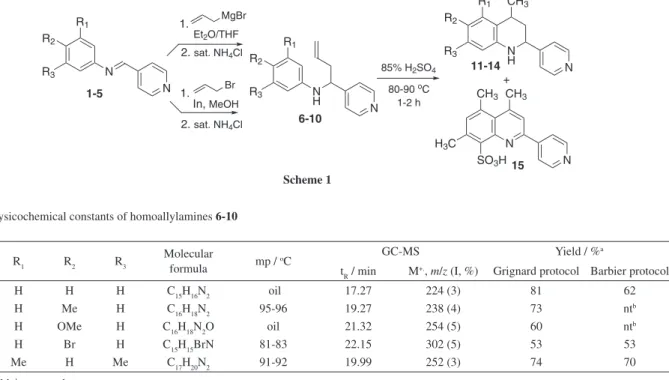
The series of homoallylamines 6-10 were prepared using both standard Grignard and Barbier procedures9
with prepared in situ allyl bromide magnesium in ether and with allyl bromide/indium/methanol system, respectively. Performing this later procedure, a mixture of allyl bromide (3 mmol), powder indio (1.5 mmol) and aldimines 1-5 (1 mmol) in dry MeOH was stirred at room temperature until the complete dissolution of metal, taking 1-4 h to obtain the desired products. Classical Grignard protocol consists in the addition of an ether solution of aldimines to preformed allyl magnesium bromide in ether that affords desired amine products. Thus, this nucleophilic addition was realized in ether (or THF) at 20 oC and, after stirring for
4 h, the reaction mixture was treated with saturated NH4Cl solution. The organic products were extracted affording the homoallylamines 6-10 in 53-81% yields (Scheme 1, Table 1). It is worth noting that the use of ether is limited by the solubility of utilized aldimines.
Each of these procedures demonstrated some advantages and disadvantages: traditional Grignard protocol needs to use commercial, expensive organometallic reagent and dry solvents that are toxic and expensive, but magnesium is an easily available and inexpensive metal. Barbier protocol does not need to form organometallic reagent and dry solvents, but indium is still a very expensive metal to perform scale-up preparation of precursor compounds.
Homoallylamines 6-10 were easily characterized by IR (νNH 3273 and 3293 cm-1), 1H-NMR, and Mass Spectra.
This later technique demonstrated that molecular ions were of low intensity (< 5%) and the principal fragmentation of these compounds were due to the lost of allyl radical [M-41]+, that generates ArNHCHPy+-cations.101H-NMR
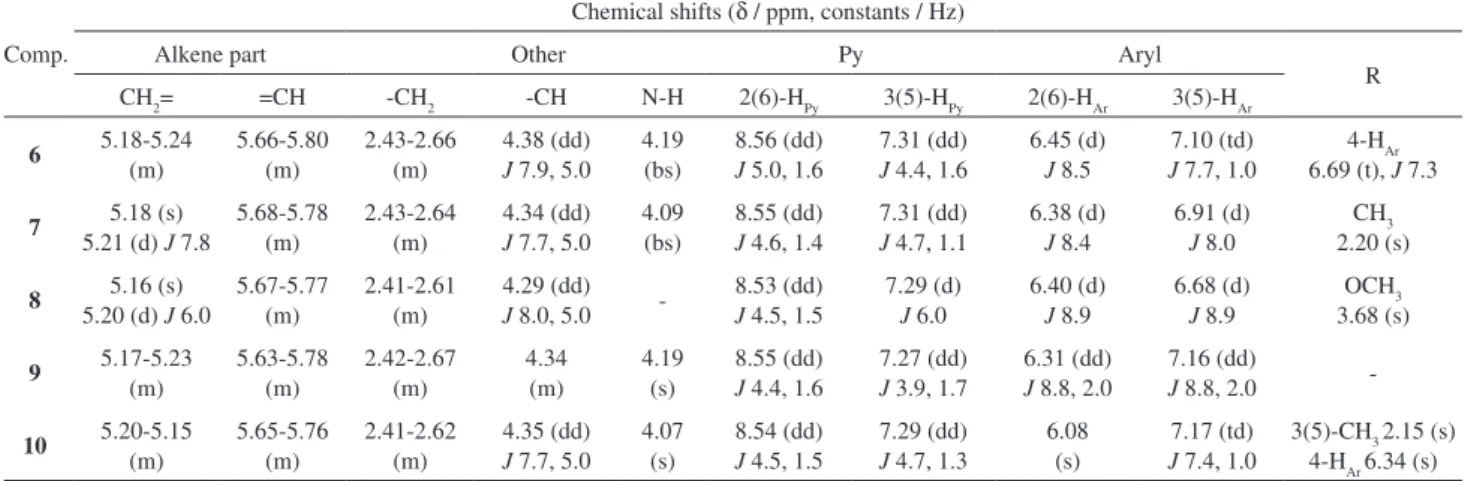
spectra of homoallylamines 6-10 were very similar one each other, and were characterized by the presence of three groups of signals, which resonated in different zones (Table 2).
Preparation of desired 1,2,3,4-tetrahydroquinolines 11-14 consisted in the simple treatment of obtained homoallylamines mainly with sulfuric acid (85%). This mixture was heated at 80-90 oC during 1-5 h. Final products
were isolated, and then purified by alumina column chromatography. In the case of homoallylamine 8, PPA was used as mild cycling agent, because its treatment with sulfuric acid gave a complex mixture of inseparable products. It should be also noted that during the sulfuric acid catalysis of homoallylamine 10, quinoline sulfonic acid 15 was formed as a sulfonation and oxidation product in considerable yields (Table 3). The structure of each inal product was strongly conirmed by NMR (1H, 13C), IR and
GC-MS data.
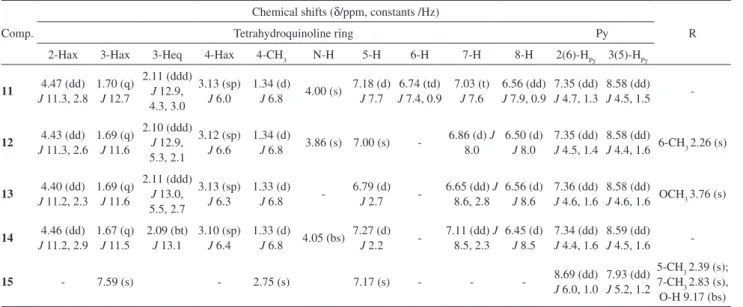
Analysing GC-MS and NMR data, it was noted that inal products 11-14 presented a mixture of two diastereomers (cis and trans) from different spatial orientation of the substituents at C-2 and C-4 positions. GC-MS data indicated that the cis:trans ratio for comp. 11-14 were: 68:32; 79:21; 88:12 and 91:9, respectively. From NMR studies it was possible to assign cis-form for major isomer. This was corroborated by the protons 2-H, 3-H and 4-H coupling
Table 1. Physicochemical constants of homoallylamines 6-10
Comp. R1 R2 R3 Molecular
formula mp /
oC GC-MS Yield / %
a
tR / min M+., m/z (I, %) Grignard protocol Barbier protocol
6 H H H C15H16N2 oil 17.27 224 (3) 81 62
7 H Me H C16H18N2 95-96 19.27 238 (4) 73 ntb
8 H OMe H C16H18N2O oil 21.32 254 (5) 60 ntb
9 H Br H C15H15BrN 81-83 22.15 302 (5) 53 53
10 Me H Me C17H20N2 91-92 19.99 252 (3) 74 70
aisolated yield. bnot tested.
Scheme 1 N N R1 R2 R3 N H R1 R3 R2 MgBr Et2O/THF
N 6-10
1-5
In, MeOH Br N H CH3 R1 R3 R2 N 11-14 N CH3 CH3
H3C
N
15
+
85% H2SO4 80-90 oC
1-2 h
SO3H
1.
2. sat. NH4Cl
1.
constants (J2ax,3ax 11.2-11.3 Hz, J2ax,3eq 2.3-2.9 Hz and J4ax,3eq 6.0-6.9 Hz, and J4ax,3ax 11.5-12.7 Hz), afirmation enough to indicate the equatorial-equatorial (cis) relationship to the case (Table 4). Figure 1 shows both diastereomeric forms. All our attempts in the separation of these diastereomers by gravity column chromatography failed in our hands, only the major diastereomer of comp. 13 was isolated and characterized as a pure cis-form.
The antifungal properties of compounds 6-14 were evaluated by the microbroth dilution method following the guidelines of the Clinical and Laboratory Standard Institute (CLSI, formerly National Committee for Clinical and Laboratory Standards (NCCLS) against a panel of ten fungal species: four human opportunistic pathogenic yeasts, three hialohyphomycetes and three dermatophytes. To carry out the antifungal evaluation, concentrations of compounds up to 250 µg mL-1 were incorporated to
growth media according to published procedures.11,12 The
three most clinically used type of antifungal drugs were used as positive controls: the polyene Amphotericin B, the allylamine terbinaine and the azole ketoconazole. Biological results on fungal inhibition of the prepared molecules are summarized in Tables 5,6.
Regarding the activity displayed by homoallylamines 6-10 against the three most active fungal species, M. gypseum, T. rubrum and T. mentagrophytes, it appears that a substituent in the p-position produces an enhancement of the antifungal activity since 11 out the 12 MIC values of compounds 7-9 are lower than the corresponding MICs of compound 6. In addition, the electronic properties of the p-substituents could play a role in the antifungal activity since compound 9 with aelectron-withdrawing substituent (Br) was more active (MIC range = 16-31.2 µg mL-1) than
compounds 7 and 8, which contain electron-donating
groups (CH3 and OCH3) and their MICs range were 25-125 µg mL-1. Another interesting observation is that
methyl groups in both, the positions C-3 and C-5, do not signiicantly modify the activity (compare the activity of 6 with 10).
Regarding tetrahydroquinolines, the high activity displayed by compound 11, clearly showed that the closing of the ring dramatically enhanced the activity of the
Table 3. Physicochemical parameters of THQ 11-14 and quinoline 15
Comp. R1 R2 R3 Molecular formula mp / oC IR
(νNH / cm-1)
GC-MS tR / min
M+, m/z
(I / %) Yield / %
a
11 H H H C15H16N2 88-90 3266 20.06/20.29 224 (9)/244 (91) 84
12 H Me H C16H18N2 138-139 3299 20.78/21.84 238(10)/238(100) 72
13 H OMe H C16H18N2O 113-115 3267 22.74 254(100) 54
14 H Br H C15H15BrN2 104-106 3256 23.30/24.05 304(5)/304(97) 68
15 Me H Me C17H16N2O3S 239-240 -- 26.06 264(100) 56
aisolated yield.
Figure 1. Spatial representation of cis-2eq,4eq and trans-2eq,4ax forms for the 2,4-disubstituted tetrahydroquinolines.
N
H3C
Ha Py Ha He Ha H R1
R2 R3
N He Ha Py Ha He CH3 H R1
R2 R3
cis-form trans-form
Table 2.1H MNR data of 4-N-aryl-N-[1-(4-pyridyl)buten-3-yl]amines 6-10
Comp.
Chemical shifts (δ / ppm, constants / Hz)
Alkene part Other Py Aryl
R CH2= =CH -CH2 -CH N-H 2(6)-HPy 3(5)-HPy 2(6)-HAr 3(5)-HAr
6 5.18-5.24 (m) 5.66-5.80 (m) 2.43-2.66 (m) 4.38 (dd) J 7.9, 5.0
4.19 (bs)
8.56 (dd) J 5.0, 1.6
7.31 (dd) J 4.4, 1.6
6.45 (d) J 8.5
7.10 (td) J 7.7, 1.0
4-HAr 6.69 (t), J 7.3
7 5.18 (s)
5.21 (d) J 7.8
5.68-5.78 (m)
2.43-2.64 (m)
4.34 (dd) J 7.7, 5.0
4.09 (bs)
8.55 (dd) J 4.6, 1.4
7.31 (dd) J 4.7, 1.1
6.38 (d) J 8.4 6.91 (d) J 8.0 CH3 2.20 (s)
8 5.16 (s)
5.20 (d) J 6.0
5.67-5.77 (m)
2.41-2.61 (m)
4.29 (dd) J 8.0, 5.0
-8.53 (dd) J 4.5, 1.5
7.29 (d) J 6.0 6.40 (d) J 8.9 6.68 (d) J 8.9 OCH3 3.68 (s) 9 5.17-5.23 (m) 5.63-5.78 (m) 2.42-2.67 (m) 4.34 (m) 4.19 (s) 8.55 (dd) J 4.4, 1.6
7.27 (dd) J 3.9, 1.7
6.31 (dd) J 8.8, 2.0
7.16 (dd)
J 8.8, 2.0
-10 5.20-5.15 (m) 5.65-5.76 (m) 2.41-2.62 (m) 4.35 (dd) J 7.7, 5.0
4.07 (s)
8.54 (dd) J 4.5, 1.5
7.29 (dd) J 4.7, 1.3
6.08 (s)
7.17 (td) J 7.4, 1.0
Synthesis of New 4-Methyl-2-(4-pyridyl)-1,2,3,4-tetrahydroquinolines J. Braz. Chem. Soc. 108
unsubstituted homoallylamine 6, although the same was not observed for substituted homoallylamines 7-9. Compound 11 showed a broad spectrum of action inhibiting all fungi tested with MICs between 8 and 125 µg mL-1. It was highly
active against Aspergillus spp. (MIC = 31.2 µg mL-1) and
mainly against dermatophytes (MIC = 8 µg mL-1).
The fact that tetrahydroquinoline molecule 11 inhibited Aspergillus spp. is highly interesting since it is worthwhile to take in account that previous homoallylamine-derived tetrahydroquinolines did not show activity against Aspergillus species up to 50 µg mL-1.3,4
It is well known13 that invasive aspergillosis has
emerged as a leading cause of infection-related mortality
among immunocompromised individuals, in particular among recipients of hematopoietic stem cell transplants or solid organ transplants. Historically, the drug of choice for the treatment of invasive aspergillosis has been amphotericin B, followed by the newer medications voriconazole and the recently approved caspofungin, which appeared more effective and with fewer side effects than the polyene. However, although the last drugs have advanced the management of these fungal infections, failure rates remain high, and emergence of intrinsically resistant fungi is a growing problem.14 So, there is a general consensus that
the discovery of new structures acting against Aspergillus spp. is highly necessary.
Table 4.1H MNR data of tetrahydroquinolines 11-14 and quinoline 15
Comp.
Chemical shifts (δ/ppm, constants /Hz)
R
Tetrahydroquinoline ring Py
2-Hax 3-Hax 3-Heq 4-Hax 4-CH3 N-H 5-H 6-H 7-H 8-H 2(6)-HPy 3(5)-HPy
11 4.47 (dd)
J 11.3, 2.8 1.70 (q) J 12.7 2.11 (ddd) J 12.9, 4.3, 3.0 3.13 (sp) J 6.0 1.34 (d) J 6.8 4.00 (s)
7.18 (d) J 7.7
6.74 (td) J 7.4, 0.9
7.03 (t) J 7.6
6.56 (dd) J 7.9, 0.9
7.35 (dd) J 4.7, 1.3
8.58 (dd) J 4.5, 1.5
-12 4.43 (dd)
J 11.3, 2.6 1.69 (q) J 11.6 2.10 (ddd) J 12.9, 5.3, 2.1 3.12 (sp) J 6.6 1.34 (d)
J 6.8 3.86 (s) 7.00 (s)
-6.86 (d) J 8.0
6.50 (d) J 8.0
7.35 (dd) J 4.5, 1.4
8.58 (dd)
J 4.4, 1.6 6-CH3 2.26 (s)
13 4.40 (dd)
J 11.2, 2.3 1.69 (q) J 11.6 2.11 (ddd) J 13.0, 5.5, 2.7 3.13 (sp) J 6.3 1.33 (d) J 6.8
-6.79 (d) J 2.7
-6.65 (dd) J 8.6, 2.8
6.56 (d) J 8.6
7.36 (dd) J 4.6, 1.6
8.58 (dd)
J 4.6, 1.6 OCH3 3.76 (s) 14 4.46 (dd)
J 11.2, 2.9 1.67 (q) J 11.5 2.09 (bt) J 13.1 3.10 (sp) J 6.4 1.33 (d)
J 6.8 4.05 (bs) 7.27 (d)
J 2.2
-7.11 (dd) J 8.5, 2.3
6.45 (d) J 8.5
7.34 (dd) J 4.4, 1.6
8.59 (dd) J 4.5, 1.6
-15 - 7.59 (s) - 2.75 (s) 7.17 (s) - - - 8.69 (dd)
J 6.0, 1.0
7.93 (dd) J 5.2, 1.2
5-CH3 2.39 (s); 7-CH3 2.83 (s), O-H 9.17 (bs)
Table 5. Antifungal activity (MIC / µg mL-1) of prepared molecules 6-14
Comp. Ca1 Ct2 Sc3 Cn4 Afu5 Al6 An7 Mg8 Tr9 Tm10
6 250 250 125 250 250 250 250 125 250 62
7 >250 100 62 125 250 250 >250 25 50 50
8 >250 >250 >250 250 >250 >250 >250 62 125 125
9 >250 >250 250 >250 >250 >250 >250 16 16 32
10 250 250 250 >250 >250 >250 >250 125 250 125
11 125 125 125 125 32 32 32 8 8 8
12 >250 100 100 25 >250 >250 >250 25 50 25
13 125 125 125 125 32 125 250 62 62 62
14 >250 >250 >250 >250 >250 >250 >250 125 125 125
Amp. 1 0.5 0.5 0.25 0.5 0.5 0.5 - -
-Ket. 0.5 0.12 0.5 0.25 0.12 0.5 0.25 0.05 0.025 0.025
Terb. - - - 0.04 0.01 0.04
1Candida albicans ATCC 10231; 2Candida tropicalis C 131; 3Saccharomyces cerevisiae ATCC 9763; 4Cryptococcus neoformans ATCC 32264; 5Aspergillus
Regarding the activity of compounds 9 and 11 against dermatophytes, the most important indings are that these compounds display low MICs (16-32 and 8 µg mL-1, respectively) against both, T. rubrum and
T. mentagrophytes. It is worthwhile to take in account that approximately 80-93% of chronic and recurrent dermatophyte infections (tineas) are estimated to be caused
by Trichophyton spp.15 Although the treatment outcomes
of these infections have now been greatly improved with the azole itraconazole or the allylamine terbinaine, there is unfortunately a considerable overlap of the strategies for treating the different tineas. This lack of speciicity leads to chronic dermatophytoses or early re-infections after antifungal therapy and therefore, the supericial infections are very dificult to eradicate.15
The very low MIC displayed by compounds 9 and
11 against both Trichophyton spp. opens the possibility
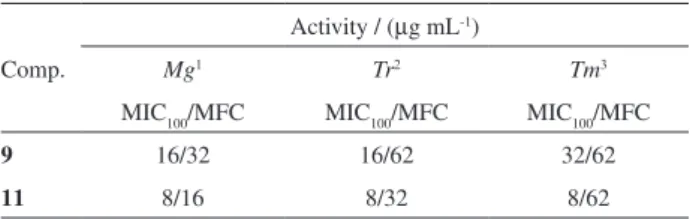
of using them as starting points for the development of new antifungal agents that selectively inhibit the most prevalent fungi in dermatomycoses. This hope is higher considering that both compounds not only inhibit but kill Trichophyton spp. (Minimum Fungicidal
Concentration = 62 µg mL-1 for compound 9 and
32-62 µg mL-1 for compound 11) (Table 6) adding one
of the needed requirements for being good candidates for future development.
In summary, we found that both γ-pyridyl substituted precursors, homoallylamines, and final products, tetrahydroquinolines, showed very good antifungal activities against A. fumigatus, A. flavus, A. niger
and the dermatophytes M. gypseum, T. rubrum and T.
mentagrophytes. Among the compounds tested, the homoallylamine 9 and the tetrahydroquinoline 11 displayed the best activities against dermatophytes. Compound 11 showed also a very good activity against Aspergillus spp. In addition, 9 and 11 showed to be fungicide rather than fungistatic against dermatophytes, results that permit to consider them as good candidates for the further development of new antifungal agents.
Experimental
The melting points (uncorrected) were determined on a Fisher-Johns melting point apparatus. The IR spectra were recorded on a Lumex Infralum FT-02 spectrophotometer
in KBr. 1H NMR spectra were recorded on Bruker
AM-400 spectrometer. Chemical shifts are reported in ppm (d) relative to the solvent peak (CHCl3 in CDCl3 at 7.24 ppm for protons). Signals are designated as follows: s, singlet; d, doublet; dd, doublet of doublets; ddd, doublet of doublets of doublets; t, triplet; td, triplet of doublets; q, quartet; sp, septet; m, multiplet; b, broad. On DEPT-135 spectra, the signals of CH3, CH2 and CH carbons are shown as positive (+) and negative (-), respectively. Quaternary carbons are not shown. A Hewlett Packard 5890a series II Gas Chromatograph interfaced to an HP 5972 Mass Selective Detector (MSD) with an HP MS Chemstation Data system was used for ms identiication at 70 EV using a 60 m capillary column coated with HP-5 [5%-phenyl-poly(dimethyl-siloxane)]. Elemental analyses were performed on a Perkin Elmer 2400 Series II analyzer and were within ±0.4 of theoretical values. The reaction progress was monitored using thin layer chromatography on a silufol UV254 TLC aluminum sheet.
General procedure for the preparation of 4-N-aryl-N-[1-(4-pyridyl)buten-3-yl]amines
Grignard protocol
To an Et2O solution (200 mL) of allyl magnesium bromide, prepared from allyl bromide (36.3 g, 0.30 mol) and magnesium (12.15 g, 0.50 mol), were added slowly aldimines 1-5 (0.10 mol), dissolved in absolute THF (50 mL). The mixture was kept during 4 h at room temperature, and then cooled to 0 oC to treat rapidly with water, and inally
with saturated ammonium chloride solution. The organic layer was separated and the aqueous layer was extracted with ether (4 × 50 mL). The combined organic extracts were dried (Na2SO4) and concentrated. The residue was puriied by Al2O3 column chromatography (eluent - hexanes/ ethyl acetate) to give new homoallylamines 6-10, those physicochemicalcharacteristics are shown in Tables 1,2.
Barbier protocol
To a mixture of aldimines 1, 4 and 5 (1 mmol) and powder indium (170 mg, 1.5 mmol) in methanol (10 mL) was added allyl bromide (365 mg, 3 mmol). The reaction mixture was stirred vigorously at room temperature until all the indium had dissolved (1 h to 4 h), at which time TLC indicated complete reaction. The reaction mixture was diluted with sat. NH4Cl solution and extracted with Table 6. MIC-100 and MFC (µg mL-1) of compounds 9 and 11 against
M. gypseum, T. rubrum y T. mentagrophytes
Comp.
Activity / (µg mL-1)
Mg1 Tr2 Tm3
MIC100/MFC MIC100/MFC MIC100/MFC
9 16/32 16/62 32/62
11 8/16 8/32 8/62
1Microsporum gypseum C 115; 2Trichophyton rubrum C 110;
Synthesis of New 4-Methyl-2-(4-pyridyl)-1,2,3,4-tetrahydroquinolines J. Braz. Chem. Soc. 110
ethyl acetate. The extract was washed with brine and dried (Na2SO4). The product was puriied by lash column chromatography on alumina, using hexanes/ethyl acetate as eluent. Physicochemicalcharacteristics of the obtained homoallylamines 6, 9 and 10 were in agreement with those obtained by Grignard method.
General procedure for the preparation of 4-methyl-2-(4-pyridyl)-1,2,3,4-tetrahydroquinolines
85% (v/v) sulfuric acid (4.0 mL) was added dropwise at 0 oC to the homoallylamines 6-10 (2.0 g) in minimal CH
2Cl2
amount, and the resulting mixture was heated at 80-90 oC
for 3 h while stirring vigorously. The reaction progress was monitored via TLC. At the end of the reaction the mixture was cooled down to room temperature and concentrated ammonium hydroxide solution was added to pH 10. Four 25 mL extractions with dichloromethane were performed. The organic layers were combined, dried (Na2SO4) and concentrated. The oily residue was puriied by column
chromatography over alumina to give new THQ 11-14 and
quinoline sulfonic acid 15. The synthesis of THQ 13 was realized using PPA. Physicochemicalcharacteristics of the obtained compounds are given in Table 3.
Antifungal evaluation
Microorganisms and media
For the antifungal evaluation, standardized strains from the American Type Culture Collection (ATCC), Rockville, MD, USA, and CEREMIC (C), Centro de Referencia en Micología, Facultad de Ciencias Bioquímicas y Farmacéuticas, Suipacha 531-(2000)-Rosario, Argentina were used: Candida albicans ATCC 10231, Saccharomyces cerevisiae ATCC 9763, Cryptococcus neoformans ATCC 32264, Aspergillus lavus ATCC 9170, A. fumigatus ATTC 26934, A. niger ATCC 9029, Trichophyton rubrum C 110, T. mentagrophytes ATCC 9972, and M. gypseum C 115.
Strains were grown on Sabouraud-chloramphenicol agar slants for 48 h at 30 oC, maintained on slopes of
Sabouraud-dextrose agar (SDA, Oxoid) and subcultured every 15 days to prevent pleomorphic transformations. Inocula of cell or spore suspensions were obtained according to reported procedures and adjusted to 1-5 ×10³ cells/spores with
colony forming units (CFU) mL-1.11,12
Antifungal susceptibility testing
Minimal Inhibitory Concentration (MIC) of each compound was determined by using broth microdilution techniques according to the guideliness of the CLSI (formerly NCCLS) M27-A211 and for ilamentous fungi
M 38 A.12 MIC values were determined in RPMI-1640
(Sigma, St Louis, Mo, USA) buffered to pH 7.0 with MOPS. Microtiter trays were incubated at 35 oC for yeasts
and hialohyphomycetes and at 28-30 oC for dermatophyte
strains in a moist, dark chamber, and MICs were visually recorded at 48 h for yeasts, and at a time according to the control fungus growth, for the rest of fungi.
Endpoints were deined as the lowest concentration of compound resulting in total inhibition (MIC100) of visual growth compared to the growth control wells which contain culture medium and fungal inoculum but no antifungal drug.
For the assay, stock solutions of pure compounds were two-fold diluted with RPMI from 250-0.95 µg mL-1 (inal
volume = 100 µL) and a inal DMSO concentration ≤ 1%.
A volume of 100 µL of inoculum suspension was added to
each well with the exception of the sterility control where sterile water was added to the well instead. Ketoconazole (Sigma Chem. Co.), Terbinaine (Novartis, Bs. As.) and Amphotericin B (Sigma Chem. Co.) were used as positive controls. All tests were made by duplicate.
The minimum fungicidal concentration (MFC) of each compound against each strain was determined as follows: After determining the MIC, an aliquot of 5 µL was withdrawn from each clear well of the microtiter tray and plated onto a 150-mm RPMI-1640 agar plate buffered with MOPS (Remel, Lenexa, Kans.). Inoculated plates were incubated at 30 °C, and MFC was recorded after 48 h. The MFC was deined as the lowest concentration of each compound that resulted in total inhibition of visible growth in the agarized plate.
Acknowledgments
LYVM thanks COLCIENCIAS for her fellowship. VK thanks Instituto Colombiano para el Desarrollo de la Ciencia y la Tecnología “Francisco José de Caldas” (COLCIENCIAS-CENIVAM, contract No. 432-2004) and DIEF-UIS (grant No. 5151). SAZ thanks Agencia de Promoción Científica y Tecnológica de Argentina (ANPCyT), grant PICT 995 and RIBIOFAR (CYTED).
Supplementary Information
Supplementary data are available free of charge at http://jbcs.sbq.org.br, as PDF ile.
References
2. Kuznetsov, V. V.; Andreeva, E. I.; Prostakov, N. S.; Khim. Farm. Zh. 1995, 29, 61. (CA, 1996, 124:48.290a).
3. Urbina, J. M. G.; Cortés, J. C.; Palma, A.; López, S. N.; Zacchino, S. A.; Enriz, D. R.; Ribas, J. C.; Kouznetsov, V.; Bioorg. Med. Chem. 2000, 8, 691.
4. Vargas Méndez, L. Y.; Castelli, M. V.; Kouznetsov, V. V.; Urbina, G. J. M.; López, S. N.; Sortino, M.; Enriz, R. D.; Ribas, J. C.; Zacchino, S. A.; Bioorg. Med. Chem. 2003, 11, 155. Suvire, D. F.; Sortino, M.; Kouznetsov, V. V.; Vargas Méndez, L. Y.; Zacchino, S. A.; Mora Cruz, U.; Enriz, R. D.; Bioorg. Med. Chem. 2006, 14, 1851.
6. Kouznetsov, V. V.; Vargas Méndez, L. Y.; Sortino, M.; Vásquez, Y.;Gupta, M. P.; Freile, M.; Enriz, R. D.; Zacchino, S. A.; Bioorg. Med. Chem. 2008, 16, 794.
7. Vargas Méndez, L.Y.; Kouznetsov,V.; Heterocycl. Commun.
2002, 8, 583.
8. Vargas Méndez, L. Y.; Kouznetsov,V.; Stashenko,E.; Bahsas, A.; Amaro-Luis,J.; Heterocycl. Commun. 2001, 7, 323. 9. Kouznetsov, V. V.; Vargas Méndez, L. Y.; Synthesis 2008, 491. 10. Mikaya, A. I.; Lantsetov, S. V.; Kuznetsov, V. V.; Varlamov, A.
V.; Prostakov, N. S.; Org. Mass Spectrom. 1991, 26, 763.
11. Clinical and Laboratory Standards Institute (CLSI, formerly National Committee for Clinical and Laboratory Standards NCCLS); Method M27-A2, 2nd ed, Wayne, ed.; NCCLS:
Pennsylvania, 2002, Vol. 22 (15), pp. 1-29.
12. Clinical and Laboratory Standards Institute (CLSI, formerly National Committee for Clinical and Laboratory Standards NCCLS); Method M-38A, 2nd ed, Wayne, ed.; NCCLS:
Pennsylvania, 2002, Vol. 22 (16), pp. 1-27.
13. Morgan, J.; Wannemuehler, K.; Marr, K.; Hadley, S.; Kontoyiannis, D.; Walsh, T.; Fridkin, S.; Pappas, P.; Warnock, D.; Med. Mycol. Suppl. 2005, 43, s49.
14. Maertens,J.; Raad, I.; Petrikkos, G.; Boogaerts, M.; Selleslag, D.; Petersen, F.; Sable, C.; Kartsonis, N.; Ngai, A.; Taylor, A.; Patterson, T.; Denning, D.; Walsh, T.J.; Clin. Infectious Diseases
2004, 39, 1563.
15. Weitzman, I.; Summerbell, R.; Clin. Microbiol. Rev. 1995, 8, 240.
16. Ablordeppey, S.; Fan, P.; Ablordeppey, J.; Mardenborough, L.; Curr. Med. Chem. 1999, 6, 1151.
Received: April 21, 2009
Supplementary Information
J. Braz. Chem. Soc., Vol. 21, No. 1, S1-S8, 2010. Printed in Brazil - ©2010 Sociedade Brasileira de Química 0103 - 5053 $6.00+0.00*e-mail: [email protected]
Synthesis of New 4-Methyl-2-(4-pyridyl)-1,2,3,4-tetrahydroquinolines
as Potent Antifungal Compounds
Leonor Y. Vargas Méndez,a Susana A. Zacchinob and Vladimir V. Kouznetsov*,c
aGrupo de Investigaciones Ambientales, Universidad Santo Tomas, A.A. 1076, Bucaramanga, Colombia bLaboratorio de Farmacognosia, Universidad Nacional del Rosario, Suipacha 531, Rosario, Argentina
cLaboratorio de Química Orgánica y Biomolecular, Universidad Industrial de Santander,
A. A. 678, Bucaramanga, Colombia
Experimental
The melting points (uncorrected) were determined on a Fisher-Johns melting point apparatus. The IR spectra were recorded on a Lumex Infralum FT-02 spectrophotometer
in KBr. 1H NMR spectra were recorded on Bruker
AM-400 spectrometer. Chemical shifts are reported in ppm (d) relative to the solvent peak (CHCl3 in CDCl3 at 7.24 ppm for protons). Signals are designated as follows: s, singlet; d, doublet; dd, doublet of doublets; ddd, doublet of doublets of doublets; t, triplet; dt, doublet of triplets; td, triplet of doublets; q, quartet; quint., quintet; sext., sextet; m, multiplet; br, broad. On DEPT-135 spectra, the signals of CH3, CH2 and CH carbons are shown as positive (+) and negative (−), respectively. Quaternary carbons are not shown. A Hewlett Packard 5890a series II Gas Chromatograph interfaced to an HP 5972 Mass Selective Detector (MSD) with an hp ms Chemstation Data system was used for ms identiication at 70 EV using a 60 m capillary column coated with HP-5 [5%-phenyl-poly(dimethyl-siloxane)]. Elemental analyses were performed on a Perkin Elmer 2400 Series II analyzer and were within ±0.4 of theoretical values. The reaction progress was monitored using thin layer chromatography on a silufol UV254 TLC aluminum sheet.
General procedure for the preparation of 4-N-aryl-N-[1-(4-pyridyl)buten-3-yl]amines
Grignard protocol
To an Et2O solution (200 mL) of allyl magnesium
bromide, prepared from allyl bromide (36.3 g, 0.30 mol) and magnesium (12.15 g, 0.50 mol), were added slowly
aldimines 1-5 (0.10 mol), dissolved in absolute THF
(15 mL). The mixture was kept during 4 h at room
temperature, and then cooled to 0 oC to treat rapidly
with water, and finally with saturated ammonium chloride solution. The organic layer was separated and the aqueous layer was extracted with ether (4×50 mL).
The combined organic extracts were dried (Na2SO4) and
concentrated. The residue was puriied by Al2O3 column
chromatography (eluent - hexanes/ethyl acetate) to give new homoallylamines 6-10.
Barbier protocol
To a mixture of aldimines 1, 4 and 5 (1 mmol) and
powder indium (170 mg, 1.5 mmol) in methanol (10 mL) was added allyl bromide (365 mg, 3 mmol). The reaction mixture was stirred vigorously at room temperature until all the indium had dissolved (1 h to 4 h), at which time TLC indicated complete reaction. The reaction mixture
was diluted with sat. NH4Cl and extracted with ethyl
acetate. The extract was washed with brine and dried
(Na2SO4). The product was purified by flash column
chromatography on alumina, using hexanes/ethyl acetate as eluent. Physicochemical characteristics of the obtained homoallylamines 6, 9 and 10 were in agreement with those obtained by Grignard method.
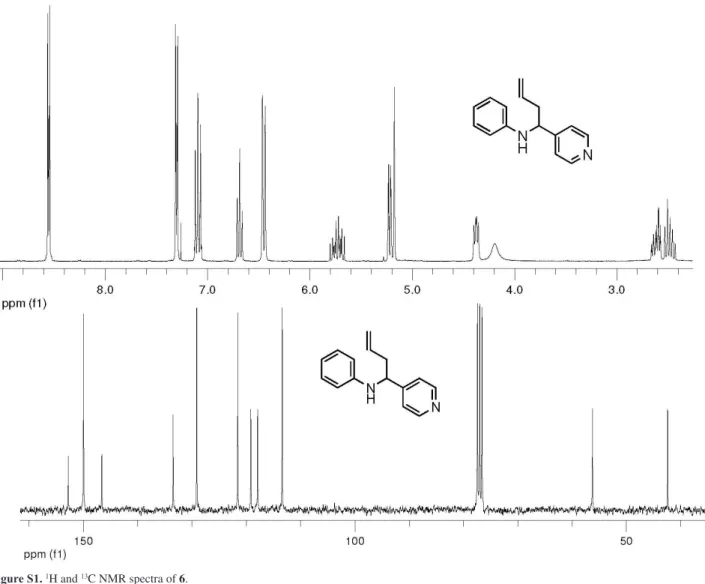
4-N-Phenyl -N-[1-(4-pyridyl)buten-3-yl]amine 6
Yellow viscous oil. Yield: 81%. Molecular formula: C15H16N2. Molecular weight: 224.30 g mol-1. Eluent:
petroleum eter/AcOEt, 10:1. IR (KBr) νmax/cm-1: 3287
(νNH), 1601 (νC=CH). 1H-NMR (CDCl
3, 400 MHz) d (ppm):
2.43-2.66 (2H, m, −CH2), 4.19 (1H, bs, N-H), 4.38 (1H, dd,
J 7.9, 5.0 Hz, -CH), 5.18-5.24 (2H, m, =CH2), 5.66-5.80
(1H, m, =CH), 6.45 (2H, d, J 8.5 Hz, 2(6)-HPh), 6.69 (1H,
tt, J 7.3 Hz, 4-HPh), 7.10 (2H, td, J 7.7, 1.0 Hz, 3(5)-HPh), 7.31 (2H, dd, J 4.4, 1.6 Hz, 3(5)-HPy), 8.56 (2H, dd, J 5.0,
Figure S1.1H and 13C NMR spectra of 6.
56.2, 113.4 (2C), 117.9, 119.1, 121.6 (2C), 129.1 (2C),
146.6, 133.5, 150.0 (2C), 152.8. GC: tR 17.27 min. MS:
m/z (%): 224 (M+, 3), 183 (100), 77 (11), 51 (4). Anal.
calc. for C15H16N2: C, 80.32; H, 7.19; N, 12.49. Found: C,
80.54; H, 7.04; N, 12.40.
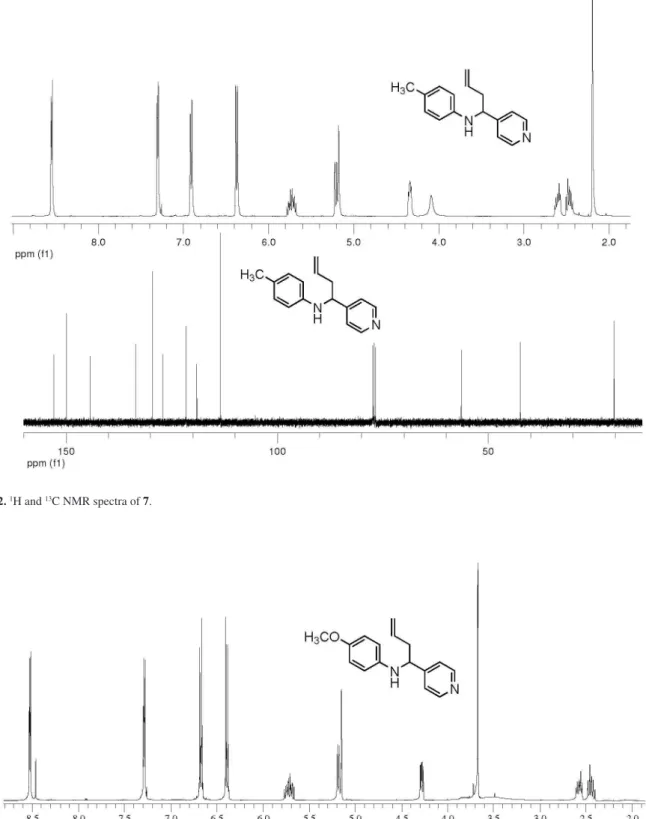
4-N-(4-Methylphenyl)-N-[1-(4-pyridyl)buten-3-yl]amine 7
White crystals. mp 95-96 oC. Yield: 73%. Molecular
formula: C16H18N2. Molecular weight: 238.33 g mol-1.
Eluent: petroleum eter/AcOEt, 20:1. IR (KBr) νmax/cm-1:
3273 (νNH), 1599 (νC=CH). 1H-NMR (CDCl
3, 400 MHz) d
(ppm): 2.20 (3H, s, CH3), 2.43-2.64 (2H, m, −CH2), 4.09
(1H, br. s, N-H), 4.34 (1H, dd, J 7.7, 5.0 Hz, −CH), 5.18
(1H, s, CHA=), 5.21 (1H, d, J 7.8 Hz, CHB=), 5.68-5.78
(1H, m, =CH), 6.38 (2H, d, J 8.4 Hz, 2(6)-HAr), 6.91 (2H,
d, J 8.0 Hz, 3(5)-HAr), 7.31 (2H, dd, J 4.7, 1.1 Hz, 3(5)-HPy), 8.55 (2H, dd, J 4.6, 1.4 Hz, 2(6)-HPy). 13C-NMR (100
MHz) d (ppm): 20.3, 42.4 (-), 56.4 (+), 113.4 (2C, +), 119.0
(-), 121.6 (2C, +), 127.0, 129.6 (2C, +), 133.6 (+), 144.3,
150.0 (2C, +), 152.9. GC: tR 19.27 min. MS: m/z (%): 238
(M+, 4), 197 (100), 91 (8), 65 (4). Anal. calc. for C
16H16N2:
C, 80.63; H, 7.61; N, 11.75. Found: C, 80.51; H, 7.49; N,
12.05.
4-N-(4-Methoxyphenyl)-N-[1-(4-pyridyl)buten-3-yl]amine 8 Yellow viscous oil. Yield: 60%. Molecular formula: C16H18N2O. Molecular weight: 254.33 g mol-1. Eluent:
petroleum eter/AcOEt, 20:1. IR (KBr)νmax/cm-1: 3294
(νNH), 1597 (dNH).
1H-NMR (CDCl
3, 400 MHz) d (ppm):
2.41-2.61 (2H, m, -CH2), 3.68 (3H, s, OCH3), 4.29 (1H,
dd, J 8.0, 5.0 Hz, -CH), 5.16 (1H, s, CHB=), 5.20 (1H, d,
J 6.0 Hz, CHA=), 5.67-5.77 (1H, m, =CH), 6.40 (2H, d, J
8.9 Hz, 2(6)-HAr), 6.68 (2H, d, J 8.9 Hz, 3(5)-HAr), 7.29
(2H, d, J 6.0 Hz, 3(5)-HPy), 8.53 (2H, dd, J 4.5, 1.5 Hz,
2(6)-HPy). 13C-NMR (100 MHz) d (ppm): 42.4, 55.6, 57.0,
114.5 (2C), 114.7 (2C), 119.0, 121.6 (2C), 133.6, 140.8,
149.8 (2C), 152.2, 153.1. GC: tR 21.32 min. MS: m/z (%):
254 (M+, 5), 213 (100), 198 (4), 169 (7). Anal. calc. for
Méndez et al. 3 Vol. 21, No. 1, 2010
Figure S2.1H and 13C NMR spectra of 7.
Figure S3.1H NMR spectrum of 8.
4-N-(4-Bromophenyl)-N-[1-(4-pyridyl)buten-3-yl]amine 9
Yellow crystalls. mp 81-83 oC. Yield: 53%. Molecular
formula: C15H15BrN2. Molecular weight: 303.20 g mol-1.
Eluent: petroleum eter/AcOEt, 10:1. IR (KBr) νmax /cm-1:
3275 (νNH), 1594 (νC=CH) cm-1. 1H-NMR (CDCl
3, 300 MHz)
d (ppm): 2.42-2.67 (2H, m, −CH2), 4.19 (1H, bs, N-H), 4.34
(1H, m, -CH), 5.17-5.23 (2H, m, CH2=), 5.63-5.78 (1H,
m, =CH), 6.31 (2H, dd, J 8.8, 2.0 Hz, 2(6)-HAr), 7.16 (2H,
(75 MHz) d (ppm): 42.3, 56.2, 109.7, 115.0 (2C), 119.5, 121.5 (2C), 128.1, 131.9 (2C), 133.2, 145.5, 150.0, 150.1. GC: tR 22.15 min. MS: m/z (%): 302 (M+ for 79Br, 5), 261
[(M-C3H5)+, 100]. Anal. calc. for C
15H15BrN2: C, 59.42; H,
4.99; N, 9.24. Found: C, 59.75; H, 5.21; N, 9.56.
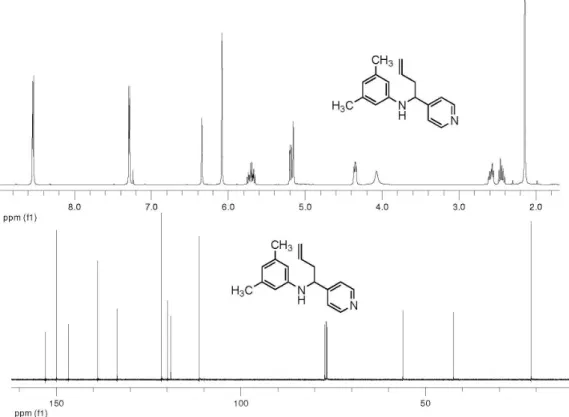
4-N-(3,5-Dimethylphenyl)-N-[1-(4-pyridyl)buten-3-yl] amine 10
White crystals. Mp 91-92 oC. Yield: 74%. Molecular
formula: C17H20N2. Molecular weight: 252.35 g mol-1.
Eluent: petroleum eter/AcOEt, 10:1. IR (KBr) νmax /cm-1:
3293 (νNH), 1603 (νC=CH). 1H-NMR (CDCl
3, 400 MHz) d
(ppm): 2.15 (6H, s, 3(5)-CH3), 2.41-2.62 (2H, m, -CH2),
4.07 (1H, bs, N-H), 4.35 (1H, dd, J 7.7, 5.0 Hz, -CH),
5.20-5.15 (2H, m, CH2=), 5.65-5.76 (1H, m, =CH), 6.08
(2H, s, 2(6)-HAr), 6.34 (1H, s, 4-HAr), 7.29 (2H, dd, J 4.7, 1.3 Hz, 3(5)-HPy), 8.54 (2H, dd, J 4.5, 1.5 Hz, 2(6)-HPy).
13C-NMR (100 MHz) d (ppm): 21.4 (2C), 42.4, 56.2,
111.3 (2C), 119.0, 119.9, 121.5 (2C), 133.6, 138.8 (2C),
146.8, 150.0 (2C), 152.9. GC: tR 19.99 min. MS: m/z (%):
252 (M+, 3), 211 (100), 105 (5), 77 (7). Anal. calc. for
C17H20N2: C, 80.91; H, 7.99; N, 11.10. Found: C, 81.14;
H, 7.70; N, 11.21.
General procedure for the preparation of 4-methyl-
2-(4-pyridyl)-1,2,3,4-tetrahydro-quinolines
85% (v/v) sulfuric acid (4.0 mL) was added dropwise at
0 oC to the homoallylamines 6-10 (2.0 g) in minimal CH
2Cl2
amount, and the resulting mixture was heated at 80-90 oC
for 3 h while stirring vigorously. The reaction progress was
monitored via TLC. At the end of the reaction the mixture
Figure S4.1H NMR spectrum of 9.
was cooled down to room temperature and concentrated ammonium hydroxide solution was added to pH 10. Four 25 mL extractions with dichloromethane were performed.
The organic layers were combined, dried (Na2SO4) and
concentrated. The oily residue was puriied by column chromatography over alumina to give new THQ 11-14 and quinoline sulfonic acid 15. The synthesis of THQ 13 was realized using PPA.
4-Methyl-2-(4-pyridyl)-1,2,3,4-tetrahydroquinoline 11
White crystals. mp 88-90 oC. Yield: 84%. Molecular
formula: C15H16N2. Molecular weight: 224.30 g mol-1.
Eluent: petroleum eter/AcOEt, 5:1. IR (KBr) νmax/cm-1:
3266 (νNH). 1H-NMR (CDCl
3, 400 MHz) d (ppm):
cis Isomer: 1.34 (3H, d, J 6.8 Hz, 4-CH3), 1.70 (1H, c, J
12.7 Hz, 3-Ha), 2.11 (1H, ddd, J 12.9, 4.3, 3.0 Hz, 3-He),
3.13 (1H, sp, J 6.0 Hz, 4-H), 4.00 (1H, s, NH), 4.47 (1H,
Table S1. Possible fragmentation and principal ions in the MS of homoallylamines 6-10
Compound m
/z (I/%)
M+•
Φ1 [M-C3H5•]+
6 224 (3) 183 (100)
7 238 (4) 197 (100)
8 254 (5) 213 (100)
9 302 (5) 261 (100)
Méndez et al. 5 Vol. 21, No. 1, 2010
Figure S5.1H and 13C NMR spectra of 10.
dd, J 11.3, 2.8 Hz, 2-H), 6.56 (1H, dd, J 7.9, 0.9 Hz, 8-H), 6.74 (1H, td, J 7.4, 0.9 Hz, 6-H), 7.03 (1H, t, J 7.6 Hz, 7-H),
7.18 (1H, d, J 7.7 Hz, 5-H), 7.35 (2H, dd, J 4.7, 1.3 Hz,
3(5)-HPy), 8.58 (2H, dd, J 4.5, 1.5 Hz, 2(6)-HPy). 13C-NMR
(100 MHz) d (ppm): 20.1, 31.1, 41.2, 56.0, 114.4, 118.2,
121.6 (2C), 126.0, 126.9, 127.1, 144.1, 150.2 (2C), 153.4.
GC: tR 20.06 min. MS: m/z (%): 224 (M+, 9), 132 (100),
117 (28), 93 (29), 77 (5). tR 20.29 min. 224 (M+, 91), 209
(46), 146 (100), 130 (24), 117 (15), 104 (7), 91 (11), 77 (14), 51 (8). Anal. calc. for C15H16N2: C, 80.32; H, 7.19; N,
12.49. Found: C, 80.34; H, 7.23; N, 12.51.
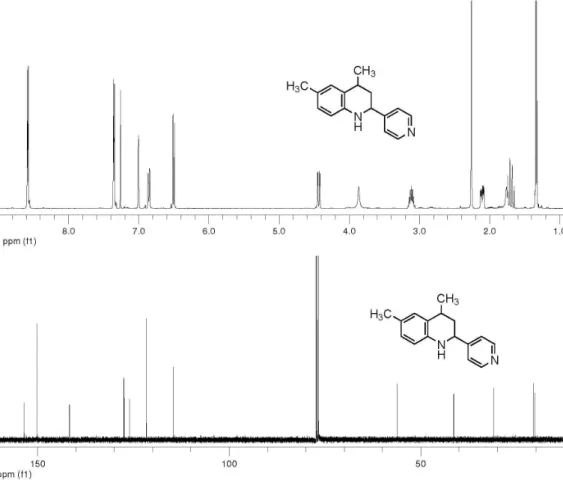
4,6-Dimethyl-2-(4-pyridyl)-1,2,3,4-tetrahydroquinoline 12
White crystals. mp 138-139 oC. Yield: 72%. Molecular
formula: C16H18N2. Molecular weight: 238.33 g mol-1.
Eluent: petroleum eter/AcOEt, 5:1. IR (KBr) νmax/cm-1:
3273 (νNH) cm-1. 1H-NMR (CDCl
3, 400 MHz) d (ppm): cis Isomer: 1.34 (3H, d, J 6.8 Hz, 4-CH3), 1.69 (1H, c, J 11.6
Hz, 3-Ha), 2.10 (1H, ddd, J 12.9, 5.3, 2.1 Hz, 3-He), 2.26
(3H, s, 6-CH3), 3.12 (1H, sp, J 6.6 Hz, 4-H), 3.86 (1H, bs,
NH), 4.43 (1H, dd, J 11.3, 2.6 Hz, 2-H), 6.50 (1H, d, J 8.0
Hz, 8-H), 6.86 (1H, d, J 8.0 Hz, 7-H), 7.00 (1H, s, 5-H), 7.35 (2H, dd, J 4.5, 1.4 Hz, 3(5)-HPy), 8.58 (2H, dd, J 4.4, 1.6 Hz,
2(6)-HPy). 13C-NMR (100 MHz) d (ppm): 20.2, 20.6, 31.1,
41.4, 56.1, 114.6, 121.6 (2C), 126.0, 127.3, 127.5, 127.6,
141.7, 150.1 (2C), 153.5. GC: tR 20.78 min. MS: m/z (%):
238 (M+, 10), 146 (100), 131 (26), 93 (25). t
R 21.84 min. 238
(M+, 100), 223 (44), 160 (83), 144 (20), 130 (12), 115 (8),
91 (8), 51 (6). Anal. calc. for C16H16N2: C, 80.63; H, 7.61;
N, 11.75. Found: C, 80.33; H, 7.57; N, 12.02.
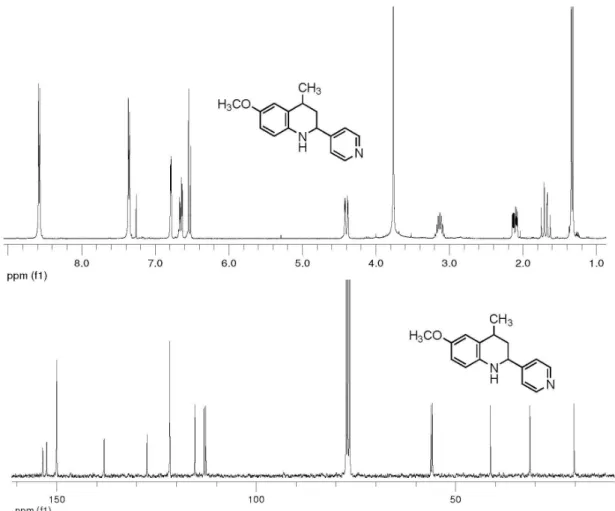
4-Methyl-6-methoxy-2-(4-pyridyl)-1,2,3,4-tetrahydro-quinoline 13
Yellow crystals. mp 113-115 oC. Yield: 54%. Molecular
formula: C16H18N2O. Molecular weight: 254.33 g mol-1.
Eluent: petroleum eter/AcOEt, 1:1. IR (KBr) νmax/cm-1:
3267 (νNH). 1H-NMR (CDCl
3, 300 MHz) d (ppm):
cis Isomer: 1.33 (3H, d, J 6.8 Hz, 4-CH3), 1.69 (1H, c, J
11.6 Hz, 3-Ha), 2.11 (1H, ddd, J 13.0, 5.5, 2.7 Hz, 3-He),
3.13 (1H, sp, J 6.3 Hz, 4-H), 3.76 (3H, s OCH3), 4.40 (1H,
dd, J 11.2, 2.3 Hz, 2-H), 6.56 (1H, d, J 8.6 Hz, 8-H), 6.65
(1H, dd, J 8.6, 2.8 Hz, 7-H), 6.79 (1H, d, J 2.7 Hz, 5-H),
7.36 (2H, dd, J 4.6, 1.6 Hz, 3(5)-HPy), 8.58 (2H, dd, J 4.6,
1.6 Hz, 2(6)-HPy). 13C-NMR (75 MHz) d (ppm): 20.3, 31.3,
41.3, 55.8, 56.2, 112.6, 113.1, 115.4, 121.7 (2C), 127.4,
138.2, 150.0 (2C), 152.5, 153.5. GC: tR 22.74 min. MS:
Méndez et al. 7 Vol. 21, No. 1, 2010
Figure S8.1H and 13C NMR spectra of 13.
m/z (%): 254 (M+, 100), 239 (60), 176 (61), 93 (5). Anal.
calc. for C16H18N2O: C, 75.56; H, 7.13; N, 11.01. Found:
C, 75.44; H, 7.08; N, 11.15.
6-Bromo-4-methyl-(4-pyridyl)-1,2,3,4-tetrahydroquinoline 14
Yellow crystals. mp 104-106 oC. Yield: 68%. Molecular
formula: C15H15BrN2. Molecular weight: 303.20 g mol-1.
Eluent: AcOEt. IR (KBr) νmax/cm-1: 3256 (ν
NH).
1H-NMR
(CDCl3, 300 MHz) d (ppm): cis Isomer: 1.33 (3H, d, J 6.8
Hz, 4-CH3), 1.67 (1H, c, J 11.5 Hz, 3-Ha), 2.09 (1H, bt, J
13.1 Hz, 3-He), 3.10 (1H, sp, J 6.4 Hz, 4-H), 4.05 (1H, bs,
N-H), 4.46 (1H, dd, J 11.2, 2.9 Hz, 2-H), 6.45 (1H, d, J
8.5 Hz, 8-H), 7.11 (1H, dd, J 8.5, 2.3 Hz, 7-H), 7.27 (1H,
d, J 2.2 Hz, 5-H), 7.34 (2H, dd, J 4.4, 1.6 Hz, 3(5)-HPy),
8.59 (2H, dd, J 4.5, 1.6 Hz, 2(6)-HPy). 13C-NMR (75 MHz)
d (ppm): 19.8, 31.0, 40.6, 55.9, 109.8, 115.9, 121.5 (2C),
128.0, 129.6, 129.7, 143.1, 150.1 (2C), 152.9. GC: tR 23.30
min. MS: m/z (%): 302 (M+ for 79Br, 100), 287 (19), 224
(80), 208 (48), 145 (39), 130 (87). tR 24.05 min. 302 (M+
for 79Br, 100), 287 (13), 224 (74), 208 (47), 145 (24), 130
(68). Anal. calc. for C15H15BrN2: C, 59.42; H, 4.99; N, 9.24.
Found: C, 59.23; H, 5.16; N, 9.33.
Acid 4,5,7-trimethyl-2-(4-pyridyl)quinoline-8-sulfonic 15
Green crystals. mp 239-240 oC. Yield: 56%. Molecular
formula: C17H16N2O3S. Molecular weight: 328.39 g mol-1.
Eluent: AcOEt/MeOH, 20:1. IR (KBr) νmax/cm-1: 1265,
1180 (νS=O), 710 (νS-O). 1H-NMR (DMSO-d6, 400 MHz)
d (ppm): 2.39 (3H, s, 5-CH3), 2.75 (3H, s, 4-CH3), 2.83
(3H, s, 7-CH3), 7.17 (1H, s, 5-H), 7.59 (1H, s, 3-H), 7.93
(2H, dd, J 5.2, 1.2 Hz, 3(5)-HPy), 8.69 (2H, dd, J 6.0, 1.0
Hz, 2(6)-HPy), 9.17 (1H, bs, O-H). 13C-NMR (100 MHz)
d (ppm): 15.4, 20.5, 24.8, 123.8 (2C), 126.9, 127.5, 130.3,
132.3, 134.0, 135.3, 144.3, 145.7, 146.1, 147.5, 149.3
(2C). GC: tR 26.06 min. MS: m/z (%): 328 (M+, 100), 235
(52), 221 (12), 158 (15), 128 (7), 115 (13). Anal. calc. for
Figure S9.1H and 13C NMR spectra of 14.
![Table S1. Possible fragmentation and principal ions in the MS of homoallylamines 6-10 Compound m/z (I/%) M +• Φ 1 [M-C 3 H 5 • ] + 6 224 (3) 183 (100) 7 238 (4) 197 (100) 8 254 (5) 213 (100) 9 302 (5) 261 (100) 10 252 (3) 211 (100)](https://thumb-eu.123doks.com/thumbv2/123dok_br/18994852.461869/11.892.109.762.772.1064/table-possible-fragmentation-principal-ions-ms-homoallylamines-compound.webp)