Article
J. Braz. Chem. Soc., Vol. 22, No. 7, 1241-1245, 2011. Printed in Brazil - ©2011 Sociedade Brasileira de Química
0103 - 5053 $6.00+0.00
A
*e-mail: [email protected]
Detection of DNA Nucleotides on Pretreated Boron Doped Diamond Electrodes
Gustavo S. Garbellini,* Carolina V. Uliana and Hideko Yamanaka
Institute of Chemistry, São Paulo State University (UNESP), 14800-900 Araraquara-SP, Brazil
A detecção individual e em mistura equimolar dos nucleotídeos de DNA guanosina (GMP), adenosina (AMP), timidina (TMP) e citidina (CMP) 5’-monofosfato, utilizando a voltametria de onda quadrada, foi realizada sobre o eletrodo de diamante dopado com boro (DDB) prétratado catodicamente (Red-DDB) e anodicamente (Oxi-DDB). A oxidação dos nucleotídeos individuais de DNA foi mais sensível sobre o Oxi-DDB. Na detecção simultânea de nucleotídeos, as respostas de GMP, AMP, TMP e CMP foram muito adequadas sobre ambos os eletrodos tratados. Particularmente, picos mais sensíveis e mais separados para TMP e CMP sobre o Oxi-DDB e Red-DDB, respectivamente, foram observados após procedimento de deconvolução. A detecção dos nucleotídeos em soluções aquosas certamente contribuirá para avaliação genotóxica de substâncias e em reações de hibridização por meio da imobilização de ss ou ds-DNA sobre a superfície do DDB.
The individual detection and equimolar mixture of DNA nucleotides guanosine monophosphate (GMP), adenosine monophosphate (AMP), thymidine (TMP) and cytidine (CMP) 5’-monophosphate using square wave voltammetry was performed on boron doped diamond (BDD) electrodes cathodically (Red-DDB) and anodically (Oxi-DDB) pretreated. The oxidation of individual DNA nucleotides was more sensitive on Oxi-BDD electrode. In a simultaneous detection of nucleotides, the responses of GMP, AMP, TMP and CMP were very adequate on both treated electrodes. Particularly, more sensitive and separate peaks for TMP and CMP on Oxi-BDD and Red-BDD electrodes, respectively, were observed after deconvolution procedure. The detection of nucleotides in aqueous solutions will certainly contribute for genotoxic evaluation of substances and hybridization reactions by immobilizing ss or ds-DNA on BDD surface.
Keywords: DNA, nucleotides, diamond electrodes, surface termination
Introduction
DNA, a relatively stable polymer, consists of two chains of polynucleotides (double stranded: ds-DNA) formed by antiparallel nucleotide.1 Each nucleotide has
a nitrogeneous base (purine or pyrimidine), a pentose sugar, and one phosphate group. Guanosine (GMP), adenosine (AMP), thymidine (TMP) and cytidine (CMP) 5’-monophosphate are monomeric units in DNA.1 As
subunits of nucleic acids, they carry genetic information but also serve a diverse set of important functions in cells like primary carriers of chemical energy in cells, structural components of many enzyme cofactors and cellular second messengers.1 The cellular genetic information
is encoded by the purine bases adenine (A) and guanine (G) and, pyrimidines, cytosine (C) and thymine (T) as a function of the consecutive order in the chain.
Damage of nucleotides along DNA strands plays a crucial role in mutagenesis, carcinogenesis and aging.2
Oxidative DNA damage3,4 can be caused by endogenous
(reactive oxygen species)5-7 and exogenous sources
(metals, dyes, pesticides, food contaminants).8-11 Since
the oxidized nucleotides are important biomarkers in cell extract and body luids, it is very important to investigate the oxidation of DNA nucleotides. Therefore, electrochemical methods have been applied for the study of nucleotide oxidation processes using carbon materials as glassy carbon,12 carbon paste13 and boron
doped diamond (BDD) electrodes.14-18
BDD electrodes can be a possible key to provide simultaneous detection of all DNA bases and nucleotides due to its advantages in comparison to glassy carbon electrodes, such as the wide electrochemical window and a very low background current.19-21 Published
DNA in aqueous solution on BDD electrodes.14-18 In these
works, great dificulties were observed on the detection of nucleotides (TMP and CMP) due to high values of oxidation potentials.
The different surface terminations of the BDD electrode can be obtained by application of a ixed potential and pretreatment time.22,23 Cathodic pretreatment20,24 leads to
H-termination surface while the anodic pretreatment25,26
allows partial derivatization of C-H terminations into oxygen containing groups, e.g. carbonyl, carboxyl and hydroxyl functions. The detection of a speciic analyte can be strongly inluenced by the different function groups on the BDD electrode surface.27,28
Considering the above mentioned, the aim of this work is to present the detection of the DNA nucleotides on the BDD electrodes pretreated cathodically (Red) and anodically (Oxi) using the square wave voltammetry (SWV).
Experimental
Reagents and solutions
Nucleotides (GMP, AMP, TMP and CMP) were obtained from Sigma-Aldrich. Stock solutions 1.0 × 10⁻² mol L-1 of the analytes in Milli-Q water were
prepared. For the detection of the analytes individually or equimolar mixture, a Britton-Robinson (BR) 0.1 mol L-1
buffer solution prepared with analytical grade reagents at pH 7.0 was used as supporting electrolyte.
Apparatus
Electrochemical measurements were performed using a PGSTAT 30 Autolab potentiostat with GPES version 4.9 software. The voltammetric studies were carried out using a three electrode arrangement itted into a one-compartment Pyrex® glass cell (20 mL). The BDD
ilms were provided by Adamant Technologies SA, La Chaux-de-Fonds, Switzerland, containing 8000 ppm of boron (working electrode area = 0.1 cm2). The reference
system was an Ag / AgCl (3.0 mol L-1 KCl) electrode
and counter one was a 1 cm2 Pt foil. The electrochemical
technique used throughout this work was SWV using the following parameters for all nucleotides: f = 100 Hz, a = 50 mV, ∆Es = 2 mV.
Voltammetric procedure
Voltammetric measurements were carried out in 5.0 × 10⁻⁴ mol L-1 nucleotides individually or equimolar
mixture on the BDD electrode cathodically and
anodically pretreated. The electrochemical pretreatment of the BDD surface for Red-BDD was −3.0 V vs.
Ag/AgCl during 30 s in a 0.5 mol L-1 H
2SO4 solution
and for Oxi-BDD was 2.5 V vs. Ag / AgCl during 5 s in a 0.5 mol L-1 H
2SO4 solution.
Acquisition and presentation of voltammetric curves
All the experimental curves were firstly baseline-corrected using the moving average application with a step window of 5 mV included in GPES version 4.9 software. This mathematical treatment improves the visualization and identiication of the nucleotide oxidation peaks.12 Two
additional different procedures (background-subtracted and/or deconvolution of the peaks) were applied, when necessary, on voltammetric data, since oxidation peaks from Red and Oxi-BDD surfaces were observed in the supporting electrolyte. The deconvolutions of square wave voltammograms were performed using a commercially available software application Microsoft Origin®.29
Results and Discussion
The effect of different pretreatments at the BDD electrode on the electrochemical response of the Fe(CN)64−/3−
redox couple was evaluated. The cathodic pretreatment greatly facilitates this redox reaction leading to a reversible behavior, as previously reported.20 On the other hand,
the anodic pretreatment strongly affects the kinetics and voltammetric response of the Fe(CN)6
4−/3− redox couple.23
Figure 1 presents the cyclic voltammograms for this redox couple obtained in 0.1 mol L-1 BR buffer solution (pH 7.0)
at Red and Oxi-BDD electrodes.
Chemical effects responsible for the slow kinetics of the redox couple are directed linked to the surface carbon-oxygen functionalities (e.g. carboxyl groups) formed during
Figure 1. Cyclic voltammograms (sweep rate of 50 mV s-1) for
1.0 × 10⁻³ mol L-1 K
the anodic polarization.22 As previously mentioned, it is
considered very interesting to evaluate the inluence of the BDD surface terminations on the analytes voltammetric responses. Thus, this effect was studied on the DNA nucleotide voltammograms.
Oxidation of individual nucleotides on the Red-BDD and Oxi-BDD electrodes
Baseline-corrected square wave voltammograms for 5.0 × 10⁻⁴ mol L-1 individual nucleotides GMP, AMP, TMP
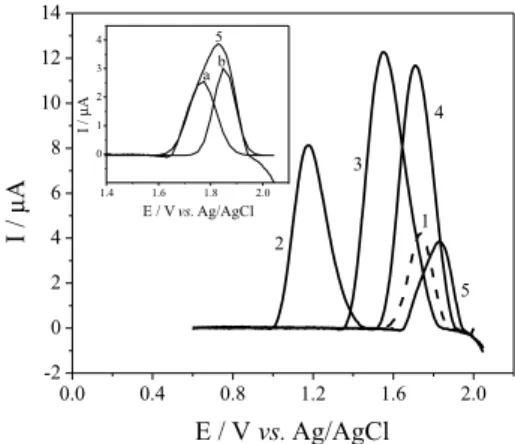
and CMP were obtained on the BDD electrode surface cathodically (Figure 2) and anodically (Figure 3) pretreated. In both treatments of the BDD, well-deined voltammetric shapes and intense responses for all nucleotides were observed. It is important to mention that TMP and CMP detections on Red and Oxi-BDD electrodes were easily carried out if compared to the detection reported in previous literature works.14-18
Besides the facility of detection, voltammograms obtained in 0.1 mol L-1 BR buffer solution (pH 7.0) at
Red-BDD and Oxi-BDD presented oxidation peaks. At Red-BDD, one peak at 1.74 V (4.20 µA) representing the oxidation of sp2 carbon impurities30 was observed. At
Oxi-BDD surface, one peak at 1.31 V (1.4 µA) was detected that possibly represents the carboxyl functions. The other peak that represents the sp2 carbon diminishes 93% since
the anodic polarization is suficient to eliminate these impurities,31 facilitating the analyte detection. Whereupon,
two different procedures (background-subtracted or deconvolution of the peaks) were applied, when necessary, in the voltammograms of Figures 2 and 3 to be taken only the response of the nucleotides. The deconvolution,
that can separate the peaks from electrode surface and nucleotides, is showed as inset in Figures 2 and 3. The oxidation currents and potentials of nucleotides on the Red-BDD and Oxi-BDD are presented in Table 1. In this table, it is also presented which procedure was applied in each oxidation case.
Evaluating data of Table 1, it is possible to observe that the response of nucleotides GMP and AMP on the Oxi-BDD occurs at smaller potential values and with higher current peaks than the responses obtained on the Red-BDD. In GMP oxidation on the Oxi-BDD, a deconvolution procedure was necessary to eliminate the small BDD surface contribution in the total current. Nevertheless, higher current for this oxidation was observed in comparison with GMP oxidation on the Red-BDD, which did not require any procedure. An important feature is that in AMP oxidation on Oxi-BDD, the application of no procedure was necessary, resulting in a high sensitivity of the detection if compared to that on the Red-BDD, since it required application of deconvolution procedure.
Figure 2. Baseline-corrected square wave voltammograms obtained
in 0.1 mol L-1 BR buffer solution (pH 7.0) at Red-BDD without nucleotides (1, dash line) and for 5.0 × 10⁻⁴ mol L-1 individual nucleotides GMP (2), AMP (3), TMP (4) and CMP (5). Inset: deconvolution of the voltammogram 5 as a: sp2 carbon impurities in BDD surface and b: only CMP oxidation.
Table 1. Currents and potentials for nucleotide oxidations. Voltammograms obtained in 0.1 mol L-1 BR buffer solution at Red-BDD and Oxi-BDD electrodes with or without procedures
Nucleotides Red-BDD Oxi-BDD
Ip / µA Ep / V Ip / µA Ep / V
GMP 8.11 a 1.18 10.7 b 1.09
AMP 8.86 b 1.52 19.5 a 1.46
TMP 8.81 c 1.69 13.1 a 1.71
CMP 3.01 b 1.85 6.01b 1.89
aWithout procedures; bdeconvolution; cbackground subtracted.
Figure 3. Baseline-corrected square wave voltammograms obtained in
On the other hand, TMP and CMP detections on the Oxi-BDD and Red-BDD occur practically at similar potential values. However, the detection sensitivity of these nucleotides on the Oxi-BDD electrode was higher than those obtained for Red-BDD. Speciically, the detection of TMP on the Oxi-BDD was performed without prior procedures, while in the TMP oxidation on the Red-BDD required background current subtration. In the case of CMP oxidation in both pre-treated surfaces, the application of deconvolution procedure on the voltammograms was necessary, resulting in a higher detection sensitivity of the CMP on the Oxi-BDD.
Despite the necessity of the procedure application in the nucleotide responses on Red and Oxi-BDD, it is clearly noted that the oxidation of individual DNA nucleotides is more sensitive on the BDD anodically pretreated electrode. The unpolar hydrogen-terminated surface (Red-BDD) gives the electrode a hydrophobic nature. Hydrogen-terminated surface is changed to oxygen terminated diamond surface (Oxi-BDD) during anodic oxidation in aqueous electrolytes showing hydrophilic (polar) tendency.32 It is known
that nucleoside monophosphates (nucleotides) are polar molecules.33 The results showed that the oxidation of these
molecules on Oxi-BDD occurs at lower potential values with higher current intensities than analytes oxidation at Red-BDD, possibly due to the higher electrostatic interaction. This effect was more intense in GMP and AMP responses. These considerations were evaluated in the simultaneous detection of the nucleotides on both treated electrodes.
Simultaneous detection of DNA nucleotides on the Red and Oxi-BDD electrodes
The effect of the BDD surface cathodically and anodically pre-treated on the simultaneous detection in a 5.0 × 10⁻⁴ mol L-1 equimolar mixture of DNA nucleotides
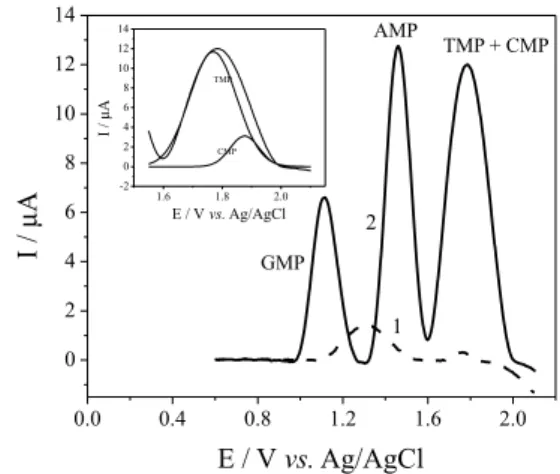
was examined. Baseline-corrected voltammograms for the mixture and for the “blank” obtained on the Red-BDD and Oxi-BDD were presented in Figures 4 and 5, respectively. In Figure 4 voltammogram 2 (Red-BDD), at the potential region of 1.6 to 2.0 V, it was observed a large part of the response that possibly can couple TMP, CMP and sp2
carbon impurities in BDD surface. As a result, background subtraction on the mixture voltammogram was necessary, as showed in Figure 4, since the deconvolution procedure was very complicated. Therefore, the resulting response (voltammogram 3) presented three peaks corresponding to the oxidation of GMP, AMP and a mixture of TMP and CMP. The deconvolution was successfully performed in the part of voltammogram concerning the mixture of TMP and CMP (inset of Figure 4) showing the individual nucleotide responses.
In the case of simultaneous detection of nucleotides on the Oxi-BDD, GMP and AMP detection it was well carried out at practically the same sensitivity of the peaks and at smaller potential values in relation to GMP and AMP detection performed on the Red-BDD. Additionally, it is important to describe that the peak at 1.30 V on voltammogram 1 (Figure 5) did not inluence the oxidation of GMP and AMP, as observed for individual GMP oxidation (see inset in the Figure 3).
As predicted by Figure 3, the responses of TMP and CMP overlapped in an equimolar mixture of nucleotides. These smaller potential values, especially for AMP oxidation, facilitate the TMP and CMP detection on the Oxi-BDD, as clearly observed in Figure 5. The inset in Figure 5 presents the deconvolution procedure of the voltammogram at 1.6 to 2.2 V, showing TMP and CMP oxidation.
Figure 4. Baseline-corrected square wave voltammograms obtained in
0.1 mol L-1 BR buffer solution (pH 7.0) at Red-BDD without nucleotides (1), for 5.0 × 10⁻⁴ mol L-1 equimolar mixture of all nucleotides (2) and for subtracted response (dash dot line 3 = 2 − 1). Inset: TMP + CMP deconvolution peak.
Figure 5. Baseline-corrected square wave voltammograms obtained in
Particularly, more sensitive and separated peaks for TMP and CMP on Oxi-BDD and Red-BDD electrodes, respectively, were observed after deconvolution procedure.
Conclusions
Individual and equimolar mixture detection of DNA nucleotides GMP, AMP, TMP and CMP on BDD electrode with different surface terminations was successfully performed. It was clearly observed that the detection of individual DNA nucleotides was more sensitive on BDD electrode anodically pretreated. The simultaneous detection of all nucleotides was properly carried out on both pre-treated BDD electrode. Particularly for TMP and CMP responses, deconvolution and/or background-subtracted procedures were required. This improvement in the simultaneous detection of DNA nucleotides in aqueous solutions may be an important step on the development of DNA modiied BDD electrodes to evaluate the interaction of substances with DNA or hybridization reactions.
Acknowledgments
The authors thank Fundação de Amparo à Pesquisa do Estado de São Paulo (Fapesp 2009/08161-8 and 2008/08990-1) of Brazil, for the scholarships and inancial support to this work.
References
1. Lehninger, A. L.; Nelson, D. L.; Cox, M. M.; Principles of Biochemistry, 2nd ed., Worth Publishers: New York, 1993.
2. Baumann, A.; Lohmann, W.; Jahn, S.; Karst, U.; Electroanalysis
2010, 22, 286.
3. Kanvah, S.; Joseph, J.; Schuster, G. B.; Barnett, R. N.; Cleveland, C. L.; Landman, U.; Acc. Chem. Res. 2010, 43, 280. 4. Jackson, S. P.; Barek, J.; Nature 2009, 461, 1071.
5. Hernández-García, D.; Wood, C. D.; Castro-Obregón, S.; Covarrubias, L.; Free Radical Biol. Med. 2010, 49, 130. 6. Mena, S.; Ortega, A.;Estrela, J. M.; Mutat. Res., Genet. Toxicol.
Environ. Mutagen.2009, 674, 36.
7. Goetz, M. E; Luch, A.; Cancer Lett.2008, 266, 73. 8. Beyersmann, D; Hartwig, A.; Arch. Toxicol.2008, 82, 493. 9. Johnson, G. E.; Quick, E. L.; Parry, E. M.; Parry, J. M. M.;
Mutagenesis2010, 25, 327.
10. Atherton, K. M.;Williams, F. M.; Gonzalez, F. J. E.; Glass, R.; Rushton, S.; Blain, P. G.; Mutch, E.; Biomarkers 2009, 14, 443. 11. De la Monte, S. M.; Tong, M.; J. Alzheimers Dis.2009, 17, 817. 12. Oliveira-Brett, A. M.; Piedade, J. A. P.; Silva, L. A.; Diculescu,
V. C.; Anal. Biochem.2004, 332, 321.
13. Stempkowska, I.; Ligaj, M.; Jasnowska, J.; Langer, J.; Filipiak, M.; Bioelectrochem.2007, 70, 488.
14. Prado, C.; Flechsig, G. U.; Grundler, P.; Foord, J. S.; Marken, F.; Compton, R. G.; Analyst2002, 127, 329.
15. Ivandini, T. A.; Sarada, B. V.; Rao, T. N.; Fujishima, A.; Analyst
2003, 128, 924.
16. Ivandini, T. A.; Honda, K.; Rao, T. N.; Fujishima, A.; Einaga, Y.; Talanta 2007, 71, 648.
17. Fortin, E.; Chane-Tune, J.; Mailley, P.; Szunerits, S.; Marcus, B.; Petit, J. P.; Mermoux, M.; Vieil, E.; Bioelectrochem.2004, 63, 303.
18. Oliveira, S. C. B.; Oliveira-Brett, A. M.; J. Electroanal. Chem.
2010, 648, 60.
19. Luong, J. H. T.; Male, K. B.; Glennon, J. D.; Analyst2009, 134, 1965.
20. Salazar-Banda G. R.; Andrade, L. S.; Nascente, P. A. P.; Pizani, P. S.; Rocha, R. C.; Avaca, L. A.; Electrochim. Acta2006, 51, 4612.
21. McCreery, R. L.; Chem. Rev.2008, 108, 2646.
22. Oliveira, S. C. B.; Oliveira-Brett, A. M.; Electrochim. Acta
2010, 55, 4599.
23. Granger, M. C.; Swain, G. M.; J. Electrochem. Soc.1999, 12, 4551.
24. Salazar-Banda G. R.; Carvalho, A. E.; Andrade, L. S.; Rocha, R. C.; Avaca, L. A.; J. Appl. Electrochem.2010, 40, 1817. 25. Fortin, E.; Chane-Tune, J.; Delabouglise, D.; Bouvier, P.;
Livache, T.; Mailley, P.; Marcus, B.; Mermoux, M.; Petit, J.; Szunerits, S.; Vieil, E.; Electroanal.2005, 17, 517.
26. Zhanga, W.; Xie, S.; Chen, H.; Li, M.; Ma, L.; Jia, J.; Collect. Czech. Chem. Commun.2008, 73, 73.
27. Azevedo, A. F.; Braga, N. A.; Souza, F. A.; Matsushima, J. T.; Baldan, M. R.; Ferreira, N. G.; Diamond Relat. Mater.2010, 19, 462.
28. Kondo, T.; Ito, H.; Kusakabe, K.; Ohkawa, K.; Einaga, Y.; Fujishima, A.; Kawai, T.; Electrochim. Acta2007, 52, 3841. 29. Matos, M.; Canhoto, C.; Bento, M. F.; Geraldo, M. D.;
J. Electroanal.Chem.2010, 647, 144.
30. Bennett, J. A.; Wang, J. A.; Show, Y.; Swain, G. M.; J. Electrochem. Soc. 2004, 151, E306.
31. Duo, I.; Levy-Clement, C.; Fujishima, A.; Comninellis, C.; J. Appl. Electrochem.2004, 34, 935.
32. Kraft, A.; Int. J. Electrochem. Soc.2007, 2, 355.
33. Cohena, S.; Jordheim, L. P.; Megherbi, M.; Dumontet, C.; Guitton, J. J.; J. Chromatogr. B2010, 878, 1912.
Submitted: October 27, 2010
Published online: March 1, 2011
![Figure 1. Cyclic voltammograms (sweep rate of 50 mV s -1 ) for 1.0 × 10 -3 mol L -1 K 4 [Fe(CN) 6 ] obtained in 0.1 mol L -1 BR buffer solution (pH 7.0) at Red (1) and Oxi (2) -BDD electrodes.](https://thumb-eu.123doks.com/thumbv2/123dok_br/18995236.461993/2.892.486.760.830.1055/figure-cyclic-voltammograms-sweep-obtained-buffer-solution-electrodes.webp)