Brazilian Journal of Physics, vol. 34, no. 2B, June, 2004 611
Electronic Structure of the n-Type Doped AgInO
2
and CuAlO
2
Delafossites: Similarities and Differences
M. V. Lali´c
∗, J. Mestnik-Filho, A. W. Carbonari, and R. N. Saxena
Instituto de Pesquisas Energ´eticas e Nucleares, CP 11049, 05422-970, S˜ao Paulo, SP, Brazil
Received on 31 March, 2003
We performed the first-principles band-structure calculations for a pure and a Cd-doped AgInO2 delafossite
compound. The results are carefully analyzed and compared with the results obtained for a pure and a Cd-doped CuAlO2compound, calculated previously by our group. The electronic structures of both systems are
found to be similar in many details, being characterized by the same hybridization scheme that occurs at both Cu and Ag positions. Introduction of Cd impurity into the Cu site produces a shallow band within the CuAlO2
gap, while the Cd presence at the Ag site creates a wide band pinned at the Fermi level in the AgInO2spectrum.
In both cases, however, the n-type conductivities are predicted.
1
Introduction
The semiconducting delafossite oxides (SDOs) have a chemical formula ABO2, where A is either Cu or Ag, and
B can be one of the many trivalent metal ions (Al, In, Cr, Co, Fe etc.). Their crystalline structure belongs to the space groupR ¯3m, characterized by a linear coordination of the A atom with its two neighboring oxygens along the c-axis.
In the last few years the SDOs attracted much attention due to their potential technological applications. Besides be-ing transparent by virtue of their large band gaps, SDOs can be doped both p- and n-type [1, 2]. This property separates them from other semiconducting oxides which can be doped merely n-type. Consequently, the SDOs are indicated as candidates for the construction of transparent semiconduc-tor devices.
A number of experiments with the objective to study how the electric properties of the SDOs change in the pres-ence of impurities were performed lately [3]. In most of them the impurities were introduced into the B sites of the structure, and dynamic properties, such as the p- or n-type conductivities, measured.
Recently, we demonstrated theoretically that doping of the A site could also produce either n or p-type conductiv-ities in the SDOs. This conclusion emerged as a result of series of the first-principles full-potential linear augmented plane wave (FP-LAPW) calculations that we performed for the CuAlO2system containing Cd impurities [4], and the Zn
or Ni impurities [5] at the Cu position. In this paper we con-tinue to investigate the A site doping effects in the SDOs, but now in their Ag-based branch. Towards this aim, we performed the band-structure calculations for both pure and Cd-doped AgInO2compound. It is our intention to present
their electronic structure features, to discuss them, and to compare them with the corresponding features of the pure and the Cd-doped CuAlO2compound.
The computational details were the same as published in the ref. [4]. The FP-LAPW method, as implemented in the WIEN97 computer code, has been used. Exchange and correlation effects were treated within the generalized gradi-ent approximation. Parameters which determine the AgInO2
crystal structure were taken from the ref. [6]. Calculations of the Cd-containing system were performed in a supercell geometry, with the supercell consisting of 32 atoms (8 orig-inal unit cells), in which one central Ag atom has been re-placed by the impurity atom. Relaxation of all atomic posi-tions in the supercell has been allowed.
In the section II, results for pure CuAlO2 and AgInO2
are presented, while in the section III we discuss the effects of the Cd presence in the compounds.
2
Pure compounds
Resulting density of states (DOS) for the pure CuAlO2and
AgInO2compounds, as well as the projected DOS (PDOS)
for each inequivalent atom, are presented in Fig. 1. In the case of CuAlO2, the fundamental gap is found to be 1.97
eV, in fair agreement with the experimental value of∼1.8 eV. The AgInO2gap is however difficult to determine since
the slope of the conduction band bottom is extremely slight, and the possibility of making a numerical mistake signifi-cant. In any case, this gap is much smaller than in CuAlO2,
and range between 0.7 and 1.0 eV approximately (there is no experimental data in the literature). The electronic struc-ture of both compounds is dominated by the O 2pand the Cu (or Ag)dstates, while the Al and In states contribute very little to the DOS and do not play significant role in the com-pounds. A specifics−dhybridization scheme, proposed for the cases whend9
andd10
612 M. V. Lali´cet al.
Figure 1. The calculated DOS for the pure CuAlO2 and AgInO2
compounds, in states/Ry/cell. Predominant orbital characters of bands are designated. The dashed line denotes Fermi level.
In order to stabilize the energy of a linear coordina-tion, the Cu (or Ag)sanddz2 orbitals hybridize, forming
a filled bonding1/√2(s−dz2)and an empty anti-bonding
1/√2(s+dz2)orbitals (the z-axis is parallel to the c-axis
of the crystal). The bonding orbital has charges concen-trated mainly in the basal plane, giving rise to anisotropy of the conductivity due to electron hopping between neigh-boring A ion orbitals. The antibonding orbital is used for mixing with neighboring O pz orbitals, making a bonding
complex that lies deep below the Fermi energy (EF) and an
anti-bonding complex that forms a conduction band. All of the three described hybrids are seen in Fig. 1 in case of AgInO2. The peak positioned at the (EF) consists of Ags
anddz2 states, with negligible amount of Opzstates. It can
be identified as a bonding1/√2(s-dz2) orbital of Ag. The
first peak in the conduction band is builded from Ags,dz2,
and Opzstates mostly. It therefore corresponds to the
anti-bonding combination of the Ag1/√2(s+dz2) orbital and O
pzorbital. The bonding combination of the same orbitals is
situated deeply below EF, at∼0Ry. In the case of CuAlO2
this combination can not be identified being smeared in the lower energy part of the valence band. The other two hy-brids are, however, formed in exactly the same way as in AgInO2case.
3
Cd-doped compounds
When Cd replaces the Cu and Ag atoms in CuAlO2 and
AgInO2, it causes significant changes: (1) in rearrangement
of the atoms around the impurity, and (2) in the electronic structure of the compounds. We accounted for the first ef-fect by allowing a relaxation of all atomic positions in the supercell. The largest changes were registered in immediate vicinity of Cd: its two nearest-neighbor (NN) oxygens were moved along the c-axis in both compounds. In CuAlO2they
were pushed from the Cd, changing the Cd-O distance from 1.860 to 2.073 ˚A. In AgInO2, on the contrary, Cd attracted
the NN oxygens changing the Cd-O distance slightly, from
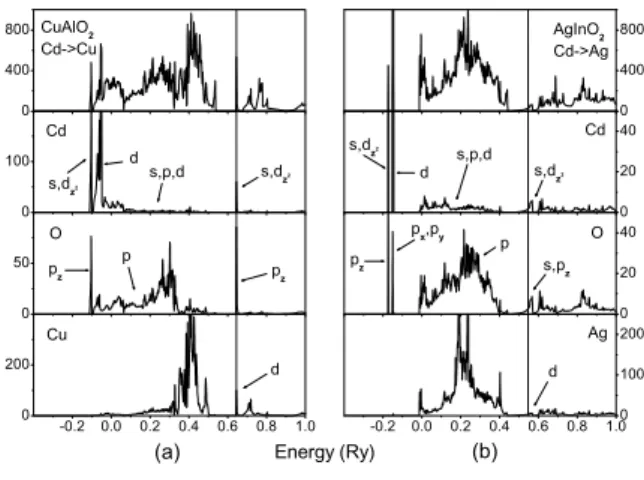
2.071 to 2.045 ˚A. The electronic structure changes are found to be considerable only within the cluster consisting of the Cd itself, its two NN O atoms, and the six second NN Cu (and Ag) atoms in the basal plane. Their PDOS is therefore presented in Fig. 2.
In the case when Cd substitutes the Cu in CuAlO2(Fig.
2a), a narrow band within the gap is created, near the con-duction band bottom. This band is impurity induced, half filled (one electron), and consists mainly of the Cd s and dz2, NN Opzand second NN Cudstates. Since its electron
density is widely spread over the crystal [4], the band can be considered as shallow. Similarly to the Cu, the Cd d-shell also obeys the specifics−dhybridization scheme. While the Cd bonding1/√2(s-dz2) orbital can not be recognized
being smeared over the energies from∼0 to∼0.5 Ry, the Cd antibonding 1/√2(s+dz2) orbital is clearly hybridized
with O pzorbital. Their bonding combination is recognized
as a sharp resonance at the energy of∼–0.1 Ry, while the antibonding combination is located at EF. The present
re-sults clearly demonstrate that replacement of the Cu atom by the Cd impurity changes the CuAlO2electric properties
in a fundamental way, producing the n-type conductivity. When Cd replaces the Ag in AgInO2(Fig. 2b), the
elec-tronic structure displays some relevant differences. The Cd impurity obeys the sames−dhybridization scheme since its antibonding 1/√2(s+dz2) orbital, together with NN O
pzorbital, builds a sharp bonding complex at∼ −0.18Ry,
and an antibonding complex positioned around EF. The
lat-ter is, however, much broader than the corresponding one in CuAlO2, which surprises since it does not seem that
Cd-Cd interaction in AgInO2is stronger than in CuAlO2.
In-deed, the Cd-Cd distance in AgInO2 (6.56 ˚A) is
consid-erably larger than in CuAlO2 (5.70 ˚A). Besides, majority
of the Cd d-states are lying deeply below the Fermi en-ergy, highly localized in space and without mixing with Ag states, which eliminates the possibility of propagation of the impurity-impurity interaction by the intermediate Ag atoms in basal plane, through the sequences Cd-Ag-Cd.
Figure 2. The calculated DOS for (a) CuAlO2compound in which
Cd substitutes for the Cu, and (b) AgInO2compound in which Cd
Brazilian Journal of Physics, vol. 34, no. 2B, June, 2004 613
Table I. Experimental and theoretical Vzzvalues in the
Cd-doped CuAlO2 and AgInO2 compounds. Vzz is the main
component of the EFG tensor, directed along the c-axis of the crystal. The signs of the experimental Vzz’s have not
been determined. All numbers given in the table are in units 1021
V/m2
.
Experiment Theory |Vzz| Vzz
Cd at Cu site in CuAlO2 27.44 -25.74
Cd at Ag site in AgInO2 31.34 -28.96
Very different widths of the bands positioned at EF in
CuAlO2and AgInO2can be explained on the basis of
dif-ferent relative positions of Cd and Cu, and Cd and Ag d-bands. In Cd-doped CuAlO2 the Cd d-states are situated
much deeper in energy than the Cu d-states. When Cd, as a donor, replaces a Cu it introduces an attractive potential for the host electrons and brings the conduction states of the nearest neighbors down in energy. Since formed from the conduction band bottom, the band situated at the EF in
CuAlO2includes therefore mostly the states which belong
to the cluster composed of Cd and its first and second NNs (∼ 60%). In Cd-doped AgInO2 the energy difference
be-tween Cd and Ag d-states is smaller, so the impurity poten-tial is less attractive for the host electrons. When the band at the EF is formed, the participation of the states from the
Cd and its first and second NN is halved (∼30%), and the states from more distant atoms dominate. This effect delo-calizes the band, which becomes considerably broader. Our calculations could not distinct if this band is merged to the conduction band bottom or detached from it. We registered a very small, but non-zero DOS between the band and the con-duction band bottom, but this could be a consequence of ap-proximation implemented into the calculations. In any case,
the impurity induced band at the EF introduces some
elec-tron states at the bottom of the conduction band, and thus indicates the n-type conductivity in the Cd-doped AgInO2.
In order to check reliability of the presented results, we calculated the electric field gradient (EFG) at the Cd impuri-ties in both delafossites, and compared them with the exper-imental data [8]. Very good agreement between these values (Table 1) indicates that the presented calculations succeeded to describe the ground state of the impurity-containing sys-tems correctly.
Acknowledgments
Presented research was supported by the Fundac¸˜ao de Amparo `a Pesquisa do Estado de S˜ao Paulo (FAPESP).
References
[1] H. Kawazoe, M. Yasukawa, H. Hyodo, M. Kurita, H. Yanagi, and H. Hosono, Nature389, 939 (1997).
[2] X. Nie, S. Wei, and S. B. Zhang, Phys. Rev. Lett.88, 066405 (2002).
[3] R. Nagarajan, A.D. Draeseke, A.W. Sleight, and J. Tate, J. Appl. Phys.89, 8022 (2001).
[4] M. V. Lali´c, J. Mestnik-Filho, A. W. Carbonari, R. N. Saxena, and M. Moralles, J. Phys.: Condens. Matter.14, 5517 (2002). [5] M. V. Lali´c, J. Mestnik-Filho, A. W. Carbonari, and R. N.
Saxena, Solid State Commun.125, 175 (2003).
[6] B. W. Khler and M. Jansen, J. Solid State Chem. 71, 566 (1987).
[7] L. E. Orgel, J. Chem. Soc. 4186 (1958).